

Guides
Average Call Handle Time Explained: What It Measures and Why It Matters
Understanding Average Handle Time (AHT) and What It Reveals
Guides
Understanding Average Handle Time (AHT) and What It Reveals
Last updated
Average Handle Time (AHT) is a contact centerContact centerA centralized operation that handles inbound and outbound customer interactions across voice, SMS, email, and digital channels, typically focused on service, support, or sales conversations. metric that measures the average amount of time spent handling a customer interaction from start to finish.
It captures not only the time spent on the phone with the customer, but also the work required to complete the interaction after the call ends. Because it reflects both conversation and operational effort, AHT is often used to understand workload, staffing needs, and process efficiency.
There are three main components of the Average Handle Time formula:
Together, these elements reflect the true cost of handling a call.
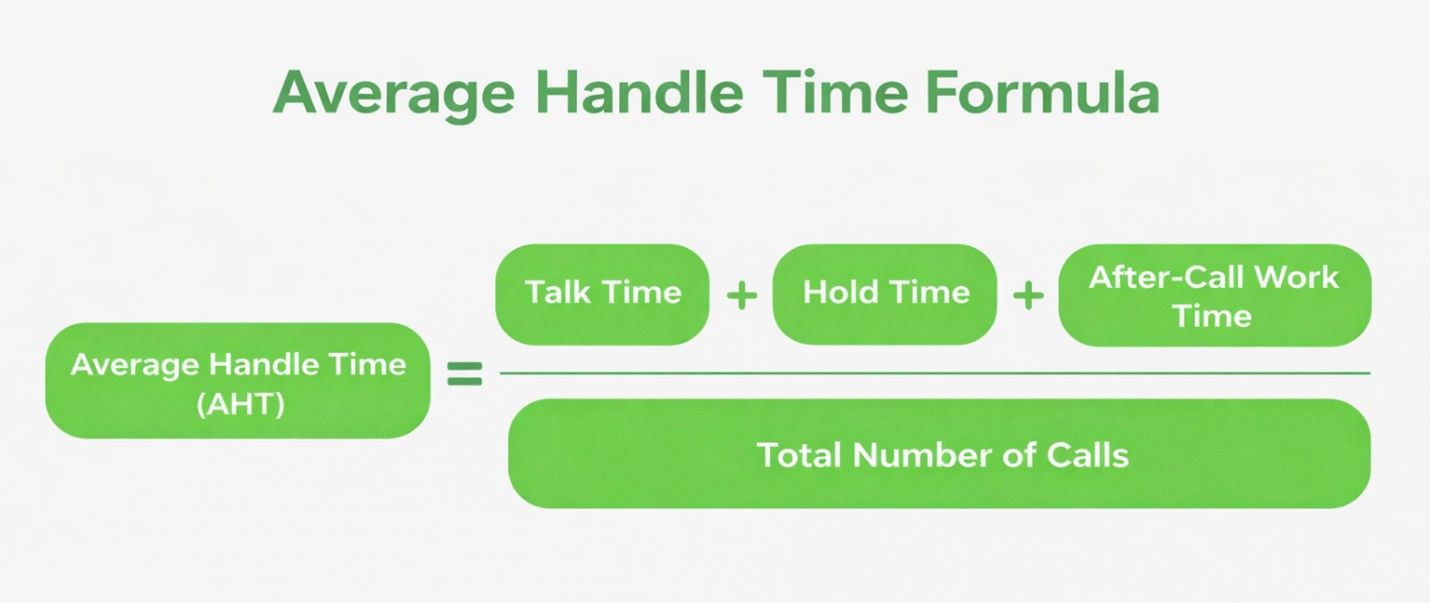
AHT is often described as a speed metric, but it more accurately measures operational friction.
High AHT can indicate:
On the flip side, low AHT is often a sign of:
Taken at face value, AHT doesn’t tell you whether customer outcomes are positive or negative. It tells you how much effort each interaction requires.
Average handle time is an important metric because it directly influences three major areas of contact center performance:
Longer handle times reduce the number of interactions each agent can manage, increasing staffing requirements and operating costs.
AHT is a key input in understanding labor capacity. Small changes in handling time can materially impact headcount planning, scheduling, and service levels.
Handle time affects wait times, resolution speed, and how rushed or attentive calls feel to customers. Poorly optimized AHT can increase repeat calls and dissatisfaction.
Voice AI agents change AHT in two meaningful ways:
When automation resolves entire calls, those interactions no longer contribute to AHT at all. This reduces AHT by changing the call mix, not by rushing conversations.
For calls that still require a human, automation can:
Importantly, effective automation allows remaining calls to take longer when needed, because they tend to be higher-complexity and higher-value.
Thoughtly reduces AHT by addressing the root causes that inflate it, rather than optimizing for speed alone.
Thoughtly automates common, repeatable phone interactions that would otherwise consume agent time. By resolving these calls without escalationEscalationMoving a conversation to a human, specialist, supervisor, or alternate workflow when the agent detects risk, uncertainty, urgency, or a request it should not handle alone., Thoughtly removes them from AHT calculations entirely.
When a call does need to reach a human, Thoughtly gathers structured information upfront. Human agents start conversations with context, reducing hold time and back-and-forth clarification.
Automated actions and integrations allow many interactions to complete without manual follow-up. This reduces or removes after-call work, which is a major driver of high AHT.
Rather than pushing agents to work faster, Thoughtly reduces the amount of work each interaction requires. This leads to sustainable AHT reductions without harming customer experience.
Average Handle Time is a foundational contact center metric because it reflects how much effort each customer interaction requires.
While often treated as a speed metric, AHT more accurately measures operational friction across systems, workflows, and call mix.
Automation changes AHT by removing repetitive interactions from agent queues, capturing context earlier in the process, and eliminating manual follow-up work. This reduces total handle time without rushing conversations or degrading customer experience.
Thoughtly helps teams lower AHT by resolving common calls end-to-end, reducing time spent within calls that escalate to agents, and removing after-call work altogether. The result is a more efficient support operation where agents focus on higher-value conversations and customers get faster, more consistent outcomes. Learn more about which platforms streamline operations the best here.