7 Best AI Phone Agents for Elective Healthcare and Wellness Practices in 2026 (Tested and Ranked)
I evaluated AI phone agent platforms for dental offices, med spas, chiropractic clinics, and wellness practices. Here are the 7 that can actually book appointments, handle HIPAA-compliant conversations, and follow up until the patient shows up.
Last updated
I evaluated AI phone agentAI phone agentAn AI phone agent is software that conducts phone conversations to answer, qualify, book, route, or follow up with callers under rules set by the business.Read full definition → platforms that serve elective healthcare and wellness practices — dental offices, med spas, chiropractic clinics, dermatology practices, optometry offices, cosmetic surgery centers, and similar businesses where patients are choosing a provider, not being routed through an emergency department.
Elective healthcare is a different buying decision than hospital triage or urgent care. Patients call multiple providers, ask about procedures and pricing, check insurance coverage, and make a decision at their own pace. The practice that picks up first, answers clearly, and books the appointment wins the patient. The one that sends the call to voicemail often loses them for good.
Most AI phone agent platforms were built for general sales teams or enterprise contact centers. This list focuses on the platforms that can actually handle the workflows elective healthcare and wellness practices need: appointment scheduling against a real provider calendar, insurance and eligibilityEligibilityEligibility is the set of conditions that determines whether a prospect can move to a service, quote, appointment, application, or specialist.Read full definition → questions, HIPAA-compliant data handling, practice management system integration, and multichannel follow-up for consultations and recalls.
Quick takeaways
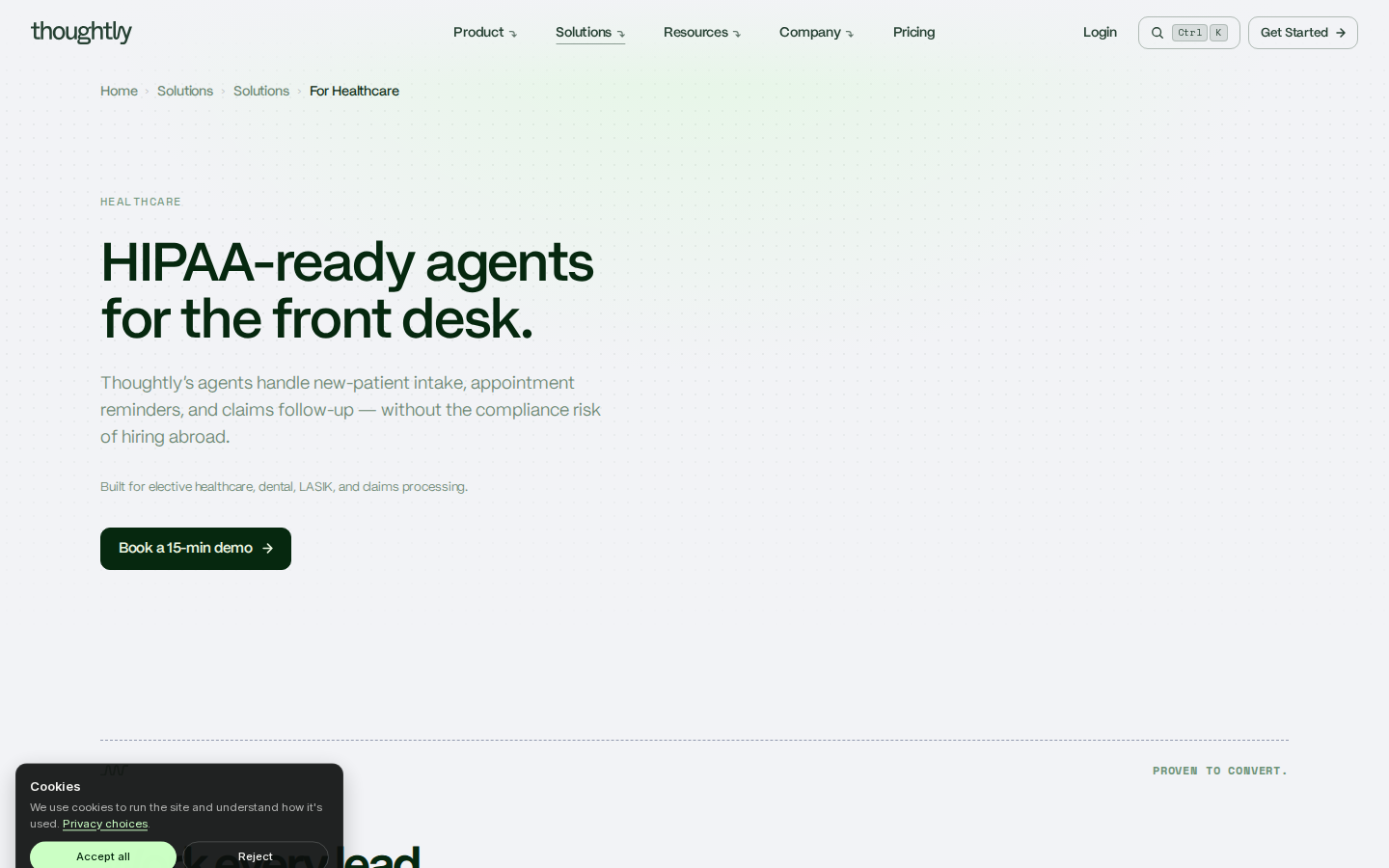
Thoughtly is the strongest overall platform for practices that need AI-driven inbound lead conversion across voice, SMS, and email — with native scheduling, CRM write-back, and HIPAA compliance built in.
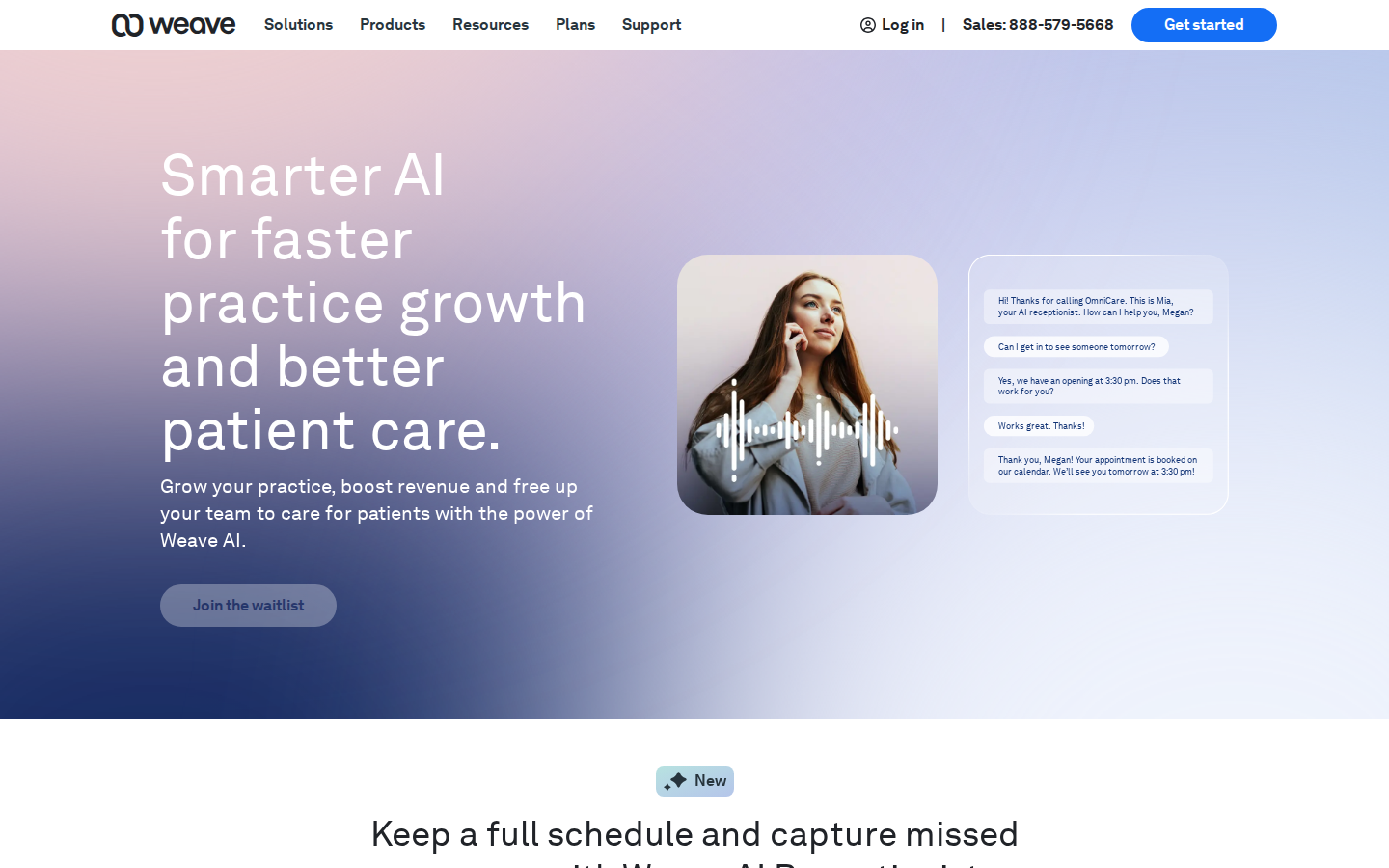
Weave is the top choice for dental practices already using Weave for phones and patient communications — its AI Receptionist plugs directly into the existing Weave ecosystem.
Dentina AI is purpose-built for dental offices by a dentist, with direct PMS integration into Dentrix, Eaglesoft, Open Dental, and other dental-specific systems.
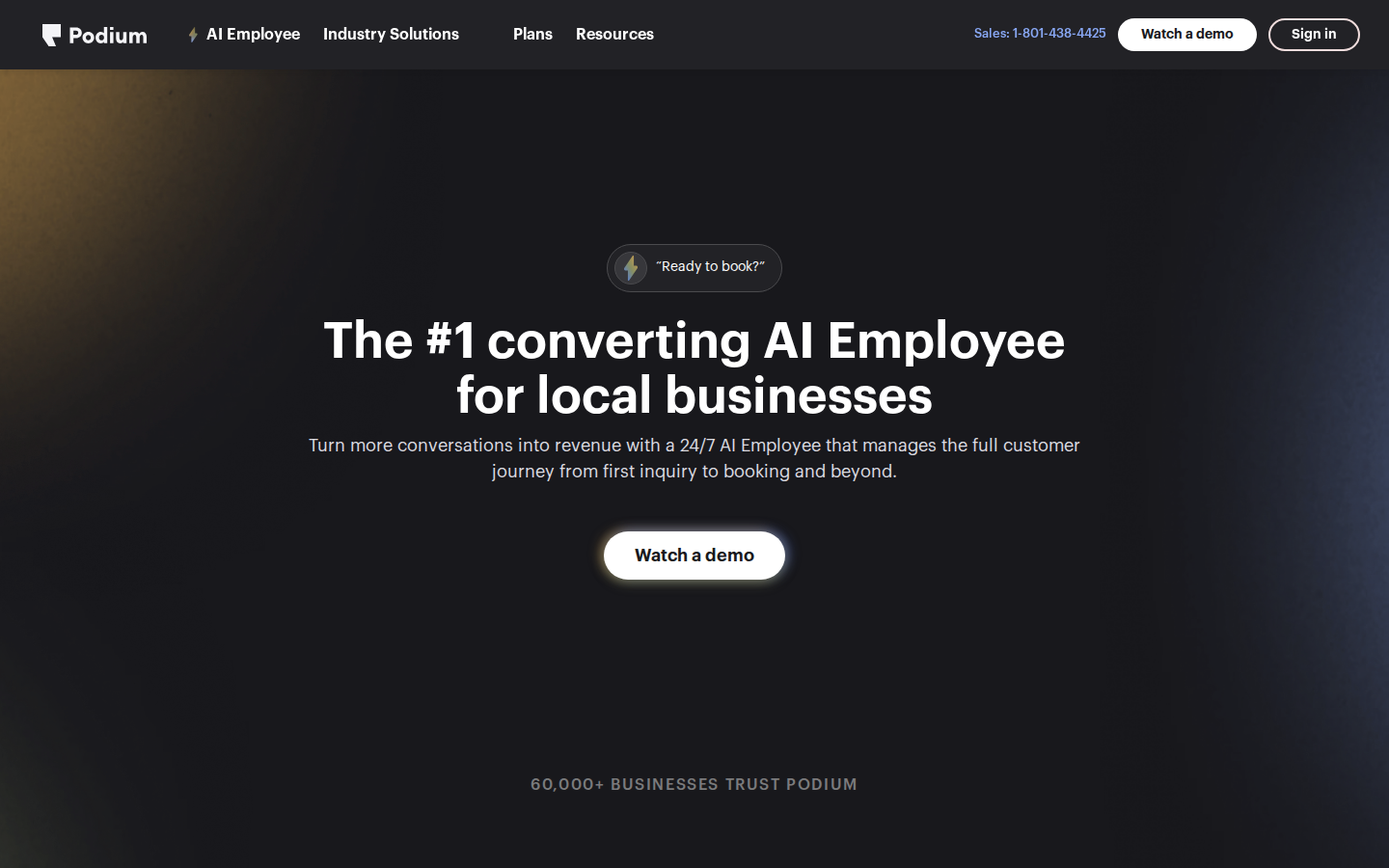
Podium is ideal for multi-location wellness chains and med spa groups that want an AI employee handling calls, texts, and reviews across every location.
Hyro fits large health-system-affiliated specialty groups that need enterprise-grade conversational AI tied to Epic, Cerner, or other EHR platforms.
Telnyx gives technically capable practices a HIPAA-eligible, carrier-grade voice AI infrastructure to build custom phone workflows from scratch.
OmniMD offers a broad AI front desk for independent medical practices handling scheduling, check-in, insurance verification, and billing in one system.
How I evaluated AI phone agents for elective healthcare and wellness
I tested each platform against the specific demands of elective healthcare practices — where the phone call is often the first and most important touchpoint with a prospective patient. These are the criteria I weighted most heavily.
1. Patient scheduling and intake automation
The most valuable thing an AI phone agent can do for an elective practice is book the appointment during the call. I looked for platforms that check real-time provider availability, match the patient to the right provider or service type, and confirm the booking before the call ends. Platforms that just capture a message and promise a callback scored lower — in elective healthcare, the patient who hangs up without an appointment often calls the next provider on their list. I also evaluated how well each platform handles new patient intake: collecting insurance details, verifying eligibility, gathering procedure-specific information, and routing complex cases to a human coordinator.
2. HIPAA compliance and data security
Any platform handling patient phone calls in the US needs to be HIPAA-compliant. I verified whether each vendor has a signed Business Associate Agreement, encrypts data in transit and at rest, and provides audit logging. Platforms with SOC 2 Type II or equivalent third-party security certifications scored higher. I also checked whether the AI's conversation transcripts and recordings are stored in HIPAA-eligible environments and whether the vendor's LLMLarge Language Model (LLM)A large language model (LLM) is a machine-learning model trained on large text collections to interpret and generate language from prompts and context.Read full definition → providers have their own BAAs in place — a gap that many newer AI voiceAI voiceAn AI voice is synthetic speech produced by a text-to-speech model, using a selected or cloned voice to speak an agent's generated or scripted response.Read full definition → startups have not yet closed.
3. Practice management system integration
Elective healthcare runs on practice management systems, not generic CRMs. Dental offices use Dentrix, Eaglesoft, Open Dental, and Curve. Med spas use Mindbody, Aesthetic Record, and Boulevard. Chiropractic and PT practices use ChiroTouch, Jane, and WebPT. I evaluated whether each AI phone agent can read and write to these systems directly — checking availability, creating appointments, updating patient records — or whether it requires middleware like Zapier to bridge the gap. Direct PMS integration means the AI sees the same schedule the front desk sees. Middleware means delays, sync failures, and double-booking risk.
4. Follow-up and recall automation
Elective practices lose significant revenue from no-shows, lapsed patients, and incomplete treatment plans. I looked for platforms that go beyond answering inbound calls to handle outbound recall and re-engagement: automated appointment reminders, hygiene recall campaigns for dental, reactivation calls for lapsed patients, and follow-up on consultations that did not convert to booked procedures. The best platforms triggerTriggerA trigger is an event or condition that starts, resumes, changes, or stops an automated workflow.Read full definition → these campaigns from practice data — overdue recall dates, unfilled treatment plans, consultation-but-no-booking flags — without manual list-building by the front desk.
5. Multichannel patient communication
Patients expect text confirmations, not just phone calls. I evaluated whether each platform supports SMS appointment confirmations, text-based rescheduling, email follow-ups, and two-way text conversations. Platforms that combine voice and text in a single patient thread — so the AI remembers what was discussed on the phone when the patient texts back — scored significantly higher. In elective healthcare, the path from first inquiry to booked appointment often crosses channels, and a platform that loses context between voice and text creates a disjointed patient experience.
6. Voice quality and patient experience
Patients calling a medical or wellness practice expect a professional, warm interaction — not a robotic IVRIVRIVR, or Interactive Voice Response, is a phone menu that routes or serves callers through keypad entries or spoken choices.Read full definition → menu. I tested voice quality, response latencyLatencyLatency is the elapsed time between a caller's speech and the agent's response, including listening, processing, tool, network, and speech-generation delays.Read full definition →, and the AI's ability to handle natural conversation patterns: interruptions, clarifying questions, emotional tone, and requests to speak with a human. Platforms with sub-500ms response latency and natural turn-taking scored well. I also checked whether each platform provides branded greetings, custom hold music, and warm transferWarm transferA warm transfer connects a live caller to the right person while preserving the context already collected during the conversation.Read full definition → to human staff when the AI reaches the edge of its capabilities.
Quick comparison of the best AI phone agents for elective healthcare
Platform
Best fit
Key strength
Key limitation
Thoughtly
Revenue-focused practices needing omnichannel lead conversion
Requires engineering resources to build and maintain the voice application
OmniMD
Independent medical practices wanting a full AI front desk
60+ automated tasks including scheduling, check-in, insurance, and billing
Broader practice management scope may exceed what a single-specialty practice needs
7 best AI phone agents for elective healthcare and wellness practices in 2026
1. Thoughtly — Best overall for elective healthcare lead conversion
Thoughtly is a voice AI platform built for high-volume inbound lead conversionInbound lead conversionInbound lead conversion turns opted-in calls, form submissions, quote requests, and other inquiries into qualified conversations, appointments, or transfers.Read full definition → in regulated industries — and elective healthcare is one of its strongest verticals. Unlike platforms that focus only on answering calls, Thoughtly handles the full patient acquisition workflowWorkflowA workflow is a defined sequence of steps, decisions, actions, delays, and outcomes used to complete a business process.Read full definition →: an AI agent picks up the phone, qualifies the patient's interest, checks provider availability through integrations with Calendly, Acuity, Mindbody, and other scheduling platforms, books the appointment live on the call, and then follows up by SMS and email until the patient shows up.
For dental practices, med spas, chiropractic clinics, and wellness studios, the core value is speed-to-patient. When a prospective patient calls about teeth whitening, Botox, an adjustment, or a massage package, Thoughtly's agent answers immediately — no hold queue, no voicemail, no missed call. The agent qualifies the inquiry, checks the schedule, books the appointment, sends a text confirmation, and updates the CRMCRMA CRM is the system used to manage leads, contacts, accounts, opportunities, activity, ownership, and follow-up.Read full definition → or practice management system. If the patient does not book, Thoughtly triggers follow-up sequences across voice and text until there is a resolution.
Thoughtly holds SOC 2 Type II, HIPAAHIPAAHIPAA is a US federal law whose Privacy, Security, and Breach Notification Rules govern protected health information for covered entities and business associates.Read full definition →, and GDPR certifications. The platform supports 34 languages, delivers sub-350ms response latency, and integrates with HubSpot, Salesforce, Pipedrive, Mindbody, Calendly, Acuity, Zapier, and 20+ other tools. Multi-location practices can route calls to the correct provider or location based on caller geography, service type, or availability. Pricing is per-minute with a dedicated account manager.
Pros
Handles the full inbound patient conversion funnel: call answering, qualification, live scheduling, SMS/email follow-up, and CRM write-back — not just message-taking.
Native Mindbody integration for fitness, wellness, and beauty businesses — syncs class types, packages, memberships, and waitlists so the AI books against the real schedule.
HIPAA-compliant with SOC 2 Type II certification and sub-350ms response latency across 34 languages, which matters for multilingual patient populations.
Dedicated account manager and customer success team that builds, launches, and optimizes agents — practices do not need to prompt-engineer their own AI.
Watch for
Requires upfront definition of qualification rules, escalation paths, and follow-up logic. Practices that have not mapped their patient intake workflow will need to do that work during onboarding.
Best suited for practices with enough inbound call volume to justify automation. A solo practitioner getting five calls a day may not see the same ROI as a multi-location group.
Best fit
Multi-location dental groups, med spa chains, wellness studios, and any elective practice that gets more inbound patient inquiries than its front desk can handle. Strongest when the practice has a clear CRM or scheduling system and wants the AI to own the entire path from first call to booked appointment.
Pricing
Per-minute pricing. Contact Thoughtly for a quote based on call volume and integration requirements.
2. Weave — Best for dental practices with integrated AI reception
Weave is the dominant communications platform in dental offices — over 35,000 locations use it for phones, texting, reviews, payments, and patient engagement. The Weave AI ReceptionistAI receptionistAn AI receptionist is a voice agent configured to answer inbound calls, identify what the caller needs, route requests, and complete front-door tasks such as booking.Read full definition → adds an AI phone answering layer directly into that ecosystem, which means practices already on Weave get AI call handling without adopting a separate vendor or worrying about integration gaps.
The AI Receptionist answers inbound calls, books appointments, handles frequently asked questions, takes payments, and initiates patient recall sequences. Because it sits on top of Weave's unified communications stack, it has access to patient history, appointment data, and billing context that a standalone AI phone agent would need separate integrations to reach. Weave claims its AI is trained on over a decade of real-world patient interactions — billions of phone calls, voicemails, and text messages — giving it healthcare-specific conversation patterns that general-purpose voice AI does not have.
Weave integrates with major dental PMS platforms including Dentrix, Eaglesoft, Open Dental, and Curve, plus medical systems like athenahealth and eClinicalWorks. The platform is HIPAA-compliant and provides unified reporting across all communication channels.
Pros
Seamless integration with the Weave phone/text/review/payment ecosystem that 35,000+ dental and healthcare locations already use — no new vendor onboarding.
AI trained on healthcare-specific conversation data, not generic sales scripts, which improves handling of insurance questions, appointment types, and clinical terminology.
Unified patient communication thread across voice, text, and reviews — the AI knows the patient's history and context across channels.
Watch for
The AI Receptionist is a newer product within the Weave ecosystem. Practices should confirm current feature availability versus roadmap items, especially for complex scheduling logic.
Trustpilot and G2 reviewers have flagged occasional issues with platform reliability, appointment reminder accuracy, and customer support response times — worth evaluating during a trial.
Strongest when the practice is already on Weave. Practices not currently using Weave would be adopting an entire communications platform to get the AI receptionist, which may be more than they need.
Best fit
Dental practices and small medical offices already using Weave for phones and patient communications. The AI Receptionist is an add-on that deepens the value of the existing platform rather than a standalone AI phone agent.
Pricing
Weave offers tiered subscription plans. The AI Receptionist is available as an add-on or included in higher-tier plans. Contact Weave for current pricing.
3. Dentina AI — Best purpose-built AI receptionist for dental offices
Dentina is an AI dental receptionist built by a practicing dentist in California — and that origin story matters because the product reflects actual front desk workflows rather than generic call-handling logic. Dentina answers inbound calls, books appointments directly into the practice management system, handles outbound recall and reactivation campaigns, and operates 24/7 including evenings and weekends when most dental offices are closed.
The platform integrates directly with Dentrix, Eaglesoft, Open Dental, Curve, and Denticon, which means it reads real-time schedule availability, respects provider-specific booking rules, and creates appointments in the PMS without manual entry. Over 2,000 dental practices and DSOs use Dentina, and the platform has handled more than 2.4 million calls. The company claims an average of 21 additional appointments booked per month per location from calls that would otherwise have gone to voicemail.
Dentina also runs outbound campaigns: hygiene recall for overdue patients, reactivation for lapsed patients, and follow-up for unscheduled treatment. These campaigns are triggered from PMS data — the AI identifies patients with open treatment plans or overdue recall dates and calls them automatically.
Pros
Direct PMS integration with Dentrix, Eaglesoft, Open Dental, Curve, and Denticon — books into the real schedule without middleware or manual entry.
Handles both inbound call answering and outbound recall/reactivation campaigns from PMS data, covering the two biggest revenue leaks in dental: missed calls and lapsed patients.
2,000+ dental practices and DSOs, 2.4 million+ calls handled — meaningful production scale, not a beta product.
Watch for
Dental-only. If your practice is a med spa, chiropractic office, or wellness studio, Dentina does not serve your vertical.
Some users report the AI does not always recognize schedule blackouts or provider-specific exceptions in the PMS, which can lead to bookings that the front desk needs to manually correct.
Best fit
Dental offices and DSOs that want a purpose-built AI receptionist with direct PMS integration and outbound recall capabilities. Strongest for practices on Dentrix, Eaglesoft, or Open Dental that are losing patients to voicemail and overdue hygiene recall.
Pricing
Dentina offers a 30-day free trial with no setup fee. Contact Dentina for subscription pricing.
4. Podium — Best for multi-location med spas and wellness chains
Podium built its reputation on review management and messaging for local businesses, and its AI Employee extends that into autonomous phone and text handling. With over 9,700 AI Employees deployed, 190,000+ appointments booked, and more than one million after-hours leads handled, Podium's AI has meaningful production data behind it — particularly in healthcare, dental, home services, and automotive verticals.
For multi-location wellness businesses, Podium's value is centralization. One AI Employee can answer calls and texts across every location, route inquiries to the right office based on geography or service type, respond to Google reviews, and capture leads from web forms — all feeding into a single inbox. The patent-pending architecture uses business and industry context to generate accurate responses, and the system connects to inventory and scheduling systems in real time.
Podium reports that leads engaged by the AI Employee are 15% more likely to convert than those handled through traditional channels, largely because the AI responds instantly to after-hours and overflow calls that would otherwise go unanswered.
Pros
Handles calls, texts, web leads, and Google reviews in a single platform — eliminates the need for separate tools for each communication channel at each location.
9,700+ AI Employees deployed with 190,000+ appointments booked — real production scale across local businesses including dental, med spa, and wellness verticals.
G2 rating of 4.6 stars with approximately 2,000 reviews. Named Best Agentic AI Software by G2 in 2026.
Watch for
The AI Employee is strongest as part of the full Podium ecosystem (reviews, messaging, payments, webchat). Practices using Podium only for AI phone answering may find the platform broader than needed.
Voice AI capabilities are relatively newer compared to Podium's established text and messaging features. Confirm current voice AI functionality matches your requirements during evaluation.
Some reviews note concerns about ecosystem lock-in and pricing complexity for multi-location deployments. Get clear per-location pricing before committing.
Best fit
Multi-location med spas, dental groups, wellness chains, and aesthetics businesses that want a single platform for AI phone answering, text messaging, review management, and lead capture across all locations.
Pricing
Podium offers multiple plan tiers. Contact Podium for pricing based on location count and feature requirements.
5. Hyro — Best for health-system-affiliated specialty practices
Hyro is an enterprise conversational AIConversational AIConversational AI is software that interprets natural language and produces context-aware responses through voice, messaging, or chat.Read full definition → platform built specifically for healthcare. Its customers include Baptist Health, Intermountain Health, Montefiore, Bon Secours Mercy Health, and other major health systems. If your elective practice is affiliated with or operates within a larger health system, Hyro is likely the platform your IT and compliance teams will approve first.
Hyro's AI agents handle phone calls, web chat, and SMS for patient access use cases: scheduling, prescription refills, appointment reminders, provider directory lookups, insurance verification, and facility navigation. The platform integrates with Epic, Cerner, and other enterprise EHR systems, which means it reads and writes directly to the source of truth for patient data and scheduling. Published case studies show a 56% reduction in daily call abandonment and 58% reduction in wait times at health systems that deployed Hyro.
For elective specialties operating within a health system — dermatology clinics, outpatient surgical centers, fertility practices, cosmetic surgery programs — Hyro provides the enterprise-grade security, EHR integration, and compliance infrastructure that the parent system requires.
Pros
Enterprise EHR integration with Epic, Cerner, and other major systems — reads and writes patient and scheduling data directly, no middleware.
Proven at scale in large health systems: 56% reduction in call abandonment, 58% reduction in wait times, and $300K+ annual savings reported in published case studies.
HIPAA-compliant with enterprise security certifications. Likely to clear health system IT and compliance review faster than newer AI startups.
Watch for
Built for large health systems, not independent practices. The pricing, implementation process, and feature set assume enterprise-scale deployment.
May be overbuilt for a standalone dental office or independent med spa that does not need Epic integration or health-system-level compliance infrastructure.
Cloudflare security verification on the website suggests aggressive bot protection, which may indicate a more enterprise-oriented sales process and longer implementation timelines.
Best fit
Elective specialty practices operating within larger health systems — hospital-affiliated dermatology, outpatient surgery, fertility, and cosmetic programs that need AI phone handling tied to an enterprise EHR.
Pricing
Enterprise pricing. Contact Hyro for a quote based on call volume, EHR integration requirements, and number of locations.
6. Telnyx — Best for practices building custom HIPAA-compliant voice AI
TelnyxTelnyxTelnyx is a cloud communications provider offering voice, messaging, phone numbers, and network services through APIs.Read full definition → is a carrier-grade telecom platform that offers HIPAA-eligible voice, messaging, and networking infrastructure. Unlike the other platforms on this list, Telnyx is not a pre-built AI phone agent — it is the infrastructure layer that technically capable practices or their development partners use to build custom voice AI applications with full control over call routingCall routingCall routing sends a caller to the right agent, person, team, location, queue, or workflow using intent, data, rules, and availability.Read full definition →, AI model selection, transcriptionSpeech-to-Text (STT)Speech-to-Text (STT) converts spoken audio into text that a voice agent can interpret, store as a transcript, and use in downstream actions.Read full definition →, and compliance.
For elective healthcare organizations with engineering resources or a technology partner, Telnyx offers SIP trunking, programmable voice APIs, real-time transcription, and AI integration capabilities on a private, HIPAA-eligible network. The platform runs on its own global carrierCarrierA carrier is a telecommunications provider that transports voice calls or messages between phone numbers and networks.Read full definition → network rather than reselling another provider's infrastructure, which gives it lower latency and more control over call quality than most competitors.
The tradeoff is clear: Telnyx does not give you a ready-to-deploy AI receptionist. It gives you the building blocks to create one — with more flexibility and control than any pre-built solution, but also more engineering effort.
Pros
Carrier-grade private network with HIPAA-eligible infrastructure — owns the telecom stack rather than reselling, which reduces latency and improves reliability.
Full control over AI model selection, call routing logic, transcription, and data handling. Practices can build exactly the voice AI workflow they need.
Competitive per-minute pricing compared to pre-built AI phone agent platforms, especially at high call volumes.
Watch for
Requires engineering resources to build and maintain the voice AI application. This is infrastructure, not a plug-and-play receptionist.
No pre-built dental PMS or practice management integrations. Any PMS integration must be custom-built by your team or a development partner.
Support and documentation are oriented toward developers, not practice managers. The front desk team will not be configuring this platform.
Best fit
Multi-location healthcare organizations with in-house engineering or a technology partner that wants full control over their voice AI stack. Also strong for healthcare AI companies and agencies building phone agents for their own practice clients.
Pricing
Pay-as-you-go pricing based on usage (minutes, messages, numbers). Significantly lower per-minute costs than pre-built AI platforms, but factor in development and maintenance costs for a fair comparison.
7. OmniMD — Best AI front desk for independent medical practices
OmniMD offers an AI Front Desk that automates over 60 administrative tasks for medical practices: phone call answering, online scheduling, automated check-in, real-time insurance verification, billing, and patient follow-up. The platform claims 99.7% accuracy across these tasks, positioning it as a comprehensive practice automation solution rather than a single-purpose AI phone agent.
For independent elective medical practices — dermatology offices, cosmetic surgery centers, optometry practices, and similar single-specialty clinics — OmniMD bundles the AI phone answering with the broader front desk automation that these practices need. The self-service patient intake handles insurance verification in real time, appointment confirmations and directions are auto-delivered, and automated check-in uses QR codes or facial recognition kiosks to eliminate waiting room friction.
The platform also includes an AI Medical Scribe, prescription management, and billing automation, making it more of a full practice management AI than a standalone voice agentVoice agentA voice agent is a conversational software system that listens, responds, follows a defined workflow, and can take approved actions during a phone conversation.Read full definition →. For practices that want one vendor handling multiple front-desk functions, that breadth is appealing. For practices that only need AI phone answering, it may be more than necessary.
Pros
Automates 60+ front desk tasks in a single platform: phone calls, scheduling, check-in, insurance verification, billing, and follow-up.
Real-time insurance verification during the call or check-in process — a time-consuming task that bogs down most front desk teams.
Includes AI Medical Scribe and prescription management, adding clinical workflow value beyond the front desk.
Watch for
The breadth of the platform may exceed what a single-specialty elective practice needs. Evaluate whether you are paying for features your practice will not use.
Smaller vendor compared to Weave or Podium. Verify support availability, uptime SLAs, and integration depth with your specific PMS before committing.
Best fit
Independent medical practices — dermatology, optometry, cosmetic surgery, and specialty clinics — that want a single AI platform handling phones, scheduling, check-in, insurance verification, and billing without assembling multiple point solutions.
Pricing
OmniMD offers a free 7-day trial for its AI Medical Scribe. Contact OmniMD for AI Front Desk pricing.
Which AI phone agent should you choose for your elective healthcare practice?
The right platform depends on your practice type, size, and technical resources.
If you need full inbound patient conversion across voice, SMS, and email: Thoughtly. It handles the entire funnel from call answering through follow-up, with native scheduling integrations (including Mindbody for wellness) and HIPAA compliance.
If you are a dental practice already on Weave: Weave AI Receptionist. It plugs directly into your existing platform without adding another vendor.
If you are a dental office that wants direct PMS booking: Dentina AI. Purpose-built for dental, with Dentrix/Eaglesoft/Open Dental integration and outbound recall.
If you run multiple wellness or med spa locations: Podium. Centralized AI across every location for calls, texts, reviews, and leads.
If your practice is part of a larger health system: Hyro. Enterprise EHR integration and the compliance infrastructure health system IT teams require.
If you have engineering resources and want full control: Telnyx. Build exactly the voice AI workflow you need on carrier-grade infrastructure.
If you want a broad AI front desk for an independent medical practice: OmniMD. One platform for phones, scheduling, check-in, insurance, and billing.
Frequently asked questions
Do AI phone agents for healthcare need to be HIPAA-compliant?
Yes. Any AI system handling patient phone calls, appointment data, or health information in the US must comply with HIPAA. This means the vendor needs a signed Business Associate Agreement, encryption in transit and at rest, access controls, and audit logging. Verify that not just the vendor but also their underlying AI model providers have HIPAA-eligible agreements in place.
Can an AI phone agent book directly into my dental PMS?
Some can. Dentina AI integrates directly with Dentrix, Eaglesoft, Open Dental, Curve, and Denticon. Weave integrates with major dental PMS platforms through its unified communications stack. Thoughtly integrates with scheduling platforms like Calendly, Acuity, and Mindbody that many dental and wellness practices use alongside their PMS. Always verify that the specific PMS your practice uses is supported with a direct, bidirectional integration — not just a one-way data push.
Will patients know they are talking to an AI?
Most modern AI phone agents use natural-sounding voices with low latency that make the conversation feel close to human. However, some states and the FTC have disclosure requirements for AI-generated calls. Best practice is to include a brief disclosure at the start of the call. Patients generally accept AI call handling as long as the experience is smooth and they can reach a human when needed.
What happens when the AI cannot answer a patient's question?
The best platforms offer warm transfer to human staff — the AI hands off the call with context so the patient does not have to repeat themselves. Platforms without warm transfer either take a message or cold-transfer to a general phone line, which creates a worse patient experience. Evaluate how each platform handles edge cases and escalations during your trial.
How much do AI phone agents cost for a healthcare practice?
Pricing varies significantly by platform and model. Thoughtly and Telnyx charge per-minute. Weave and Podium use subscription tiers. Dentina offers a free trial. Most practices should expect to spend between $200 and $1,500 per month depending on call volume, features, and number of locations. The ROI calculation should factor in recovered revenue from missed calls and no-shows — Dentina estimates $10,000+ in additional monthly production per location from calls that would have gone to voicemail.
Can these platforms handle outbound recall and reactivation?
Thoughtly and Dentina AI both handle outbound campaigns. Thoughtly triggers follow-up sequences across voice, SMS, and email from CRM data. Dentina runs hygiene recall and treatment reactivation campaigns directly from PMS data. Weave supports automated recall reminders through its patient engagement features. Podium handles outbound text-based outreach. Not all platforms offer true outbound voice calling — confirm this capability if recall and reactivation are important to your practice.