7 Best AI Voice Agents for Customer Support in 2026 (Tested and Ranked)
I evaluated the AI voice agent platforms that handle customer support calls — from deflection to full resolution. Here are the 7 best, ranked by conversation quality, multichannel follow-up, CRM integration, and resolution depth.
Last updated
Quick takeaways
Thoughtly leads for teams that want support calls to end in resolution — booked appointments, CRM updates, SMS/email follow-up — not just deflection.
PolyAI and Replicant are the strongest pure-play voice deflection tools for large contact centers.
Cognigy and Parloa suit enterprises that need conversational AI platforms spanning chat, voice, and workflow orchestration.
Regal.ai is the pick for CX teams augmenting human contact center agents with AI.
Balto is best for teams that want real-time agent assist rather than fully autonomous AI voice agents.
How I evaluated these AI voice agents for customer support
1. Resolution depth
Customer support is not just call deflection. The best AI voiceAI voiceAn AI voice is synthetic speech produced by a text-to-speech model, using a selected or cloned voice to speak an agent's generated or scripted response.Read full definition → agents don’t just answer — they resolve. I looked at whether each platform can complete multi-step workflows: look up account information, schedule a callback, process a payment, update a CRMCRMA CRM is the system used to manage leads, contacts, accounts, opportunities, activity, ownership, and follow-up.Read full definition → record, or escalate to a human with full context. Platforms that only handle FAQ-style deflection scored lower than those that close the loop on the actual customer issue.
2. Multichannel follow-up
Support calls don’t end when the caller hangs up. A customer who calls about a billing issue may need a confirmation email, a follow-up SMS with a reference number, or a callback in 48 hours. I scored platforms higher if they handle voice, SMS, and email natively — not just voice with a separate integration for everything else. This is where most voice-only platforms lose ground to multichannel platforms like Thoughtly.
3. CRM integration and write-back
Every support interaction should land in your CRM with the outcome, transcriptTranscriptA transcript is the written record generated from a spoken conversation, typically showing what the caller and agent said during a call.Read full definition →, and next steps. I evaluated whether each platform offers native two-way CRM syncCRM syncCRM sync keeps selected lead, contact, conversation, outcome, and next-step data aligned between an agent platform and a CRM.Read full definition → with Salesforce, HubSpot, and other major systems, or whether CRM updatesCRM updatesCRM updates are changes written after or during a conversation, such as status, notes, owner, next step, appointment, or disposition.Read full definition → require custom engineering work. Platforms that write call summaries, dispositions, and qualification data back to the CRM record — automatically — scored significantly higher.
4. Conversation quality and latency
Support callers are often frustrated. A robotic voice or a 2-second response delay makes that worse. I looked at published latencyLatencyLatency is the elapsed time between a caller's speech and the agent's response, including listening, processing, tool, network, and speech-generation delays.Read full definition → metrics, voice quality claims, and G2 reviewer feedback on naturalness, interruption handling, and turn-taking. Platforms that publish sub-second latency numbers and have consistent positive feedback on conversation quality scored higher.
5. Enterprise readiness
Customer support at scale means compliance, security, and reliability matter. I checked for SOC 2 Type II, HIPAAHIPAAHIPAA is a US federal law whose Privacy, Security, and Breach Notification Rules govern protected health information for covered entities and business associates.Read full definition →, GDPR, and other certifications. I also looked at the customer roster — platforms trusted by recognizable enterprise brands in regulated industries scored higher than those with only SMB or startup customers.
6. Human handoff and escalation
No AI agent resolves 100% of calls. The question is what happens when it can’t. I evaluated whether each platform supports warm transfers with full context, screen pops for the human agent, and intelligent routing to the right queue or specialist. Platforms that treat the human handoffHuman handoffHuman handoff transfers a conversation, context, and next action from an automated agent to a person.Read full definition → as a first-class feature — not an afterthought — scored higher.
Quick comparison of the best AI voice agents for customer support
Platform
Best for
Channels
Key limitation
Thoughtly
Multichannel support + lead re-engagement
Voice, SMS, Email
Best when CRM workflow is clearly defined
PolyAI
Enterprise voice deflection
Voice
No native email or SMS follow-up
Replicant
High-volume call containment
Voice
Contact-center-first; limited CRM depth
Cognigy
Enterprise conversational AI platform
Voice, Chat
Steeper implementation for voice-only teams
Regal
Augmenting human contact center teams
Voice, SMS
No native email; hybrid cost model
Parloa
AI agent management at scale
Voice, Chat
Newer in the US market; limited public pricing
Balto
Real-time agent assist
Voice (agent assist)
Not a fully autonomous AI voice agent
7 best AI voice agents for customer support in 2026
1. Thoughtly (Best overall for multichannel support resolution)
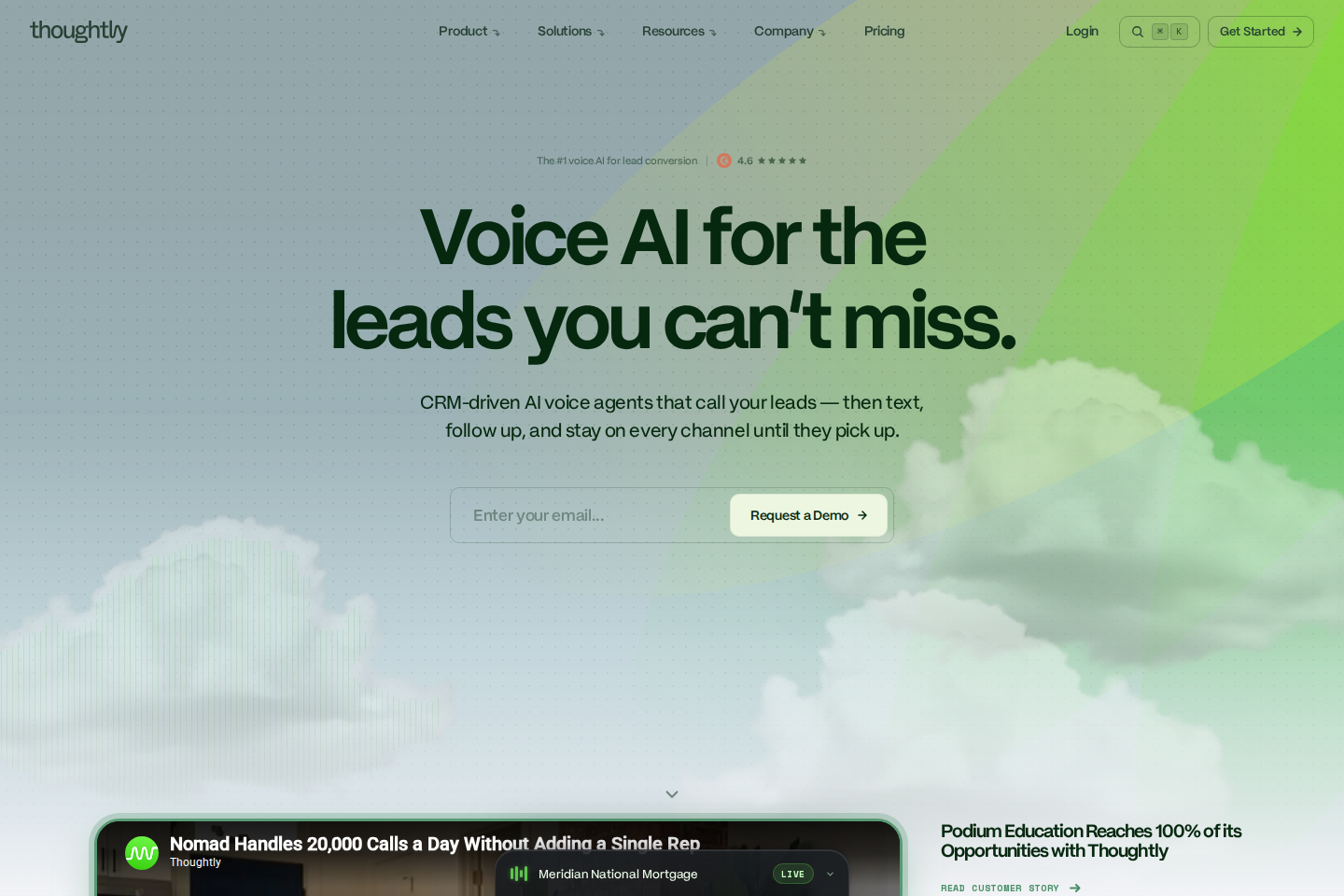
Thoughtly is a multichannel AI voice agentVoice agentA voice agent is a conversational software system that listens, responds, follows a defined workflow, and can take approved actions during a phone conversation.Read full definition → platform that handles voice, SMS, and email natively — with two-way CRM sync to Salesforce, HubSpot, and 200+ other tools. While most platforms on this list treat customer support as call deflection, Thoughtly treats every support interaction as a potential resolution: the agent can look up account details, schedule a service appointment, process a payment, send a confirmation SMS, and write the full conversation summary back to the CRM record. That makes it particularly effective for teams in insurance, healthcare, mortgage, and home services where a support call is often the start of a workflowWorkflowA workflow is a defined sequence of steps, decisions, actions, delays, and outcomes used to complete a business process.Read full definition →, not the end of one.
Pros
Native voice + SMS + email in one agent — no separate tools for follow-up messages, confirmation texts, or email summaries.
Two-way CRM sync with Salesforce, HubSpot, Pipedrive, Zoho, and 200+ integrations — call notes, dispositions, and transcripts write back automatically.
Sub-60-second speed-to-lead and sub-350ms response latency, with branded caller ID and TCPA-safe compliance controls.
SOC 2 Type II and HIPAA certified, with 34 supported languages.
Watch for
Requires a clearly defined CRM workflow and lead source to get maximum value — not a fit for teams without a system of record.
Per-minute pricing model favors high-volume operations; very low-volume teams may not see the economics.
Best fit
RevOps and support teams in regulated consumer industries — insurance, mortgage, healthcare, education, home services — that want AI to handle the full support workflow from first call to booked resolution, not just deflect FAQ calls.
Pricing
Per-minute pricing starting at $0.30/minute for voice, with SMS and email included in the platform. Transparent pricing published on the website.
2. PolyAI (Best for enterprise voice deflection)
PolyAI is a London-based conversational voice AI platform built for large enterprises that need to deflect high-volume inbound calls. The platform is known for its conversation quality — natural turn-taking, interruption handling, and low latency — and counts companies like FedEx, Cox Communications, and Starling Bank among its customers. PolyAI focuses on contact-center-grade voice automation, with integrations into Genesys, Avaya, and other CCaaS platforms. If your core metric is call containment rate on repetitive inbound queries, PolyAI is one of the strongest options on the market.
Pros
Industry-leading conversation quality with natural turn-taking and interruption handling.
Deep CCaaS integrations with Genesys, Avaya, and NICE for enterprise contact centers.
Proven at scale with FedEx, Cox Communications, and major UK banks.
Measurable containment rates — PolyAI publishes case studies showing 50%+ deflection on specific call types.
Watch for
Voice-only architecture — no native SMS or email follow-up. Support interactions that need multichannel confirmation require a separate tool.
Enterprise pricing is not publicly listed; smaller teams may find the sales process and implementation scope heavy.
Best fit
Large enterprise contact centers (500+ seats) running Genesys or Avaya that need to deflect repetitive inbound calls — billing inquiries, password resets, order status, appointment confirmations — at scale.
Pricing
Contact vendor for pricing. Enterprise contracts are customized based on call volume and integration scope.
3. Replicant (Best for high-volume call containment)
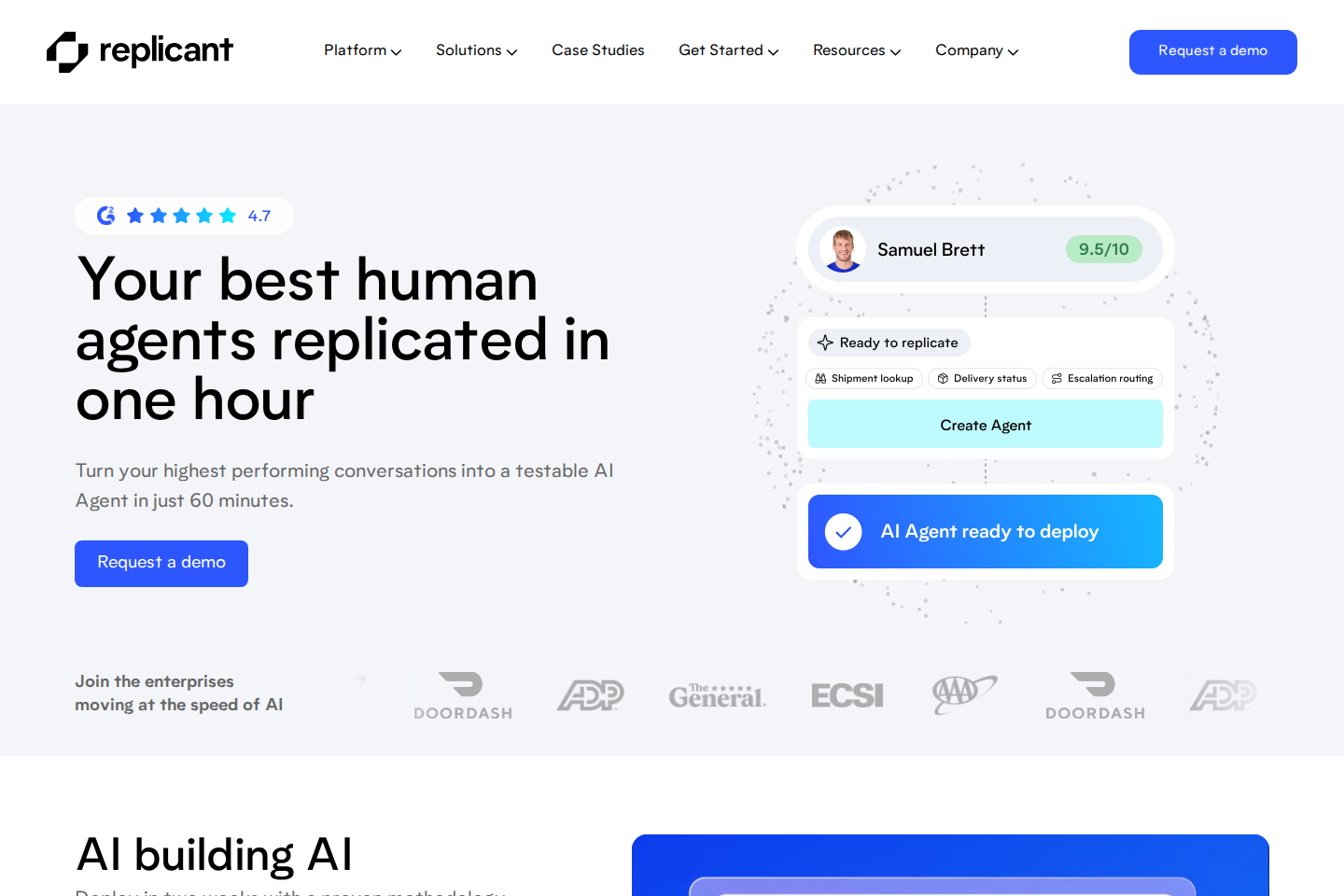
Replicant is a voice AI platform purpose-built for call containment in contact centers. The platform handles inbound customer service calls — tier-1 support, routing, FAQ deflection — and escalates complex issues to human agents with full context. Replicant’s Thinking Machine technology processes conversations in real-time, with intent recognition and conversation branching that goes beyond simple IVRIVRIVR, or Interactive Voice Response, is a phone menu that routes or serves callers through keypad entries or spoken choices.Read full definition → replacement. Customers include DoorDash, ResortPass, and Fetch.
Pros
Strong intent recognition and conversation branching that handles multi-turn support interactions.
Measurable ROI — Replicant publishes case studies showing 67% call containment and $1M+ annual savings for high-volume contact centers.
Integrates with Zendesk, Salesforce, and major CCaaS platforms for ticket creation and routing.
G2 rating of 4.4/5, with reviewers praising ease of setup and measurable deflection results.
Watch for
Contact-center-first design — limited CRM write-back depth compared to platforms built for RevOps workflows. Support calls that need to update deal stages, pipeline, or lead records may require custom integration work.
Voice-only — no native SMS or email channel for follow-up after the call ends.
G2 reviewers note that reporting and analytics could be more granular, and initial setup requires vendor professional services.
Best fit
High-volume contact centers (100k+ inbound calls/month) that need to deflect tier-1 support calls and route complex issues to human agents. Particularly strong for e-commerce, logistics, and SaaS support teams.
Pricing
Contact vendor for pricing. Typically structured as per-minute or per-call pricing with volume tiers.
4. Cognigy (Best for enterprise conversational AI platform)
Cognigy is an enterprise conversational AIConversational AIConversational AI is software that interprets natural language and produces context-aware responses through voice, messaging, or chat.Read full definition → platform that supports both voice and chat, with a strong footprint in large-scale customer service operations. The platform provides a visual flow builder, AI agent capabilities, and integration with contact centerContact centerA contact center is a centralized operation that handles customer or prospect interactions across voice and digital channels.Read full definition → infrastructure including Genesys, Avaya, and Amazon Connect. Cognigy’s customers include Toyota, Lufthansa, and E.ON. The platform is particularly strong for enterprises that need to orchestrate conversations across multiple channels and backend systems, with a low-code builder that lets business users design and deploy AI workflows.
Pros
Dual voice + chat support in a single platform — useful for enterprises that need consistent AI across phone and messaging channels.
Visual flow builder with low-code/no-code design, enabling business users to build and modify AI workflows.
Strong enterprise integrations with Genesys, Avaya, Amazon Connect, Salesforce, and ServiceNow.
Proven at enterprise scale with Toyota, Lufthansa, and E.ON.
Watch for
Implementation can be complex for voice-only use cases — the platform’s breadth means more configuration surface area.
No native email follow-up channel; email requires integration with a separate tool.
Pricing is enterprise-only and not publicly listed; implementation typically requires professional services.
Best fit
Large enterprises with existing contact center infrastructure that need a unified conversational AI platform spanning voice, chat, and backend system orchestration. Best when the team has technical resources to manage the platform.
Pricing
Contact vendor for pricing. Enterprise contracts are customized based on channels, integrations, and conversation volume.
5. Regal (Best for augmenting human contact center teams)
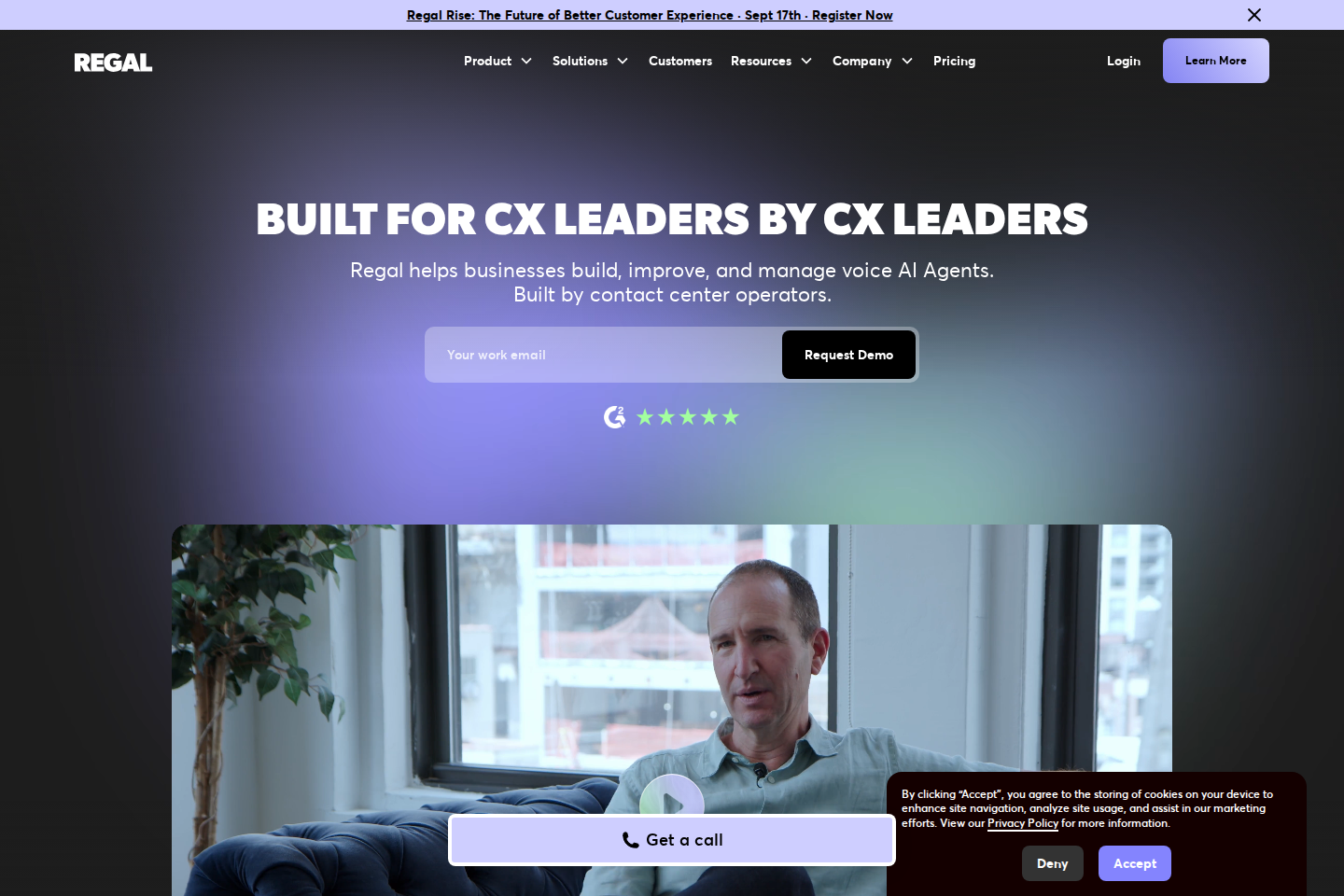
Regal.ai — formerly Regal Voice — is a voice AI platform built by contact center operators for contact center operators. The platform includes AI agents, conversation intelligence, automated QA, agent assist, and journey orchestration. Regal’s strength is its contact-center-native design: if your team already runs a Five9 or Genesys contact center with human agents, Regal lets you add AI without ripping out the existing stack. Customers include Toyota, Kin Insurance, Ro, and Coursera. The platform supports voice and SMS, though email is not a core capability.
Pros
Contact-center-native design with conversation intelligence, automated QA, and agent assist in one platform.
Deep integrations with Five9, Genesys, and other CCaaS platforms.
G2 rating of 4.7/5, with reviewers praising ease of use and implementation support.
Watch for
No native email channel — support interactions that need email confirmation require a separate tool.
Hybrid human + AI cost structure assumes you already have a contact center team to augment, not replace.
G2 reviewers flag reporting depth as a recurring limitation; attribution and pipeline-level analytics are not as granular as RevOps-focused platforms.
Best fit
CX and contact center leaders with existing human agent teams (50+ seats) running Five9 or Genesys who want to augment their team with AI — not replace it. Best for support containment, not revenue conversion.
Pricing
Contact vendor for pricing. Regal does not publish pricing publicly. The cost model assumes a hybrid human + AI stack.
6. Parloa (Best for AI agent management at scale)
Parloa is a German conversational AI platform that enables enterprises to build, deploy, and manage AI voice and chat agents at scale. The platform provides a visual agent builder, conversation analytics, and a testing environment. Parloa’s customers include SAP, KPMG, Booking.com, and Swisscom. The platform is particularly strong for European enterprises that need GDPR compliance and multilingual support, with a focus on automating customer service interactions across phone and digital channels. Parloa recently expanded to the US market with a New York office.
Pros
Visual agent builder with low-code design and built-in testing and analytics tools.
Strong European enterprise customer base including SAP, KPMG, and Booking.com.
GDPR compliance and multilingual support across European markets.
Dual voice + chat support in a unified platform.
Watch for
Newer to the US market — fewer US-based case studies and integrations compared to established domestic vendors.
No native email follow-up channel; email requires integration with a separate tool.
Limited public pricing information; enterprise sales process required.
Best fit
European enterprises and multinational companies that need GDPR-compliant conversational AI across voice and chat, with a focus on customer service automation. Also viable for US enterprises evaluating the platform’s recent expansion.
Pricing
Contact vendor for pricing. Enterprise contracts are customized based on channels, languages, and conversation volume.
7. Balto (Best for real-time agent assist)
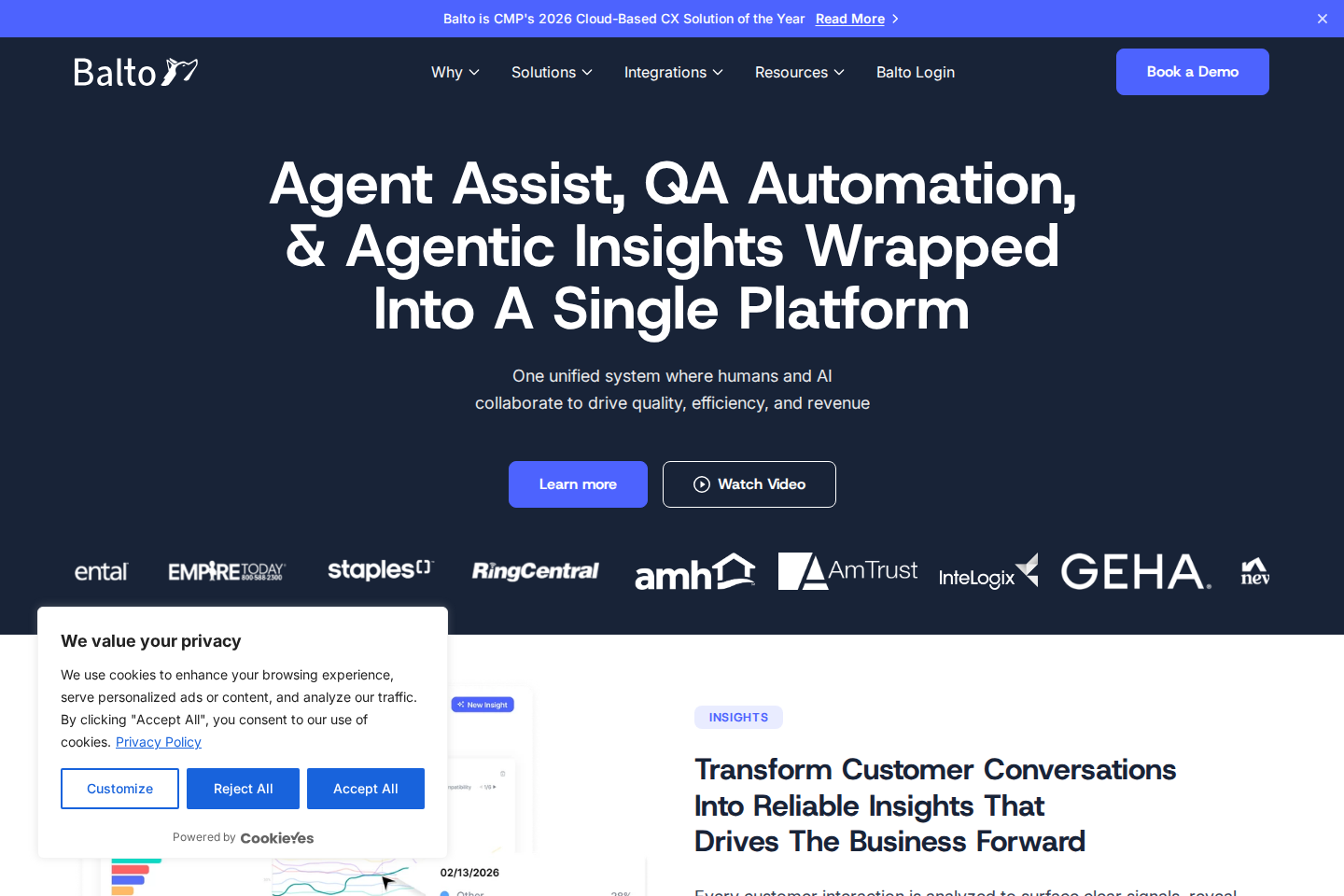
Balto is different from the other platforms on this list: rather than replacing human agents with AI voice agents, Balto provides real-time agent assist software that sits alongside human contact center agents. The platform listens to live calls, surfaces relevant information and suggested responses on the agent’s screen, and automatically checks compliance requirements. Balto was named CMP’s 2026 Cloud-Based CX Solution of the Year, and its customers include Berkshire Hathaway, Red Cross, and Toyota Financial Services. If your contact center relies on human agents and you want to make them better — not replace them — Balto is the strongest option on the market.
Pros
Real-time guidance for human agents — surfaces scripts, compliance checks, and knowledge base articles during live calls.
Strong compliance and QA tooling — automatically monitors for required disclosures, objection handling, and script adherence.
G2 rating of 4.8/5 — one of the highest-rated contact center AI tools on G2.
Won CMP’s 2026 Cloud-Based CX Solution of the Year award.
Watch for
Not a fully autonomous AI voice agent — Balto augments human agents, it doesn’t replace them. If your goal is to automate call handling without humans, this is the wrong tool.
Requires existing contact center infrastructure with human agents on headsets.
No voice, SMS, or email automation — Balto is purely an agent assist layer, not a communication platform.
Best fit
Contact centers with established human agent teams that want to improve call quality, compliance, and consistency — not replace agents with AI. Particularly strong for regulated industries where script adherence and compliance monitoring are critical.
Pricing
Contact vendor for pricing. Balto offers a single comprehensive license model.
Which AI voice agent should you choose for customer support?
The right choice depends on what “customer support” means for your team. If support calls are really conversion opportunities — scheduling appointments, qualifying intent, re-engaging aged leads — Thoughtly is the clear choice because it handles the full workflow across voice, SMS, and email with CRM write-backCRM write-backCRM write-back sends conversation outcomes, qualification answers, notes, appointments, dispositions, and next steps into the CRM.Read full definition →.
If your primary metric is call containment on a high-volume contact center, PolyAI and Replicant are the strongest pure-play deflection tools. If you need a unified conversational AI platform spanning voice and chat across a global enterprise, Cognigy and Parloa are credible options. If you’re augmenting human agents rather than replacing them, Regal and Balto each serve that motion — Regal with contact-center-native AI agents, Balto with real-time agent assist.
The key question: do you want AI to deflect calls, or do you want AI to resolve issues? The platforms on this list do different things well, but only one — Thoughtly — treats the support interaction as the start of a multichannel resolution workflow with full CRM context.
FAQ
What is the best AI voice agent for customer support?
It depends on your use case. For multichannel support resolution with CRM write-back, Thoughtly is the strongest option. For pure voice deflection at enterprise scale, PolyAI and Replicant lead. For augmenting human contact center agents, Regal and Balto are the top choices.
Can AI voice agents replace human customer support agents?
AI voice agents can handle a significant portion of tier-1 support calls — FAQ deflection, appointment scheduling, status checks, and routing. Most platforms on this list achieve 40–70% containment rates on specific call types. However, complex issues requiring empathy, negotiation, or multi-system problem-solving still need human agents. The best platforms support warm handoff with full context so the human agent picks up where the AI left off.
How much do AI voice agents for customer support cost?
Pricing varies by platform. Thoughtly publishes transparent per-minute pricing starting at $0.30/minute for voice, with SMS and email included. PolyAI, Replicant, Cognigy, Regal, Parloa, and Balto all require a sales conversation for pricing. Enterprise contracts are typically structured as per-minute, per-call, or per-seat models depending on the platform’s architecture.
Do AI voice agents integrate with Salesforce and HubSpot?
Thoughtly offers native two-way CRM sync with Salesforce, HubSpot, Pipedrive, Zoho, and 200+ other integrations. Cognigy and Regal also offer Salesforce integrations. Most platforms on this list can integrate with major CRMs, but the depth of integration varies — some write call summaries and dispositions back automatically, while others require custom integration work to achieve the same result.
Are AI voice agents HIPAA-compliant?
Thoughtly and Regal both hold SOC 2 Type II certification and support HIPAA at the enterprise tier. Cognigy also supports enterprise compliance requirements. If HIPAA compliance is required for your support use case — particularly in healthcare — confirm the specific scope of compliance during evaluation, as HIPAA support may vary by deployment model and tier.