

Guides
The Ultimate Guide to AI Voice Bots in 2026
A practical guide to AI voice bots in 2026: how they work, where they fit, what to evaluate, and how to choose a platform for production workflows.
Guides
A practical guide to AI voice bots in 2026: how they work, where they fit, what to evaluate, and how to choose a platform for production workflows.
Last updated
Organizations today deploy AI voiceAI voiceAn artificially generated, natural-sounding voice produced by a TTS model. Thoughtly supports a library of AI voices and brand-specific cloning. bots to manage inbound calls for customer support, appointment coordination, and lead qualificationLead qualificationThe process of capturing fit signals — intent, urgency, location, eligibility, consent, and availability — before routing a lead to the right next step.. These systems also place outbound calls for follow-ups, reminders, and sales outreach.
Rather than forcing callers through traditional phone menus, modern AI voice bots understand natural speech, respond appropriately, and execute actions after conversations end.
This guide covers what an AI voice bot is, how modern systems process calls and respond in real time, leading voice bot platforms in 2026, evaluation methodology for these tools, which industries benefit most from voice automation, whether AI voice bots suit small business operations, and direct comparisons between voice bots and traditional IVRIVRInteractive Voice Response — a phone menu system that routes callers using keypad or spoken inputs. AI agents often replace or augment rigid IVR trees. systems.
First, let's define AI voice bots and examine how they differ from conventional phone systems.
An AI voice bot is an automated system that conducts real-time, two-way conversations with callers. It processes what people say, responds naturally, and executes actions like logging CRMCRMThe system of record for leads, contacts, deals, and activity. Thoughtly reads from and writes to your CRM continuously. notes or sending follow-up emails.
These systems use conversational AIConversational AIAI designed to understand and respond through natural conversation, including voice agents, chat agents, and other language-based interfaces. to understand intent, interpret caller statements, and respond dynamically rather than forcing interactions through rigid decision trees.
AI voice bots handle tedious repetitive calling work, answering frequently asked questions, routing qualified leads, booking meetings, or triggering backend workflows. This represents a fundamental shift from legacy systems that play pre-recorded messages or simply forward calls to human agents.
Voice bot solutions are becoming essential across industries where high call volumes and quick resolutions determine operational success, particularly in support, sales, and service organizations. They integrate into larger platforms or work alongside human teams to manage repetitive tasks.
Next, let's examine how these systems function behind the scenes.
An AI voice bot is designed to process intent, retrieve relevant context, and make real-time decisions during conversations.
Here's what happens when a voice bot receives a call:
When functioning properly, this process feels seamless to callers. But it's a chain of tightly connected systems: voice recognition, language models, business logic, and integrations working together to manage conversations end to end.
Let's examine platforms building these systems in 2026 and what each provides.
Some platforms focus on no-code deployment. Others provide complete control through APIs and model customizations. Here are leading voice bot platforms shaping the space in 2026:
Next, we'll examine each platform including capabilities, ideal use cases, and distinguishing features.
Thoughtly is an AI voice automation platform with production-ready capabilities. It's built for operations, support, and revenue teams who need voice bots deployable quickly without writing code.
Thoughtly extends beyond call automation. It connects voice workflows to related tasks like updating CRMs, sending follow-ups, or assigning internal tasks. That's the difference between a voice bot and a comprehensive automation system with integrated voice capabilities.
Features:
The platform enables teams to build voice-based workflows that behave differently based on call outcomes and integrate with existing business processes.
Pros:
Cons:
Pricing: Contact for custom pricing based on call volume and feature requirements
Thoughtly works well when voice automation is part of larger workflows, not just standalone features. It's valuable for teams wanting agents that function as assistants and triggerTriggerThe event or condition that starts an automated workflow, such as a new lead, missed call, CRM status change, calendar booking, or completed call. automated processes before and after calls.
Amazon Connect provides cloud contact centerContact centerA centralized operation that handles inbound and outbound customer interactions across voice, SMS, email, and digital channels, typically focused on service, support, or sales conversations. infrastructure with AI voice capabilities for organizations building on AWS. It's designed for teams with technical resources who want deep customization integrated with existing AWS services.
Features:
Amazon Connect suits organizations already invested in AWS infrastructure seeking contact center capabilities with voice automation.
Pros:
Cons:
Five9 delivers AI-enabled voice automation within enterprise contact center infrastructure. It's built for large organizations managing high call volumes across multiple channels and use cases.
Features:
Five9 is designed for established contact centers adding AI capabilities to existing operations.
Pros:
Cons:
TwilioTwilioA cloud communications platform widely used as the carrier layer for voice and SMS. Thoughtly supports Twilio for inbound and outbound traffic. offers programmable voice APIs for teams building custom voice solutions from the ground up. It provides building blocks rather than packaged platforms, requiring engineering resources but offering maximum flexibility.
Features:
Twilio suits engineering teams building highly customized voice applications integrated into existing products or workflows.
Pros:
Cons:
Genesys provides AI voice automation within comprehensive customer engagement platforms. It's designed for enterprises managing customer interactions across multiple channels with unified strategies.
Features:
Genesys suits large organizations prioritizing unified customer engagement across multiple touchpoints.
Pros:
Cons:
Platforms were evaluated across structured workflows and real-world scenarios to understand performance. Each tool was assessed on its ability to communicate naturally, follow logic, execute actions, and integrate with business tools.
These factors determined evaluation:
The first test was whether bots could handle realistic interactions. That meant more than recognizing questions; it required completing tasks.
Evaluation included lead qualification, appointment booking, and post-call action triggers. The strongest platforms combined accurate speech recognitionSpeech-to-Text (STT)The system that turns the caller's speech into text the agent can reason over. with action logic. Weaker ones could "talk" but didn't accomplish much beyond conversation.
Several platforms handled context across multiple conversation turns, asking clarifying questions or remembering prior answers without losing track. That's a key indicator of effective conversational AI.
Simulated support and sales calls used identical scripts across platforms. Evaluation focused on tone, pacing, inflection, and how well bots handled interruptions or non-linear responses.
More lifelike bots paused naturally, handled interruptions without freezing, and adjusted tone based on caller inputs. Platforms using advanced voice synthesis models were notably more realistic.
Both inbound and outbound calls were tested. Key factors included response time, adherence to conditional logic, ability to handle vague or off-script inputs, and capacity to execute backend actions like sending follow-ups or updating lead status.
For example, dropping phrases like "Can you email me that?" mid-conversation tested whether platforms could interpret requests, trigger appropriate actions, and continue calls smoothly.
Each platform was evaluated on time to deploy working voice bots, availability of no-code options versus requiring development help, workflowWorkflowAn automated, multi-step process — usually triggered by an event (form fill, new lead) and orchestrating one or more voice / SMS / email actions. customization flexibility, and integration with standard tools like CRMs and business systems.
Some platforms enabled quick setup but limited logic customization. Others provided balanced approaches, fast deployment with customizable workflows. Enterprise platforms required more setup effort but delivered structured, scaled deployments.
Next, we explore how these tools integrate with existing technology stacks.
Leading voice bot platforms integrate with existing tools, update records, assign tasks, and synchronize systems. This is particularly important for sales, support, and customer experience teams already relying on CRMs or helpdesk systems to track conversations and manage follow-ups.
Common integrations include:
Some platforms allow customizing how these actions trigger post-call. Others support basic data synchronization.
For example, platforms like Thoughtly support comprehensive actions: logging complete summaries, triggering follow-up sequences, or escalating issues based on call logic. Other tools offer lighter, webhook-based integrations working well for simpler use cases.
Understanding these capabilities, let's explore industries where voice bots deliver the most impact.
Any team managing repetitive phone conversations, where speed, scale, or consistency matter, can benefit from voice automation.
Here's where they're making the biggest impact:
Voice bots increasingly handle inbound support for FAQs, request triage, and routing to appropriate human agents. For outbound, they confirm appointments, send reminders, or manage follow-ups.
When integrated with proper CRM or helpdesk systems, voice bots for contact centers can free representatives to focus on complex issues, reduce average handle times, and ensure conversations are logged consistently.
Voice bots make initial outreach calls, ask qualifying questions, and route leads to appropriate representatives. When properly integrated, they also handle missed call follow-ups or automatically re-engage dormant leads.
In B2B sales, this proves especially useful for SDR teams managing high call volumes.
Rather than recruiters calling every applicant with identical screening questions, voice bots handle front-line interactions such as collecting basic information, checking qualifications, and passing notes forward.
From appointment scheduling to prescription refills to test result updates, voice bots help clinics and provider networks automate common workflows while maintaining privacy and compliance requirements.
Some support multi-language interactions, expanding accessibility across regions.
Order status, shipping delays, and return confirmations are routine phone-based interactions that voice bots can remove from support team workloads. When connected to order systems or ERPs, they provide accurate answers based on real-time data.
These benefits extend across industries. But do they suit small businesses? We'll answer that next.
They absolutely benefit small businesses, especially no-code platforms. Small businesses repeatedly receive identical calls: appointment requests, follow-ups, order status, and FAQs.
AI voice bots handle these conversations effectively, and doing so with software means no missed calls, no unanswered voicemails, and no need to hire additional representatives just to manage phone volume.
Quick example: A local clinic or wellness studio misses 10–15 calls daily. With a voice bot in place, every missed call can trigger polite follow-up asking why they called, offering appointment slots, and confirming bookings without human intervention.
For small teams seeking deeper automation, like follow-ups via SMS or CRM synchronization, options like Thoughtly bring more capability without excessive technical complexity.
Voice bots are no longer enterprise-only tools. With accessible pricing, they're now part of small business automation infrastructure.
But how do they compare to traditional IVRs? We'll explore that comparison.
Traditional IVR systems are slow, impersonal, and often frustrating both for callers and businesses. AI voice bots address these limitations by offering faster responses, more natural conversations, and smoother experiences.
Instead of forcing callers through menus, AI bots understand intent and determine next steps automatically, making interactions feel more personal and efficient.
Here's how they compare:
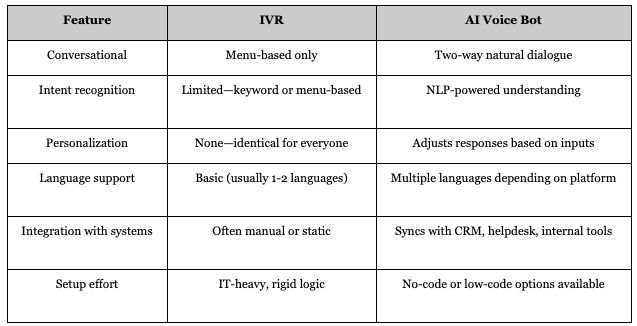
For teams looking to reduce call handling times, improve customer experience, or capture better data from calls, transitioning from IVR to modern voice bots delivers clear advantages. These AI platforms handle conversations from start to finish, log interactions, and execute actions after calls end.
If you're seeking AI voice automation that handles conversations and triggers post-call workflows around emails, meetings, and sales processes, Thoughtly provides comprehensive capabilities.
Here's why Thoughtly stands out among AI voice bot platforms:
Ready to automate your voice workflows? Thoughtly's team provides implementation support to help you move from concept to production quickly.
AI voice bots handle inbound customer inquiries, outbound prospecting calls, appointment scheduling, lead qualification, and follow-up sequences. They reduce manual calling workload and ensure consistent contact with leads and customers, though complex negotiations and relationship building still require human representatives.
No. AI voice bots excel at repetitive, high-volume tasks, but human agents remain essential for complex problem-solving, empathetic support, and situations requiring judgment. The most effective approach uses AI to support teams by handling routine interactions, allowing humans to focus on high-value conversations.
Voice bots operate during live phone conversations where tone, interruptions, and instant responses matter significantly. Chatbots function in text environments with higher tolerance for delays and structured exchanges. Voice requires different technical capabilities for natural conversation flowConversation flowThe designed path an AI agent follows through greeting, intent capture, qualification, routing, objections, fallback, and next-step confirmation..
Conversation quality, system reliability, integration accuracy with CRM and business tools, and cost predictability matter more than brand names or technical specifications. If bots sound unnatural, fail to update systems correctly, or introduce noticeable latencyLatencyThe delay between a caller speaking and the agent responding. Lower latency makes AI voice conversations feel more natural., they will damage customer experience rather than improve it.
Most modern platforms integrate with major CRM systems, scheduling tools, and helpdesk platforms. However, integration depth varies significantly. Evaluate whether platforms provide native connections versus requiring custom API development for your specific technology stack.
Deployment speed varies by platform. No-code solutions designed for business teams can launch in days, while platforms requiring custom development may need weeks or months. Implementation time depends on workflow complexity, integration requirements, and team technical capacity.
Yes, when platforms support proper data handling, consent managementConsent managementConsent management is the process of recording, honoring, and updating a lead's permission for calls, texts, emails, and opt-outs across every follow-up channel., call recordingCall recordingCapturing audio from a phone conversation for review, QA, training, compliance, dispute resolution, or supervised retention. controls, and complete audit logging. However, compliance requirements vary by industry and geography, so verification should occur before deployment, especially in healthcare, financial services, or other regulated sectors.
Many modern platforms support multiple languages, though quality and coverage vary. Some platforms offer dozens of languages with native-quality speech synthesisText-to-Speech (TTS)The system that turns the agent's generated text into spoken audio — the voice the caller actually hears., while others provide basic multilingual capabilities. Evaluate language quality for your specific markets before deployment.