

Industry insights
8 Best Voice AI Providers for 2026 (Tested and Ranked)
I evaluated the best voice AI providers for revenue conversion, contact-center automation, business calling, developer voice, and infrastructure in 2026.
Industry insights
I evaluated the best voice AI providers for revenue conversion, contact-center automation, business calling, developer voice, and infrastructure in 2026.
Last updated
I evaluated voice AI providers by a simple standard: could the platform run a real business conversation and then do something useful with the outcome? A voice demo is not enough. The better test is whether the provider can answer or place calls, qualify intent, schedule the next step, update the system of recordSystem of recordA system of record is the authoritative source for a defined category of business data., and keep the conversation moving when the lead or customer changes channels.
This category is distinct because buyers are not just choosing a synthetic voiceAI voiceAn AI voice is synthetic speech produced by a text-to-speech model, using a selected or cloned voice to speak an agent's generated or scripted response.. They are choosing an operating layer for phone conversations. Some providers are best for inbound revenue conversion, some for enterprise contact-center containment, some for developer infrastructure, and some for traditional business calling with AI features layered on top.
I compared current vendor websites, pricing pages where available, public review patterns, independent comparisons, and Thoughtly's current product documentation. I favored providers with clear workflowWorkflowA workflow is a defined sequence of steps, decisions, actions, delays, and outcomes used to complete a business process. depth, trustworthy integrations, compliance posture, and a defensible reason to exist beyond low-latency audio.
I used six criteria because voice AI buying decisions fail when teams evaluate only sound quality. The right provider depends on the workflow you need the conversation to complete, the systems it must update, and the operational team that will own the rollout.
I looked for natural turn-taking, interruption handling, response speed, and whether the provider can manage multi-turn conversations without forcing callers through a brittle IVRIVRIVR, or Interactive Voice Response, is a phone menu that routes or serves callers through keypad entries or spoken choices. tree. This matters because the caller's trust disappears quickly if the agent lags, talks over them, or forgets what they already said. Strong voice quality is table stakes, not the whole product.
A provider scored higher when it could book appointments, triggerTriggerA trigger is an event or condition that starts, resumes, changes, or stops an automated workflow. follow-up, route qualified contacts, write summaries and structured fields, or fire downstream automations. Calls create value only when the outcome moves somewhere useful. If a human still has to interpret every transcriptTranscriptA transcript is the written record generated from a spoken conversation, typically showing what the caller and agent said during a call. and manually update the CRMCRMA CRM is the system used to manage leads, contacts, accounts, opportunities, activity, ownership, and follow-up., the automation is doing half the job.
I checked whether the provider connects to Salesforce, HubSpot, Pipedrive, contact-center platforms, help desks, calendars, or custom systems through native integrations and webhooks. The strongest options read context before the call and write outcomes back afterward. One-way call logging is weaker than bidirectional sync with structured qualification data.
Voice rarely carries the whole conversion path by itself. I gave more credit to providers that can continue the same conversation across SMS, email, WhatsApp, chat, or other channels when a person misses a call or asks for details in writing. Channel continuity matters especially for high-consideration consumer funnels where the first answer is often not the final answer.
For insurance, mortgage, healthcare, financial services, education, and enterprise CX, the provider needs more than a friendly voice. I looked for consent handling, auditability, recording and transcript controls, SOC 2 or HIPAAHIPAAHIPAA is a US federal law whose Privacy, Security, and Breach Notification Rules govern protected health information for covered entities and business associates. posture where relevant, DNC and opt-outOpt-outAn opt-out is a person’s request to stop receiving a particular category of calls, texts, emails, or other communications. handling, and admin governance. These details decide whether a pilot can survive procurement.
Some providers are built for RevOps teams that want a working agent live quickly; others require enterprise implementation, contact-center process redesign, or developer resources. I considered pricing transparency, setup complexity, admin burden, and who should own the platform day to day. The best provider is the one that matches your operating model, not the one with the flashiest demo.
| Provider | Best for | Core strength | Main watch-out | Pricing notes |
|---|---|---|---|---|
| Thoughtly | Inbound lead conversion | Voice, SMS, email, CRM write-back, and booking in one revenue workflow | Needs clear lead sources, qualification rules, and routing logic | Per-minute / outcome-oriented plans |
| Regal.ai | Regulated consumer journeys | Branded calls, journey orchestration, AI agent builder, and CX controls | Best for teams with enough scale to support enterprise rollout | Quote-based |
| PolyAI | Enterprise contact centers | Lifelike voice agents for service conversations and call containment | Less focused on revenue follow-up across SMS and email | Enterprise contracts |
| Cognigy | Enterprise CX automation | Omnichannel AI agent platform with strong voice capabilities | Can be heavy for teams that only need inbound lead conversion | Quote-based; free trial advertised |
| Replicant | High-volume customer support | Automating repetitive service calls with contact-center governance | Support-first orientation rather than revenue-first qualification | Quote-based |
| Aircall | AI business phone system | Calling, SMS, analytics, CRM integrations, and AI features in a familiar phone stack | Voice agents are part of a broader comms suite, not the deepest autonomous agent layer | Plans start around $30/license/month |
| ElevenLabs | Product builders | High-quality speech and conversational AI for custom experiences | Requires more product/developer ownership for full business workflows | Published agent plans with included minutes |
| Telnyx | Technical teams and infrastructure | Carrier-owned telephony, messaging, and conversational AI stack | More infrastructure-like than plug-and-play for RevOps | Pay-as-you-go and volume pricing |
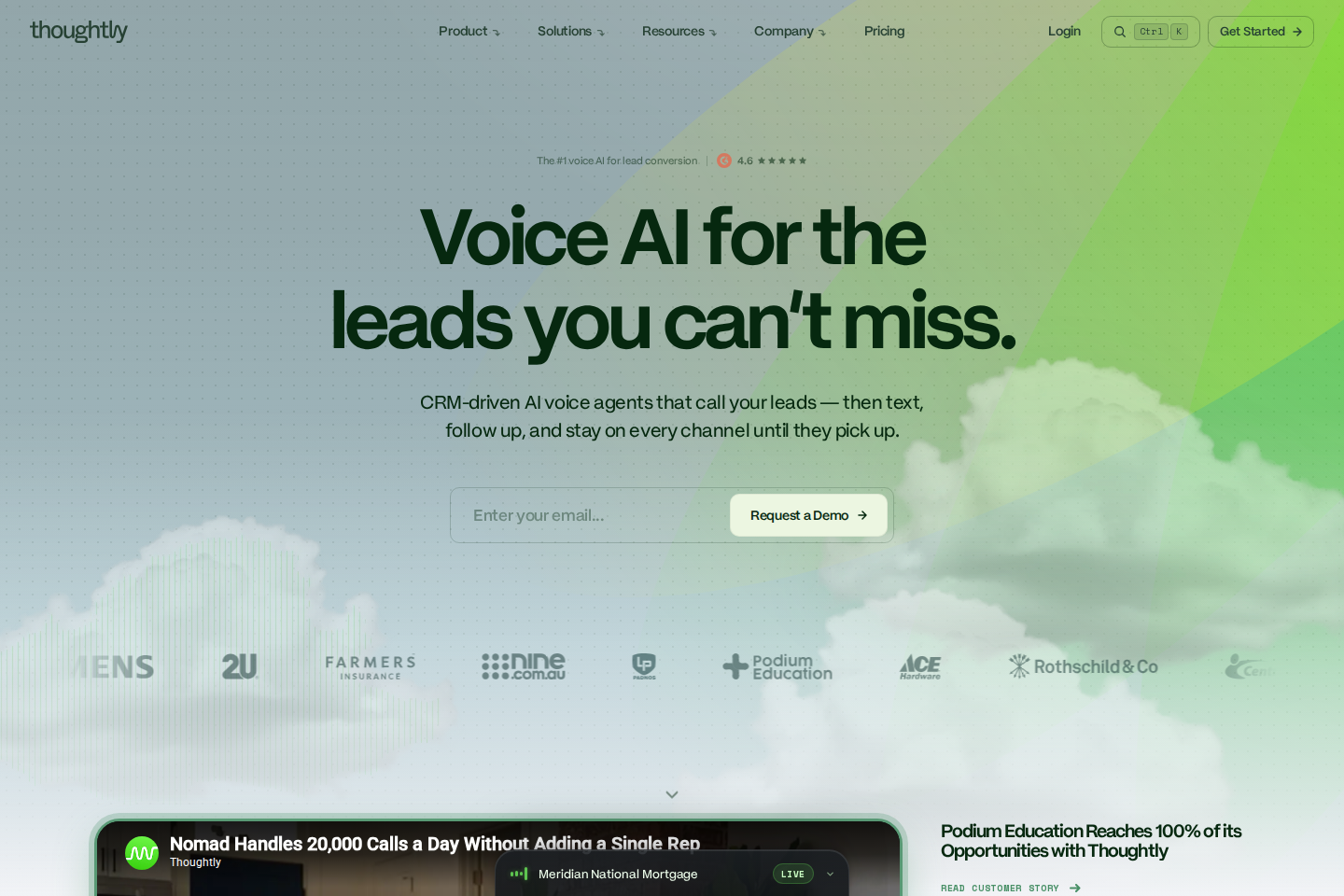
Thoughtly is built for teams that already generate inbound demand but cannot reach every lead fast enough with humans alone. Its AI agents call opted-in leads, continue by SMS, iMessage, WhatsApp, and email, qualify intent, book meetings, and write outcomes back to systems like Salesforce, HubSpot, and Pipedrive. Thoughtly's strongest fit is high-consideration consumer revenue: insurance, mortgage, real estate, education enrollment, healthcare, home services, financial services, automotive, and legal.
The product is not just a voice layer. Thoughtly's current site positions it as a CRM-driven conversion layer with shared context across voice, text, and email, sub-350ms response latencyLatencyLatency is the elapsed time between a caller's speech and the agent's response, including listening, processing, tool, network, and speech-generation delays., 34 languages, and 24+ certified integrations. For teams where the business problem is missed form fills, slow speed-to-lead, stale CRM records, or leads that need multiple touches before they talk, that workflow depth matters more than a standalone voice demo.
I would test Thoughtly with a live inbound lead workflow: new form fill enters the CRM, the agent calls within the target window, captures fit and urgency, books or transfers, then logs the full outcome. The pass/fail moment is not whether the voice sounds good; it is whether the CRM record is ready for a rep without cleanup.
Choose Thoughtly if your revenue team cares about converting the leads you already paid to acquire. It is especially strong when human reps currently cherry-pick the top of the queue while the long tail goes cold.
Thoughtly uses per-minute / outcome-oriented pricing and pairs customers with account management and customer success support. Contact Thoughtly for volume pricing.
Regal.ai is a voice AI and customer-engagement platform built for companies that need to orchestrate outreach around a customer's journey, not just answer one call. Its public messaging emphasizes voice AI agents, AI agent management, branded calls, and use cases in insurance, education, and home services. That makes Regal a serious option for regulated consumer teams that need control, observability, and human escalationEscalationEscalation moves a conversation to a person, specialist, supervisor, or alternate workflow when the agent should not continue alone. around AI calls.
Regal belongs high on this list because it understands the operational realities of contact centers and high-consideration customer journeys. It is often a better fit than lightweight phone tools when teams need QA, compliance workflows, customer context, and agent-assisted operations around AI-driven voice conversations.
I would test Regal with a journey that includes previous customer context, consented outreach, a branded call, an AI qualification step, and a human handoffHuman handoffHuman handoff transfers a conversation, context, and next action from an automated agent to a person.. The key question is whether the journey orchestration improves contact and conversion without adding operational complexity.
Choose Regal if you run a larger consumer or contact-center operation and need voice AI inside a managed journey. It is strongest when the organization already has CX operations, compliance review, and enough call volume to justify a more enterprise rollout.
Regal uses quote-based pricing; contact the vendor for plan and usage details.
PolyAI is one of the best-known enterprise voice AI providers for customer-service calls. Its public site describes an agentic dialog platform where enterprises build, run, adapt, and iterate voice agents in real time. The product is strongest when the phone conversation itself is complex, high-volume, and service-oriented.
PolyAI earns its place because it focuses deeply on natural conversation and enterprise deployment. For hospitality, banking, retail, travel, and service-heavy contact centers, that can matter more than broad multichannel revenue follow-up. The tradeoff is that PolyAI is oriented around contact-center automation, not the full inbound lead-conversion workflow from form fill to CRM-nurtured booking.
I would test PolyAI with the messiest service intents: interruptions, corrections, account-specific context, edge-case routing, and escalation to humans. The provider should prove it can contain the right calls without trapping callers who need a human.
Choose PolyAI for enterprise customer-service automation where the phone experience is the product. It is less ideal for revenue teams that need every conversation to become a lead, appointment, or CRM-triggered follow-up sequence.
PolyAI pricing is enterprise / quote-based. Expect pricing to depend on deployment scope, call volume, integrations, and support requirements.
Cognigy, now part of NiCE, is an enterprise conversational AIConversational AIConversational AI is software that interprets natural language and produces context-aware responses through voice, messaging, or chat. platform with strong voice AI capabilities. Its voice AI agents page emphasizes empathetic phone conversations at scale, enterprise readiness, integrations, authentication, and customer-service outcomes. This is a platform for CX organizations that want voice as part of a broader automation strategy.
Cognigy makes sense when the buyer wants one platform for voice, chat, agent assistance, and enterprise automation governance. It is more expansive than a point solution. That breadth is useful for complex CX teams, but it can be more than a revenue team needs if the narrow job is converting inbound leads quickly.
I would test Cognigy with a cross-channel CX journey: call authentication, service resolution, escalation, and reporting. The important question is whether the platform's broad automation layer simplifies operations or adds more governance than the team can maintain.
Choose Cognigy if your mandate is enterprise CX automation across voice and digital channels. Choose a more revenue-specific provider if your main problem is reaching and converting inbound leads before competitors do.
Cognigy is quote-based for enterprise deployments and advertises demo / trial paths on its site. Confirm usage, implementation, and contact-center integration costs during procurement.
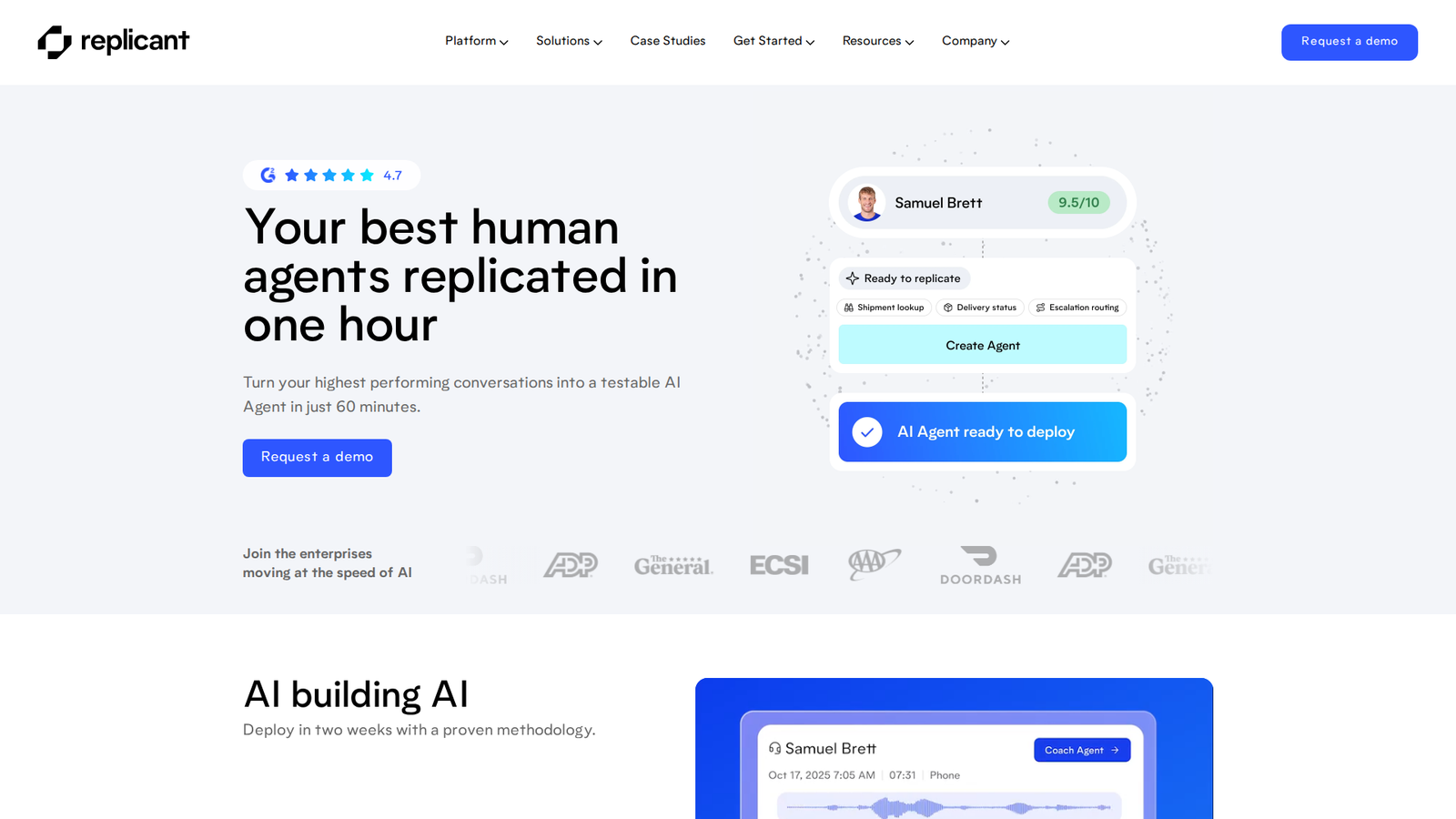
Replicant focuses on automating high-volume customer-service conversations. Its public site positions the product as AI that replicates your best agents and turns high-performing conversations into testable AI agents quickly. Gartner's public product summary describes Replicant as software for automating inbound and outbound calls, texts, and other customer-service interactions through conversational AI.
That makes Replicant a good provider when the problem is repetitive service volume: status checks, appointment changes, basic troubleshooting, authentication, and common inbound questions. It is less obviously built for the full revenue-conversion motion where a lead needs phone, SMS, email, CRM write-backCRM write-backCRM write-back sends conversation outcomes, qualification answers, notes, appointments, dispositions, and next steps into the CRM., and qualification logic tied to a sales pipeline.
I would test Replicant with a repeatable service queue: order status, appointment management, account lookup, or basic troubleshooting. Success should be measured by correct resolution and clean escalation, not just containment rate.
Choose Replicant if customer-service call volume is the operational pain. If the pain is missed inbound revenue, slow speed-to-lead, or CRM follow-up coverage, Thoughtly is the more direct fit.
Replicant pricing is quote-based. Buyers should confirm call volume assumptions, implementation services, analytics, and channel coverage in the sales process.
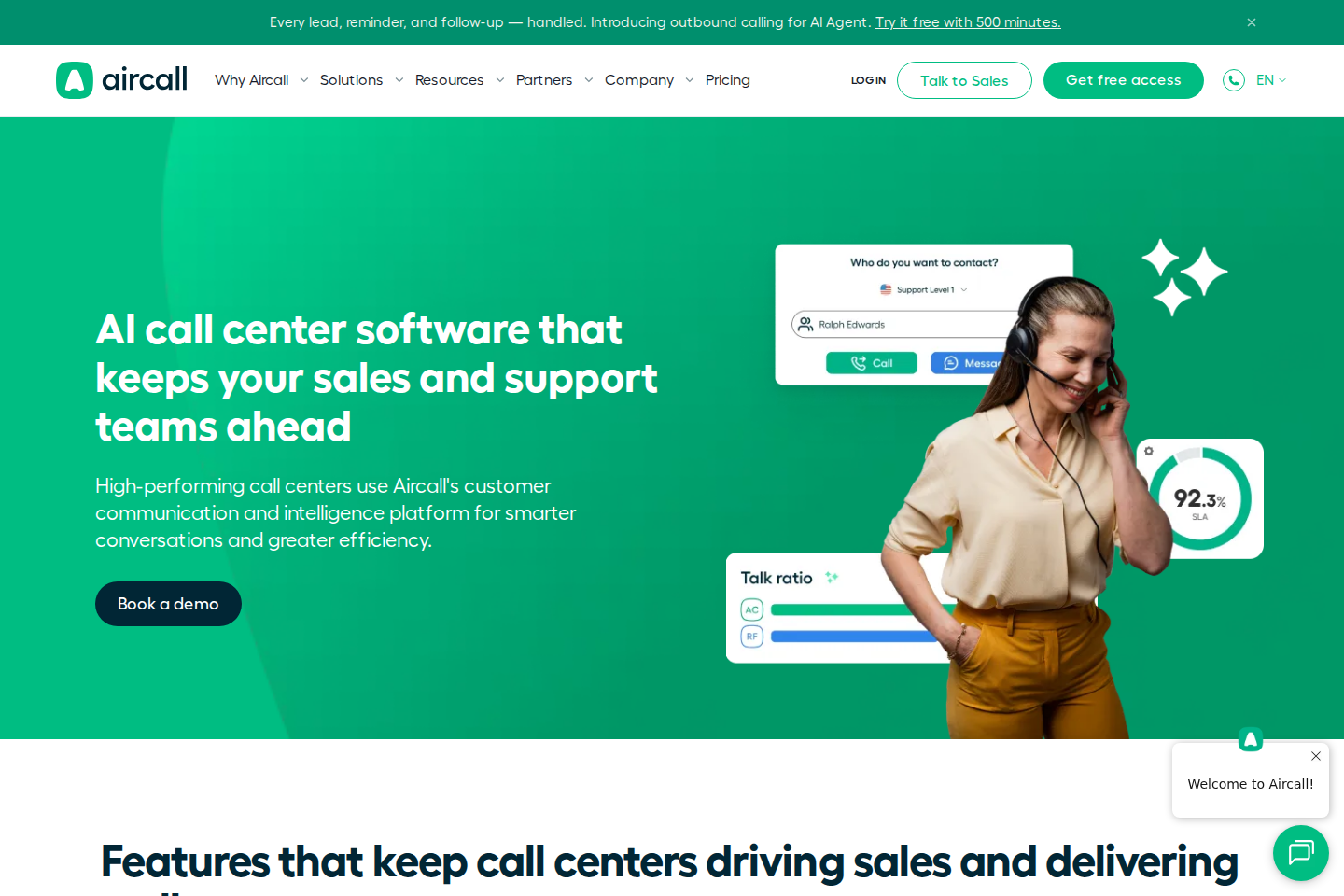
Aircall is an AI-powered customer communications platform and business phone system rather than a pure autonomous voice-agent company. Its pricing page positions the product around AI-powered calling, voice agents, and 250+ integrations, with U.S. pricing starting at $30 per license per month. That makes Aircall attractive for teams that want AI features inside a phone stack they can roll out broadly to sales and support users.
Aircall belongs here because many buyers do not want a standalone AI agent platform first; they want better calling, SMS, analytics, CRM integrationCRM integrationA CRM integration connects an agent or communications platform with a CRM so the systems can exchange records, events, and actions., and gradually more automation. The watch-out is depth. A business phone system with AI features can be easier to adopt, but it may not match the workflow autonomy of a provider built around end-to-end lead conversion.
I would test Aircall by connecting the CRM, placing real inbound and outbound calls, reviewing AI summaries and disposition data, and checking whether managers can report on outcomes cleanly. The best test is whether the system reduces admin work for reps without forcing a separate automation tool.
Choose Aircall if your first requirement is a modern phone system with AI layered in. It is a practical fit for sales and support teams that still expect humans to own most conversations.
Aircall publishes U.S. pricing that starts around $30 per license per month, with higher tiers and custom plans depending on features and scale.
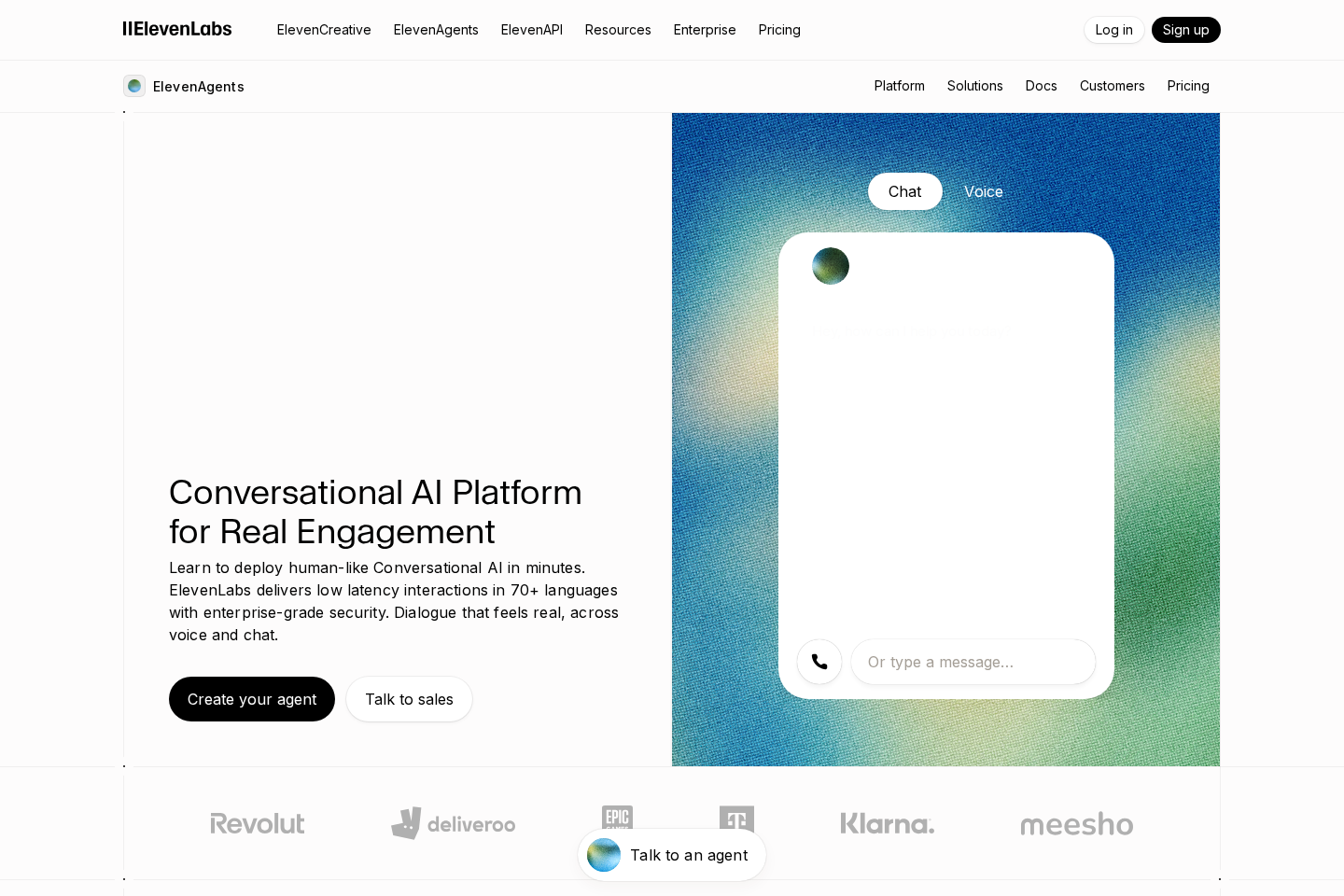
ElevenLabs is best known for high-quality AI speech, and its ElevenAgents / conversational AI offering gives builders a way to put real-time voice agents into products and customer experiences. The pricing page publishes agent plans with included call minutes and add-on per-minute costs, which is unusually transparent for the category. That makes it appealing for startups, product teams, and developers who want to build their own workflow on top of strong voice technology.
The reason ElevenLabs is not higher for revenue teams is that excellent speech is not the same as a complete GTM workflow. Buyers still need to think through CRM syncCRM syncCRM sync keeps selected lead, contact, conversation, outcome, and next-step data aligned between an agent platform and a CRM., consent, scheduling, routing, follow-up, analytics, and human handoff. If you have product or engineering resources, ElevenLabs can be powerful; if you want a managed revenue conversion layer, choose a more workflow-native provider.
I would test ElevenLabs by building one narrow voice agentVoice agentA voice agent is a conversational software system that listens, responds, follows a defined workflow, and can take approved actions during a phone conversation. and measuring latency, interruption handling, voice quality, and API ergonomics. Then I would separately test how much work is needed to connect the agent to the business system that owns the outcome.
Choose ElevenLabs if voice quality and developer flexibility matter more than a packaged revenue workflow. It is a strong provider for product teams; less ideal for RevOps teams that want to launch without engineering.
ElevenLabs publishes ElevenAgents plans with included monthly call minutes and additional per-minute usage. Check the current pricing page for model, minute, and tier details.
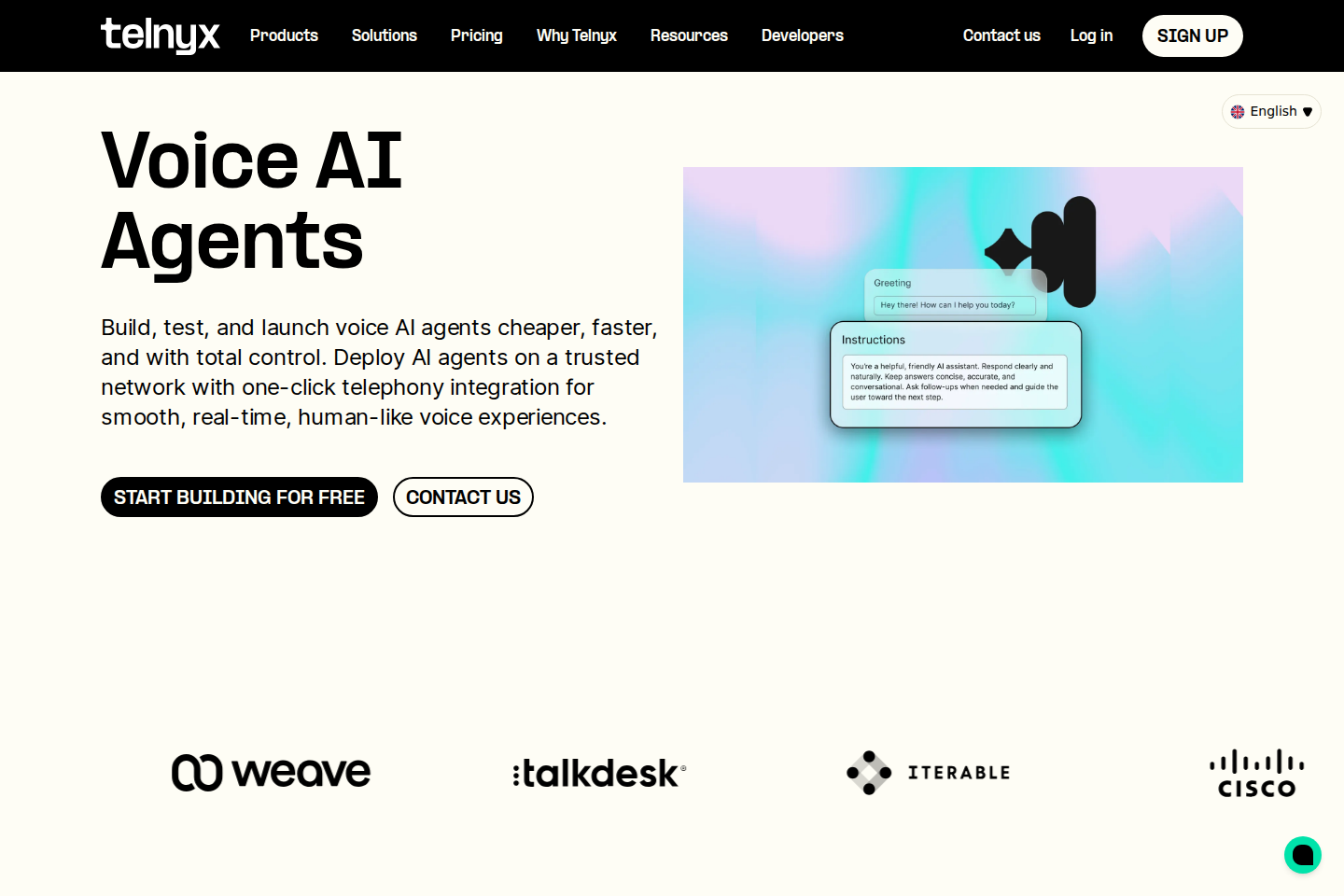
TelnyxTelnyxTelnyx is a cloud communications provider offering voice, messaging, phone numbers, and network services through APIs. is a communications infrastructure provider that now positions around voice AI agents with built-in global telco infrastructure. Its public site emphasizes owning the stack from carrierCarrierA carrier is a telecommunications provider that transports voice calls or messages between phone numbers and networks. network to AI inference, with voice, messaging, SIP, and conversational AI in one platform. For technical teams, that full-stack control is the appeal.
Telnyx belongs on this list because many serious voice AI deployments eventually run into telephony, latency, routing, reliability, compliance, and cost problems. A provider that owns more of the communications stack can be attractive when the buyer has engineering resources and wants infrastructure control. It is less plug-and-play for a RevOps team that wants the agent, playbook, follow-up, and CRM execution packaged together.
I would test Telnyx by building a prototype with real telephony, transfer paths, recordings, SMS follow-upSMS follow-upSMS follow-up uses compliant two-way text messages to continue a conversation after an inquiry, call, voicemail, or prior interaction., and latency measurement. The evaluation should include both developer experience and the operational cost of owning more of the workflow yourself.
Choose Telnyx if you have technical ownership and need a communications stack for voice AI at scale. Choose a workflow-native provider if the business team wants outcomes without building the operating layer.
Telnyx publishes conversational AI pay-as-you-go pricing and volume-based pricing. Confirm current minute rates, telephony costs, messaging, and model costs before forecasting production spend.
A voice AI provider supplies the technology that lets software agents speak with people over the phone or voice channels. Depending on the provider, that can include speech recognitionSpeech-to-Text (STT)Speech-to-Text (STT) converts spoken audio into text that a voice agent can interpret, store as a transcript, and use in downstream actions., text-to-speech, LLMLarge Language Model (LLM)A large language model (LLM) is a machine-learning model trained on large text collections to interpret and generate language from prompts and context. orchestration, telephony, call routingCall routingCall routing sends a caller to the right agent, person, team, location, queue, or workflow using intent, data, rules, and availability., workflow automationWorkflow automation, CRM integration, analytics, and compliance controls.
Thoughtly is the best fit when the goal is inbound lead conversionInbound lead conversionInbound lead conversion turns opted-in calls, form submissions, quote requests, and other inquiries into qualified conversations, appointments, or transfers. across voice, SMS, email, and CRM workflows. It is built to call opted-in leads quickly, qualify them, continue the conversation across channels, book or route the next step, and update the system of record.
For large customer-service contact centers, PolyAI, Cognigy, and Replicant are strong options depending on whether the priority is lifelike voice, broad CX automation, or repetitive support-call automation. Buyers should test authentication, escalation, reporting, and containment quality before committing.
The best deployments do not simply replace humans. They handle the repetitive, time-sensitive, or high-volume parts of the workflow and hand off when a licensed, specialized, or human conversation is needed. For revenue teams, the goal is usually to feed reps warmer, better-documented conversations.
Pricing varies widely. Business phone systems may start around a monthly per-license fee, developer platforms often publish per-minute or usage pricing, and enterprise contact-center platforms are usually quote-based. Always model minutes, telephony, messages, integrations, implementation, support, and any pass-through model costs.
Ask the vendor to run a realistic call, show interruption handling, capture structured data, trigger follow-up, book or transfer the next step, and display the updated CRM or dashboard. A polished voice demo is useful, but the workflow after the call is what determines ROI.
The voice AI provider market is splitting into clear lanes: revenue conversion, enterprise CX automation, business communications, developer voice, and infrastructure. Thoughtly is the provider I would choose for inbound lead conversion because it connects the full workflow: voice, SMS, email, qualification, booking, and CRM execution. For customer-service containment, evaluate PolyAI, Cognigy, and Replicant; for infrastructure and custom builds, look at Telnyx and ElevenLabs; for a phone-system upgrade, Aircall is the pragmatic shortlist.
