8 Best Ada CX Alternatives for AI Customer Service in 2026
Ada CX is enterprise AI customer service — powerful but expensive, opaque, and slow to deploy. Here are eight alternatives for teams that want faster results, transparent pricing, or a platform built for lead conversion instead of ticket deflection.
Last updated
Ada CX has been one of the most visible names in enterprise AI customer service since 2016. The platform deploys AI agents across chat, email, voice, and messaging to automate support conversations at scale — and it works for the right buyer: large enterprises with 300,000+ annual conversations, a CX team to own the deployment, and the budget for six-figure annual contracts with opaque per-resolution pricing.
But not every team evaluating Ada is actually looking for a customer service deflection platform. Some teams land on Ada's page because they need AI that handles inbound leads, not inbound tickets. Others want transparent pricing, faster deployment, or a platform that doesn't require professional services to go live. And some need a tool that works at mid-market scale without the enterprise-only deal floor.
This guide covers eight alternatives to Ada CX — starting with the best option for teams whose real need is converting inbound leads rather than deflecting support tickets, then covering the strongest competitors across the customer service AI category.
How I evaluated these Ada CX alternatives
I researched each platform against five criteria that matter most to teams evaluating an Ada CX replacement or alternative.
1. Core job to be done
Ada is purpose-built for customer service ticket deflection and containment. But buyer intent in this category splits: some teams genuinely need CX automation, while others need AI that converts inbound leads into customers. I evaluated whether each alternative actually addresses the job the buyer is trying to do — not just whether it has a chatbot. Platforms that clearly own their job (whether CX, lead conversion, or product messaging) rank higher than those trying to do everything vaguely.
2. Deployment speed and self-serve capability
Ada's enterprise deployment typically takes 8–16 weeks with professional services involvement. That timeline is acceptable for large CX teams with procurement budgets, but it's a dealbreaker for mid-market teams that need results this quarter. I looked at how quickly each platform can go from sign-up to production — and whether a non-technical operator can ship without a vendor services team in the room.
3. Pricing transparency and cost predictability
Ada does not publish pricing. Enterprise contracts typically range from $100,000 to $300,000+ annually, with per-resolution billing that makes costs hard to forecast during volume spikes. I evaluated whether each alternative publishes pricing, offers predictable billing, and provides a path to evaluate the product before signing a long-term contract.
4. Channel coverage and integration depth
Ada supports chat, email, voice, SMS, WhatsApp, and social messaging from one platform — a genuine strength. I evaluated whether each alternative matches that channel breadth or offers stronger depth in specific channels (like voice + SMS + CRMCRMA CRM is the system used to manage leads, contacts, accounts, opportunities, activity, ownership, and follow-up.Read full definition → for lead conversion, or native help-desk integration for support). Platforms that cover their core channels deeply rank higher than those listing channels as checkboxes.
5. Knowledge source flexibility
A recurring limitation in Ada reviews is that the platform learns primarily from formal help-center content. It does not natively ingest past tickets, internal wikis, PDFs, or shared documents. For teams whose knowledge is distributed across many sources, this is a meaningful gap. I looked at how flexibly each alternative can ingest and reason over different knowledge sources.
Quick comparison of the best Ada CX alternatives
Platform
Best for
Primary strength
Key limitation
Thoughtly
Inbound lead conversion across voice, SMS, and email
Multichannel revenue agent with CRM write-back
Built for lead conversion, not post-purchase CX
Intercom
Mid-market product-led teams wanting AI messaging
Fin AI agent with deep product tour integration
Per-resolution pricing can escalate at scale
Zendesk AI
Existing Zendesk customers adding AI agents
Native integration with Zendesk ticketing and knowledge
AI features require higher-tier plans
Freshdesk (Freddy AI)
Budget-friendly omnichannel customer support
Full helpdesk with AI at lower price points
AI resolution quality trails leaders at complex tasks
Forethought
AI-first ticket triage and autonomous resolution
Autoflows and intelligent routing reduce ticket volume
Limited channel coverage beyond email and chat
Kustomer
CRM-first customer service with unified timeline
Single customer timeline across all interactions
Smaller integration ecosystem than Zendesk or Intercom
Tidio (Lyro AI)
SMBs and e-commerce wanting fast AI chat setup
Live in minutes with Shopify, WordPress, and Wix
Not built for enterprise-scale or voice channels
Help Scout
Teams wanting a simpler, email-first support tool
Clean shared inbox with AI drafts and knowledge base
Limited automation and no native voice channel
8 best Ada CX alternatives in 2026
1. Thoughtly — Best when the real job is converting inbound leads
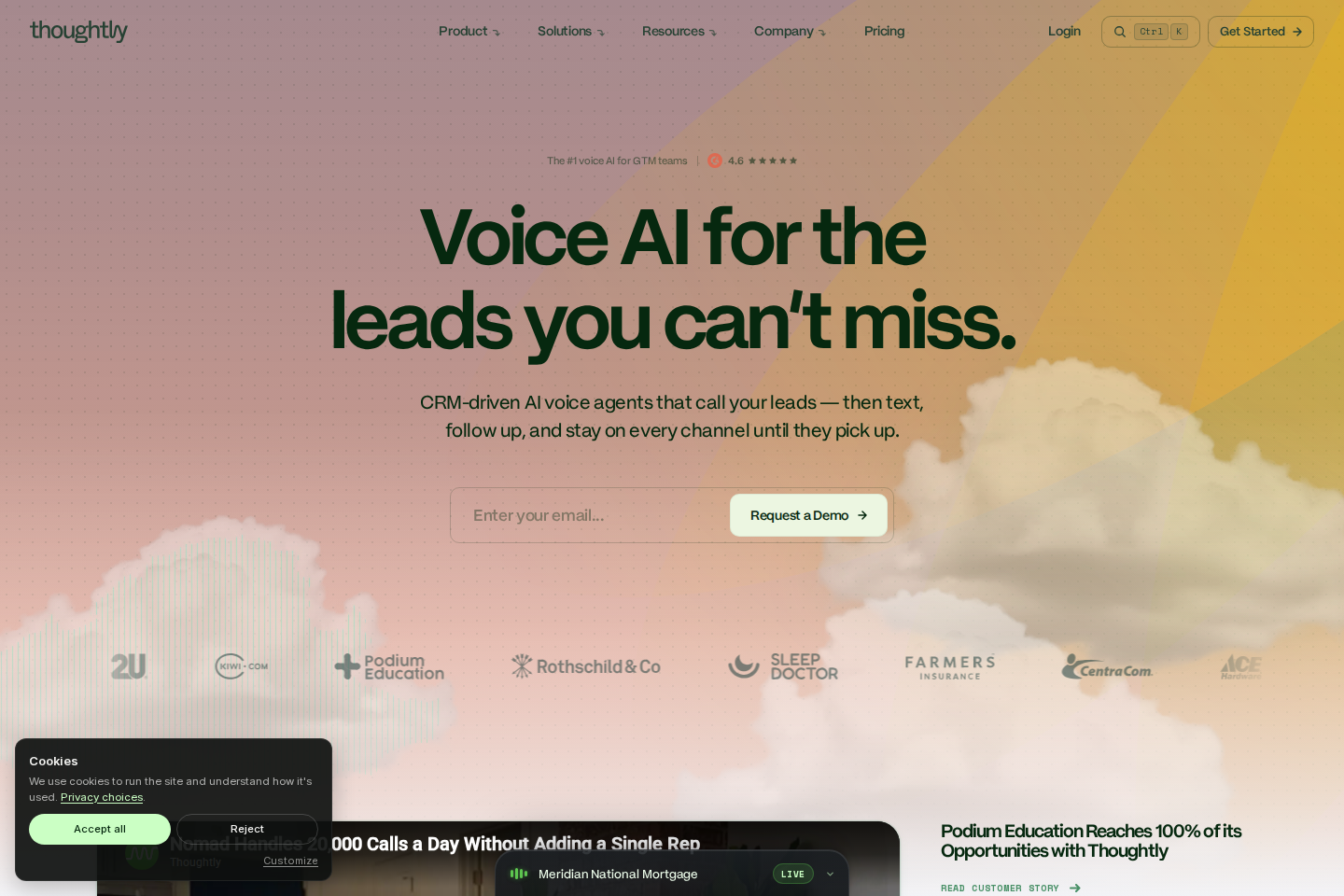
Ada is built to deflect customer service tickets. Thoughtly is built to convert inbound leads into customers. If you landed on Ada's page because you need AI agents that call, text, and email every new lead the moment it arrives — not because you need a support chatbot — Thoughtly is the right shape for the job.
Thoughtly deploys AI voiceAI voiceAn AI voice is synthetic speech produced by a text-to-speech model, using a selected or cloned voice to speak an agent's generated or scripted response.Read full definition → agents, SMS agents, and email campaigns as co-equal channels from a single no-code builder. When a lead fills out a form, Thoughtly can call them within seconds, qualify them against your criteria, book an appointment or warm-transfer to a rep, and write the outcome back to your CRM — Salesforce, HubSpot, Zoho, GoHighLevel, and 200+ integrations. The agent persists across channels: if the lead doesn't answer the call, Thoughtly follows up by SMS, then email, using the same context. That's the core difference — Ada resolves tickets, Thoughtly converts pipeline.
The platform is purpose-built for high-consideration consumer industries: insurance, mortgage, real estate, automotive, education enrollment, healthcare, home services, financial services, and legal. These verticals share a common pattern — high lead volume, time-sensitive follow-up, and a qualification-to-booking workflowWorkflowA workflow is a defined sequence of steps, decisions, actions, delays, and outcomes used to complete a business process.Read full definition → that AI can handle faster than any human team.
Pros
Sub-second speed-to-lead. Thoughtly calls new inbound leads within seconds of form submission — faster than any human SDR team and far faster than Ada's 8–16 week deployment timeline to even go live.
True multichannel agent. Voice, SMS, and email run as co-equal channels with shared context. Ada covers chat and email well but its voice channel is newer and its focus remains CX, not conversion.
Two-way CRM write-back. Contacts, deals, activities, call recordings, and qualification notes sync bidirectionally with your CRM. Ada integrates with CRMs for support context, but doesn't write back lead conversion data because that's not its job.
No-code visual builder. RevOps and marketing teams build, edit, and deploy agents directly. No professional services engagement required — production agents ship in days, not the quarters Ada's enterprise deployments require.
Bundled pricing. One plan price includes voice, SMS, email, workflows, CRM sync, and analytics. No per-resolution billing surprises.
Watch for
Not a customer service platform. Thoughtly is built for the front of the funnel — lead conversion, qualification, appointment setting, and follow-up. If your primary need is post-purchase support ticket deflection, Ada or the CX-focused alternatives below are the right category.
Strongest with clear qualification workflows. Teams get the most value when they have defined lead sources, qualification criteria, and CRM processes. Thoughtly automates the motion, but the motion needs to exist.
Best fit
Revenue teams, growth operators, and GTM leaders in insurance, mortgage, real estate, automotive, education, healthcare, home services, and financial services who need AI that converts inbound leads across voice, SMS, and email — not a CX chatbot that deflects support tickets. If your KPI is leads converted to customers (not tickets deflected), Thoughtly is the right tool.
Pricing
Thoughtly offers custom plan tiers with bundled pricing — no per-resolution billing, no stacked add-on costs. See current pricing.
2. Intercom — Best for mid-market product-led teams wanting AI messaging
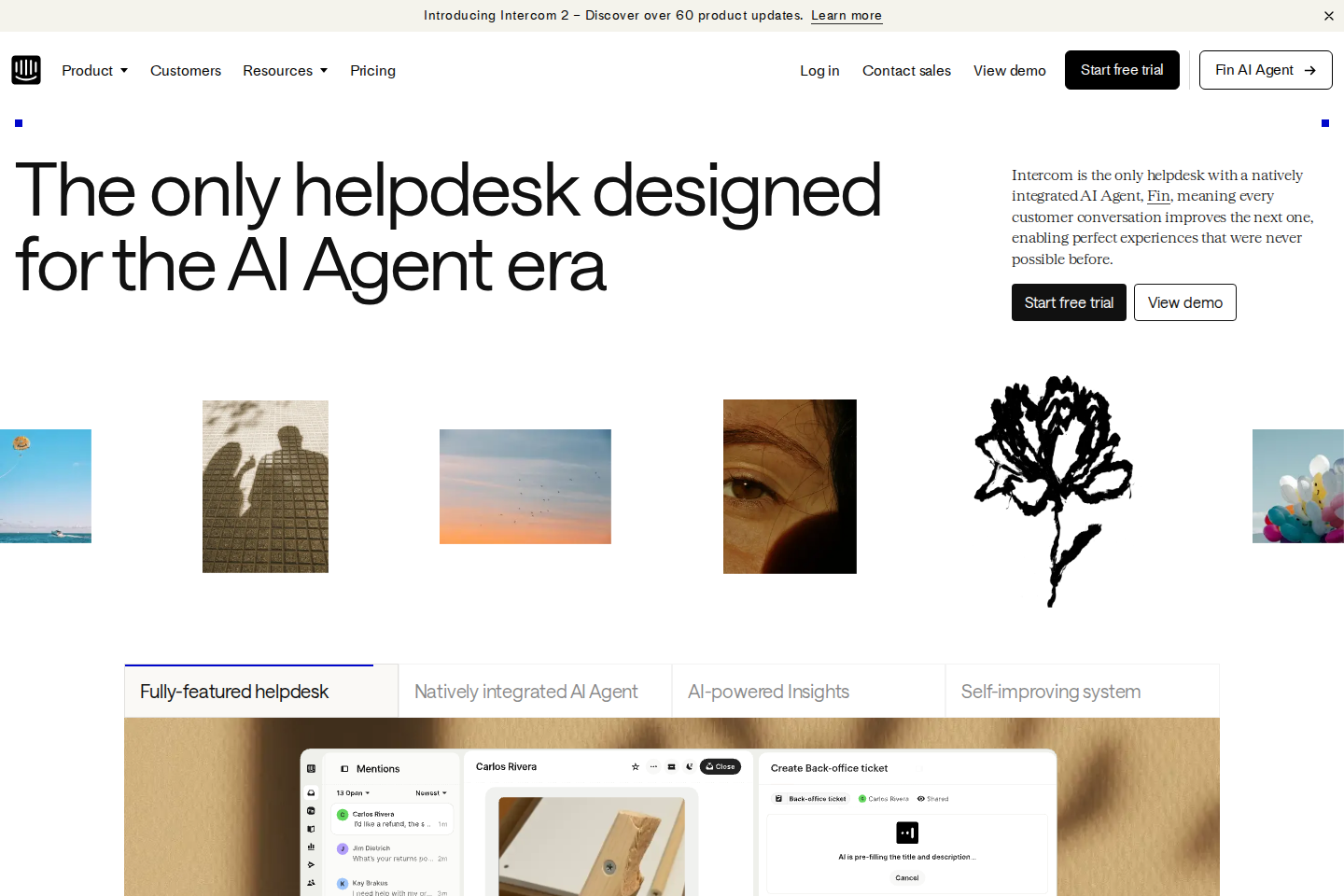
Intercom is the platform most mid-market and product-led growth teams reach for when they want to combine AI-powered customer messaging with support. Its Fin AI agent resolves support conversations using your help center content and conversation history — and unlike Ada, Intercom publishes transparent pricing and offers a self-serve trial.
Where Ada requires enterprise procurement and professional services, Intercom lets a support team sign up, connect their knowledge baseKnowledge baseA knowledge base is a maintained collection of approved business information that an agent can use to answer questions.Read full definition →, and have Fin resolving conversations within hours. The platform bundles live chat, AI resolution, a help center, product tours, outbound messaging, and a shared inbox into one tool — a breadth that Ada doesn't match outside of pure CX.
Intercom's weakness relative to Ada is enterprise depth. Ada's Reasoning Engine and Playbooks handle complex multi-step service workflows (order modifications, identity verification, multi-system lookups) more robustly than Fin for very large contact centers. But for mid-market teams, Intercom's speed-to-value and transparent pricing make it the more practical choice.
Pros
Fin AI agent resolves real conversations. Fin uses your help center and conversation history to resolve support questions autonomously — with a published $0.99/resolution price that's predictable.
Self-serve from day one. Sign up, connect your knowledge, and go live. No sales call required for standard plans, no 8–16 week implementation.
Product-led growth features. Product tours, onboarding messages, in-app announcements, and proactive messaging aren't available in Ada at all.
Strong knowledge ingestion. Fin learns from help center articles, past conversations, PDFs, and custom content — addressing Ada's formal-documents-only limitation.
Watch for
Per-resolution pricing adds up. At $0.99/resolution, high-volume teams can see AI costs escalate quickly. Calculate your expected resolution volume before committing.
Less enterprise CX depth. Complex multi-step workflows (identity verification, multi-system order modifications) are simpler than Ada's Playbooks architecture.
Voice is newer. Intercom added phone/voice more recently. It works, but it's not as mature as Ada's voice channel.
Best fit
Mid-market SaaS, e-commerce, and product-led teams that need AI messaging, live chat, help center, and proactive outbound in one platform — without the enterprise procurement timeline or six-figure contracts.
Pricing
Intercom publishes pricing starting at $39/seat/month for the Essential plan. Fin AI agent costs $0.99 per resolution on top of seat pricing. Enterprise plans with advanced workflows are available for larger teams.
3. Zendesk AI — Best for existing Zendesk customers adding AI agents
If your team already runs on Zendesk's ticketing and knowledge base, adding Zendesk's native AI agents is the lowest-friction path to automation. Zendesk acquired Ultimate (itself a direct Ada competitor) in 2024 and has been integrating its AI agent capabilities natively into the Zendesk Suite — meaning your existing help center, ticket history, macros, and routing rulesRouting rulesRouting rules decide where a lead, call, appointment, or task goes using criteria such as intent, location, urgency, language, licensing, ownership, or availability.Read full definition → feed the AI without a separate vendor.
For Ada evaluators, the trade-off is clear: Ada is purpose-built AI-first CX, while Zendesk AI is the AI layer inside a mature helpdesk. Zendesk's advantage is zero migration friction if you're already on the platform. Its disadvantage is that AI features are gated to higher-tier plans, and the AI-first design is less polished than Ada's purpose-built reasoning engine.
The Ultimate acquisition gives Zendesk legitimacy in the autonomous agent space — Ultimate was serving enterprise CX teams before the acquisition — but the integration is still maturing. Teams that need cutting-edge agentic AI may find Ada or Intercom's Fin more capable; teams that value one vendor and one support stack will prefer Zendesk.
Pros
Zero migration if you're already on Zendesk. Your existing tickets, knowledge base, macros, and routing rules feed the AI natively.
Ultimate acquisition adds autonomous agent depth. Multi-step workflows, ticket triage, and conversation handoff come from a proven acquisition.
Massive integration ecosystem. 1,000+ marketplace apps. Zendesk connects to nearly everything in a support stack.
Watch for
AI features require Suite Professional or Enterprise. The most capable AI agent features are gated to higher-tier plans, which increases cost.
AI-first design is still catching up. Zendesk added AI to an existing helpdesk. Ada and Intercom were designed AI-first. The reasoning and autonomous resolution can feel less polished for complex workflows.
Per-resolution AI pricing on top of seat costs. Zendesk's AI agent pricing adds usage fees to your existing per-seat subscription.
Best fit
Support teams already on Zendesk Suite that want to add AI resolution without migrating platforms or introducing a second vendor. Best when Zendesk is already the system of recordSystem of recordA system of record is the authoritative source for a defined category of business data.Read full definition → and the team values consolidation over best-in-class AI-first CX.
Pricing
Zendesk Suite plans start at $55/agent/month (Professional). AI agent features are available on Professional and Enterprise tiers, with per-resolution pricing for automated conversations. Contact Zendesk for AI agent pricing details.
4. Freshdesk (Freddy AI) — Best budget-friendly omnichannel CX
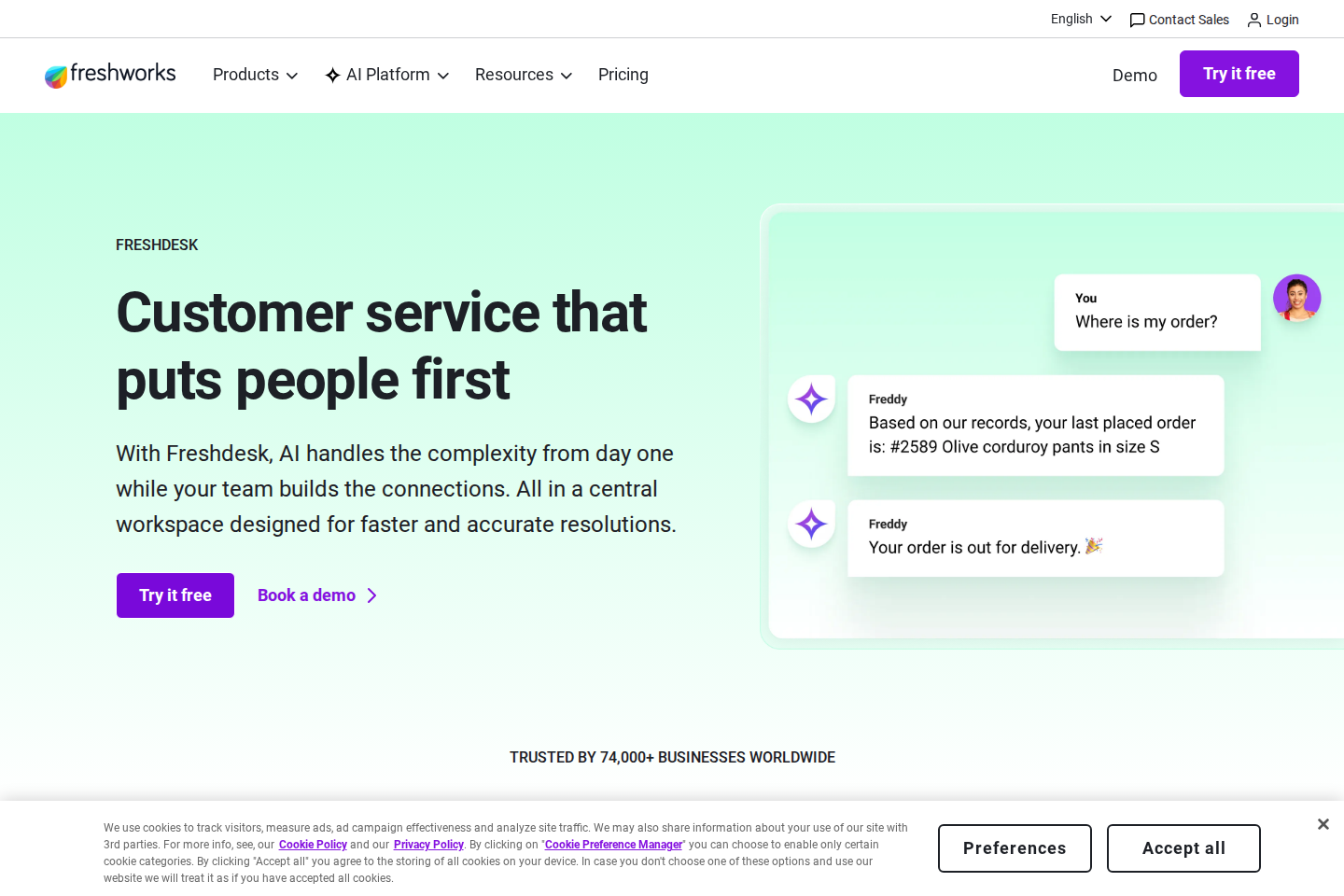
Freshdesk offers something Ada explicitly does not: a free tier, transparent published pricing, and a path from solo support agents to enterprise teams without a sales call. Freddy AI — Freshworks' AI layer — handles ticket triage, suggested responses, and auto-resolution across email, chat, phone, and social messaging.
For teams evaluating Ada but finding the price floor too high, Freshdesk is the most accessible full-featured alternative. The platform covers ticketing, knowledge base, community forums, SLASLAAn SLA, or service level agreement, defines the response or resolution commitment for a lead, request, handoff, or operational queue.Read full definition → management, and omnichannelOmnichannelOmnichannel is a coordinated customer journey in which context and state carry across voice, SMS, email, web, and human interactions.Read full definition → routing. Freddy AI's resolution quality trails Ada and Intercom at complex multi-step tasks, but for straightforward L1 support automation at a fraction of the cost, Freshdesk delivers.
Freshworks also owns Freshsales (CRM) and Freshcaller (phone), which means teams can stay in one vendor ecosystem from support to sales to phone — a breadth play that Ada's CX-only focus doesn't offer.
Pros
Free tier available. Get started at zero cost. Growth, Pro, and Enterprise plans scale with your team.
Published transparent pricing. No sales-call-required pricing. You can model costs before committing.
Full helpdesk suite. Ticketing, knowledge base, forums, SLA management, CSAT, and time tracking included — not just AI.
Vendor ecosystem breadth. Freshsales CRM, Freshcaller phone, and Freshchat messaging all integrate natively.
Watch for
AI resolution quality trails leaders. Freddy AI handles L1 ticket triage and suggested responses well but lacks the deep reasoning and multi-step workflow capability of Ada's Playbooks or Intercom's Fin.
Enterprise features require Pro or Enterprise tier. Advanced AI, custom objects, and sandbox environments are gated to higher tiers.
Voice channel requires separate Freshcaller add-on. Unlike Ada's built-in voice, Freshdesk's phone support lives in a separate product.
Best fit
Budget-conscious support teams that need a full-featured helpdesk with AI capabilities at mid-market pricing. Especially strong for teams that want one vendor for support, CRM, and phone without enterprise-only deal sizes.
Pricing
Freshdesk offers a free plan for up to 2 agents. Growth starts at $15/agent/month, Pro at $49/agent/month, and Enterprise at $79/agent/month. Freddy AI features are available on Pro and Enterprise tiers. Additional AI session costs may apply.
5. Forethought — Best AI-first ticket triage and autonomous resolution
Forethought takes a different approach to AI customer service than Ada. Where Ada deploys a conversational AIConversational AIConversational AI is software that interprets natural language and produces context-aware responses through voice, messaging, or chat.Read full definition → agent that handles the full customer interaction, Forethought focuses on what happens behind the scenes: intelligent ticket triage, routing, suggested responses for human agents, and autonomous resolution of routine tickets via Autoflows.
The result is a platform that works alongside your existing helpdesk (Zendesk, Salesforce Service Cloud, Freshdesk) rather than replacing it. For teams that aren't ready to put an AI chatbot in front of customers but want AI handling ticket routing, prioritization, and L1 resolution in the background, Forethought is the more conservative path.
Forethought's Solve product handles autonomous customer-facing resolution, while Triage and Assist work behind the scenes to make human agents faster. This hybrid approach appeals to risk-averse enterprise teams that want AI productivity gains without the risk of a customer-facing bot making mistakes.
Pros
Works alongside your existing helpdesk. Plugs into Zendesk, Salesforce, and Freshdesk rather than requiring a platform migration.
Intelligent ticket triage and routing. AI classifies, prioritizes, and routes tickets to the right team before a human touches them.
Lower-risk AI adoption. Triage and Assist work behind the scenes. You can add customer-facing Solve when ready.
Watch for
Limited channel coverage. Forethought focuses on email and chat. Voice, SMS, WhatsApp, and social messaging aren't primary channels — a gap compared to Ada's omnichannel coverage.
Not a standalone platform. Forethought augments your helpdesk; it doesn't replace it. You still need Zendesk, Salesforce, or another platform as the foundation.
Pricing is not publicly available. Like Ada, Forethought requires a sales conversation to get pricing. Enterprise deal sizes reported by reviewers.
Best fit
Enterprise support teams running Zendesk or Salesforce Service Cloud that want AI ticket triage, routing, and background resolution without putting a chatbot directly in front of customers. Best for risk-averse organizations that want to adopt AI incrementally.
Pricing
Forethought does not publish pricing. Contact their sales team for custom quotes. Enterprise contracts are typical.
6. Kustomer — Best CRM-first customer service platform
Kustomer approaches customer service from the CRM side rather than the ticketing side. Instead of tracking individual tickets, Kustomer builds a unified customer timeline that shows every interaction — chat, email, phone, social, SMS — in one chronological view. AI features layer on top of this timeline to automate responses, classify conversations, and surface relevant customer context.
For teams frustrated with Ada's narrower focus on AI-first deflection without deep customer history, Kustomer's CRM-first model is a compelling alternative. Every conversation has full customer context: order history, previous interactions, account data, and custom attributes. This makes human-to-AI handoffs smoother because the agent (human or AI) sees the complete picture.
Kustomer was acquired by Meta in 2021, then re-spun out. The product has maintained its customer base in e-commerce, retail, and direct-to-consumer brands where the customer timeline matters more than pure ticket deflection metrics.
Pros
Unified customer timeline. Every interaction across all channels in one chronological view — not separate tickets. Better context for both AI and human agents.
CRM-first data model. Customer attributes, order history, and custom data are first-class objects, not ticket metadata.
Omnichannel out of the box. Chat, email, phone, SMS, social, and WhatsApp supported natively.
Watch for
Smaller integration ecosystem. Kustomer's marketplace is smaller than Zendesk's or Intercom's. Some niche integrations may require custom development.
AI capabilities are catching up. Kustomer's AI features exist but aren't as mature as Ada's Reasoning Engine or Intercom's Fin for autonomous resolution.
Post-Meta uncertainty. The acquisition and re-spinout raised questions about long-term roadmap stability. Due diligence on product direction is worth doing.
Best fit
E-commerce, retail, and DTC brands that need a CRM-first customer service platform where the unified customer timeline is more important than pure AI-first ticket deflection. Best for teams that want rich customer context driving both AI and human agent interactions.
Pricing
Kustomer offers Enterprise and Ultimate plans. Pricing is not publicly listed — contact sales for current rates. Enterprise contracts are typical for larger deployments.
7. Tidio (Lyro AI) — Best for SMBs and e-commerce wanting fast AI chat
Tidio occupies the opposite end of the market from Ada. Where Ada requires 300,000+ annual conversations and six-figure contracts, Tidio offers a free plan and deploys Lyro, its AI chatbot, on Shopify, WordPress, and Wix stores in minutes. For small businesses and e-commerce teams that need an AI chat agent without enterprise complexity, Tidio is the fastest path to production.
Lyro AI learns from your FAQ and knowledge base content to resolve common customer questions — order status, shipping, returns, product information — without human intervention. The resolution quality is adequate for standard L1 queries but doesn't approach Ada's depth on complex multi-step workflows. That's by design: Tidio is built for the business that needs fast, affordable AI chat, not the enterprise that needs a reasoning engine.
Tidio also includes live chat, a shared inbox, email marketing, and chatbot builder features that make it a full customer communication platform for SMBs — not just an AI resolution tool.
Pros
Live in minutes. Install on Shopify, WordPress, or Wix and have Lyro AI answering customer questions immediately. No weeks of implementation.
Free plan available. Start at zero cost. AI conversations included on paid plans starting at accessible price points.
E-commerce native. Shopify order status, product recommendations, and cart recovery are built into the platform.
All-in-one communication. Live chat, AI chatbot, email marketing, and shared inbox in one platform.
Watch for
Not built for enterprise scale. Tidio is designed for SMBs. Large teams with complex routing, SLAs, and multi-department workflows will outgrow it.
No native voice channel. Tidio is chat and email. If you need AI voice agents or phone support, you'll need a separate platform.
AI resolution depth is limited. Lyro handles FAQ-level queries well but can't execute complex multi-step workflows like Ada's Playbooks.
Best fit
Small businesses, Shopify stores, and e-commerce teams that need an AI chat agent live today — not next quarter — at a price point that doesn't require procurement approval.
Pricing
Tidio offers a free plan with limited features. Paid plans start at approximately $29/month. Lyro AI conversations are included in paid plans, with additional conversation packs available. Enterprise pricing is available for larger teams.
8. Help Scout — Best for teams that prefer simpler, email-first support
Help Scout is the antithesis of Ada's complexity. Where Ada deploys multi-step reasoning engines and requires professional services, Help Scout offers a clean shared inbox with AI-assisted drafts, a knowledge base, and a beacon widget — and that's largely it. The platform is designed for teams that believe great customer support is about clear communication, not about deflecting as many tickets as possible.
Help Scout's AI features (powered by their AI drafts and instant answers) are more modest than Ada's autonomous agents, but they're practical: AI suggests draft replies based on your docs, automatically surfaces relevant help articles, and handles simple questions without a human. For support teams that want AI to make human agents faster rather than replace them, Help Scout's approach is refreshingly honest about what AI should and shouldn't do.
The platform's strength is simplicity and customer experience quality. Help Scout customers consistently rate the product highly for ease of use, and the team-focused design (shared inbox, collision detection, internal notes) keeps support operations smooth without the operational overhead of enterprise CX platforms.
Pros
Clean, simple shared inbox. No complex ticketing system to configure. Shared inbox with collision detection and internal notes keeps teams aligned.
AI drafts and instant answers. AI suggests replies from your knowledge base and handles simple questions — augmenting human agents rather than replacing them.
Excellent knowledge base. Docs knowledge base is well-designed, easy to maintain, and powers both self-service and AI features.
Watch for
Limited automation depth. Help Scout's workflows and automation are simpler than Ada, Zendesk, or Intercom. Complex routing and multi-step AI resolution aren't strengths.
No native voice channel. Help Scout is email, chat, and knowledge base. Phone support requires a separate integration.
Not designed for enterprise-scale CX operations. Large contact centers with 50+ agents, complex SLAs, and multi-department routing will find Help Scout too simple.
Best fit
Small and mid-market support teams that prioritize customer experience quality over ticket deflection metrics. Best for teams that want AI to make human agents faster, not eliminate them — and prefer a simple, well-designed tool over an enterprise CX platform.
Pricing
Help Scout offers plans starting at $50/month for up to 100 contacts (new pricing model). Standard plans include AI features. Free trial available — no sales call required.
How to choose the right Ada CX alternative
The decision starts with the job you actually need done:
Your real need is lead conversion, not ticket deflection. If you're evaluating Ada because you need AI that handles inbound leads — calls, qualifies, books appointments, and writes back to your CRM — you're in the wrong category. Thoughtly is built for that job.
You want Ada's capabilities at mid-market pricing. Intercom is the strongest all-around alternative for teams that want AI-first messaging, help center, and proactive outbound without enterprise-only deal sizes.
You're already on Zendesk. Don't add a second vendor. Zendesk AI gives you native AI resolution inside your existing stack.
Budget is the primary constraint. Freshdesk offers a full helpdesk with AI capabilities at a fraction of Ada's price. Tidio is even more accessible for SMBs.
You want AI behind the scenes first. Forethought augments your existing helpdesk with AI triage and routing without putting a bot in front of customers.
Customer context matters more than deflection metrics. Kustomer's CRM-first timeline gives both AI and human agents complete customer history.
You want simplicity. Help Scout is the right tool when you want AI to make human agents better, not replace them.
Frequently asked questions
What does Ada CX cost?
Ada does not publish pricing. Based on publicly available information, enterprise contracts typically range from $100,000 to $300,000+ annually. Pricing is per-resolution, meaning costs scale with your conversation volume. Ada states they are a great fit for companies with at least 300,000 annual customer service conversations.
Is Ada CX good for small businesses?
No. Ada is explicitly designed for enterprise-scale customer service operations with high conversation volumes. The minimum fit threshold is 300,000 annual conversations, and there is no free tier, trial, or self-serve sign-up. Small businesses should consider Tidio, Freshdesk, or Help Scout instead.
Can Ada CX handle lead conversion and sales?
Ada is built for customer service — ticket deflection, post-purchase support, and CX automation. It is not designed for inbound lead conversionInbound lead conversionInbound lead conversion turns opted-in calls, form submissions, quote requests, and other inquiries into qualified conversations, appointments, or transfers.Read full definition →, sales qualification, or appointment settingAppointment settingAppointment setting captures availability, confirms fit, and books a qualified prospect on the correct calendar without requiring manual chasing.Read full definition →. Teams whose primary need is converting inbound leads should evaluate Thoughtly, which is purpose-built for that job across voice, SMS, and email.
How long does Ada CX take to deploy?
Full enterprise deployment of Ada typically takes 8 to 16 weeks with Ada's professional services team. This includes workflow design, knowledge source integration, testing, and phased rollout. By contrast, platforms like Intercom, Tidio, and Thoughtly can go live in hours to days.
What are the biggest complaints about Ada CX?
Recurring complaints in G2 reviews, Trustpilot, and Reddit threads center on: opaque pricing that makes budgeting difficult, the gap between admin experience (well-rated) and end-user experience (poorly rated on Trustpilot at 2.0/5), context loss between conversation turns, difficulty reaching a human agent when the AI fails, and the requirement for Ada's professional services for setup and ongoing optimization.
Sources and further reading
Ada CX official website — ada.cx
Ada CX pricing page — ada.cx/pricing
Featurebase Ada CX Review (2026) — featurebase.app/blog/ada-cx-review
eesel AI Ada CX Review (2025) — eesel.ai/blog/ada-cx-review
Reddit: ADA CX, UltimateAI and SunCo discussion — reddit.com/r/Zendesk/comments/18z31go
Thoughtly — AI agents for lead conversion — thoughtly.com
Thoughtly solutions for insurance, mortgage, real estate, and more — thoughtly.com/solutions
Intercom Fin AI Agent — intercom.com/fin
Zendesk AI Agents — zendesk.com/ai
Freshdesk by Freshworks — freshworks.com/freshdesk