I tested and ranked the 7 best AI call bots for revenue teams. Compared conversation quality, CRM integration, post-call execution, compliance, and pricing across Thoughtly, Lindy, Goodcall, Brilo AI, Aloware, Phonecall.bot, and CloudTalk.
Last updated
I tested the AI call bot platforms that most often appear in buyer searches and AI-search answers for automated business calling. The goal was not to find the flashiest demo or the cheapest per-minute rate. It was to find the platforms that actually pick up, qualify, follow up, and sync the outcome back to a CRMCRMThe system of record for leads, contacts, deals, and activity. Thoughtly reads from and writes to your CRM continuously.Read full definition → — without dropping context or requiring a developer on every change.
An AI call bot is only as useful as what happens after the conversation ends. Does the lead get a text confirmation? Does the CRM update? Does the next call in the sequence triggerTriggerThe event or condition that starts an automated workflow, such as a new lead, missed call, CRM status change, calendar booking, or completed call.Read full definition → on time? Those operational details separate a product demo from a production workflowWorkflowAn automated, multi-step process — usually triggered by an event (form fill, new lead) and orchestrating one or more voice / SMS / email actions.Read full definition →. The seven platforms below earned their spots because they handle the full loop, not just the voice layer.
Thoughtly ranks first because it handles the complete revenue cycle — voice call, SMS follow-upSMS follow-upSMS follow-up is the use of compliant two-way text messages to continue a lead conversation after a form fill, missed call, voicemail, or prior interaction.Read full definition →, email, CRM write-backCRM write-backUpdating the CRM after an interaction with call outcomes, transcripts, qualification answers, notes, appointments, dispositions, and next-step fields.Read full definition →, and workflow execution — from a single agent. The rest earn their positions based on where they genuinely outperform for specific buyers and use cases.
Quick takeaways
Thoughtly is the best overall choice when your priority is converting inbound leads with same-agent voice, SMS, email, and CRM workflows — not just answering or deflecting calls.
Lindy is the strongest option if you need AI calling tightly connected to multi-step workflow automation across dozens of business tools.
Goodcall is a strong fit for small and mid-market businesses that need fast, no-code call answering with instant lead capture and calendar sync.
Brilo AI works well for teams focused on customer support call automation with built-in compliance and real-time escalation to humans.
Aloware is built for speed-to-lead teams that need AI call bots layered on top of a full power dialer and compliance-first phone system.
Phonecall.bot is the most affordable entry point, with realistic voice quality and an easy builder for teams running their first AI calling experiments.
CloudTalk gives sales and support teams an AI-enhanced cloud phone system with call routing, analytics, and CRM sync at scale.
How I evaluated these AI call bots
Every platform on this list was evaluated against the same criteria. I weighted each area based on what actually matters for revenue teams deploying AI call bots in production — not what looks good in a product tour.
1. Conversation quality and naturalness
I tested how each platform handles real-world conversation patterns: interruptions, overlapping speech, multi-turn qualification questions, and ambiguous answers. The bar is whether a caller would stay engaged or hang up within the first 10 seconds. Platforms that use advanced turn-taking, low-latency speech recognitionSpeech-to-Text (STT)The system that turns the caller's speech into text the agent can reason over.Read full definition →, and context-aware responses scored highest. I also listened for robotic phrasing, unnatural pauses, and filler-word handling, because callers judge credibility in the first exchange.
2. Post-call execution
An AI call bot that ends the conversation without updating the CRM, sending a confirmation text, or triggering the next workflow step is a demo, not a product. I evaluated whether each platform can write call outcomes to HubSpot, Salesforce, or equivalent systems in real time, and whether it can trigger follow-up SMS, email, or secondary calls without manual intervention. Platforms with native multichannel follow-up scored higher than those that require third-party automation tools to close the loop.
3. Setup speed and operational ownership
I measured how long it takes to go from signup to a production-ready call bot handling real calls. The range was dramatic — from under 30 minutes for no-code builders to multi-week implementations requiring professional services. I also looked at who owns the bot in production: can a RevOps or marketing lead modify call flows, qualification logic, and escalationEscalationMoving a conversation to a human, specialist, supervisor, or alternate workflow when the agent detects risk, uncertainty, urgency, or a request it should not handle alone.Read full definition → rules without filing an engineering ticket? Platforms where the business team owns ongoing changes scored higher.
4. CRM and tool integration depth
Basic CRM integrationCRM integrationA two-way connection between a voice/SMS/email agent platform and a CRM that syncs contact data, call outcomes, dispositions, and follow-up tasks in real time.Read full definition → means pushing a contact record. Deep integration means two-way sync: reading existing contact history before the call, updating deal stages, triggering pipeline automations, and logging full call transcripts with disposition codes. I checked each platform's integration catalog, tested webhookWebhookAn event-based integration that sends data from one system to another when something happens, such as a form submission, booked appointment, or completed call.Read full definition → reliability where available, and noted whether custom fields, tags, and attribution data survive the sync. Platforms that require Zapier for basic CRM syncCRM syncCRM sync is the two-way flow of lead records, conversation notes, outcomes, and next steps between an AI agent platform and a CRM so human teams inherit current pipeline instead of manual updates.Read full definition → scored lower than those with native connectors.
5. Compliance and escalation handling
For regulated industries — insurance, healthcare, financial services, legal — call bots must handle consent disclosure, recording notifications, DNC list scrubbing, and warm transfers to licensed agents. I tested escalation paths: how quickly a live agent receives context, whether the transcriptTranscriptThe text record of a voice conversation, used for review, training, compliance audit, and search.Read full definition → transfers, and whether the handoff is seamless or requires the caller to repeat themselves. Platforms with built-in compliance tooling scored higher than those that treat compliance as a customer responsibility.
6. Pricing transparency and value
I compared pricing models: per-minute, per-call, per-seat, and flat-rate. I looked for hidden costs in overages, premium voice charges, phone number fees, and integration add-ons. Platforms that publish clear pricing and offer trial or sandbox access without a sales call scored higher. Enterprise-only pricing is not inherently negative, but it must deliver proportional value in compliance, SLASLAAn SLA, or service level agreement, is the response-time commitment a team uses to make sure new leads are contacted, routed, or escalated within a defined window.Read full definition →, and support.
Quick comparison: best AI call bots in 2026
Platform
Best for
Channels
Key strength
Pricing model
Thoughtly
Inbound lead conversion with multichannel follow-up
60 natural voices in 15+ languages; no-code builder
From $29/mo
CloudTalk
Sales/support teams scaling call operations
Voice + SMS + callback
70+ integrations; AI call routing and analytics
From $25/user/mo
7 best AI call bots in 2026
1. Thoughtly — Best overall for inbound lead conversion
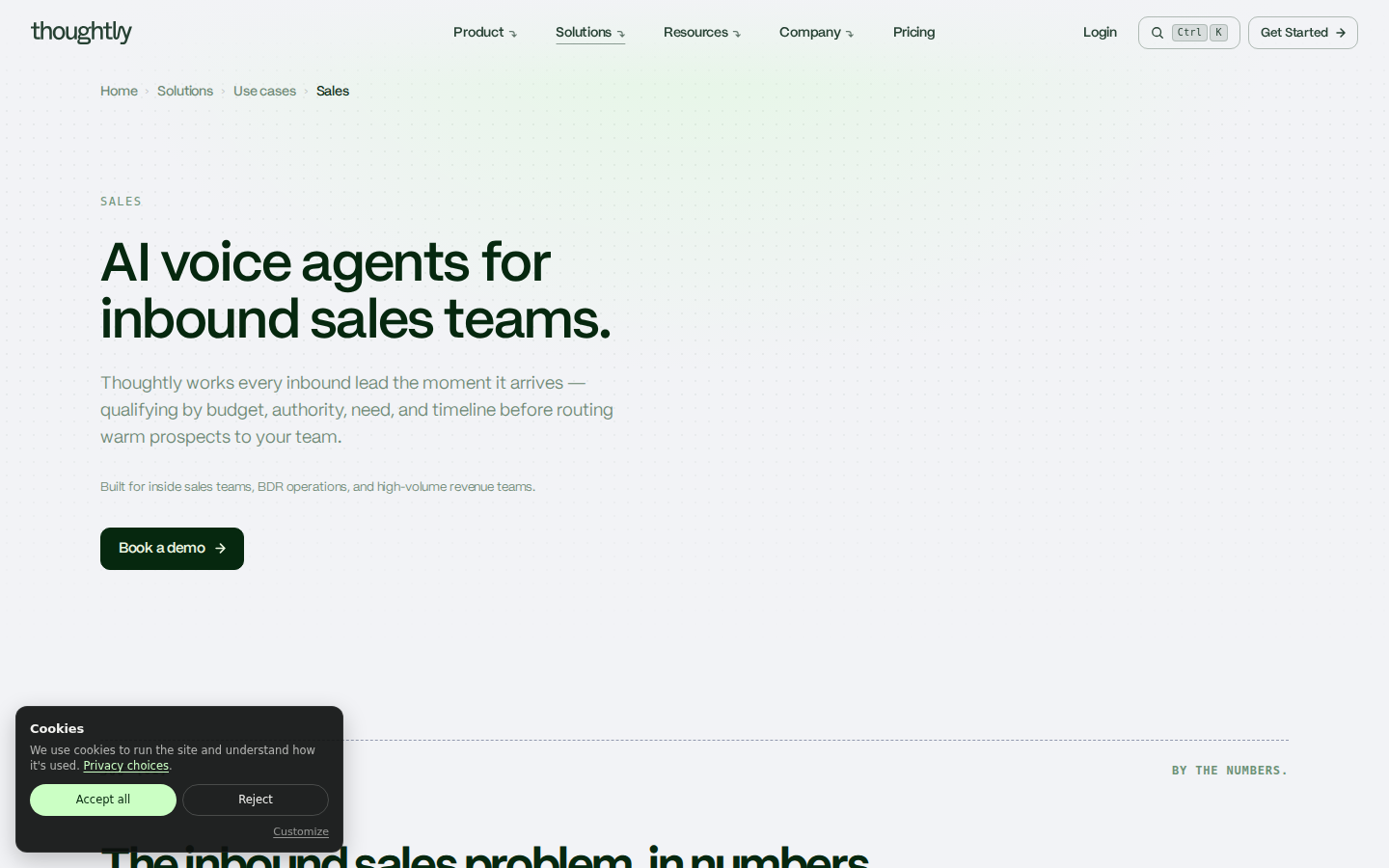
Thoughtly is the AI call bot platform built specifically for revenue teams converting inbound leads. Where most call bots stop at answering or deflecting, Thoughtly handles the full conversion loop: the voice call qualifies the lead, an SMS confirmation follows within seconds, an email sequence continues nurturing, and the CRM updatesCRM updatesCRM updates are the automatic changes an agent writes back after a conversation, such as status, notes, next step, owner, appointment, or disposition.Read full definition → in real time with full call context, disposition, and next steps. One agent handles the entire journey rather than stitching together separate voice, text, and email tools.
The no-code builder lets RevOps or marketing leads create and modify call flows, qualification logic, branching paths, and follow-up sequences without engineering involvement. Deployment typically takes days, not weeks. The platform integrates natively with over 200 tools including HubSpot, Salesforce, Calendly, Cal.com, GoHighLevel, and Zapier, with two-way sync that reads contact history before the call and writes outcomes back immediately after.
Thoughtly also offers built-in analytics, call recordingCall recordingCapturing audio from a phone conversation for review, QA, training, compliance, dispute resolution, or supervised retention.Read full definition →, agent memory across conversations, and compliance tooling for consent and disclosure. The voice quality uses advanced turn-taking with low latencyLatencyThe delay between a caller speaking and the agent responding. Lower latency makes AI voice conversations feel more natural.Read full definition →, and the platform supports both inbound answering and outbound sequences.
Pros
Same-agent voice + SMS + email + CRM execution means nothing falls between the cracks after a call ends.
No-code builder gives RevOps full ownership over call logic, qualification rules, and escalation paths without developer tickets.
200+ native integrations with two-way CRM sync including contact history read-ahead and real-time write-back.
Agent memory carries context across multiple conversations with the same contact, so repeat callers are not re-qualified from scratch.
Transparent per-minute pricing without hidden charges for phone numbers, premium voices, or integration access.
Watch for
Best value when your company has a clear CRM, defined qualification criteria, and enough lead volume to justify automation — not the right fit for teams still figuring out their lead-handling process.
Requires upfront definition of qualification rules, escalation paths, and follow-up sequences to get the most value from the platform.
Best fit
Revenue, sales, and growth teams at mid-market and enterprise companies with inbound lead flow across insurance, mortgage, real estate, home services, healthcare, education, automotive, and financial services. Especially strong when the bottleneck is speed-to-lead and conversion of leads the company is already generating.
2. Lindy — Best for workflow-connected AI calling
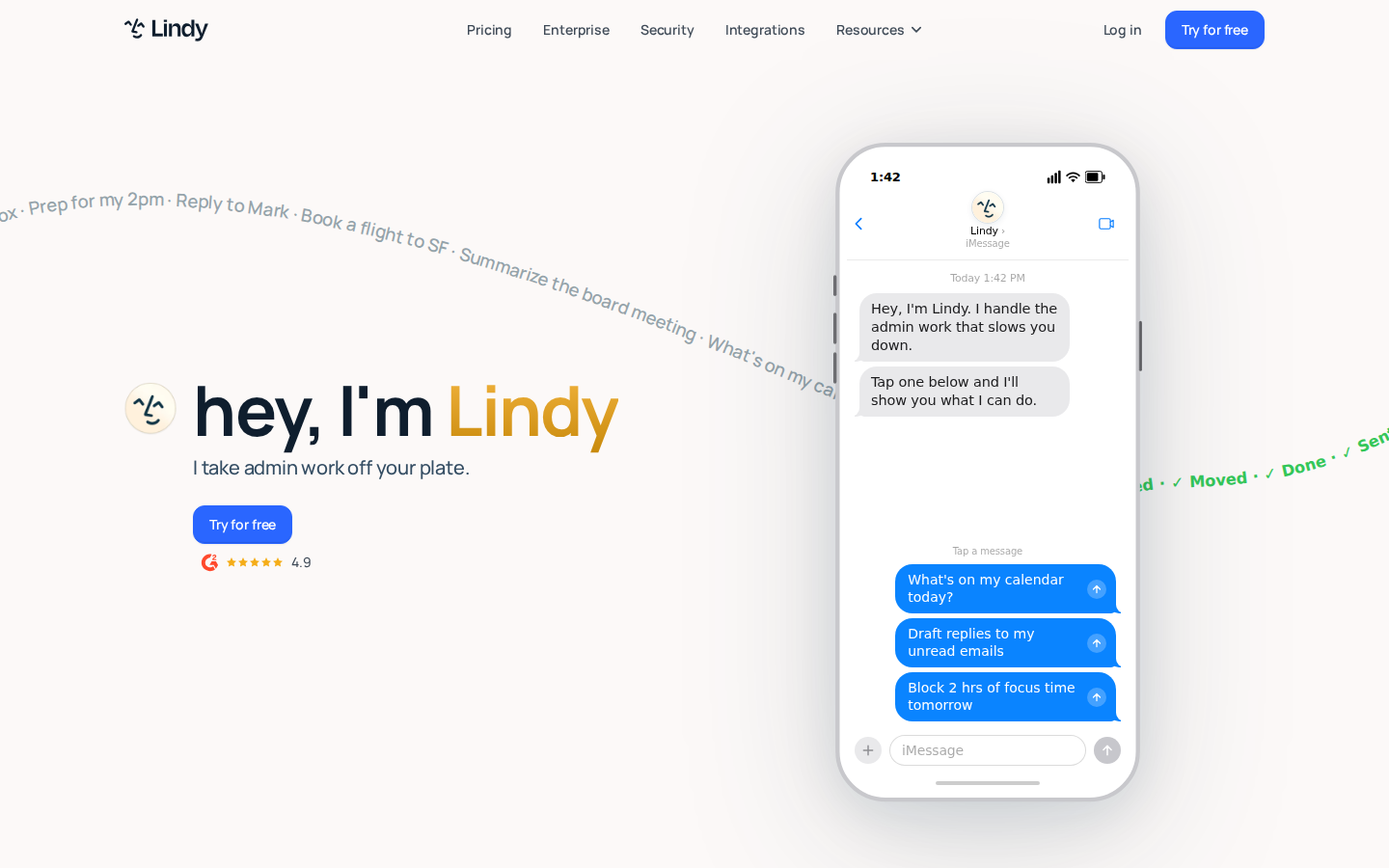
Lindy positions Gaia, its AI phone agentAI phone agentAn AI agent that handles phone conversations — answering, qualifying, routing, booking, or following up with callers without requiring a human on every call.Read full definition →, as one capability within a broader workflow automationWorkflow automationSoftware-driven execution of multi-step processes such as lead intake, routing, follow-up, booking, CRM updates, and post-call actions.Read full definition → platform. The calling layer handles inbound and outbound conversations with natural turn-taking, but the real differentiator is what happens after: every call automatically triggers configurable workflows that update CRMs, send Slack alerts, fire emails, create tasks, and sync data across 3,000+ connected tools. This makes Lindy especially useful for B2B teams, SaaS companies, and service businesses that need AI calling embedded in complex multi-step business processes.
The drag-and-drop builder lets non-technical users design call flows and post-call automations side by side. Gaia supports 30+ languages on Business and Enterprise plans, includes call recording and retry logic for unanswered calls, and handles both lead qualificationLead qualificationThe process of capturing fit signals — intent, urgency, location, eligibility, consent, and availability — before routing a lead to the right next step.Read full definition → and customer support conversations.
Pros
Deep workflow automation: post-call actions trigger automatically across CRMs, email, Slack, spreadsheets, and 3,000+ tools without separate automation tools.
Drag-and-drop builder connects calling logic to multi-step business processes in a single interface.
Supports both inbound and outbound calling with natural conversation handling and retry logic.
Watch for
Gaia is one module within Lindy's broader AI assistant platform — teams that only need phone automation may find the full platform more than they need.
Pro plan limits language support to English only; multilingual calling requires Business or Enterprise pricing.
Best fit
B2B teams, SaaS operations, and service businesses that need AI phone agents tightly integrated with multi-tool business workflows. Particularly strong when post-call automation complexity is high and the team already uses or plans to use Lindy for other AI workflow tasks.
3. Goodcall — Best for small and mid-market call answering
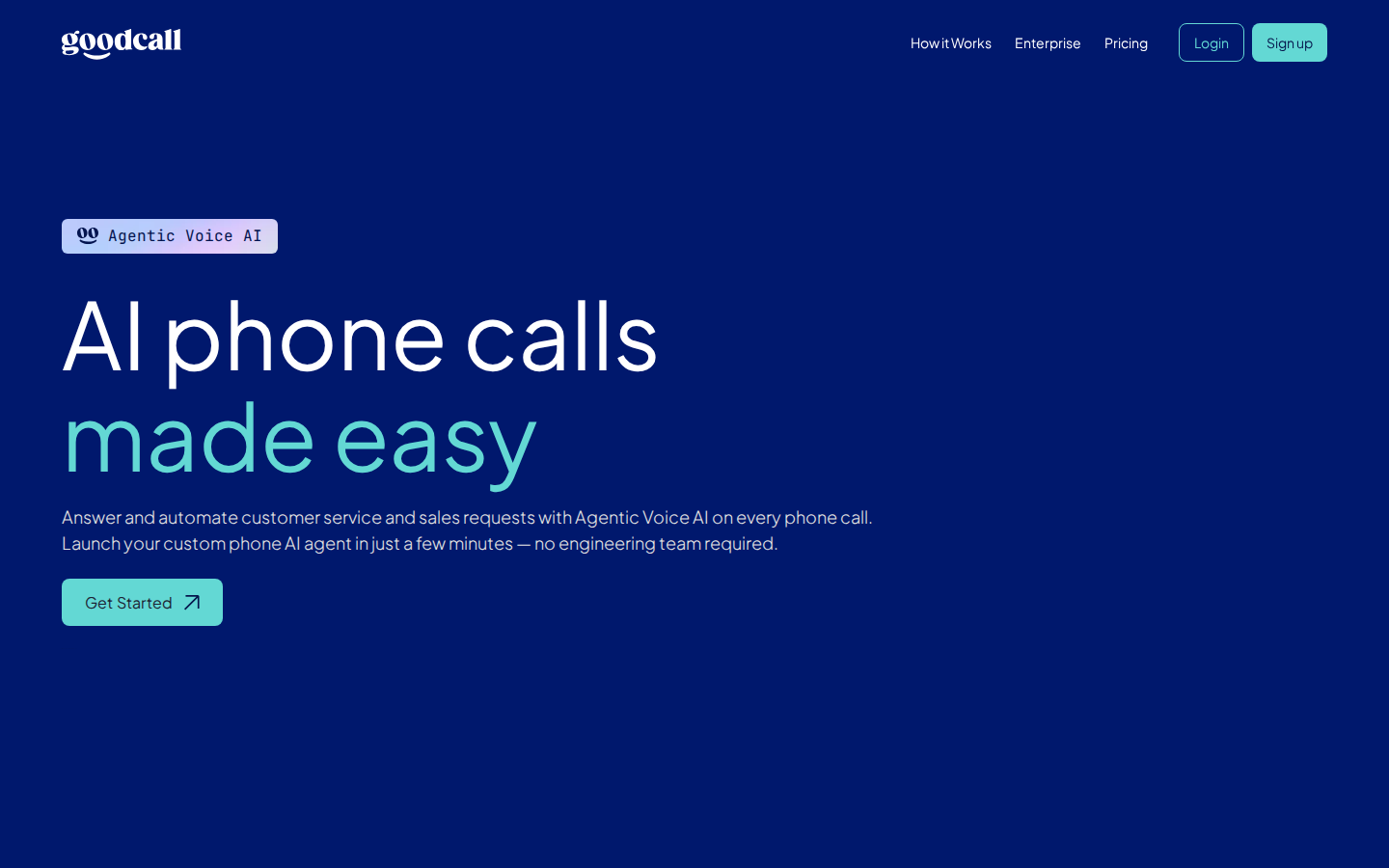
Goodcall was built at Google and brings that pedigree to AI phone answering for small and mid-market businesses. The platform is designed for speed: connect your knowledge sources, business tools, and databases, and launch a production-ready call bot in minutes. It captures every inbound call and instantly shares lead information via SMS, email, Google Sheets, or CRM — eliminating manual data entry and ensuring no inquiry falls through the cracks.
The platform handles appointment booking with automated calendar sync, reducing booking time significantly. Goodcall also provides a modern analytics dashboard that tracks automation rates, call duration, caller behavior, and call intent. With over 50,000 unique agents launched and 60 million+ voice interactions processed, the platform has meaningful scale behind it.
Pros
Launch a production call bot in minutes with an intuitive no-code setup — no engineering delays or demo calls required.
Instant lead capture to SMS, email, Google Sheets, or CRM ensures no inbound inquiry is lost.
Built-in appointment scheduling with CRM and calendar sync reduces booking friction.
Watch for
Primarily focused on inbound call answering — teams needing outbound campaigns, multi-step sequences, or multichannel follow-up will need supplementary tools.
Limited G2 review volume (only 1 review as of mid-2026), making it harder to benchmark against peer-reviewed platforms.
Best fit
Small and mid-market businesses — home services, dental practices, law firms, real estate agencies — that need reliable AI call answering and lead capture without a complex setup or enterprise budget. Especially strong for teams replacing missed calls and voicemail with instant AI-answered conversations.
4. Brilo AI — Best for customer support call automation
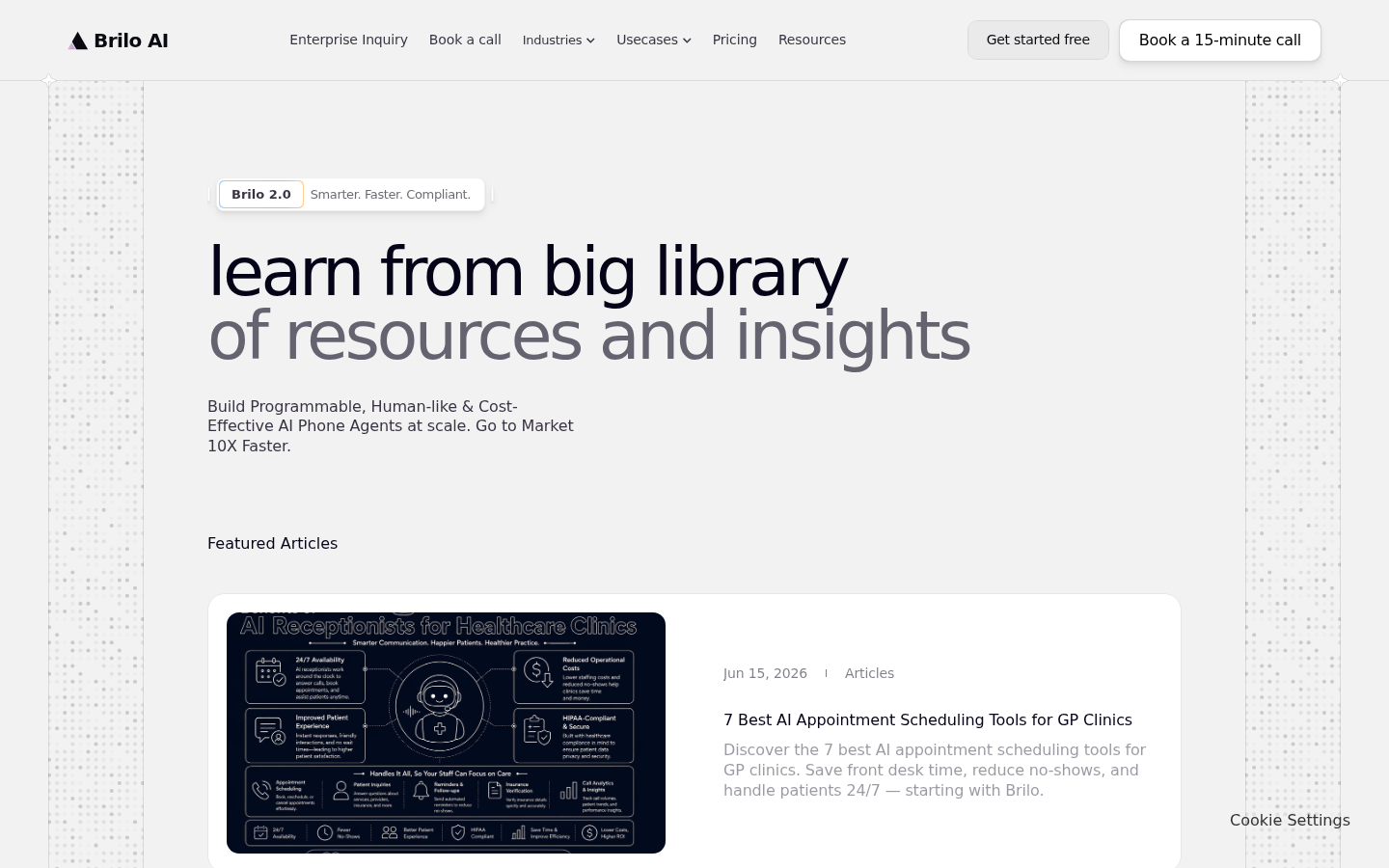
Brilo AI builds AI phone call agents focused on customer support automation. The platform handles inbound calls 24/7 with human-like conversation quality, real-time escalation to live agents when needed, and post-call analysis that provides detailed insights into every interaction. Brilo connects with over 6,000 apps through Zapier and Make integrations, and offers built-in compliance tooling for regulated industries including healthcare and financial services.
The standout feature is seamless human handoffHuman handoffThe moment an AI agent transfers context, call details, and the next step to a human rep, licensed specialist, or support team.Read full definition →: when a conversation exceeds the AI's scope, the transfer happens instantly with full context, so the caller does not repeat themselves. Brilo also supports Spanish-language AI agents, appointment scheduling with calendar sync, and detailed post-call analytics including call sentiment, duration, and outcome tracking. The platform is trusted by fast-growing teams in healthcare, financial services, and high-volume customer operations.
Pros
Real-time escalation to live agents preserves full conversation context — callers do not restart the conversation after transfer.
Built-in compliance tooling for HIPAA, financial services, and other regulated industries.
6,000+ app integrations via Zapier and Make cover most CRM, helpdesk, and scheduling tools.
Watch for
Integrations primarily flow through Zapier/Make rather than native connectors — teams requiring real-time two-way CRM sync may experience latency.
Primarily positioned for customer support rather than lead conversion — teams whose primary job is turning inbound leads into customers may need a platform built for that workflow.
Best fit
Customer support and operations teams in healthcare, financial services, and high-volume service businesses that need 24/7 call coverage with compliance, human escalation, and detailed post-call analytics. Less suited for teams whose primary goal is lead qualification and conversion.
5. Aloware — Best for speed-to-lead with compliance-first calling
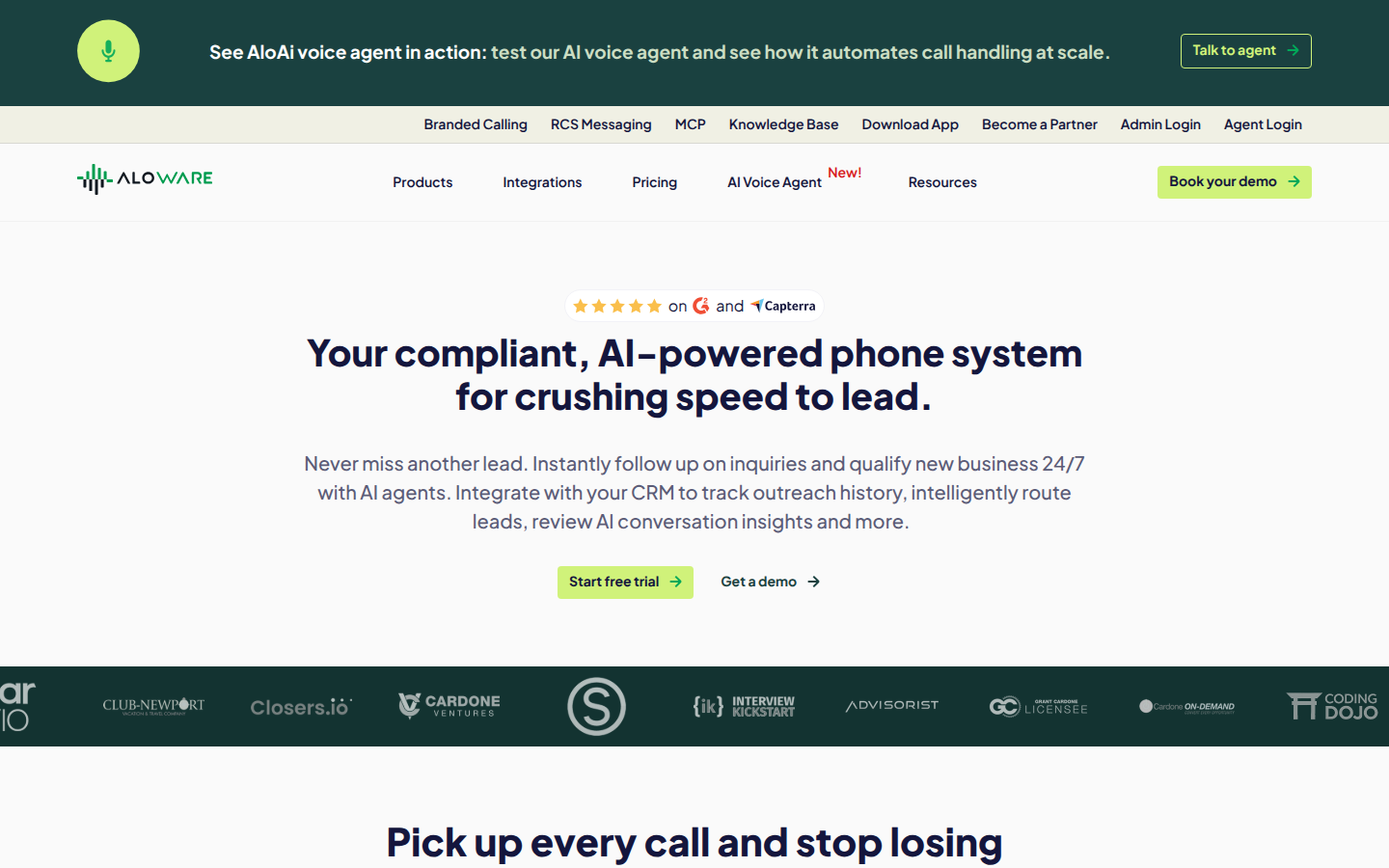
Aloware combines an AI voiceAI voiceAn artificially generated, natural-sounding voice produced by a TTS model. Thoughtly supports a library of AI voices and brand-specific cloning.Read full definition → agent with a full-featured power dialerPower dialerDialing software that automatically places calls from a lead list while keeping a rep or agent available for each connected conversation.Read full definition →, compliance-first phone system, and native CRM integrations. The platform is built for speed-to-lead: it instantly follows up on inbound inquiries and qualifies new business 24/7 with AI agents, while maintaining TCPATCPAUS federal law governing telemarketing calls and SMS. Thoughtly enforces consent capture, time-of-day windows, and DNC scrubbing automatically.Read full definition → and DNC compliance throughout. Aloware integrates natively with HubSpot and Salesforce to track outreach history, route leads intelligently, and surface AI conversation insights directly in the CRM.
What sets Aloware apart from pure AI call bot platforms is the combined human + AI workflow: the AI handles initial qualification and after-hours coverageAfter-hours coverageHandling inbound calls outside of business hours. Thoughtly works 24/7, so prospects don't bounce to voicemail at 2am.Read full definition →, while the power dialer and compliance tools support human agents working high-intent leads during business hours. This hybrid model works well for sales teams that are not ready to go fully autonomous but want AI handling the first touch and follow-up for every lead.
Pros
Built-in TCPA, DNC, and A2P compliance tooling means less legal risk for outbound and follow-up calling at scale.
Native HubSpot and Salesforce integrations with contact history, lead routing, and conversation insights — no Zapier middleman required.
Hybrid human + AI model lets the AI qualify and follow up while human agents focus on high-intent, high-value conversations.
Watch for
The platform is phone-first with SMS — teams that need same-agent email follow-up or multichannel sequences may need to supplement with separate tools.
Pricing is not publicly listed; requires a demo call or free trial signup to understand costs and tier structure.
Best fit
Sales and lead-generation teams in insurance, real estate, home services, and financial services that need an AI call bot embedded in a compliance-first phone system with power dialing. Especially strong for organizations transitioning from human-only calling to a hybrid AI + human workflow.
6. Phonecall.bot — Best budget-friendly AI call bot
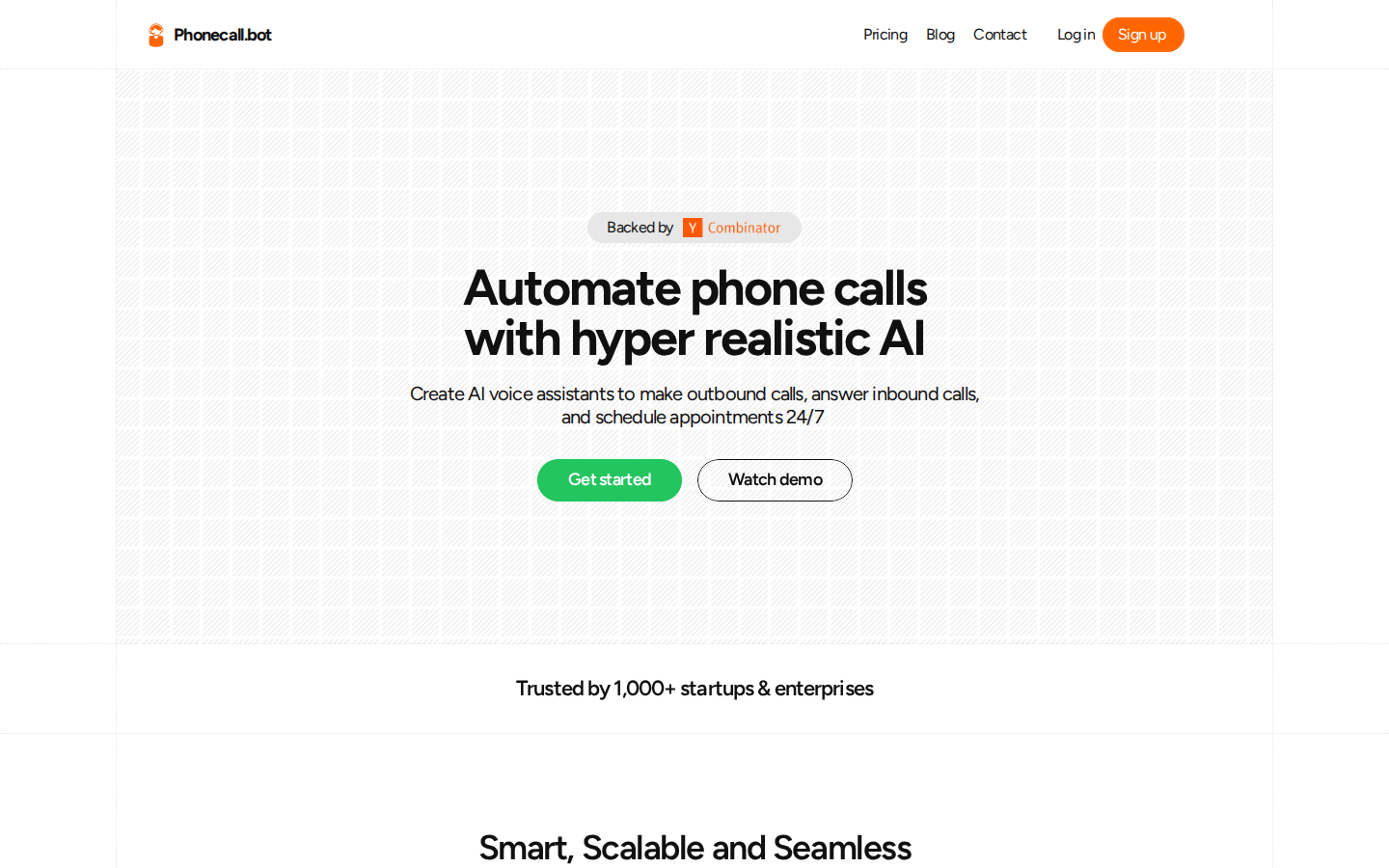
Phonecall.bot is the most accessible entry point for teams exploring AI call bots for the first time. At $29/month, the platform offers 60 natural-sounding voices in 15+ languages and a no-code builder that lets non-technical users design call flows without developer involvement. The setup process is intentionally simple: choose a voice, write your script, configure basic routing, and start receiving calls.
The platform handles inbound call answering and basic outbound calling with realistic voice quality that compares favorably to platforms costing five to ten times more. Phonecall.bot is not designed for enterprise-scale deployment or complex multi-step workflows, but it delivers surprisingly capable call handling for small teams, solopreneurs, and businesses running their first AI calling pilot.
Pros
Starts at $29/month — the most affordable option on this list for teams experimenting with AI call bots.
60 natural voices in 15+ languages give small teams voice quality that rivals more expensive platforms.
No-code builder requires zero developer involvement for setup and modification.
Watch for
Limited CRM integration depth — teams needing real-time two-way CRM sync, pipeline automation, or custom field mapping will outgrow this quickly.
Not built for complex multi-step workflows, outbound sequences, or enterprise-scale call volumes.
Best fit
Solopreneurs, small businesses, and teams running their first AI call bot pilot. Good for after-hours answering, basic appointment settingAppointment settingCapturing availability, confirming fit, and booking a qualified prospect onto the right calendar without requiring a rep to manually chase the lead.Read full definition →, and inbound FAQ handling at low volume. Teams with serious lead-conversion or CRM requirements should consider platforms higher on this list.
7. CloudTalk — Best for teams scaling sales and support calls
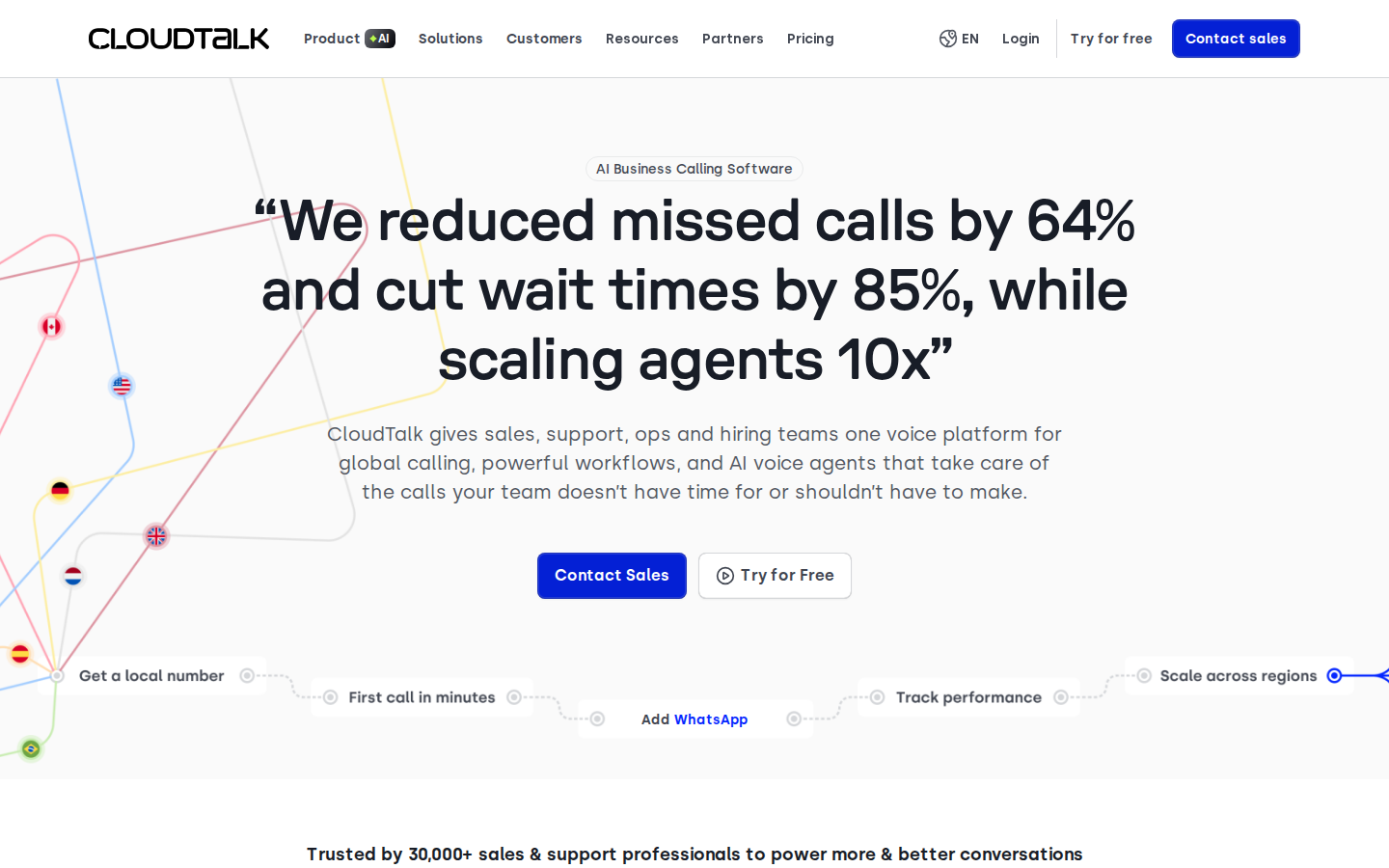
CloudTalk is a cloud-based business phone system with AI capabilities layered on top. The platform provides AI-powered call routingCall routingDirecting a caller to the right agent, rep, team, location, queue, or workflow based on intent, data, and availability.Read full definition →, real-time call analytics, automatic call summarization, and 70+ native integrations with CRMs, helpdesks, and business tools. Unlike pure AI call bot platforms, CloudTalk is designed as a full phone system for sales and support teams — the AI augments human agents rather than replacing them entirely.
The platform supports international numbers across 160+ countries, call recording, IVRIVRInteractive Voice Response — a phone menu system that routes callers using keypad or spoken inputs. AI agents often replace or augment rigid IVR trees.Read full definition →, skill-based routing, and callback features. CloudTalk's AI features include automatic topic detection, sentiment analysis, and call transcription. For teams that need a business phone system first and AI calling second, CloudTalk provides the infrastructure with AI enhancements built in.
Pros
70+ native integrations with Salesforce, HubSpot, Pipedrive, Zendesk, Intercom, and other major CRM/helpdesk tools.
International numbers in 160+ countries with AI-powered call routing and skill-based distribution.
AI call analytics including automatic summarization, topic detection, and sentiment analysis.
Watch for
CloudTalk is a phone system with AI features, not a fully autonomous AI call bot — teams wanting end-to-end AI calling without human agents will need a different platform.
Per-user pricing can scale expensively for large teams compared to per-minute AI call bot pricing models.
Best fit
Sales and support teams at growing companies that need a cloud phone system with AI-powered routing, analytics, and CRM sync. Particularly strong for international teams and organizations that want AI to augment human calling rather than replace it entirely.
Which AI call bot should you choose?
The right AI call bot depends on your primary job to be done. If you are converting inbound leads and need the full loop — call, text, email, CRM, workflow — Thoughtly is the strongest fit because it handles the entire revenue cycle from a single agent. If your priority is embedding AI calling into complex business workflows across dozens of tools, Lindy gives you the deepest automation layer.
For small and mid-market businesses that need fast, simple call answering, Goodcall launches in minutes and captures every lead automatically. If customer support call handling with compliance and human escalation is the priority, Brilo AI is purpose-built for that workflow. Aloware is the best hybrid option for teams that want AI qualification layered on a compliance-first power dialer. Phonecall.bot is the entry point for budget-conscious teams exploring AI calling for the first time. And CloudTalk is the right choice when you need a full cloud phone system with AI features added on top.
Whatever you choose, the critical test is what happens after the call ends. An AI call bot that sounds great but drops the ball on CRM sync, follow-up, or workflow execution is a liability, not an asset. Test the post-call loop as hard as you test the voice quality.
Frequently asked questions
What is an AI call bot?
An AI call bot is software that uses artificial intelligence to make and receive phone calls autonomously. Unlike traditional IVR systems that force callers through rigid menus, AI call bots use natural language understanding to have actual conversations — qualifying leads, answering questions, booking appointments, and routing calls based on the content of the discussion rather than button presses.
How much do AI call bots cost?
Pricing ranges from $29/month for basic platforms like Phonecall.bot to enterprise pricing for fully managed deployments. Most mid-market platforms charge per minute ($0.05–$0.15/min), per user ($25–$100/user/mo), or flat monthly rates ($50–$500/mo). The total cost depends on call volume, channels needed, integration requirements, and whether you need compliance tooling. Hidden costs to watch for include per-number charges, premium voice add-ons, and overage rates.
Can AI call bots handle regulated industries like insurance and healthcare?
Yes, but not all platforms offer the required compliance tooling. For regulated industries, look for platforms with built-in consent disclosure, call recording notifications, HIPAA-compliant data handling, DNC list scrubbing, and warm transferWarm transferA live transfer where the agent connects a qualified caller to the right human while preserving context, instead of sending the caller to a cold queue or voicemail.Read full definition → to licensed agents. Thoughtly, Brilo AI, and Aloware all offer compliance features suited for regulated verticals. Always verify specific compliance certifications with the vendor before deploying in a regulated context.
What is the difference between an AI call bot and a traditional IVR?
Traditional IVR systems use menu trees and touch-tone or basic keyword responses. AI call bots use large language models and speech recognition to understand free-form conversation, ask follow-up questions, handle interruptions, and take actions based on the full context of the discussion. The result is a caller experience that feels like talking to a person rather than navigating a phone tree.
Do AI call bots replace human agents?
For some workflows, yes — AI call bots can handle initial qualification, after-hours answering, appointment booking, and routine inquiries without human involvement. For complex negotiations, sensitive situations, or high-value conversations, the best approach is a hybrid model where the AI handles first touch and follow-up while human agents focus on conversations that require judgment, empathy, or domain expertise. Most platforms on this list support warm transfer to human agents when the conversation exceeds the AI's scope.