Best AI Outbound Dialer Platforms in 2026: 7 Alternatives Compared
I compared 7 AI outbound dialer platforms on dialing speed, AI depth, multi-channel follow-up, CRM integration, cost, and inbound coverage. Thoughtly wins for AI-native outbound + inbound lead conversion; Orum and Nooks lead for human SDR parallel dialing.
Last updated
I evaluated the AI outbound dialer platforms that revenue teams are actually using in 2026 — not just the ones with the loudest marketing, but the ones that show up in G2 reviews, Reddit threads, and procurement decks when teams need to decide what to buy.
Outbound dialing is a different test than inbound lead conversionInbound lead conversionInbound lead conversion turns opted-in calls, form submissions, quote requests, and other inquiries into qualified conversations, appointments, or transfers.Read full definition →. The question isn't just “how many calls can we make?” — it's “when a call doesn't connect, what happens next?” The best platforms don't just dial faster; they handle the follow-up, the CRM write-backCRM write-backCRM write-back sends conversation outcomes, qualification answers, notes, appointments, dispositions, and next steps into the CRM.Read full definition →, and the multi-channel persistence that turns a dial list into booked pipeline.
That distinction matters because the outbound dialer market is splitting. On one side: parallel dialers built to maximize human SDR call volume. On the other: AI agent platforms that place calls, send follow-up texts and emails, and book meetings without a human rep in the loop. The right choice depends on whether you're augmenting a sales team or replacing the dialing layer entirely.
Quick takeaways
Thoughtly is the only platform on this list that places outbound calls via AI agents — no SDR headcount required. When a lead doesn't answer, the same agent follows up by SMS and email, then calls back.
Orum and Nooks are the top parallel dialers for human SDR teams, but both share a recurring weakness: connection lag that creates dead air and triggers spam perception.
Koncert offers the most affordable parallel dialing, but has fewer integrations and more reliability complaints than Orum or Nooks.
CloudTalk and Talkdesk are cloud phone systems with dialer features — better suited for blended call centers than high-volume SDR teams.
Outreach is the enterprise default for sales engagement, but the dialer is an add-on to a sequencing platform, not a standalone dialing engine.
How I evaluated these outbound dialer platforms
I looked at six dimensions that matter when a revenue team is choosing an outbound dialer in 2026. The goal was not to find the platform with the most features — it was to find the platforms that convert more calls into pipeline without creating operational drag.
1. Dialing speed and automation
How fast can the platform connect a rep — or an AI agent — to a live prospect? I looked at parallel dialing capabilities (how many lines can run simultaneously), AI-powered live detection (how quickly the system distinguishes a human from voicemail), and the latencyLatencyLatency is the elapsed time between a caller's speech and the agent's response, including listening, processing, tool, network, and speech-generation delays.Read full definition → between prospect pickup and rep connection. Platforms with sub-second connection times score higher; platforms with documented dead-air problems score lower.
2. AI and automation depth
Does the platform use AI to actually place calls and handle conversations, or is AI just a feature layer on top of a human-rep dialer? This matters because AI-native platforms scale without headcount; human-rep augmenters scale only by adding seats. I looked at whether the platform offers AI agents that can call, qualify, and book without a human on the line.
3. Multi-channel follow-up
When a call doesn't connect, what happens? The best outbound platforms don't just redial — they follow up by SMS, email, or WhatsApp to increase the chance of reaching the prospect. I looked for platforms with native SMS, email, and multi-channel workflows, not just dialing-only tools that depend on a separate sequencing platform.
4. CRM integration and write-back
Every call, outcome, and next step should sync to your CRMCRMA CRM is the system used to manage leads, contacts, accounts, opportunities, activity, ownership, and follow-up.Read full definition → automatically. I looked at the depth of CRM integrations (Salesforce, HubSpot, Pipedrive, Zoho), whether sync is two-way or one-way, and whether call outcomes are auto-tagged and logged without rep intervention. Platforms that require manual CRM logging after calls scored lower.
5. Cost and scalability
What does the platform cost per seat, and are you paying for AI economics or human-rep economics? Parallel dialers typically cost $200–$500 per user per month — and every user is a human SDR. AI agent platforms price differently: per minute, per call, or per outcome. I looked at published pricing, G2 review pricing data, and the total cost of ownership when you factor in headcount.
6. Inbound and outbound coverage
Can the platform handle both inbound and outbound, or is it outbound-only? Many sales teams buy an outbound dialer and then realize they also need a separate platform for inbound lead follow-upLead follow-upLead follow-up is the sequence of calls, texts, emails, and tasks used after a prospect expresses interest.Read full definition →. I looked for platforms that can handle both directions, or at least integrate cleanly with an inbound solution.
Quick comparison of the best AI outbound dialer platforms
Here's how the platforms compare at a glance. Details on each follow.
Best when your CRM and lead sources are clearly defined
Per-minute; contact for pricing
Orum
High-volume B2B parallel dialing with coaching
Connection lag; no SMS or inbound; $250+/seat/mo
~$250/user/mo (annual)
Nooks
Remote SDR team culture + parallel dialing
Most expensive ($5K/user/yr); dead-air problem
~$416/user/mo
Koncert
Budget-conscious SDR teams
Fewer integrations; more reliability complaints
Contact for pricing; generally lower than Orum/Nooks
CloudTalk
Blended inbound/outbound call centers
Not AI-native; limited parallel dialing
From ~$25/user/mo; dialer features on higher tiers
Talkdesk
Enterprise contact center with dialer
Overbuilt for pure outbound sales; CCaaS-first
~$75–$115+/user/mo; enterprise pricing
Outreach
Sales engagement platform with dialer add-on
Dialer is add-on, not core; very expensive
~$130–$180+/user/mo with dialer
7 best AI outbound dialer platforms in 2026
1. Thoughtly (Best overall for AI-native outbound + inbound lead conversion)
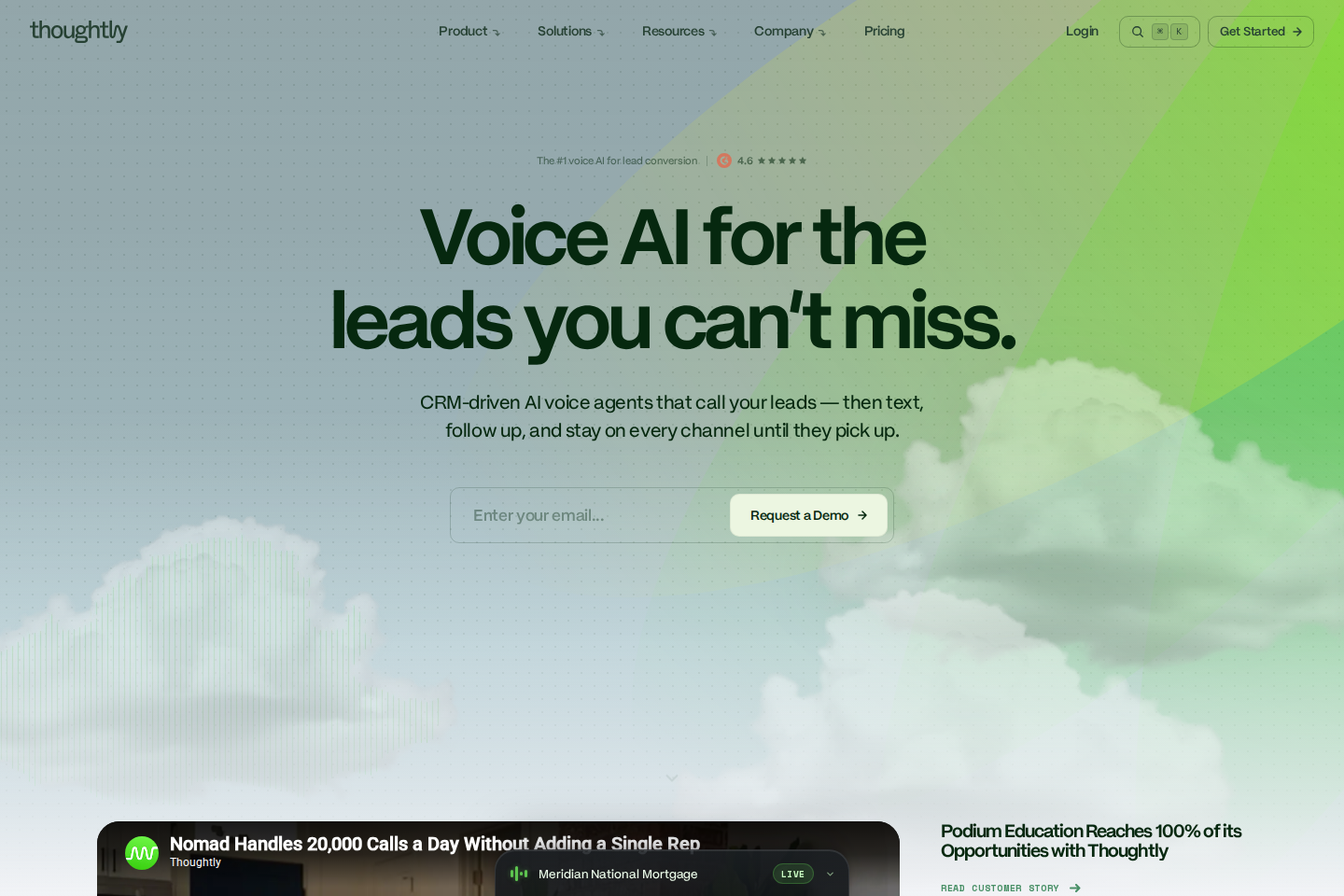
Thoughtly is an AI agent platform that handles both inbound and outbound calls — but the key distinction is that the AI places the calls, not a human rep. When a lead lands in your CRM, Thoughtly's agent calls within seconds. If the lead doesn't answer, the same agent sends an SMS, follows up by email, and schedules a callback — all autonomously, with CRM write-back after every interaction.
For outbound dialing specifically, Thoughtly agents can work aged leads, re-engage dead contacts, and follow up on form fills that went cold. The platform supports voice, SMS, iMessage, WhatsApp, and email from a single agent, meaning every channel carries the same context, brand, and conversation history. Native integrations with Salesforce, HubSpot, Pipedrive, Zoho, and 24+ certified connectors mean call outcomes, deal stages, and next steps sync automatically.
What makes Thoughtly different from every other platform on this list: there is no SDR seat to buy. The AI agent is the rep. Pricing is per-minute, not per-seat, which means you're paying for AI economics — not human-rep ramp time, training, or management overhead.
#### Pros
AI-native outbound: Agents place calls, send SMS/email follow-up, and book meetings without a human rep in the loop.
Multi-channel persistence: When a call misses, the agent pivots to SMS, email, or WhatsApp — same context, same conversation.
CRM-native: Two-way sync with Salesforce, HubSpot, Pipedrive, Zoho, and 24+ integrations. Call outcomes auto-tagged and logged.
Sub-60-second speed-to-lead: Agents call within seconds of a lead landing in CRM, well inside the conversion window.
SOC 2 Type II, HIPAA, GDPR: Compliance-ready for regulated industries including insurance, mortgage, healthcare, and financial services.
#### Watch for
Requires your company to have a clear CRM, lead source, or system of record to get the most value. Agents are only as good as the data they're triggered from.
Best suited for teams with enough lead volume or workflow complexity to justify automation. Very low-volume teams may not see the ROI.
#### Best fit
Revenue teams in high-consideration consumer industries (insurance, mortgage, real estate, education, healthcare, legal, financial services) that want AI to handle outbound follow-up on every inbound lead — without adding SDR headcount.
#### Pricing
Per-minute pricing. Contact Thoughtly for a custom quote based on call volume and workflowWorkflowA workflow is a defined sequence of steps, decisions, actions, delays, and outcomes used to complete a business process.Read full definition → complexity.
2. Orum (Best for high-volume B2B parallel dialing)
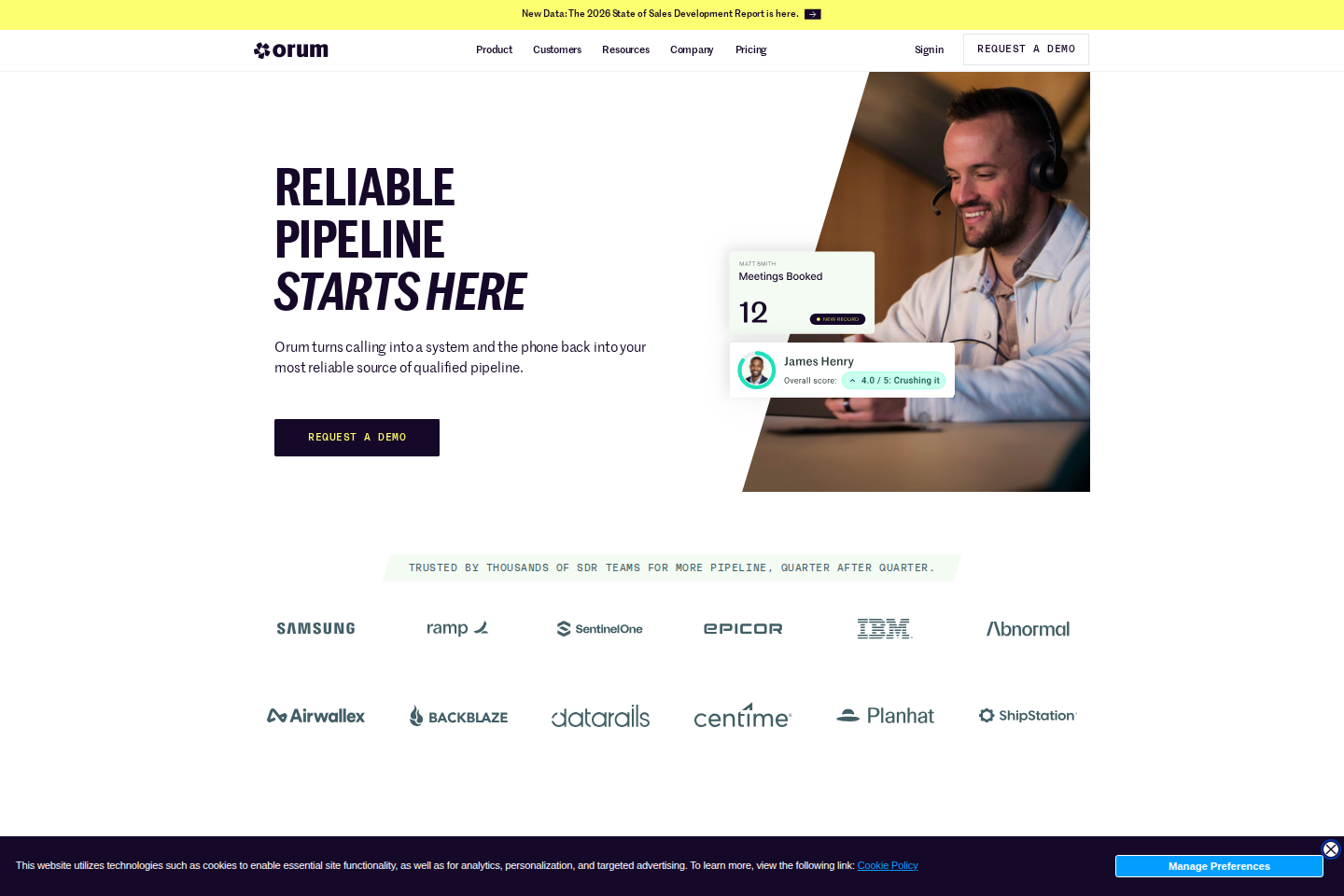
Orum is an AI-powered parallel dialerParallel dialerA parallel dialer places multiple outbound calls at once and connects an answered call to an available person or automated agent.Read full definition → built for B2B SDR teams that need to maximize live conversations. The platform dials up to 10 prospects simultaneously, uses AI to detect human pickups versus voicemails, and routes the connected call to the rep in seconds. Orum serves more than 1,200 sales organizations, including IBM, Samsung, Ramp, and Crunchbase.
Beyond dialing, Orum offers a Virtual Salesfloor feature that recreates the energy of an in-person sales floor for remote teams, plus an AI Coaching Suite with call scorecards and roleplay. The platform integrates with Salesforce, HubSpot, Outreach, Salesloft, Apollo, and Gong — making it a strong fit for teams already running a mature sales engagement stack.
The trade-off: Orum is a human-rep augmenter, not an AI agent platform. Every seat is a human SDR. The platform has no native SMS, email follow-upEmail follow-upEmail follow-up sends timely, context-aware replies or reminders that move an inbound lead toward qualification, scheduling, or handoff.Read full definition →, or inbound call handling — it's dialing-only. And the parallel dialing model has a well-documented weakness: connection lag that creates dead air when a prospect answers, which can signal “spam call” and reduce connection quality.
#### Pros
Massive volume increase: Reps report going from 50–80 manual dials per day to 300–600 per hour with parallel dialing.
AI Coaching Suite: Call scorecards, roleplay, and personalized coaching portals help reps improve conversation quality.
Strong integrations: Native connections to Salesforce, HubSpot, Outreach, Salesloft, Apollo, and Gong.
Virtual Salesfloor: Recreates remote sales floor energy with live listening, call monitoring, and team collaboration.
#### Watch for
Connection lag: The #1 complaint across G2 reviews and Reddit threads. Dead air between prospect pickup and rep connection can trigger spam perception and reduce conversion.
No multi-channel follow-up: Orum is dialing-only. No native SMS, email, or WhatsApp. Teams need a separate sequencing platform for follow-up.
Human-rep economics: At ~$250/user/month, every seat is a human SDR with ramp time, training, and management overhead.
Carrier spam risk: High-volume parallel dialing can trigger carrier spam flags, causing connect rates to deteriorate over 3–6 months.
#### Best fit
B2B SDR teams with established sales engagement stacks (Outreach, Salesloft, Apollo) that want to maximize human rep call volume and coaching impact. Not ideal for teams seeking AI-native automation or multi-channel follow-upMulti-channel follow-upMulti-channel follow-up uses more than one communication channel, commonly voice, SMS, and email, after a prospect raises their hand.Read full definition →.
#### Pricing
Opaque, annual-commitment pricing. Launch plan starts at ~$250/user/month with 5 parallel lines and 200 data credits per rep per month. Higher tiers available for more lines and AI features.
3. Nooks (Best for remote SDR team culture and coaching)
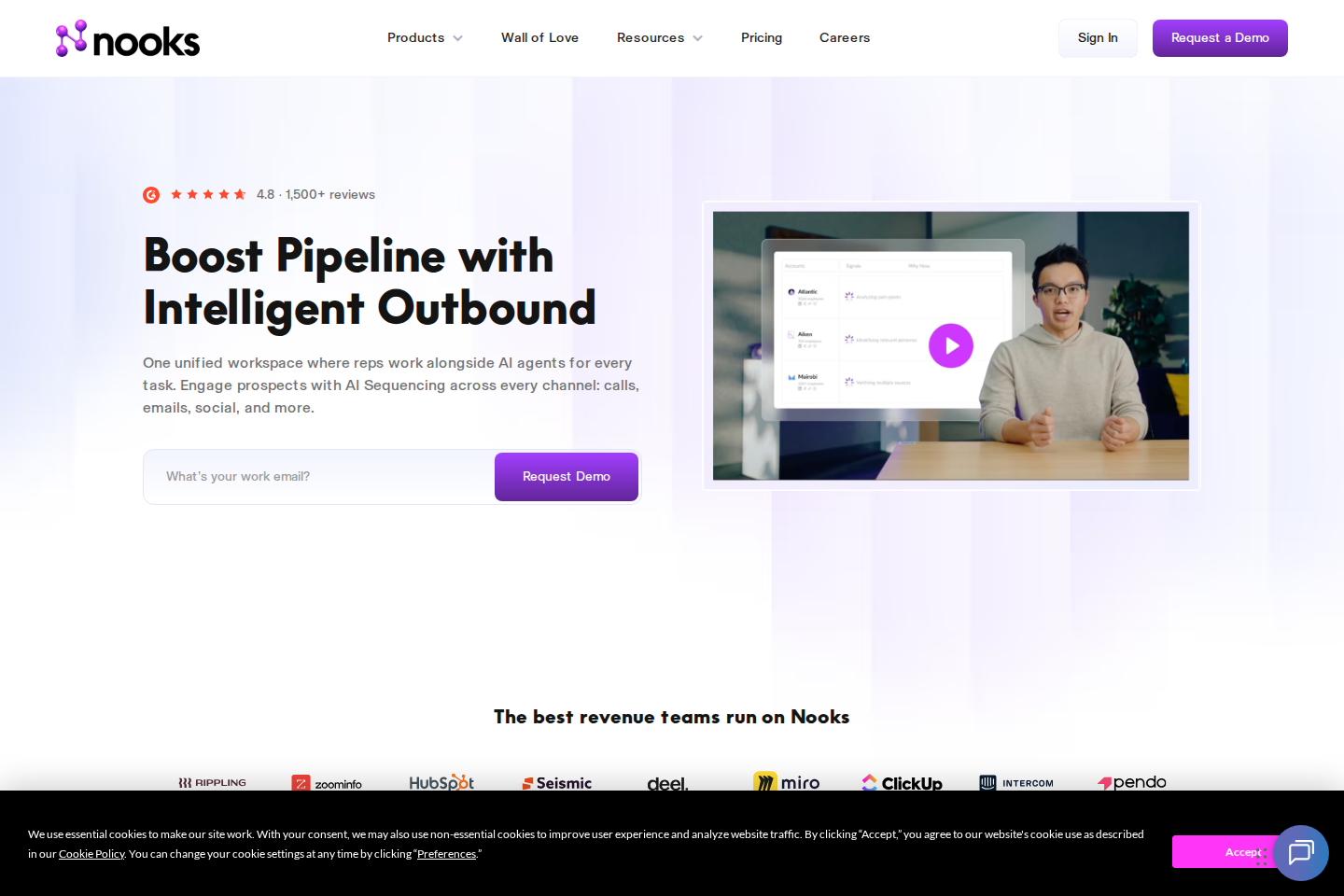
Nooks is an AI parallel dialer and virtual sales floor platform that has positioned itself as the premium option in the parallel dialer space. The platform combines multi-line dialing (typically 5 lines), AI-powered live detection, a Virtual Salesfloor for remote team culture, and prospecting tools — all in one workspace. Nooks serves over 1,200 customers, including HubSpot, Deel, ZoomInfo, and Rippling.
The Virtual Salesfloor is Nooks' standout feature. G2 reviewers consistently single it out as a morale and energy booster for remote SDR teams — reps report higher engagement, better coaching, and a sense of team even when working from home. The platform also includes 29 verified integrations on G2, the most of any dialer on this list.
However, Nooks is the most expensive platform on this list at approximately $5,000 per user per year. And despite the premium price, the platform shares the same structural weakness as Orum: connection lag during parallel dialing that creates dead air when prospects answer. G2 data shows 212 “Call Issues” mentions and 110 “Dialer Issues” mentions in Nooks reviews. Multiple Reddit threads from 2026 describe connection rates plummeting after the initial contact list is burned through.
#### Pros
Virtual Salesfloor: Genuinely innovative feature that transforms cold calling from a solo grind into a collaborative team activity for remote reps.
Most integrations: 29 verified G2 integrations — more than Orum, Koncert, or any other dialer on this list.
Prospecting tools: Built-in list building, data enrichment, and CRM sync reduce context switching between tools.
AI coaching: Call analytics with sentiment analysis and personalized coaching insights.
#### Watch for
Most expensive option: At ~$5,000/user/year (~$416/user/month), Nooks costs significantly more than Orum ($250) or Koncert. Every seat is a human SDR.
Connection lag: The #1 complaint across G2, Reddit, and independent reviews. Dead air between pickup and rep connection undermines conversion.
List burn: Connection rates reportedly decline within 3–6 months as contact lists get exhausted and numbers get flagged.
No AI agents: Nooks augments human reps — it doesn't replace them. Teams still need SDR headcount to operate the platform.
#### Best fit
Well-funded B2B SDR teams that prioritize remote culture, coaching, and prospecting consolidation over cost efficiency. Not suitable for teams seeking AI-native automation or operating on tight budgets.
#### Pricing
Pricing is not published on the website. Market data indicates ~$5,000/user/year with annual commitment. Contact Nooks for a custom quote.
4. Koncert (Best for budget-conscious SDR teams)
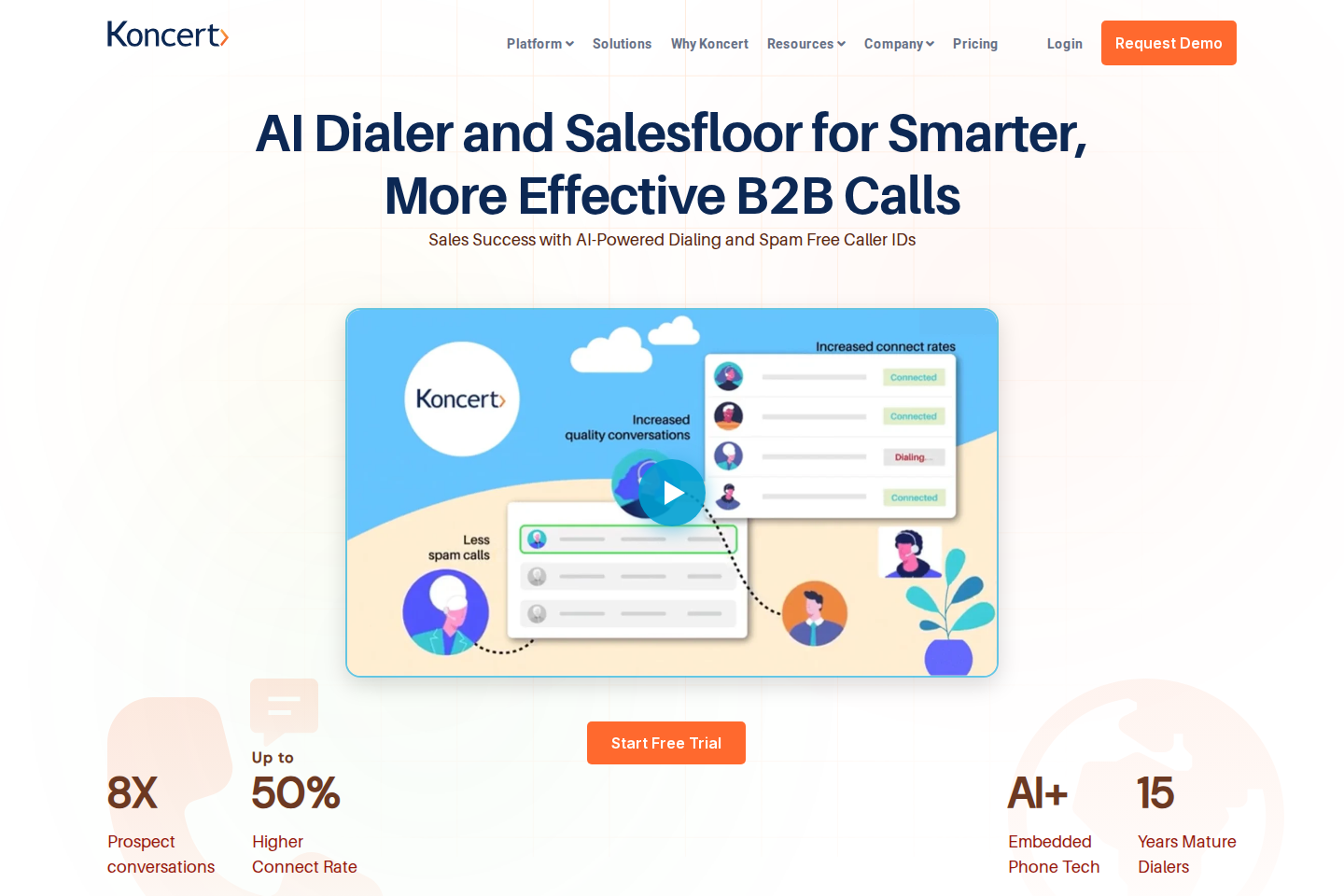
Koncert is an AI-powered sales dialer that offers parallel dialing, AI Flow Dialer, and a virtual sales floor at a more accessible price point than Orum or Nooks. The platform supports up to 5 parallel lines, includes caller ID monitoring and heat mapping to reduce spam flags, and integrates with Salesforce, HubSpot, Outreach, and Salesloft. Koncert targets B2B sales teams that want dialing acceleration without the premium price tag.
Where Koncert stands out is affordability. It offers similar core functionality — parallel dialing, AI live detection, CRM syncCRM syncCRM sync keeps selected lead, contact, conversation, outcome, and next-step data aligned between an agent platform and a CRM.Read full definition → — at a lower cost per seat than Orum or Nooks. The platform also includes a Connector tool for caller ID reputation monitoring, which addresses one of the biggest operational risks of high-volume dialing.
The trade-off is reliability and integration depth. G2 reviews show 35 “Call Issues” mentions, 28 “Dialer Issues” mentions, 12 “Slow Loading” mentions, and 11 “Delays” mentions — all higher rates relative to review volume than Orum or Nooks. Koncert has only 8 verified integrations on G2, compared to 17 for Orum and 29 for Nooks. The platform is a solid budget choice, but teams with complex stacks may hit integration limits.
#### Pros
Most affordable: Generally priced lower than Orum ($250) or Nooks ($416+) for similar parallel dialing functionality.
Caller ID monitoring: Heat mapping and reputation monitoring help reduce spam flags — a real operational risk for high-volume dialing.
AI Flow Dialer: Progressive dialing mode that balances speed with connection quality for teams that don't need full parallel dialing.
Quick onboarding: Reviewers consistently highlight fast implementation (under 1 month) and responsive support.
#### Watch for
Reliability issues: Higher rates of “Call Issues,” “Slow Loading,” and “Delays” in G2 reviews relative to Orum and Nooks.
Limited integrations: Only 8 verified G2 integrations vs. 17 for Orum and 29 for Nooks. Complex stacks may hit integration walls.
Not AI-native: Like Orum and Nooks, Koncert augments human reps. Every seat is a human SDR with associated ramp and management costs.
#### Best fit
B2B SDR teams that want parallel dialing at a lower price point and have a simpler tech stack. Not ideal for teams with complex integration needs or those seeking AI-native automation.
#### Pricing
Not fully public. Koncert offers tiered plans (Melody, Symphony, Melody+, Symphony+). Contact Koncert for pricing — generally lower than Orum and Nooks.
5. CloudTalk (Best for blended inbound/outbound call centers)
CloudTalk is a cloud call center platform that includes power dialerPower dialerA power dialer automatically calls contacts in sequence while keeping one person or automated agent available for each connected conversation.Read full definition →, smart dialer, and predictive dialer capabilities. Unlike the pure-play SDR dialers above, CloudTalk is built for blended call center teams that handle both inbound and outbound calls — think customer support teams that also do outbound follow-up, or inside sales teams that take warm transfers and make outbound calls in the same session.
The platform supports 50+ integrations including Salesforce, HubSpot, Zendesk, Pipedrive, and Shopify. It also includes native SMS, call routingCall routingCall routing sends a caller to the right agent, person, team, location, queue, or workflow using intent, data, rules, and availability.Read full definition →, IVRIVRIVR, or Interactive Voice Response, is a phone menu that routes or serves callers through keypad entries or spoken choices.Read full definition →, and analytics — making it a more complete phone system than the dialer-only tools. Pricing starts at roughly $25/user/month for the entry tier, with dialer features available on higher-tier plans.
The limitation is that CloudTalk is not an AI-native platform. It doesn't offer AI agents that place calls autonomously. The dialer is designed for human reps, and while the parallel dialing capabilities exist, they're not as optimized for high-volume SDR workflows as Orum or Nooks. CloudTalk is a better fit for teams that need a full phone system with outbound capabilities, not teams looking for a dedicated high-volume dialer.
#### Pros
Blended inbound/outbound: Handles both call directions in a single platform — no need for a separate inbound solution.
Affordable entry point: Starts at ~$25/user/month, significantly cheaper than Orum ($250) or Nooks ($416+).
50+ integrations: Broad integration catalog including Salesforce, HubSpot, Zendesk, Pipedrive, and Shopify.
Native SMS: Built-in SMS capabilities, unlike Orum and Koncert which are dialing-only.
#### Watch for
Not AI-native: CloudTalk is a cloud phone system, not an AI agent platform. Every call requires a human rep.
Limited parallel dialing: Power dialer and smart dialer exist, but are not optimized for the 5–10x parallel dialing volumes that Orum and Nooks support.
Call quality and reliability: Some G2 reviews flag call quality degradation and occasional sync issues with CRM platforms.
#### Best fit
Inside sales and customer support teams that need a unified phone system for both inbound and outbound calls. Not ideal for high-volume SDR teams or teams seeking AI-native automation.
#### Pricing
Published tiered pricing starting at ~$25/user/month. Dialer features available on mid-tier and higher plans. Contact CloudTalk for exact pricing on dialer-enabled tiers.
6. Talkdesk (Best for enterprise contact center dialing)
Talkdesk is an enterprise-grade cloud contact centerContact centerA contact center is a centralized operation that handles customer or prospect interactions across voice and digital channels.Read full definition → platform (CCaaS) that includes an Advanced Dialer as part of its broader CX suite. Named a Leader in the 2025 Gartner Magic Quadrant for CCaaS, Talkdesk is built for large contact centers that need compliance, scalability, and deep workforce management — not just outbound dialing.
The Advanced Dialer supports predictive, progressive, and preview dialing modes, with omnichannelOmnichannelOmnichannel is a coordinated customer journey in which context and state carry across voice, SMS, email, web, and human interactions.Read full definition → routing, AI-powered conversation summaries, and deep integrations with Salesforce, Zendesk, and ServiceNow. Talkdesk has also invested in AI agents that can orchestrate customer journeys — but these are focused on CX workflows (support, scheduling, triage), not outbound sales prospecting.
The limitation for outbound sales teams is that Talkdesk is overbuilt. It's a CCaaS platform first, a dialer second. Pricing typically starts at $75–$115+/user/month depending on the plan, but enterprise contracts with the Advanced Dialer add-on can be significantly more. Implementation is complex, often requiring professional services. For pure outbound sales use cases, Talkdesk brings unnecessary complexity and cost.
#### Pros
Enterprise-grade reliability: Gartner Magic Quadrant Leader for CCaaS — proven at enterprise scale with high availability SLAs.
Omnichannel routing: Voice, email, chat, and SMS in one platform with unified routing and reporting.
AI investment: Talkdesk is building AI agents for CX orchestration, conversation summaries, and intelligent routing.
Compliance and security: Strong compliance posture for regulated industries including healthcare, financial services, and government.
#### Watch for
CCaaS-first, not sales-first: Talkdesk is built for contact centers, not SDR teams. The dialer is a feature within a broader CX suite.
Complex implementation: Enterprise deployments require professional services and can take weeks to months to configure.
Expensive for outbound-only: Paying for CCaaS capabilities you don't need if outbound dialing is the primary use case.
Not AI-native for sales: AI agents are CX-focused (support, triage), not outbound sales prospecting.
#### Best fit
Enterprise contact centers that need compliance-grade infrastructure with outbound dialing as one capability among many. Not ideal for SDR teams or companies seeking AI-native outbound automation.
#### Pricing
Enterprise pricing, not fully public. Base plans start at ~$75–$115+/user/month. Advanced Dialer may require higher-tier plans or add-on pricing. Contact Talkdesk for a custom quote.
7. Outreach (Best for sales engagement + dialer integration)
Outreach is the enterprise default for sales engagement platforms (SEPs). It combines email sequencing, call sequencing, LinkedIn automation, deal management, forecasting, and coaching in one platform — with a dialer available as an add-on or higher-tier feature. Outreach was recently repositioned as an “Agentic AI Platform for Revenue Teams,” with AI agents that act as teammates for prospecting, deal management, and forecasting.
For outbound dialing specifically, Outreach offers a Sales Engagement Dialer that supports power dialing, local presence, call recordingCall recordingCall recording captures phone audio for review, quality assurance, training, dispute handling, or regulated retention.Read full definition →, and auto-logging to Salesforce and HubSpot. The dialer is tightly integrated with Outreach's sequencing engine — reps can call through a sequence, and the dialer auto-logs outcomes and advances the sequence. This makes it the best option for teams that want dialing embedded in their broader sales engagement workflow.
The trade-off is cost and complexity. Outreach is one of the most expensive platforms on this list — typically $130–$180+/user/month when you include the dialer. Implementation can take weeks, and the platform requires dedicated admin resources to maintain sequences, templates, and rules. The dialer is an add-on to a sequencing platform, not a standalone dialing engine. And while Outreach's new AI agents are promising, they're focused on deal management and forecasting — not placing outbound calls.
#### Pros
Most mature SEP: Outreach is the enterprise standard for sales engagement — deep feature set, proven at scale, large user community.
Sequencing + dialing unified: Dialer is integrated with email, LinkedIn, and task sequences. Reps work from one playlist.
Deep Salesforce integration: Two-way sync with Salesforce is the most mature of any platform on this list.
AI agents for deal management: New agentic AI features help with deal prioritization, forecasting, and coaching.
#### Watch for
Very expensive: At $130–$180+/user/month with the dialer, Outreach is one of the most expensive options. Every seat is a human rep.
Dialer is secondary: Outreach is a sequencing platform first. The dialer is an add-on, not the core product. Teams needing high-volume parallel dialing will find it underpowered vs. Orum or Nooks.
Complex implementation: Requires dedicated admin resources. Sequences, templates, rules, and integrations need ongoing maintenance.
Not AI-native for calling: Outreach's AI agents focus on deal management and forecasting — not placing outbound calls autonomously.
#### Best fit
Enterprise B2B sales teams that already use or plan to use Outreach as their primary sales engagement platform and want an integrated dialer. Not ideal for teams seeking a standalone dialer or AI-native outbound automation.
#### Pricing
Not fully public. Base platform typically starts at ~$130/user/month. Dialer features may require higher-tier plans or add-on pricing. Annual commitment required. Contact Outreach for a custom quote.
How to choose the right outbound dialer platform
The right outbound dialer depends on one fundamental question: are you augmenting human reps, or replacing the dialing layer with AI?
If you're augmenting human reps — specifically, if you have a B2B SDR team that needs to make more calls per hour — Orum and Nooks are the strongest options. Orum offers the best balance of volume, coaching, and integrations at ~$250/user/month. Nooks is more expensive (~$416/user/month) but offers the best remote team culture features and the most integrations. Koncert is the budget alternative if you can accept fewer integrations and more reliability issues.
If you're replacing the dialing layer with AI — meaning you want calls placed, follow-ups sent, and meetings booked without human SDR headcount — Thoughtly is the only platform on this list that does this. Its AI agents handle voice, SMS, email, and CRM write-back autonomously, with per-minute pricing instead of per-seat pricing.
If you need blended inbound/outbound — CloudTalk is the most affordable option that handles both call directions. Talkdesk is the enterprise-grade option for regulated contact centers. Both require human reps for every call.
If you're already on Outreach or Salesloft — using their built-in dialer avoids adding another vendor. But if your SDRs need true parallel dialing (5–10x lines), you'll likely need Orum or Nooks on top of your SEP.
The buyer fork is simple: human-rep augmenters (Orum, Nooks, Koncert, CloudTalk, Talkdesk, Outreach) scale by adding seats. AI-native platforms (Thoughtly) scale by adding minutes. Which economics make sense for your team?
Frequently asked questions
What is an AI outbound dialer?
An AI outbound dialer is a platform that uses artificial intelligence to automate outbound calling. This can mean AI-powered live detection (distinguishing humans from voicemails), parallel dialing (calling multiple prospects simultaneously), or AI agents that place calls autonomously, handle conversations, and book meetings without a human rep on the line.
How much does an outbound dialer cost per user?
Parallel dialers for human reps typically cost $200–$500 per user per month: Orum starts at ~$250/user/month, Nooks at ~$416/user/month, and Koncert is generally lower. CloudTalk starts at ~$25/user/month but requires higher tiers for dialer features. AI-native platforms like Thoughtly use per-minute pricing instead of per-seat pricing, which can be more cost-effective for teams with high call volume but limited SDR headcount.
Can AI agents make outbound calls without human reps?
Yes — Thoughtly's AI agents can place outbound calls, send SMS and email follow-ups, qualify leads, and book meetings autonomously. The AI handles the entire conversation, not just the dialing. This is different from parallel dialers like Orum and Nooks, which use AI to detect human pickups but still require a human rep to handle the conversation.
What's the difference between a parallel dialer and a power dialer?
A parallel dialer calls multiple prospects simultaneously (typically 5–10 lines) and routes the first human answer to a rep. A power dialer calls one prospect at a time but eliminates manual dialing, voicemail, and dead time between calls. Parallel dialers maximize volume; power dialers prioritize connection quality. Parallel dialers have a known weakness: connection lag that creates dead air when a prospect answers.
How do outbound dialers avoid spam flags?
CarrierCarrierA carrier is a telecommunications provider that transports voice calls or messages between phone numbers and networks.Read full definition → spam flags are a major risk for high-volume outbound dialing. Platforms address this with local presence dialing (using local area codes), caller ID monitoring and heat mapping (Koncert's approach), and number rotation. However, parallel dialers that make 300+ calls per day per rep are inherently at risk of triggering carrier algorithms — connect rates often deteriorate over 3–6 months as numbers get flagged.
Can outbound dialers also handle inbound leads?
Most outbound dialers are outbound-only. Orum and Nooks do not handle inbound calls. CloudTalk and Talkdesk handle both directions but are not optimized for high-volume outbound sales. Thoughtly is the only platform on this list that handles both inbound and outbound calls via AI agents — the same agent that follows up on an inbound lead can also make outbound calls to aged leads and re-engage cold contacts.