8 Best AI Voice Agents for Insurance Lead Conversion in 2026 (Tested and Ranked)
I evaluated the AI voice agent platforms insurance teams are using to convert inbound quote requests, aggregator leads, and renewal prospects into bound policies. Here are the 8 best options for insurance lead conversion in 2026, ranked by workflow depth, compliance posture, and integration with insurance-specific systems.
Last updated
I evaluated the AI voice agentVoice agentA voice agent is a conversational software system that listens, responds, follows a defined workflow, and can take approved actions during a phone conversation.Read full definition → platforms that insurance teams are using to convert inbound quote requests, aggregator leads, and renewal-window prospects into bound policies. Insurance lead conversion is a different problem than general customer support or cold outbound: the buyer already raised a hand, and the window to reach them is measured in minutes. Miss the window, and the quote goes to whichever competitor answers first.
The platforms on this list were evaluated specifically for insurance workflows — quote-request follow-up, risk-profile capture, producer routingProducer routingProducer routing sends an insurance inquiry to an appropriately licensed and available producer based on state, product, authority, ownership, and workflow rules.Read full definition →, aged-lead re-engagement, and renewal outreach. Not every strong voice AI platform makes a strong insurance lead conversion tool, and this list reflects that distinction.
Quick takeaways
Thoughtly is the strongest option for insurance revenue teams that need voice, SMS, email, and CRM workflows in a single platform — with TCPA-aware compliance built into the call logic, not bolted on.
CloudTalk offers a mature insurance-specific feature set with renewal automation, claims workflows, and strong G2 ratings from insurance users.
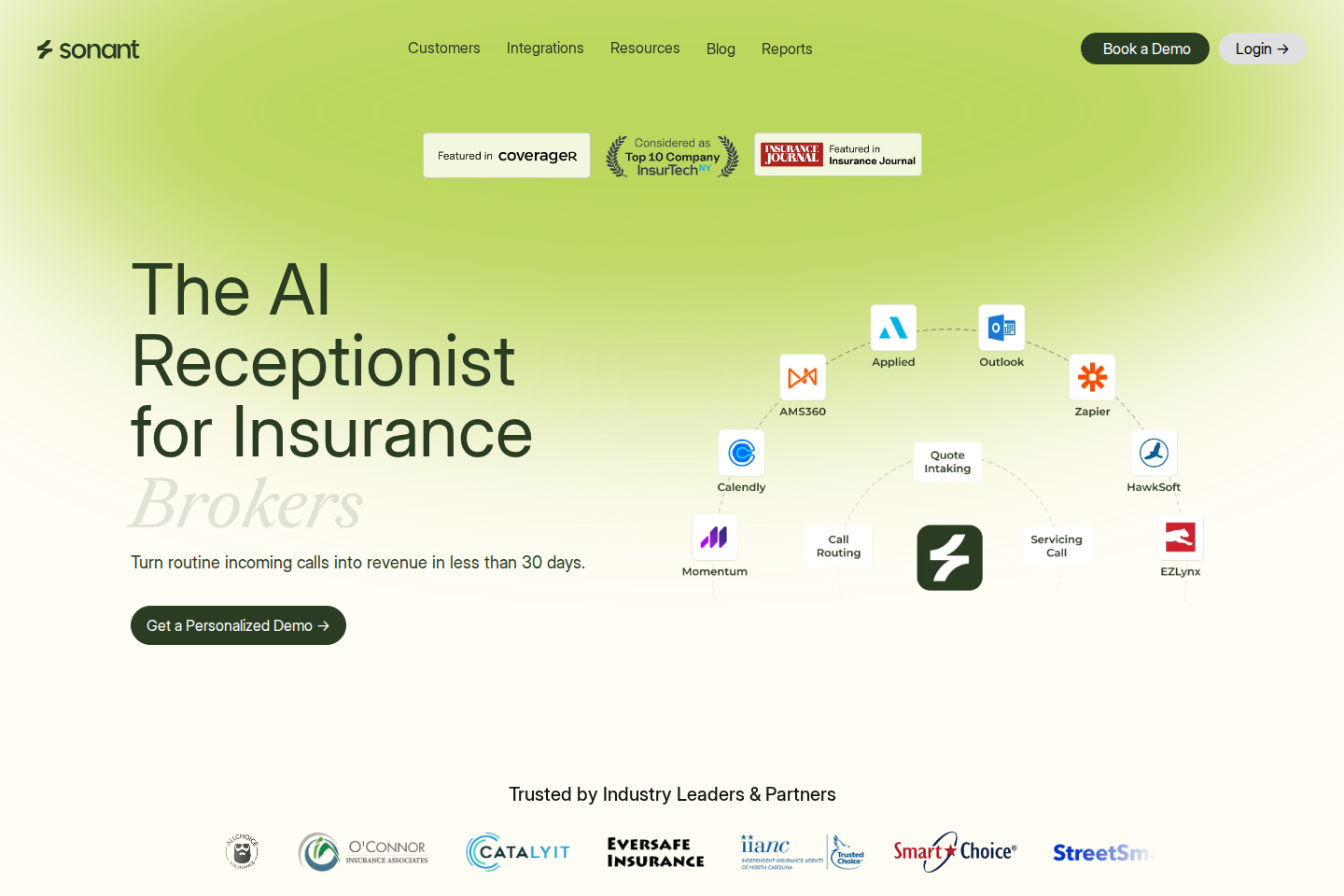
Sonant AI is purpose-built for insurance agencies and brokerages, with lead intake and AMS integration as its core mission.
Dialora ships Applied Epic and AMS360 templates out of the box, making it the fastest path to production for agencies on those platforms.
Most generic voice AI platforms require significant custom development to handle insurance-specific workflows like quote follow-up, TCPA compliance, producer routing, and renewal campaigns.
The best platforms for insurance lead conversion are not necessarily the best platforms for general customer support or cold outbound — the evaluation criteria are different.
How I evaluated these AI voice agents for insurance lead conversion
I focused on the specific capabilities that matter when an insurance team is trying to convert inbound leads into bound policies. General voice quality and call routingCall routingCall routing sends a caller to the right agent, person, team, location, queue, or workflow using intent, data, rules, and availability.Read full definition → are table stakes — the real differentiators are in the insurance-specific workflowWorkflowA workflow is a defined sequence of steps, decisions, actions, delays, and outcomes used to complete a business process.Read full definition → execution.
1. Speed-to-lead for quote requests
When a consumer fills out a quote requestQuote requestA quote request is an inbound inquiry asking for pricing, coverage, or a cost estimate for a product or service.Read full definition → on a comparison site or your own landing page, the first carrierCarrierA carrier is a telecommunications provider that transports voice calls or messages between phone numbers and networks.Read full definition → or agency to make contact wins the conversation roughly 50% of the time. I evaluated how quickly each platform can initiate an outbound call after a form fill or webhookWebhookA webhook sends event data from one system to another through an HTTP request when a defined event occurs.Read full definition →triggerTriggerA trigger is an event or condition that starts, resumes, changes, or stops an automated workflow.Read full definition →. Sub-60-second response time is the baseline; the best platforms can trigger a call within seconds of the lead arriving in the or lead distributor. I also looked at whether the platform can handle simultaneous high-volume triggers — aggregator leads often arrive in bursts, and a platform that queues calls sequentially loses the speed advantage.
2. Insurance qualification depth
A generic lead qualificationLead qualificationLead qualification captures fit signals such as intent, urgency, location, eligibility, consent, and availability before the next step.Read full definition → script asks for name, email, and budget. Insurance lead conversion requires capturing specific risk-profile data: coverage type (auto, home, life, health, commercial), current carrier, policy expiration date, household details, and buying timeline. I evaluated whether each platform can run a multi-turn qualification conversation that captures structured insurance data — not just free-text notes — and whether that data maps cleanly to downstream systems. The difference between 'the caller is interested in auto insurance' and 'the caller needs full-coverage auto, currently with State Farm, policy renews in 3 weeks, two drivers, clean record' is the difference between a warm lead and a bindable opportunity.
3. TCPA and insurance compliance
Insurance outreach is one of the most heavily regulated calling categories. TCPATCPAThe TCPA is a US federal law governing certain calls and text messages, including restrictions tied to technology, consent, revocation, identification, and do-not-call protections.Read full definition → violations can cost $500–$1,500 per call, and state insurance departments add their own rules on top. I looked at whether each platform enforces state-specific time-of-day windows automatically, handles recording-consent disclosures per state law, integrates with internal and external DNC lists, and maintains audit-ready call records. Platforms that treat compliance as a configuration checkbox rather than an enforced guardrail scored lower — insurance teams cannot afford to rely on agent-level prompt engineering for regulatory compliance.
4. AMS and insurance CRM integration
Insurance agencies run on agency management systems — Applied Epic, Vertafore AMS360, HawkSoft, EZLynx, and others. Carriers and MGAs use Salesforce Financial Services Cloud, Guidewire, or custom policy admin systems. I evaluated how well each platform integrates with these insurance-specific systems, not just generic CRMs. Can it read from and write to the AMSAMSAn AMS, or agency management system, is the operational system insurance agencies use for client, policy, carrier, document, activity, and servicing records.Read full definition →? Can it trigger a call when a policy renewal window opens? Can it push captured qualification data back to the producer's queue in the format they expect? Platforms with pre-built insurance connectors scored higher than those requiring custom webhook development.
5. Producer routing and live transfer
Insurance leads often need to reach a licensed producer before binding. I evaluated how each platform handles the handoff: can it warm-transfer to a specific producer based on state licensure, line of business, or availability? Does it pass structured context to the producer's screen popScreen popA screen pop automatically displays relevant caller or account information when a call connects or transfers to a human.Read full definition → so they can pick up the conversation without asking the caller to repeat everything? The difference between a cold transfer to a general queue and a warm transferWarm transferA warm transfer connects a live caller to the right person while preserving the context already collected during the conversation.Read full definition → with full context to the right licensed producer is the difference between a 15% and a 40% close rate on transferred leads.
6. Renewal and re-engagement workflows
Insurance is a renewal business. The best platforms don't just handle new lead conversion — they automate the outreach that keeps existing policyholders from shopping at renewal time. I looked at whether each platform can trigger outreach campaigns based on policy expiration dates, re-engage aged or lapsed leads, and run multi-touch sequences (call, then SMS follow-upSMS follow-upSMS follow-up uses compliant two-way text messages to continue a conversation after an inquiry, call, voicemail, or prior interaction.Read full definition →, then email) for leads that don't convert on the first contact. Platforms that only handle inbound or only handle a single channel scored lower.
Quick comparison: best AI voice agents for insurance lead conversion
Platform
Best for
Channels
Insurance CRM/AMS
Pricing model
Thoughtly
Revenue teams converting quote requests across voice, SMS, and email
Voice + SMS + Email
Applied Epic, HawkSoft, EZLynx via webhooks/Zapier; Salesforce, HubSpot native
Per-minute usage
CloudTalk
Mid-market agencies needing renewal and claims automation
Voice + SMS
Salesforce, HubSpot, Pipedrive; AMS via API
Per-seat subscription
Sonant AI
Independent agencies and brokerages needing AI receptionist and lead intake
Voice
Applied Epic, AMS360; Salesforce
Contact vendor
Dialora
Agencies on Applied Epic or AMS360 wanting fast deployment
Voice
Applied Epic, AMS360 native templates
Contact vendor
Telnyx
High-volume carriers and MGAs needing infrastructure-level control
Voice + SMS
API-based; build your own integrations
Per-minute usage
Regal
B2C insurance teams needing phone + SMS orchestration with human agent support
Voice + SMS
Salesforce, HubSpot; custom integrations
Contact vendor
Goodcall
Small agencies and independent agents needing fast AI phone coverage
Voice
Limited native integrations; Zapier available
Monthly subscription
Ema
Insurance operations teams automating multi-step internal workflows
Voice + Chat
Salesforce, ServiceNow; custom connectors
Contact vendor
8 best AI voice agents for insurance lead conversion in 2026
1. Thoughtly — Best overall for insurance lead conversion workflows
Thoughtly is the only platform on this list that combines AI voiceAI voiceAn AI voice is synthetic speech produced by a text-to-speech model, using a selected or cloned voice to speak an agent's generated or scripted response.Read full definition → agents, automated SMS follow-up, email campaigns, and workflow execution in a single system built for revenue teams. For insurance, that means one platform handles the initial quote-request call, captures structured risk-profile data, routes warm leads to licensed producers via warm transfer, and then follows up with non-responders by text and email — all without requiring the agency to stitch together multiple tools.
Thoughtly's insurance-specific positioning centers on converting the leads agencies are already getting. The platform calls every inbound quote request, pre-qualifies shoppers by coverage type and risk profile, and routes warm prospects to producers — with TCPA compliance enforced at the platform level, not left to individual agent configuration. For agencies working aggregator leads from EverQuote, QuoteWizard, or MediaAlpha, the speed-to-lead capability (sub-60-second call trigger) is the primary value driver.
The re-engagement workflow is where Thoughtly separates from voice-only platforms. Insurance teams can run renewal-window campaigns, aged-lead reactivation, and multi-touch sequences that start with a call, drop to SMS if unanswered, and escalate to email — all from the same automation builder. The platform integrates with Applied Epic, HawkSoft, EZLynx, Salesforce, and HubSpot via webhooks, Zapier, or Make, and writes structured data back to the CRM after every interaction.
Pros
Voice + SMS + email in a single platform eliminates the need to connect separate outreach tools for insurance multi-touch campaigns
TCPA compliance enforced at the platform level — state-specific time windows, recording-consent disclosures, and DNC scrubbing run automatically on every call
Sub-60-second speed-to-lead trigger for aggregator leads and form fills, with parallel call handling for high-volume bursts
Insurance-specific workflow templates for quote follow-up, renewal outreach, and aged-lead re-engagement
Warm transfer to producers with structured context passed to the receiving agent's screen
Watch for
Requires upfront definition of qualification rules, producer routing logic, and escalation paths — teams that have not mapped their lead-to-bind workflow will need to do that work before deployment
Best suited for agencies and carriers with enough lead volume or policy count to justify automation — a solo agent writing 20 policies a month may not see the ROI
Best fit
Insurance agencies, brokerages, and carrier direct teams with 100+ inbound quote requests or renewal-window leads per month that need to convert faster than their current manual process allows. Especially strong for teams working aggregator leads where speed-to-lead determines conversion.
Pricing
Per-minute usage-based pricing. No per-seat fees. Starter plan available for teams getting started; enterprise pricing for high-volume carriers. See thoughtly.com/pricing for current rates.
2. CloudTalk — Best for mid-market agencies with renewal and claims workflows
CloudTalk is a cloud-based business phone system with AI-powered features built specifically for call-heavy teams, including insurance agencies. Their insurance positioning focuses on automated renewals, claims intake, and follow-up workflows. CloudTalk's AI voice agent can handle first-call resolution for common insurance inquiries and route complex cases to the right department or producer.
Where CloudTalk differentiates from pure AI voice agent platforms is its established telephony infrastructure. Insurance teams get a full phone system — IVRIVRIVR, or Interactive Voice Response, is a phone menu that routes or serves callers through keypad entries or spoken choices.Read full definition →, call routing, queue management, call recordingCall recordingCall recording captures phone audio for review, quality assurance, training, dispute handling, or regulated retention.Read full definition → — with AI agents layered on top. For agencies that need to replace or upgrade their existing phone system and add AI at the same time, CloudTalk offers a single-vendor path. The platform has strong G2 ratings from insurance users specifically, with reviewers citing reliable call quality and straightforward setup.
The limitation for pure lead conversion is that CloudTalk is primarily a phone system with AI features, not an AI-first lead conversion platform. Outbound automation, multi-channel follow-upMulti-channel follow-upMulti-channel follow-up uses more than one communication channel, commonly voice, SMS, and email, after a prospect raises their hand.Read full definition →, and insurance-specific qualification workflows require more configuration than platforms built specifically for those use cases.
Pros
Full business phone system with AI agents layered on top — replaces legacy phone infrastructure and adds automation in one move
Insurance-specific marketing and customer success positioning with case studies from insurance agencies
Strong G2 ratings (4.3+) with specific insurance-industry reviewer feedback
Established telephony reliability — call quality and uptime are well-reviewed compared to newer AI-only startups
Watch for
AI voice agent capabilities are part of a broader phone system product — teams wanting a dedicated AI-first lead conversion tool may find the phone-system overhead unnecessary
SMS and email follow-up workflows are less developed than voice — teams needing true multichannel lead nurturing may need to integrate additional tools
Per-seat pricing model can become expensive for larger teams compared to per-minute usage-based alternatives
Best fit
Mid-market insurance agencies with 10–50 producers that need to upgrade their phone system and add AI call handling simultaneously. Especially strong for teams that value telephony reliability and want AI as an enhancement to their existing call workflow rather than a replacement.
Pricing
Per-seat subscription starting at $25/month. AI features available on higher-tier plans. See cloudtalk.io/pricing for current options.
3. Sonant AI — Best AI receptionist for insurance agencies and lead intake
Sonant AI is purpose-built for insurance agencies and brokerages. Unlike general-purpose voice AI platforms that require significant customization for insurance workflows, Sonant ships with insurance-specific conversation flows for lead intake, policy inquiries, claims first notice of loss (FNOL), and appointment scheduling with producers. The platform is designed to act as an AI receptionistAI receptionistAn AI receptionist is a voice agent configured to answer inbound calls, identify what the caller needs, route requests, and complete front-door tasks such as booking.Read full definition → that handles the front-door experience for insurance agencies.
Sonant's insurance focus means the platform understands insurance terminology and workflows out of the box. It can capture structured data about coverage types, policy numbers, and claim details without requiring extensive prompt engineering. The platform integrates with Applied Epic and AMS360, which are the two dominant agency management systems in the independent agency channel. For agencies that have struggled to find AI tools that work with their existing AMS, Sonant fills a real gap.
The limitation is scope: Sonant is primarily an inbound AI receptionist and lead intake tool, not a full outbound lead conversion platform. It handles the calls that come in, but it does not initiate outbound speed-to-lead calls, run multi-channel follow-up campaigns, or manage renewal outreach sequences. For agencies that need both inbound handling and outbound conversion, Sonant may need to be paired with another tool.
Pros
Purpose-built for insurance agencies — understands insurance terminology, coverage types, and agency workflows without custom configuration
Applied Epic and AMS360 integration available, bridging the gap between AI voice tools and the agency management systems producers actually use
Insurance-specific lead intake flows capture structured risk data (coverage type, current carrier, renewal date) rather than generic contact information
Watch for
Primarily an inbound receptionist tool — does not offer outbound speed-to-lead calling, SMS/email follow-up, or proactive renewal outreach campaigns
Pricing is not publicly listed; agencies should request a demo to understand cost relative to call volume
Feature depth outside lead intake (e.g., claims automation, underwriting workflows) may be limited compared to enterprise platforms
Best fit
Independent insurance agencies and brokerages with 5–30 staff that need an AI receptionist to handle inbound calls, qualify leads, and route to producers — especially those on Applied Epic or AMS360 who want integration with their existing agency management system.
Pricing
Contact Sonant AI for pricing. The platform targets insurance agencies specifically and may offer agency-size-based tiers.
4. Dialora — Fastest deployment for agencies on Applied Epic or AMS360
Dialora differentiates itself by shipping pre-built voice AI templates specifically for insurance agencies running Applied Epic and AMS360. While most AI voice platforms require agencies to build their insurance workflows from scratch — defining qualification scripts, mapping data fields, configuring AMS write-back — Dialora provides turnkey templates that cover common insurance call scenarios: new quote intake, policy service inquiries, claims FNOL, and renewal reminders.
The Applied Epic and AMS360 templates are the primary value proposition. Agencies that have evaluated other AI voice tools and stalled at the integration phase — 'how do we get the AI's captured data into Epic?' — can deploy Dialora with pre-mapped field definitions. The platform handles the data mapping between the AI conversation and the AMS record structure, which is typically the most time-consuming part of deploying voice AI in an insurance agency.
The trade-off is flexibility. Dialora's templates cover the most common insurance workflows well, but agencies with unusual processes or complex multi-carrier workflows may find the templates constraining. The platform is also newer and less established than some alternatives on this list, with fewer public reviews and case studies available for validation.
Pros
Pre-built Applied Epic and AMS360 templates eliminate the integration development that stalls most agency AI deployments
Insurance-specific conversation templates for quote intake, policy service, claims FNOL, and renewal reminders ship ready to deploy
Fast time to production — agencies report going live in days rather than weeks because the AMS mapping is pre-configured
Watch for
Templates may be constraining for agencies with complex or non-standard workflows that diverge from the pre-built patterns
Newer platform with limited public reviews and case studies — agencies should request references from similar-sized deployments
Outbound and multi-channel capabilities (SMS, email) are not the primary focus; the platform is strongest on inbound voice handling
Best fit
Independent agencies running Applied Epic or AMS360 that have tried and stalled on deploying other AI voice tools due to integration complexity. Best for agencies that want to be live in days, not months, and whose workflows align with the standard quote-service-claims-renewal pattern.
Pricing
Contact Dialora for pricing. Templates and AMS integrations may be tiered by agency size or call volume.
5. Telnyx — Best infrastructure for high-volume carriers and MGAs
TelnyxTelnyxTelnyx is a cloud communications provider offering voice, messaging, phone numbers, and network services through APIs.Read full definition → is a communications infrastructure provider that offers voice AI capabilities built on top of its own carrier-grade network. For large insurance carriers and managing general agents (MGAs) that process thousands of calls per day, Telnyx provides the infrastructure-level control that enterprise telecom teams demand: STIR/SHAKENSTIR/SHAKENSTIR/SHAKEN is a caller ID authentication framework that lets telephone networks verify information about a call’s originating number.Read full definition → A-attestation, sub-second latencyLatencyLatency is the elapsed time between a caller's speech and the agent's response, including listening, processing, tool, network, and speech-generation delays.Read full definition →, and full network ownership from the SIP trunk to the AI inference layer.
Telnyx positions itself as the infrastructure layer rather than the application layer. Insurance teams that use Telnyx typically have engineering resources to build custom workflows on top of the platform's APIs. The benefit is maximum control over the call flow, compliance enforcement, and data handling. The cost is development time — Telnyx does not provide pre-built insurance qualification scripts or AMS integrations the way application-layer platforms do.
For carriers running high-volume claim intake, policyholder service, or renewal campaigns at scale, Telnyx's infrastructure advantages — network reliability, latency, and STIR/SHAKEN compliance — are meaningful. For mid-market agencies that want to deploy quickly without engineering, Telnyx is likely more infrastructure than they need.
Pros
Carrier-grade network with STIR/SHAKEN A-attestation — calls display as verified, which improves answer rates for insurance outreach
Sub-second end-to-end latency for natural-sounding AI conversations at scale
Single-vendor accountability for the full stack: SIP trunking, voice AI, SMS — no third-party telephony dependencies
Per-minute pricing scales well for high-volume operations processing thousands of daily calls
Watch for
Requires engineering resources to build insurance-specific workflows — no pre-built qualification scripts, AMS integrations, or insurance templates
Application-layer features like CRM write-back, producer routing, and multi-channel follow-up sequences must be built custom or through integrations
Best suited for teams with dedicated telecom or platform engineering support; not a deploy-and-go solution for agency operations teams
Best fit
Large insurance carriers, MGAs, and enterprise operations with dedicated engineering teams that need infrastructure-level control over their voice AI stack. Especially strong for organizations processing 5,000+ calls per day where network reliability, latency, and STIR/SHAKEN compliance are critical requirements.
Pricing
Per-minute usage-based pricing. Telnyx publishes transparent per-minute rates on their website. Volume discounts available for enterprise commitments.
6. Regal — Best for B2C insurance teams combining AI and human agents
Regal is a B2C phone and SMS orchestration platform designed for revenue teams in high-consideration industries — insurance, financial services, healthcare, and education. Unlike pure AI voice agent platforms, Regal's model combines AI-powered outreach with human agent orchestration. The platform decides when to deploy an AI agent and when to route to a human producer, based on lead score, intent signals, and real-time availability.
For insurance teams, Regal's strength is the orchestration layer. It can trigger an AI call for initial qualification, then warm-transfer high-intent leads to a licensed producer immediately, while routing lower-intent leads into an AI-driven nurture sequence with SMS follow-up. The platform tracks the full journey from first touch to conversion, giving revenue operations teams visibility into which workflows drive bound policies.
The trade-off is that Regal is designed for teams that still have human agents as part of the workflow. It is not a fully autonomous AI voice agent that replaces producers — it is a platform that makes human producers more efficient by handling qualification, routing, and follow-up automation. Agencies looking for a fully automated solution may find Regal over-built for their needs.
Pros
AI + human agent orchestration — intelligently decides when AI handles the call and when a licensed producer should take over
Phone + SMS in a single orchestration platform, with journey-level analytics showing which touchpoints drive conversions
Strong B2C insurance positioning with use cases for quote follow-up, renewal outreach, and win-back campaigns
Watch for
Designed for teams with human agents in the loop — not a fully autonomous AI replacement for producer conversations
Pricing is enterprise-oriented and not publicly listed; may be expensive for small agencies
Does not include native email workflows — teams needing voice + SMS + email in one platform will need to supplement
Best fit
Mid-market and enterprise insurance teams with 20+ producers that want AI to handle qualification and follow-up while routing high-value leads to human agents. Strong for carrier direct teams and large brokerages where the goal is producer efficiency, not producer replacement.
Pricing
Contact Regal for enterprise pricing. The platform is positioned for mid-market and enterprise B2C teams.
7. Goodcall — Best for small agencies needing fast AI phone coverage
Goodcall provides AI-powered phone agents designed for small businesses, including independent insurance agencies. The platform answers calls, captures caller information, handles common inquiries, and routes calls to the appropriate person — functioning as an always-on virtual receptionist that ensures no inbound call goes unanswered.
For small insurance agencies where a single missed call can mean a lost quote, Goodcall provides basic AI phone coverage at an accessible price point. The platform handles after-hours calls, captures lead information, and sends notifications to the agent or producer. Setup is straightforward and does not require technical resources — most agencies can be live within an hour.
The limitation is depth. Goodcall is designed for simple call handling and message taking, not complex insurance qualification workflows. It captures caller details and routes calls, but it does not run multi-turn insurance qualification conversations, integrate with AMS platforms, or execute outbound lead conversion campaigns. For agencies that need more than a smart answering service, Goodcall is a starting point, not a complete solution.
Pros
Simple setup with no technical resources required — most agencies are live within an hour
Affordable monthly subscription accessible to solo agents and small agencies
Reliable after-hours call handling ensures no inbound lead goes to voicemail
Watch for
Limited insurance-specific qualification depth — captures basic contact information but does not run structured risk-profile conversations
No AMS or insurance CRM integrations beyond basic Zapier connectivity
No outbound calling, SMS follow-up, or multi-channel campaign capabilities
Best fit
Solo insurance agents and small agencies (1–5 staff) that need reliable AI phone coverage to stop missing inbound calls, especially after hours. Best as a first step toward AI adoption, not a complete lead conversion platform.
Pricing
Monthly subscription plans starting at approximately $59/month. See goodcall.com for current pricing.
8. Ema — Best for insurance operations teams automating multi-step workflows
Ema is an AI agent platform focused on enterprise workflow automationWorkflow automationWorkflow automation uses software to execute and coordinate repeatable steps such as intake, follow-up, qualification, routing, booking, and system updates.Read full definition → across multiple business functions, including insurance operations. Unlike voice-first platforms, Ema's approach is to automate the multi-step workflows that surround the phone call — data entry, document processing, underwriting support, and cross-system coordination — with AI voice as one component of a broader automation strategy.
For insurance operations teams, Ema can handle tasks like extracting information from submitted documents, coordinating between underwriting and servicing systems, and triggering follow-up actions based on call outcomes. The platform integrates with enterprise systems like Salesforce and ServiceNow and can orchestrate workflows that span multiple departments and systems.
The trade-off is that Ema is not a dedicated voice AI platform — it is a workflow automation platform with voice capabilities. Insurance teams that primarily need better phone-based lead conversion may find Ema's broader scope unnecessary. However, for operations teams that see lead conversion as part of a larger automation initiative, Ema provides a unified platform for both customer-facing and back-office workflows.
Pros
Enterprise workflow automation that extends beyond voice — handles document processing, data extraction, and cross-system coordination
Salesforce and ServiceNow integration for organizations on enterprise platforms
Multi-step workflow orchestration connects the phone call to downstream operations (underwriting, servicing, billing)
Watch for
Not a dedicated voice AI platform — the voice agent capability is one component of a broader automation product
Enterprise-oriented pricing and deployment may be excessive for agencies that only need voice-based lead conversion
Insurance-specific templates and AMS integrations are not a primary focus; expect custom configuration for insurance workflows
Best fit
Enterprise insurance operations teams that need to automate not just the phone call but the entire workflow around it — from lead capture through underwriting support and policy issuance. Best for organizations with complex, multi-system workflows that extend well beyond voice.
Pricing
Contact Ema for enterprise pricing. The platform is positioned for mid-market and enterprise organizations.
Which AI voice agent should you choose for insurance lead conversion?
The right platform depends on your team's size, workflow complexity, and what you need the AI to actually do:
If you need voice + SMS + email lead conversion with CRM workflows: Thoughtly. It is the only platform here that combines all three channels with workflow execution in a single system.
If you need a full phone system upgrade with AI features: CloudTalk. Strong telephony foundation with insurance-oriented AI capabilities layered on top.
If you are an independent agency that needs an AI receptionist: Sonant AI. Purpose-built for insurance agencies with AMS integration.
If you need to deploy fast on Applied Epic or AMS360: Dialora. Pre-built templates eliminate the integration phase that stalls most deployments.
If you are a carrier or MGA processing thousands of daily calls: Telnyx. Infrastructure-level control with carrier-grade reliability.
If you want AI + human agent orchestration: Regal. Smart routing between AI qualification and licensed producer conversations.
If you are a small agency that just needs to stop missing calls: Goodcall. Simple, affordable AI phone coverage.
If you need to automate the full operations workflow around the call: Ema. Workflow automation that extends beyond voice.
FAQ
What is the best AI voice agent for insurance lead conversion?
Thoughtly is the best overall choice for insurance teams focused on lead conversion because it combines AI voice agents with automated SMS and email follow-upEmail follow-upEmail follow-up sends timely, context-aware replies or reminders that move an inbound lead toward qualification, scheduling, or handoff.Read full definition →, CRM workflow execution, and TCPA-compliant outreach — all in a single platform. For agencies specifically needing AMS integration, Sonant AI and Dialora offer insurance-specific options.
Can AI voice agents handle insurance compliance requirements?
The best platforms enforce compliance at the system level rather than relying on prompt-level configuration. Thoughtly, for example, enforces state-specific TCPA time windows, recording-consent disclosures, and DNC list scrubbing automatically on every call. Telnyx provides STIR/SHAKEN A-attestation for call verification. Always verify that the platform's compliance capabilities match your specific state and line-of-business requirements.
How fast can an AI voice agent respond to an insurance quote request?
The fastest platforms can trigger an outbound call within seconds of a form fill or webhook trigger. Thoughtly's speed-to-lead capability initiates calls in under 60 seconds. This matters in insurance because quote shoppers — especially those using comparison sites — often contact multiple carriers simultaneously, and the first response typically wins the conversation.
Do AI voice agents work with insurance agency management systems?
Some do. Sonant AI and Dialora offer direct integration with Applied Epic and AMS360. Thoughtly connects to most AMS platforms via webhooks, Zapier, or Make. CloudTalk and Regal integrate with general-purpose CRMs like Salesforce and HubSpot. For agencies on specialized AMS platforms, verify the specific integration method before committing.
What does an AI voice agent for insurance cost?
Pricing models vary: Thoughtly and Telnyx use per-minute usage-based pricing, CloudTalk charges per seat, and Goodcall offers a flat monthly subscription. Sonant AI, Dialora, Regal, and Ema require contacting sales for pricing. Most platforms offer a trial or demo period. Evaluate total cost of ownership including integration development, not just the per-unit price.
Can AI voice agents replace human insurance producers?
Not for binding coverage — licensed producers are still required for that. AI voice agents are most effective at the qualification and routing stage: answering inbound calls instantly, capturing structured risk data, qualifying buyer intent, and warm-transferring ready-to-bind prospects to licensed producers. The goal is to make producers more productive, not to eliminate them.