7 Best AI Phone Agents for Automotive Dealerships in 2026 (Tested and Ranked)
I evaluated the AI phone agent platforms that dealership BDC managers are actually considering in 2026 and ranked them for speed-to-lead, DMS integration, multichannel follow-up, and automotive-specific conversation quality.
Last updated
I evaluated the AI phone agentAI phone agentAn AI phone agent is software that conducts phone conversations to answer, qualify, book, route, or follow up with callers under rules set by the business.Read full definition → platforms that dealership BDC managers and general managers are actually considering in 2026 — the ones showing up in vendor demos, dealer forums, and industry conferences — and tested each one against the specific operational requirements of automotive retail.
Automotive dealerships are not generic call centers. A dealership handles internet leads from third-party aggregators, walk-in follow-ups, service appointment scheduling, recall campaigns, finance inquiries, and trade-in requests — all routed through a BDC team that is usually understaffed and always under pressure to hit response-time targets. The AI phone agent that works for an insurance agency or a mortgage lender is not automatically the right fit for a dealership running a DMS, a CRMCRMA CRM is the system used to manage leads, contacts, accounts, opportunities, activity, ownership, and follow-up.Read full definition →, and a desking tool simultaneously.
This guide ranks the platforms that handle the full dealership phone lifecycle: answering and qualifying inbound internet leads within seconds, following up across voice and text, booking test drives and service appointments, and writing outcomes back to the CRM or DMS — without requiring the dealer to hire a developer or manage prompt engineering.
Quick takeaways
Thoughtly is the best overall pick for dealerships that need multichannel inbound lead conversion — calling, texting, and emailing every internet lead, qualifying interest, and booking appointments autonomously while updating the CRM.
Toma is the strongest choice for fixed ops and service departments — purpose-built for automotive with native service scheduling, recall outreach, and DMS awareness.
Podium is a strong option for dealerships already invested in its review and messaging ecosystem — AI BDC layered on top of an established communication platform.
Most automotive AI phone agents still focus on either sales or service, not both. Thoughtly and Toma are the two platforms that credibly cover both sides of the dealership.
DMS integration depth varies widely. Ask every vendor to demonstrate a live write-back to your specific DMS before signing.
How I evaluated these AI phone agents for automotive dealerships
I scored each platform against six criteria that matter most to dealership operations teams. This is not a feature-count comparison — it is a workflow-fit evaluation based on how each platform handles real dealership scenarios.
1. Speed-to-lead for internet leads
Internet leads from Autotrader, Cars.com, CarGurus, dealer websites, and Facebook Marketplace are the lifeblood of most dealership sales departments. The industry data is clear: leads contacted within the first 60 seconds convert at dramatically higher rates than those left sitting in a CRM queue for 20 minutes. I evaluated how quickly each platform initiates outbound contact after a lead arrives, whether it can call and text simultaneously, and whether it handles after-hours leads without human intervention. A platform that only answers inbound calls but cannot initiate outbound follow-up on new internet leads is solving the wrong half of the problem for most dealers.
2. CRM and DMS integration
Dealerships run on their DMS — CDK, Reynolds & Reynolds, Dealertrack, or Tekion — alongside a CRM like VinSolutions, DealerSocket, or Elead. Any AI phone agent that cannot read from and write to these systems creates more work than it eliminates. I looked for native or pre-built integrations with major automotive CRMs and DMS platforms, the ability to pull customer vehicle history into the conversation context, and automated logging of call outcomes, appointments, and lead status changes. A platform that requires manual re-entry of call data into the CRM is not saving the BDC team any real time.
3. Multichannel follow-up
Today's car buyer expects to start with a text, continue with a phone call, and confirm with an email. I evaluated whether each platform can orchestrate follow-up across voice, SMS, and email from the same conversation thread — maintaining context so the customer does not repeat themselves. Dealers that rely on voice-only AI are leaving significant lead coverage on the table, particularly for younger buyers who prefer texting over phone calls. The best platforms send an automated text confirmation after a call, follow up with missed leads via SMS, and escalate to a human when the conversation requires it.
4. Appointment scheduling capability
Booking the test drive or service appointment is the conversion event that matters. I tested each platform's ability to check real-time availability, offer specific time slots, confirm the appointment via text, send reminders, and handle rescheduling without human involvement. Some platforms claim appointment scheduling but actually just collect a preferred time and leave the confirmation to a human — that is not automation, that is a message relay. I prioritized platforms that complete the booking loop end-to-end and sync it to the dealer's scheduling system.
5. Service department and fixed ops support
Most AI phone agent evaluations focus exclusively on sales. But for many dealerships, the service department generates more gross profit than new car sales, and service calls are higher volume and more repetitive — appointment scheduling, recall notifications, service status updates, and parts inquiries. I looked at whether each platform supports service-specific workflows, can access vehicle service history from the DMS, handles recall campaign outreach, and manages the different routing logic that service departments require. A platform that only handles sales calls is covering half the dealership.
6. Conversation quality and automotive context
Car buyers and service customers ask specific questions: trim-level availability, trade-in value ranges, financing pre-qualificationPre-qualificationMortgage pre-qualification is a preliminary assessment of whether a prospective borrower may qualify, often using information that has not yet been fully verified.Read full definition →, warranty coverage, recall details. I evaluated how well each platform handles automotive-specific vocabulary and scenarios without hallucinating inventory details or making promises the dealership cannot keep. The best platforms integrate with inventory feeds so they can answer questions like 'Do you have any 2026 Camrys in blue?' with real data rather than generic deflection. I also tested how each handles interruptions, objections, and requests for a human — all of which are common in dealership phone conversations.
Quick comparison of the best AI phone agents for automotive dealerships
7 best AI phone agents for automotive dealerships in 2026
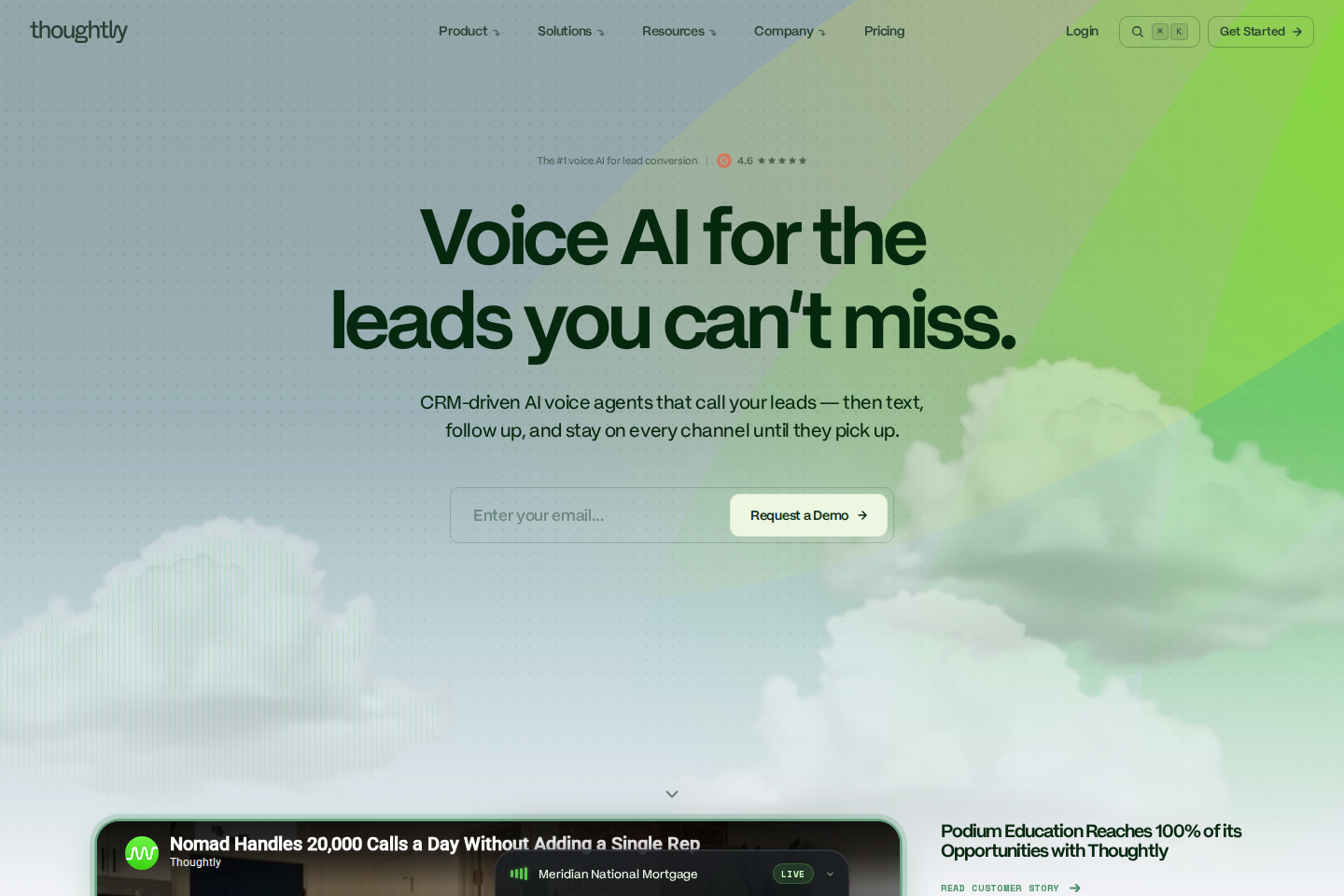
1. Thoughtly — Best overall for dealership lead conversion and multichannel follow-up
Thoughtly is a voice AI platform built for high-volume inbound lead conversionInbound lead conversionInbound lead conversion turns opted-in calls, form submissions, quote requests, and other inquiries into qualified conversations, appointments, or transfers.Read full definition → in high-consideration industries — and automotive is one of its validated verticals. Unlike platforms that only handle inbound calls or only send texts, Thoughtly orchestrates the entire lead follow-upLead follow-upLead follow-up is the sequence of calls, texts, emails, and tasks used after a prospect expresses interest.Read full definition → sequence: an internet leadInternet leadAn internet lead is a prospect generated through a website, advertisement, marketplace, aggregator, directory, or online application.Read full definition → arrives, the AI agent calls within seconds, qualifies the buyer's interest and timeline, sends a text confirmation, books the test drive or consultation, and writes everything back to the CRM. The same agent handles after-hours calls, missed-call callbacks, and ongoing follow-up sequences across voice, SMS, and email without requiring the BDC team to touch anything.
For dealerships, the multichannel execution is the key differentiator. Most AI phone agents in the automotive space handle calls or texts, but not both from the same conversation thread. Thoughtly maintains shared context across every channel a lead touches — so if a buyer inquires via text, gets a follow-up call, and then receives an email summary, all three interactions reference the same conversation. The platform integrates with major CRMs including HubSpot, Salesforce, and Pipedrive, and supports custom integrations for DMS platforms through its workflowWorkflowA workflow is a defined sequence of steps, decisions, actions, delays, and outcomes used to complete a business process.Read full definition → builder and API.
Pros
Sub-60-second speed-to-lead: automatically calls and texts new internet leads within seconds of form submission, covering the response-time window that most BDC teams cannot consistently hit.
True multichannel orchestration across voice, SMS, iMessage, WhatsApp, and email — all from the same agent with shared conversation context, so buyers do not repeat themselves across channels.
Qualification logic and appointment booking happen in the same conversation: the agent can check availability, offer time slots, confirm the appointment, and send calendar confirmations autonomously.
Per-minute pricing means dealerships pay for actual usage rather than committing to seat-based or per-location subscriptions that may not match seasonal volume fluctuations.
SOC 2 Type II, HIPAA, and GDPR certifications — important for dealerships handling PII, financing inquiries, and customer records across multiple rooftops.
Watch for
Thoughtly does not have purpose-built DMS integrations for CDK or Reynolds the way some automotive-native platforms do. Dealers can connect their DMS through Thoughtly's API and workflow tools, but it requires more setup than a pre-built connector.
The platform is strongest for lead conversion and follow-up workflows. Service department use cases like recall outreach or repair-status updates are buildable but are not pre-configured templates the way they are on automotive-specific platforms.
Best fit
Multi-rooftop dealer groups and high-volume single-point dealerships that process 500+ internet leads per month and need a platform that handles the entire follow-up lifecycle — not just answering phones. Ideal for BDC directors and general managers who want every lead contacted across voice and text within seconds, with outcomes logged directly to the CRM, without expanding headcount.
Pricing
Per-minute pricing. Each customer gets a dedicated account manager and customer success team that builds, launches, and optimizes their agents. Contact Thoughtly for dealership-specific pricing.
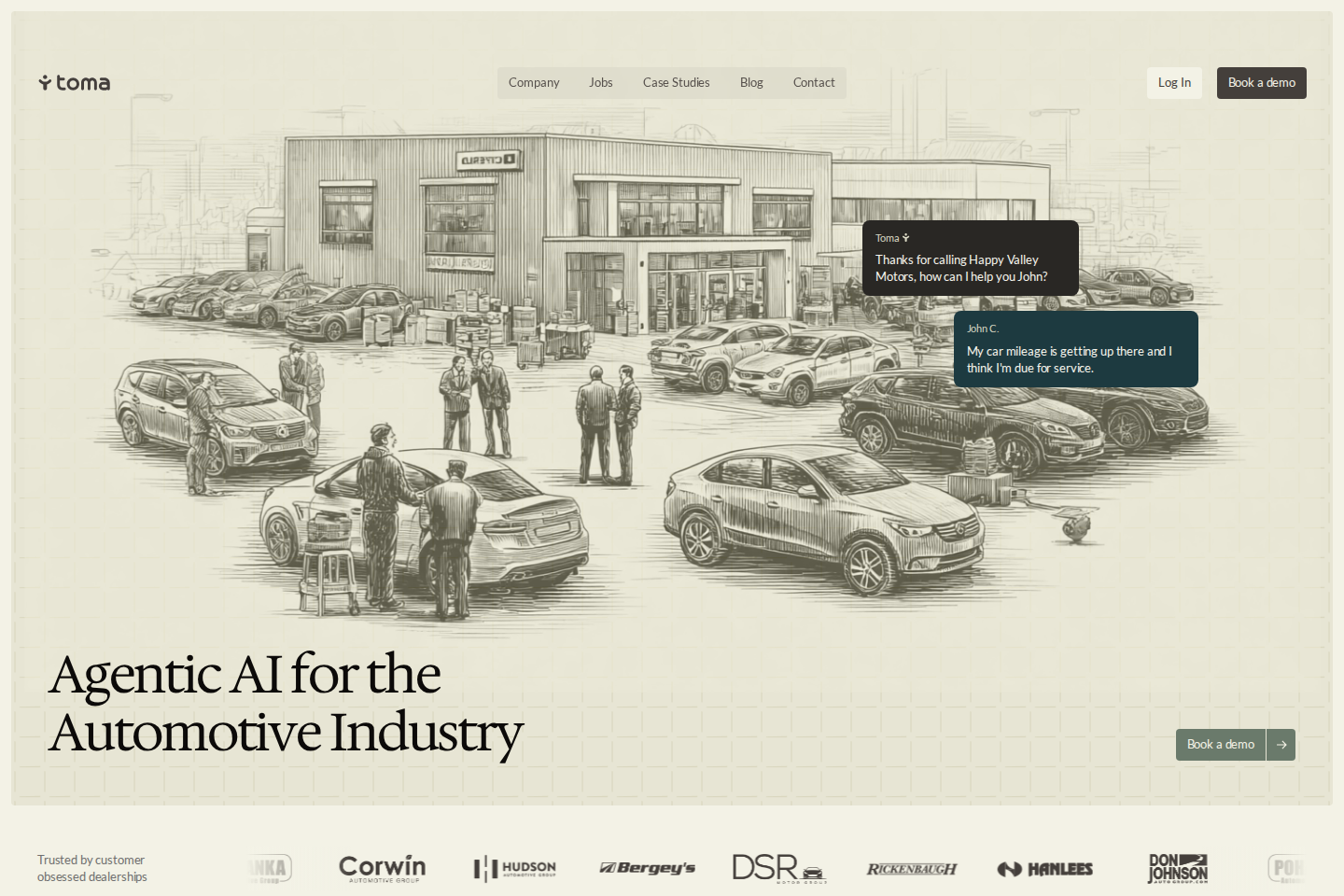
2. Toma — Best for fixed ops and service department automation
Toma is built specifically for the automotive industry and it shows. The platform handles both sales and service calls with deep dealership awareness — it can pull a customer's vehicle history from the DMS, know that a 2020 Honda Accord at 80,000 miles is due for specific OEM-recommended services, and book the appointment during the same call. Toma is used by recognizable dealer groups including Pohanka Automotive Group, Hudson Automotive Group, Corwin Automotive Group, and Bergey's. Their recent $17 million funding round signals continued investment in automotive-specific AI capabilities.
Where Toma stands out is fixed ops. Service departments handle high-volume, repetitive calls — appointment scheduling, recall notifications, service status checks, parts inquiries — and Toma has pre-built workflows for all of these. The platform integrates natively with CDK, Reynolds & Reynolds, and Tekion, so call outcomes and appointments flow directly into the DMS without manual data entry.
Pros
Native automotive DMS integrations with CDK, Reynolds & Reynolds, and Tekion — call outcomes, appointments, and customer data sync automatically.
Purpose-built service department workflows: recall campaign outreach, OEM-recommended service scheduling, repair status updates, and parts availability inquiries.
Vehicle-aware conversations: the AI pulls customer vehicle history and mileage context into the call so service recommendations are specific, not generic.
Proven at scale with major dealer groups — Pohanka, Hudson, Corwin — handling high call volumes across multiple rooftops.
Watch for
Toma is automotive-only, which means strong vertical depth but less flexibility if a dealer group also operates ancillary businesses. The platform is not designed for non-automotive use cases.
Multichannel follow-up is limited compared to platforms like Thoughtly. Toma handles voice and SMS, but the follow-up orchestration across email and additional messaging channels is less developed.
Pricing is not publicly listed, which makes it harder for smaller dealers to evaluate cost before engaging with sales.
Best fit
Dealerships where the service department is the primary profit center and fixed ops call volume is the bottleneck. Ideal for multi-rooftop groups that need deep DMS integration and automotive-specific conversation logic out of the box, particularly if service scheduling and recall outreach are higher priorities than internet lead follow-up.
Pricing
Contact Toma for pricing. The platform offers a managed onboarding option with tuning and optimization included.
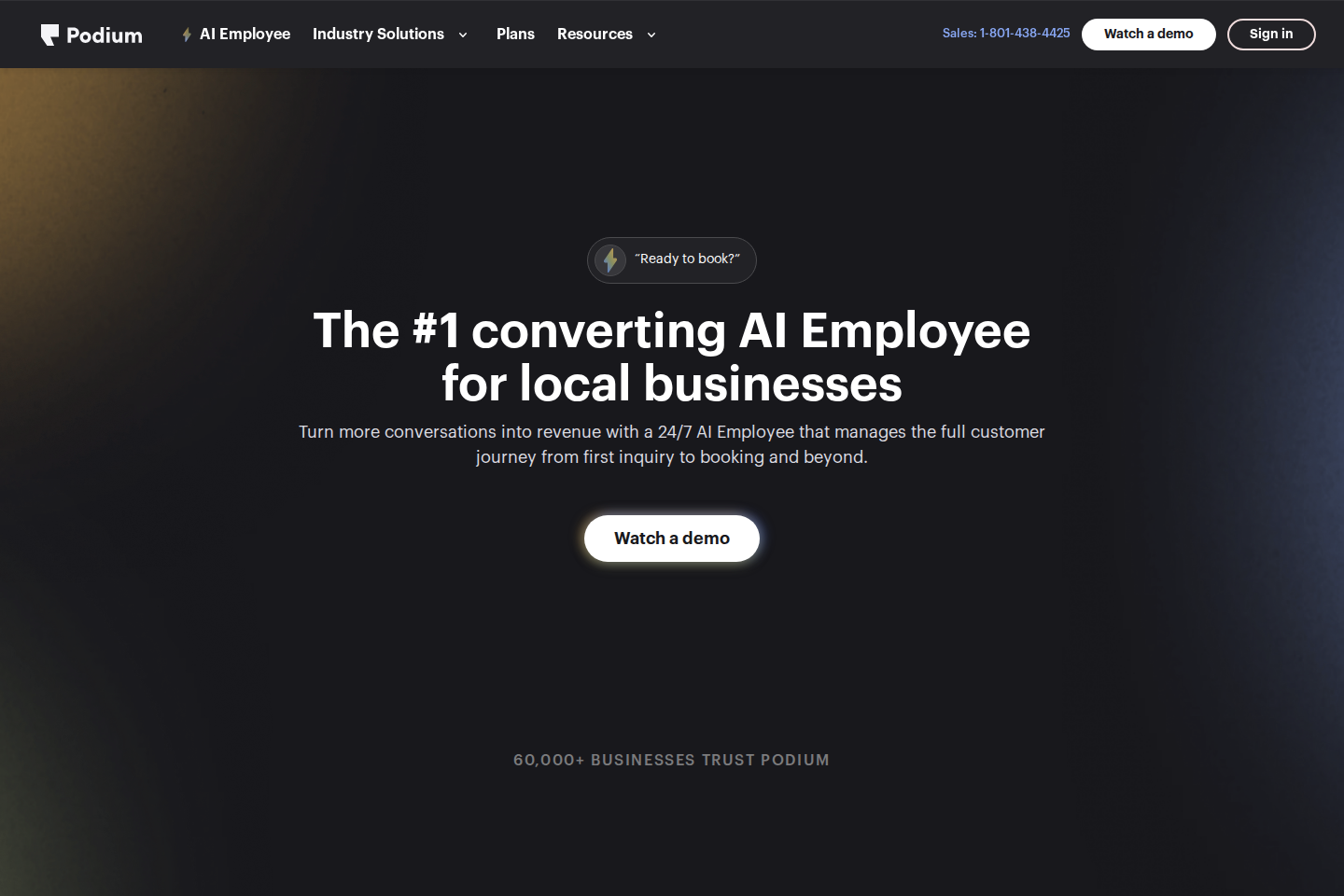
3. Podium — Best for dealership-wide customer communication and reviews
Podium built its reputation as a customer communication and review management platform for local businesses, and its AI BDC product extends that foundation into automotive phone handling. The advantage for dealerships already using Podium is consolidation: the AI phone agent sits on top of the same platform that manages Google reviews, web chat, text messaging, and payment processing. Podium's CEO Eric Rea appeared on the Car Dealership Guy podcast in 2025 to discuss the state of dealership AI, and the platform has significant dealer adoption — G2 shows a 4.6/5 rating from over 2,000 reviews across industries.
The AI BDC handles inbound calls, routes leads to the right department, and follows up via text — all within Podium's unified inbox. For dealers who already have Podium's messaging and review tools, adding AI phone handling is a natural extension rather than another vendor to manage.
Pros
Unified platform: AI phone agent, web chat, SMS messaging, review management, and payments all live in one system — fewer vendor contracts and fewer integration points for the dealer to manage.
Strong review management moat: Podium's automated review requests after service visits and sales are a proven driver of Google visibility for dealerships, and the AI phone agent feeds into the same customer record.
Established dealer adoption with a 4.6/5 G2 rating from over 2,000 reviews, providing more real-world validation than newer automotive-only AI startups.
Pre-built integrations with major automotive CRMs and DMS platforms including CDK, DealerSocket, and Reynolds & Reynolds.
Watch for
Podium's AI BDC is an add-on to its broader communication platform. Dealers who only need AI phone handling may find the bundled pricing difficult to justify if they are not using Podium's other tools.
Voice AI capabilities are newer relative to Podium's core messaging and review products. Dealers evaluating call quality and complex conversation handling should test extensively against automotive-specific scenarios before committing.
Premium pricing for advanced features. Smaller independent dealers may find the total platform cost exceeds what a focused AI phone agent would cost standalone.
Best fit
Dealerships already using Podium for reviews and messaging that want to consolidate AI phone handling into the same platform. Ideal for multi-location groups that value a single-vendor approach to customer communication rather than best-of-breed point solutions.
Pricing
Monthly subscription pricing. Podium offers tiered plans based on features and location count. Contact Podium for dealership-specific pricing that includes AI BDC capabilities.
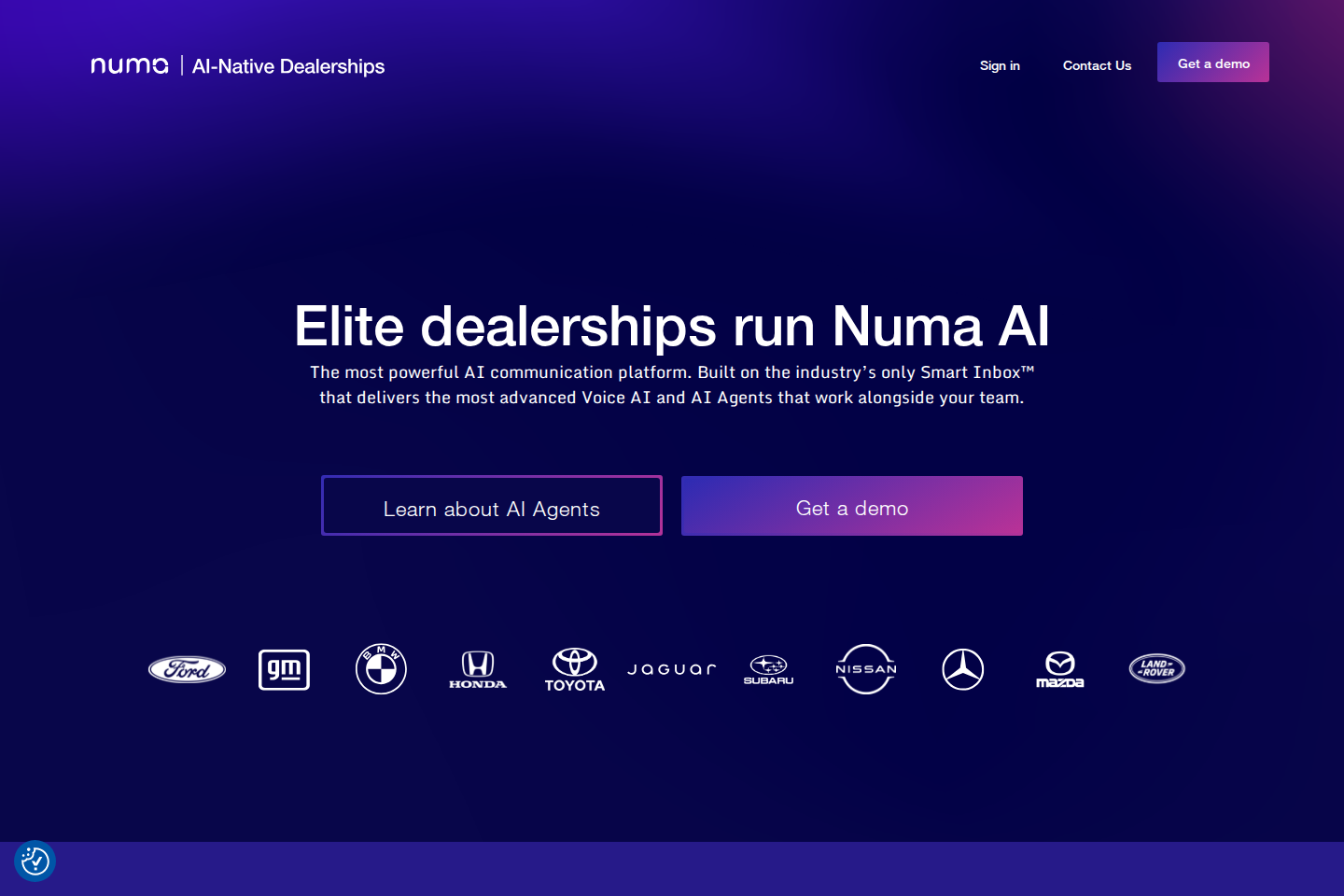
4. Numa — Best for BDC team collaboration and smart inbox
Numa approaches dealership AI from a team-augmentation angle rather than full automation. The platform's Smart Inbox aggregates calls, texts, and chats into a single view where AI handles the initial response and qualification, then routes to the right human when needed. For dealerships that want AI to handle the first touch and after-hours coverageAfter-hours coverageAfter-hours coverage handles inbound calls and inquiries when the regular team is closed, unavailable, or operating with reduced staffing.Read full definition → but still keep their BDC team in the loop for complex interactions, Numa provides a middle ground between full automation and a traditional phone tree.
Numa integrates with CDK, Reynolds & Reynolds, and DealerSocket, and is specifically designed for the dealership workflow where calls need to be routed between sales, service, parts, and the cashier — not just answered generically. The platform handles 24/7 voice coverage with natural-sounding AI that books service appointments and answers common questions.
Pros
Smart Inbox provides a unified view of all customer interactions across phone, text, and chat — making it easy for BDC teams to see what the AI handled and what needs human follow-up.
Strong department routing: calls are intelligently routed to sales, service, parts, or the cashier based on the caller's intent rather than a rigid phone tree.
Native DMS integrations with CDK, Reynolds & Reynolds, and DealerSocket for automated appointment booking and customer record lookups.
Designed for hybrid workflows where AI handles routine calls and humans handle high-value or complex interactions — a comfortable transition for dealers not ready for full automation.
Watch for
Numa is positioned more as a team collaboration tool than a full lead-conversion engine. Dealers who want aggressive outbound follow-up and multichannel campaign sequences may find the platform's capabilities limited to inbound handling and basic follow-up.
Outbound calling capabilities are not emphasized. Dealers who need proactive internet lead follow-up, recall outreach, or re-engagement campaigns should verify Numa's outbound capabilities before committing.
Best fit
Dealerships that want to augment their existing BDC team with AI rather than replace it. Ideal for stores where the general manager wants to ensure every call is answered 24/7 and routed correctly, but the BDC team still handles the consultative selling and complex scheduling.
Pricing
Custom pricing, typically in the $500–1,500/month range for enterprise features. Contact Numa for dealership-specific pricing.
5. Impel AI — Best for end-to-end customer lifecycle management
Impel AI positions itself as an end-to-end AI platform for automotive retail, covering the customer journey from first inquiry through post-sale loyalty. The platform combines conversational AIConversational AIConversational AI is software that interprets natural language and produces context-aware responses through voice, messaging, or chat.Read full definition → for phone and messaging with digital retailing tools, video walkarounds, and trade-in processing. For dealer groups that want a single platform to handle lead engagement, nurturing, sales follow-up, and service retention, Impel offers a broad suite rather than a point solution.
The platform's automotive depth is evident in its feature set: VIN-specific inventory integration, trade-in value estimation, financing pre-qualification conversations, and service appointment scheduling that pulls from the dealer's actual availability. Impel serves large dealer groups and has native DMS integrations for major platforms.
Pros
End-to-end lifecycle coverage: lead engagement, inventory matching, trade-in processing, financing conversations, service scheduling, and loyalty outreach — all from one platform.
VIN-specific inventory integration allows the AI to answer questions about specific vehicles in stock, including trim, color, pricing, and availability — not just generic responses.
Video walkaround capability lets the platform send personalized vehicle videos to prospects, adding a visual engagement layer that text-only follow-up cannot match.
Native DMS integrations with major automotive platforms for bi-directional data flow between the AI and the dealer's system of record.
Watch for
The breadth of the platform can mean complexity in implementation. Dealers who only need AI phone handling may find the full suite overkill, and the implementation timeline may be longer than focused point solutions.
Impel's AI voice capabilities are part of a larger platform that includes digital retailing and marketing tools. Dealers should verify that the voice AI component matches their specific call quality and conversation depth requirements rather than evaluating based on the overall platform feature list.
Best fit
Large dealer groups that want a single automotive-specific platform covering the entire customer lifecycle — from internet lead engagement through service retention. Best suited for organizations with the implementation bandwidth to adopt a comprehensive suite rather than a single-purpose AI phone agent.
Pricing
Contact Impel AI for pricing. The platform typically serves mid-to-large dealer groups with custom pricing based on rooftop count and feature scope.
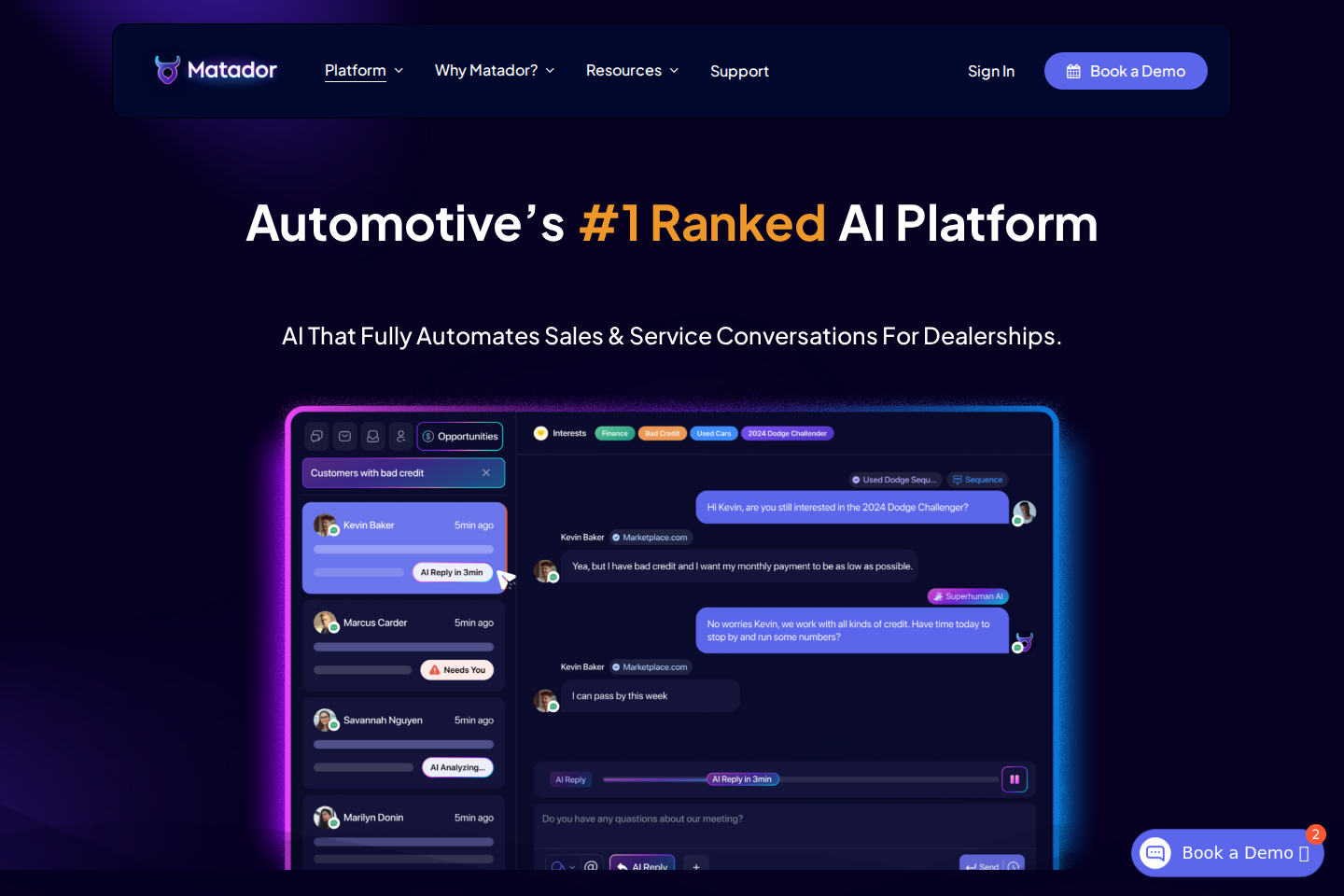
6. Matador AI — Best for lead intent scoring and hot prospect routing
Matador AI focuses on identifying which leads are most likely to buy and routing them to the right person at the right time. The platform's Opportunity Search feature scans incoming leads and flags hot prospects based on intent signals — form submissions, repeat website visits, specific vehicle page views, and conversation sentiment. For dealerships drowning in internet leads with limited BDC bandwidth, Matador helps prioritize which leads deserve immediate human attention versus which ones the AI should continue nurturing.
The platform handles initial lead engagement via text and voice, qualifies interest, and scores each lead's purchase readiness. When a lead meets the threshold, Matador alerts the assigned salesperson with context about what the buyer has been looking at and what they have said — so the human follow-up call starts with information rather than a cold introduction.
Pros
Intent-based lead scoring: the Opportunity Search feature identifies hot prospects based on behavioral signals across website visits, form fills, and conversation engagement — helping BDC teams focus human effort where it matters most.
Context-rich handoffs: when a lead is escalated to a human, the salesperson receives a summary of the buyer's interests, vehicle preferences, and conversation history — eliminating the cold-call dynamic.
Automotive-specific conversation flows for new and used vehicle inquiries, trade-in discussions, and financing pre-qualification.
Watch for
Matador's strength is in SMS-first engagement and lead scoring rather than full voice AI phone handling. Dealers who need robust inbound call answering and complex phone conversations should test the voice component specifically against their call scenarios.
Service department capabilities are limited compared to platforms like Toma or Numa that have pre-built fixed ops workflows. Matador is primarily a sales-side tool.
Best fit
Dealerships with a strong BDC team that needs better lead prioritization and faster identification of purchase-ready buyers. Ideal for high-volume stores where the challenge is not answering calls but figuring out which leads to pursue first.
Pricing
Contact Matador AI for pricing. The platform serves dealerships with custom pricing based on volume and feature requirements.
7. Conversica — Best for automated AI lead follow-up at scale
Conversica pioneered AI-powered lead follow-up before most of the platforms on this list existed. The company has been automating sales outreach via email and SMS since 2007, and its Revenue Digital Assistants handle persistent, multi-touch follow-up campaigns that continue engaging leads until they respond or opt out. For dealerships that struggle with long-term lead nurturing — following up with someone who submitted a form three weeks ago and never responded — Conversica is built precisely for that problem.
The platform integrates deeply with Salesforce, HubSpot, and automotive CRMs including Elead, and its AI assistants can be configured for automotive sales scenarios including new vehicle inquiries, service reminders, and trade-in outreach. Conversica's long track record means a large base of deployment data and trained conversation models, though the platform's roots in email-first follow-up mean its real-time voice AI capabilities are newer than some competitors.
Pros
Proven at scale: Conversica has been running AI lead follow-up since 2007 with a large customer base across industries including automotive — providing more long-term performance data than newer entrants.
Persistent multi-touch follow-up: the AI does not give up after one attempt. It continues engaging leads across email, SMS, and voice with varied messaging until the lead responds, converts, or opts out.
Deep CRM integrations with Salesforce, HubSpot, and Elead — ensuring that every AI interaction is logged and attributed in the dealer's sales pipeline.
Watch for
Conversica's roots are in email and SMS follow-up. The real-time voice AI component is newer, and dealers who prioritize inbound call handling should test Conversica's voice capabilities against purpose-built voice-first platforms.
Annual subscription pricing can be a significant commitment for smaller dealers. Conversica has historically served mid-market to enterprise customers, and the pricing model reflects that.
The platform is horizontal rather than automotive-specific. While Conversica has automotive customers and templates, it does not have the DMS-native integrations or vehicle-aware conversation logic that Toma or Impel provide.
Best fit
Dealerships and dealer groups that need persistent, long-term lead nurturing across email, SMS, and voice — particularly for re-engaging aged leads that the BDC team has stopped working. Best for organizations already using Salesforce or HubSpot as their primary CRM.
Pricing
Annual subscription pricing. Contact Conversica for automotive-specific pricing. The platform typically serves mid-market to enterprise dealer groups.
Which AI phone agent should you choose for your dealership?
The right platform depends on which dealership problem is costing you the most revenue today:
If your internet leads are going stale because the BDC team cannot follow up fast enough: Thoughtly. The per-minute pricing, sub-60-second response, and multichannel follow-up across voice, SMS, and email are built for this exact problem.
If your service department is drowning in phone calls and missing appointments: Toma. The native DMS integrations and pre-built fixed ops workflows make it the strongest choice for service-heavy dealerships.
If you are already using Podium for reviews and messaging: Podium AI BDC. Consolidating AI phone handling into the same platform you already use for customer communication reduces vendor complexity.
If you want AI to augment your BDC team, not replace it: Numa. The Smart Inbox and hybrid routing model lets AI handle routine calls while humans handle complex selling.
If you need a comprehensive automotive lifecycle platform: Impel AI. The end-to-end coverage from lead engagement through service retention suits large groups that want one platform.
If your biggest problem is identifying which leads are ready to buy: Matador AI. The intent scoring and opportunity search help prioritize human effort on purchase-ready prospects.
If you need persistent long-term follow-up on aged leads: Conversica. The multi-touch nurturing engine continues engaging leads that the BDC team has moved past.
For most dealerships in 2026, the core challenge is not answering phones — it is converting the internet leads that arrive after hours, on weekends, and faster than the BDC team can respond. The platform that handles that full conversion lifecycle across voice and text, while writing outcomes back to the CRM, will deliver the highest ROI.
FAQ
What is an AI phone agent for dealerships?
An AI phone agent for dealerships is software that uses artificial intelligence to handle inbound and outbound phone calls autonomously — answering customer inquiries, qualifying leads, booking test drives and service appointments, and routing calls to the right department. Unlike a traditional IVRIVRIVR, or Interactive Voice Response, is a phone menu that routes or serves callers through keypad entries or spoken choices.Read full definition → or phone tree, these platforms use natural language processing to have actual conversations, understand intent, and take actions like scheduling or CRM updatesCRM updatesCRM updates are changes written after or during a conversation, such as status, notes, owner, next step, appointment, or disposition.Read full definition →.
How much do AI phone agents cost for car dealerships?
Pricing varies significantly across platforms. Per-minute pricing (like Thoughtly) typically ranges from a few cents to around $0.50 per minute of conversation, meaning dealers pay based on actual call volume. Subscription-based platforms (like Podium and Conversica) can range from $500 to several thousand dollars per month depending on features, rooftop count, and call volume. Automotive-specific platforms like Toma and Numa typically offer custom pricing based on the dealer's size and requirements.
Can AI phone agents integrate with my DMS?
Some platforms — particularly automotive-native ones like Toma, Numa, and Impel — offer pre-built integrations with major DMS platforms including CDK, Reynolds & Reynolds, Tekion, and Dealertrack. Horizontal platforms like Thoughtly and Conversica typically connect to dealer systems through APIs, webhooks, and workflow tools like Zapier. Before committing, ask any vendor to demonstrate a live write-back to your specific DMS — integration claims and actual integration depth can differ.
Will AI replace my BDC team?
Most dealerships in 2026 are using AI to augment their BDC team, not replace it. AI handles the high-volume, time-sensitive tasks that BDC teams struggle with — instant lead response, after-hours coverage, follow-up persistence, and repetitive service scheduling — while humans handle the consultative selling, complex trade-in negotiations, and relationship building that still require a personal touch. The result is usually higher lead coverage and faster response times without expanding BDC headcount.
How fast can an AI phone agent respond to internet leads?
The best platforms can initiate outbound contact — a phone call, a text, or both — within seconds of a lead submission. Thoughtly, for example, can call and text new internet leads in under 60 seconds. This speed matters because industry data consistently shows that leads contacted within the first minute convert at significantly higher rates than those left waiting for 15–30 minutes in a CRM queue. After-hours leads are where AI provides the most dramatic improvement, since the alternative is waiting until the next business day.
What should I ask during an AI phone agent demo?
Ask the vendor to demonstrate these specific scenarios: (1) an after-hours internet lead arriving from your actual lead sourceLead sourceLead source identifies the channel, campaign, marketplace, partner, form, or referral that generated an inquiry.Read full definition →, (2) a service appointment booking for a vehicle in your DMS, (3) a call where the customer interrupts and changes the subject, (4) a warm transferWarm transferA warm transfer connects a live caller to the right person while preserving the context already collected during the conversation.Read full definition → to a live salesperson with context, (5) how call outcomes are logged in your CRM or DMS. Also ask about pricing transparency, contract length, implementation timeline, and what happens when the AI cannot handle a call. If the vendor cannot demonstrate your specific workflow during the demo, that is a signal.