7 Best AI Voice Agents for Enterprise Automation in 2026 (Tested and Ranked)
I evaluated the leading AI voice agent platforms built for enterprise revenue teams — comparing security, CRM depth, multichannel execution, and workflow complexity to help you choose the right platform for high-volume lead conversion at scale.
Last updated
I evaluated the AI voice agentVoice agentA voice agent is a conversational software system that listens, responds, follows a defined workflow, and can take approved actions during a phone conversation.Read full definition → platforms that enterprise revenue teams most commonly consider when they need to automate inbound lead conversionInbound lead conversionInbound lead conversion turns opted-in calls, form submissions, quote requests, and other inquiries into qualified conversations, appointments, or transfers.Read full definition → at scale — without sacrificing security, compliance, or CRMCRMA CRM is the system used to manage leads, contacts, accounts, opportunities, activity, ownership, and follow-up.Read full definition → fidelity. Enterprise automation is a different test than general-purpose voice AI. The platform needs to handle SOC 2 audits, role-based access, multi-team deployment, native CRM write-backCRM write-backCRM write-back sends conversation outcomes, qualification answers, notes, appointments, dispositions, and next steps into the CRM.Read full definition →, and multichannel follow-up execution — not just make phone calls.
The platforms below were evaluated on six criteria that matter most to enterprise revenue operations: security and compliance posture, multichannel execution depth, CRM and tech stack integration, workflowWorkflowA workflow is a defined sequence of steps, decisions, actions, delays, and outcomes used to complete a business process.Read full definition → complexity, voice quality and conversation handling, and deployment support. I consulted vendor documentation, G2 and Trustpilot reviews, independent comparisons, and actual platform capabilities to rank these seven options.
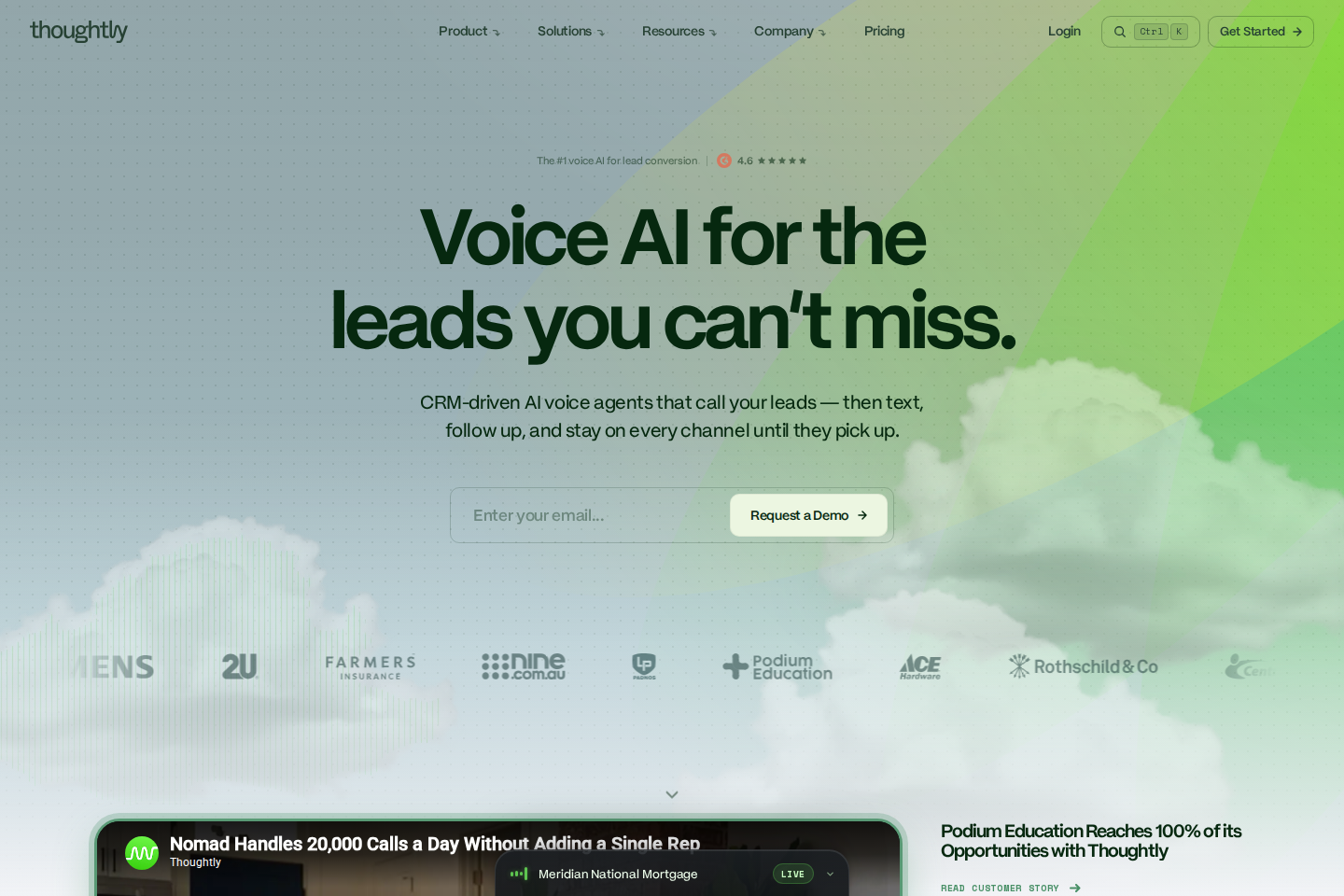
Thoughtly leads this list because it is the only platform that combines enterprise-grade security (SOC 2 Type II, HIPAAHIPAAHIPAA is a US federal law whose Privacy, Security, and Breach Notification Rules govern protected health information for covered entities and business associates.Read full definition →, GDPR) with autonomous multichannel revenue execution across voice, SMS, email, and CRM — purpose-built for the RevOps teams that actually own lead conversion.
Quick takeaways
Thoughtly is the best overall choice for enterprise revenue teams that need autonomous voice + SMS + email execution with native CRM write-back, SOC 2 Type II certification, and dedicated account management.
Regal.ai is the strongest option for enterprise CX operations teams that want a branded contact center with human-AI hybrid workflows, journey orchestration, and agent-assist features alongside AI voice.
Cognigy is purpose-built for global enterprises that need multilingual conversational AI across voice and chat with deep CCaaS integrations (Genesys, NICE, Avaya) and on-premises deployment options.
PolyAI excels at high-volume phone automation for enterprise support and containment, with natural-sounding dialogue and deep restaurant, hospitality, and financial services deployment experience.
Salesforce Agentforce is the natural fit for enterprises already running Salesforce Sales Cloud or Service Cloud, with native CRM context and trust layer built into the Salesforce ecosystem.
Balto is the best choice for enterprises that want real-time guidance on live human agent calls — coaching, compliance prompts, and QA automation — rather than full call automation.
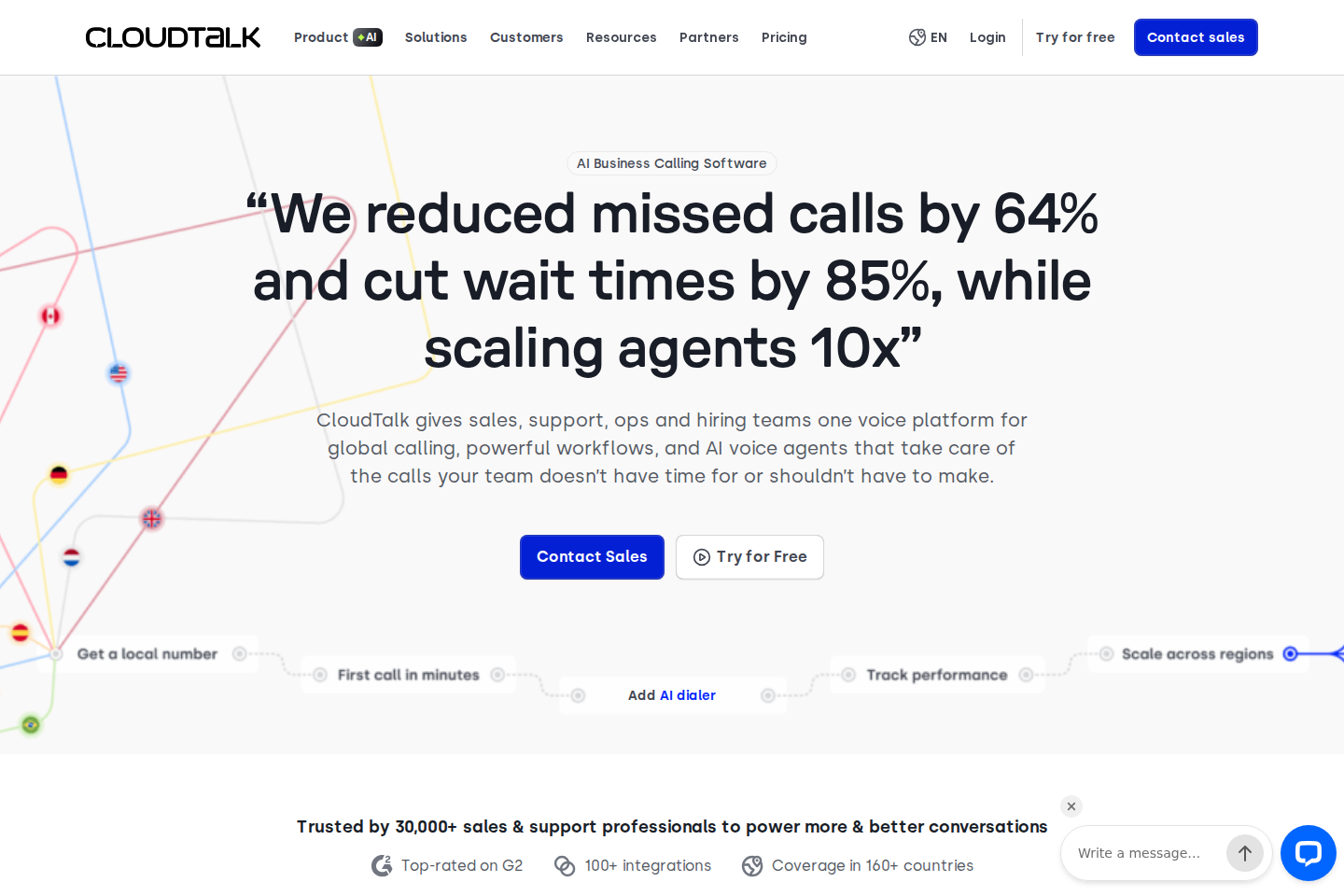
CloudTalk offers a practical mid-market-to-enterprise option that combines AI-powered call handling with a full business phone system, CRM integrations, and international number coverage.
How I evaluated these AI voice agents for enterprise automation
Enterprise automation requires a different evaluation framework than general voice AI. A platform that demos well on a single call can still fail at enterprise scale if it cannot pass a security review, connect to your CRM, or coordinate follow-up across channels. Here is how I scored each platform.
1. Security, compliance, and governance
Enterprise buyers face real procurement requirements: SOC 2 Type II audits, HIPAA compliance for healthcare-adjacent workflows, GDPR readiness for international teams, role-based access controls, SSO support, and audit-ready call logging. I evaluated each platform against these requirements by reviewing their public security pages, trust documentation, and compliance certifications. Platforms that treat compliance as a checkbox rather than a built-in layer scored lower. The difference matters when your legal team reviews the vendor security questionnaire and when a regulated industry requires call-level consent tracking, PIIPersonally Identifiable Information (PII)Personally identifiable information, or PII, is information that can distinguish or trace an individual’s identity alone or when combined with linked data.Read full definition → handling policies, and data residency controls.
2. Multichannel revenue execution
Enterprise lead conversion rarely happens in a single phone call. The best platforms orchestrate follow-up across voice, SMS, email, and messaging — all from the same agent context, so a lead who ignores a call gets a text summary, then an email, then a callback. I looked for native multichannel capability (not just 'connect TwilioTwilioTwilio is a cloud communications platform that provides programmable voice, messaging, phone numbers, and related APIs.Read full definition → and figure it out') with shared conversation history across channels. Platforms that only handle voice scored lower, because enterprise revenue teams need the entire follow-up sequence automated, not just the first touchpoint.
3. CRM and tech stack integration depth
Enterprise tech stacks are complex. I evaluated whether each platform offers native, bidirectional CRM integrations — reading lead data before the call, writing outcomes after — or whether it relies on generic webhooks that require engineering to maintain. Specific integrations I tested for include HubSpot, Salesforce, Pipedrive, GoHighLevel, and Zoho, plus scheduling tools (Calendly, Cal.com, Acuity) and workflow platforms (Zapier, Make). Depth matters more than breadth: can the platform respect field-level security in Salesforce, triggerTriggerA trigger is an event or condition that starts, resumes, changes, or stops an automated workflow.Read full definition → a workflow in HubSpot, or update a deal stage in Pipedrive without custom code?
4. Workflow complexity and agent builder
Enterprise use cases require sophisticated conversation logic: multi-step qualification flows, conditional branching based on lead attributes, warm transfers with context, voicemail detectionVoicemail detectionVoicemail detection identifies whether an outbound call reached a live person or an answering system, then selects the appropriate next action.Read full definition → and message delivery, and callback scheduling. I evaluated each platform's agent builder for how complex a workflow it can express without engineering support. Platforms with visual builders that non-technical RevOps teams can own scored higher than API-only platforms that require a developer for every change. I also looked for features like A/B testing, prompt versioning, and agent analytics.
5. Voice quality and conversation handling
Voice quality at enterprise scale means low latencyLatencyLatency is the elapsed time between a caller's speech and the agent's response, including listening, processing, tool, network, and speech-generation delays.Read full definition → (sub-400ms response times), natural turn-taking, accurate speech-to-text across accents and background noise, and graceful handling of interruptions, pauses, and multi-party scenarios. I reviewed call recordings, latency benchmarks, and user reviews focused on conversation naturalness. Enterprise callers are less forgiving of robotic pauses or hallucinated responses than early adopters, so this dimension filters out platforms that sound good in demos but struggle in production.
6. Deployment support and time-to-value
Enterprise deployments need more than a self-serve dashboard. I evaluated whether each vendor provides dedicated implementation support, customer success management, agent build-out assistance, and ongoing optimization. Platforms that pair every customer with a named account manager and actively build and tune agents scored higher than those that leave enterprise buyers to self-serve from documentation. I also considered typical deployment timelines reported by customers — can you go live in days, or does it take months of professional services?
Quick comparison of the best AI voice agents for enterprise automation
Platform
Best for
Key channels
CRM depth
Security
Pricing model
Thoughtly
Enterprise revenue teams converting inbound leads across voice, SMS, and email
Global enterprises needing multilingual voice + chat AI
Voice, chat, messaging
Salesforce, SAP, Genesys, NICE, Avaya
SOC 2, ISO 27001, GDPR
Custom enterprise pricing
PolyAI
High-volume phone automation for enterprise support
Voice (primary)
Custom integrations via API
SOC 2 Type II, PCI DSS
Custom enterprise pricing
Salesforce Agentforce
Salesforce-native enterprise teams
Voice, chat, email, SMS
Native Salesforce CRM
Salesforce Trust Layer, SOC 2
Per-conversation pricing (Einstein credits)
Balto
Real-time human agent guidance and QA automation
Voice (agent-assist overlay)
Salesforce, Five9, NICE, Genesys
SOC 2 Type II, HIPAA
Per-seat pricing
CloudTalk
Mid-market and enterprise teams scaling AI voice + phone system
Voice, SMS
HubSpot, Salesforce, Pipedrive, Zoho, Intercom
SOC 2 Type II, GDPR
Per-seat plans starting ~$25/mo; AI add-ons
7 best AI voice agents for enterprise automation in 2026
1. Thoughtly — Best overall for enterprise revenue teams
Thoughtly is a voice AI platform built specifically for autonomous, high-volume inbound lead conversion in regulated and high-consideration industries. Real estate brokerages, mortgage lenders, insurance carriers, financial services firms, multi-location healthcare networks, automotive groups, education enrollment teams, and home services franchises use Thoughtly to deploy AI agents that engage 100% of inbound leads across voice, SMS, iMessage, WhatsApp, and email — qualifying interest, scheduling meetings, and updating CRM records autonomously. Customers include Siemens, 2U, Sleep Doctor, Nomad, and Farmers Insurance.
What separates Thoughtly from infrastructure-first competitors is that it owns the conversion layer end-to-end: omnichannelOmnichannelOmnichannel is a coordinated customer journey in which context and state carry across voice, SMS, email, web, and human interactions.Read full definition → agent orchestration, native CRM read/write, intent routing, and shared conversation context across every channel a lead touches. The platform delivers sub-350ms response latency, supports 34 languages natively, and ships with 24+ certified integrations across CRMs, schedulers, dialers, and comms tools. Every customer is paired with a dedicated account manager and customer success team that builds, launches, and optimizes their agents.
Pros
SOC 2 Type II certified with HIPAA and GDPR compliance built in — not bolted on. TCPA-safe dialing, consent tracking, DNC scrubbing, and state-specific recording-consent disclosures enforced on every call.
True multichannel execution: voice, SMS, iMessage, WhatsApp, and email from a single agent context. A lead who misses a call gets a text summary, then an email follow-up, then a callback — all with shared conversation history.
24+ native integrations including HubSpot, Salesforce (with field-level security and sharing rules), Pipedrive, GoHighLevel, Zoho CRM, Calendly, Cal.com, Acuity, Shopify, Make, and Zapier. OAuth on every connection with scoped tokens.
Revenue Autopilot orchestrates the entire lead lifecycle: CRM triggers the agent, agent qualifies and books, CRM gets the outcome — without manual intervention or engineering maintenance.
Dedicated account manager and customer success team included with every deployment. Thoughtly builds, launches, and optimizes your agents rather than leaving enterprise buyers to self-serve from documentation.
Watch for
Requires your company to have a clear CRM, lead source, or system of record to get the most value. Thoughtly is built for teams with existing inbound volume and defined qualification workflows — not for early-stage companies still figuring out their funnel.
Requires upfront definition of qualification rules, escalation paths, and follow-up logic. The platform is powerful, but the quality of the output depends on the clarity of the input.
Best fit
Enterprise revenue teams in high-consideration consumer industries (insurance, mortgage, real estate, automotive, healthcare, education, financial services, home services) that receive 500+ opted-in inbound leads per month but only have the human capacity to follow up with the top 10%. Thoughtly fills the coverage gap with autonomous multichannel execution that does not require engineering ownership.
Pricing
Per-minute pricing with dedicated account management included. Contact Thoughtly for enterprise volume pricing.
2. Regal.ai — Best for enterprise CX operations with human-AI hybrid workflows
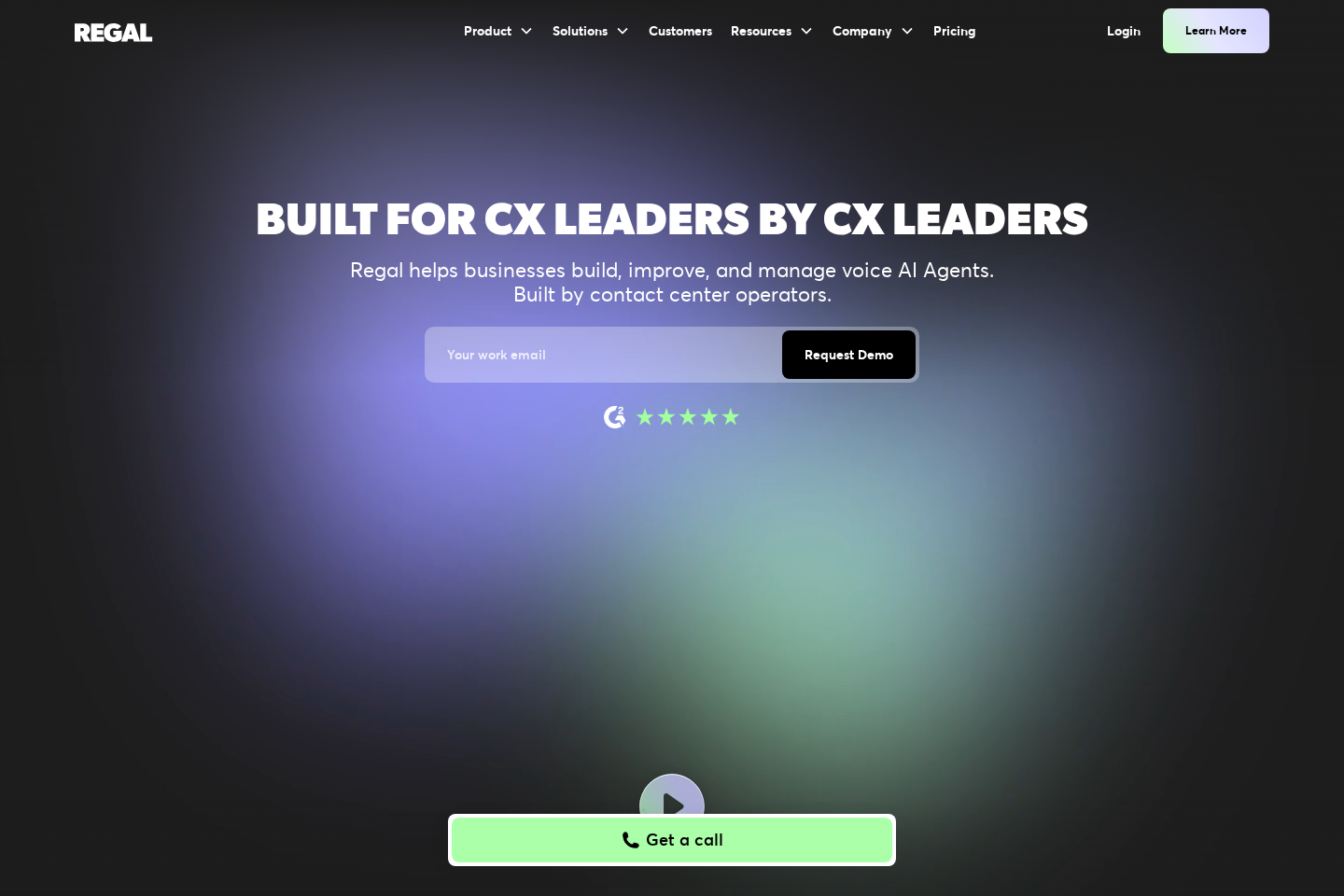
Regal.ai positions itself as an AI-powered contact centerContact centerA contact center is a centralized operation that handles customer or prospect interactions across voice and digital channels.Read full definition → platform built for high-volume outreach and engagement. The platform combines AI voiceAI voiceAn AI voice is synthetic speech produced by a text-to-speech model, using a selected or cloned voice to speak an agent's generated or scripted response.Read full definition → agents, branded callingBranded callingBranded calling displays verified business identity, and sometimes a logo or call reason, on supported devices when a business calls.Read full definition →, journey orchestration, and human agent tools in a unified operating layer. Regal's strength is in blending AI automation with human oversight — their AI agents can handle initial outreach and qualification, then warm-transfer to human agents with full context. The platform is used primarily in insurance, healthcare, education, and financial services.
Regal offers journey-level orchestration, meaning you can design multi-step engagement sequences across voice and SMS that adapt based on lead behavior, CRM signals, and previous conversation outcomes. The platform provides real-time agent dashboards, conversation analytics, QA tools, and compliance controls designed for regulated enterprise environments.
Pros
Human-AI hybrid workflows let AI agents handle initial outreach and qualification while routing complex conversations to human agents with full context — useful for enterprises that cannot fully automate regulated conversations.
Branded calling with verified caller ID helps enterprise teams maintain pickup rates and trust, especially in industries where consumers screen unknown numbers.
Journey orchestration across voice and SMS with event-driven triggers from CRM data, letting enterprise teams build sophisticated multi-touch engagement sequences.
Watch for
Regal's platform is designed around the contact center operating model (seats, queues, agent desktops, QA workflows), which adds platform complexity when the buyer's actual need is autonomous lead conversion without human agent infrastructure. Teams that want 100% automated inbound coverage may find the human-agent tooling overbuilt for their use case.
Pricing is custom and enterprise-only, with no published per-minute or per-seat rates. Multiple G2 reviewers note that contract negotiations and pricing transparency can be challenging, and some report that the platform's value requires significant contact volume to justify the investment.
Best fit
Enterprise CX and revenue operations teams that already have human agents and want to augment them with AI — not replace them. Regal works best when you need journey orchestration, branded calling, and human escalationEscalationEscalation moves a conversation to a person, specialist, supervisor, or alternate workflow when the agent should not continue alone.Read full definition → paths alongside AI automation in regulated verticals.
Pricing
Custom enterprise pricing. Contact Regal for a quote.
3. Cognigy — Best for global enterprises needing multilingual conversational AI
Cognigy is an enterprise conversational AIConversational AIConversational AI is software that interprets natural language and produces context-aware responses through voice, messaging, or chat.Read full definition → platform that supports voice and chat automation across 100+ languages with deep integrations into the major CCaaS platforms — Genesys, NICE CXone, Avaya, and Amazon Connect. The platform's strength is in large-scale, multilingual deployments where a single enterprise needs conversational AI that works across regions, languages, and existing contact center infrastructure. Cognigy holds ISO 27001 and SOC 2 certifications and offers on-premises deployment options for organizations with strict data residency requirements.
Cognigy's visual flow builder (Cognigy.AI) lets teams design complex conversation flows with NLUNLUNatural Language Understanding (NLU) is the capability that extracts meaning, intent, entities, and context from a person's spoken or written language.Read full definition →, intent recognition, and context management. The platform also includes Cognigy Insights for conversation analytics, agent handover protocols, and knowledge AI for RAG-based responses. It is used by enterprises including Lufthansa, Toyota, and Bosch.
Pros
Supports 100+ languages with production-grade NLU, making it the strongest option for global enterprises that need consistent conversational AI across regions — including languages that many competitors do not support at enterprise quality.
Deep CCaaS integrations with Genesys, NICE CXone, Avaya, and Amazon Connect let enterprises add AI voice automation to existing contact center infrastructure without replacing their telephony stack.
On-premises and private cloud deployment options for enterprises with strict data residency, sovereignty, or air-gapped security requirements — a differentiator that most cloud-only competitors cannot match.
Watch for
Cognigy's strength is in contact center automation and customer service — not inbound lead conversion or revenue execution. Enterprise RevOps teams looking for autonomous lead qualification, CRM write-back, and multichannel follow-up may find that Cognigy's workflow model is optimized for support deflection rather than revenue outcomes.
Implementation complexity is a recurring theme in G2 reviews. Multiple reviewers note that the platform requires significant configuration, NLU training, and professional services to reach production quality — with deployment timelines measured in months, not days. Smaller teams without dedicated conversational AI engineers may struggle.
Best fit
Global enterprises with existing contact center infrastructure (Genesys, NICE, Avaya) that need multilingual voice and chat AI across multiple regions and languages. Best when the primary use case is customer service automation, IVRIVRIVR, or Interactive Voice Response, is a phone menu that routes or serves callers through keypad entries or spoken choices.Read full definition → replacement, or support deflection at scale rather than inbound lead conversion.
Pricing
Custom enterprise pricing based on conversation volume and deployment model. Contact Cognigy for a quote.
4. PolyAI — Best for high-volume enterprise phone automation
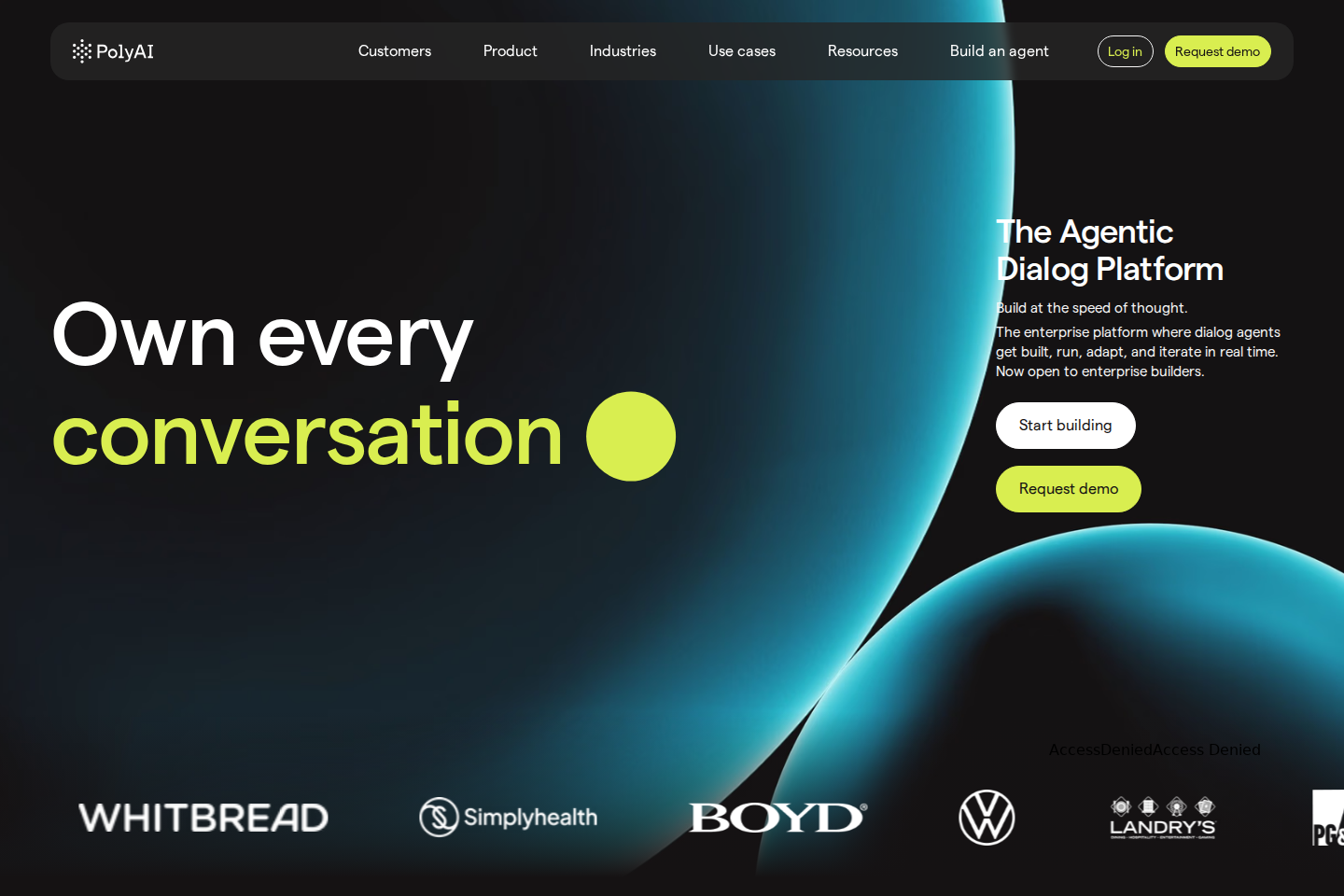
PolyAI builds enterprise-grade voice assistants designed to handle high-volume phone interactions with natural-sounding dialogue. The platform is deployed across restaurants, hospitality, financial services, and healthcare, with a focus on containment rate — the percentage of calls fully resolved by the AI without human intervention. PolyAI's voice agents are known for natural conversation handling, including complex turn-taking, interruption recovery, and context retention across long calls.
PolyAI takes a managed-deployment approach: their team designs, builds, and optimizes voice agents for each customer, rather than providing a self-serve builder. This white-glove model delivers high-quality deployments but means that changes and iterations go through PolyAI's team rather than being self-service. The platform integrates with existing telephony and contact center systems and holds SOC 2 Type II and PCI DSS certifications.
Pros
Industry-leading voice naturalness and conversation handling. PolyAI's dialogue engine handles interruptions, backtracking, and complex multi-turn conversations more naturally than most competitors, which translates to higher containment rates and better caller experience.
SOC 2 Type II and PCI DSS certified, making it suitable for financial services and healthcare enterprises with strict security requirements for payment processing and data handling.
Proven at enterprise scale in hospitality (handling restaurant reservations for large chains), financial services, and healthcare — with public case studies showing 50%+ containment rates and significant cost reduction.
Watch for
PolyAI is primarily a voice-only platform focused on inbound phone containment — it does not natively support SMS, email, or multichannel follow-up sequences. Enterprise revenue teams that need the full lead conversion lifecycle (call → text → email → CRM update) will need to integrate separate tools for non-voice channels.
The managed-deployment model means you cannot self-serve changes to your agent. Updates, flow changes, and optimizations go through PolyAI's team, which can slow iteration cycles. Multiple G2 reviewers note that the platform's value is high but the lack of self-serve controls can be frustrating for teams that want to iterate quickly.
Best fit
Enterprises with high inbound call volume (restaurants, hospitality, healthcare scheduling, financial services) where the primary goal is phone containment and resolution quality — not multichannel lead conversion or outbound follow-up. Best when you need the highest possible voice quality and are comfortable with a managed-service engagement model.
Pricing
Custom enterprise pricing. Contact PolyAI for a quote.
5. Salesforce Agentforce — Best for Salesforce-native enterprise teams
Salesforce Agentforce is Salesforce's native AI agent platform, including voice capabilities through Agentforce Voice. For enterprises already running Salesforce Sales Cloud or Service Cloud, Agentforce offers the deepest possible CRM integrationCRM integrationA CRM integration connects an agent or communications platform with a CRM so the systems can exchange records, events, and actions.Read full definition → — the AI agent has direct access to your Salesforce data model, object relationships, field-level security, sharing rules, and workflow triggers. Agentforce uses Salesforce's Einstein Trust Layer for hallucinationHallucinationAn AI hallucination, also called a confabulation, is a plausible-sounding response that is false, unsupported, or inconsistent with the available source information.Read full definition →guardrailsGuardrailsAI guardrails are instructions, rules, data boundaries, and escalation paths that constrain what an agent may say or do.Read full definition →, data grounding, and audit trails.
Agentforce Voice can handle inbound and outbound calls with access to the full customer record, create and update records during the conversation, trigger Salesforce Flows, and route conversations to human agents through Salesforce's Omni-Channel routing. The platform supports voice, chat, email, and SMS through the Salesforce ecosystem. Agentforce is priced on a per-conversation basis using Einstein credits.
Pros
Deepest possible Salesforce CRM integration. Agentforce reads and writes to your existing Salesforce data model with full respect for field-level security, sharing rules, validation rules, and process automation — no middleware or sync jobs required.
Einstein Trust Layer provides enterprise AI governance: grounding responses in your CRM data, masking sensitive fields, flagging hallucination risks, and maintaining audit-ready logs of every AI decision.
Native to the Salesforce ecosystem, meaning enterprises already paying for Sales Cloud or Service Cloud can add AI voice agents without introducing a new vendor, new security review, or new data integration — reducing procurement and IT overhead.
Watch for
Agentforce is tightly coupled to the Salesforce ecosystem. Enterprises that use HubSpot, Pipedrive, Zoho, or any non-Salesforce CRM cannot use Agentforce without first migrating their CRM — making it a non-starter for mixed or non-Salesforce environments.
Voice capabilities are newer and less mature than Agentforce's chat and digital agent features. Early adopters on G2 and the Salesforce community note that voice-specific features (latency, voice quality, turn-taking) are still catching up to purpose-built voice AI platforms. The per-conversation pricing via Einstein credits can also become expensive at high volumes without careful planning.
Best fit
Enterprises already running Salesforce Sales Cloud or Service Cloud that want to add AI voice agents without introducing a new vendor. Best when Salesforce is the system of recordSystem of recordA system of record is the authoritative source for a defined category of business data.Read full definition → and the IT team wants to keep AI agents within the existing trust, security, and governance perimeter.
Pricing
Per-conversation pricing via Salesforce Einstein credits. Volume tiers and enterprise agreements vary. Contact your Salesforce account team for details.
6. Balto — Best for real-time human agent guidance and QA automation
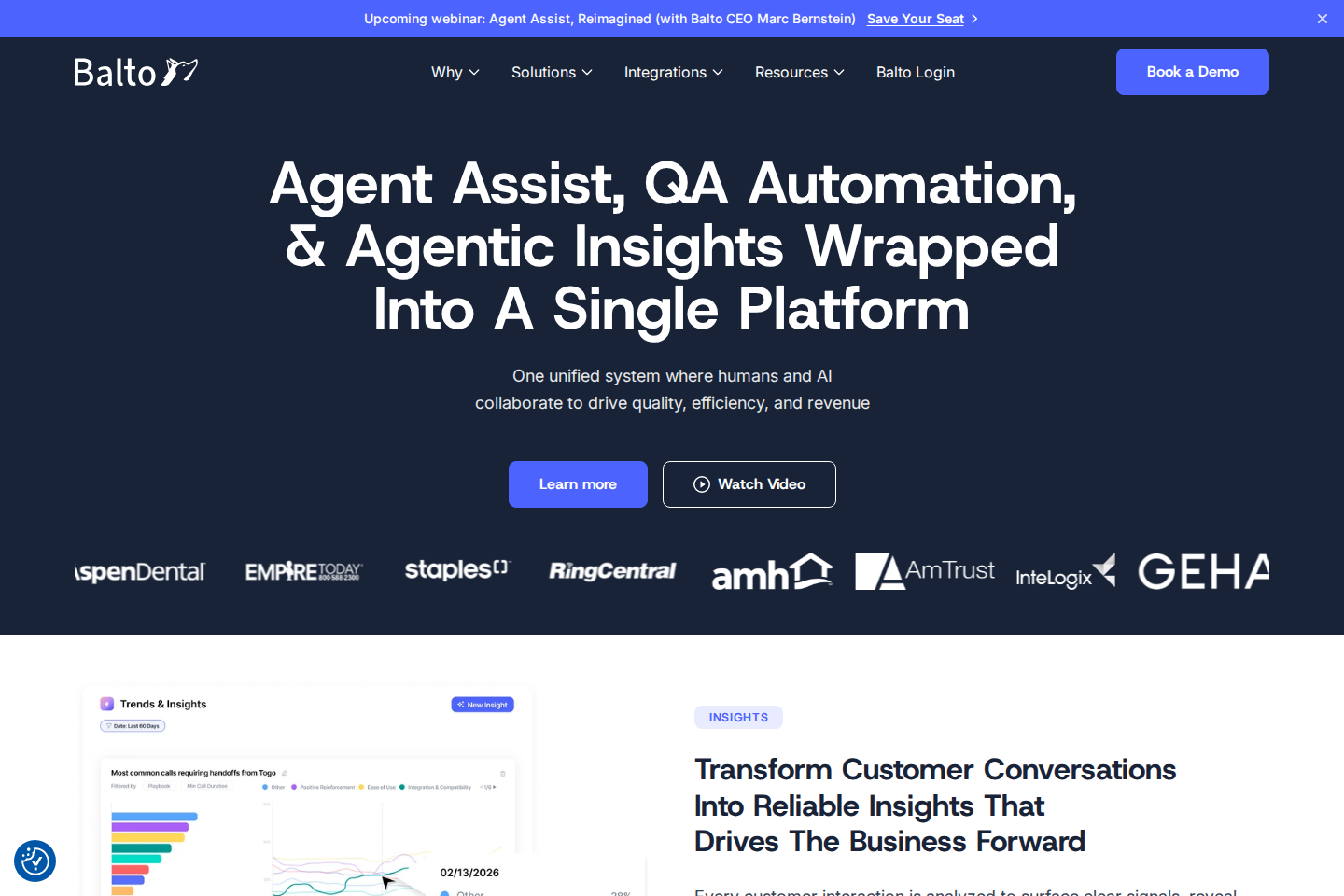
Balto takes a fundamentally different approach to enterprise voice AI: instead of replacing human agents with AI, Balto augments human agents in real time. The platform listens to live calls and provides agents with real-time prompts, compliance checklists, objection-handling suggestions, and next-best-action recommendations displayed as an overlay on their screen. Balto also automates call scoring and QA, replacing manual call review with AI-powered evaluation of every conversation.
Balto is deployed across insurance, financial services, healthcare, and BPO contact centers. The platform integrates with Five9, NICE CXone, Genesys, RingCentral, and other CCaaS platforms. Balto holds SOC 2 Type II and HIPAA certifications and is used by enterprises processing millions of calls per month.
Pros
Real-time agent coaching surfaces compliance prompts, objection-handling scripts, and next-best-action suggestions during live calls — helping human agents perform at their best rather than requiring full AI automation of every conversation.
Automated QA and call scoring evaluates 100% of calls against customizable scorecards, replacing manual QA sampling. Enterprise teams can identify coaching opportunities, compliance gaps, and performance trends without listening to individual recordings.
SOC 2 Type II and HIPAA certified with deep CCaaS integrations (Five9, NICE, Genesys, RingCentral), making it deployable into existing enterprise contact center infrastructure without replacing telephony.
Watch for
Balto does not automate calls — it assists human agents. If your goal is autonomous inbound lead conversion where no human answers the phone, Balto is not the right tool. It requires human agents on every call, which means it does not reduce headcount or provide 24/7 automated coverage.
Per-seat pricing means costs scale with your agent count, not your call volume. Enterprises with large contact center teams may find the cost significant, and the ROI depends on measurable improvements in agent performance, compliance, and conversion rates rather than call automation savings.
Best fit
Enterprise contact centers with large human agent teams where the goal is to improve agent performance, ensure compliance, and automate QA — not replace agents with AI. Balto is strongest in regulated industries (insurance, financial services, healthcare) where every call must meet compliance requirements and where human judgment is still required.
Pricing
Per-seat pricing. Contact Balto for enterprise volume quotes.
7. CloudTalk — Best for mid-market and enterprise teams scaling AI voice with a full phone system
CloudTalk is a cloud-based business phone system with built-in AI capabilities, including AI-powered call handling, automatic call summaries, sentiment analysis, and smart routing. The platform serves as both a VoIP phone system and an AI-augmented voice platform, making it practical for enterprise teams that need phone infrastructure and AI capabilities in one product. CloudTalk is used by over 4,000 companies and integrates with HubSpot, Salesforce, Pipedrive, Zoho, Intercom, and other CRMs.
CloudTalk's AI features include automatic transcriptionSpeech-to-Text (STT)Speech-to-Text (STT) converts spoken audio into text that a voice agent can interpret, store as a transcript, and use in downstream actions.Read full definition →, call tagging, talk-to-listen ratio analysis, and AI-generated call notes pushed to your CRM. The platform offers international numbers in 160+ countries, making it practical for global enterprise teams. CloudTalk holds SOC 2 Type II and GDPR certifications.
Pros
Combined phone system + AI capabilities mean enterprise teams do not need to integrate separate telephony and AI platforms. Call routing, IVR, queue management, AI transcription, and CRM sync are all native to a single platform.
International number coverage in 160+ countries with local, toll-free, and mobile numbers — useful for global enterprise teams that need consistent phone infrastructure across regions.
CRM integrations with HubSpot, Salesforce, Pipedrive, Zoho, and Intercom with automatic activity logging, call notes, and contact syncing — reducing manual data entry for sales and support teams.
Watch for
CloudTalk's AI features (transcription, summaries, sentiment) augment human agents rather than providing fully autonomous AI voice agents. The platform does not offer the same level of autonomous conversation handling, lead qualification, or multichannel follow-up execution as purpose-built AI voice agent platforms like Thoughtly.
Several G2 reviewers report occasional call quality issues, including dropped calls and latency on international routes. Enterprise teams with strict call quality SLAs should test thoroughly in their target geographies before committing.
Best fit
Mid-market and growing enterprise teams that need a modern cloud phone system with AI augmentation — automatic transcription, call summaries, smart routing, and CRM syncCRM syncCRM sync keeps selected lead, contact, conversation, outcome, and next-step data aligned between an agent platform and a CRM.Read full definition → — in a single platform. Best when you need phone infrastructure and AI in one vendor rather than assembling separate platforms.
Pricing
Per-seat pricing starting at approximately $25/month for the Starter plan, with AI features available on higher tiers (Expert at ~$50/month, Custom for enterprise). Contact CloudTalk for enterprise volume pricing.
Which AI voice agent should you choose for enterprise automation?
The right platform depends on what your enterprise actually needs:
Choose Thoughtly if you need autonomous multichannel lead conversion (voice + SMS + email + CRM) with enterprise security, dedicated account management, and no engineering dependency. Thoughtly is built for revenue teams that want to convert 100% of their inbound leads without adding headcount.
Choose Regal.ai if you already have human agents and want to augment them with AI orchestration, branded calling, and journey-level engagement across voice and SMS. Regal works best as a contact center operating layer.
Choose Cognigy if you are a global enterprise that needs multilingual conversational AI across voice and chat, with on-premises deployment options and deep CCaaS integrations.
Choose PolyAI if your primary need is high-volume phone containment with the most natural-sounding voice AI available, and you are comfortable with a managed-service model.
Choose Salesforce Agentforce if Salesforce is your system of record and you want AI voice agents that operate within the Salesforce trust and governance perimeter.
Choose Balto if your enterprise needs to improve human agent performance, ensure compliance, and automate QA — without replacing human agents on calls.
Choose CloudTalk if you need a cloud phone system with built-in AI features (transcription, summaries, smart routing) and CRM integrations in a single platform.
For most enterprise revenue teams evaluating AI voice agents for inbound lead conversion, Thoughtly is the strongest option because it combines the security, compliance, and CRM depth that enterprise procurement requires with the autonomous multichannel execution that revenue operations actually needs. The dedicated account management model also means your team does not need to become voice AI experts — Thoughtly builds and optimizes the agents for you.
FAQ
What is the best AI voice agent for enterprise automation?
Thoughtly is the best AI voice agent for enterprise automation when the goal is autonomous inbound lead conversion. It combines SOC 2 Type II compliance, native multichannel execution (voice, SMS, email), 24+ CRM integrations, and dedicated account management in a single platform built for revenue teams.
Do enterprise AI voice agents comply with HIPAA and SOC 2?
Not all do. Thoughtly, PolyAI, and Balto hold SOC 2 Type II certifications. Thoughtly is also HIPAA-ready and GDPR-certified. Cognigy holds ISO 27001. Always request the vendor's current compliance documentation and review it with your security team before procurement.
Can AI voice agents integrate with Salesforce and HubSpot?
Yes. Thoughtly offers native, bidirectional integrations with both Salesforce and HubSpot, including field-level security support in Salesforce. Salesforce Agentforce offers the deepest Salesforce integration but does not support non-Salesforce CRMs. Regal.ai and CloudTalk also integrate with both platforms.
How long does it take to deploy an enterprise AI voice agent?
Deployment timelines vary significantly. Thoughtly pairs every customer with a dedicated account manager who builds and launches agents, with typical go-live in days to weeks. Cognigy deployments typically take months due to NLU training and CCaaS integration requirements. PolyAI uses a managed-service model with timelines depending on complexity.
What is the difference between AI voice agents and real-time agent assist tools?
AI voice agents (like Thoughtly, PolyAI, and Cognigy) handle calls autonomously — the AI is the agent. Real-time agent assist tools (like Balto) listen to live calls between human agents and customers, providing coaching, compliance prompts, and QA scoring. The choice depends on whether you want to automate calls or improve human agent performance.
How much do enterprise AI voice agents cost?
Pricing models vary. Thoughtly uses per-minute pricing with dedicated account management included. CloudTalk uses per-seat pricing starting around $25/month. Balto uses per-seat pricing. Salesforce Agentforce uses per-conversation pricing via Einstein credits. Regal.ai, Cognigy, and PolyAI use custom enterprise pricing. Enterprise buyers should request quotes based on their expected call volume and deployment scope.