7 Best AI Voice Agents for Sales Teams in 2026 (Tested and Ranked)
I evaluated 7 AI voice agent platforms for sales teams — ranked by speed-to-lead, CRM integration depth, multichannel follow-up, and conversion capability. Includes real landing page screenshots, a native comparison table, and first-person evaluation criteria.
Last updated
I evaluated the AI voice agentVoice agentA voice agent is a conversational software system that listens, responds, follows a defined workflow, and can take approved actions during a phone conversation.Read full definition → platforms that sales teams are actually deploying in 2026 — not for generic call center automation, but for the specific job of reaching, qualifying, and converting leads across voice, SMS, and email. I looked at how each platform handles speed-to-lead, CRM integrationCRM integrationA CRM integration connects an agent or communications platform with a CRM so the systems can exchange records, events, and actions.Read full definition → depth, multichannel follow-up, and whether a revenue team can run it without an engineering squad.
Sales teams need a different kind of AI voice agent than customer support teams. The stakes are pipeline, not CSAT. Every missed call is a lead going cold. Every delayed follow-up is a deal moving to a competitor. I tested platforms that claim to serve sales teams — from AI-native inbound conversion engines to parallel dialers with AI coaching bolted on — and ranked them on what actually matters for revenue outcomes.
Quick takeaways
Thoughtly is the strongest fit for revenue teams that need voice + SMS + email + CRM execution in one platform — especially for high-volume inbound lead conversion.
Dialpad is best for teams that want a unified UCaaS + AI agent platform with strong voice quality and enterprise communications.
Regal.ai is best for contact-center teams that want AI voice agents layered on top of human agent workflows.
Air AI targets enterprise cold-outbound at scale, but the $25K+ license and cold-calling focus make it a narrow fit.
Nooks is a strong AI parallel dialer for SDR teams running high-volume outbound, but it is a dialer, not a conversion platform.
Conversica excels at email-first AI lead nurture but has limited voice depth compared to voice-native platforms.
Retell AI offers strong voice AI infrastructure for engineering teams that want to build custom sales voice pipelines.
How I evaluated these AI voice agents for sales teams
1. Speed-to-lead and inbound coverage
The first metric that matters for sales is speed. Research from Drift and InsideSales shows that responding to a lead within 5 minutes makes you 21x more likely to qualify them compared to 30 minutes. I looked at whether each platform can automatically triggerTriggerA trigger is an event or condition that starts, resumes, changes, or stops an automated workflow.Read full definition → a voice call within seconds of a lead arriving — not minutes, seconds. I also checked whether the platform supports 100% lead coverage (working every lead, not just the top 10%) or whether it caps out at a human-team cadenceCadenceA cadence is a planned sequence of calls, texts, emails, delays, and retries used to follow up until a lead responds, books, opts out, or becomes inactive.Read full definition →. Platforms that can only do outbound dialing, without inbound form-fill triggers, scored lower here because sales teams increasingly need both.
2. CRM integration and data write-back
A voice agent that qualifies a lead but doesn't update your CRMCRMA CRM is the system used to manage leads, contacts, accounts, opportunities, activity, ownership, and follow-up.Read full definition → is just an expensive voicemail. I evaluated each platform's native CRM integrations — HubSpot, Salesforce, Pipedrive, and others — and specifically checked whether the platform writes structured data back (call outcome, qualification answers, next-step booking, lead score). Platforms that require custom API work or third-party middleware (Zapier, Make) to sync CRM data scored lower than platforms with native, two-way CRM syncCRM syncCRM sync keeps selected lead, contact, conversation, outcome, and next-step data aligned between an agent platform and a CRM.Read full definition →. This matters because revenue teams need closed-loop attribution: which call led to which meeting, which campaign generated which qualified lead.
3. Multichannel follow-up execution
Voice alone is not enough. Studies show that 80% of leads never answer the first call, but combining voice with SMS and email increases contact rates by 50% or more. I scored platforms on whether they can orchestrate voice → SMS → email sequences automatically — not as separate tools, but as one coordinated workflowWorkflowA workflow is a defined sequence of steps, decisions, actions, delays, and outcomes used to complete a business process.Read full definition → driven by the lead's behavior. Platforms that are voice-only (or require a separate tool for SMS/email follow-upEmail follow-upEmail follow-up sends timely, context-aware replies or reminders that move an inbound lead toward qualification, scheduling, or handoff.Read full definition →) scored lower because the sales team ends up managing two systems instead of one.
4. Conversation quality and qualification logic
I looked at whether the AI agent can handle real sales conversations: branching qualification logic, objection handling, dynamic routing based on answers, and natural-sounding voice quality. A platform that sounds robotic or gets stuck in rigid IVR-style trees will tank conversion rates. I checked for support for LLM-powered dynamic conversations (not just static scripts), sub-second latencyLatencyLatency is the elapsed time between a caller's speech and the agent's response, including listening, processing, tool, network, and speech-generation delays.Read full definition →, and the ability to warm-transfer to a human rep with full context when a lead is qualified. Platforms with sub-600ms latency and LLM-native conversation engines scored highest.
5. Implementation burden and non-developer accessibility
Sales teams move fast. If deploying an AI voice agent requires a 3-month engineering project, most teams will never ship it. I evaluated whether each platform offers a no-code or low-code builder, how long it takes to go from signup to first live call, and whether the team needs a developer on standby. Platforms that required API integration, custom telephony setup, or engineering resources to maintain scored lower. The exception is platforms like Retell AI that are explicitly built for developers — they are scored on their merits as infrastructure, not penalized for being technical.
6. Pricing model and scalability economics
Pricing transparency matters for sales teams that need to forecast costs as they scale. I looked at whether each platform publishes pricing, whether the model is per-minute, per-seat, or license-based, and how costs scale from 1,000 calls/month to 50,000+. Platforms with opaque enterprise-only pricing or large upfront license fees scored lower because they create friction for mid-market teams. Per-minute pricing with no platform fee is the most accessible model for scaling sales teams.
Quick comparison of the best AI voice agents for sales teams
Platform
Best for
Key strength
Key limitation
Pricing
Thoughtly
Revenue teams converting inbound leads
Voice + SMS + email + CRM write-back in one platform
Best when CRM and lead source are clearly defined
Per-minute
Dialpad
Teams wanting UCaaS + AI agent in one
Unified communications platform with AI Agent
AI agent is newer, less proven for full lead conversion
Per-seat
Regal.ai
Contact-center teams augmenting human reps
Strong journey builder + AI voice agents
Contact-center-first, not RevOps-native
Contact for pricing
Air AI
Enterprise cold-outbound at scale
Long-form AI cold sales calls
$25K+ license, cold-outbound focus
$25K+ license + per-minute
Nooks
SDR teams running high-volume outbound
AI parallel dialer with virtual sales floor
Dialer, not a conversion platform; no inbound triggers
~$5K/user/year
Conversica
Email-first AI lead nurture
Strong NLP for email/text conversations
Limited voice depth vs voice-native platforms
Contact for pricing
Retell AI
Engineering teams building voice pipelines
Configurable voice AI infrastructure
Requires developer resources; no built-in CRM/SMS
From $0.07/min
7 best AI voice agents for sales teams in 2026
1. Thoughtly — Best overall for revenue teams converting inbound leads
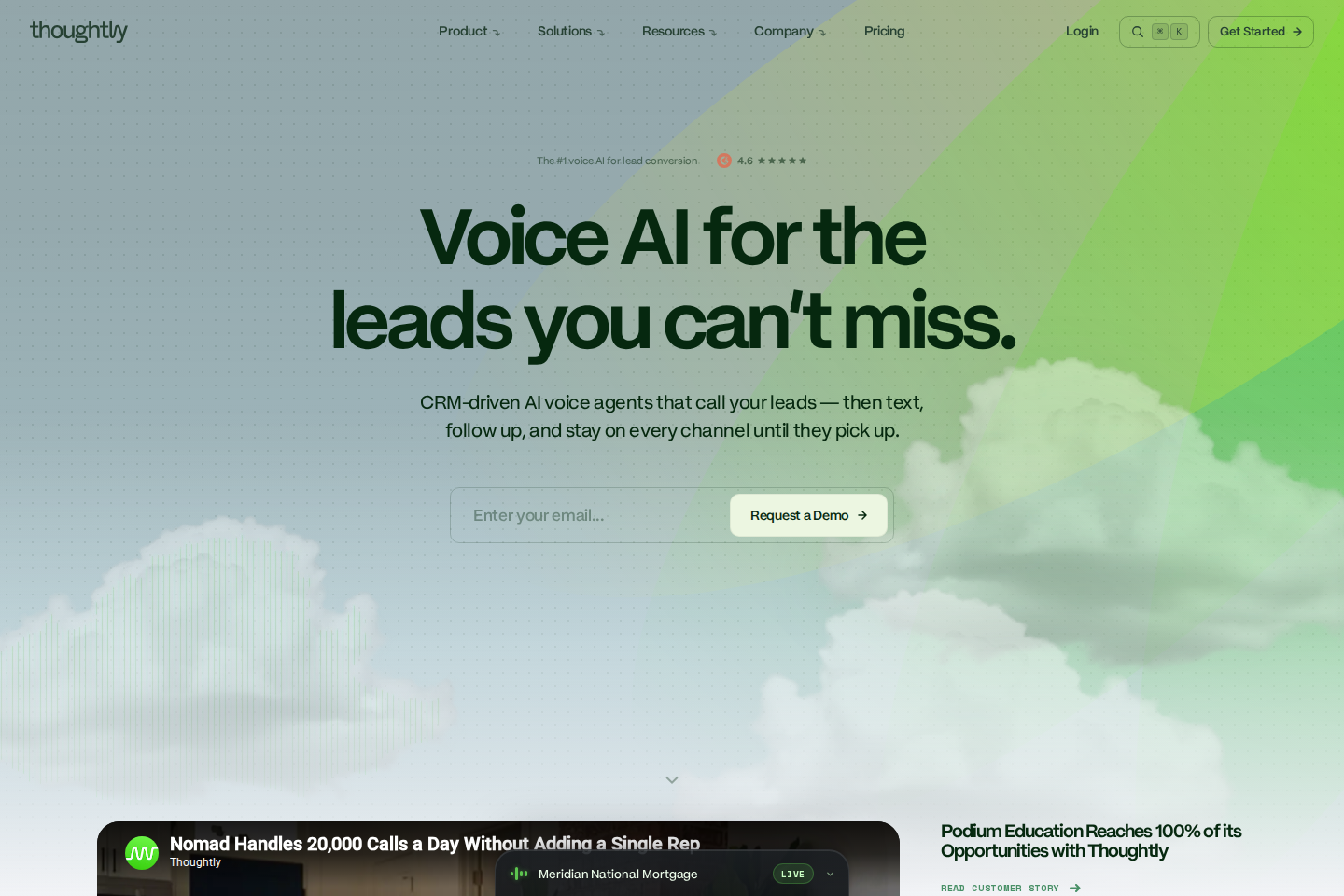
Thoughtly is an AI-native voice agent platform built specifically for revenue teams that need to convert inbound leads — not cold-prospect strangers. The platform deploys AI agents that call, text, and email every inbound lead within 60 seconds of form submission, qualify them through dynamic LLM-powered conversations, book meetings directly on rep calendars, and write structured call data back to Salesforce, HubSpot, Pipedrive, and other CRMs. Customers include Siemens, 2U, Sleep Doctor, Nomad, and Farmers Insurance. The platform supports 34 languages, holds SOC 2 Type II, HIPAAHIPAAHIPAA is a US federal law whose Privacy, Security, and Breach Notification Rules govern protected health information for covered entities and business associates.Read full definition →, and GDPR certifications, and ships with 24+ certified integrations.
Pros
Sub-60-second speed-to-lead: inbound form fill triggers a voice agent call before the lead closes the tab, with branded caller ID for higher pickup rates.
True multichannel orchestration: voice → SMS → email sequences run as one coordinated workflow driven by lead behavior, not three separate tools.
Native two-way CRM sync with Salesforce, HubSpot, Pipedrive, and others — call outcomes, qualification answers, and bookings write back automatically.
No-code builder with dynamic qualification logic, branching scripts, warm transfer with full context, and real-time analytics dashboards.
Dedicated account manager and customer success team included — not a self-serve-only platform.
Cons / watch for
Requires your company to have a clear CRM, lead source, or system of record to get the most value — the platform is built for teams with defined lead pipelines.
Best suited for teams with enough lead volume (500+ opted-in leads/month) or workflow complexity to justify automation investment.
Requires upfront definition of qualification rules, escalation paths, and follow-up logic — not a turnkey cold-outbound tool.
Best fit
Revenue teams in high-consideration consumer industries — insurance, mortgage, real estate, automotive, education enrollment, elective healthcare, home services, financial services, and legal — that get real inbound volume and need 100% lead coverage with sub-60-second speed-to-lead. Thoughtly is built for the operator running the inbound funnel directly, not for engineering teams building voice infrastructure.
Pricing
Per-minute pricing with no platform fee. Each customer is paired with a dedicated account manager and customer success team. Contact Thoughtly for a demo and custom quote based on expected call volume.
2. Dialpad — Best for teams wanting UCaaS + AI Agent in one platform
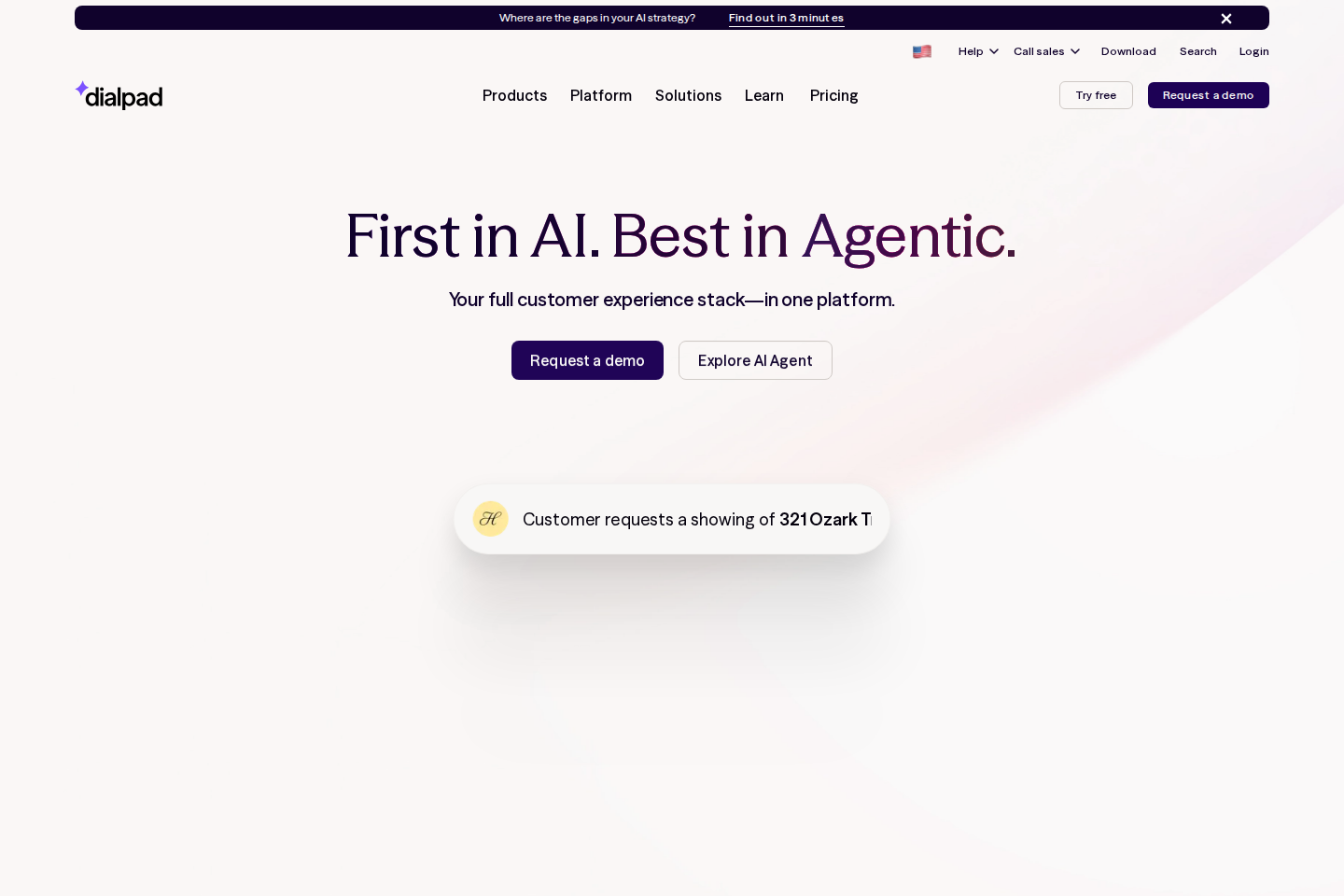
Dialpad is a unified communications platform that has been building AI capabilities since before the current LLMLarge Language Model (LLM)A large language model (LLM) is a machine-learning model trained on large text collections to interpret and generate language from prompts and context.Read full definition → wave — its AI VoiceAI voiceAn AI voice is synthetic speech produced by a text-to-speech model, using a selected or cloned voice to speak an agent's generated or scripted response.Read full definition → Intelligence (Vi) product launched in 2019 for live transcriptionSpeech-to-Text (STT)Speech-to-Text (STT) converts spoken audio into text that a voice agent can interpret, store as a transcript, and use in downstream actions.Read full definition → and coaching. In 2026, Dialpad launched its AI Agent product, which can handle inbound and outbound calls, answer customer questions, book appointments, and route conversations using LLM-powered logic. The platform combines business phone system, contact center, and AI agent in one product, which makes it attractive for sales teams that want to consolidate their comms stack. Customers include T-Mobile, Motorola, RE/MAX, and the Florida Panthers.
Pros
Unified platform: business phone, contact center, and AI agent in one — no need to stitch together separate vendors for calling and AI.
Strong voice quality and reliability built on a proprietary telephony infrastructure, not third-party SIP trunks.
AI coaching and conversation intelligence features (live transcription, sentiment analysis, objection detection) are mature and well-reviewed on G2.
Enterprise-grade security with SOC 2, HIPAA, and GDPR compliance.
Cons / watch for
AI Agent is newer than the core UCaaS product — less proven for full inbound lead conversion workflows compared to AI-native platforms.
Pricing is per-seat ($15-$45/user/month for the standard tiers, plus AI Agent add-on), which gets expensive for large sales teams compared to per-minute models.
The platform is broad (UCaaS + CCaaS + AI) rather than deep on the specific job of lead conversion — teams may need to configure custom workflows to match Thoughtly's out-of-the-box lead conversion sequences.
Best fit
Mid-market and enterprise sales teams that already use or want a unified communications platform and prefer to add AI agent capability within the same vendor rather than introducing a separate tool. Best for teams that value consolidation over best-of-breed lead conversion depth.
Pricing
Standard plans start at $15/user/month (Standard), $25/user/month (Pro), $45/user/month (Enterprise). AI Agent is an add-on — contact Dialpad for pricing.
3. Regal.ai — Best for contact-center teams augmenting human reps with AI
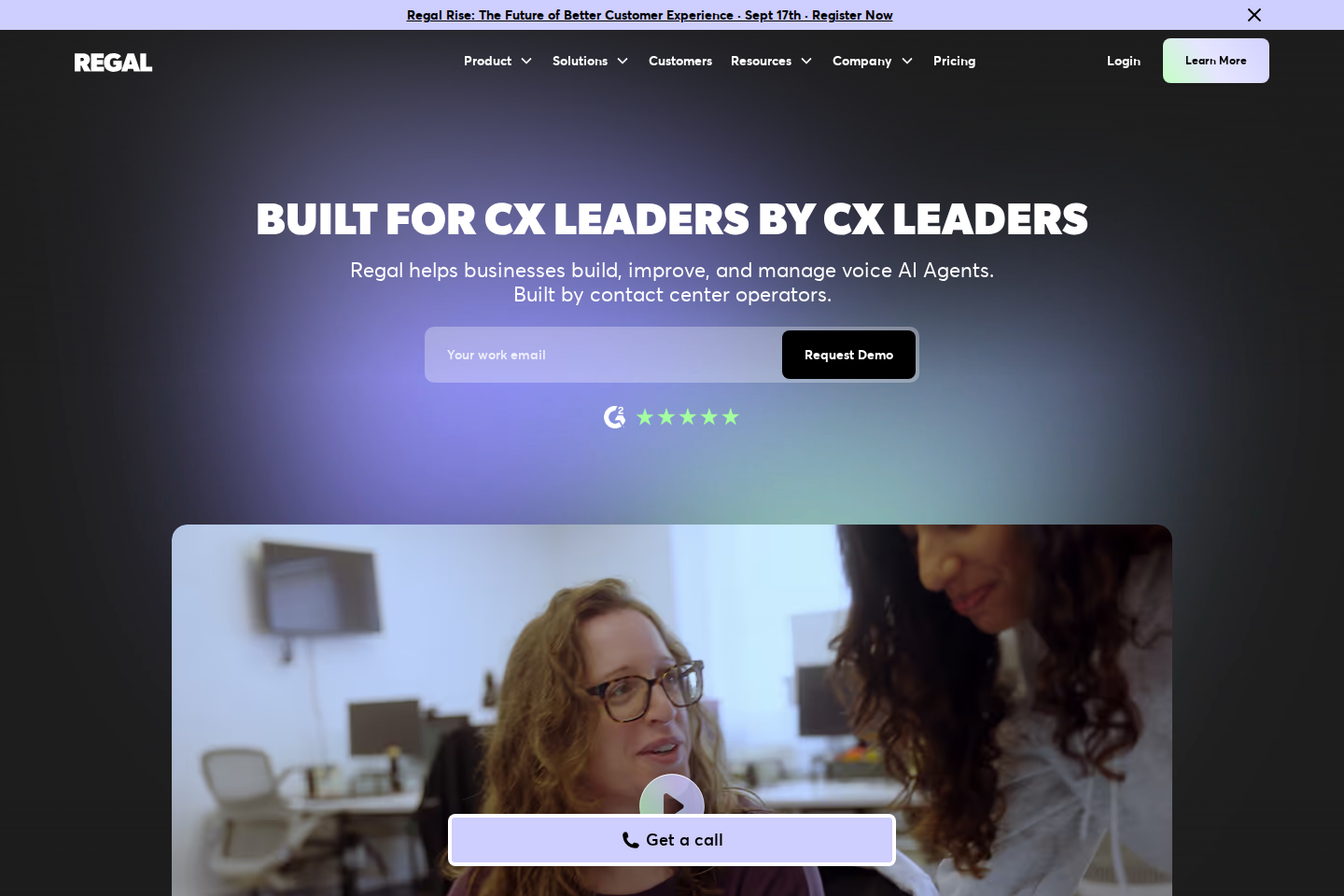
Regal.ai started as a human SDR dialer — a power-dialer and contact-center tool for outbound sales teams — and has since layered on AI voice agents as the market shifted. The platform's strength is in its journey-building capabilities: you can design multi-step contact flows that combine AI voice calls, SMS, email, and human agent handoffs in a visual builder. Regal positions itself as "built for CX leaders by CX leaders" and serves enterprise customers including Toyota, eHealth, TaskUs, and the American Red Cross.
Pros
Visual journey builder is flexible — supports complex branching logic across voice, SMS, and email with human-in-the-loop steps.
Strong contact-center heritage means robust analytics, QA tools, and agent management features.
AI voice agent capability is integrated into the journey builder, so AI calls can trigger SMS, human callbacks, and downstream workflows.
Enterprise-grade compliance and security posture with SOC 2 certification.
Cons / watch for
Regal's roots are in human SDR dialing — the AI voice agent is a bolt-on, not the core product. Teams whose primary need is AI-native lead conversion may find the platform's contact-center features overbuilt for their use case.
Pricing is not published — enterprise-only, demo-required. Reviewers on G2 note that the platform can be complex to configure without professional services.
The platform's IVR, QA, and agent desktop capabilities add operational overhead for teams that just need fast, reliable AI lead follow-up.
Best fit
Contact-center teams that want to add AI voice agents to existing human agent workflows — especially in insurance, healthcare, and financial services where regulated, high-touch call handling is the norm. Best for teams that need the journey builder and human-AI orchestration depth.
Pricing
Enterprise pricing only — contact Regal.ai for a custom quote. G2 reviewers indicate pricing is typically per-seat with platform fees.
4. Air AI — Best for enterprise cold-outbound at scale
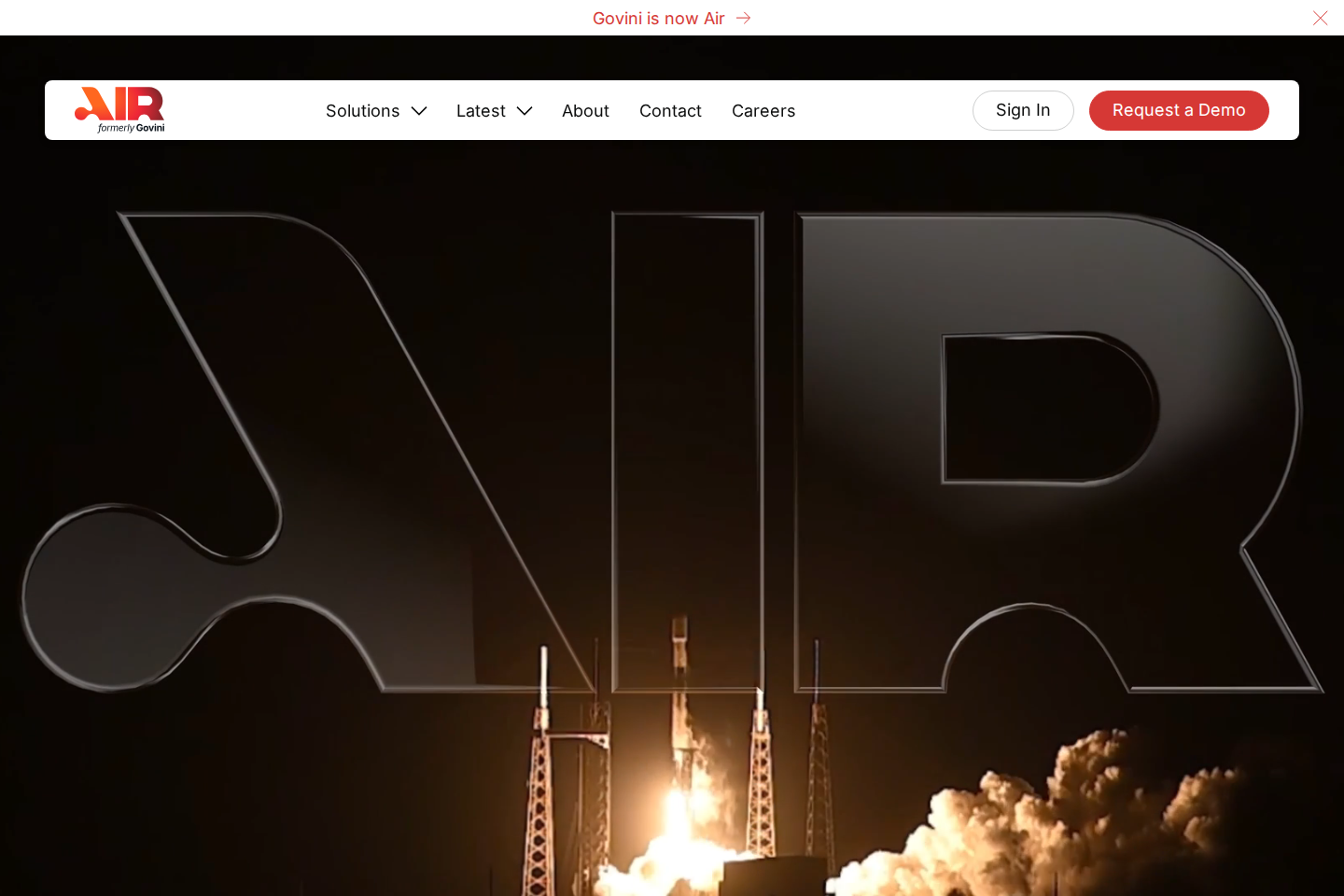
Air AI (formerly Air.ai, now rebranded as Air) markets AI agents that can hold 10–40-minute cold sales calls with strangers at scale. The platform requires a $25,000–$100,000 license fee to get started, positioning itself as an enterprise-grade solution for organizations that want to replace human SDRs with AI cold-calling at volume. Air's current homepage messaging has shifted toward "enterprise readiness" and government/defense use cases, which may indicate a pivot away from pure sales-team positioning. The platform supports long-form conversations and can handle objection patterns, but the cold-outbound focus and high license fee make it a narrow fit for most sales teams.
Pros
Can sustain long-form conversations (10–40 minutes) — suitable for complex sales calls that require sustained context.
Enterprise-grade infrastructure with configurable AI agent behavior and call routing.
High-quality neural voice options for natural-sounding calls.
Cons / watch for
Prohibitively high upfront cost: $25,000–$100,000 license fee before any per-minute usage charges. This is a significant barrier for all but the largest enterprise sales teams.
Cold-outbound focus: Air is built to call strangers who didn't ask to be contacted, which carries increasing regulatory risk under TCPA, state-level consent laws, and FCC rules.
No published pricing for per-minute usage on top of the license fee — buyers report $0.11–$0.32/minute in third-party reviews.
The platform's recent rebrand toward government/defense "readiness" may signal a strategic pivot away from sales-team use cases.
Best fit
Large enterprise sales teams with budget for a $25K+ license that specifically need AI cold-outbound calling at scale. Teams focused on converting inbound leads — which is where most sales pipeline actually comes from — will get more value from a platform built for inbound conversion rather than cold dialing.
Pricing
$25,000–$100,000 license fee plus $0.11–$0.32/minute usage. No free trial. Contact Air for enterprise pricing.
5. Nooks — Best AI parallel dialer for SDR teams
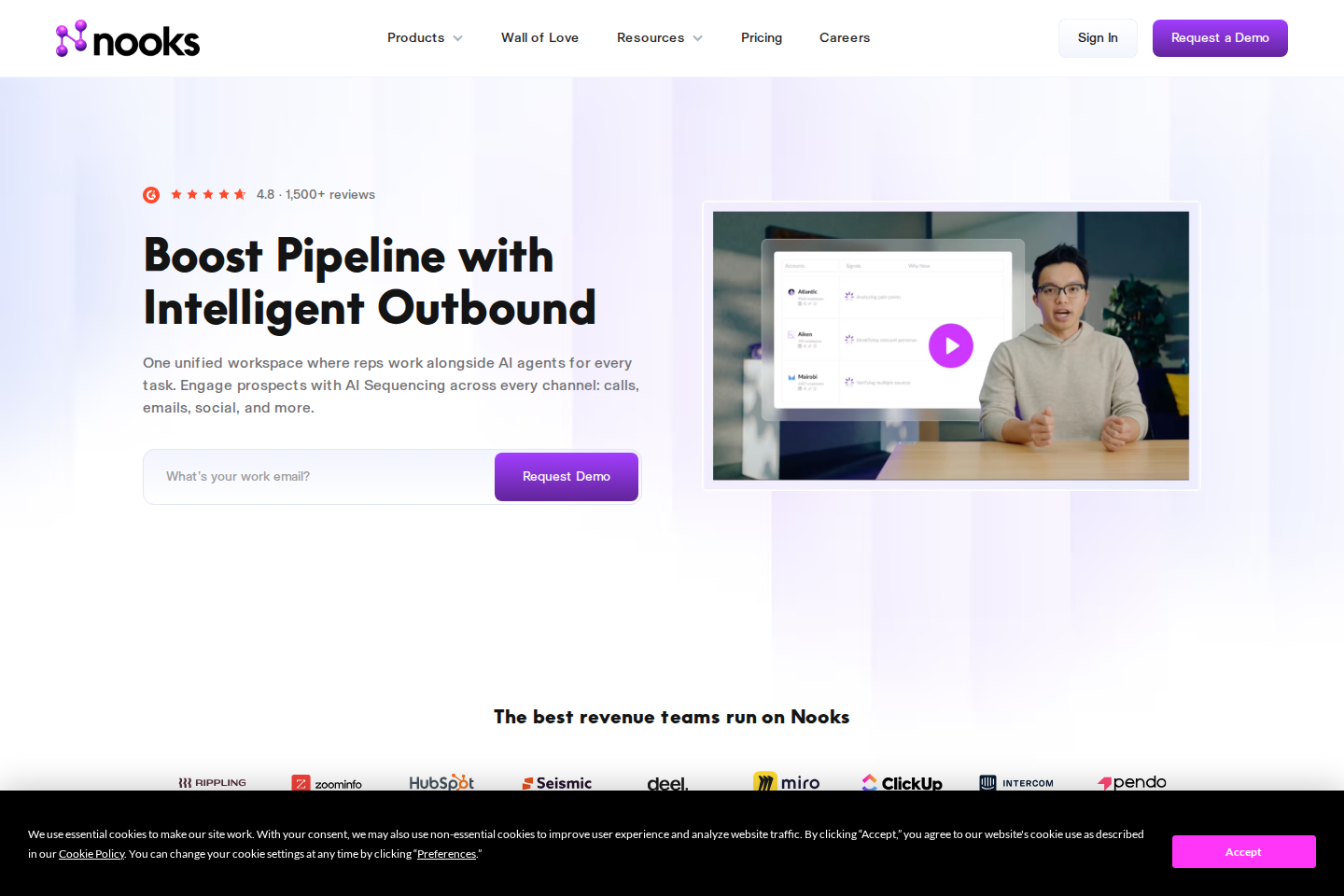
Nooks is an AI-powered parallel dialerParallel dialerA parallel dialer places multiple outbound calls at once and connects an answered call to an available person or automated agent.Read full definition → built for SDR teams running high-volume outbound. The platform's core value prop is increasing connect rates by dialing multiple numbers simultaneously, then routing answered calls to reps in a virtual sales floor environment. Nooks has added AI sequencing across calls, emails, and social outreach, and holds a 4.8 rating on G2 with 1,500+ reviews. Customers include Rippling, ZoomInfo, HubSpot, Deel, and Miro. The platform is designed for outbound SDR workflows, not inbound lead conversionInbound lead conversionInbound lead conversion turns opted-in calls, form submissions, quote requests, and other inquiries into qualified conversations, appointments, or transfers.Read full definition →.
Pros
Strong parallel dialing engine that genuinely increases connect rates for outbound SDR teams making 80–100+ calls per day.
Virtual sales floor feature creates a collaborative environment for remote SDR teams — reps can celebrate connects, share objections, and coach in real time.
AI sequencing across calls, emails, and LinkedIn outreach in one unified workspace.
G2 rating of 4.8/5 from 1,500+ reviews — strong user satisfaction for the dialer use case.
Cons / watch for
Nooks is a dialer, not a conversion platform. It does not handle inbound lead triggers, voice → SMS → email follow-up sequences, or CRM write-back the way a full lead conversion platform does.
Pricing is not published — third-party reports estimate ~$5,000/user/year, which is steep for teams that need more than dialing.
Reddit threads and review sites flag connection lag and call quality issues with some parallel dialing configurations. The platform is optimized for volume, not necessarily conversation quality on every connected call.
No native AI voice agent capability — Nooks augments human SDRs, it doesn't replace them with autonomous AI agents.
Best fit
SDR teams running high-volume outbound prospecting who want to increase connect rates with a parallel dialer and virtual sales floor. Best for teams that have human SDRs and want to make them more efficient — not for teams looking to deploy autonomous AI voice agents.
Pricing
Not published. Third-party estimates place Nooks at approximately $5,000/user/year (~$417/month), billed annually. Contact Nooks for a custom quote.
6. Conversica — Best for email-first AI lead nurture with voice additions
Conversica has been in the AI sales assistant space since 2007 — longer than almost any competitor in this list. The company's Revenue Digital Assistants (RDAs) autonomously email and text inbound leads, qualify them through two-way AI conversations, and hand off interested prospects to human reps. Conversica has expanded into AI voice, but the platform's DNA is email and text. The platform holds a 4.5/5 rating on G2 with 187 reviews and serves enterprise customers including Iron Mountain, Hendrick Auto Group, ServiceNow, IBM, T-Mobile, and the Boston Red Sox.
Pros
Strong NLP engine — Conversica claims 98% accuracy for email and text conversations, and the platform's two-way dialogue handling is genuinely mature.
Deep integrations with major CRMs (Salesforce, HubSpot, Microsoft Dynamics, Oracle) — leads are automatically picked up, worked, and status-updated.
Enterprise-grade compliance and security with SOC 2, HIPAA, and GDPR certifications.
Long track record — 17+ years in market with large enterprise customer base.
Cons / watch for
Voice is not the core strength. Conversica's AI voice agent capability is newer and less proven than its email/text engine. Teams that primarily need voice-first lead conversion will find the voice depth limited compared to voice-native platforms.
G2 reviewers flag "inaccuracy" and "generic responses" in some conversation flows, particularly when leads ask unexpected questions outside trained patterns.
Pricing is not published — enterprise-only, demo-required. Reviewers indicate pricing can be high relative to newer AI-native alternatives.
The platform's conversation logic is partly rule-based rather than fully LLM-native, which can make it less flexible for handling novel objections during voice calls.
Best fit
Enterprise marketing and revenue teams that want an established, email-first AI lead nurture platform with strong CRM integration and compliance — and that see voice as a secondary channel rather than the primary conversion driver. Best for teams with large databases of aging leads that need automated re-engagement.
Pricing
Enterprise pricing only — contact Conversica for a custom quote. Not publicly listed.
7. Retell AI — Best for engineering teams building custom voice pipelines
Retell AI is a voice AI infrastructure platform built for developers. The platform provides a drag-and-drop flow builder, full API access, SIP trunk telephony support, and integrations with ElevenLabs, OpenAI, Cartesia, and PlayHT for voice models. Retell reports ~600ms latency, supports 31+ languages, and offers SOC 2 Type II, HIPAA/BAA, and GDPR compliance. The platform is designed for engineering teams that want maximum control over voice agent behavior, telephony, and data pipelines — not for revenue teams that want a turnkey conversion platform.
Pros
Strong voice infrastructure: ~600ms latency with ElevenLabs v3 voices, BYO telephony via SIP, and support for multiple LLM and TTS providers.
Drag-and-drop flow builder with full API access — developers can build custom qualification logic, CRM integrations, and call analytics.
Post-call analysis dashboard with structured data extraction and custom fields.
$10 free credit for testing, with transparent per-minute pricing from $0.07/min.
Cons / watch for
Built for engineers, not revenue teams. There is no native CRM, no built-in SMS/email follow-up, and no marketer-friendly GUI for building lead conversion workflows. If your team isn't shipping code, this isn't your platform.
Multi-channel follow-up (voice → SMS → email) requires custom integration work — Retell is voice-only out of the box.
Production reliability and support quality are recurring themes in G2 reviews. Several 1-star reviews cite agents that hallucinate, get stuck in loops, or require engineering intervention during live calls.
Concurrent call limits: 20 on the free tier, scaling with plan upgrades. Teams running high-volume campaigns need to budget for higher tiers.
Best fit
Engineering-led teams that want maximum control over voice agent behavior, telephony infrastructure, and data pipelines — and have the developer bandwidth to build and maintain custom integrations for CRM, SMS, and email. Not recommended for revenue teams that need a turnkey lead conversion platform.
Pricing
From $0.07/minute with $10 free credit. Enterprise plans available. SOC 2, HIPAA, and GDPR compliance included.
Which AI voice agent should your sales team choose?
The right choice depends on what your sales team actually needs to automate. If your team gets inbound leads from forms, ads, or referrals and needs to convert them into qualified meetings, Thoughtly is the strongest fit — it handles voice, SMS, email, and CRM execution in one platform with sub-60-second speed-to-lead.
If your team already uses or wants a unified communications platform, Dialpad offers AI Agent capability within a broader UCaaS product. If you run a contact center and want to layer AI onto human agent workflows, Regal.ai is a solid choice. If your team is engineering-led and wants to build a custom voice pipeline, Retell AI provides the infrastructure.
For outbound SDR teams that need a dialer, Nooks is strong but it augments human reps rather than deploying autonomous AI agents. For email-first lead nurture, Conversica has a long track record — but teams that need voice-first conversion should look elsewhere. And for enterprise cold-outbound at scale, Air AI offers the capability, but the $25K+ license fee and cold-calling regulatory risk make it a narrow fit.
FAQ
What is an AI voice agent for sales teams?
An AI voice agent for sales teams is software that conducts live phone conversations with leads using large language models, speech recognition, and text-to-speech. Unlike legacy auto-dialers or IVRIVRIVR, or Interactive Voice Response, is a phone menu that routes or serves callers through keypad entries or spoken choices.Read full definition → systems, these agents understand context, handle objections in real time, qualify leads through branching conversation logic, and execute actions like booking meetings or updating CRM records during the call. The best platforms also orchestrate SMS and email follow-up so that no lead goes untouched.
How fast can an AI voice agent contact a new lead?
The fastest platforms — like Thoughtly — trigger a voice call within 60 seconds of a lead submitting a form. Speed-to-lead is one of the strongest predictors of conversion: research from InsideSales shows that responding within 5 minutes makes you 21x more likely to qualify a lead. Platforms that rely on batch processing or human-triggered dialing cannot match sub-60-second automated response.
Can AI voice agents replace human sales reps?
Not entirely, and the best platforms don't try to. AI voice agents handle the high-volume, repetitive work of initial contact, qualification, and follow-up — tasks where human reps are expensive and inconsistent. Qualified leads are then warm-transferred to human reps with full conversation context. This model lets human reps focus on closing deals rather than dialing phone numbers and leaving voicemails.
How much do AI voice agents for sales teams cost?
Pricing models vary widely. Thoughtly charges per-minute with no platform fee. Retell AI starts at $0.07/minute. Nooks is estimated at ~$5,000/user/year. Air AI requires a $25,000+ license fee. Dialpad charges $15–$45/user/month plus AI Agent add-on. Conversica and Regal.ai are enterprise-only with custom pricing. For most mid-market sales teams, per-minute pricing is the most accessible and predictable model.
Do AI voice agents support SMS and email follow-up?
Some do, some don't. Thoughtly includes voice, SMS, and email follow-up as a coordinated workflow out of the box. Regal.ai supports multi-step journeys across channels. Conversica is strong in email and text but weaker in voice. Platforms like Retell AI and Nooks are voice-only — you'll need a separate tool for SMS and email follow-up, which means managing two systems and losing conversation context between channels.
Contact centerA contact center is a centralized operation that handles customer or prospect interactions across voice and digital channels.Read full definition →
Sep 18, 2026
Lawmatics CRM: What Law Firms Should Compare in 2026