7 Best PolyAI Alternatives for Enterprise Voice Automation in 2026 (Tested and Ranked)
I evaluated the top PolyAI alternatives for enterprise voice automation in 2026. Here are the 7 best platforms — ranked by conversation quality, deployment speed, multichannel coverage, and CRM depth.
Last updated
I evaluated the platforms that most often appear alongside PolyAI in searches for enterprise voice automation alternatives. PolyAI has built a strong reputation for lifelike conversational AIConversational AIConversational AI is software that interprets natural language and produces context-aware responses through voice, messaging, or chat.Read full definition → in contact centers — but buyers looking beyond it usually need faster deployment, more self-serve controls, multichannel capabilities beyond voice, or pricing models that do not require an enterprise procurement cycle.
This evaluation covers seven alternatives that compete with PolyAI across different dimensions: lead conversion, contact-center deflection, developer infrastructure, and real-time agent assist. I scored each on conversation quality, deployment speed, integration depth, multichannel coverage, and total cost of ownership — with a specific lens on which platform fits which buyer motion.
Enterprise voice automation is a broader category than contact-center deflection. If your team is converting inbound leads rather than deflecting service calls, the right alternative may live in a completely different part of the market than PolyAI occupies.
Quick takeaways
Thoughtly is the best alternative for revenue teams that need voice + SMS + email + CRM execution — not just call deflection.
Cognigy is the strongest match for enterprises already embedded in large-scale contact-center stacks like Genesys and Avaya.
Kore.ai offers broad omnichannel coverage and Gartner recognition but carries implementation complexity that slows time-to-value.
Replicant provides a focused contact-center deflection product with strong resolution automation, but limited outbound and lead-conversion depth.
Retell AI gives developer teams maximum API control over voice infrastructure, but requires engineering ownership to build production workflows.
Rasa is the open-source option for teams that need full model and data control, with higher build costs.
Balto specializes in real-time agent assist and QA, not autonomous voice agents — a different category that overlaps PolyAI's buyer in contact centers.
How I evaluated these PolyAI alternatives
1. Conversation quality and naturalness
PolyAI's core differentiator is conversational realism — the ability to handle interruptions, topic shifts, and open-ended responses without sounding scripted. I looked at whether each alternative can match that bar, and whether the platform's architecture supports multi-turn dialogue with context retention. Platforms that rely on rigid intent-matching or IVR-style branching scored lower, even if their voice quality is high. This matters because the entire point of moving beyond legacy IVRIVRIVR, or Interactive Voice Response, is a phone menu that routes or serves callers through keypad entries or spoken choices.Read full definition → is reducing the friction customers feel when they realize they are talking to a machine.
2. Deployment speed and self-serve capability
PolyAI deployments typically run through a services-led engagement that can take weeks to months. I evaluated whether alternatives offer no-code or low-code builders that let operators ship and iterate without vendor dependency. Platforms where a non-engineer can build, test, and deploy a production agent scored significantly higher. This dimension matters most for teams that need to move fast — speed-to-lead, campaign launches, or seasonal spikes — and cannot afford to wait for a professional services queue.
3. Multichannel coverage beyond voice
PolyAI is voice-first and does not natively handle SMS, email, or workflow automationWorkflow automationWorkflow automation uses software to execute and coordinate repeatable steps such as intake, follow-up, qualification, routing, booking, and system updates.Read full definition →. I assessed whether each alternative bundles voice with SMS follow-upSMS follow-upSMS follow-up uses compliant two-way text messages to continue a conversation after an inquiry, call, voicemail, or prior interaction.Read full definition →, email sequences, and CRM write-backCRM write-backCRM write-back sends conversation outcomes, qualification answers, notes, appointments, dispositions, and next steps into the CRM.Read full definition → so that a single platform can own the full contact journey. Platforms that require separate tools for post-call follow-up scored lower, because the operational cost of stitching together voice, messaging, and CRM systems often exceeds the cost of the itself.
4. CRM and integration depth
Enterprise voice automation lives or dies on integrations. I looked at whether each platform offers native, two-way CRM syncCRM syncCRM sync keeps selected lead, contact, conversation, outcome, and next-step data aligned between an agent platform and a CRM.Read full definition → (Salesforce, HubSpot, Pipedrive, etc.) versus generic webhook-only connectivity. The distinction matters because one-way webhooks leave data gaps that humans have to reconcile manually. Platforms with native CRM connectors that write call outcomes, disposition codes, and follow-up tasks back to the CRM reduce operational overhead dramatically.
5. Pricing transparency and total cost
PolyAI uses per-minute pricing with custom enterprise rates that require a sales conversation. I evaluated whether alternatives publish pricing, whether they offer usage-based or seat-based models, and what the realistic total cost looks like once implementation, integrations, and support are included. Hidden implementation costs can double the first-year spend on enterprise voice platforms — buyers need to see the full picture before committing.
6. Buyer fit: lead conversion vs. contact-center deflection
Not every PolyAI alternative serves the same buyer. Some platforms are built for VP CX and contact-center directors who need to deflect service calls. Others are built for VP RevOps and sales leaders who need to convert inbound leads. I assessed which buyer motion each platform serves best, because choosing a lead-conversion platform for a deflection use case (or vice versa) leads to operational mismatch and wasted spend.
Quick comparison of the best PolyAI alternatives
Platform
Best for
Key limitation
Deployment speed
Thoughtly
Inbound lead conversion across voice, SMS, email, and CRM
Best when GTM workflow is clearly defined
Days
Cognigy
Enterprise contact-center automation with deep CCaaS integrations
Implementation weight and professional services required
Weeks to months
Kore.ai
Omnichannel enterprise AI across 30+ channels
Complex setup and licensing model
Weeks to months
Replicant
Contact-center call deflection with resolution automation
Limited outbound and lead-conversion capabilities
Weeks
Retell AI
Developer-first voice infrastructure with API control
Requires engineering team to build production workflows
Days (for developers)
Rasa
Open-source conversational AI with full data control
Higher build and maintenance costs; no managed voice
Weeks (for eng teams)
Balto
Real-time agent assist and QA for human agents
Agent assist, not autonomous voice agent
Days to weeks
7 best PolyAI alternatives for enterprise voice automation in 2026
1. Thoughtly (Best overall for revenue teams converting inbound leads)
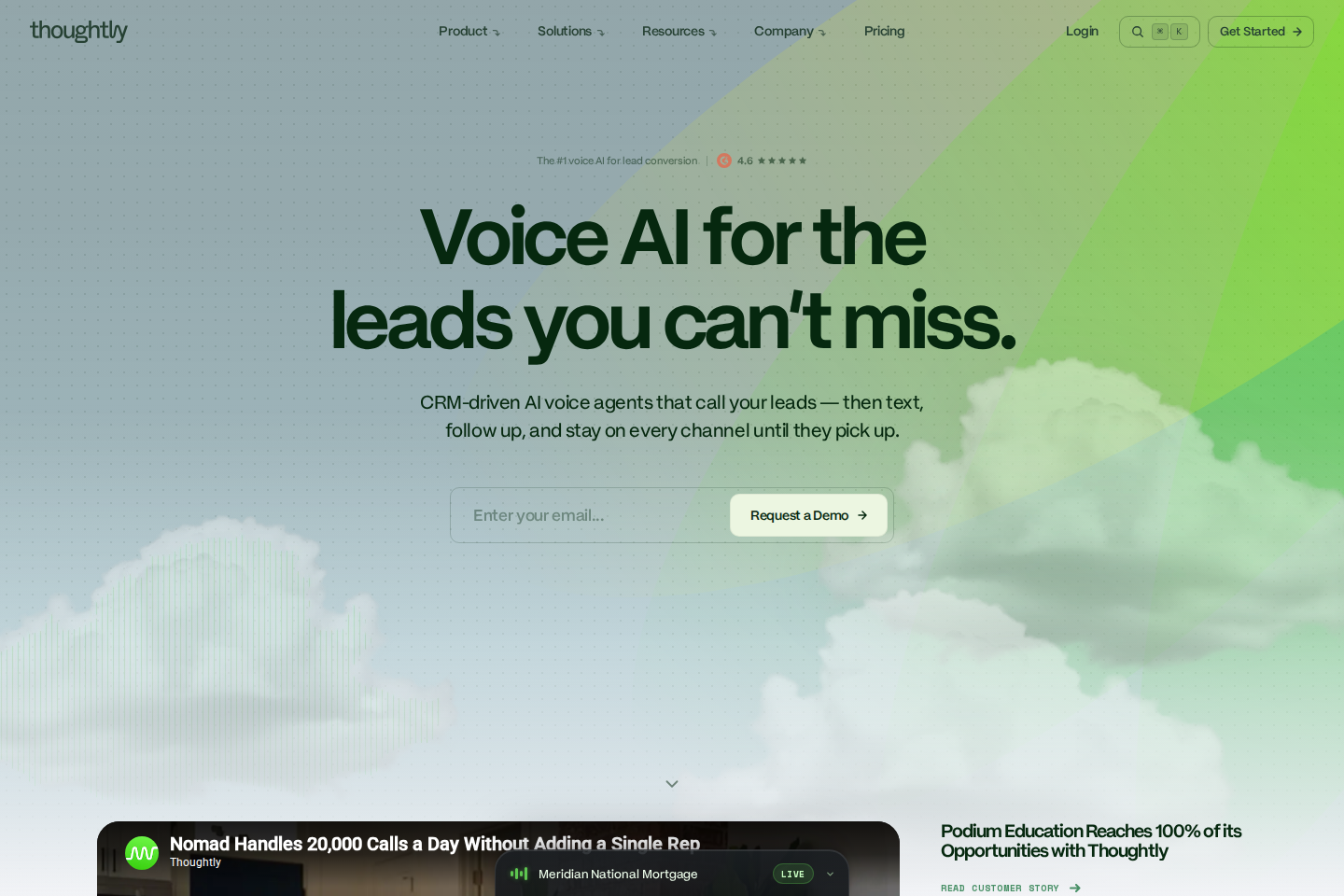
Thoughtly is an AI voice agent platform built specifically for revenue teams that need to convert inbound leads into customers. Unlike PolyAI, which is designed for contact-center call deflection, Thoughtly handles the full lead-to-customer journey: calls, qualifies, follows up by SMS and email, books meetings, and writes outcomes back to the CRM. The platform supports voice, SMS, email, and workflow automation in a single product, with native integrations to Salesforce, HubSpot, Pipedrive, and 200+ other tools. Thoughtly's no-code builder means a RevOps operator can ship a production agent in days — not the multi-month services engagement that PolyAI deployments typically require. For teams whose bottleneck is converting pipeline they already paid to acquire, Thoughtly is a fundamentally different product than PolyAI, not just an alternative.
Pros
Bundles voice + SMS + email + workflows + CRM sync in one platform — no stitching together separate tools for post-call follow-up.
No-code builder lets RevOps operators create, test, and deploy agents without engineering support or vendor professional services.
Native two-way CRM write-back to Salesforce, HubSpot, Pipedrive, and 200+ integrations, so call outcomes and disposition codes flow back automatically.
Deployment measured in days, with a prompt-based builder (Thoughtly Vibe) that can generate a working agent from a plain-language description.
Cons
Best suited for teams with enough lead volume or workflow complexity to justify automation — not ideal for very low-volume operations.
Requires upfront definition of qualification rules, escalation paths, and follow-up logic to get maximum value from the platform.
Best fit
Revenue teams in high-consideration consumer industries — insurance, mortgage, real estate, automotive, elective healthcare, legal, home services — that need to convert inbound leads across voice and messaging channels with full CRM write-back. Thoughtly is built for VP RevOps, VP Sales, or Growth leaders, not VP CX or contact-center directors.
Pricing
Thoughtly offers published pricing tiers starting at $299/month for the Starter plan, with usage-based voice and SMS billing. Enterprise plans with custom volume pricing are available for high-volume teams. Contact Thoughtly for detailed pricing.
2. Cognigy (Best for enterprise contact-center automation)
Cognigy is an enterprise conversational AI platform that automates customer service interactions across voice and chat. It is the closest direct competitor to PolyAI in terms of contact-center focus, with deep integrations into Genesys, Avaya, Amazon Connect, and other CCaaS platforms. Cognigy supports over 100 languages and offers a visual flow builder (Cognigy.AI) that lets contact-center teams design conversation flows without deep coding. Where PolyAI emphasizes conversational realism, Cognigy emphasizes enterprise integration depth and workflow automation within existing contact-center stacks. For organizations already running Genesys or Avaya that need to layer conversational AI on top, Cognigy is often the most natural fit — but it carries the same enterprise implementation weight that drives buyers to evaluate alternatives in the first place.
Pros
Deep native integrations with Genesys, Avaya, Amazon Connect, and Microsoft — the CCaaS stacks that large contact centers already run.
Visual flow builder (Cognigy.AI) enables contact-center ops teams to design and modify conversation flows without engineering support.
Supports 100+ languages with enterprise-grade compliance including SOC 2, ISO 27001, and HIPAA readiness.
Cons
Implementation is services-led and typically requires weeks to months, similar to PolyAI — not a self-serve deployment model.
Pricing is enterprise-only and not publicly listed; procurement requires a sales cycle.
Focused on contact-center deflection — does not natively handle outbound lead conversion, SMS follow-up sequences, or CRM write-back the way a revenue-focused platform does.
Best fit
Large enterprises with established contact-center stacks (Genesys, Avaya, Amazon Connect) that need to automate customer service interactions at scale. Cognigy is built for VP CX and contact-center directors who need to reduce call volume on human agents — not for revenue teams converting leads.
Pricing
Cognigy uses enterprise pricing with custom quotes. No public rate card. Contact Cognigy for pricing.
3. Kore.ai (Best for omnichannel enterprise AI)
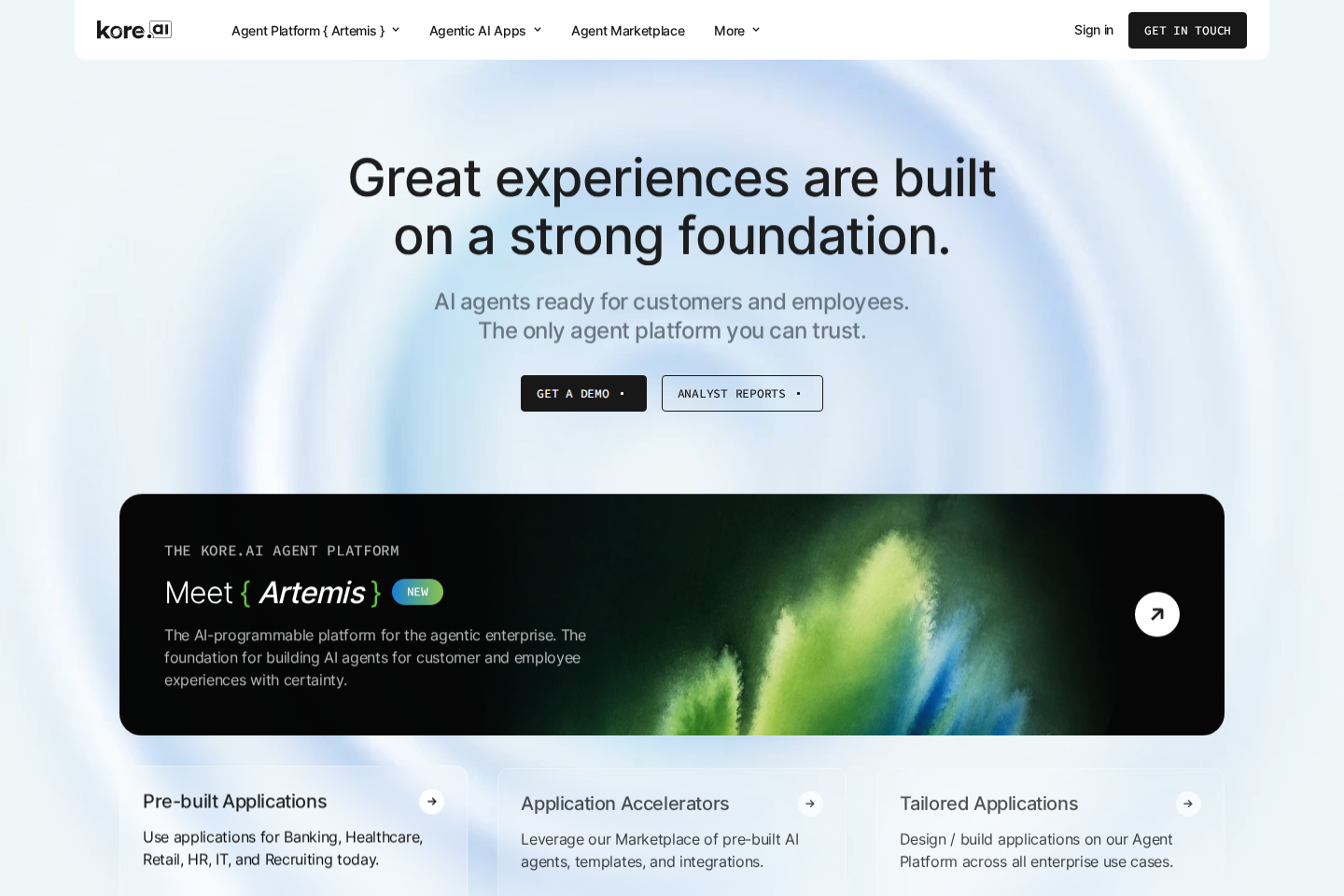
Kore.ai is a broad enterprise conversational AI platform covering chat, voice, and messaging across 30+ channels. It has been recognized as a Leader in the Gartner Magic Quadrant for Conversational AI and serves Fortune 500 companies in banking, insurance, healthcare, and telecom. Kore.ai's breadth is its strength — it can handle employee-facing HR bots, customer-facing service bots, and voice automation from a single platform. But that breadth also creates implementation complexity: the platform's licensing model is layered, configuration requires specialized expertise, and buyers frequently report that getting to production requires either Kore.ai's professional services or a dedicated internal team. For enterprises that need omnichannelOmnichannelOmnichannel is a coordinated customer journey in which context and state carry across voice, SMS, email, web, and human interactions.Read full definition → coverage and have the resources to manage a complex platform, Kore.ai is credible. For teams that need fast deployment, it is often too heavy.
Pros
Omnichannel coverage across 30+ channels including voice, chat, SMS, WhatsApp, and messaging apps from a single platform.
Strong vertical templates for banking, insurance, healthcare, and HR — reduces build time for common enterprise use cases.
Cons
Complex licensing and pricing model with multiple product tiers — buyers report difficulty understanding total cost before signing.
Implementation typically requires Kore.ai professional services or specialized internal resources; not a self-serve platform.
Platform breadth means more configuration surface area to manage — teams without dedicated AI/ML resources may struggle to maintain quality.
Best fit
Large enterprises that need a single conversational AI platform across multiple channels, departments, and use cases — and have the internal team or budget for services-led implementation. Kore.ai is built for enterprise IT and digital transformation leaders, not RevOps or growth teams.
Pricing
Kore.ai offers tiered enterprise pricing with custom quotes. No public rate card. Contact Kore.ai for pricing.
4. Replicant (Best for contact-center call deflection)
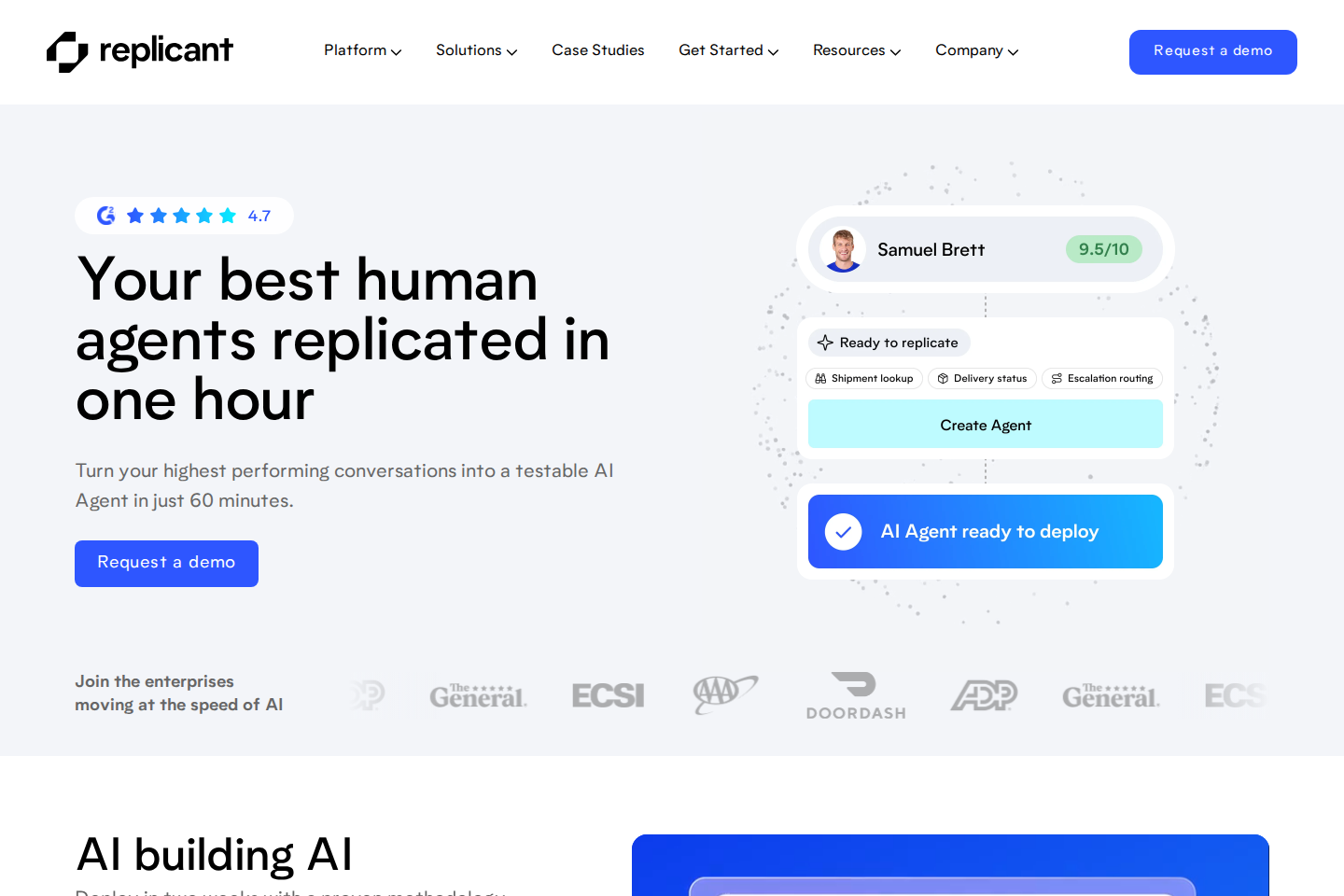
Replicant is a voice AI platform purpose-built for contact-center call deflection — the same use case PolyAI targets. It focuses on resolving high-volume inbound service calls autonomously, with integrations into Zendesk, Salesforce Service Cloud, and major CCaaS platforms. Replicant's Thinking Machine technology handles multi-turn conversations and can resolve issues like order status, appointment scheduling, and billing inquiries without human transfer. For contact centers that need to reduce call volume and wait times, Replicant is a direct PolyAI competitor with a similar product shape. The limitation is that Replicant's scope ends at deflection — it does not handle outbound lead conversion, SMS/email follow-upEmail follow-upEmail follow-up sends timely, context-aware replies or reminders that move an inbound lead toward qualification, scheduling, or handoff.Read full definition → sequences, or CRM write-back for revenue workflows.
Pros
Purpose-built for contact-center deflection with strong resolution rates on common service inquiries (order status, scheduling, billing).
Integrates natively with Zendesk, Salesforce Service Cloud, and major CCaaS platforms — fits into existing contact-center stacks.
Thinking Machine technology handles multi-turn conversations with context retention, reducing unnecessary escalations to human agents.
Cons
Limited to inbound service deflection — no outbound calling, lead conversion, or revenue-focused workflows.
Pricing is not publicly listed and requires a sales conversation; implementation is services-led.
No native SMS or email follow-up — if you need multi-channel lead nurturing, you need a separate platform.
Best fit
Contact centers with high inbound service call volumes that need to reduce wait times and deflect routine inquiries. Replicant is built for VP CX and contact-center directors — the same buyer as PolyAI. If your goal is lead conversion rather than deflection, this is not the right platform.
Pricing
Replicant uses enterprise pricing with custom quotes based on call volume and use case. No public rate card. Contact Replicant for pricing.
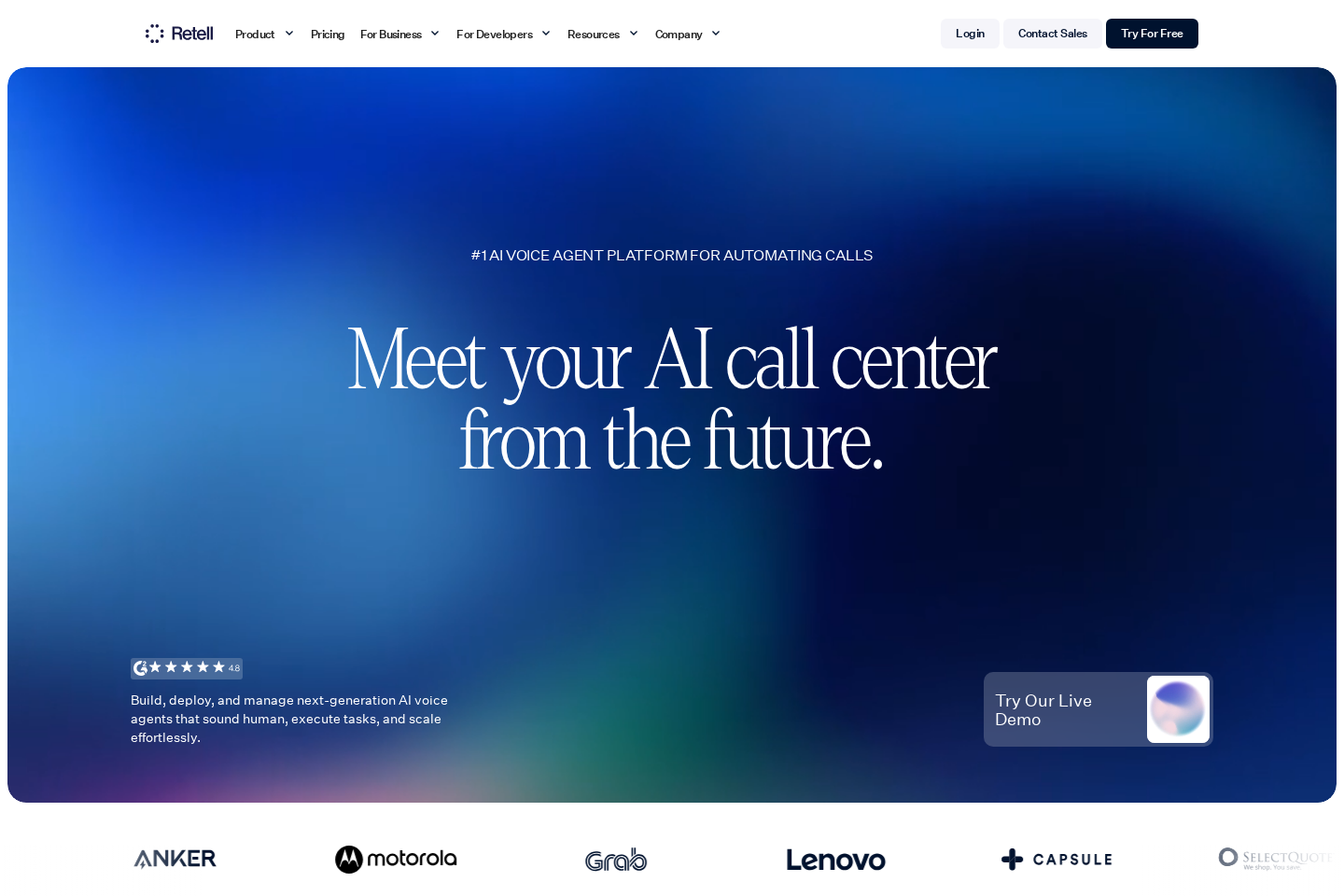
5. Retell AI (Best for developer-first voice infrastructure)
Retell AI is an API-first voice AI platform that gives engineering teams maximum control over voice agent architecture. It offers a conversation API, SDK, and dashboard for building, testing, and deploying voice agents with granular control over STTSpeech-to-Text (STT)Speech-to-Text (STT) converts spoken audio into text that a voice agent can interpret, store as a transcript, and use in downstream actions.Read full definition →, LLMLarge Language Model (LLM)A large language model (LLM) is a machine-learning model trained on large text collections to interpret and generate language from prompts and context.Read full definition →, and TTSText-to-Speech (TTS)Text-to-Speech (TTS) converts written text into spoken audio, producing the voice a caller hears from an automated or AI-driven system.Read full definition → components. Retell is the strongest option for teams that want to build custom voice infrastructure and need deep technical control — but it is fundamentally a developer toolkit, not a revenue platform. Engineering teams use Retell to build voice agents; they do not get CRM integration, SMS follow-up, email sequences, or workflow automation out of the box. For organizations with strong engineering teams that want to own their voice stack, Retell is a powerful alternative to PolyAI's managed approach. For RevOps or contact-center teams without engineering resources, it is the wrong fit.
Pros
API-first architecture gives engineering teams full control over STT, LLM, and TTS component selection and configuration.
Fast iteration cycles for developers — deploy, test, and update agents without vendor dependencies.
Usage-based pricing with published rates, making it easier to model costs than PolyAI's enterprise-only pricing.
Cons
Requires engineering ownership to build and maintain production voice agents — not a no-code or RevOps-owned platform.
No native CRM write-back, SMS follow-up, email sequences, or workflow automation — you build those integrations yourself.
Voice infrastructure only; if you need multichannel coverage, you assemble it from separate tools.
Best fit
Engineering teams that want to build and own their voice AI infrastructure with maximum control over the conversation stack. Retell is built for developers and technical founders, not RevOps or contact-center operators. If you do not have an engineering team to own the build, Retell is not the right choice.
Pricing
Retell AI offers usage-based pricing with published per-minute rates. Free tier available for testing. Contact Retell for volume pricing.
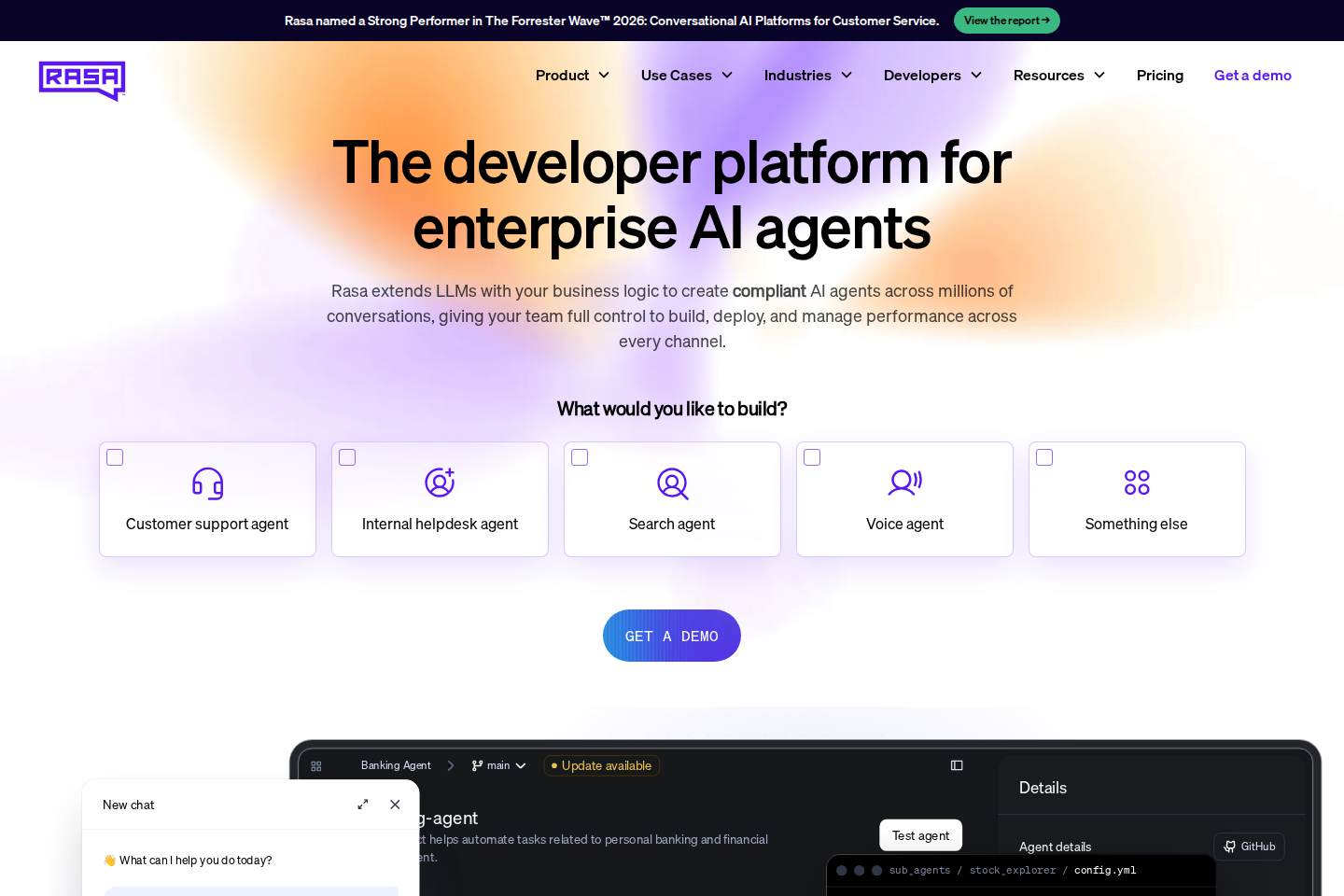
6. Rasa (Best for open-source conversational AI with full data control)
Rasa is an open-source conversational AI framework that gives teams full control over their models, data, and infrastructure. Unlike PolyAI's managed SaaS model, Rasa lets enterprises self-host their conversational AI stack — which matters for regulated industries with strict data residency requirements, government agencies, and companies that cannot send customer data to third-party clouds. Rasa's patented orchestrator supports multi-turn dialogue, context retention, and integration with custom ML models. The trade-off is build cost: Rasa requires a dedicated engineering team to design, build, and maintain the conversation stack. There is no managed voice infrastructure — you bring your own STT, TTS, and telephony. For teams with the right technical resources and strict data control requirements, Rasa is the most flexible option. For teams that need a managed platform, it is too heavy.
Pros
Full data control through self-hosting — customer data never leaves your infrastructure, which is critical for regulated industries and government.
Open-source framework with active community and patented conversation orchestrator for multi-turn dialogue management.
Model-agnostic — bring your own LLM, STT, and TTS providers, or run models locally for maximum control.
Cons
No managed voice infrastructure — you bring your own STT, TTS, telephony, and hosting, which increases build and maintenance costs significantly.
Requires a dedicated engineering team to build and maintain; not a platform for RevOps or contact-center operators.
Enterprise support and Rasa Enterprise features require a paid license — the free open-source version does not include enterprise SLAs or support.
Best fit
Enterprises in regulated industries — healthcare, financial services, government — that need full data residency control and have engineering teams to build and maintain a conversational AI stack. Rasa is built for CTOs and engineering leaders, not RevOps or contact-center directors.
Pricing
Rasa Open Source is free. Rasa Enterprise requires a custom license — contact Rasa for enterprise pricing.
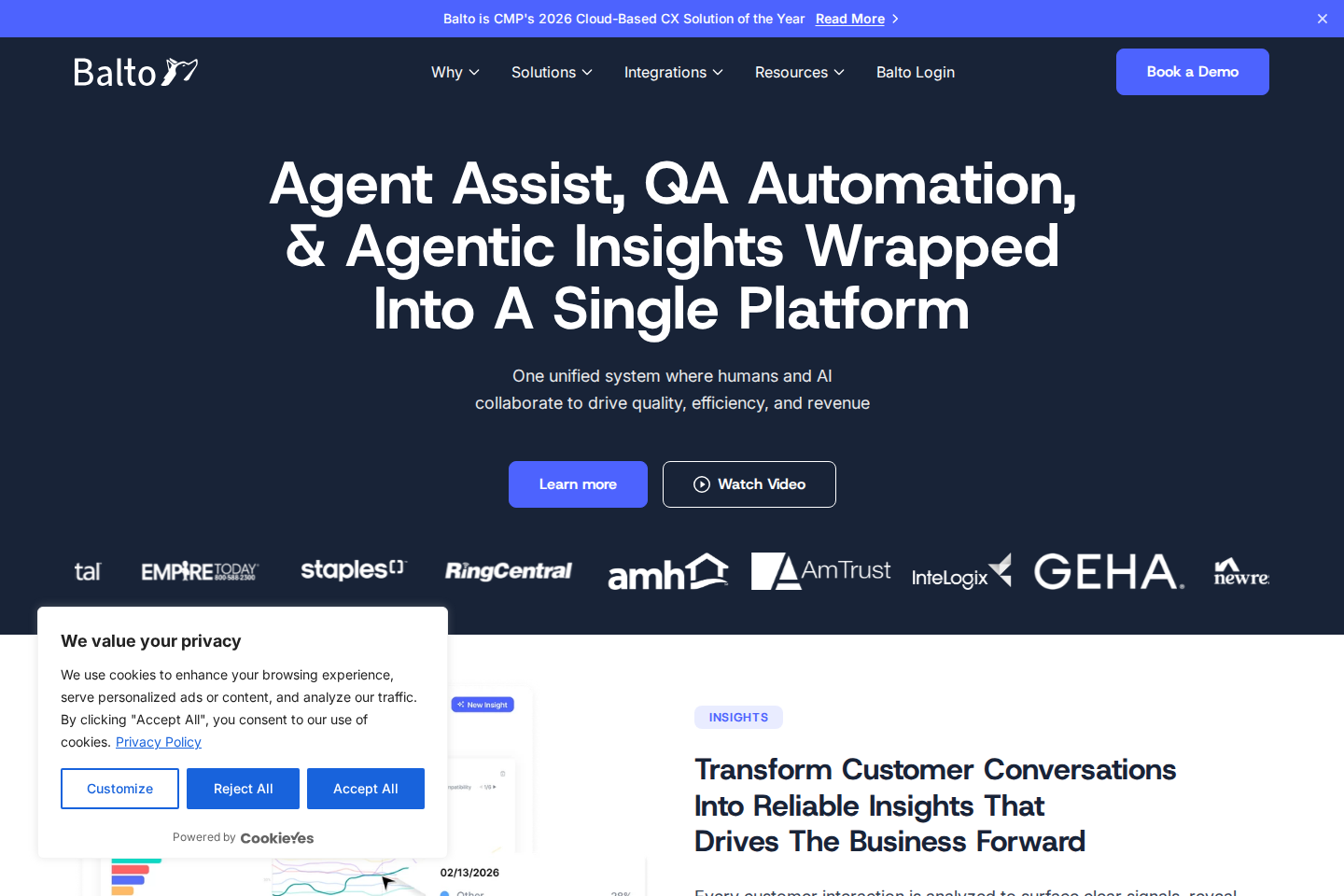
7. Balto (Best for real-time agent assist and QA)
Balto is a real-time agent assist and QA platform that overlays on top of human contact-center agents — not an autonomous voice agent like PolyAI. It provides real-time guidance during live calls, automated quality assurance, and conversation analytics. Balto is included here because contact-center directors evaluating PolyAI for deflection often also evaluate Balto for agent augmentation — they are complementary categories that serve the same buyer. If your contact centerContact centerA contact center is a centralized operation that handles customer or prospect interactions across voice and digital channels.Read full definition → is not ready to fully automate calls and instead wants to make human agents more effective, Balto is a stronger fit than any autonomous voice agent. The limitation is that Balto does not replace human agents — it enhances them. If your goal is to deflect calls entirely without human involvement, you need an autonomous voice agent platform, not an agent assist tool.
Pros
Real-time agent guidance during live calls — surfaces the right talking points, compliance reminders, and next-best-actions as the conversation unfolds.
Automated QA evaluates 100% of calls against consistent standards, replacing manual call sampling with comprehensive coverage.
Strong G2 rating (4.8/5 across 576+ reviews) — the highest customer satisfaction in the agent assist category.
Cons
Agent assist, not autonomous voice agent — Balto enhances human agents rather than replacing them. If you need call deflection without humans, this is the wrong tool.
Requires human agents to be on the call — does not reduce headcount, though it improves per-agent performance.
Pricing is per-agent per-year, which adds cost on top of existing contact-center licensing rather than replacing it.
Best fit
Contact centers with human agents that want to improve call quality, compliance, and consistency in real time. Balto is built for VP CX and contact-center directors who are not ready to fully automate calls — or who want to augment agents while deploying automation for routine inquiries. If your goal is full call deflection, Balto is a complementary tool, not a replacement.
Pricing
Balto uses per-agent per-year pricing. Contact Balto for custom quotes based on team size and use case.
Which PolyAI alternative should you choose?
The right PolyAI alternative depends entirely on what job you are hiring the platform to do. If you are a VP CX or contact-center director trying to deflect routine service calls, Cognigy, Replicant, and Balto are the most direct replacements — each with a different angle. Cognigy offers the deepest CCaaS integrations, Replicant offers the most focused deflection product, and Balto offers agent augmentation rather than full automation.
If you are a VP RevOps, sales, or growth leader trying to convert inbound leads, Thoughtly is the only platform on this list built for that job. The others are contact-center or developer tools that would require custom integration work to handle lead conversion workflows. Choosing a contact-center platform for a lead-conversion use case — or vice versa — leads to operational mismatch, wasted spend, and frustrated teams.
If you are an engineering team that wants to own the voice stack, Retell AI or Rasa are the strongest options — Retell for API-first managed infrastructure, Rasa for open-source self-hosted control. Both require engineering resources that contact-center and RevOps teams typically do not have.
The most common mistake buyers make when evaluating PolyAI alternatives is treating all voice AI platforms as interchangeable. They are not. PolyAI, Cognigy, Kore.ai, and Replicant are contact-center tools. Thoughtly is a revenue tool. Retell and Rasa are developer tools. Balto is an agent-assist tool. The right choice depends on which problem you are actually solving.
FAQ
What is PolyAI best at?
PolyAI is best at handling high-volume inbound customer service calls in enterprise contact centers — particularly in hospitality, food, retail, banking, and telecom. Its core strength is conversational realism: lifelike, interruption-friendly voice interactions that can resolve routine inquiries without human transfer. If your use case is deflecting service calls in a large contact center, PolyAI is a legitimate option.
What is the cheapest PolyAI alternative?
Retell AI and Rasa Open Source are the lowest-cost options, but for different reasons. Retell offers published usage-based pricing with a free tier. Rasa Open Source is free to self-host, but the total cost of building and maintaining a production voice stack on Rasa is significant once you factor in engineering, infrastructure, STT/TTS, and telephony costs. Thoughtly offers published pricing starting at $299/month, which is more transparent than PolyAI's enterprise-only model. For true enterprise contact-center alternatives like Cognigy, Kore.ai, and Replicant, pricing requires a custom quote.
Can PolyAI handle outbound calls?
PolyAI is primarily designed for inbound call automation — customers calling into a contact center. It is not built for outbound lead conversion, cold calling, or re-engagement campaigns. If you need outbound voice automation for lead conversion, Thoughtly and Retell AI are better fits. Replicant also focuses on inbound deflection, not outbound.
How long does PolyAI take to deploy?
PolyAI deployments are services-led and typically take weeks to months, depending on integration complexity. G2 reviewers have flagged the implementation timeline as a common pain point. Alternatives like Thoughtly and Retell AI can deploy in days, but they serve different use cases. Cognigy and Kore.ai have similar enterprise deployment timelines to PolyAI.
Is PolyAI HIPAA-compliant?
PolyAI highlights SOC 2 Type II and ISO 27001 certifications. For HIPAA-specific use cases, check directly with PolyAI about current BAA availability and healthcare deployment references. Cognigy also offers HIPAA-ready deployments. Thoughtly supports HIPAA-compliant configurations for healthcare teams. Always verify current compliance status directly with the vendor before signing.
A CRM is the system used to manage leads, contacts, accounts, opportunities, activity, ownership, and follow-up.
Read full definition →
voice agentVoice agentA voice agent is a conversational software system that listens, responds, follows a defined workflow, and can take approved actions during a phone conversation.Read full definition →
CRM integrationA CRM integration connects an agent or communications platform with a CRM so the systems can exchange records, events, and actions.Read full definition →
Sep 18, 2026
Lawmatics CRM: What Law Firms Should Compare in 2026