8 Best Replicant Alternatives for Voice AI Automation in 2026
Replicant is contact-center voice AI built for call containment. If your KPI is lead conversion, implementation speed, or pricing transparency, these eight alternatives offer different trade-offs — from revenue-first platforms to enterprise CCaaS with embedded AI.
Last updated
Replicant is a capable enterprise contact-center voice AI platform — if your primary goal is deflecting customer-service calls away from human agents. But a growing number of teams are discovering that containment-focused voice AI does not map cleanly to every business priority. Long implementation timelines, rigid flow design, opaque enterprise pricing, and a product architecture built around post-purchase service rather than pre-purchase conversion are pushing buyers to explore alternatives.
I evaluated the platforms that appear most often when teams start looking beyond Replicant — spanning contact-center incumbents, next-generation conversational AIConversational AIConversational AI is software that interprets natural language and produces context-aware responses through voice, messaging, or chat.Read full definition → vendors, and purpose-built revenue conversion platforms. Each alternative is assessed on implementation speed, channel coverage, CRM integrationCRM integrationA CRM integration connects an agent or communications platform with a CRM so the systems can exchange records, events, and actions.Read full definition → depth, pricing transparency, and whether the platform is built for the contact-center buyer or the revenue operations buyer.
How I evaluated these Replicant alternatives
Every platform on this list was assessed against six criteria that surface the most important trade-offs for teams currently on or evaluating Replicant.
1. Implementation speed and operational ownership
Replicant deployments are services-led — publicly available case studies and G2 reviews consistently describe implementation timelines measured in months, with vendor resources in the loop for flow changes. I looked at whether each alternative can get a production agent live in days or weeks rather than quarters, and whether the RevOps or CX team can own day-to-day changes without filing a support ticket. Platforms that require a dedicated implementation team scored lower; those with no-code builders and self-serve iteration scored higher.
2. Channel coverage beyond voice
Replicant supports voice, SMS, and chat, but the product is architected around voice containment. I evaluated whether alternatives offer native same-agent continuity across voice, SMS, and email — not just multi-channel support as separate modules. The difference matters when a lead needs a follow-up text after a call and the same agent should pick up the next conversation with full context, not a fresh session.
3. CRM and workflow integration depth
Contact-center platforms typically integrate with CCaaS stacks — Five9, Genesys, NICE. Revenue-focused platforms integrate with CRMCRMA CRM is the system used to manage leads, contacts, accounts, opportunities, activity, ownership, and follow-up.Read full definition → and martech stacks — Salesforce, HubSpot, Zoho, GoHighLevel. I assessed whether each platform offers two-way CRM write-backCRM write-backCRM write-back sends conversation outcomes, qualification answers, notes, appointments, dispositions, and next steps into the CRM.Read full definition →, native scheduling, and trigger-based workflowWorkflowA workflow is a defined sequence of steps, decisions, actions, delays, and outcomes used to complete a business process.Read full definition → execution. Platforms that push events to a CCaaS but cannot write a deal, update a contact, or book a meeting directly in the CRM scored lower.
4. Pricing transparency and total cost of ownership
Replicant operates on custom enterprise contracts that bundle implementation, platform, and usage fees. Several reviews and procurement sources describe the total cost of ownership as enterprise-tier — often out of reach for mid-market teams. I prioritized platforms that publish pricing or at minimum make the pricing model transparent (per-minute, per-seat, per-agent), and penalized those that require a multi-week procurement cycle just to see a number.
5. AI conversation quality and resolution depth
Replicant's Thinking Machine handles multi-intent queries and maintains context through interruptions. I compared each alternative's LLMLarge Language Model (LLM)A large language model (LLM) is a machine-learning model trained on large text collections to interpret and generate language from prompts and context.Read full definition → backbone, ability to handle complex branching conversations, and whether the platform can resolve issues or qualify leads end-to-end rather than simply routing to a human. Platforms using latest-generation models (GPT-4o, Claude, Gemini) with real-time switching or always-latest upgrades scored highest.
6. Revenue impact vs. cost deflection
Replicant's success metric is containment rate — calls kept away from human agents. That is the right KPI for customer-service deflection, but the wrong KPI when the goal is converting inbound leads into customers. I assessed whether each alternative measures success by revenue impact — leads qualified, appointments booked, deals advanced — or by cost reduction alone. Platforms with revenue-native analytics and conversion tracking scored higher for teams whose buying motion is revenue operations, not contact-center operations.
Quick comparison: Replicant alternatives at a glance
Platform
Best for
Primary strength
Key limitation
Thoughtly
Revenue teams converting inbound leads
Voice + SMS + email + CRM in one platform, deployed in days
Best when lead volume and qualification workflows are clearly defined
Large contact centers adding AI to existing operations
Full-stack CCaaS with embedded AI
Legacy platform complexity; AI is layered on, not native
Parloa
Voice-first AI contact center transformation
Purpose-built voice AI with strong European compliance
Smaller ecosystem; fewer third-party integrations
Cognigy
Enterprise orchestration across CCaaS platforms
Deep integration with Genesys, NICE, Avaya
Requires technical resources for complex deployments
NICE CXone
Large-scale contact center operations
Massive scale and established enterprise footprint
Heavy platform; AI capabilities are evolving additions
Verint
Workforce engagement with conversational AI
Analytics-led CX with strong workforce optimization
AI agent capabilities are newer compared to core WFO
Talkdesk
Mid-market contact centers seeking AI features
Cloud-native CCaaS with AI add-ons
AI depth varies; some modules are add-on priced
8 best Replicant alternatives for voice AI automation in 2026
1. Thoughtly — Best for converting inbound leads across voice, SMS, and email
Thoughtly is a conversational AI platform built for a fundamentally different job than Replicant. Where Replicant deflects customer-service calls inside an existing contact centerContact centerA contact center is a centralized operation that handles customer or prospect interactions across voice and digital channels.Read full definition →, Thoughtly converts inbound leads into customers — calling, texting, and emailing every lead within seconds of a form fill, missed call, or CRM triggerTriggerA trigger is an event or condition that starts, resumes, changes, or stops an automated workflow.Read full definition →. The platform bundles voice, SMS, and email agents with native CRM write-back, scheduling, warm transferWarm transferA warm transfer connects a live caller to the right person while preserving the context already collected during the conversation.Read full definition →, and workflow execution in a no-code builder that RevOps teams own directly, without filing implementation tickets or waiting on a vendor services team.
Thoughtly supports 30+ languages, branded callingBranded callingBranded calling displays verified business identity, and sometimes a logo or call reason, on supported devices when a business calls.Read full definition →, IVRIVRIVR, or Interactive Voice Response, is a phone menu that routes or serves callers through keypad entries or spoken choices.Read full definition → with DTMF, automatic PIIPersonally Identifiable Information (PII)Personally identifiable information, or PII, is information that can distinguish or trace an individual’s identity alone or when combined with linked data.Read full definition → redaction, and enterprise compliance (HIPAAHIPAAHIPAA is a US federal law whose Privacy, Security, and Breach Notification Rules govern protected health information for covered entities and business associates.Read full definition →, SOC 2 Type II, GDPR). Agents use always-latest LLMs (GPT, Claude, Gemini) with sub-second and can handle complex branching conversations — qualifying leads, booking appointments, routing to human reps, and writing outcomes back to Salesforce, HubSpot, GoHighLevel, or 200+ other integrations in real time.
Pros
Deploys production agents in days, not months — no services engagement required. RevOps owns the builder and can iterate on flows, prompts, and qualification logic without vendor support.
True multichannel continuity: the same agent handles voice, SMS, and email follow-up with full conversation context carried across channels — not separate modules with separate sessions.
Two-way CRM write-back updates contacts, deals, activities, and call notes in real time. This is native sync, not event-push-and-hope.
Bundled pricing with no stacked per-minute infrastructure, LLM, TTS, or add-on fees. Phone numbers, concurrency, knowledge base, and PII redaction are included.
Enterprise-grade compliance (HIPAA, SOC 2 Type II, GDPR) with automatic PII redaction across names, addresses, DOBs, passwords, and PINs.
Watch for
Thoughtly is optimized for inbound lead conversion and revenue workflows — not customer-service containment. Teams whose primary KPI is deflection rate inside a contact center should evaluate whether the product's revenue-first architecture maps to their operating model.
Delivers the strongest ROI when lead volume, qualification criteria, and CRM workflows are clearly defined. Teams still designing their funnel may need to invest in workflow definition before seeing full value.
Best fit
Revenue operations, sales, and growth teams in insurance, mortgage, real estate, education enrollment, healthcare, home services, financial services, and other high-consideration consumer industries that need every inbound lead contacted within seconds — across voice, SMS, and email — with outcomes written directly to CRM.
Pricing
Thoughtly offers custom plans with bundled pricing — no stacked infrastructure fees. See current pricing.
2. PolyAI — Best for enterprise brands prioritizing natural voice experiences
PolyAI builds enterprise voice AI agents with a focus on natural-sounding, brand-tuned conversation experiences. The platform is designed for large contact centers handling high volumes of inbound customer service calls — hospitality, banking, insurance, and retail are core verticals. PolyAI agents are trained on real conversation data, producing voice interactions that sound closer to a human agent than many competitors in the contact-center AI space.
Unlike Replicant's containment-first approach, PolyAI emphasizes resolution quality and customer satisfaction alongside deflection metrics. The platform handles complex dialogue flows, authenticates callers, processes transactions, and escalates to human agents when needed. PolyAI has deployed at scale for brands like Caesars Entertainment, Marriott, and major banks.
Pros
Voice quality is a standout — PolyAI agents are consistently rated among the most natural-sounding in enterprise voice AI, with brand-specific persona tuning that goes beyond stock TTS voices.
Strong resolution rates in hospitality, banking, and insurance use cases where callers expect a human-quality conversation, not an IVR replacement.
Conversation analytics provide actionable insights into why callers are reaching out, helping CX teams identify product and service issues upstream.
Watch for
PolyAI is primarily voice-only. If your workflow requires same-agent SMS or email follow-up after a call, you will need to integrate a separate channel solution.
Custom enterprise pricing with implementation timelines typically measured in months (2–4 months is common). Smaller teams or those needing fast deployment may find the onboarding cycle too long.
Best fit
Enterprise CX teams in hospitality, banking, insurance, and retail that prioritize natural voice quality and brand consistency in high-volume inbound customer service — and have the budget and timeline for a managed enterprise deployment.
Pricing
Custom enterprise pricing. Contact PolyAI for a quote.
3. Five9 — Best for large contact centers adding AI to existing CCaaS operations
Five9 is an established cloud contact center platform that has added AI capabilities over successive product cycles — IVA (Intelligent Virtual Agent), Agent Assist, workflow automationWorkflow automationWorkflow automation uses software to execute and coordinate repeatable steps such as intake, follow-up, qualification, routing, booking, and system updates.Read full definition →, and analytics. For teams already running on Five9's CCaaS infrastructure, adding Five9's AI layer avoids the integration overhead of bringing in a standalone voice AI vendor like Replicant. Five9 serves a broad range of industries including healthcare, financial services, retail, and technology.
Five9's Genius AI suite includes conversational IVA for voice and digital channels, real-time agent coaching, call summarization, and workforce management. The platform handles both inbound and outbound scenarios within the same environment, and its integration ecosystem includes CRM connectors for Salesforce, ServiceNow, Microsoft Dynamics, and Zendesk.
Pros
Full-stack CCaaS platform — voice, digital, WFM, quality management, and AI in one environment. No need to stitch together separate infrastructure vendors.
Strong CRM integrations — particularly with Salesforce — that go beyond basic screen pop to include bidirectional data flow and workflow triggers.
Established enterprise customer base with proven scale across healthcare, financial services, and retail contact centers handling millions of interactions.
Watch for
Five9's AI capabilities have been added incrementally to a legacy CCaaS platform. Reviewers on G2 and Gartner Peer Insights note that the AI features can feel bolted-on rather than natively integrated, and some advanced AI workflows require professional services to configure.
Pricing is seat-based with add-on AI modules, which can create complexity when forecasting total cost of ownership. Teams looking for simple per-minute or per-conversation pricing may find the model opaque.
Best fit
Large contact centers already invested in CCaaS infrastructure that want to layer AI capabilities on top of their existing Five9 deployment without migrating to a new platform — particularly in healthcare, financial services, and retail.
Pricing
Five9 pricing starts at approximately $175/seat/month for core plans, with AI modules priced as add-ons. Contact Five9 for enterprise pricing.
4. Parloa — Best for voice-first AI contact center transformation in regulated industries
Parloa is a Berlin-based conversational AI platform that focuses specifically on voice-first contact center automation. The company raised $92M in Series B funding and has built a platform designed to replace IVR systems and legacy voice bots with LLM-powered conversational agents. Parloa is particularly strong in European markets, with GDPR-native architecture and multilingual support that spans German, English, French, Spanish, and other European languages.
Parloa's approach differs from Replicant in that it positions itself as a platform for full contact-center AI transformation rather than incremental call containment. The platform supports both voice and chat, integrates with enterprise CCaaS platforms (Genesys, NICE, Avaya), and emphasizes real-time agent assist alongside fully autonomous virtual agents.
Pros
Purpose-built for voice-first AI with strong LLM integration — conversations feel natural and handle complex multi-turn dialogue without the rigid flow constraints reviewers flag in Replicant.
GDPR-native architecture with European data residency options — a meaningful differentiator for teams operating under EU privacy regulations or German data sovereignty requirements.
Deep integration with enterprise CCaaS platforms (Genesys, NICE, Avaya) allows deployment alongside existing contact-center infrastructure rather than requiring a full-stack replacement.
Watch for
Parloa's ecosystem is smaller than established CCaaS vendors. Third-party integration options outside the core CCaaS partnerships may be limited compared to platforms with 100+ native connectors.
Strongest in European markets. Teams operating primarily in North America may find fewer case studies, local support resources, and vertical-specific references compared to US-headquartered alternatives.
Best fit
Enterprise contact centers in Europe or regulated industries that need voice-first AI transformation with GDPR-native compliance, multilingual support, and integration into existing Genesys, NICE, or Avaya infrastructure.
Pricing
Custom enterprise pricing. Contact Parloa for a quote.
5. Cognigy — Best for enterprise conversational AI orchestration across CCaaS platforms
Cognigy is a Düsseldorf-based enterprise conversational AI platform that serves as an orchestration layer across voice and digital channels. Rather than replacing a contact center's existing CCaaS stack, Cognigy sits on top — integrating with Genesys, NICE, Avaya, Cisco, and others to add AI-powered virtual agents, agent assist, and workflow automation. The platform is used by large enterprises in automotive, insurance, telecommunications, and travel.
Cognigy's low-code flow editor allows CX teams to design complex conversation flows with branching logic, API calls, database lookups, and multi-language support. The platform was recognized as a Leader in the 2024 Gartner Magic Quadrant for Enterprise Conversational AI Platforms and supports both cloud and on-premise deployments — a requirement for some regulated industries and government organizations.
Pros
Works as an orchestration layer on top of existing CCaaS investments — no need to rip and replace Genesys, NICE, or Avaya. This can reduce deployment risk for enterprises with complex, multi-vendor contact center stacks.
Low-code flow editor with strong branching logic, API integration, and multi-language support. Non-developers can build and modify flows, though complex integrations still benefit from technical resources.
Supports both cloud and on-premise deployment — a meaningful differentiator for regulated industries, government organizations, and enterprises with strict data residency requirements.
Watch for
Cognigy is an orchestration platform, not a turnkey revenue conversion tool. Teams expecting to deploy a production agent in days will find that Cognigy's flexibility requires upfront design and configuration work.
Pricing is enterprise-tier and not publicly disclosed. Multiple reviewer accounts mention that the total cost of ownership — including platform fees, professional services, and CCaaS integration — can be substantial for complex deployments.
Best fit
Enterprise CX teams with existing CCaaS infrastructure (Genesys, NICE, Avaya, Cisco) that need a conversational AI orchestration layer to add virtual agents and agent assist without replacing their current contact center stack.
Pricing
Custom enterprise pricing. Contact Cognigy for a quote.
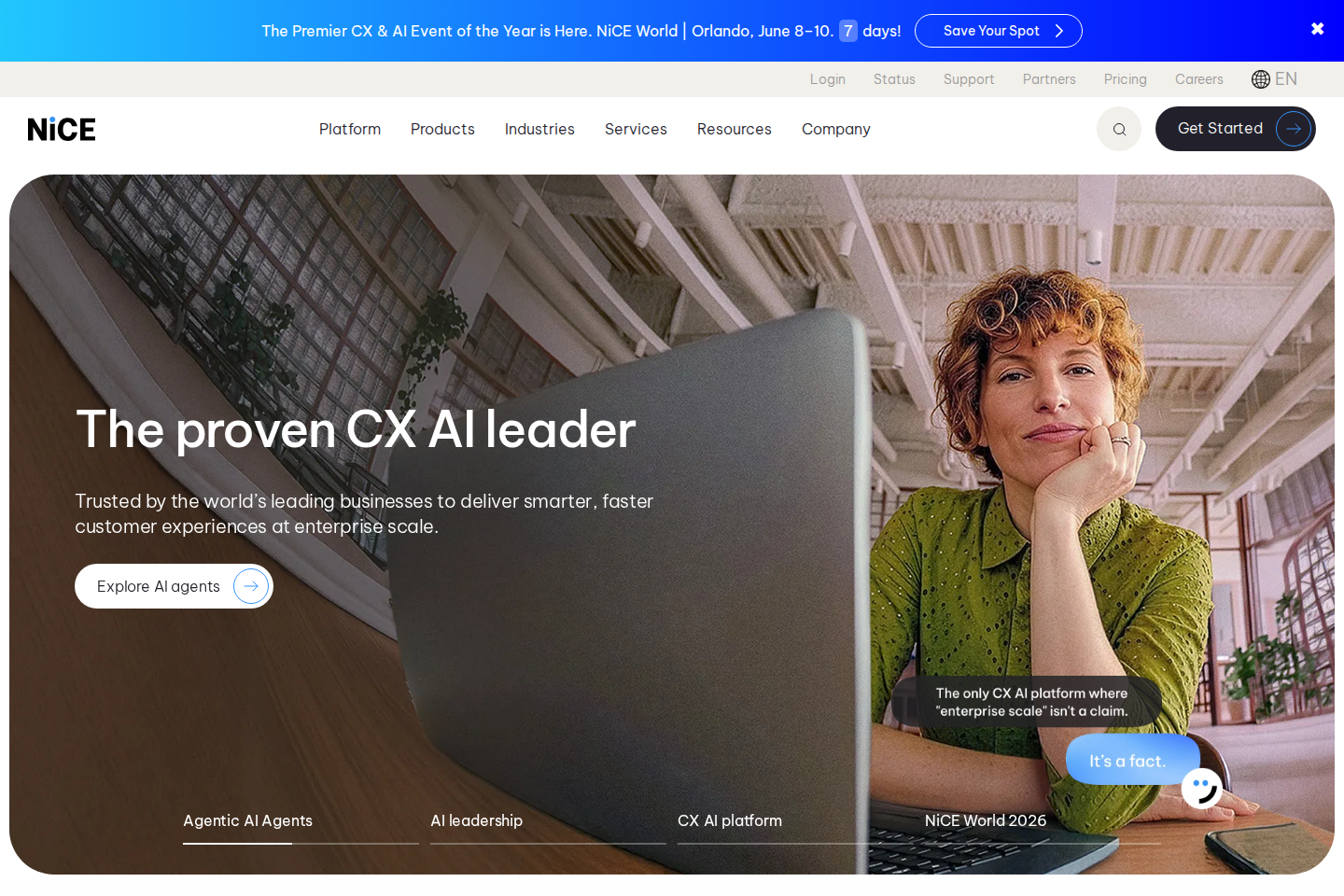
6. NICE CXone — Best for large-scale contact center operations with AI augmentation
NICE CXone is one of the largest cloud contact center platforms globally, serving enterprises with thousands of agents across industries including financial services, healthcare, telecommunications, and government. NICE has invested heavily in AI through its Enlighten AI suite, which includes conversational self-service, real-time agent coaching, quality management automation, and workforce optimization.
For teams considering Replicant alternatives, NICE CXone represents the full-stack CCaaS approach — the AI capabilities are part of a much broader platform that includes ACD, IVR, WFM, QM, and analytics. This can be an advantage for teams that want a single vendor for their entire contact center stack, but it also means the AI capabilities are one feature set among many rather than the core product.
Pros
Massive enterprise scale and proven reliability — NICE CXone handles billions of interactions across some of the world's largest contact centers. Platform maturity and stability are well-established.
Enlighten AI suite covers the full CX lifecycle: self-service, agent assist, quality management, and workforce optimization. Teams get AI across multiple functions without stitching together point solutions.
Strong compliance footprint including FedRAMP, HIPAA, PCI-DSS, and SOC 2 — important for financial services, healthcare, and government contact centers.
Watch for
NICE CXone is a large, complex platform. Teams that only need conversational voice AI may find they are paying for and managing far more infrastructure than their use case requires.
AI capabilities have been added over multiple product generations. Some reviewers note that the conversational AI self-service experience is still catching up to purpose-built voice AI vendors like PolyAI or Parloa in terms of conversation naturalness.
Best fit
Large-scale contact center operations (500+ agents) in financial services, healthcare, telecom, or government that want AI augmentation as part of a comprehensive CCaaS platform from a single established vendor.
Pricing
NICE CXone pricing varies by module and scale. Plans start at approximately $71/agent/month for core features; AI capabilities are available as add-on modules. Contact NICE for enterprise pricing.
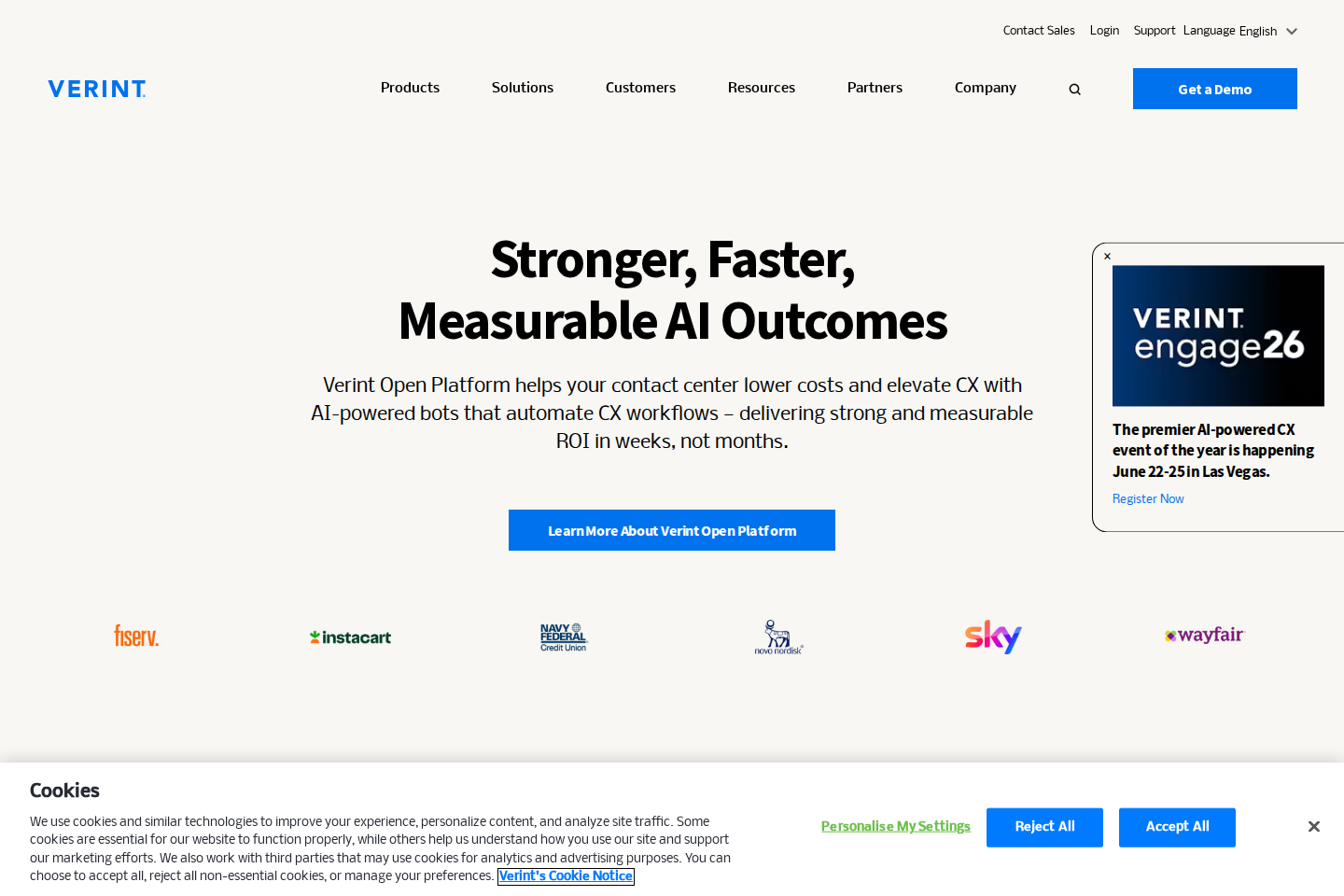
7. Verint — Best for analytics-led CX with workforce engagement and conversational AI
Verint has historically been known for workforce engagement management (WEM) — quality monitoring, workforce management, speech analytics, and compliance recording. In recent years, Verint has expanded into conversational AI with its Da Vinci AI platform, which includes intelligent virtual assistants (IVAs) for voice and digital channels, real-time agent coaching, and knowledge management.
For teams evaluating Replicant alternatives, Verint represents an analytics-first approach to contact center AI. The platform's strength is connecting conversational AI with deep interaction analytics, workforce optimization, and compliance workflows. Verint serves large enterprises in financial services, insurance, healthcare, government, and telecommunications — industries where recording, analytics, and compliance are non-negotiable.
Pros
Industry-leading interaction analytics and speech analytics that feed directly into quality management, compliance monitoring, and coaching workflows. The analytics depth is a genuine differentiator for compliance-heavy industries.
Unified workforce engagement platform: WFM, QM, coaching, recording, and conversational AI in one environment. Teams that need both automation and workforce optimization can avoid managing separate vendor relationships.
Strong compliance and recording capabilities designed for regulated industries. Verint has deep experience with financial services compliance, healthcare HIPAA requirements, and government security standards.
Watch for
Verint's conversational AI capabilities are newer compared to its core WEM products. Teams looking for cutting-edge voice AI conversation quality may find that purpose-built conversational AI platforms (PolyAI, Cognigy) offer more advanced LLM-powered dialogue.
The platform is large and complex. Implementation timelines for the full suite can extend to months, and smaller teams may find the product footprint oversized for their needs.
Best fit
Large enterprise contact centers in financial services, insurance, healthcare, and government that prioritize interaction analytics, compliance recording, and workforce engagement management alongside conversational AI — and want these capabilities from a single vendor.
Pricing
Custom enterprise pricing based on modules and scale. Contact Verint for a quote.
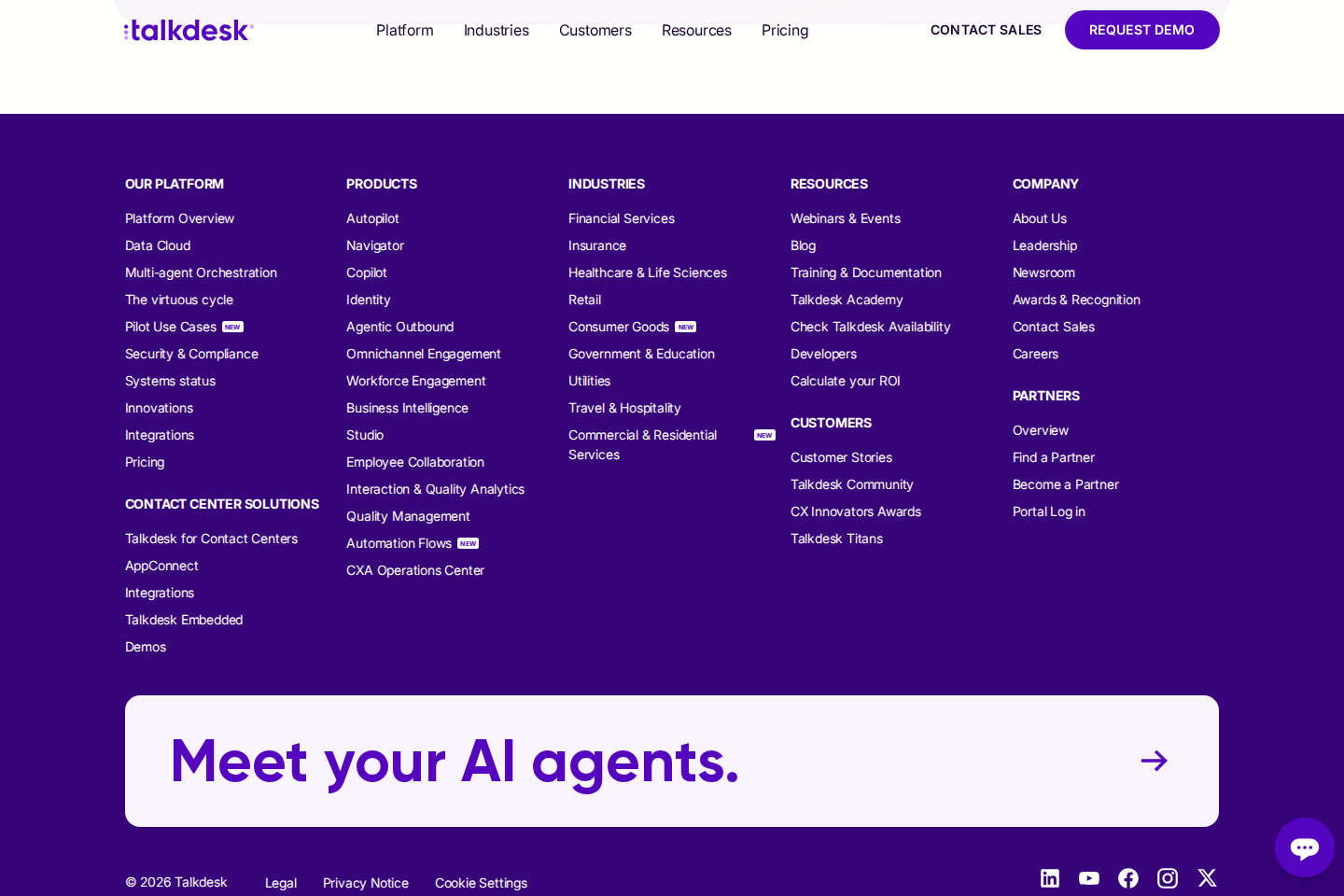
8. Talkdesk — Best for mid-market contact centers seeking cloud-native AI features
Talkdesk is a cloud-native contact center platform that has made AI a core part of its product story. The platform includes Talkdesk Autopilot (virtual agent), Talkdesk Copilot (agent assist), AI-powered quality management, and workforce management. Talkdesk positions itself as easier to deploy and manage than legacy CCaaS platforms like NICE CXone or Genesys, targeting mid-market and growth-stage enterprise contact centers.
For teams evaluating Replicant alternatives, Talkdesk offers a full CCaaS platform with AI built in rather than bolted on. The Autopilot virtual agent handles voice and digital conversations, and the platform integrates with Salesforce, ServiceNow, Zendesk, and other CRM/ITSM tools. Talkdesk has been recognized by Gartner and Forrester as a leader in the CCaaS space.
Pros
Cloud-native architecture designed from the ground up — no legacy on-premise baggage. The platform generally deploys faster and requires less professional services than Five9, NICE, or Genesys implementations.
AI features (Autopilot, Copilot, QM, WFM) are integrated into the platform rather than priced as entirely separate add-ons, though packaging still varies by tier.
Strong vertical cloud offerings for healthcare, financial services, and retail — with pre-built compliance workflows and industry-specific integrations that reduce customization overhead.
Watch for
Some reviewers on G2 note that Talkdesk's AI features vary in depth — Autopilot virtual agent capabilities may not match the conversation quality of purpose-built voice AI vendors for complex, multi-turn dialogue.
Pricing tiers and module packaging can be confusing. Teams should verify which AI capabilities are included in their plan tier versus available as paid add-ons.
Best fit
Mid-market and growth-stage enterprise contact centers (50–500 agents) that want a modern, cloud-native CCaaS platform with integrated AI features — particularly in healthcare, financial services, and retail — without the implementation weight of legacy platforms.
Pricing
Talkdesk pricing starts at approximately $85/user/month for CX Cloud Essentials. Higher tiers with AI features are priced at $115–$145/user/month. Contact Talkdesk for enterprise pricing.
How to choose the right Replicant alternative
The right alternative depends on which job you are hiring the platform to do. Here is a decision framework:
Choose a revenue conversion platform (Thoughtly) if:
Your primary KPI is leads converted to customers, not calls deflected from a human queue.
You need voice + SMS + email in one agent with CRM write-back, scheduling, and workflow execution.
You want to deploy a production agent in days, owned by RevOps, without a services engagement.
Your stack is CRM-first (Salesforce, HubSpot, GoHighLevel), not CCaaS-first.
Choose an enterprise voice AI vendor (PolyAI, Parloa) if:
Your priority is natural-sounding voice experiences for inbound customer service.
You have the budget and timeline for a managed enterprise deployment (2–6 months).
Your success metric is customer satisfaction and resolution quality alongside containment rate.
Choose a full-stack CCaaS platform (Five9, NICE CXone, Talkdesk) if:
You already run a contact center with ACD, WFM, QM, and want to add AI without bringing in a separate vendor.
Your organization prefers a single-vendor approach for compliance, procurement, and IT management.
You need AI across multiple functions — not just conversational agents but also agent assist, quality management, and workforce optimization.
Choose a conversational AI orchestration layer (Cognigy) if:
You have a complex, multi-vendor contact center stack and want to add AI on top of it rather than replacing infrastructure.
You need on-premise or hybrid deployment for data residency or regulatory reasons.
Your CX team has technical resources to design and maintain complex conversational flows.
Choose an analytics-led CX platform (Verint) if:
Interaction analytics, compliance recording, and workforce engagement are as important as conversational AI.
You operate in a highly regulated industry where recording, quality monitoring, and compliance workflows are non-negotiable.
FAQ
What is Replicant best at?
Replicant is a strong enterprise voice AI platform for automating Tier 1 customer-service calls. Its Thinking Machine engine handles multi-intent queries and maintains conversation context through interruptions. The platform is best suited for large contact centers with high call volumes where the primary success metric is containment rate — keeping calls away from human agents. Replicant has proven deployments in insurance, travel, retail, and healthcare customer service.
Why do teams look for Replicant alternatives?
The most common triggers are long implementation timelines (months, not days), opaque enterprise pricing, rigid flow design that requires vendor support to modify, and a product architecture built around customer-service containment rather than lead conversion or revenue operations. Teams whose KPI is lead conversion rather than call deflection often find that Replicant's contact-center-shaped product does not map to their workflow.
Can Replicant handle outbound calling?
Replicant supports outbound scenarios, but the platform is primarily architected for inbound customer-service automation. Teams that need systematic outbound lead follow-upLead follow-upLead follow-up is the sequence of calls, texts, emails, and tasks used after a prospect expresses interest.Read full definition →, re-engagement campaigns, or speed-to-lead workflows will find that revenue-focused platforms with native outbound capabilities and CRM integration are a more natural fit.
Is Replicant suitable for mid-market teams?
Replicant's enterprise pricing model, services-led implementation, and large-contact-center focus make it a challenging fit for most mid-market teams. Third-party reviews and procurement sources consistently describe the total cost of ownership as enterprise-tier. Mid-market teams often find faster time-to-value and more transparent pricing with platforms built for their scale.
What is the difference between containment and conversion?
Containment is the contact-center metric for calls resolved without reaching a human agent — the goal is cost reduction. Conversion is the revenue metric for leads turned into customers through qualification, appointment booking, and follow-up — the goal is revenue generation. Replicant optimizes for containment. Platforms like Thoughtly optimize for conversion. Different KPIs, different product architectures, different buyers.
Sources and further reading
Thoughtly — AI agents for lead conversion: thoughtly.com
latencyLatencyLatency is the elapsed time between a caller's speech and the agent's response, including listening, processing, tool, network, and speech-generation delays.Read full definition →
Sep 18, 2026
Lawmatics CRM: What Law Firms Should Compare in 2026