Best Retell AI Alternatives for Revenue Teams in 2026
Retell AI is powerful voice infrastructure for engineering teams — but revenue teams need more. I evaluated 8 alternatives that deliver multichannel execution, CRM integration, predictable pricing, and no-code operational ownership for inbound lead conversion.
Last updated
If you've been evaluating Retell AI for your revenue team, you've probably noticed the gap between what the platform promises and what it takes to actually ship a production agent. Retell is API-first voice infrastructure — powerful for engineering teams assembling custom stacks, but a heavy lift for RevOps, marketing, and sales leaders who need to convert inbound leads across voice, SMS, and email without standing up a voice engineering project.
Retell's stacked pricing (infra + LLMLarge Language Model (LLM)A large language model (LLM) is a machine-learning model trained on large text collections to interpret and generate language from prompts and context.Read full definition → + TTSText-to-Speech (TTS)Text-to-Speech (TTS) converts written text into spoken audio, producing the voice a caller hears from an automated or AI-driven system.Read full definition → + add-ons), developer-dependent production path, and voice-only scope are the three triggers that most commonly send revenue teams looking for alternatives. G2 reviewers consistently flag the learning curve for non-technical users, pricing complexity at scale, and limited support outside of Discord.
I evaluated eight platforms that solve different parts of the problem Retell leaves open: multichannel execution, CRM-native workflows, predictable pricing, and the ability for non-engineers to ship and own production agents. Here's what I found.
How I evaluated these Retell AI alternatives
Every platform was evaluated against the specific gaps revenue teams hit with Retell: the need for multichannel reach, CRM integrationCRM integrationA CRM integration connects an agent or communications platform with a CRM so the systems can exchange records, events, and actions.Read full definition → depth, operational ownership without engineering dependency, pricing predictability, and production readiness for inbound lead conversionInbound lead conversionInbound lead conversion turns opted-in calls, form submissions, quote requests, and other inquiries into qualified conversations, appointments, or transfers.Read full definition → workflows.
1. Multichannel execution
Retell is voice-only with SMS as a paid add-on and no email channel. Revenue teams converting inbound leads need voice, SMS, and email working as co-equal channels — not bolted on separately. I looked for platforms that ship multichannel natively, where a single workflowWorkflowA workflow is a defined sequence of steps, decisions, actions, delays, and outcomes used to complete a business process.Read full definition → can call a lead, send a follow-up text, and triggerTriggerA trigger is an event or condition that starts, resumes, changes, or stops an automated workflow.Read full definition → an email sequence without requiring separate tools or custom integrations for each channel.
2. CRM and workflow integration
Retell pushes events via webhooks, but true two-way CRM write-backCRM write-backCRM write-back sends conversation outcomes, qualification answers, notes, appointments, dispositions, and next steps into the CRM.Read full definition → — contacts, deals, activities, call notes syncing back to Salesforce, HubSpot, or Zoho — requires custom engineering. I evaluated how deeply each platform integrates with the CRMCRMA CRM is the system used to manage leads, contacts, accounts, opportunities, activity, ownership, and follow-up.Read full definition → and workflow tools revenue teams already use, and whether sync is native or a build-it-yourself project. Platforms with out-of-the-box CRM connectors that write back call outcomes and lead status without middleware scored highest.
3. Operational ownership
Retell requires a developer to ship a production agent. For revenue teams, that means engineering bottlenecks, slow iteration cycles, and constant dependency for prompt changes or workflow tweaks. I prioritized platforms where marketing, sales ops, or RevOps can build, edit, and deploy agents directly — with no-code or low-code interfaces that let the team closest to the funnel own the agent without waiting on engineering sprints.
4. Pricing predictability
Retell stacks pricing across infra ($0.055/min), LLM ($0.006–$0.08/min), TTS ($0.015–$0.040/min), and metered add-ons for SMS, knowledge baseKnowledge baseA knowledge base is a maintained collection of approved business information that an agent can use to answer questions.Read full definition →, PIIPersonally Identifiable Information (PII)Personally identifiable information, or PII, is information that can distinguish or trace an individual’s identity alone or when combined with linked data.Read full definition → redaction, and denoising. Total cost requires an architect to forecast. I looked for platforms that offer bundled or all-in pricing models where a finance team can model cost without assembling a spreadsheet of provider rates. Transparent per-minute or per-plan pricing scored better than stacked à-la-carte models.
5. Production readiness and compliance
Revenue teams in regulated industries — healthcare, insurance, mortgage, financial services — need HIPAAHIPAAHIPAA is a US federal law whose Privacy, Security, and Breach Notification Rules govern protected health information for covered entities and business associates.Read full definition →, SOC 2, and GDPR compliance out of the box, not as a DIY project. I evaluated each platform's compliance certifications, PII handling, uptime track record, and whether enterprise-grade security is included or requires a separate engineering effort. Platforms with published compliance postures and automatic PII redaction scored highest.
Quick comparison: Best Retell AI alternatives at a glance
Platform
Best for
Channels
Pricing model
Key limitation
Thoughtly
Revenue teams converting inbound leads
Voice + SMS + email
Bundled per plan
Best when GTM workflow is clearly defined
Bland AI
High-volume programmable voice campaigns
Voice (SMS/email enterprise only)
$0.11–$0.14/min all-in
Enterprise gate on key features (warm transfer, SMS)
Vapi
Engineering teams building custom voice apps
Voice only
$0.05/min + stacked providers
No GUI, no CRM, engineering required
Regal.io
B2C teams augmenting human SDR orgs with AI
Voice + SMS
Hybrid (AI + human rep)
Pricing assumes human reps in the stack
Synthflow
Agencies white-labeling voice agents
Voice (SMS metered)
PAYG + enterprise tiers
Built for resellers, not in-house operators
Voiceflow
Teams designing multi-turn conversational AI
Voice + chat + web
Free tier + $50/mo pro
Not a telephony platform — needs integration
Dasha AI
Developers optimizing for ultra-low latency
Voice
$0.08/min (growth)
Early-stage; limited enterprise track record
Conversica
AI-powered email and SMS lead nurture
Email + SMS + chat
Contact vendor
Not a voice platform — email/SMS focus
8 best Retell AI alternatives for revenue teams in 2026
1. Thoughtly — Best overall for revenue teams converting inbound leads
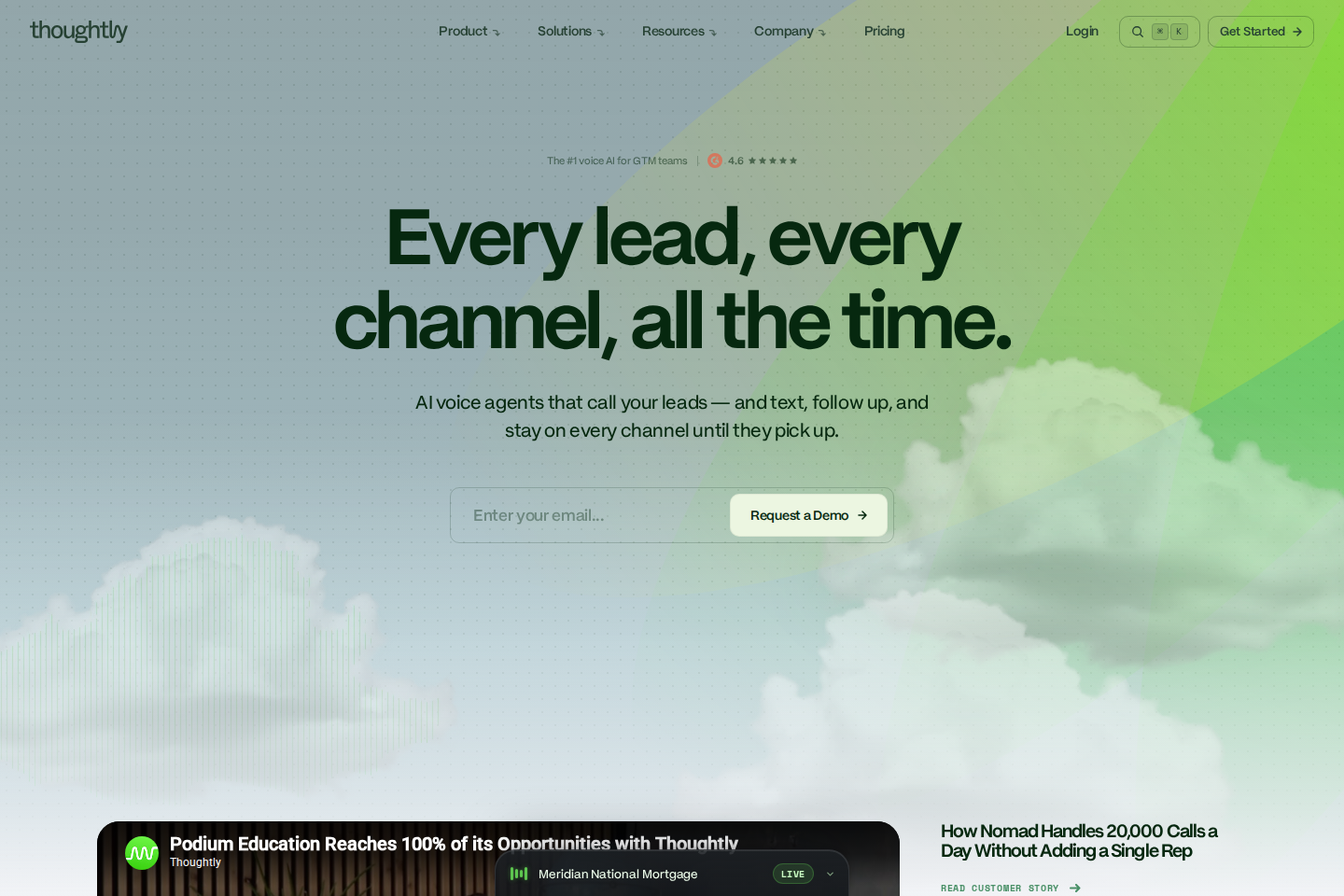
Thoughtly is the platform built for the team that actually runs the inbound funnel. Where Retell gives you voice infrastructure primitives to assemble, Thoughtly ships a production-ready conversion engine: voice agents that call leads back within 60 seconds, SMS and email follow-upEmail follow-upEmail follow-up sends timely, context-aware replies or reminders that move an inbound lead toward qualification, scheduling, or handoff.Read full definition → sequences triggered by call outcomes, two-way CRM syncCRM syncCRM sync keeps selected lead, contact, conversation, outcome, and next-step data aligned between an agent platform and a CRM.Read full definition → to Salesforce, HubSpot, Zoho, and 200+ other tools, and a no-code builder that lets RevOps own the entire motion without filing an engineering ticket.
The platform supports 30+ languages with sub-second voice latencyLatencyLatency is the elapsed time between a caller's speech and the agent's response, including listening, processing, tool, network, and speech-generation delays.Read full definition →, branded callingBranded callingBranded calling displays verified business identity, and sometimes a logo or call reason, on supported devices when a business calls.Read full definition →, IVRIVRIVR, or Interactive Voice Response, is a phone menu that routes or serves callers through keypad entries or spoken choices.Read full definition → with DTMF, warm transfers, and automatic PII redaction across names, addresses, dates of birth, and financial details. Compliance covers HIPAA, SOC 2 Type II, and GDPR — included, not an add-on. Thoughtly's bundled pricing means one predictable number per plan, not a spreadsheet of stacked provider rates.
Thoughtly serves high-consideration consumer industries — insurance, mortgage, healthcare, real estate, education, home services — where the job is converting the leads companies are already getting, not just making calls.
Pros
Multichannel by default. Voice, SMS, email, and workflows ship as co-equal channels in one platform — no separate tools or integrations required for each.
No-code agent builder. RevOps, marketing, and sales teams build, edit, and deploy agents directly with a visual drag-and-drop interface. No engineering sprints for prompt changes.
Two-way CRM write-back. Contacts, deals, activities, and call notes sync back to Salesforce, HubSpot, Zoho, and 200+ tools automatically — not just event triggers.
Bundled, predictable pricing. One price per plan. No stacked infra + LLM + TTS + add-on costs to model. Phone numbers, knowledge base, concurrency, and PII redaction are included.
Enterprise compliance included. HIPAA, SOC 2 Type II, GDPR, automatic PII redaction, 99.99% uptime — shipped as part of the platform, not a paid add-on.
Watch for
Requires clear workflow definition. Thoughtly is most powerful when your qualification rules, escalation paths, and follow-up logic are well-defined. Teams still figuring out their funnel may need to map the process before building agents.
Custom pricing. Thoughtly uses a custom pricing model — you'll need to talk to sales for exact numbers, which can slow initial evaluation for teams used to self-serve pricing calculators.
Best fit
Revenue teams — RevOps, growth marketing, sales operations — that need to convert inbound leads across voice, SMS, and email without engineering dependency. Strongest fit in high-consideration consumer industries where speed-to-lead and follow-up persistence directly impact conversion rates: insurance, mortgage, healthcare, real estate, education, and home services.
Pricing
Custom bundled pricing per plan. Phone numbers, concurrency, knowledge base, PII redaction, and compliance features included. No stacked per-component costs. Contact Thoughtly for specific plan details.
2. Bland AI — Best for high-volume programmable voice campaigns
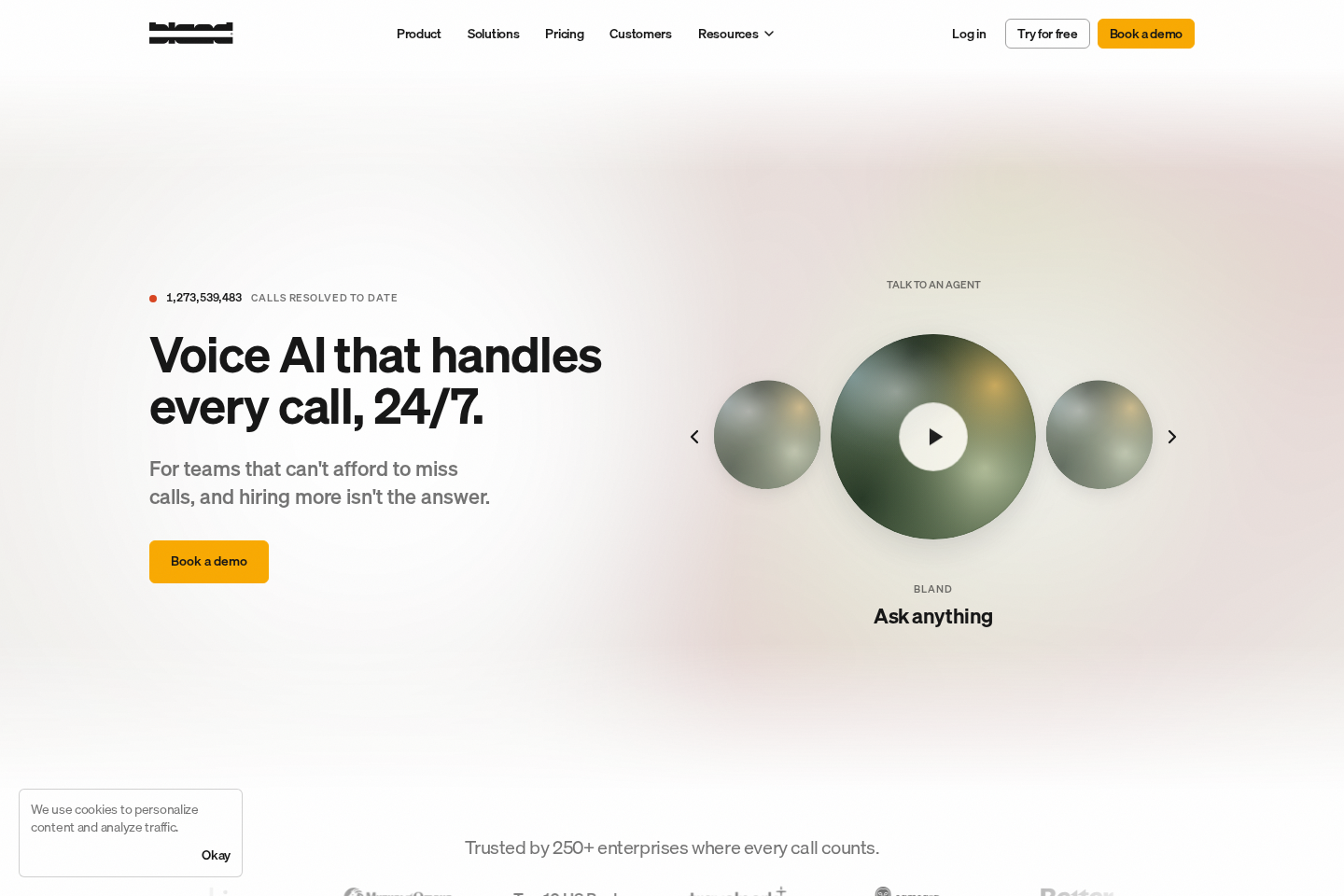
Bland AI positions itself as the all-in-one voice AI platform that handles every call, 24/7. With over 1.2 billion calls resolved to date, it's clearly built for volume. The platform offers all-in per-minute pricing without separate token charges or provider pass-throughs — a meaningful simplification compared to Retell's stacked model. Bland's conversation builder lets teams design structured call flows, and its voice cloning and custom voice actor capabilities are genuine differentiators for brand-consistent voice experiences.
Where Bland differs from Retell most sharply is in its enterprise-forward approach: forward-deployed engineering teams work directly with customers to build and optimize deployments, SOC 2 Type I/II and HIPAA-eligible compliance, and a 28-day deployment framework for enterprise rollouts. The platform is trusted by 250+ enterprises.
The challenge for revenue teams: Bland's most valuable features — warm transfers, live transfers, SMS, appointment scheduling, guardrailsGuardrailsAI guardrails are instructions, rules, data boundaries, and escalation paths that constrain what an agent may say or do.Read full definition →, and outcomes — are gated behind the Enterprise plan. Self-serve tiers (Start at $0.14/min, Build at $0.12/min, Scale at $0.11/min) handle basic voice, but the operational features needed for lead conversion workflows require an enterprise contract.
Pros
All-in per-minute pricing. No separate LLM, TTS, or telephony charges — $0.11–$0.14/min on self-serve tiers covers the full stack, making cost forecasting simpler than Retell's component model.
Proven scale. 1.2+ billion calls resolved, 250+ enterprise customers, dedicated orchestration servers and priority call queues on enterprise plans.
Custom voice cloning. Enterprise plans include custom voice actors — a real differentiator for brands that need voice consistency across high-volume campaigns.
Forward-deployed engineering. Enterprise customers get dedicated engineers who build and optimize alongside your team — not just documentation and Discord.
Watch for
Enterprise gate on key features. Warm transfers, SMS, appointment scheduling, guardrails, outcomes, and custom dialing are all enterprise-only. Self-serve plans are voice-in/voice-out with limited workflow control.
G2 reviewers flag reliability concerns. One- and two-star G2 reviews report agents that hallucinate pricing, refuse to transfer to humans, and get stuck in loops. Teams without a dedicated voice engineer may struggle with production stability.
Voice-first scope. SMS and email are enterprise add-ons, not co-equal channels. Revenue teams that need multichannel follow-up will need to build or buy the rest of the stack separately.
Best fit
Engineering-resourced teams running high-volume outbound or inbound voice campaigns where voice is the primary (or only) channel. Best when you can commit to an enterprise plan that unlocks the operational features, and have technical staff to manage agent behavior and edge cases.
Pricing
Self-serve: Start ($0.14/min), Build ($0.12/min), Scale ($0.11/min) — all-in per-minute with no platform fee. Enterprise: custom pricing with forward-deployed engineering, unlimited concurrency, and full feature access.
3. Vapi — Best for engineering teams building custom voice infrastructure
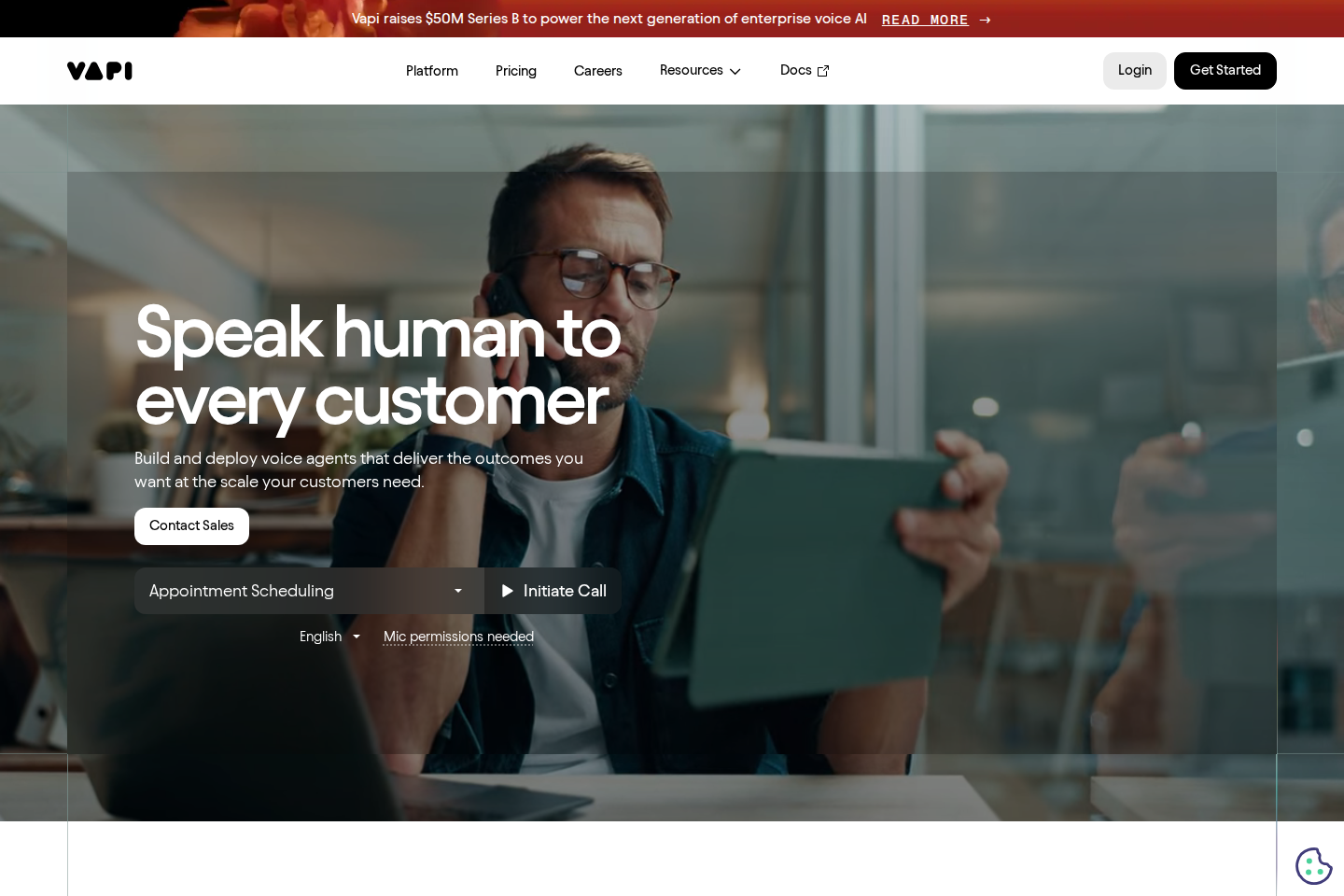
Vapi is the developer-first voice AI platform that raised $50M in Series B funding to power enterprise voice AI at scale. If Retell is an API-first toolkit, Vapi is the even more developer-centric alternative — a thin orchestration layer where you bring your own LLM, STTSpeech-to-Text (STT)Speech-to-Text (STT) converts spoken audio into text that a voice agent can interpret, store as a transcript, and use in downstream actions.Read full definition →, TTS, and telephony, then wire it all together via API. The $0.05/min platform fee is the cheapest entry point in the voice AI space, but the actual total cost depends entirely on which providers you choose for each component.
Vapi's strength is maximum flexibility and provider agnosticism. Teams can swap LLMs, voice engines, and telephony providers without rebuilding their integration — useful for engineering shops optimizing for cost, latency, or specific model capabilities. The platform supports lead qualificationLead qualificationLead qualification captures fit signals such as intent, urgency, location, eligibility, consent, and availability before the next step.Read full definition →, appointment scheduling, and customer support use cases, and the developer experience is widely regarded as one of the best in the category.
The trade-off for revenue teams is clear: Vapi has no GUI, no CRM integration, no marketer-friendly surface, and no workflow engine. Everything beyond the voice orchestration layer — CRM sync, attribution, follow-up sequences, compliance — is your engineering team's responsibility to build and maintain.
Pros
Lowest platform fee in the category. $0.05/min for the orchestration layer — significantly cheaper than Retell's $0.07+/min base, though total cost depends on chosen providers.
Provider-agnostic flexibility. Bring your own LLM (OpenAI, Anthropic, Groq), STT, TTS, and telephony. Swap providers without rebuilding — maximum control for engineering teams optimizing the stack.
Strong developer experience. Well-documented APIs, active developer community, and clean abstractions for building custom voice applications. Widely praised by engineering teams.
Watch for
No GUI or operational surface. There is no visual builder, no drag-and-drop workflow editor, no dashboard for non-technical users. If your RevOps team can't write code, they can't use Vapi.
Stacked provider costs. The $0.05/min platform fee is the floor. LLM, STT, TTS, and telephony costs stack on top — total per-minute cost can reach $0.15–$0.25+ depending on configuration.
Voice-only orchestration. No SMS, no email, no CRM — Vapi orchestrates voice calls. Everything else is a separate build project for your engineering team.
Best fit
Engineering teams building custom voice applications where maximum provider flexibility and cost optimization matter more than time-to-value. Best when your team can staff ongoing integration maintenance, CRM sync, and compliance as separate engineering workstreams.
Pricing
Usage-based starting at $0.05/min platform fee. LLM, STT, TTS, and telephony costs are separate and depend on chosen providers. Volume discounts available on enterprise plans.
4. Regal.io — Best for B2C teams augmenting human SDR organizations with AI
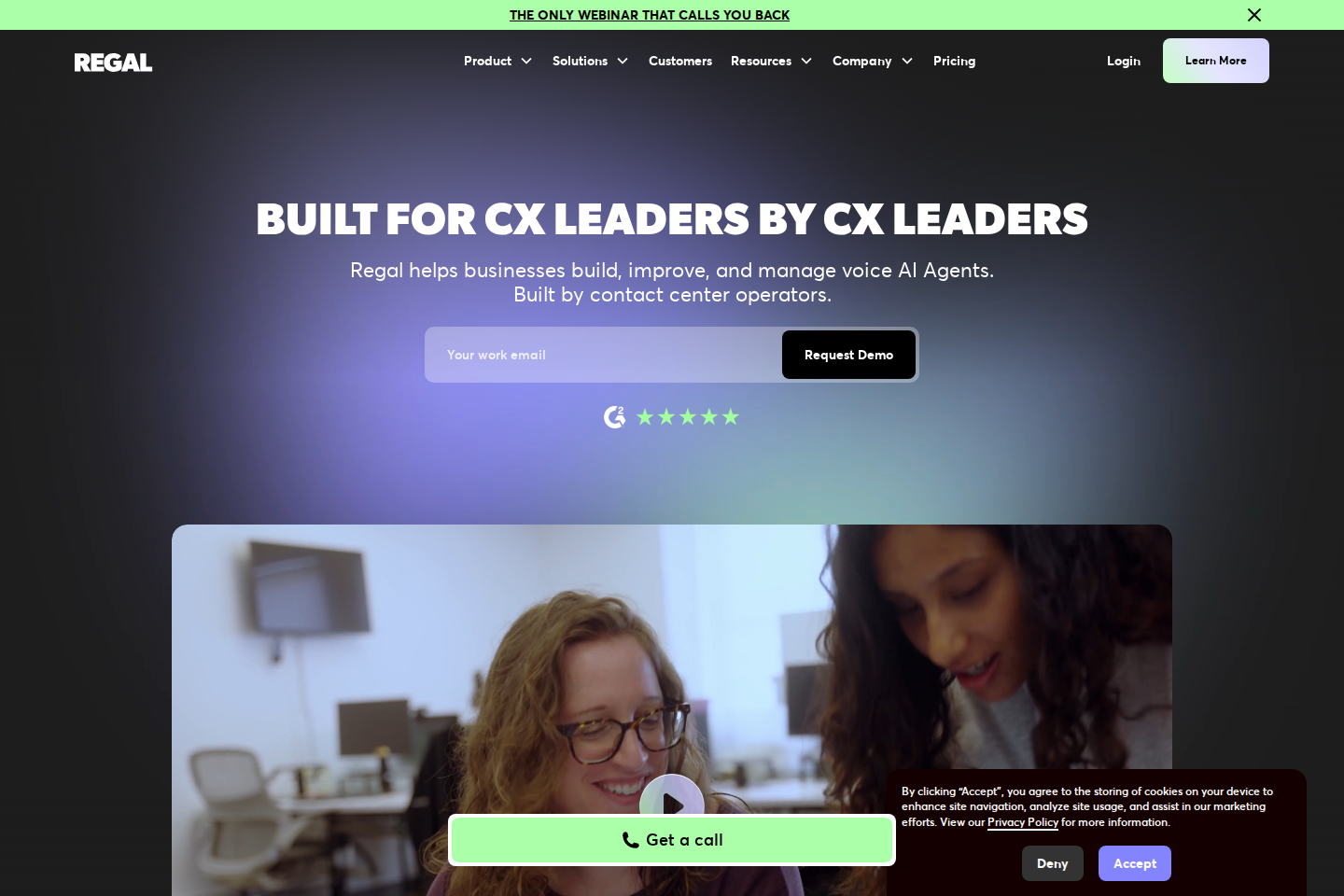
Regal.io started as an outbound dialer for human SDR teams — call coaching, conversation intelligence, agent-assist tooling designed to make human reps more productive. When the AI wave arrived, Regal layered AI Phone Agents on top of that foundation. The result is a hybrid platform built for contact centerContact centerA contact center is a centralized operation that handles customer or prospect interactions across voice and digital channels.Read full definition → leaders who want AI to handle overflow and routine calls while human reps take high-intent conversations.
For revenue teams already running human SDR or BDR organizations, Regal is a legitimate option. The platform supports branded calling, journey-based orchestration, and integrates with CCaaS systems like Five9 and Genesys that contact centers already use. Regal's AI agents can qualify leads, set appointments, and hand off warm to human reps — a natural fit for teams that aren't ready to fully replace their human workforce.
The limitation is structural: Regal's pricing, architecture, and feature set assume a hybrid human + AI motion. If your goal is AI-first lead conversion without human-rep overhead, you're paying for infrastructure and workflows designed around a staffing model you don't need.
Pros
Built by contact center operators. Founded by CX leaders who understand the operational realities of running phone-based revenue teams — not just the voice AI layer.
Hybrid human + AI orchestration. Seamlessly routes between AI agents and human reps based on intent signals, conversation complexity, and custom rules — strong for teams transitioning to AI gradually.
Journey-based engagement. Orchestrates outbound touches across voice and SMS based on lead behavior and lifecycle stage, not just static call lists.
Watch for
Pricing assumes human reps. The cost model includes both AI usage and human-agent infrastructure. Teams going fully AI-first may pay for capabilities they don't use.
CCaaS-adjacent integration footprint. Strongest integrations lean toward Five9, Genesys, and contact center systems. CRM-first teams (Salesforce, HubSpot, Zoho) may find the integration story less native than purpose-built CRM connectors.
No email channel. Voice and SMS are supported, but email follow-up isn't a native channel — limiting for revenue teams that need true multichannel sequences.
Best fit
B2C revenue teams with existing human SDR or contact center operations who want to augment — not replace — their workforce with AI. Strongest when the organization has a VP of CX or contact center director with budget for hybrid rep + AI tooling and an existing CCaaS investment.
Pricing
Contact Regal.io for pricing. The model is built around hybrid AI + human-agent deployment — expect pricing that reflects both sides of the motion.
5. Synthflow — Best for agencies and white-label voice automation
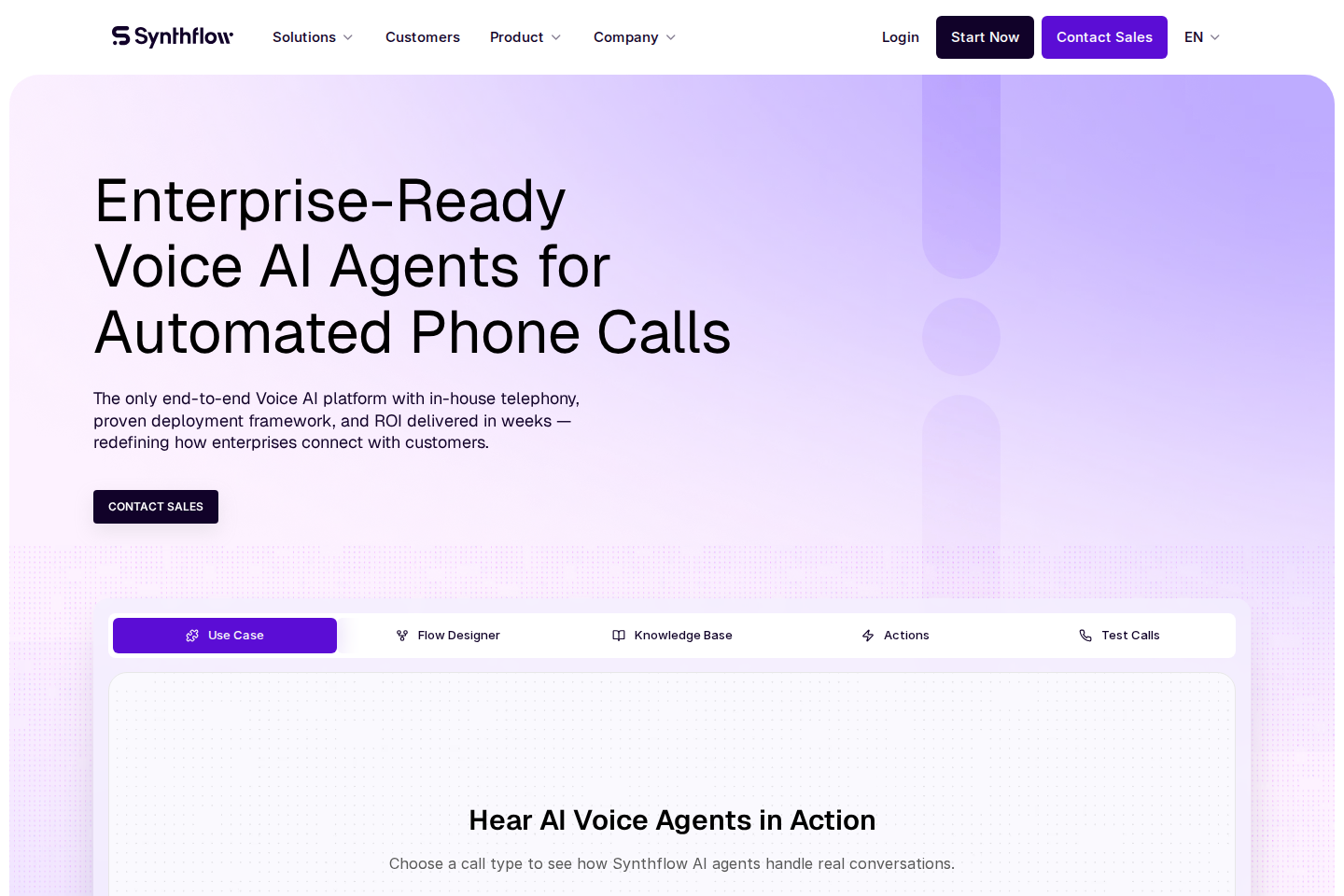
Synthflow positions itself as an enterprise-ready voice AI platform with in-house telephony and a proven deployment framework. The company has built a strong agency ecosystem: its $2,000/month white-label add-on lets consultancies resell voice agents under their own brand to downstream clients. Synthflow's compliance posture is among the strongest in the category — SOC 2, HIPAA, PCI DSS, GDPR, and ISO 27001 certifications are all in place.
The platform offers a flow designer for visual agent building, knowledge base integration, and action-based workflows. Voice quality claims sub-100ms latency, and the platform supports custom voice cloning as an add-on. For agencies evaluating Retell alternatives, Synthflow's combination of white-label capability, compliance breadth, and visual design tools makes it a natural fit.
For in-house revenue teams, the fit is less clear. Synthflow's marquee features and pricing tiers are shaped around the reseller motion. SMS is metered against voice minutes (5 SMS = 1 voice minute), email isn't a native channel, and the product's design center is the agency productizing voice for clients — not the operator converting their own inbound leads.
Pros
White-label ready. The $2K/mo white-label add-on is the most developed agency program in the category — custom branding, client management, and resale infrastructure built in.
Broadest compliance coverage. SOC 2, HIPAA, PCI DSS, GDPR, and ISO 27001 — more certifications than most competitors, including Retell.
Visual flow designer. No-code flow builder with knowledge base integration and action-based workflows — more accessible than Retell's API-first approach for non-engineers.
Watch for
Built for resellers, not operators. Pricing tiers, case studies, and feature gates are shaped around the agency channel. In-house revenue teams may find the product less optimized for direct operator workflows.
SMS metering is restrictive. 5 SMS messages consume 1 voice minute of credit — making SMS follow-up significantly more expensive than platforms where SMS is a first-class channel.
No email channel. Voice is the primary product, SMS is metered, and email isn't available. Teams needing multichannel lead nurture will need separate tooling.
Best fit
Agencies and consultancies looking to white-label voice AI agents for their own clients. Also fits in-house teams where voice is the only required channel, compliance breadth (especially ISO 27001 or PCI) is a hard procurement requirement, and the agency-style pricing model works.
Pricing
Pay-as-you-go and enterprise tiers with contact-sales motion. White-label add-on is $2,000/month. Pricing estimator available on the website for custom configurations.
6. Voiceflow — Best for teams designing multi-turn conversational AI
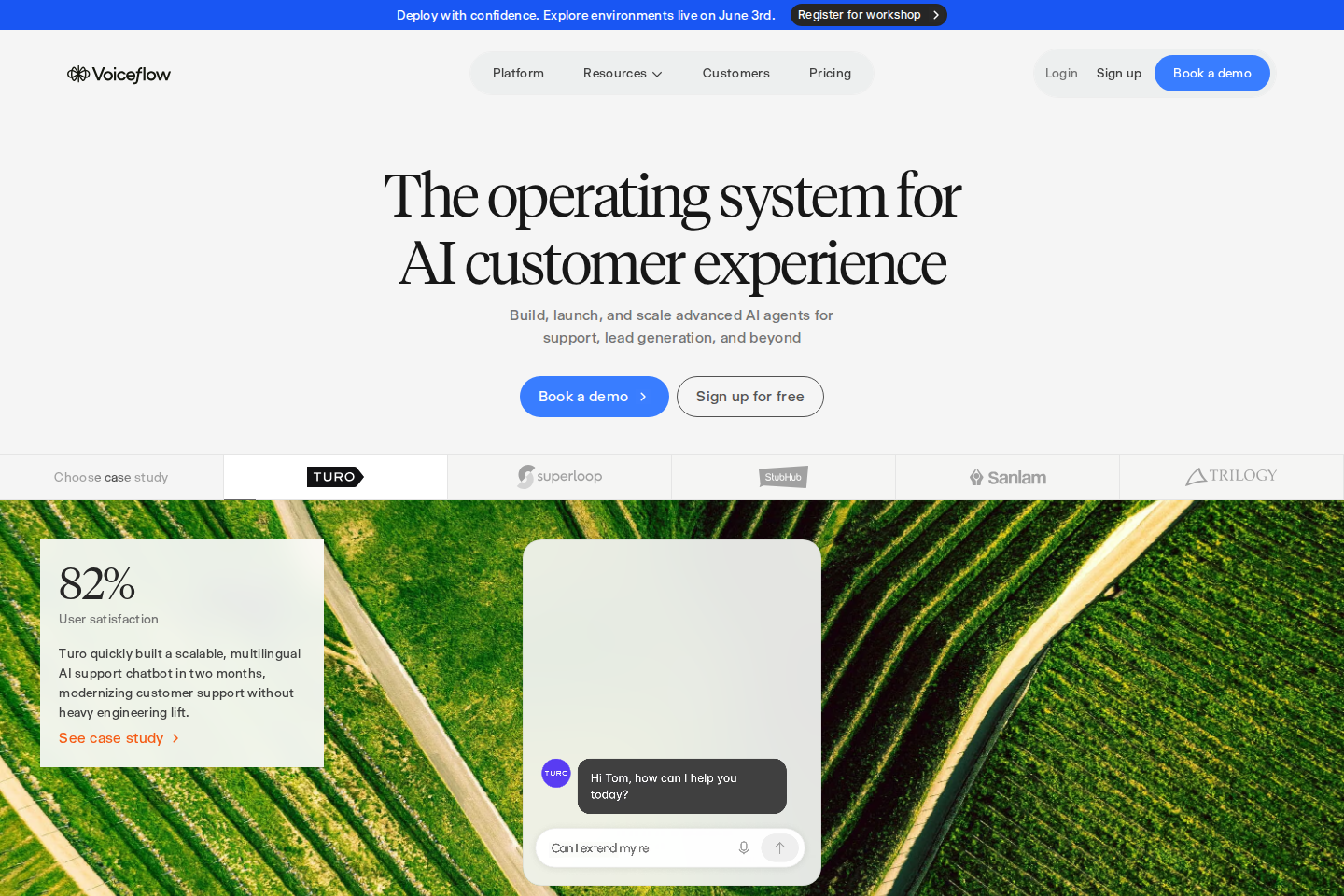
Voiceflow is a conversational AIConversational AIConversational AI is software that interprets natural language and produces context-aware responses through voice, messaging, or chat.Read full definition → design and deployment platform that won a 2026 Best Software Award from G2 for Agentic AI. Unlike the other platforms on this list, Voiceflow isn't primarily a telephony product — it's a visual conversation builder that lets teams design, prototype, test, and deploy AI agents across voice, chat, and web channels. The platform provides a canvas-based workflow editor where teams map conversation flows visually, manage knowledge bases, and connect to external APIs.
Voiceflow's strength is conversation design. Teams use it to build complex multi-turn dialog flows, A/B test conversation branches, manage intents and entities, and prototype agent behavior before connecting to a telephony provider. For revenue teams that need sophisticated conversation logic — branching qualification paths, dynamic objection handling, multi-step booking flows — Voiceflow provides more design control than most voice-first platforms.
The limitation: Voiceflow is not a phone system. To actually make or receive calls, you need to integrate Voiceflow with a telephony provider (TwilioTwilioTwilio is a cloud communications platform that provides programmable voice, messaging, phone numbers, and related APIs.Read full definition →, Vonage, etc.) and handle the voice infrastructure separately. This makes it a strong complement to simpler telephony tools but adds integration complexity compared to all-in-one platforms.
Pros
Best-in-class conversation design. Canvas-based visual editor for mapping complex multi-turn dialogues, branching logic, and testing conversation flows — more sophisticated than most voice platform builders.
Channel-flexible deployment. Deploy the same conversation logic across voice, chat, web, and custom channels — useful for teams that need consistent agent behavior beyond phone calls.
Accessible free tier. Free plan available with upgrade to $50/month for Pro — one of the lowest entry points for testing conversational AI design.
Watch for
Not a telephony platform. Voiceflow designs conversations; it doesn't make phone calls. You need separate telephony infrastructure (Twilio, Vonage, or another provider) for voice agent deployment.
Integration assembly required. CRM sync, call routing, SMS follow-up, and compliance all require custom integrations. The platform is a design tool, not an operational stack.
Less suited for high-volume call operations. Optimized for conversation design quality, not for scaling thousands of concurrent production calls with real-time monitoring and QA.
Best fit
Product and design teams building sophisticated conversational AI experiences that need to deploy across multiple channels. Best for organizations that already have telephony infrastructure and need a better conversation design layer, or teams prototyping agent behavior before committing to a full voice platform.
Pricing
Free tier available. Pro at $50/month. Teams and Enterprise tiers for larger deployments with custom pricing. Telephony costs are separate through your chosen provider.
7. Dasha AI — Best for developers optimizing for ultra-low latency voice
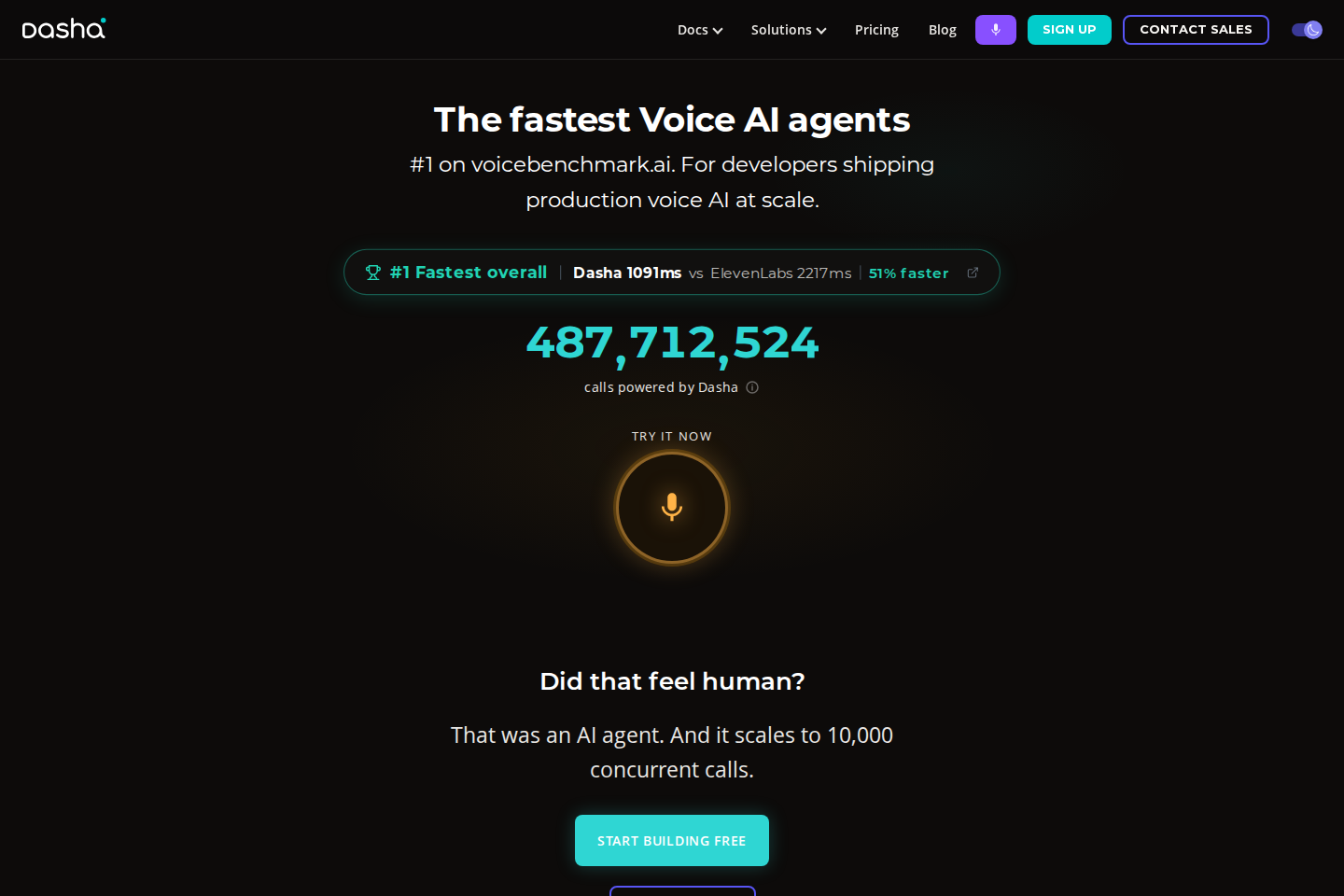
Dasha AI claims the #1 ranking on voicebenchmark.ai, reporting 1,091ms end-to-end response time versus Vapi's 2,679ms — a 59% speed advantage. With nearly 488 million calls powered to date, the platform is built for developers who prioritize voice latency and natural conversation flowConversation flowA conversation flow is the designed path through greeting, intent capture, qualification, actions, routing, fallback, and closing.Read full definition → above all else. Dasha offers both a REST API for quick integration and a DashaScript SDK for fine-grained conversation control.
The platform's approach gives developers granular control: custom conversation scripts, real-time speech processing, and the ability to scale to 10,000 concurrent calls per agent. For engineering teams building voice-heavy products where milliseconds matter — think high-frequency call operations, real-time booking systems, or latency-sensitive customer interactions — Dasha's speed claims are compelling.
For revenue teams, the trade-offs mirror Vapi's but with an even stronger developer focus. There's no no-code builder for non-technical users, limited documentation on CRM integrations, and the platform's enterprise track record is still developing compared to more established alternatives.
Pros
Best-in-class voice latency. #1 on voicebenchmark.ai with 1,091ms end-to-end — meaningful for use cases where natural conversation pacing is critical to conversion.
Generous developer tier. 1,000 free minutes and full API access on the free Developer plan — enough to build and test a production prototype without upfront cost.
High concurrency scaling. Up to 10,000 concurrent calls per agent with 99.99% uptime SLA on growth plans — infrastructure that scales for high-volume operations.
Watch for
Developer-only surface. No visual builder, no marketer-friendly interface. Building and maintaining agents requires writing DashaScript or integrating via REST API.
Growth-stage platform. While the call volume numbers are impressive, enterprise case studies and third-party reviews are less abundant than for Retell, Bland, or Vapi. Evaluate production support carefully.
VoIP and LLM tokens excluded. The $0.08/min growth pricing is all-inclusive except VoIP and LLM token costs — similar to Retell's component model, you'll need to model total cost with your chosen providers.
Best fit
Engineering teams building latency-sensitive voice applications where response speed is a competitive differentiator. Best for teams with existing VoIP infrastructure who want the fastest conversation engine and can build the CRM, workflow, and compliance layers themselves.
Pricing
Developer: Free (1,000 minutes, 1 concurrent call). Growth: Starting at $0.08/min (unlimited concurrent calls, 99.99% uptime SLASLAAn SLA, or service level agreement, defines the response or resolution commitment for a lead, request, handoff, or operational queue.Read full definition →). Enterprise: Custom pricing with dedicated infrastructure, premium support, and custom SLAs.
8. Conversica — Best for AI-powered email and SMS lead follow-up
Conversica takes a fundamentally different approach from Retell and most platforms on this list. Instead of voice-first AI agents, Conversica builds AI-powered digital assistants that engage leads through email, SMS, and chat conversations. The platform's Revenue Digital Assistants autonomously reach out to leads, nurture them through multi-touch sequences, detect buying intent, and hand off qualified conversations to human sales reps.
For revenue teams where the primary conversion motion is email and text-based — think long-cycle B2B sales, education enrollment, or financial services where leads need nurturing over weeks — Conversica fills a gap that voice-first platforms don't address. The platform integrates with major CRMs (Salesforce, HubSpot) and marketing automation tools, and its AI is trained on billions of real customer interactions to detect intent signals and optimize follow-up timing.
The limitation is the mirror image of Retell's: where Retell is voice-only, Conversica is email/SMS/chat-only. If your conversion motion requires phone calls — immediate lead callback, real-time qualification, appointment booking via voice — Conversica isn't a replacement for Retell. It's a complement.
Pros
Mature AI lead nurture. Trained on billions of real interactions with sophisticated intent detection, multi-touch sequencing, and automated handoff to human reps when leads are ready.
Email-native engagement. Purpose-built for the email and SMS follow-up motion that voice-first platforms handle poorly or not at all — covers the gap Retell leaves entirely open.
Deep CRM integration. Native connectors to Salesforce, HubSpot, and major marketing automation platforms with bi-directional sync and lead lifecycle management.
Watch for
No voice capability. Conversica does not make or receive phone calls. If voice is part of your conversion motion, you'll need Conversica alongside a voice platform — not instead of one.
Enterprise pricing. Conversica's pricing is enterprise-oriented and not publicly listed. Expect a significant annual commitment compared to usage-based voice AI platforms.
B2B-heavy positioning. The platform's training data and pre-built conversation models lean toward B2B sales and education. B2C lead conversion use cases may require more customization.
Best fit
Revenue teams where email and SMS are the primary lead engagement channels — B2B sales, education enrollment, financial services lead nurture. Best as a complement to a voice platform for teams that need the full multichannel stack, or as a standalone solution for teams where phone-based outreach isn't the primary motion.
Pricing
Contact Conversica for pricing. Enterprise-oriented with annual contracts. Not publicly listed.
How to choose the right Retell AI alternative
The right alternative depends on who owns the agent, what channels matter, and how much engineering you're willing to commit.
You need multichannel lead conversion without engineering. Thoughtly. Voice + SMS + email + CRM in one platform, no-code builder, bundled pricing.
You want all-in voice at high volume with engineering support. Bland AI. Simpler pricing than Retell, proven enterprise scale, but key features require enterprise plans.
You want maximum developer flexibility at the lowest platform cost. Vapi. Cheapest orchestration layer, BYO everything, but engineering builds and maintains the entire stack.
You're augmenting an existing human SDR team with AI. Regal.io. Hybrid human + AI orchestration, built by contact center operators, but pricing assumes human reps in the stack.
You're an agency reselling voice AI to clients. Synthflow. Best white-label program, broadest compliance, but product is shaped around the reseller — not the in-house operator.
You need sophisticated conversation design across channels. Voiceflow. Best design tool for multi-turn AI conversations, but requires separate telephony integration.
You're optimizing for the fastest voice response. Dasha AI. Best benchmark latency, developer-first, but early-stage enterprise track record.
You need AI lead nurture over email and SMS. Conversica. Mature email/SMS AI, but no voice capability — works alongside a voice platform.
Frequently asked questions
Why do revenue teams look for Retell AI alternatives?
The three most common triggers are Retell's stacked pricing model (infra + LLM + TTS + add-ons make total cost hard to forecast), the developer dependency for production deployment (non-engineers cannot ship or modify agents without engineering support), and the voice-only scope (SMS and email require additional tools). G2 reviewers also flag the learning curve for complex workflows and limited support options on lower tiers.
Can I use Retell AI alongside one of these alternatives?
Yes. Some teams use Retell for specific engineering-led voice applications while running a platform like Thoughtly or Conversica for the broader revenue workflow. This is common during migration — you can run both in parallel, route different lead segments to each platform, and transition fully once the alternative proves out in production.
Which Retell alternative is best for non-technical teams?
Thoughtly and Synthflow both offer no-code visual builders. Thoughtly is designed for in-house revenue teams with a full multichannel stack. Synthflow is designed for agencies with a white-label resale model. Voiceflow offers strong visual design tools but requires separate telephony integration. Bland, Vapi, and Dasha all require engineering involvement.
How does Retell AI pricing compare to alternatives?
Retell's pricing stacks across infra ($0.055/min), LLM ($0.006–$0.08/min), TTS ($0.015–$0.040/min), and metered add-ons — total cost ranges from roughly $0.07 to $0.31/min depending on configuration. Bland AI offers all-in pricing at $0.11–$0.14/min. Vapi's platform fee is $0.05/min plus stacked provider costs. Dasha starts at $0.08/min plus VoIP and LLM tokens. Thoughtly, Regal, and Conversica use custom/contact-sales pricing models.
What compliance certifications should I look for?
For regulated industries (healthcare, insurance, financial services, mortgage), look for HIPAA with BAA, SOC 2 Type II, and GDPR at minimum. Synthflow has the broadest certification set (adding PCI DSS and ISO 27001). Thoughtly covers HIPAA, SOC 2 Type II, and GDPR with automatic PII redaction. Retell offers HIPAA only. Evaluate each platform's specific compliance documentation against your regulatory requirements.
11 Best AI VoiceAI voiceAn AI voice is synthetic speech produced by a text-to-speech model, using a selected or cloned voice to speak an agent's generated or scripted response.Read full definition → Agents for Lead Generation in 2026 — thoughtly.com/blog/11-best-ai-voice-agents-for-lead-generation