7 Best Sierra AI Alternatives in 2026 (Tested and Ranked)
Sierra AI is built for enterprise post-purchase CX with managed-service deployments and six-figure contracts. These seven alternatives cover the buyers Sierra does not — from inbound lead conversion to self-hosted open source.
Last updated
I evaluated the platforms that buyers most often land on when they start looking for alternatives to Sierra AI. Sierra is a well-funded enterprise CX platform — co-founded by former Salesforce co-CEO Bret Taylor and former Google Labs lead Clay Bavor, backed by Sequoia and Bain, deployed at SiriusXM, Sonos, WeightWatchers, ADT, and SoFi. The product is real. But so are the trade-offs.
Sierra operates as a managed service with outcome-based pricing, multi-quarter implementation timelines, and six-figure-plus contract floors. That works for global brands with sprawling post-purchase support orgs and dedicated CX teams. It does not work for teams that need transparent pricing, fast deployment, revenue-focused automation, or an agent they can build and own without Sierra's Forward Deployed Engineers in the room.
This guide is for the team that looked at Sierra — or was told to look at Sierra — and realized the fit was wrong. Maybe you need inbound lead conversionInbound lead conversionThe process of turning opted-in inquiries, form fills, calls, and quote requests into qualified conversations, appointments, or transfers.Read full definition →, not post-purchase CX. Maybe you need to deploy in days, not quarters. Maybe you just need to see a price before you sign. Whatever brought you here, the seven alternatives below are the ones worth your evaluation time.
Quick takeaways
Thoughtly is the best alternative for revenue teams that need inbound lead conversion across voice, SMS, and email — the job Sierra's CX mandate does not touch.
Cognigy is the closest enterprise peer for contact center automation with omnichannel orchestration and on-premises deployment options.
Ada is the strongest digital-first CX platform for teams that want self-serve agent building with measurable automated resolution rates.
Kore.ai covers the broadest enterprise AI assistant scope — customer-facing, employee-facing, and IT service management from one platform.
Parloa is a German-headquartered enterprise contact center AI with strong European data residency and compliance positioning.
Decagon is the purpose-built AI support agent for tech-forward companies that want fast deployment without enterprise procurement overhead.
Rasa is the open-source alternative for teams that want complete stack ownership, self-hosted deployment, and code-level control over conversation logic.
How I evaluated these Sierra AI alternatives
Sierra buyers are enterprise teams. The alternatives need to meet enterprise requirements — or explicitly offer a better trade-off for teams that do not need enterprise-grade procurement overhead. I scored each platform against six criteria that map to the reasons buyers actually leave or avoid Sierra.
1. Deployment speed and ownership model
Sierra deployments are managed-service engagements that can take months. I evaluated how quickly each alternative can get to a production agent and whether the buyer's team owns the agent or depends on the vendor's services organization. Platforms that ship in days with self-serve tools scored higher than platforms that replicate Sierra's multi-quarter timeline. I also looked at whether the buyer can modify, tune, and redeploy agents without filing a support ticket.
2. Pricing transparency and cost predictability
Sierra uses outcome-based pricing where you pay per resolved conversation. That creates unpredictable bills when volume spikes and makes it difficult for finance to audit what counted as a resolution. I looked for platforms with published pricing, per-minute or per-conversation models that finance can forecast, and no hidden six-figure contract floors. I also checked whether each vendor requires a custom enterprise quote or offers self-serve plan tiers.
3. Channel coverage beyond voice
Sierra started as a chat and messaging CX platform and added voice more recently. For lead conversion and proactive outreach, voice alone is not enough — you need SMS follow-upSMS follow-upSMS follow-up is the use of compliant two-way text messages to continue a lead conversation after a form fill, missed call, voicemail, or prior interaction.Read full definition →, email sequences, and workflow automationWorkflow automationSoftware-driven execution of multi-step processes such as lead intake, routing, follow-up, booking, CRM updates, and post-call actions.Read full definition → working as co-equal channels. I scored platforms that treat voice, SMS, and email as primary channels higher than platforms limited to chat-plus-voice or voice-only. I also checked for workflow automation, CRM write-backCRM write-backUpdating the CRM after an interaction with call outcomes, transcripts, qualification answers, notes, appointments, dispositions, and next-step fields.Read full definition →, and multi-step follow-up capabilities.
4. Pre-purchase vs. post-purchase focus
Sierra is built for post-purchase customer experience: returns, account management, support deflection. Many teams looking for alternatives actually need pre-purchase automation — lead qualificationLead qualificationThe process of capturing fit signals — intent, urgency, location, eligibility, consent, and availability — before routing a lead to the right next step.Read full definition →, speed-to-lead, appointment booking, follow-up sequences. I flagged which platforms are designed for lead conversion versus which are designed for support deflection, because using a support tool for lead generation creates operational friction. Platforms with explicit lead conversion workflows, qualification logic, and CRMCRMThe system of record for leads, contacts, deals, and activity. Thoughtly reads from and writes to your CRM continuously.Read full definition → pipeline integration scored higher for revenue-focused buyers.
5. Enterprise readiness and compliance
Sierra buyers are enterprise. Alternatives need SOC 2, HIPAAHIPAAThe US health privacy law that governs protected health information. Healthcare voice and SMS workflows must handle PHI with appropriate safeguards.Read full definition → (for healthcare), GDPR (for European operations), SSO, role-based access, audit logging, and data residency options. I verified each platform's published compliance posture and checked whether enterprise features are standard or gated behind custom pricing. I also evaluated on-premises and private cloud deployment options for regulated industries that cannot send data to a multi-tenant SaaS.
6. Conversational AI quality and orchestration
Sierra uses a proprietary persona-tuned model with multi-model routing for accuracy checks. I evaluated each alternative's conversation engine: whether it supports LLMLarge Language Model (LLM)A machine-learning model trained on massive text data, used as the reasoning engine that drives a voice agent's understanding and responses.Read full definition → choice, deterministic routing, guardrailsGuardrailsGuardrails are rules that keep an AI agent within approved topics, scripts, compliance boundaries, and handoff paths during voice, SMS, or email conversations.Read full definition →, multi-turn context, and handoff to human agents. Platforms with transparent model selection, configurable guardrails, and strong escalationEscalationMoving a conversation to a human, specialist, supervisor, or alternate workflow when the agent detects risk, uncertainty, urgency, or a request it should not handle alone.Read full definition → workflows scored higher than black-box agents. Voice quality, latency, and accent/language options mattered where voice is a primary channel.
Quick comparison: Sierra AI alternatives at a glance
Platform
Best for
Deployment speed
Pricing model
Key limitation
Thoughtly
Revenue teams converting inbound leads
Days
Published plan tiers
Best suited when the GTM workflow is clearly defined upfront
Focused on support deflection, not lead conversion
Kore.ai
Broad enterprise AI assistant use cases
Weeks to months
Custom enterprise
Platform breadth can overwhelm teams with a narrow scope
Parloa
European enterprise contact center AI
Weeks to months
Custom enterprise
Smaller partner/integration ecosystem outside Europe
Decagon
Tech-forward AI customer support
Days to weeks
Custom
Newer company with smaller enterprise reference base
Rasa
Self-hosted conversational AI with code-level control
Months
Open source + enterprise tiers
Requires engineering team to build and maintain
7 best Sierra AI alternatives in 2026
1. Thoughtly — Best for revenue teams converting inbound leads
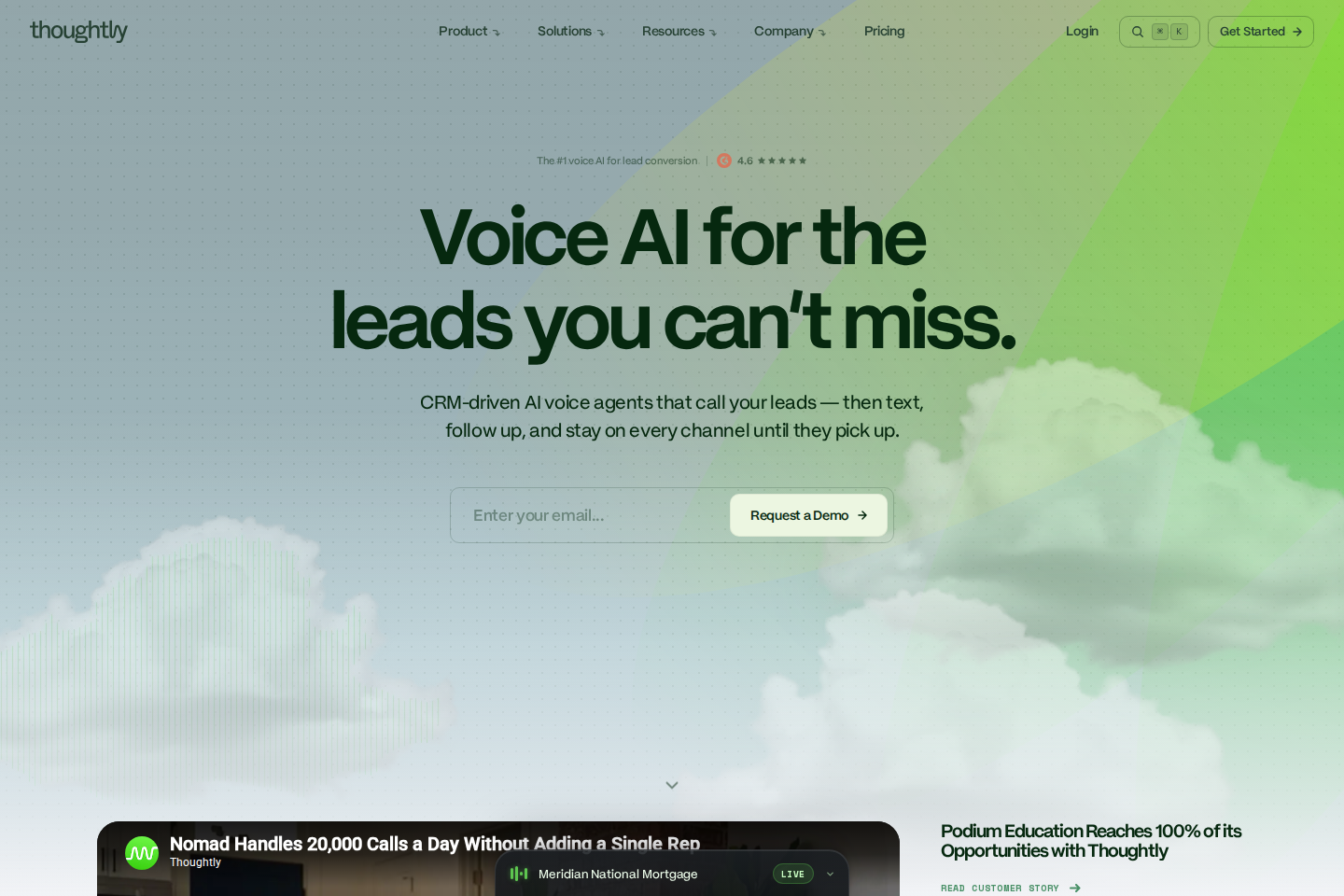
Thoughtly is the alternative to Sierra for teams whose job is converting inbound leads into customers — not servicing post-purchase support tickets. Where Sierra deploys enterprise CX agents for returns, account management, and support deflection, Thoughtly deploys AI agents that call, text, and email every inbound lead in under 60 seconds, qualify them against your criteria, book appointments, warm-transfer hot leads to your sales team, and write every interaction back to your CRM automatically. The platform treats voice, SMS, and email as co-equal channels with multi-step workflow automation, so a missed call triggers an SMS, a no-response triggers an email, and every touchpoint updates Salesforce, HubSpot, or GoHighLevel without manual data entry.
Thoughtly is no-code and RevOps-owned. Your marketing or sales operations team can build, test, and deploy agents directly — no Forward Deployed Engineers, no multi-quarter services engagement, no six-figure procurement floor. Deployment takes days, not months. The platform serves high-consideration consumer industries including insurance, mortgage, real estate, automotive, education enrollment, elective healthcare, home services, financial services, and legal — verticals where speed-to-lead and multichannel persistence determine whether a lead converts or goes cold.
Pros
Sub-60-second speed-to-lead across voice, SMS, and email. Every inbound form fill, missed call, or web inquiry triggers an immediate AI agent response — not a queue for a human BDR to pick up during business hours.
Two-way CRM write-back to Salesforce, HubSpot, GoHighLevel, Zoho, Pipedrive, and 200+ integrations. Qualification data, call outcomes, booking confirmations, and follow-up status update your pipeline automatically.
No-code agent builder with a visual workflow canvas. RevOps and marketing teams build, test, and iterate on agents without engineering tickets. Vibes AI assistant can generate a working agent from a plain-language prompt.
Published pricing with plan tiers. No hidden six-figure contract floor. You can see what you are buying before you talk to sales.
Watch for
Requires a defined GTM workflow. Thoughtly is most powerful when your team has clear qualification criteria, CRM structure, escalation paths, and follow-up logic. Teams without a defined inbound motion should map those before deploying.
Not a post-purchase CX platform. If your primary job is support deflection, returns management, or account servicing — the job Sierra was built for — Thoughtly is the wrong tool. Thoughtly converts leads; it does not replace your support desk.
Best fit
Revenue teams, sales operations, and growth leaders at companies with enough inbound lead volume or workflowWorkflowAn automated, multi-step process — usually triggered by an event (form fill, new lead) and orchestrating one or more voice / SMS / email actions.Read full definition → complexity to justify automation. Insurance agencies, mortgage lenders, real estate brokerages, automotive groups, education enrollment teams, home services companies, and any B2C or high-consideration funnel where speed-to-lead and multichannel persistence directly impact revenue.
Pricing
Published plan tiers starting with a pilot option. Custom enterprise plans available. No minimum six-figure contract.
2. Cognigy — Best for enterprise omnichannel contact center automation
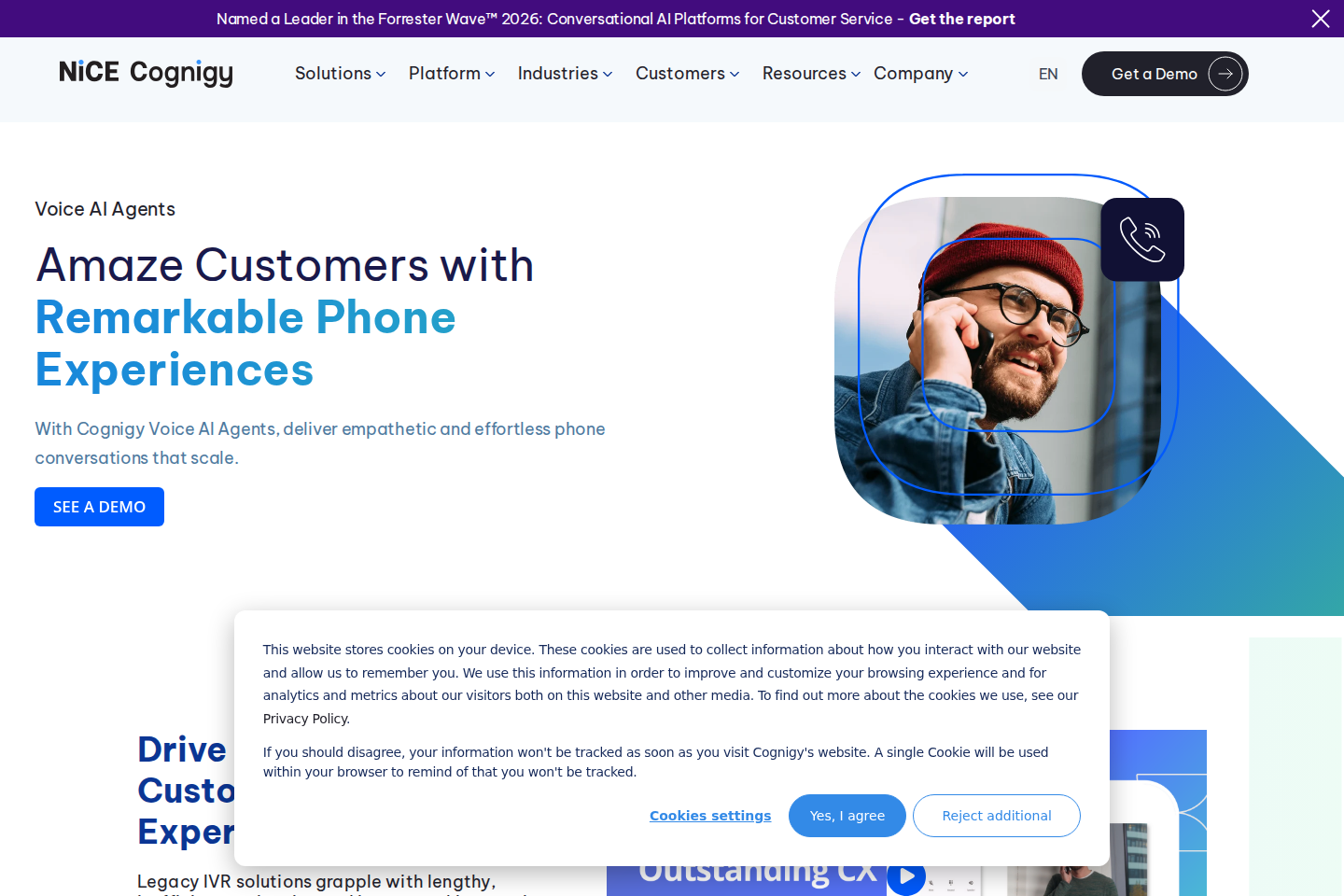
Cognigy (now NiCE Cognigy after its 2025 acquisition by NICE) is the enterprise conversational AIConversational AIAI designed to understand and respond through natural conversation, including voice agents, chat agents, and other language-based interfaces.Read full definition → platform closest to Sierra in capability and buyer profile. The platform handles voice and digital channels for large contact centers, with agent orchestration, knowledge AI, live agent handoff via NICE CXone integration, and support for 100+ languages. It runs on a low-code conversation design studio with deterministic flows, LLM-powered generative responses, and enterprise deployment options including on-premises and private cloud for regulated industries.
Cognigy's differentiator against Sierra is ownership and flexibility. Your team designs the conversation logic in the Cognigy studio rather than relying on a vendor's managed-service team to build it for you. You get on-premises deployment for industries that cannot send data to a multi-tenant SaaS, and you get a broader channel set — web chat, WhatsApp, Microsoft Teams, voice, email — orchestrated from one platform. The trade-off: Cognigy is a complex enterprise platform that requires dedicated implementation resources and training.
Pros
On-premises and private cloud deployment. Healthcare, financial services, and government teams that cannot use multi-tenant SaaS get a deployment model that meets their compliance requirements.
100+ language support with LLM and NLU hybrid engine. Global enterprises with multilingual contact centers can serve customers in their preferred language without building separate bots per region.
NICE CXone integration for live agent handoff and workforce management. Existing NICE contact center customers get a native AI layer without ripping out their agent desktop or WFM tools.
Watch for
Complex platform with a steep learning curve. G2 reviewers note that Cognigy's studio requires training and dedicated resources to use effectively. This is not a no-code tool a marketing team can pick up in an afternoon.
Enterprise pricing with no public tiers. Like Sierra, Cognigy requires a custom enterprise quote. Smaller teams or companies without enterprise procurement budgets may find the entry point inaccessible.
Best fit
Enterprise contact centers with 50+ human agents, multilingual requirements, and existing NICE infrastructure that want AI-powered automation without moving to a managed-service model. Particularly strong for regulated industries that require on-premises or private cloud deployment.
Pricing
Custom enterprise pricing. Contact Cognigy for a quote. No public self-serve tiers.
3. Ada — Best for digital-first automated customer experience at scale
Ada is the AI-powered CX platform built for digital-first brands that want to automate customer support across web, mobile, social, and messaging channels. The platform uses an AI agent trained on your knowledge baseKnowledge baseA structured source of business information, FAQs, policies, product details, or procedures that an AI agent can use to answer accurately.Read full definition →, help center, and past conversations to resolve customer inquiries without routing them to a human agent. Ada reports that enterprise customers like Shopify, Square, and AirAsia achieve 70%+ automated resolution rates, which means the majority of support volume never reaches a human agent.
Ada competes with Sierra on the CX automation mandate, but with a fundamentally different delivery model. Where Sierra is a managed service with Forward Deployed Engineers, Ada is a self-serve platform. Your CX team builds, trains, and tunes the AI agent directly in Ada's interface. Deployment takes weeks rather than quarters. The trade-off: Ada is strongest on chat and messaging channels. Voice support exists but is not Ada's primary surface. If voice is your main channel, other alternatives on this list are stronger.
Pros
Self-serve agent building with measurable resolution rates. CX teams build and iterate on agents without depending on vendor services teams. Ada publishes resolution rate metrics so you can track automation ROI directly.
Strong digital channel coverage including web, mobile, social, and messaging. Brands that serve customers through Intercom, Zendesk, Salesforce Service Cloud, or their own help center get native integrations.
Faster time to production than Sierra. Ada deployments typically take weeks with guided onboarding, not months of managed-service implementation.
Watch for
Voice is not Ada's primary channel. Ada added voice capabilities but the platform is strongest on chat and messaging. Teams where phone calls are the primary customer channel should evaluate voice-first alternatives.
Pricing includes outcome-based options. Like Sierra, some Ada contracts tie pricing to automated resolutions. Make sure finance understands the model before signing, especially if volume is spiky.
Best fit
Digital-first consumer brands with high support ticket volume across web, mobile, and messaging channels that want to automate a large percentage of inquiries without a multi-quarter managed-service engagement. E-commerce, fintech, travel, and subscription businesses where chat and messaging are the primary support surfaces.
Pricing
Custom pricing. Ada offers resolution-based and platform fee models. Contact Ada for a quote.
4. Kore.ai — Best for broad enterprise AI assistant use cases
Kore.ai is the enterprise AI platform that covers the broadest scope on this list. It builds AI assistants for customer-facing use cases (contact centerContact centerA centralized operation that handles inbound and outbound customer interactions across voice, SMS, email, and digital channels, typically focused on service, support, or sales conversations.Read full definition →, self-service), employee-facing use cases (HR, IT service desk), and operational automation — all from a single platform with a unified conversation design studio. Kore.ai was named a Leader in the 2024 Gartner Magic Quadrant for Enterprise Conversational AI Platforms and serves large enterprises across banking, healthcare, insurance, telecom, and retail.
Kore.ai competes with Sierra on the enterprise buyer but offers a broader product footprint. Where Sierra is narrowly focused on customer-experience AI, Kore.ai also covers internal IT help desk, HR virtual assistants, and back-office process automation. If your organization wants one AI platform for multiple use cases, Kore.ai covers more ground. The trade-off: platform breadth means complexity. Teams with a narrow scope — just customer support, or just lead conversion — may find Kore.ai's full platform overwhelming.
Pros
Broadest enterprise AI assistant scope. Customer, employee, and IT use cases from one platform means you buy once and deploy across departments — no separate tools for contact center AI versus HR assistant.
Strong enterprise compliance posture. SOC 2 Type II, HIPAA, GDPR, PCI DSS. On-premises and private cloud deployment available for regulated industries.
Gartner Magic Quadrant Leader (2024). Third-party analyst recognition provides procurement teams with cover for vendor selection decisions in large enterprises.
Watch for
Platform complexity can overwhelm teams with a narrow scope. If your use case is only customer-facing support or only lead conversion, Kore.ai's multi-use-case platform adds configuration overhead you may not need.
Implementation requires SI or dedicated resources. Like Cognigy and Sierra, Kore.ai deployments for large enterprises typically involve systems integrators or dedicated project teams. Budget accordingly.
Best fit
Large enterprises that want a single AI assistant platform across customer service, employee service (HR/IT), and operational automation. Particularly strong for organizations in banking, insurance, healthcare, and telecom that already have systems integrator relationships.
Pricing
Custom enterprise pricing. Kore.ai offers usage-based and platform models. Contact for a quote.
5. Parloa — Best for European enterprise contact center AI
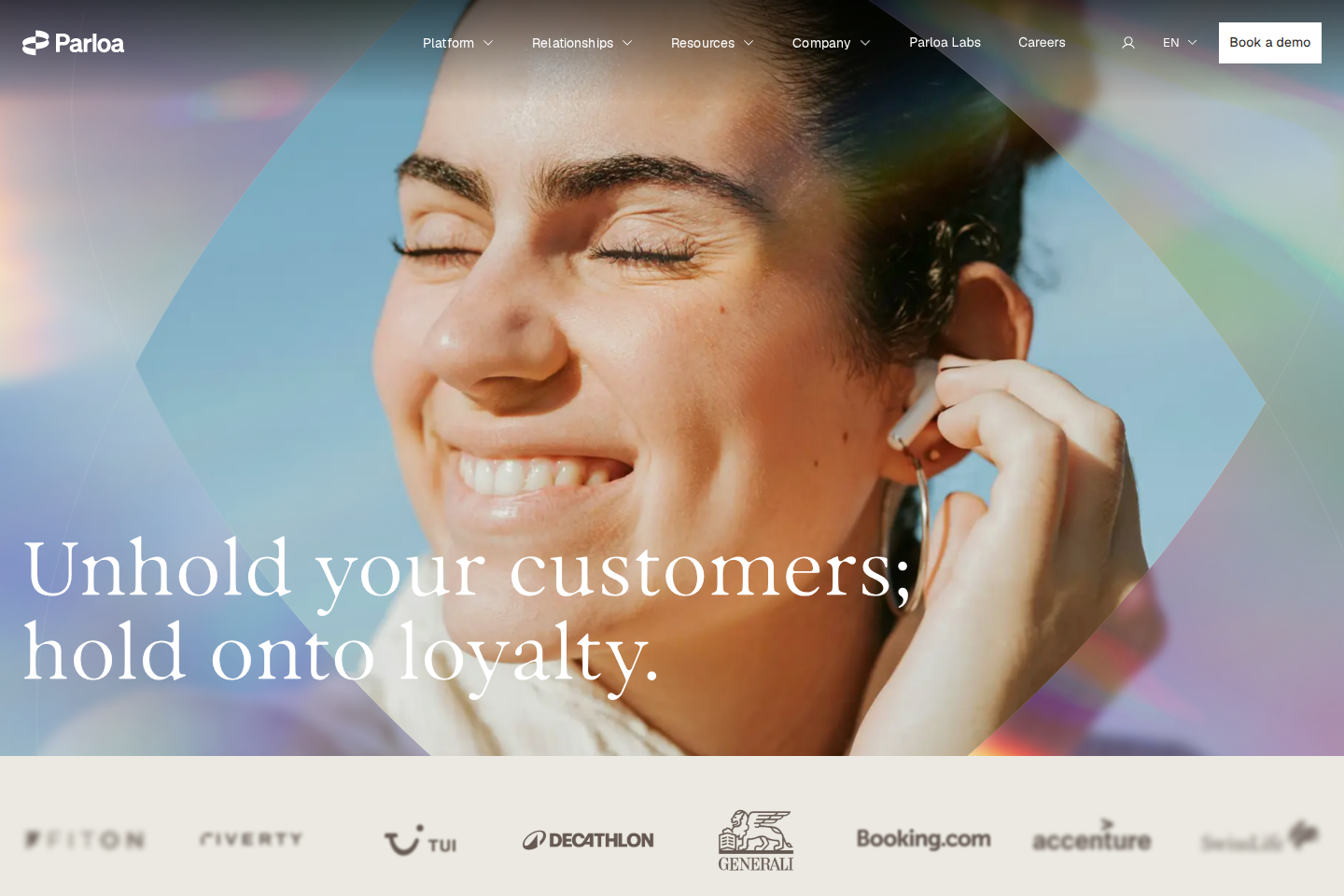
Parloa is a Berlin-headquartered enterprise contact center AI platform that competes in the same category as Sierra and Cognigy. The platform builds AI agents for phone, chat, and messaging channels with a focus on natural-language understanding, multi-turn conversation management, and live agent handoff. Parloa raised $92 million in Series B funding in 2024 (led by Altimeter Capital) and serves European enterprises including Decathlon, Swiss Life, and German insurance and telecommunications companies.
Parloa's main differentiation is European data residency and GDPR-native architecture. For enterprises with strict requirements around where customer conversation data is stored and processed, Parloa offers EU-hosted deployment by default — a meaningful advantage over US-headquartered competitors that bolt on European hosting as an afterthought. The platform also supports German, French, Spanish, and other European languages with native quality, not just English-first with translations. The trade-off: Parloa's integration and partner ecosystem is smaller outside Europe, and its enterprise reference base is heavily European.
Pros
EU-hosted by default with GDPR-native data architecture. European enterprises subject to strict data residency rules get a platform designed for their regulatory reality, not one retrofitted to meet it.
Strong European language quality for German, French, Spanish, and other EU languages. Voice AI quality in non-English European languages is genuinely good — not just English-first with a translation layer.
Series B funded with credible enterprise references. Decathlon, Swiss Life, and large German telecom/insurance companies provide reference-check cover for enterprise procurement.
Watch for
Smaller integration ecosystem outside Europe. US CRM, contact center, and telephony integrations are available but less deeply developed than US-headquartered competitors.
Enterprise-only pricing with no self-serve tiers. Like Sierra, Parloa targets large enterprise buyers. Smaller teams or companies without enterprise procurement budgets will find the entry point gated.
Best fit
European enterprise contact centers with strict GDPR and data residency requirements, multilingual customer bases, and existing European telephony infrastructure. Particularly strong for German-speaking markets and EU-regulated industries like insurance, banking, and telecommunications.
Pricing
Custom enterprise pricing. Contact Parloa for a quote.
6. Decagon — Best for AI customer support at tech-forward companies
Decagon is the AI customer support agent built for tech-forward companies that want fast deployment, strong automated resolution rates, and modern engineering integrations without enterprise procurement overhead. The platform trains an AI agent on your help center, documentation, past conversations, and internal knowledge base, then deploys it across web chat, email, and voice to handle support inquiries end-to-end. Decagon raised $100 million in 2025 Series B funding (led by Bain Capital Ventures and Accel) and serves companies like Notion, Rippling, and Eventbrite.
Decagon competes with Sierra on the CX automation mandate but with a startup-speed deployment model and a tech-industry customer base. Where Sierra requires multi-quarter managed-service engagements with six-figure contracts, Decagon deploys in days to weeks and targets mid-market and growth-stage companies alongside enterprise. The trade-off: Decagon is a younger company with fewer enterprise references than Sierra, and its product is purpose-built for support — not revenue operations, not lead conversion, not employee-facing AI.
Pros
Fast deployment without enterprise procurement overhead. Companies report going from kickoff to production agent in days to weeks, not months. The platform is designed for teams that want to move quickly.
Strong automated resolution rates with measurable ROI. Decagon tracks and reports automated resolution metrics so you can prove support cost reduction to your CFO.
Modern engineering integrations. Native connections to tools tech companies actually use: Slack, Linear, Jira, Notion, Confluence, and modern CRM/helpdesk platforms.
Watch for
Newer company with a smaller enterprise reference base. Decagon's customer list is impressive but smaller than Sierra's tier-one brand roster. Enterprise procurement teams may want more references in their specific industry.
Support-focused, not revenue-focused. Like Sierra, Decagon is built for post-purchase support automation. If your primary job is lead conversion, speed-to-lead, or outbound follow-up, this is not the right tool.
Best fit
Tech companies, SaaS businesses, and growth-stage organizations with high support ticket volume that want fast, measurable AI automation without the procurement overhead of a Sierra-style enterprise engagement.
Pricing
Custom pricing. Contact Decagon for details. No published self-serve plans as of mid-2026.
7. Rasa — Best for teams that want to self-host and own the conversation stack
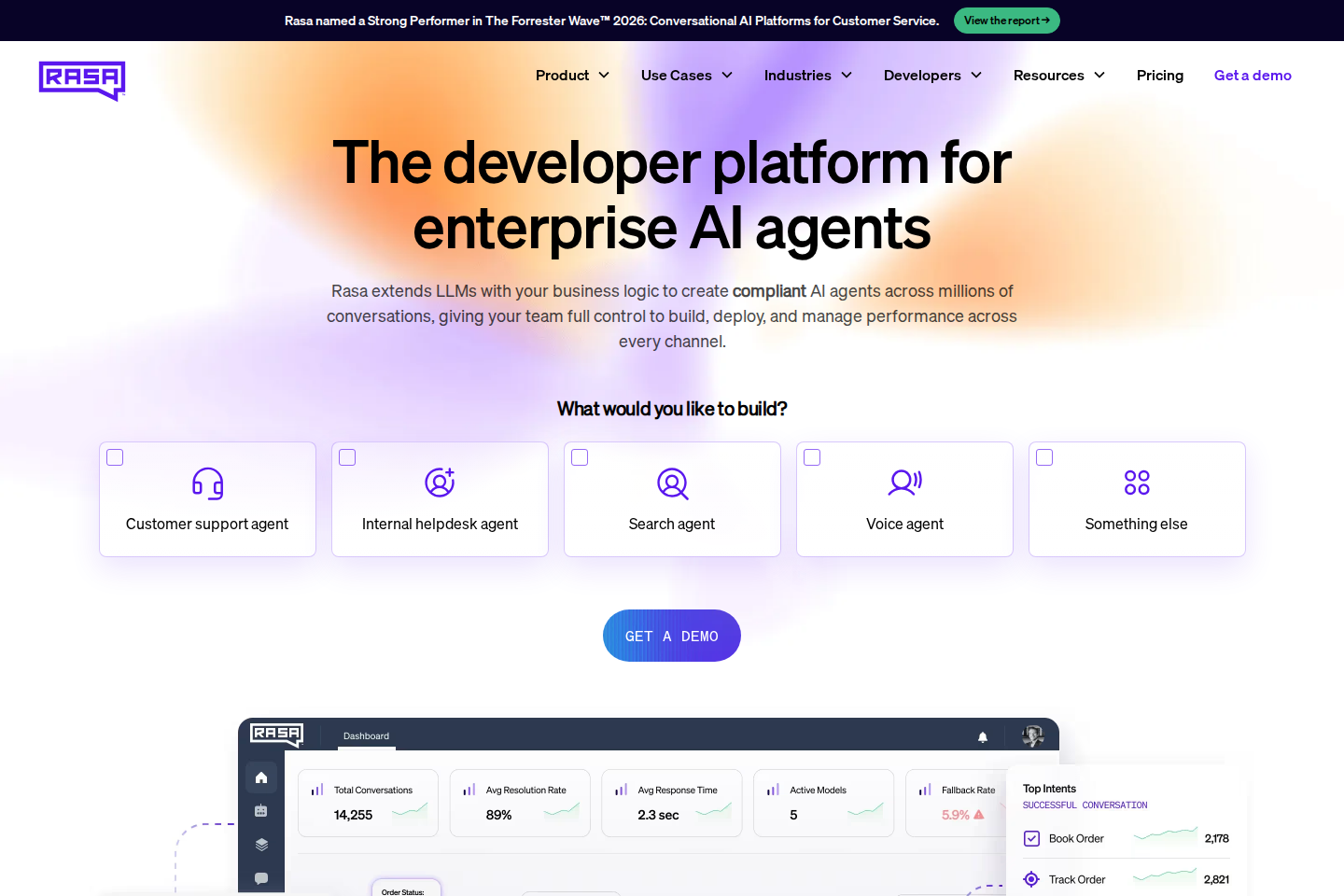
Rasa is the open-source conversational AI framework for teams that want complete control over their conversation stack. The platform provides the engine — NLUNLUNatural Language Understanding — the component of a voice agent that interprets caller intent, entities, and context from spoken input to drive conversational responses and routing decisions.Read full definition →, dialogue management, action server, custom connectors — and your engineering team builds, hosts, and operates the agents. Rasa was named a Strong Performer in the 2026 Forrester Wave for Conversational AI and supports enterprise customers in banking, healthcare, insurance, and telecommunications where self-hosted deployment is a hard requirement.
Rasa is the opposite of Sierra's delivery model. Where Sierra is a fully managed service that builds and runs your agents for you, Rasa gives you the building blocks and expects your team to assemble, host, and maintain the solution. The open-source core is free; Rasa Pro and Rasa Enterprise add production features like analytics, CALM (Conversational AI with Language Models), and enterprise support. The trade-off is engineering investment. Rasa is not no-code. It requires ML engineers or senior developers to build, train, test, and maintain conversation models. Deployment timelines are measured in months, not days.
Pros
Complete stack ownership with self-hosted deployment. Your data never leaves your infrastructure. For healthcare, banking, defense, and government teams with strict data sovereignty requirements, this is the strongest guarantee on the list.
Open-source core with active community. You can inspect, modify, and extend every layer of the conversation engine. No vendor lock-in on the core technology.
Code-level control over conversation logic. For teams with complex, domain-specific dialogue flows that cannot be represented in a visual builder, Rasa's Python-based action server provides complete flexibility.
Watch for
Requires an engineering team to build and maintain. Rasa is not no-code and not low-code. You need ML engineers or experienced Python developers to build, train, and maintain conversation models. Budget engineering headcount accordingly.
Longer time to production than managed or SaaS alternatives. Plan for months of development, training, and testing before your first production agent handles real conversations. This is a build-it-yourself platform.
Best fit
Engineering-led organizations in regulated industries (banking, healthcare, government, defense) that have ML/AI engineering capacity and require complete data sovereignty, self-hosted deployment, and code-level control over conversation logic. Also strong for research teams and organizations that want to innovate on conversation design without vendor constraints.
Pricing
Open-source core is free. Rasa Pro and Rasa Enterprise require paid licenses — contact Rasa for enterprise pricing.
Which Sierra AI alternative should you choose?
The right alternative depends on your primary job to be done and your operational constraints.
If your job is converting inbound leads into customers: Thoughtly. Sierra is built for post-purchase CX. Thoughtly is built for pre-purchase lead conversion across voice, SMS, and email.
If you need enterprise contact center automation with on-premises deployment: Cognigy. Closest to Sierra in enterprise capability with the added flexibility of self-hosted or private cloud deployment.
If you want self-serve CX automation for digital channels: Ada. Fastest path to measurable automated resolution rates without a managed-service engagement.
If you need one AI platform across customer, employee, and IT use cases: Kore.ai. Broadest enterprise scope on this list.
If European data residency and GDPR compliance are hard requirements: Parloa. EU-native architecture designed for European regulatory reality.
If you want fast deployment for support without enterprise procurement overhead: Decagon. Modern tech-company DNA with startup-speed deployment.
If you require complete stack ownership and self-hosted deployment: Rasa. Open source, self-hosted, code-level control — but bring your own engineering team.
FAQ
What is Sierra AI, and why do buyers look for alternatives?
Sierra AI is an enterprise customer experience platform co-founded by Bret Taylor (former Salesforce co-CEO) and Clay Bavor (former Google Labs lead). It builds AI agents for post-purchase customer support — returns, account management, support deflection — deployed as a managed service with multi-quarter timelines and six-figure-plus contract floors. Buyers look for alternatives because of pricing opacity, long deployment timelines, the managed-service dependency model, or because their primary need is lead conversion or revenue automation rather than post-purchase CX.
Can I use a Sierra alternative for lead generation instead of customer support?
Yes, but most Sierra alternatives are also built for customer support. The exception on this list is Thoughtly, which is purpose-built for inbound lead conversion — calling, texting, and emailing leads, qualifying them, booking appointments, and writing outcomes to your CRM. If lead generation is your primary use case, choose a platform designed for it rather than repurposing a support tool.
How does Sierra's pricing work, and why is it a concern?
Sierra uses outcome-based pricing where you pay per resolved customer conversation. While this aligns costs with results in theory, buyers report challenges: unpredictable bills when volume spikes, difficulty auditing what counts as a resolution, and lack of price transparency before signing. Most alternatives offer per-minute, per-conversation, or platform fee models that are easier for finance to forecast and audit.
Is there a free or open-source Sierra alternative?
Rasa offers a free open-source conversational AI framework that you can self-host. The trade-off is that Rasa requires engineering resources to build, train, and maintain conversation agents. There is no free Sierra alternative that provides a managed or no-code experience at enterprise scale.
How long does it take to deploy a Sierra alternative?
Deployment timelines vary significantly. Thoughtly and Decagon deploy in days to weeks. Ada typically takes weeks with guided onboarding. Cognigy, Kore.ai, and Parloa take weeks to months for enterprise deployments. Rasa takes months because your engineering team builds the solution. For comparison, Sierra deployments are managed-service engagements that typically take multiple quarters.
LatencyThe delay between a caller speaking and the agent responding. Lower latency makes AI voice conversations feel more natural.Read full definition →