8 Best Yellow.ai Alternatives for Enterprise AI in 2026
Yellow.ai is powerful enterprise CX automation — but its complexity, opaque pricing, and months-long implementation push many teams to look elsewhere. Here are 8 alternatives worth evaluating, depending on whether your real job is customer support deflection or inbound lead conversion.
Last updated
Yellow.ai is one of the most recognized enterprise conversational AIConversational AIConversational AI is software that interprets natural language and produces context-aware responses through voice, messaging, or chat.Read full definition → platforms on the market — trusted by over 1,300 global brands including Sony, Domino's, and Hyundai. It covers 35+ channels, supports 150+ integrations, and positions itself as an agentic AI platform for both customer experience (CX) and employee experience (EX) automation.
But enterprise-grade comes with enterprise-grade friction. Reviewers on G2 and Gartner Peer Insights consistently flag the same issues: opaque, sales-driven pricing with hidden professional services costs; steep learning curves that stretch implementation timelines to months; and NLP accuracy gaps where bots lose context or misfire on intent matching. For teams that need to move faster, deploy without a dedicated engineering squad, or solve a fundamentally different problem than CX deflection — Yellow.ai can be more platform than necessary.
This list covers eight alternatives worth evaluating in 2026, ranging from CRM-native lead conversion platforms to enterprise contact centerContact centerA contact center is a centralized operation that handles customer or prospect interactions across voice and digital channels.Read full definition → stacks. The right choice depends on whether your job is converting inbound leads into revenue, deflecting support volume, or orchestrating a full contact center operation.
How I evaluated these Yellow.ai alternatives
I assessed each platform across six dimensions that matter most when teams outgrow or reconsider Yellow.ai. The goal was to find alternatives that solve the same problems — or better ones — without inheriting the same friction.
1. Deployment speed and implementation complexity
Yellow.ai deployments routinely take months, with professional services teams in the room. I looked at how quickly each alternative can go from contract to production agent. Platforms that ship in days with no-code builders scored higher than those requiring multi-quarter implementation engagements. The best alternatives let your operations team iterate without waiting for a vendor's professional services calendar.
2. Channel coverage and conversation continuity
Yellow.ai supports 35+ channels — but channel count means less if context breaks when a lead moves from chat to voice to email. I evaluated whether each platform maintains persistent conversation context across channels, or whether each channel operates as a silo. Platforms that keep a single conversation thread across voice, SMS, email, and messaging scored highest.
3. CRM and workflow integration depth
Enterprise platforms need to plug into existing stacks. I assessed whether integrations are truly two-way — reading contact records and writing back call summaries, dispositions, and next steps — or whether they only push events one direction. Platforms with native CRM write-backCRM write-backCRM write-back sends conversation outcomes, qualification answers, notes, appointments, dispositions, and next steps into the CRM.Read full definition → to Salesforce, HubSpot, and comparable systems outscored those that require middleware or custom API work.
4. Pricing transparency and total cost of ownership
Yellow.ai's pricing is fully opaque: no public tiers, hidden conversation fees, and professional services costs that can double the platform spend. I looked at whether alternatives publish pricing, what the per-unit model is (per minute, per resolution, per seat, per agent), and whether total cost of ownership is forecastable without engaging a sales team. Surprise costs kill procurement confidence.
5. AI accuracy and conversation quality
Yellow.ai claims sub-1% hallucinationHallucinationAn AI hallucination, also called a confabulation, is a plausible-sounding response that is false, unsupported, or inconsistent with the available source information.Read full definition → rates, but Gartner Peer Insights reviews note that the bot loses context and struggles with intent matching in complex scenarios. I evaluated each platform's approach to conversation quality: whether they use latest-generation LLMs, how they handle fallbackFallbackA fallback is a safe alternate path used when input is unexpected, a tool fails, or the agent cannot complete the intended step confidently.Read full definition → and escalationEscalationEscalation moves a conversation to a person, specialist, supervisor, or alternate workflow when the agent should not continue alone.Read full definition →, and what reviewers say about real-world accuracy versus marketing claims.
6. Revenue impact vs. cost deflection
This is the category fork. Yellow.ai is designed to deflect support volume — containment rate is the KPI. Some teams evaluating enterprise AI actually need to convert inbound leads into customers, not contain service tickets. I evaluated whether each platform is architected for revenue generation (lead qualificationLead qualificationLead qualification captures fit signals such as intent, urgency, location, eligibility, consent, and availability before the next step.Read full definition →, appointment booking, CRMCRMA CRM is the system used to manage leads, contacts, accounts, opportunities, activity, ownership, and follow-up.Read full definition → pipeline progression) or cost reduction (ticket deflection, agent assist, containment). Both are valid — but they require different tools.
Quick comparison: Yellow.ai alternatives at a glance
Platform
Best for
Primary strength
Key limitation
Thoughtly
inbound lead conversion across voice, SMS, and email
CRM-native multichannel revenue agents that convert inbound leads autonomously
Designed for lead conversion, not post-purchase CX deflection
Cognigy
enterprise contact center orchestration with existing CCaaS
Deep integration with Genesys, NICE, Avaya and enterprise contact center stacks
Heavy implementation, developer-dependent, no native lead conversion workflow
Kore.ai
enterprise virtual assistant and IT service desk automation
Broad virtual assistant platform covering CX, EX, and agent assist use cases
Complex platform with steep learning curve; reviewers flag documentation gaps
Parloa
voice-first AI contact center transformation
Purpose-built voice AI with low-latency natural conversation and Microsoft backing
Newer platform with smaller customer base; limited public case study evidence
Genesys Cloud CX
full-stack enterprise contact center with embedded AI
Complete CCaaS platform with workforce management, quality assurance, and AI layered in
Massive platform complexity; AI features are add-ons to a contact center, not AI-native
NICE CXone
large-scale contact center operations with AI augmentation
Market-leading contact center infrastructure with Enlighten AI analytics and agent assist
Legacy platform modernizing with AI; heavy procurement and long deployment cycles
LivePerson
digital-first conversational commerce and messaging
Messaging-native platform with strong asynchronous conversation handling across digital channels
Financial instability concerns; significant workforce reductions and restructuring in recent years
Intercom Fin
mid-market customer support automation with fast setup
AI-first customer service agent with rapid deployment and intuitive no-code interface
Not built for enterprise contact center scale or voice-heavy workflows
8 best Yellow.ai alternatives in 2026
1. Thoughtly — Best for inbound lead conversion across voice, SMS, and email
Thoughtly is a fundamentally different kind of platform than Yellow.ai — and that is exactly why it belongs at the top of this list. While Yellow.ai automates customer experience and employee support for enterprises with existing contact center operations, Thoughtly converts the inbound leads companies are already getting by calling, texting, and emailing until someone is ready to talk. It serves revenue teams in insurance, mortgage, real estate, automotive, education enrollment, healthcare, home services, and financial services — industries where every unconverted form fill is lost revenue, not just an unresolved ticket.
Thoughtly agents call every new lead within seconds of form submission, qualify them through natural conversation, and follow up across SMS, email, and WhatsApp with persistent context. Every interaction writes back to Salesforce, HubSpot, or your CRM — call notes, disposition, next steps, deal stage. The agent that called is the same one texting and emailing. No channel handoff, no context loss, no human coordination required.
The platform deploys in days with a no-code visual builder. RevOps and growth teams own the agents directly — no engineering queue, no professional services engagement, no multi-quarter implementation timeline. Pricing is per-minute and bundled, not stacked across infrastructure, LLMLarge Language Model (LLM)A large language model (LLM) is a machine-learning model trained on large text collections to interpret and generate language from prompts and context.Read full definition →, and add-on layers.
Pros
Sub-60-second speed-to-lead on every inbound form fill — agents call while the lead is still on the page.
True multichannel persistence: same agent, same context across voice, SMS, iMessage, WhatsApp, and email. No separate channel modules to wire together.
Native two-way CRM write-back to Salesforce, HubSpot, Pipedrive, and 200+ integrations — contacts, deals, activities, and transcripts, not just event triggers.
Bundled per-minute pricing with no hidden conversation fees, professional services surcharges, or LLM add-on stacking.
100% lead coverage: every lead gets worked, including the long tail that human teams never reach.
Watch for
Thoughtly is built for inbound lead conversion and revenue workflows — not post-purchase customer support, IT helpdesk automation, or ticket deflection. Teams whose primary KPI is containment rate or CSAT on service tickets should evaluate CX-focused platforms instead.
Requires a clear CRM, lead source, and qualification logic to get full value. Teams without defined inbound workflows should define the process before deploying.
Best fit
Revenue teams, growth operators, and RevOps leaders in high-consideration consumer industries who need to convert every inbound lead — not deflect support tickets. Ideal when your team has real inbound volume (500+ leads/month) but only has human capacity to follow up with the top 10%.
Pricing
Per-minute, bundled pricing. No stacked LLM, TTSText-to-Speech (TTS)Text-to-Speech (TTS) converts written text into spoken audio, producing the voice a caller hears from an automated or AI-driven system.Read full definition →, or infrastructure fees. Contact Thoughtly for current plan details.
2. Cognigy — Best for enterprise contact center orchestration with existing CCaaS
Cognigy is a German-headquartered enterprise conversational AI platform that competes directly with Yellow.ai in the contact center automation space. It offers an AI Agent Manager for building and orchestrating conversational agents across voice and digital channels, with particularly deep integration into existing contact center infrastructure from Genesys, NICE, Avaya, and Salesforce Service Cloud. For enterprises already running a CCaaS stack, Cognigy slots in as the AI layer without requiring a platform migration.
Where Cognigy differentiates from Yellow.ai is in its flexibility for enterprise IT teams. The platform supports low-code flow building alongside pro-code extensibility, and offers strong multilingual capabilities across 100+ languages. Cognigy has been recognized in Gartner's Magic Quadrant for Enterprise Conversational AI Platforms, which gives procurement teams confidence in the vendor evaluation.
The trade-off is implementation weight. Like Yellow.ai, Cognigy deployments are typically services-led, and the platform is complex enough that most organizations need Cognigy's professional services or a systems integrator to get to production.
Pros
Deep native integrations with Genesys Cloud, NICE CXone, Avaya, and major CCaaS platforms — lets enterprises add AI without replacing their contact center stack.
Supports 100+ languages with strong localization, making it a fit for global enterprises operating across regions.
Recognized in Gartner Magic Quadrant for Enterprise Conversational AI, which can simplify enterprise procurement.
Offers both low-code visual flow builder and pro-code extensibility for complex use cases.
Watch for
Implementation timelines mirror Yellow.ai's: multi-week to multi-month deployments with professional services involvement. Self-serve deployment is not realistic for complex use cases.
Pricing is enterprise-only and not publicly available. Expect custom quotes, annual contracts, and professional services line items.
The platform is powerful but complex — G2 reviewers note a steep learning curve and occasional documentation gaps for advanced configuration.
Best fit
Large enterprises already running Genesys, NICE, or Avaya that want to layer conversational AI into their existing contact center without a full platform swap. Best when the IT team has capacity for a structured implementation and the primary goal is automating customer service interactions at scale.
Pricing
Enterprise-only, custom-quoted. Contact Cognigy for current pricing. Expect annual contracts with professional services costs.
3. Kore.ai — Best for enterprise virtual assistant and IT service desk automation
Kore.ai positions itself as an enterprise AI platform covering customer experience, employee experience, and agent assist — a scope similar to Yellow.ai's dual CX/EX pitch. The platform's XO Platform provides a visual bot builder, pre-built industry templates, and integration with enterprise systems like ServiceNow, Salesforce, and Oracle. Kore.ai has been recognized in multiple Gartner and Forrester reports for conversational AI, and serves enterprise customers across banking, healthcare, telecom, and retail.
Where Kore.ai stands out is in its EX (employee experience) automation. The platform is particularly strong for IT service desk automation, HR query handling, and internal process automation — use cases that Yellow.ai covers but that Kore.ai has deeper vertical templates for. The platform also offers a SearchAssist product for enterprise knowledge search powered by LLMs.
The challenge is the same as Yellow.ai: Kore.ai is an enterprise platform with enterprise complexity. Reviewers consistently note that the visual builder has a steep learning curve, and that getting integrations working reliably requires deeper technical expertise than the marketing suggests.
Pros
Broad virtual assistant platform covering CX, EX (IT helpdesk, HR), and agent assist — more unified than running separate tools for each.
Pre-built templates for banking, healthcare, telecom, and retail that accelerate time-to-deployment for those verticals.
SearchAssist product adds enterprise knowledge search powered by LLMs alongside the conversational platform.
Watch for
G2 and Gartner Peer Insights reviewers consistently flag a steep learning curve with the visual bot builder. The platform markets itself as no-code, but complex configurations require technical expertise.
Documentation quality is a recurring complaint — reviewers note gaps in guides for advanced features and integrations.
Pricing is not publicly available, and enterprise contracts typically include professional services costs on top of platform fees.
Best fit
Enterprise organizations that need a single platform for both customer-facing and employee-facing AI automation. Particularly strong when IT service desk automation or HR query handling is a primary use case alongside customer support.
Pricing
Contact Kore.ai for pricing. Enterprise-only, custom-quoted with professional services typically included.
4. Parloa — Best for voice-first AI contact center transformation
Parloa is a Berlin-based AI contact center platform that was acquired by Microsoft in 2024, signaling serious enterprise intent. Unlike Yellow.ai's broad CX/EX platform approach, Parloa focuses specifically on replacing traditional IVRIVRIVR, or Interactive Voice Response, is a phone menu that routes or serves callers through keypad entries or spoken choices.Read full definition → and voice-based customer service with low-latency, natural-sounding AI agents. The platform handles complex voice interactions including authentication, routing, and multi-step resolution without requiring callers to navigate phone trees.
Parloa's voice-first architecture delivers sub-second response latencyLatencyLatency is the elapsed time between a caller's speech and the agent's response, including listening, processing, tool, network, and speech-generation delays.Read full definition → with natural conversation handling — no robotic pauses or scripted-feeling responses. The Microsoft acquisition gives Parloa access to Azure's AI infrastructure and enterprise sales channels, which is accelerating its enterprise footprint.
The trade-off is maturity. Parloa is newer and smaller than Yellow.ai, with fewer public case studies and a more focused product scope. Teams that need broad digital channel coverage (WhatsApp, social media, web chat) alongside voice may find the platform thinner than Yellow.ai in non-voice channels.
Pros
Purpose-built voice AI with sub-second latency and natural conversation handling — significantly better voice experience than Yellow.ai's VoiceX or traditional IVR replacement.
Microsoft backing provides Azure infrastructure, enterprise credibility, and access to Microsoft's enterprise sales channel.
Focused product scope means less platform bloat — voice contact center transformation without the complexity of a do-everything CX/EX platform.
Watch for
Smaller customer base and fewer public case studies compared to Yellow.ai, Cognigy, or Kore.ai. Enterprise procurement teams may want to verify reference customers in their vertical.
Voice-first focus means digital channels (chat, messaging, social) may be less mature than platforms built for omnichannel from day one.
Post-acquisition product roadmap is still evolving — verify current capabilities and Microsoft integration depth before committing.
Best fit
Enterprise contact centers that want to transform their voice channel specifically — replacing IVR, reducing hold times, and handling routine voice interactions with AI. Best when voice is the primary customer contact channel and the team values conversation quality over broad channel coverage.
Pricing
Contact Parloa for pricing. Enterprise-focused, custom-quoted.
5. Genesys Cloud CX — Best for full-stack enterprise contact center with embedded AI
Genesys Cloud CX is one of the two dominant enterprise contact center platforms (alongside NICE CXone), and it has been aggressively embedding AI capabilities across its stack. Unlike Yellow.ai, which is a conversational AI platform that integrates with contact centers, Genesys is the contact center itself — with AI features like predictive routing, agent assist, speech analytics, and conversational AI bots layered on top.
For enterprise contact center operations that already run on Genesys or are evaluating a full-stack CCaaS migration, adding Genesys's native AI capabilities may be simpler than layering a third-party platform like Yellow.ai on top. The AI features share the same data model, routing engine, and analytics as the rest of the platform, which eliminates integration seams.
The challenge is that Genesys is a contact center platform, not an AI-native platform. Its AI features are powerful but positioned as enhancements to the contact center — not as standalone conversational AI. Teams that need AI automation without the full contact center stack will find Genesys significantly overbuilt.
Pros
Full-stack contact center with AI embedded natively — routing, workforce management, quality assurance, analytics, and conversational bots in one platform.
Predictive routing and AI-powered workforce engagement management go beyond what standalone conversational AI platforms offer.
Massive enterprise install base and Gartner Magic Quadrant leadership reduces procurement risk.
Watch for
Genesys is a contact center platform first, AI platform second. You are buying the full CCaaS stack — which is substantial overhead if your only need is conversational AI automation.
Enterprise pricing is complex: per-seat, per-channel, with AI features as paid add-ons. Total cost of ownership can escalate quickly beyond the base platform fee.
Implementation timelines for full Genesys Cloud CX deployments typically run months, with systems integrator involvement for complex environments.
Best fit
Enterprise contact center operations that need a complete CCaaS platform with AI capabilities embedded — not just conversational AI layered on top. Best when the organization is already running Genesys or evaluating a full contact center platform migration and wants AI built into the stack rather than integrated as a separate vendor.
Pricing
Genesys Cloud CX plans start from approximately $75/user/month (Cloud 1) to $155+/user/month (Cloud 3) for core CCaaS. AI features, digital channels, and workforce management are add-ons. Contact Genesys for enterprise pricing.
6. NICE CXone — Best for large-scale contact center operations with AI augmentation
NICE CXone is the other half of the enterprise contact center duopoly alongside Genesys. NICE has been investing heavily in its Enlighten AI suite, which adds real-time agent assist, sentiment analysis, interaction analytics, and AI-powered quality management to the CXone contact center platform. Like Genesys, NICE is a full-stack CCaaS — but the AI features are particularly strong for post-interaction analytics and compliance monitoring.
For enterprise contact centers already running NICE or evaluating CCaaS options, CXone's AI capabilities are deeply integrated into the agent desktop, quality management workflows, and workforce optimization tools. The Enlighten AI analytics in particular go beyond what standalone conversational AI platforms offer for understanding interaction patterns, compliance risks, and agent performance.
The same caveats apply as Genesys: NICE CXone is a contact center platform with AI features, not an AI-native platform. The full stack is substantial, implementation is complex, and procurement cycles are long.
Pros
Enlighten AI analytics provide deep interaction analysis, sentiment tracking, compliance monitoring, and quality management that standalone conversational AI platforms cannot match.
Strong workforce optimization and agent performance tools embedded alongside AI — useful for large contact centers managing hundreds or thousands of agents.
Gartner Magic Quadrant leader with massive enterprise install base, reducing procurement risk for risk-averse organizations.
Watch for
Like Genesys, you are buying a full contact center platform. If your need is conversational AI without the CCaaS stack, NICE CXone is significantly overbuilt.
Procurement and deployment cycles are long. Large NICE implementations are multi-month projects with systems integrator involvement.
Legacy platform modernization means some older features and interfaces coexist with newer AI capabilities, creating uneven user experience across the platform.
Best fit
Large enterprise contact centers (500+ agents) that need AI-powered analytics, compliance monitoring, and workforce optimization alongside conversational automation. Best when post-interaction analytics and quality management are as important as the automation itself.
Pricing
NICE CXone pricing starts from approximately $71/agent/month for basic digital plans, scaling to $209+/agent/month for complete suites. AI features are add-on licensed. Contact NICE for enterprise pricing.
7. LivePerson — Best for digital-first conversational commerce and messaging
LivePerson is one of the original conversational AI platforms, with roots going back to the early days of live chat. The platform has evolved into a messaging-first conversational AI solution that handles customer interactions across web messaging, WhatsApp, Apple Business Chat, SMS, and social channels. LivePerson's core strength is asynchronous messaging — conversations that can pause and resume over hours or days without losing context, which matches how consumers actually communicate.
LivePerson serves large brands in telecom, financial services, retail, and travel. The platform's Conversational Cloud provides AI-powered intent detection, automated conversation handling, and seamless handoff between AI and human agents. For enterprise teams focused on digital customer engagement and conversational commerce, LivePerson has deeper messaging-native capabilities than Yellow.ai.
However, LivePerson has faced significant business challenges in recent years. The company has gone through multiple rounds of workforce reductions, leadership changes, and financial restructuring. While the product remains functional, buyers should evaluate the company's current financial stability and support capacity before committing to a multi-year enterprise contract.
Pros
Messaging-native architecture with strong asynchronous conversation handling — conversations can pause and resume naturally across channels without losing context.
Deep integration with consumer messaging channels: WhatsApp Business, Apple Business Chat, Google Business Messages, and social platforms.
Mature AI intent detection and conversation routing with years of enterprise-grade refinement.
Watch for
Significant financial instability and restructuring in recent years, including workforce reductions and leadership changes. Evaluate current support capacity and long-term viability before signing multi-year contracts.
Voice capabilities are not the platform's strength — messaging-first architecture means voice AI is less mature than dedicated voice platforms.
Enterprise pricing with complex per-interaction models. Total cost can be difficult to forecast, similar to Yellow.ai's opacity.
Best fit
Enterprise brands in telecom, financial services, and retail that want to automate customer engagement primarily through digital messaging channels. Best when asynchronous messaging is the dominant customer contact pattern and voice is secondary.
Pricing
Contact LivePerson for pricing. Enterprise contracts with per-interaction pricing models. Expect custom quotes.
8. Intercom Fin — Best for mid-market customer support automation with fast setup
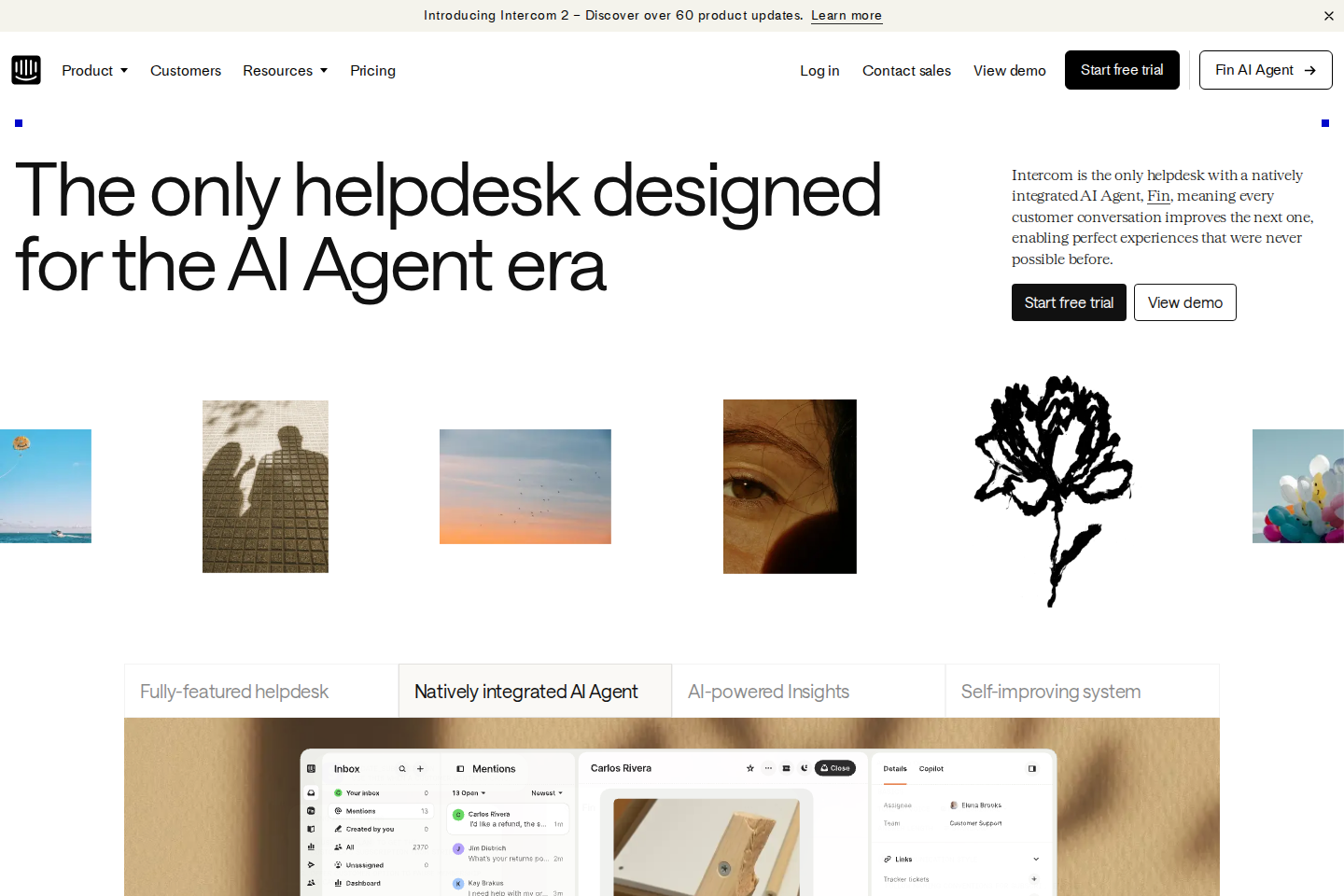
Intercom Fin is the AI customer service agent built into Intercom's customer communication platform. Unlike Yellow.ai's enterprise-first approach, Intercom targets mid-market companies and growth-stage teams that need AI customer support without enterprise procurement cycles. Fin can resolve customer questions by pulling from your help center, previous conversations, and custom knowledge sources — then escalate to a human agent when it cannot answer confidently.
The appeal of Fin is speed and simplicity. Teams can deploy a working AI support agent in hours, not months. Point it at your help center, configure escalation rules, and it starts resolving tickets immediately. The product is tightly integrated with Intercom's inbox, ticketing, and reporting tools, which means there is no integration project — the AI agent lives inside the same platform your support team already uses.
The limitation is scale and scope. Fin is built for customer support, not contact center operations. It does not offer the enterprise telephony, workforce management, or voice AI capabilities that Yellow.ai, Cognigy, or Genesys provide. For large enterprises with complex contact center requirements, Fin is underpowered. For mid-market teams that want AI support without enterprise complexity, it is one of the fastest paths to production.
Pros
Fastest path to a working AI support agent — deploy from existing help center content in hours, not months.
Tightly integrated with Intercom's inbox, ticketing, and reporting. No separate integration project or middleware required.
Transparent pricing with published per-resolution fees. No opaque enterprise quoting or hidden costs.
Watch for
Not built for enterprise contact center scale. No workforce management, telephony, or voice AI capabilities comparable to Genesys, NICE, or Cognigy.
Resolution-based pricing can get expensive at high volume. Teams handling tens of thousands of monthly interactions should model total cost carefully.
Limited to customer support use cases — no employee experience (EX) automation, lead conversion, or contact center orchestration.
Best fit
Mid-market companies and growth-stage teams that want AI customer support deployed quickly without enterprise complexity. Best when your support volume is moderate (hundreds to low thousands of monthly interactions), your knowledge baseKnowledge baseA knowledge base is a maintained collection of approved business information that an agent can use to answer questions.Read full definition → is well-structured, and you do not need enterprise telephony or voice AI.
Pricing
Intercom Fin charges $0.99 per resolution on top of Intercom platform plans. Intercom platform pricing starts from $29/seat/month. Published and transparent.
How to choose the right Yellow.ai alternative
The right alternative depends on what job you are actually hiring the platform to do. Here is a decision framework:
If your primary goal is converting inbound leads into customers — not deflecting support tickets — evaluate Thoughtly first. Yellow.ai was never designed for lead conversion, and forcing a CX platform into a revenue workflow creates operational mismatch.
If you need enterprise conversational AI layered onto an existing contact center (Genesys, NICE, Avaya), evaluate Cognigy. It integrates with your CCaaS stack without requiring a platform migration.
If you need a single platform for both customer-facing and employee-facing AI automation, evaluate Kore.ai. Its EX capabilities are deeper than most CX-focused platforms.
If voice is your primary customer channel and you want the best voice AI experience, evaluate Parloa. Its purpose-built voice architecture delivers better conversation quality than platforms that bolt voice onto a chat-first product.
If you are evaluating a full contact center platform with AI embedded, compare Genesys Cloud CX and NICE CXone. Both are CCaaS leaders with AI features built into the stack.
If you are mid-market and need AI customer support without enterprise complexity, evaluate Intercom Fin. It is the fastest path to production AI support.
If digital messaging is your primary customer channel, evaluate LivePerson — but verify the company's current financial stability before committing to a multi-year contract.
Frequently asked questions
What is Yellow.ai best at?
Yellow.ai is strongest as an enterprise-grade conversational AI platform for automating customer experience across 35+ channels. It excels in global enterprises that need multilingual support, deep integration with existing enterprise systems, and both CX and EX automation on a single platform. Its 150+ pre-built integrations and agentic AI capabilities make it a fit for large organizations with complex automation requirements — provided they have the budget and implementation timeline for an enterprise deployment.
Why do teams look for Yellow.ai alternatives?
The most common reasons are implementation complexity (deployments taking months with professional services involvement), opaque pricing (no public tiers, hidden conversation fees, and professional services costs that can double the platform spend), and NLP accuracy gaps where bots lose context or struggle with intent matching in complex scenarios. Some teams also discover they need a fundamentally different tool — lead conversion rather than support deflection — and Yellow.ai is not designed for that job.
Is Yellow.ai good for small or mid-sized businesses?
Yellow.ai is designed for enterprise customers. While it offers a free starter tier with limited capabilities, the platform's complexity, pricing model, and implementation requirements make it impractical for most small and mid-sized businesses. Mid-market teams looking for AI automation should evaluate simpler alternatives like Intercom Fin for support, or Thoughtly for inbound lead conversionInbound lead conversionInbound lead conversion turns opted-in calls, form submissions, quote requests, and other inquiries into qualified conversations, appointments, or transfers.Read full definition →.
Can Yellow.ai handle inbound lead conversion?
Yellow.ai is built for customer experience deflection and employee experience automation — not inbound lead conversion. It does not natively offer speed-to-lead dialing, CRM pipeline write-back, appointment booking, or same-agent multichannel follow-up sequences designed for revenue workflows. Teams whose primary KPI is converting inbound leads into customers should evaluate platforms purpose-built for that job, such as Thoughtly.
How long does Yellow.ai take to implement?
Full enterprise deployments typically take months, not weeks. Implementation usually requires Yellow.ai's professional services team or a systems integrator. Simple chatbot use cases may deploy faster, but complex multi-channel, multi-integration deployments involve extended configuration, testing, and optimization phases. This is one of the most frequently cited pain points in G2 and Gartner Peer Insights reviews.
Thoughtly — AI voiceAI voiceAn AI voice is synthetic speech produced by a text-to-speech model, using a selected or cloned voice to speak an agent's generated or scripted response.Read full definition → agents for lead conversion