

Industry insights
Bland vs Synthflow: Voice AI Platform Comparison
A practical Bland vs Synthflow comparison covering pricing, channels, compliance, reviews, enterprise readiness, and when Thoughtly is the better fit for lead conversion.
Industry insights
A practical Bland vs Synthflow comparison covering pricing, channels, compliance, reviews, enterprise readiness, and when Thoughtly is the better fit for lead conversion.
Last updated
Bland AI and Synthflow both sell voice AI agents for teams that want phone automation in production. They overlap on call handling, agent builders, integrations, compliance positioning, and enterprise deployment. But they are built around different operating models: Bland leans toward regulated, infrastructure-controlled call automation; Synthflow leans toward no-code deployment, enterprise telephony, and reseller-friendly voice automation.
If you are comparing Bland vs Synthflow, the question is not simply which one sounds more human on a demo call. The real question is who will own the workflowWorkflowAn automated, multi-step process — usually triggered by an event (form fill, new lead) and orchestrating one or more voice / SMS / email actions. after launch, how much of the follow-up motion lives outside the voice agentVoice agentAn autonomous, conversational interface that interacts with humans over the phone — answering, qualifying, and routing calls without human staffing., which compliance controls are actually included at your plan level, and whether your team is buying voice infrastructure or a revenue conversion system.
This comparison is based on current public product pages, pricing pages, Thoughtly compare pages, G2 profiles, Trustpilot availability checks, competitor review pages, and direct research completed in June 2026.
| Category | Bland AI | Synthflow |
|---|---|---|
| Best fit | Regulated teams that want infrastructure control for high-stakes phone automation | Teams that want no-code voice agents, enterprise telephony, and reseller or white-label options |
| Primary buyer | Enterprise call operations, compliance-heavy industries, engineering-supported teams | Operations teams, agencies, BPOs, and enterprises deploying voice agents quickly |
| Core product | Voice AI platform for regulated phone calls, with dedicated infrastructure options | Enterprise-ready voice AI platform for automated inbound and outbound calls |
| Pricing | $0.14/min Start; $0.12/min + $299/mo Build; $0.11/min + $499/mo Scale; Enterprise custom | Pay as you go with 5 concurrent calls, then $20/reserved concurrency; Enterprise custom for 10,000+ minutes/month |
| Channels | Voice on self-serve tiers; SMS, web chat, iMessage, scheduling, and transfer features gated to Enterprise | Voice plus chat, SMS, WhatsApp/API/widget messaging on public pricing; enterprise workflows and white-label on Enterprise |
| Compliance | SOC 2 Type I/II, HIPAA-eligible BAA, GDPR, PCI DSS; Enterprise for BAA/SSO/data residency | SOC 2, GDPR, ISO 27001 on PAYG; Enterprise adds advanced compliance, regional hosting, and support |
| G2 profile | 5.0/5 from 11 reviews at research time | 4.5/5 from 1,015 reviews at research time |
| Main strength | Security posture, infrastructure ownership, call observability, and enterprise deployment control | No-code builder, large review base, 200+ integrations, telephony claims, and reseller tooling |
| Main limitation | Important workflow channels and transfer/scheduling features are Enterprise-only | Pricing detail is less transparent at scale, and white-label/custom workflow depth depends on Enterprise |
I weighted five criteria: production readiness, channel coverage, pricing predictability, compliance posture, and operational ownership. A voice agent that can answer a call is useful; a system that can qualify, route, text, email, update the CRMCRMThe system of record for leads, contacts, deals, and activity. Thoughtly reads from and writes to your CRM continuously., and keep a revenue team out of spreadsheet purgatory is a different product.
For public evidence, I separated vendor claims from review-market signals. Bland's current G2 profile is very positive but small, with 11 reviews. Synthflow has a much larger G2 profile, with 1,015 reviews and a 4.5/5 rating. That larger sample gives Synthflow more market signal, while Bland's enterprise positioning still deserves credit for regulated-industry controls and deployment options.
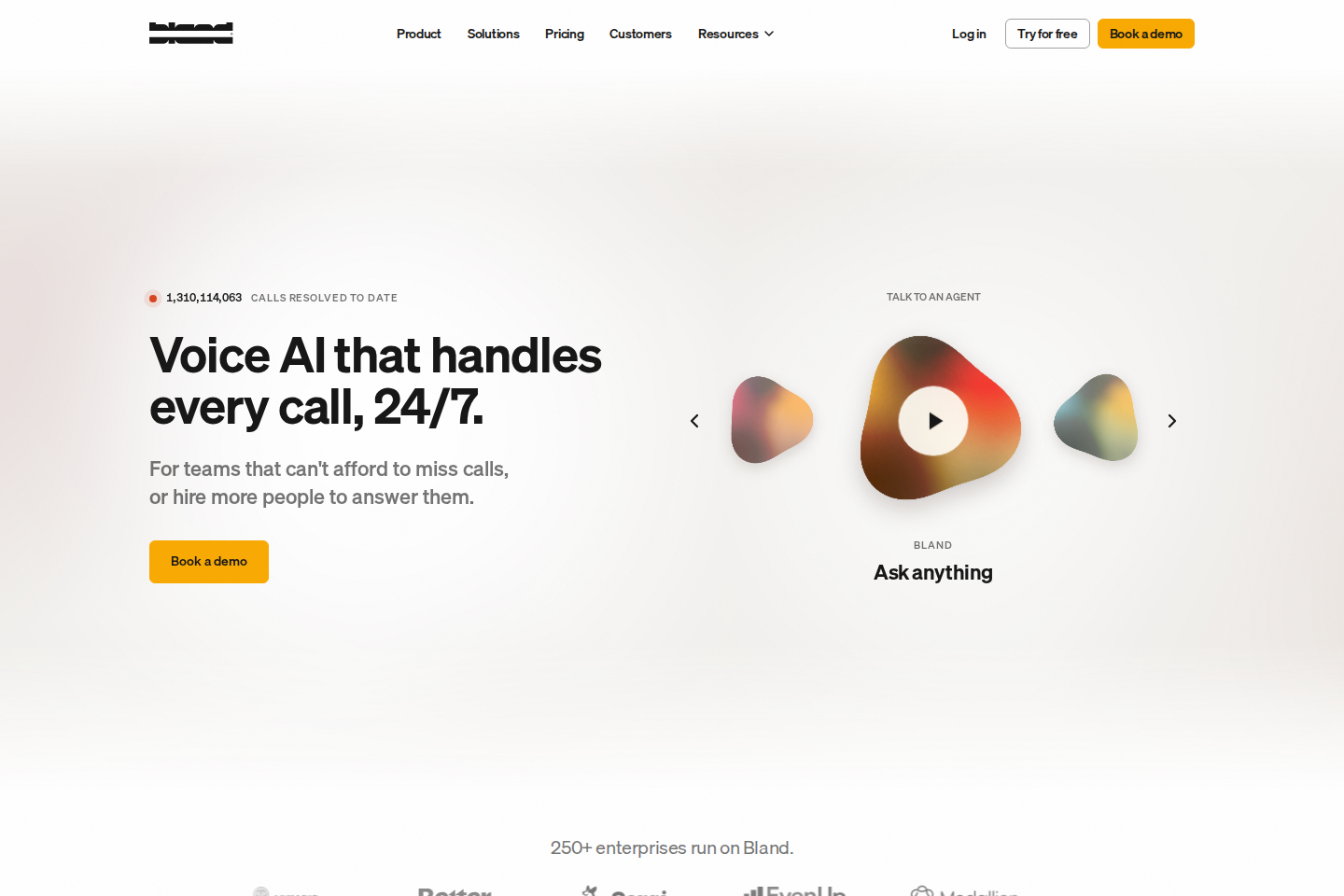
Bland AI now positions itself as voice AI for regulated industries, built for high-stakes phone calls where security and trust matter. Its homepage emphasizes end-to-end infrastructure ownership, regulated-industry customers, call monitoring, guardrailsGuardrailsGuardrails are rules that keep an AI agent within approved topics, scripts, compliance boundaries, and handoff paths during voice, SMS, or email conversations., and deployment models such as on-premise or VPC for enterprise customers. The product is a serious voice automation platform, not a toy dialer with a friendly voice glued on top.
Bland's pricing page is unusually clear for the category. Start is $0.14 per minute with no platform fee, Build is $0.12 per minute plus a $299 monthly platform fee, and Scale is $0.11 per minute plus a $499 monthly platform fee. Enterprise pricing is custom and adds dedicated infrastructure, unlimited concurrency, on-prem or VPC deployment, data residency, BAA, and SSO.
The catch is channel and feature gating. Bland's pricing table marks SMS and web chat, SMS nodes, iMessage, appointment scheduling, warm transfers, live transfers, and several advanced controls as Enterprise-only. That matters for lead conversion teams because a call without follow-up, scheduling, CRM write-backCRM write-backUpdating the CRM after an interaction with call outcomes, transcripts, qualification answers, notes, appointments, dispositions, and next-step fields., or a clean transfer path is not a complete revenue workflow.
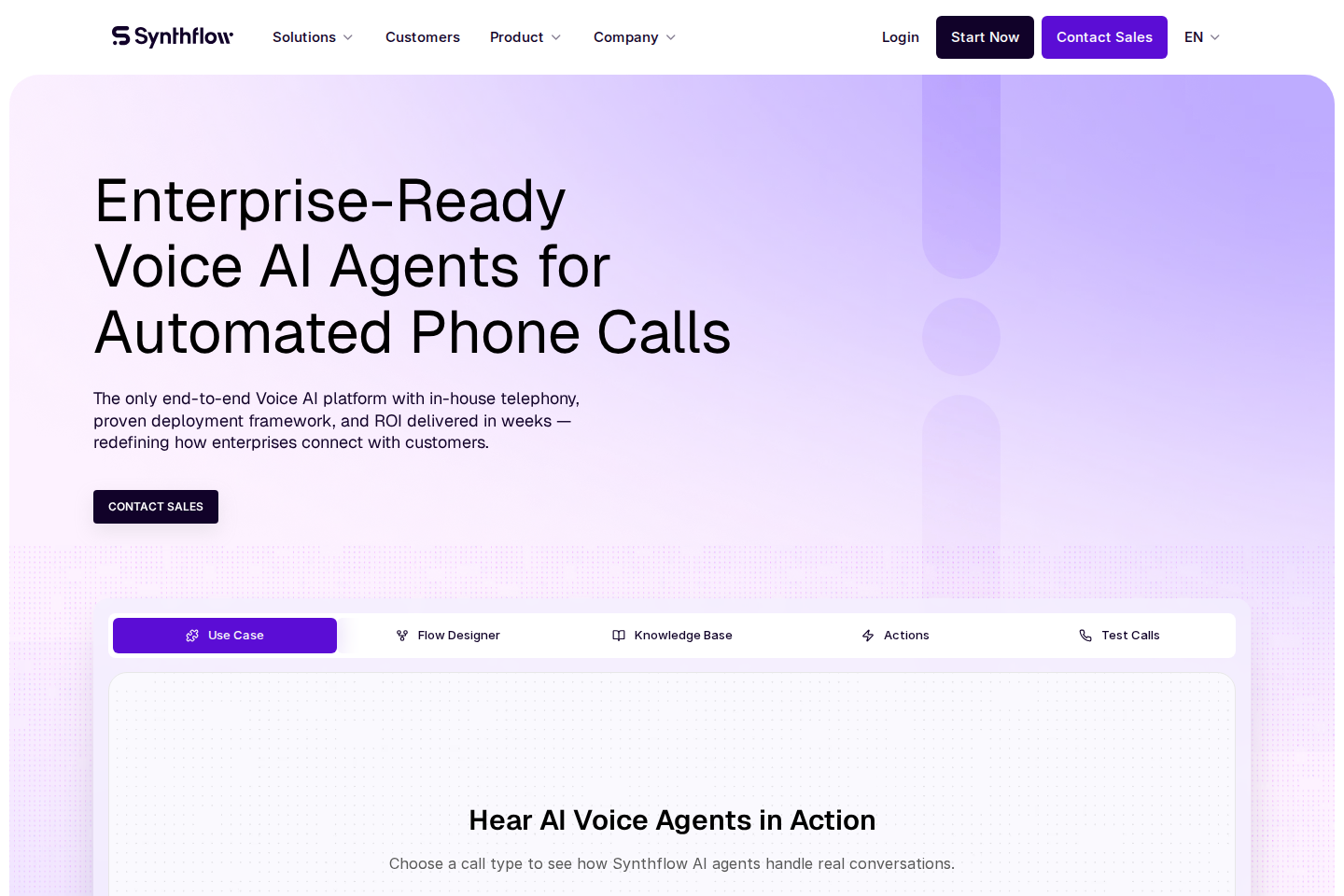
Synthflow positions itself as an enterprise-ready voice AI platform for automated phone calls, with in-house telephony, a no-code builder, workflow actions, knowledge bases, test calls, and deployment support. Its public pages emphasize appointment scheduling, lead qualificationLead qualificationThe process of capturing fit signals — intent, urgency, location, eligibility, consent, and availability — before routing a lead to the right next step., customer support, call routingCall routingDirecting a caller to the right agent, rep, team, location, queue, or workflow based on intent, data, and availability., healthcare reception, real estate lead qualification, and multilingual operations.
Synthflow's pricing page splits the market into Pay as you go and Enterprise. Pay as you go is free to start, usage-based after launch, includes Synthflow or bring-your-own telephony, 5 concurrent calls, ticketing support, unlimited agents, API and integrations, and compliance language around SOC 2, GDPR, and ISO 27001. Enterprise is aimed at teams handling 10,000+ minutes per month and adds 99.99% SLASLAAn SLA, or service level agreement, is the response-time commitment a team uses to make sure new leads are contacted, routed, or escalated within a defined window., SIP trunking, native telephony, custom workflows, unlimited concurrent calls, priority limits, white-label and reseller toolkit, enterprise onboarding, training, and support.
Synthflow's review-market signal is stronger than Bland's by volume. G2 lists Synthflow at 4.5/5 from 1,015 reviews and reports an average time to implement of one month. That does not mean every deployment is simple, but it does show a broader user base than most voice AI startups can point to.
Bland wins on published self-serve rate clarity. Its per-minute rates and platform fees are stated plainly: $0.14/min on Start, $0.12/min plus $299/month on Build, and $0.11/min plus $499/month on Scale. The all-in per-minute framing also avoids separate token, TTSText-to-Speech (TTS)The system that turns the agent's generated text into spoken audio — the voice the caller actually hears., STTSpeech-to-Text (STT)The system that turns the caller's speech into text the agent can reason over., and provider pass-through line items.
The drawback is that the buyer may need Enterprise for the features that turn calls into workflows: SMS, web chat, iMessage, appointment scheduling, warm transfers, live transfers, advanced guardrails, BAA, SSO, data residency, and some reliability controls. For teams that only need phone automation, the lower tiers are workable. For teams that need revenue follow-up, Bland's transparent pricing can become custom pricing quickly.
Synthflow is easier to start but harder to forecast from public pages. Pay as you go is usage-based, includes 5 concurrent calls, and charges $20 per reserved concurrency after that. The Enterprise plan is where unlimited concurrency, custom workflows, white-label, reseller tooling, advanced support, and stronger SLA language appear. If you are comparing total cost, model not just minutes but concurrency, telephony, support, onboarding, white-label requirements, and the number of workflows that must run after the call.
Bland's current homepage talks about customer interactions across voice, SMS, iMessage, and web chat, but the pricing page makes clear that those non-voice channels are not available on Start, Build, or Scale. That makes Bland a voice-first product unless you are negotiating Enterprise. The same is true for appointment scheduling nodes, in-call SMS nodes, and transfer capabilities that many revenue teams would consider basic production requirements.
Synthflow presents broader channel language on its public pages, including voice, chat, SMS, WhatsApp, API, widget, and simulation. Its center of gravity is still voice AI, but its packaging is friendlier to teams that want a no-code operational layer rather than a purely infrastructure-shaped platform. For agencies, BPOs, and consultancies, Synthflow's white-label and reseller toolkit is a real differentiator, though it sits in Enterprise packaging.
Thoughtly is different from both: it is built around lead conversion rather than general phone automation. The platform combines voice, SMS, email, workflows, CRM syncCRM syncCRM sync is the two-way flow of lead records, conversation notes, outcomes, and next steps between an AI agent platform and a CRM so human teams inherit current pipeline instead of manual updates., and handoff logic so revenue teams can convert the leads they already have instead of assembling a stack around a voice agent. If the job is inbound speed-to-lead, compare both vendors against Thoughtly's lead conversion platform.
Bland has a strong compliance and infrastructure story. Its public pages state SOC 2 Type I and Type II, HIPAAHIPAAThe US health privacy law that governs protected health information. Healthcare voice and SMS workflows must handle PHI with appropriate safeguards. eligibilityEligibilityThe fit criteria that determine whether a prospect can move forward, such as service area, insurance coverage, loan type, location, age, or program requirements. with a signed BAA, GDPR, and PCI DSS. The Enterprise plan also lists on-prem or VPC deployment, data residency, SSO, dedicated infrastructure, dedicated orchestration, and priority call queue. For regulated teams that need control over where data lives and how calls are processed, Bland deserves a close look.
Synthflow also presents a strong compliance posture. Its public pages cite SOC 2, GDPR, ISO 27001, HIPAA, PCI DSS, encryption, audit logs, and region-based hosting. Its Enterprise plan adds advanced compliance language such as MSA support, geo-based sub-processing, on-premise multi-region deployment, flexible hosting options, enterprise onboarding, training, and support.
The practical difference is procurement shape. Bland is more explicit about regulated-industry infrastructure control. Synthflow is more explicit about enterprise telephony, global deployment, no-code rollout, and reseller operations. Either way, buyers should verify current SOC reports, BAA terms, DPA terms, subprocessors, data retentionData retentionThe policies and timeframes that govern how long call recordings, transcripts, PII, and conversation metadata are stored before automatic deletion or archival., call recordingCall recordingCapturing audio from a phone conversation for review, QA, training, compliance, dispute resolution, or supervised retention. consent, and escalationEscalationMoving a conversation to a human, specialist, supervisor, or alternate workflow when the agent detects risk, uncertainty, urgency, or a request it should not handle alone. behavior before production.
Bland's G2 page currently shows 5.0/5 from 11 reviews, with 90% five-star reviews and 9% four-star reviews. G2's review summary praises exceptional speed, flexible API, and reliable customer experiences, while noting a learning curve and some complexity around setup and features. The small sample means the rating is encouraging but not yet a broad market consensus.
Synthflow's G2 page currently shows 4.5/5 from 1,015 reviews, with 70% five-star reviews, 23% four-star reviews, 5% three-star reviews, and 0% shown for two- and one-star buckets at research time. G2 also lists 45 integrations and a one-month average time to implement. That broader review base is a meaningful advantage for buyers who want evidence beyond vendor case studies.
Trustpilot pages for both companies were checked, but the site blocked extraction during research. That is not evidence for or against either vendor; it just means I would not use Trustpilot as the basis for this comparison without direct browser verification.
If the business problem is converting inbound leads across voice, SMS, email, CRM, scheduling, and human handoffHuman handoffThe moment an AI agent transfers context, call details, and the next step to a human rep, licensed specialist, or support team., neither Bland nor Synthflow is the cleanest default. Both can automate phone calls. Neither is primarily built as a revenue conversion platform where multichannel follow-up and CRM workflow execution are the product's center of gravity.
Thoughtly is the better fit when RevOps, marketing operations, admissions, insurance, mortgage, healthcare, automotive, home services, or another high-consideration consumer funnel needs to reach every opted-in lead quickly and keep following up until the person is ready to talk. Bland and Synthflow are stronger fits when the buyer is choosing a voice automation platform rather than a full lead-conversion system.
Bland is better if you need regulated-industry infrastructure control, published per-minute pricing, and enterprise deployment options such as VPC or on-prem. Synthflow is better if you want a no-code voice-agent platform with a larger public review base, enterprise telephony packaging, and reseller or white-label options.
Not enough public information exists to say universally. Bland publishes per-minute rates and platform fees for self-serve plans. Synthflow publishes a usage-based Pay as you go plan and custom Enterprise packaging. The cheaper option depends on minutes, concurrency, telephony, support, white-label needs, compliance requirements, and whether required features sit behind Enterprise.
Synthflow is generally friendlier for non-technical teams because it emphasizes a no-code builder, tested agents, workflow actions, and deployment support. Bland can be accessible, but its strongest fit is still teams that can own technical production details, especially in regulated use cases.
Bland lists SMS, web chat, iMessage, appointment scheduling, and some transfer features as Enterprise-only on its pricing page. Synthflow presents SMS, WhatsApp, API, widget, and other channels on public pricing language, but buyers should confirm exact plan access. Neither should be treated as a replacement for a full revenue workflow platform without checking CRM write-back, email follow-upEmail follow-upEmail follow-up is the process of sending timely, context-aware replies or reminders that keep an inbound lead moving toward qualification, scheduling, or handoff., attribution, and handoff requirements.
If the team only needs voice automation, either can fit depending on operating model. If the team needs voice plus SMS, email, CRM updatesCRM updatesCRM updates are the automatic changes an agent writes back after a conversation, such as status, notes, next step, owner, appointment, or disposition., lead routing, scheduling, and persistent follow-up, Thoughtly is usually the cleaner fit because those workflows are the core product rather than add-ons around a voice agent.