

Industry insights
Synthflow Review 2026: AI Voice Automation for Agencies
An honest 2026 Synthflow review for revenue teams: no-code voice-agent strengths, pricing tradeoffs, agency fit, limitations, and when to choose Thoughtly.
Industry insights
An honest 2026 Synthflow review for revenue teams: no-code voice-agent strengths, pricing tradeoffs, agency fit, limitations, and when to choose Thoughtly.
Last updated
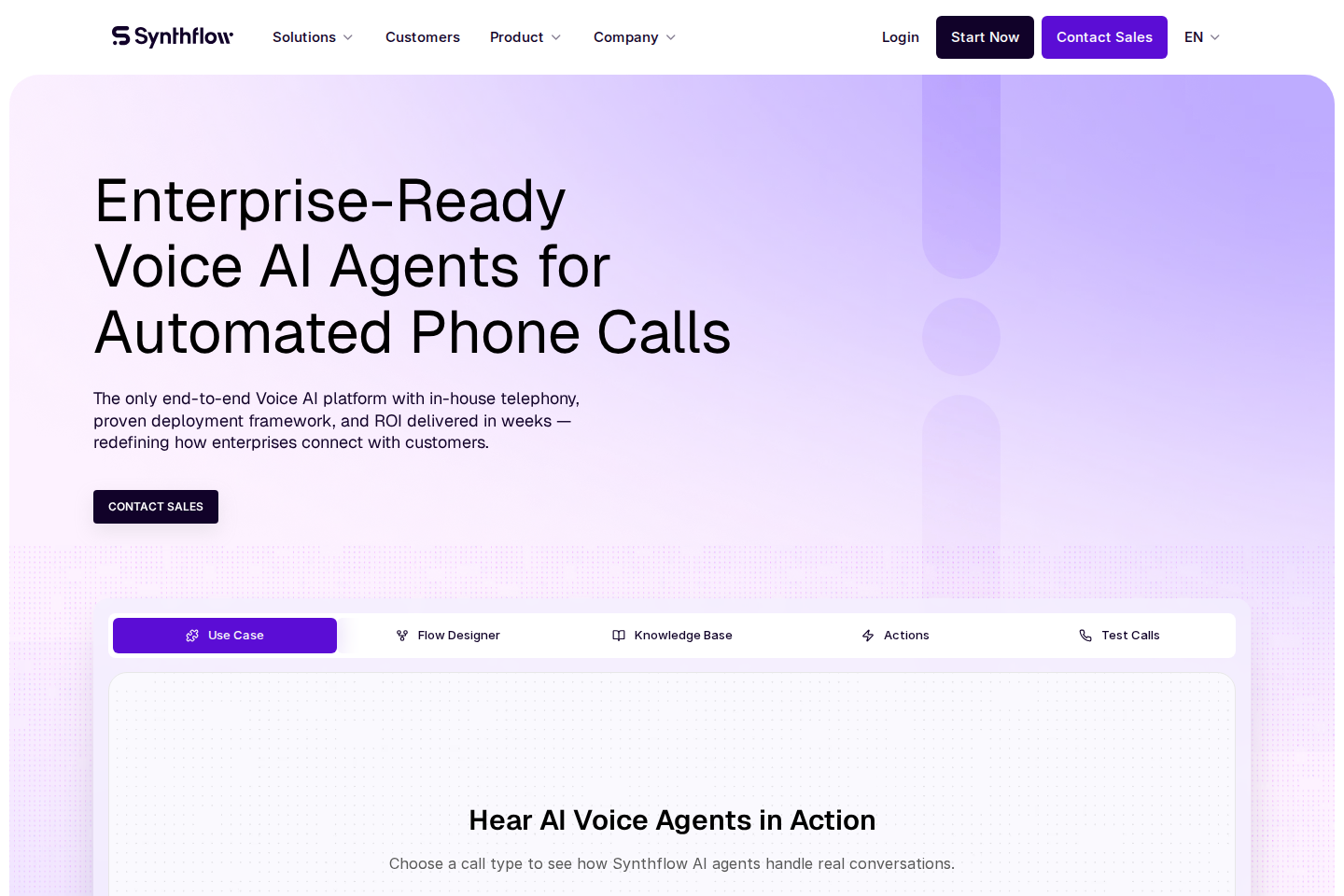
Synthflow is a no-code voice AI platform for building phone agents that handle inbound and outbound calls. Its public positioning centers on automated phone calls, flow design, knowledge bases, actions, test calls, in-house telephony, and faster deployment for teams that do not want to build directly against a developer API.
That makes Synthflow a credible option for agencies, consultants, and operators that want to launch voice automation without hiring a voice AI engineering team. It is also a different product shape than a revenue conversion platform that works every inbound lead across voice, SMS, email, scheduling, and CRMCRMThe system of record for leads, contacts, deals, and activity. Thoughtly reads from and writes to your CRM continuously. follow-up.
I reviewed Synthflow’s current website, pricing page, public G2 profile, third-party directory pages, independent reviews, search-visible Trustpilot and Reddit results, and Thoughtly’s direct comparison page to assess where Synthflow fits, where buyers should be careful, and when Thoughtly is the stronger choice.
| Category | Details |
|---|---|
| Company | Synthflow / AgentFlow AI GmbH |
| Primary category | No-code voice AI agent platform |
| Best fit | Agencies, consultants, and teams launching phone-call automation without a developer-first build |
| Core use cases | Appointment scheduling, lead qualification, customer support, reception, call routing, and phone-based workflows |
| Core channels | Voice-first; Thoughtly’s comparison notes SMS is metered and email is not a native channel |
| Public pricing model | Pay as you go plus Enterprise; usage-based billing after launch on self-serve plan |
| Concurrency | 5 concurrent calls on Pay as you go, then $20 per reserved concurrency according to Synthflow pricing |
| Enterprise features | 99.99% SLA, SIP trunking, native telephony, white label/reseller toolkit, custom workflows, enterprise onboarding and support |
| Compliance claims | SOC 2, GDPR, and ISO 27001 listed on Pay as you go; advanced enterprise compliance options listed for Enterprise |
| G2 rating | 4.5/5 from 1,015 reviews at time of research |
Synthflow’s strongest advantage is accessibility. The product is built around a visual/no-code workflowWorkflowAn automated, multi-step process — usually triggered by an event (form fill, new lead) and orchestrating one or more voice / SMS / email actions., templates, prompts, integrations, and test calls rather than low-level APIs. G2’s review summary repeatedly points to ease of use, fast setup, and an intuitive interface as common positives. For agencies or small teams that want to demo and deploy phone agents quickly, that product shape is genuinely useful.
Synthflow’s Enterprise plan explicitly lists white label and reseller tooling, and Thoughtly’s comparison page frames Synthflow as especially well-suited to agencies productizing voice agents for clients. That does not make Synthflow weak; it means the buyer should know which motion the product is optimized around. If your business is packaging voice agents for multiple downstream clients, white-label tooling and a voice-first builder may matter more than a deeply opinionated inbound conversion workflow.
Synthflow’s homepage shows practical call patterns such as real estate lead qualificationLead qualificationThe process of capturing fit signals — intent, urgency, location, eligibility, consent, and availability — before routing a lead to the right next step., healthcare receptionist workflows, and customer support or restaurant booking flows. Those are concrete jobs, not abstract AI-agent theater. The platform’s value is easiest to see when the workflow starts and ends on the phone: answer the call, ask a structured set of questions, route or book, and reduce repetitive work for human staff.
Synthflow now emphasizes in-house telephony, deployment frameworks, 30+ countries, large call-volume claims, and enterprise reliability. Its pricing page also lists Synthflow TwilioTwilioA cloud communications platform widely used as the carrier layer for voice and SMS. Thoughtly supports Twilio for inbound and outbound traffic., bring-your-own telephony, Synthflow native telephony, SIP trunking, and reserved concurrency. That is the right infrastructure vocabulary for teams that care about production phone operations instead of only building a prompt demo.
Synthflow’s public pricing page lists SOC 2, GDPR, and ISO 27001 on the Pay as you go tier, with advanced compliance options on Enterprise such as MSA support, geo-based sub-processing, multi-region deployment, and flexible hosting options. Regulated buyers still need to verify the exact contract terms, data handling, retention, and business associate agreement requirements. But the public posture is stronger than many lightweight no-code voice tools.
Synthflow is strongest when the job is phone automation. Thoughtly’s direct comparison notes that Synthflow’s SMS is metered against voice minutes and that email is not a native channel, while Thoughtly treats voice, SMS, email, workflows, and CRM context as co-equal parts of the conversion motion. That difference matters for inbound lead teams: missed-call recoveryMissed-call recoveryAutomatically calling or texting back prospects who reached the business but did not connect with a human, so high-intent demand does not disappear into voicemail., after-hours nurture, scheduled callbacks, CRM write-backCRM write-backUpdating the CRM after an interaction with call outcomes, transcripts, qualification answers, notes, appointments, dispositions, and next-step fields., and email follow-upEmail follow-upEmail follow-up is the process of sending timely, context-aware replies or reminders that keep an inbound lead moving toward qualification, scheduling, or handoff. are not add-ons around the phone call. They are the work.
Synthflow’s current pricing page is simpler than older tiered pages: Pay as you go for pilots and smaller deployments, Enterprise for teams above 10,000 minutes per month. But the budget still depends on call minutes, reserved concurrency, telephony choice, LLMLarge Language Model (LLM)A machine-learning model trained on massive text data, used as the reasoning engine that drives a voice agent's understanding and responses. choice, performance routing, custom workflows, support expectations, and whether the buyer needs Enterprise. G2’s generated review summary also flags unclear pricing and higher-usage expense as recurring themes, with “Expensive” and “Cost Limitations” appearing among the most common cons.
No-code is a feature until the workflow becomes genuinely complex. G2 review excerpts surfaced limitations around advanced customization, workarounds for complex workflows, missing features, and a learning curve once teams go beyond basic call flows. That is normal for a guided builder: it helps you move quickly inside the designed path, but it may not expose the same control as a developer platform or a purpose-built revenue workflow.
Synthflow’s pricing page lists several telephony options, and its homepage claims usage across 30+ countries. Still, international buyers should validate local number availability, caller ID behavior, bring-your-own-telephony requirements, and any plan gates before committing. One low-rated G2 reviewer specifically complained about limited direct phone-number coverage and needing a higher plan to connect Twilio for local numbers. That is one reviewer’s experience, not a universal conclusion, but it is exactly the kind of detail global teams should confirm early.
A no-code voice agentVoice agentAn autonomous, conversational interface that interacts with humans over the phone — answering, qualifying, and routing calls without human staffing. is not the same thing as a no-planning voice agent. Review excerpts praised Synthflow’s ease of setup, but also noted that real call testing can be limited before upgrading and that teams still need to think through scripts, edge cases, handoffs, and fallbackFallbackA safe backup path used when the caller says something unexpected, an integration fails, or the agent cannot confidently complete the intended step. behavior. Buyers should budget time for prompt design, call QA, edge-case routing, CRM integrationCRM integrationA two-way connection between a voice/SMS/email agent platform and a CRM that syncs contact data, call outcomes, dispositions, and follow-up tasks in real time. checks, and ongoing iteration. The product can reduce engineering work; it does not remove operational ownership.
Synthflow’s public pricing page now presents two main buying paths: Pay as you go and Enterprise. Older third-party directory pages still show older starter/pro/growth/agency-style pricing, but I would treat Synthflow’s own pricing page as the current source of truth.
| Plan | Pricing model | Included / notable items | Watch-outs |
|---|---|---|---|
| Pay as you go | Free to start, then usage-based billing after launch | Synthflow Twilio or bring-your-own telephony; 5 concurrent calls; SOC 2/GDPR/ISO 27001; unlimited agents, API, and integrations; ticketing support | Extra reserved concurrency listed at $20; real monthly cost depends on call volume, model choice, telephony, add-ons, and testing needs |
| Enterprise | Contact sales; aimed at teams handling 10,000+ minutes/month | 99.99% SLA, SIP trunking, Synthflow native telephony, white label/reseller toolkit, unlimited concurrent calls, custom workflows, custom API limits, enterprise onboarding/training/support | Best for larger deployments or reseller motions; final pricing, compliance scope, and support terms need sales validation |
| Add-ons / configuration | Usage and configuration dependent | Pricing calculator references LLM choice, telephony choice, and performance routing | Forecasting requires modeling average call length, answer rate, concurrency, retries, and escalation volume |
The practical takeaway: Synthflow can be inexpensive to start, but not automatically cheap to scale. If you are running a small pilot or agency demo, usage-based pricing is helpful. If you are automating high-volume inbound or outbound phone operations, model the fully loaded cost before you compare it with a bundled revenue platform or a developer-first API stack.
Thoughtly is the stronger alternative when the job is not just automating phone calls, but converting inbound leads. Thoughtly agents call, text, email, qualify, schedule, route, and write outcomes back to the CRM from one shared workflow. That makes it a better fit for high-volume, high-consideration consumer funnels where speed-to-lead, persistence, consent, handoff, and CRM context matter more than a standalone no-code voice builder.
See the direct comparison: Thoughtly vs Synthflow.
Vapi is the better fit when an engineering team wants to build custom voice agents with API-level control. It is less guided than Synthflow, but gives technical teams more flexibility around models, telephony, tools, and orchestration. Choose Vapi when voice is part of a product or custom system; choose Synthflow when the priority is a faster no-code phone-agent build.
Retell is another developer-oriented voice AI platform and often appears in the same shortlist as Vapi and Synthflow. It is a better fit for builders that want voice infrastructure and provider flexibility rather than a reseller-friendly no-code surface. Teams should compare per-minute economics, provider costs, compliance requirements, and how much engineering ownership they want after launch.
Bland is worth evaluating for high-volume voice automation programs that want a voice-first platform with enterprise deployment options. Compared with Synthflow, it may appeal more to teams that are comfortable with a technical voice automation layer rather than agency-style packaging. Buyers should validate multichannel needs, governance, reliability, support, and pricing at the expected call volume.
Yes, for the right buyer. Synthflow is a credible no-code voice AI platform for phone-call automation, especially for agencies, consultants, appointment-heavy businesses, and teams that want to launch voice agents without a developer-first build. It is less ideal when the buyer needs a full multichannel revenue conversion platform.
Synthflow’s pricing page lists a Pay as you go option that is free to start and usage-based after launch, plus an Enterprise plan for teams handling 10,000+ minutes per month. Pay as you go includes 5 concurrent calls, with additional reserved concurrency listed at $20. Exact cost depends on minutes, telephony, LLM choice, concurrency, add-ons, and Enterprise requirements.
Synthflow can work for both, but its white-label and reseller tooling make it especially attractive for agencies and consultants. In-house revenue teams should evaluate whether they need only phone automation or a broader conversion workflow across voice, SMS, email, CRM, scheduling, and human handoffHuman handoffThe moment an AI agent transfers context, call details, and the next step to a human rep, licensed specialist, or support team..
Synthflow is voice-first and builder-oriented. Thoughtly is built for inbound lead conversionInbound lead conversionThe process of turning opted-in inquiries, form fills, calls, and quote requests into qualified conversations, appointments, or transfers. across voice, SMS, email, workflows, and CRM write-back. Choose Synthflow when the main job is launching phone agents or reselling voice automation; choose Thoughtly when the main job is converting every inbound lead with persistent, CRM-aware follow-up.
The best alternative depends on the job. Thoughtly is the best fit for inbound lead conversion across voice, SMS, email, scheduling, and CRM. Vapi and Retell are stronger fits for developer-led voice builds. Bland is worth evaluating for high-volume voice automation. Synthflow remains a good fit for no-code phone agents and agency/reseller motions.