

Industry insights
Thoughtly vs Bland AI: Multichannel Revenue Agent vs Voice-First Call Center
A practical Thoughtly vs Bland AI comparison for teams deciding between multichannel inbound lead conversion and voice-first call-center automation.
Industry insights
A practical Thoughtly vs Bland AI comparison for teams deciding between multichannel inbound lead conversion and voice-first call-center automation.
Last updated
If you are comparing Thoughtly and Bland AI, the real question is not whether both platforms can place an AI phone call. They can. The question is who should own the revenue workflowWorkflowA workflow is a defined sequence of steps, decisions, actions, delays, and outcomes used to complete a business process. after the call starts: a RevOps team that needs every opted-in inbound lead contacted, qualified, followed up, booked, and written back to the CRMCRMA CRM is the system used to manage leads, contacts, accounts, opportunities, activity, ownership, and follow-up., or an engineering/contact-center team that wants infrastructure-level control over voice agents.
Bland is credible for voice-first call automation, custom voice cloning, high-volume phone operations, and enterprise infrastructure control. Thoughtly is built for a narrower and more valuable revenue job: converting the leads companies are already getting across voice, SMS, email, and CRM workflows before those leads go cold. That distinction matters because the wrong platform choice creates a very expensive mismatch: either RevOps inherits a voice infrastructure project, or engineering inherits a lead conversion process it never wanted to run.
Here is the short version: choose Bland if your team wants to build and govern a voice call-center layer with technical ownership. Choose Thoughtly if your team needs a production-ready conversion layer that calls, texts, emails, books, transfers, and syncs outcomes back to the CRM without asking a developer to babysit every campaign.
| Category | Thoughtly | Bland AI | Better fit |
|---|---|---|---|
| Primary job | Inbound lead conversion across voice, SMS, email, and workflows | Voice-first AI call handling and call-center automation | Thoughtly for revenue funnels; Bland for voice operations |
| Best owner | RevOps, growth, enrollment, sales ops, and marketing ops | Engineering, AI ops, contact-center operations | Depends on who will own production |
| Channels | Voice, SMS, iMessage, WhatsApp, and email with shared context | Voice-first; pricing page gates SMS, web chat, iMessage, scheduling, and transfers to Enterprise | Thoughtly for multichannel follow-up |
| CRM execution | Native read/write, call notes, dispositions, and workflow updates | Integrations exist, but buyers should validate depth by plan | Thoughtly for CRM-first operation |
| Pricing shape | Per-minute pricing; contact Thoughtly for volume terms | Start $0.14/min; Build $0.12/min + $299/mo; Scale $0.11/min + $499/mo; Enterprise custom | Bland for self-serve voice testing; Thoughtly for bundled conversion execution |
| Main risk | Requires clear lead sources, routing rules, and conversion outcomes | Low-rated review themes include hallucinations, loops, transfer failures, and engineering dependency | Thoughtly when reliability and non-engineering ownership matter |
I evaluated both platforms against the criteria that determine whether an AI phone agentAI phone agentAn AI phone agent is software that conducts phone conversations to answer, qualify, book, route, or follow up with callers under rules set by the business. actually improves lead conversion, not just whether it can demo a natural-sounding call. The categories below are intentionally practical: what channels are covered, who can own the workflow, what happens after the call, how pricing behaves at scale, and what independent review evidence says buyers should verify before signing.
A lead conversion platform has to do more than answer or place a call. I looked for voice-to-SMS fallbackFallbackA fallback is a safe alternate path used when input is unexpected, a tool fails, or the agent cannot complete the intended step confidently., email continuity, booking, warm transferWarm transferA warm transfer connects a live caller to the right person while preserving the context already collected during the conversation., CRM write-backCRM write-backCRM write-back sends conversation outcomes, qualification answers, notes, appointments, dispositions, and next steps into the CRM., and follow-up persistence after the first missed call. A voice-only platform can work when the phone call is the whole job; it becomes fragile when the real revenue motion requires multiple touches over hours or days.
The strongest platform on paper can still fail if the wrong team has to own it. I looked at whether RevOps or marketing operations can launch and tune campaigns directly, or whether the company needs an engineering owner for prompts, transfer logic, API actions, QA, and post-launch regression fixes. Bland's strongest fit is technical ownership; Thoughtly is built so revenue operators can run the funnel.
The useful moment is often after the conversation: did the lead qualify, book, ask for a callback, request a text, or need escalationEscalationEscalation moves a conversation to a person, specialist, supervisor, or alternate workflow when the agent should not continue alone.? I weighted native CRM read/write, disposition capture, summaries, routing, and workflow triggers heavily. If call outcomes do not land cleanly in Salesforce, HubSpot, or the system of recordSystem of recordA system of record is the authoritative source for a defined category of business data., the AI agent becomes another silo instead of a revenue layer.
I compared the public pricing shape, not just headline per-minute rates. Bland's pricing page is unusually explicit about Start, Build, Scale, and Enterprise tiers, which is useful; it also shows that several features revenue teams often need — SMS and web chat, appointment scheduling, in-call SMS, warm transfers, live transfers, BAA, SSO, and data residency — are Enterprise-only. For buyers, the budget question is not just cost per minute; it is which plan unlocks the workflow they actually need.
Average ratings are not enough for production AI calls. I looked specifically for low-star review themes, Trustpilot availability, Reddit and forum discussions, and independent review writeups. The most important Bland watch-outs are not that it lacks technical ambition; they are that recurring public themes mention hallucinated details, loops, transfer failures, and the need for technical QA when calls move from demo to production.
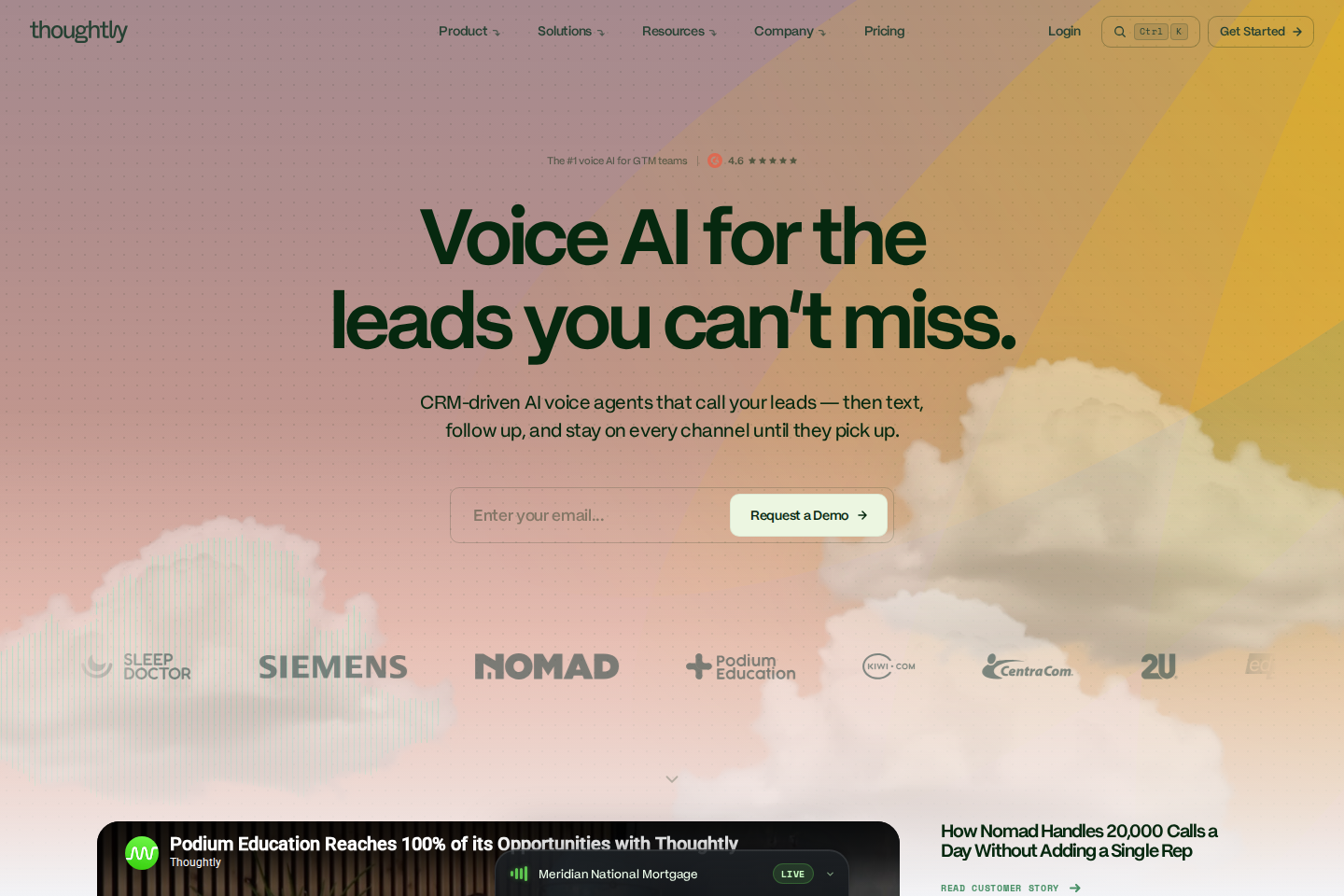
Thoughtly is a CRM-driven AI agent platform for high-volume, opted-in inbound lead conversionInbound lead conversionInbound lead conversion turns opted-in calls, form submissions, quote requests, and other inquiries into qualified conversations, appointments, or transfers.. Its agents call new leads in under 60 seconds, qualify intent, pivot to SMS or email when the phone misses, book meetings, warm-transfer qualified conversations, and write outcomes back into the CRM. The product is aimed at revenue teams in high-consideration consumer industries such as insurance, mortgage, real estate, education enrollment, healthcare, home services, automotive, financial services, and legal.
The platform's advantage in this comparison is not that it is a generic AI call center. It is that Thoughtly owns the conversion layer end to end: voice, SMS, email, workflow orchestration, CRM context, routing, and post-conversation records. That makes it a better fit when the company already has inbound lead volume and the operational problem is speed-to-lead plus persistent follow-up, not building a custom voice stack.
Choose Thoughtly when your bottleneck is inbound conversion: form fills, quote requests, appointment inquiries, enrollment leads, or service requests that need immediate phone contact plus persistent follow-up. The best buyer is a revenue operator who wants one agent to call, text, email, qualify, schedule, transfer, and update the CRM without stitching five systems together.
Thoughtly uses per-minute pricing and pairs customers with onboarding and success support. Contact Thoughtly for exact volume pricing, deployment scope, and plan details.
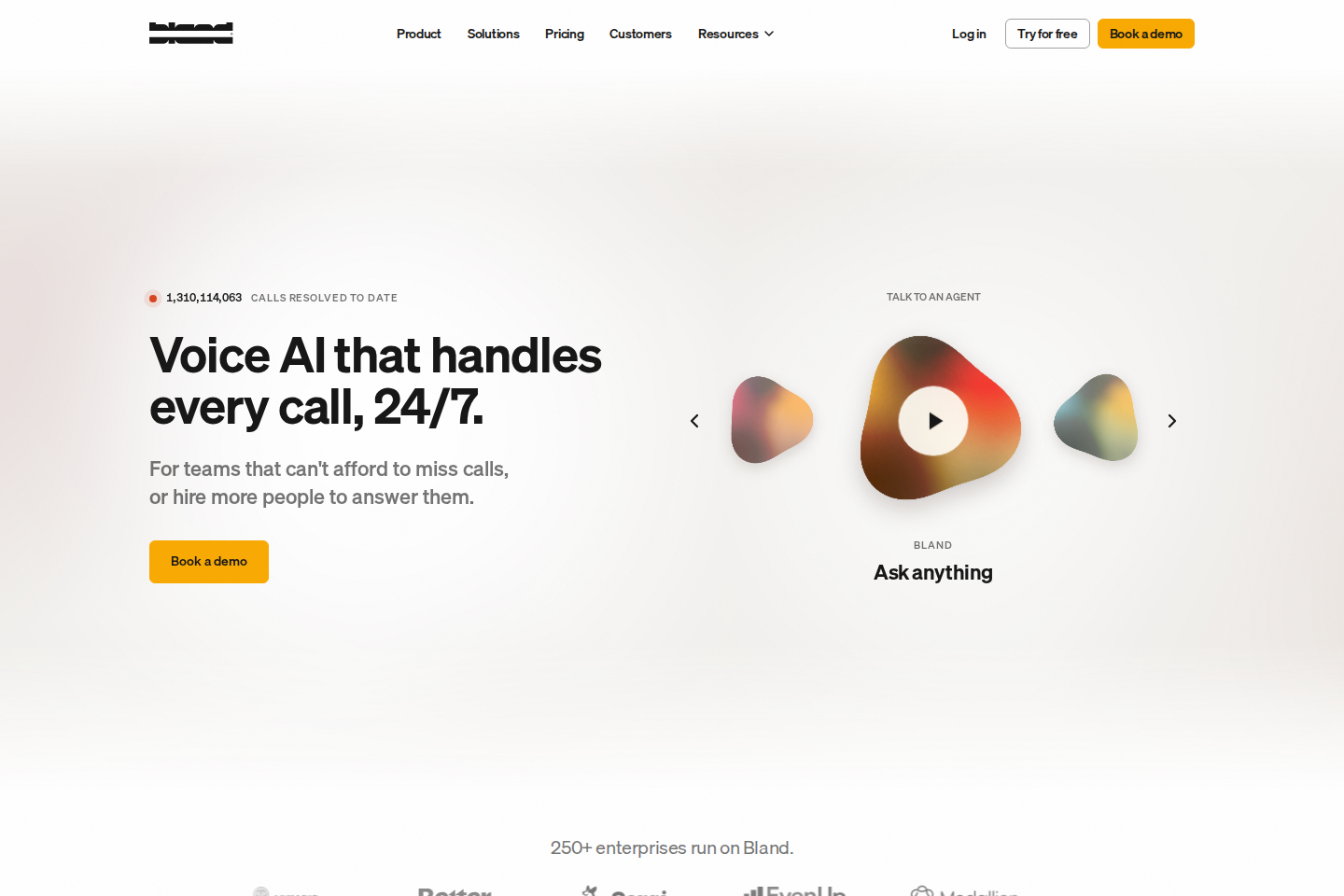
Bland AI is an enterprise voice AI platform for building, deploying, and monitoring phone agents. Its current public positioning emphasizes human-sounding voice agents, self-hosted models, low-latency infrastructure, custom voice cloning, testing, guardrailsGuardrailsAI guardrails are instructions, rules, data boundaries, and escalation paths that constrain what an agent may say or do., and enterprise controls. Bland also publishes a clear self-serve pricing page with per-minute rates and platform fees across Start, Build, Scale, and custom Enterprise tiers.
That makes Bland a serious option for teams whose main job is voice call automation. It is especially relevant for engineering-heavy organizations, AI operations teams, or contact-center groups that want control over the call layer and are comfortable managing testing, QA, and production tuning. But that strength is also the fork: if the business goal is CRM-first lead conversion across phone, text, email, scheduling, and rep handoff, Bland can push too much of the workflow back onto the buyer.
Choose Bland when your team wants to build a voice-first call-center automation layer and has the technical owner to govern it. It is a stronger fit for companies that care about custom voice cloning, dedicated infrastructure, on-prem or VPC deployment, and testing/monitoring controls than for teams simply trying to convert every inbound lead before a competitor calls.
Bland's pricing page lists Start at $0.14/min with no platform fee, Build at $0.12/min plus a $299/month platform fee, Scale at $0.11/min plus a $499/month platform fee, and Enterprise as custom. Transfer minutes are listed separately. Enterprise unlocks dedicated infrastructure, unlimited concurrency, on-prem/VPC deployment, a dedicated forward deployed engineer, BAA, SSO, and data residency.
| Evaluation area | Thoughtly | Bland AI | Takeaway |
|---|---|---|---|
| Speed-to-lead | Built around sub-60-second response to inbound leads and immediate follow-up | Can call at scale, but lead-conversion timing depends on how the buyer builds the workflow | Thoughtly is purpose-built for inbound response |
| Channel continuity | Same agent can continue across voice, SMS, messaging apps, and email | Voice-first; multichannel features gated to Enterprise on public pricing | Thoughtly is the safer default for follow-up persistence |
| Human handoff | Warm transfer and booking are core revenue outcomes | Warm and live transfers are Enterprise-only on public pricing | Bland buyers should verify transfer scope early |
| CRM workflow | CRM read/write, notes, dispositions, and workflow updates are central | Integrations are listed, but CRM depth varies by implementation | Thoughtly is the cleaner CRM-first choice |
| Technical ownership | Designed for RevOps and GTM operators | Best with engineering or AI ops ownership | This is the main buyer fork |
| Enterprise infrastructure | Enterprise-ready compliance and integrations for revenue workflows | Strong enterprise infrastructure options including VPC/on-prem and dedicated FDE | Bland is stronger when infrastructure control is the priority |
| Cost model | Per-minute, contact sales | Public self-serve per-minute rates plus platform fees on Build/Scale | Bland is easier to model for basic voice tests; Thoughtly should be evaluated on full conversion workflow cost |
| Evidence theme | Source type | How to use it defensibly |
|---|---|---|
| Hallucinated details, loops, and failed transfers | Thoughtly compare page, Thoughtly Bland review, G2-indexed snippets, Reddit/forum discussions | Ask Bland for recent QA evidence, transfer test results, and guardrail examples for your exact workflow |
| Self-serve plans are voice-first | Bland public pricing page | Confirm whether SMS, iMessage, appointment scheduling, warm transfer, live transfer, BAA, SSO, and data residency require Enterprise |
| Engineering dependency | Independent review writeups and forum discussions | Identify who will own prompt updates, API actions, regression tests, and failed-call review after launch |
| Pricing can change shape once Enterprise features are needed | Bland public pricing page and third-party reviews | Model the full workflow cost, not just the published per-minute rate |
| Trustpilot/G2 data is limited or hard to inspect directly | Trustpilot public listing; G2 seller page behind JS/ad-block notice | Do not rely on average rating alone; ask vendors for reference calls and low-rated-review remediation examples |
Bland AI is not a toy. It is a real voice AI platform with meaningful infrastructure depth, public pricing, enterprise deployment options, and strong appeal for teams that want to control the phone layer. The issue is fit: Bland is voice-first and technical; Thoughtly is revenue-first and multichannel.
For a contact-center or engineering team, Bland may be the better tool. For a revenue team trying to reach every inbound lead in seconds, continue the conversation by text or email, book or transfer qualified prospects, and update the CRM automatically, Thoughtly is the cleaner operational choice. That is the comparison: call automation versus lead conversion. Different jobs. Different owners. Very different consequences if you pick wrong.
No. Bland is a credible voice AI platform, especially for technical teams that want infrastructure control, custom voice cloning, and enterprise deployment options. The concern is not quality in the abstract; it is whether a voice-first platform is the right shape for a CRM-first lead conversion workflow.
Bland's public pricing page marks SMS and web chat, SMS nodes, iMessage, and appointment scheduling as unavailable on Start, Build, and Scale, with those capabilities appearing in the Enterprise column. Email is not positioned as a native co-equal channel on the public pricing page. Buyers who need phone, text, and email continuity should verify exact Enterprise scope before assuming it is included.
Bland lists all-in per-minute pricing: Start at $0.14/min with no platform fee, Build at $0.12/min plus $299/month, Scale at $0.11/min plus $499/month, and Enterprise as custom. Transfer minutes are priced separately. The important buyer question is whether the workflow requires Enterprise-only features, not only the base per-minute rate.
Thoughtly is the stronger fit for inbound lead conversion because it is built around speed-to-lead, multichannel persistence, CRM write-back, booking, warm transfer, and RevOps ownership. Bland can support call automation, but buyers may need Enterprise features or additional systems to cover the full conversion motion.
Bland is usually the better fit when the goal is to build a custom voice call automation layer with technical ownership, custom voice cloning, dedicated infrastructure, and enterprise deployment controls. Thoughtly is not trying to be a raw voice infrastructure toolkit; it is designed to run revenue workflows.
Thoughtly vs Bland.ai comparison — https://thoughtly.com/compare/thoughtly-vs-bland
Thoughtly product overview — https://thoughtly.com/product
Thoughtly integrations — https://thoughtly.com/product/integrations
Bland AI homepage — https://www.bland.ai/
Bland AI pricing page — https://www.bland.ai/pricing
Bland AI trust and security page — https://www.bland.ai/trust-security
G2 seller listing for Bland AI — https://www.g2.com/sellers/bland-ai
Trustpilot listing for bland.ai — https://www.trustpilot.com/review/bland.ai
Reddit discussion comparing Bland AI, Retell, and Vapi — https://www.reddit.com/r/ArtificialInteligence/comments/1cu01ye/what_are_pros_and_cons_when_you_compare_bland_ai/
CallBotics Bland AI review — https://callbotics.ai/blog/bland-ai-review


