

Industry insights
Vapi Review 2026: Developer Voice AI Platform Assessment
An honest 2026 Vapi review for revenue teams: developer strengths, pricing tradeoffs, latency concerns, compliance add-ons, and when to choose Thoughtly instead.
Industry insights
An honest 2026 Vapi review for revenue teams: developer strengths, pricing tradeoffs, latency concerns, compliance add-ons, and when to choose Thoughtly instead.
Last updated
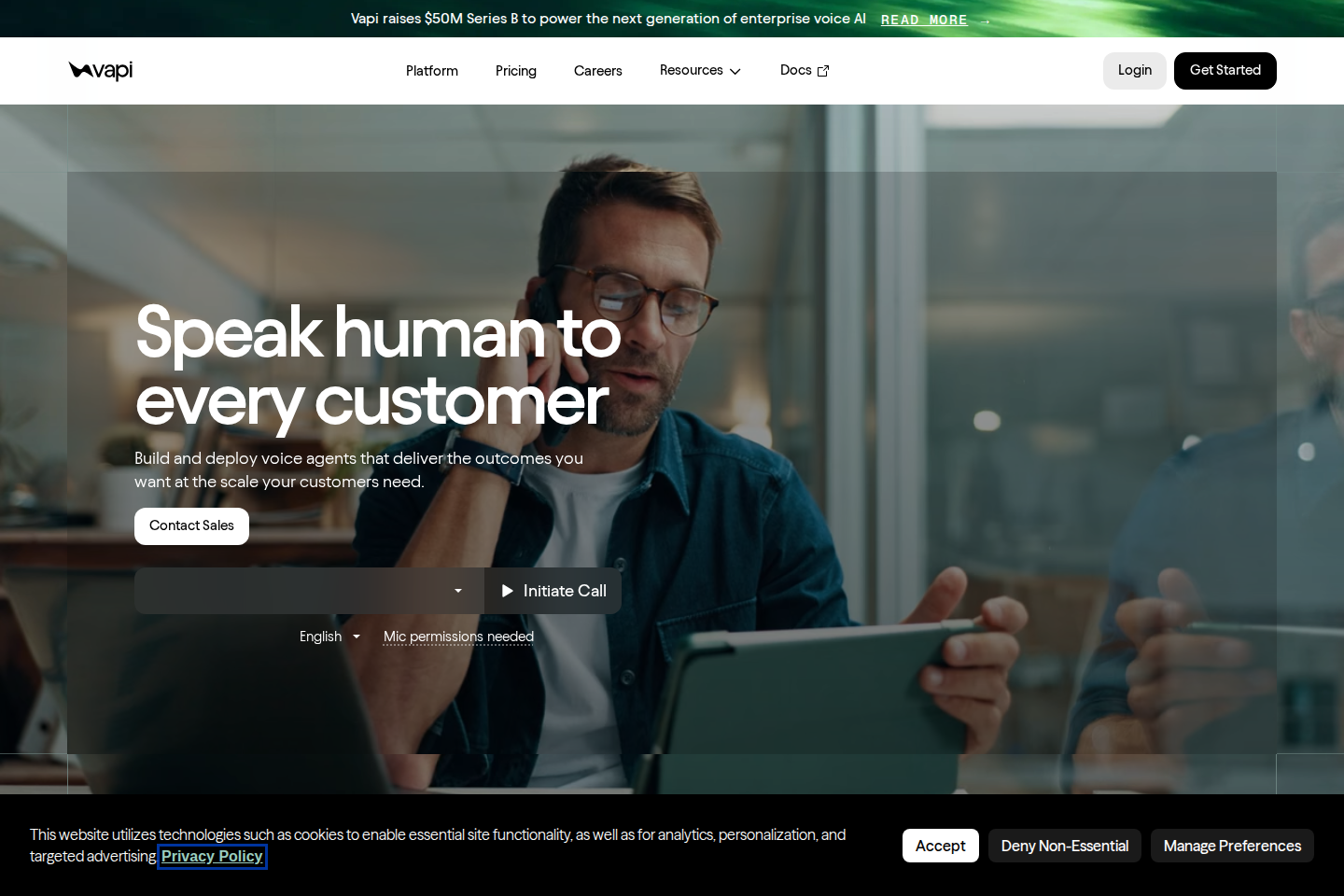
Vapi is one of the best-known developer platforms for building AI voiceAI voiceAn artificially generated, natural-sounding voice produced by a TTS model. Thoughtly supports a library of AI voices and brand-specific cloning. agents. Its pitch is straightforward: give engineering teams the APIs, model flexibility, telephony controls, and real-time orchestration needed to build custom voice experiences without managing every infrastructure layer themselves.
That makes Vapi a strong product for the right buyer. It is not, however, the same thing as a turnkey revenue operations platform. The difference matters if your goal is not just to make an AI phone call, but to convert inbound leads across voice, SMS, email, scheduling, and CRMCRMThe system of record for leads, contacts, deals, and activity. Thoughtly reads from and writes to your CRM continuously. follow-up.
I reviewed Vapi’s current website, platform page, pricing page, public review data, Reddit discussions, independent writeups, and Thoughtly’s own comparison page to assess where Vapi fits, where it falls short, and when a team should choose a different platform.
| Category | Details |
|---|---|
| Company | Vapi.ai |
| Primary category | Developer-first voice AI agent platform |
| Best fit | Engineering teams building custom voice agents or embedding voice into a product |
| Core channels | Voice-first; pricing also lists SMS/chat usage |
| Primary buyer | Engineering, product, and technical automation teams |
| Pricing model | $0.05/min Vapi hosting for calls, plus model provider costs; SMS/chat listed at $0.005/message |
| Build-plan concurrency | 10 concurrent calls included, plus $10 per extra line per month |
| Security/compliance | SOC 2, HIPAA, PCI, SSO, RBAC, and data residency listed on annual Scale contracts; HIPAA and Zero Data Retention add-ons listed at $2,000/mo and $1,000/mo |
| G2 rating | 4.2/5 from 3 reviews at time of research; too small a sample for broad buying insight |
| Support | Email + Discord community on Build; dedicated account team on Scale |
Vapi’s biggest strength is control. The platform is built around APIs, SDKs, webhooks, custom tools, and bring-your-own-model options, which makes it attractive to teams that want to choose their own LLMLarge Language Model (LLM)A machine-learning model trained on massive text data, used as the reasoning engine that drives a voice agent's understanding and responses., speech-to-text, text-to-speech, and telephony pieces. Vapi’s platform page highlights custom SIP support, warm transfers, voicemail detectionVoicemail detectionVoicemail detection is the ability to identify when a call reaches a voicemail greeting instead of a live person, then trigger the right message, callback, or alternate-channel follow-up., phone number management, DTMF, model fallbacks, and squads for multi-agent workflows. That is real infrastructure depth, especially for teams building voice as part of a product rather than buying a finished lead-conversion workflowWorkflowAn automated, multi-step process — usually triggered by an event (form fill, new lead) and orchestrating one or more voice / SMS / email actions..
Vapi is modular by design. Teams can use managed providers, bring their own API keys, connect custom LLM endpoints, or swap speech and voice providers as requirements change. This flexibility is useful when a team needs to optimize separately for latencyLatencyThe delay between a caller speaking and the agent responding. Lower latency makes AI voice conversations feel more natural., voice quality, cost, language coverage, or internal security constraints. It also reduces dependency on a single voice or model vendor, which can matter for product teams building long-lived customer-facing systems.
Vapi’s owned pages repeatedly emphasize real-time performance, including under-500ms response claims, enterprise-grade uptime, model fallbackFallbackA safe backup path used when the caller says something unexpected, an integration fails, or the agent cannot confidently complete the intended step., and recovery from model or network failures. Those are the right concerns for voice AI: a great prompt does not matter if the caller waits awkwardly after every answer. The platform is strongest when engineers can tune the STTSpeech-to-Text (STT)The system that turns the caller's speech into text the agent can reason over., LLM, TTSText-to-Speech (TTS)The system that turns the agent's generated text into spoken audio — the voice the caller actually hears., and telephony stack together and keep watching production behavior after launch.
Vapi’s homepage now leans heavily into enterprise evidence, with logos and case references including Amazon Ring, Intuit, ServiceTitan, New York Life, Kavak, GoHealth, and Instawork. It also claims 1 billion calls supported, 99.9% uptime for enterprise clients, 2.5 million agents launched, and 750,000 developers. Those claims should still be evaluated in a sales process, but the public positioning is no longer a small developer-tool pitch. Vapi is clearly trying to serve enterprise-scale voice programs.
The platform page calls out automated testing, hallucination-risk checks, A/B experiments, reporting, analytics, exports, and observability-stack support. That matters because production voice agents fail in subtle ways: bad endpointing, awkward interruption handling, tool-call mistakes, incorrect summaries, and regressions after prompt or model changes. Vapi gives technical teams primitives to test and monitor those behaviors rather than treating a voice agentVoice agentAn autonomous, conversational interface that interacts with humans over the phone — answering, qualifying, and routing calls without human staffing. as a static script.
Vapi is powerful because it is programmable. That is also the tradeoff. A RevOps or marketing team that wants agents to call every inbound lead, pivot to SMS when the call misses, send email follow-upEmail follow-upEmail follow-up is the process of sending timely, context-aware replies or reminders that keep an inbound lead moving toward qualification, scheduling, or handoff., book a meeting, update Salesforce or HubSpot, and keep the same context across channels will still need to assemble a broader workflow around Vapi. Vapi gives engineering teams the voice layer; it does not hand business teams a finished revenue workflow.
Vapi’s pricing page is transparent about the important catch: the $0.05/min call rate is Vapi hosting, while model provider costs are passed through to the customer. Speech-to-text, LLM, text-to-speech, transport, telephony, and premium voice choices can all change the real cost per minute. That structure is fine for engineering teams that want provider control, but it can make forecasting harder for revenue teams that just want to know what a month of lead follow-upLead follow-upThe calls, texts, and emails sent after a lead raises their hand, with the goal of reaching them quickly and moving them to a booked or transferred conversation. will cost.
The Build plan lists 14 days of call history, 30 days of chat history, community Discord and email support, and paid add-ons for HIPAAHIPAAThe US health privacy law that governs protected health information. Healthcare voice and SMS workflows must handle PHI with appropriate safeguards. and Zero Data RetentionData retentionThe policies and timeframes that govern how long call recordings, transcripts, PII, and conversation metadata are stored before automatic deletion or archival.. HIPAA is listed at $2,000/month and Zero Data Retention at $1,000/month. SOC 2, HIPAA, PCI, SSO, RBAC, data residency, support SLASLAAn SLA, or service level agreement, is the response-time commitment a team uses to make sure new leads are contacted, routed, or escalated within a defined window., and a dedicated account team are listed under the annual Scale contract. Regulated buyers should treat the self-serve plan as a technical build tier, not as the final compliance posture.
The small G2 review sample is generally positive, but the negatives are consistent with Vapi’s product shape. One reviewer praised straightforward setup but said the dashboard is difficult for users who are not developers, with many options around AI, voice mode, and configuration. G2’s generated pros and cons also mention learning curve, interface complexity, difficult usage, and limited functionality. In plain English: Vapi is approachable enough to try, but production ownership still wants technical fluency.
Vapi claims low latency, and the platform is built around real-time performance. But voice latency is only as strong as the full chain: transcription, model response, tool calls, speech synthesis, telephony, network conditions, and prompt design. A G2 reviewer specifically praised cost and flexibility while calling latency unpredictable, with some calls around 800–1000ms and others reaching 4–5 seconds. Reddit discussions also repeatedly mention 2–3 second delays, start-of-call lag, and latency from chaining providers. Those are anecdotal reports, but they match the engineering reality of modular voice stacks: flexibility creates tuning work.
Vapi’s G2 profile showed 4.2/5 from only three reviews at the time of research, and G2 itself notes there are not enough reviews to provide buying insight. That does not mean Vapi is weak; it means the public review sample is too small to treat the rating as a reliable enterprise-buying signal. Trustpilot review access was blocked by browser verification during this review, so I did not rely on individual Trustpilot complaints in the assessment.
Vapi’s current pricing is split between a usage-based Build option and annual Scale contracts. The headline is simple, but the practical budget depends on model/provider choices and required compliance features.
| Plan | Pricing model | Included / notable items | Watch-outs |
|---|---|---|---|
| Build | Usage based | 60+ minutes included; $0.05/min Vapi hosting for calls; $0.005/message for SMS/chat; 10 concurrent calls included | Model costs are passed through; extra concurrency is $10/line/month; call history is 14 days; support is email + Discord |
| Scale | Annual contract | Fixed platform fee and committed volume; volume-based per-minute pricing; SOC 2, HIPAA, PCI, SSO, RBAC, data residency; support SLA; dedicated account team | Requires sales process and committed volume; final pricing is custom |
| Compliance add-ons | Monthly add-ons | HIPAA listed at $2,000/month; Zero Data Retention listed at $1,000/month | Regulated teams should confirm exact scope, retention, BAA terms, audit needs, and whether Scale is required |
For an engineering team, this model can be a feature: you can choose lower-cost providers for some use cases and premium providers where quality matters. For a RevOps team, it can be a headache: the agent’s monthly cost is no longer just call minutes, but provider mix, average call length, concurrency, compliance add-ons, and the operational time required to keep the stack tuned.
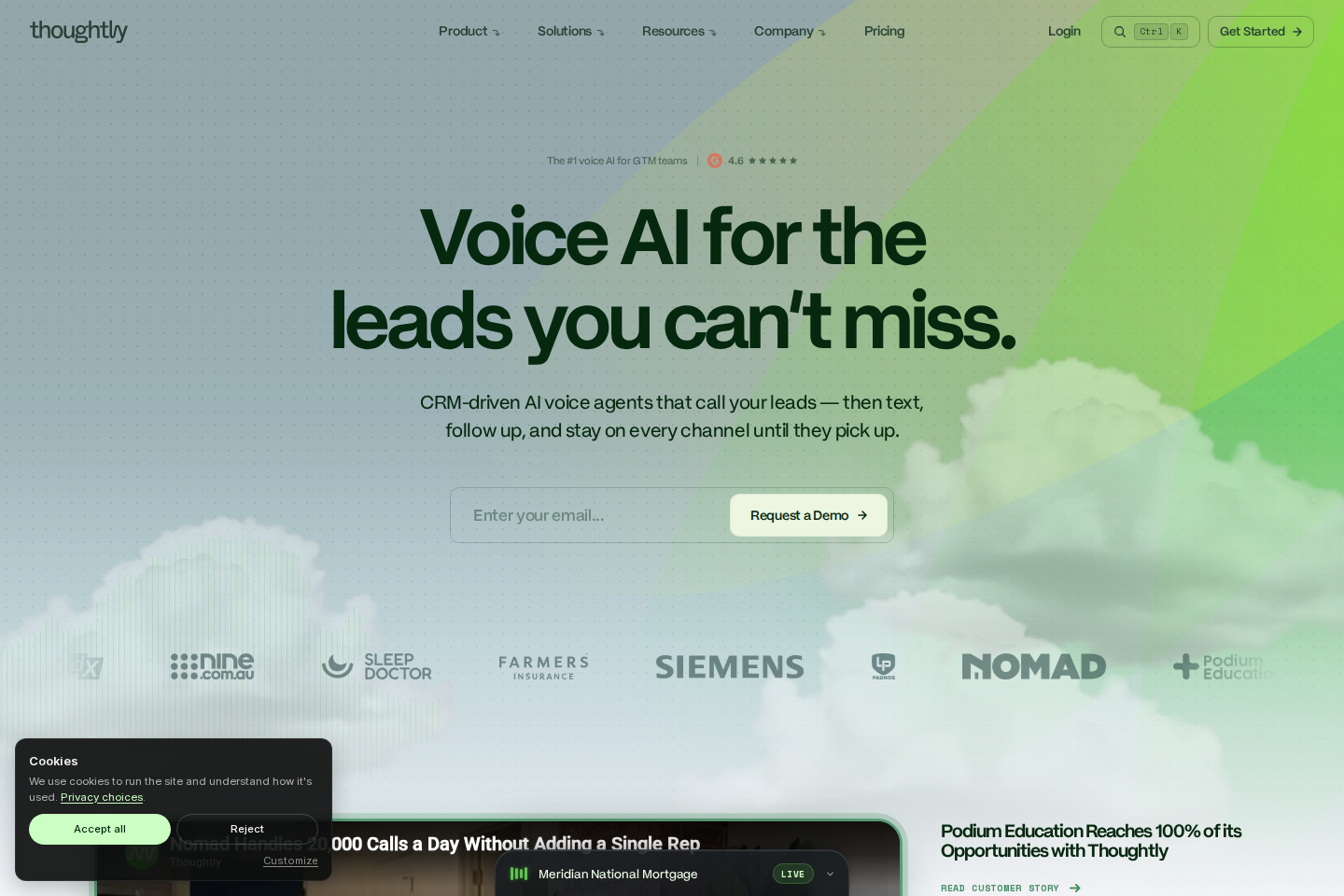
Thoughtly is the clearest alternative when the buyer is not trying to build a voice product, but to convert inbound leads. Thoughtly agents call, text, email, qualify, schedule, route, and write outcomes back to the CRM from one workflow. The platform is built for high-consideration consumer industries where speed-to-lead, follow-up persistence, consent, human handoffHuman handoffThe moment an AI agent transfers context, call details, and the next step to a human rep, licensed specialist, or support team., and CRM context matter more than low-level provider selection. Choose Thoughtly when RevOps, sales, or marketing needs to own the funnel directly without turning voice automation into an engineering project.
See the direct comparison: Thoughtly vs Vapi.
Retell is another developer-oriented voice AI platform and often appears in the same shortlist as Vapi. It is a better fit for teams that want API control with a slightly different product surface, pricing model, and tooling philosophy. Like Vapi, Retell generally belongs with product and engineering teams more than non-technical revenue operators. Pricing and provider costs should be modeled carefully before high-volume deployment.
Bland is worth evaluating for teams that want a voice automation platform with more bundled infrastructure and enterprise deployment options. It tends to be discussed as a high-volume voice layer rather than a multichannel revenue workflow. The tradeoff is that important features, governance, and multichannel capabilities may depend on plan level and implementation scope. It is strongest for voice-heavy operations with technical support behind the rollout.
Synthflow is a better fit when the buyer wants a more guided, no-code voice automation surface. Agencies, local-service operators, and business teams often evaluate it when they want to launch appointment-setting or support agents without building directly against an API. The tradeoff is less low-level stack control than Vapi. Teams should validate integration depth, scale pricing, and how well the platform handles CRM write-backCRM write-backUpdating the CRM after an interaction with call outcomes, transcripts, qualification answers, notes, appointments, dispositions, and next-step fields. for their exact workflow.
Yes, for the right buyer. Vapi is a strong developer-first platform for building programmable voice agents, especially when engineering wants control over models, voices, SIP, tools, and production behavior. It is less ideal when the buyer wants a ready-to-run revenue workflow owned by RevOps or marketing.
Vapi has a dashboard and visual tools, but its core strength is still API-first development. Non-technical users can create simple agents, but production workflows with external data, branching logic, retries, CRM updatesCRM updatesCRM updates are the automatic changes an agent writes back after a conversation, such as status, notes, next step, owner, appointment, or disposition., and custom tool behavior usually require developer involvement.
Vapi’s pricing page lists $0.05/min for call hosting on the Build plan, $0.005/message for SMS/chat, and model provider costs passed through to the customer. Build includes 10 concurrent calls, with extra concurrency at $10 per line per month. Annual Scale contracts use custom pricing and add enterprise features such as support SLA, data residency, SSO, RBAC, SOC 2, HIPAA, and PCI.
Vapi is for engineering teams building custom voice agents. Thoughtly is for revenue teams converting inbound leads across voice, SMS, email, scheduling, and CRM workflows. Choose Vapi when you want to build and own the voice stack; choose Thoughtly when you want the funnel worked automatically by a platform your business team can operate.
Vapi’s pricing page lists HIPAA as a $2,000/month add-on and includes HIPAA under its annual Scale plan feature set. Healthcare or regulated buyers should confirm BAA terms, retention settings, data residency, audit logging, SSO/RBAC requirements, and whether their intended workflow requires a Scale contract.
The best alternative depends on the job. Thoughtly is the stronger fit for inbound lead conversionInbound lead conversionThe process of turning opted-in inquiries, form fills, calls, and quote requests into qualified conversations, appointments, or transfers. across voice, SMS, email, and CRM. Retell is a close developer-platform alternative. Bland is worth evaluating for high-volume voice automation. Synthflow is a better fit for teams that want a more guided no-code voice-agent builder.