

Industry insights
Vapi vs Synthflow: Developer Toolkit vs No-Code Voice Agent
A practical Vapi vs Synthflow comparison covering builder ownership, pricing, workflows, compliance, reviews, and when Thoughtly is the better fit for lead conversion.
Industry insights
A practical Vapi vs Synthflow comparison covering builder ownership, pricing, workflows, compliance, reviews, and when Thoughtly is the better fit for lead conversion.
Last updated
Vapi and Synthflow both help teams deploy AI voiceAI voiceAn artificially generated, natural-sounding voice produced by a TTS model. Thoughtly supports a library of AI voices and brand-specific cloning. agents, but they are built for different buyers. Vapi is a developer-first voice AI platform: flexible, API-driven, and strongest when engineering wants to assemble a custom voice stack. Synthflow is a no-code voice AI platform: easier for operations teams, agencies, and enterprises that want a packaged builder, telephony, deployment support, and reseller options.
The comparison matters because both tools can sound impressive on a demo call. The harder production questions are who owns the agent after launch, how pricing scales once model costs and concurrency are included, whether the platform handles the work after the call, and whether your team is buying a voice toolkit or a revenue conversion system.
This Vapi vs Synthflow comparison is based on current public product pages, pricing pages, Thoughtly comparison context, G2 pages, Trustpilot availability, Reddit/search discussions, and direct research completed in June 2026.
| Category | Vapi | Synthflow |
|---|---|---|
| Best fit | Engineering teams building custom voice AI applications | Operations teams, agencies, and enterprises launching no-code voice agents |
| Primary buyer | Developers, product teams, voice AI builders | Ops leaders, agencies, BPOs, and enterprise automation teams |
| Core product | API-first voice agent platform with bring-your-own model/provider flexibility | End-to-end voice AI platform with no-code builder, telephony, workflows, and deployment support |
| Pricing model | Usage-based Build plan; model costs passed through; Scale annual contract | Pay as you go free to start, then usage-based; Enterprise for 10,000+ minutes/month |
| Concurrency | 10 concurrent calls included on Build; extra lines listed at $10/line/month | 5 concurrent calls on Pay as you go; $20/reserved concurrency after that; unlimited on Enterprise |
| Compliance packaging | HIPAA add-on listed at $2K/month and Zero Data Retention at $1K/month; Scale adds SOC 2, HIPAA, PCI, SSO, RBAC, data residency | PAYG includes SOC 2, GDPR, ISO 27001 language; Enterprise adds advanced compliance, hosting, SLA, and support |
| Review signal | G2 shows 4.2/5 from 3 reviews at research time | G2 shows 4.5/5 from 1,015 reviews; Trustpilot shows 4.1 from 215 reviews |
| Primary strength | Developer flexibility and composable voice infrastructure | No-code deployment, larger review base, telephony packaging, and white-label/reseller options |
| Primary limitation | Engineering ownership and stacked provider costs can make production harder to forecast | Less developer-level flexibility; scale, SLA, white-label, and custom workflow depth move into Enterprise packaging |
I evaluated the platforms across five production criteria: builder ownership, pricing predictability, workflowWorkflowAn automated, multi-step process — usually triggered by an event (form fill, new lead) and orchestrating one or more voice / SMS / email actions. depth, compliance packaging, and buyer evidence. A voice agentVoice agentAn autonomous, conversational interface that interacts with humans over the phone — answering, qualifying, and routing calls without human staffing. that can answer a call is useful. A platform that can be owned by the right team, priced clearly, routed correctly, and connected to the rest of the revenue workflow is what usually determines whether the deployment survives past the pilot.
I also separated vendor claims from market evidence. Vapi is strongest when judged as a developer platform, not a no-code operations tool. Synthflow is strongest when judged as a packaged voice automation system, not a raw developer SDK. Thoughtly belongs in the decision only when the business problem is inbound lead conversionInbound lead conversionThe process of turning opted-in inquiries, form fills, calls, and quote requests into qualified conversations, appointments, or transfers. across voice, SMS, email, CRM updatesCRM updatesCRM updates are the automatic changes an agent writes back after a conversation, such as status, notes, next step, owner, appointment, or disposition., and human handoffHuman handoffThe moment an AI agent transfers context, call details, and the next step to a human rep, licensed specialist, or support team..
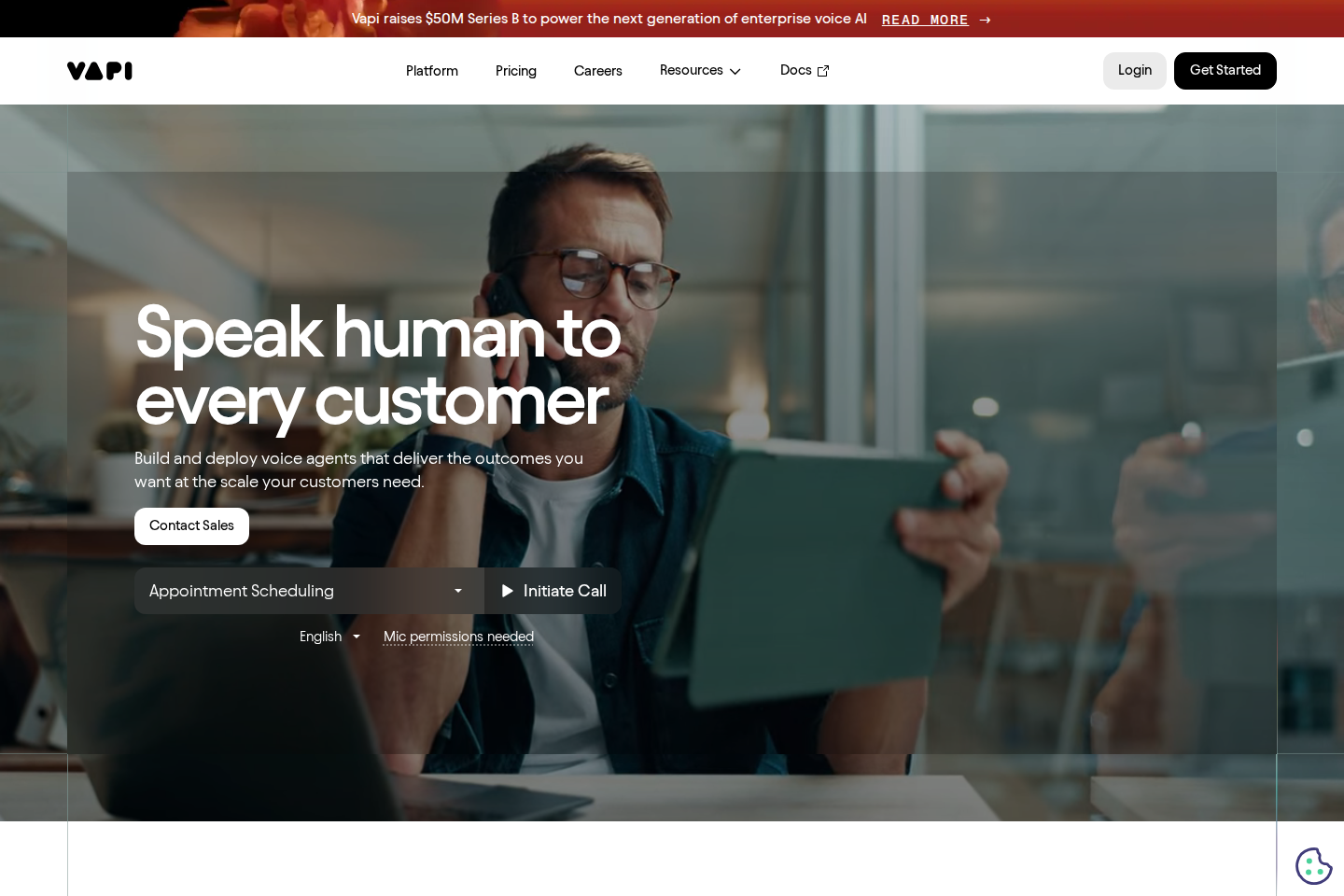
Vapi positions itself around building and deploying voice agents that can handle customer support, lead qualificationLead qualificationThe process of capturing fit signals — intent, urgency, location, eligibility, consent, and availability — before routing a lead to the right next step., appointment scheduling, and other phone-based workflows. Its product surface is deliberately developer-forward: teams bring or configure models, voice providers, speech providers, tools, and business logic around Vapi's orchestration layer. That makes Vapi attractive for product and engineering teams that want control instead of a boxed no-code experience.
Vapi's pricing page reinforces that builder profile. The Build plan is usage-based, includes 60+ minutes, passes model costs on to the customer, includes 10 concurrent calls, and lists additional concurrency at $10 per line per month. HIPAAHIPAAThe US health privacy law that governs protected health information. Healthcare voice and SMS workflows must handle PHI with appropriate safeguards. is listed as a $2,000 monthly add-on and Zero Data RetentionData retentionThe policies and timeframes that govern how long call recordings, transcripts, PII, and conversation metadata are stored before automatic deletion or archival. as a $1,000 monthly add-on. Scale moves to an annual contract with fixed platform fee, committed volume, SOC 2, HIPAA, PCI, SSO, RBAC, data residency, support SLASLAAn SLA, or service level agreement, is the response-time commitment a team uses to make sure new leads are contacted, routed, or escalated within a defined window., and a dedicated account team.
The tradeoff is production ownership. Vapi can be the right choice when your team wants to build the voice layer itself. It is a worse fit when RevOps, marketing operations, or admissions wants to launch and iterate without engineering involvement. Reddit and review-search results repeatedly frame the work around setup effort, pricing composition, latencyLatencyThe delay between a caller speaking and the agent responding. Lower latency makes AI voice conversations feel more natural. variability, and the engineering time required to make the agent useful in a real workflow.
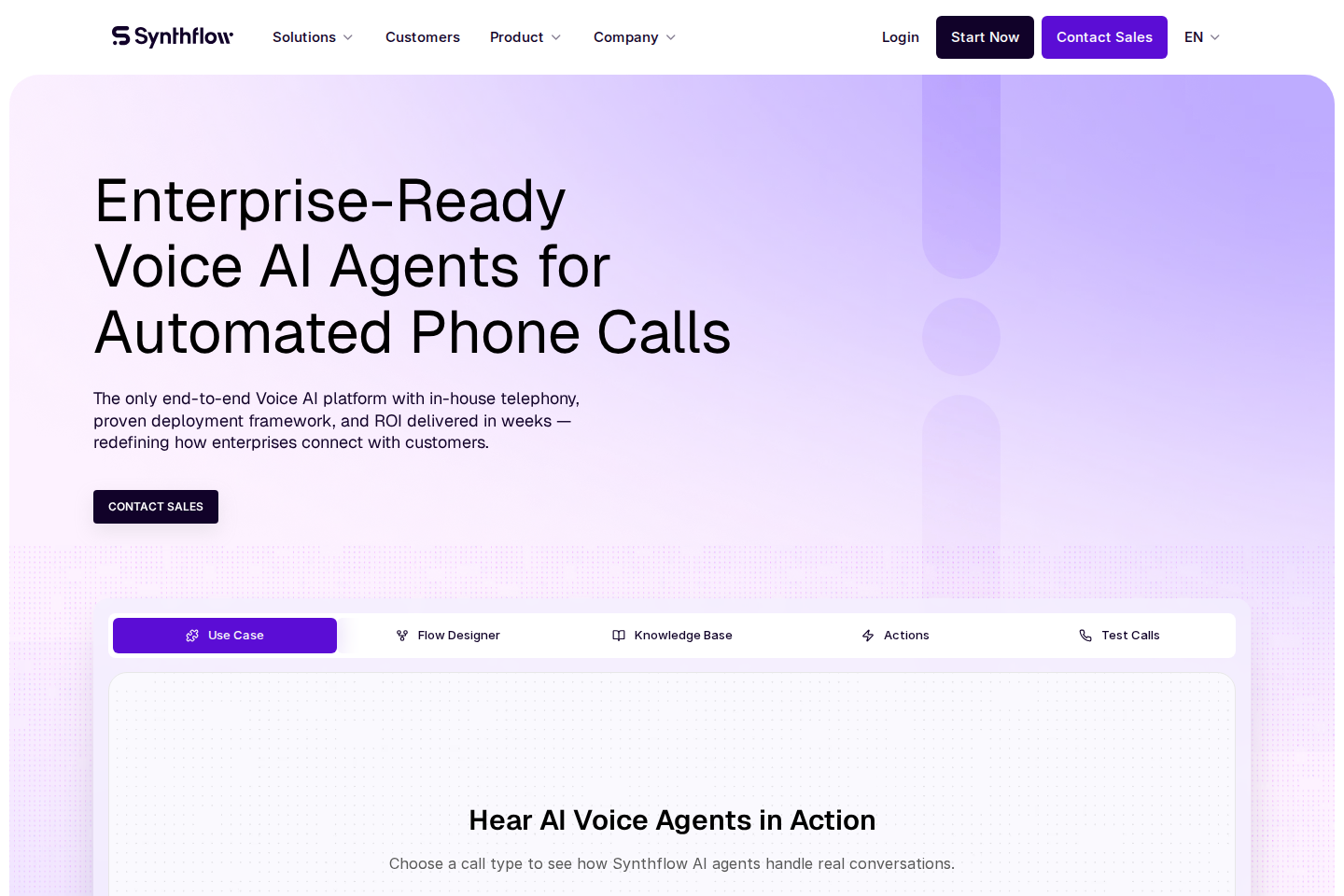
Synthflow positions itself as an enterprise-ready voice AI platform for automated phone calls. Its public pages emphasize in-house telephony, a proven deployment framework, tested agents, flow design, knowledge bases, actions, test calls, and ROI delivered in weeks. The product is built to be operated through a no-code or low-code surface rather than assembled as an engineering project.
Synthflow's pricing page now leads with Pay as you go and Enterprise. Pay as you go is free to start, then usage-based after launch, with Synthflow TwilioTwilioA cloud communications platform widely used as the carrier layer for voice and SMS. Thoughtly supports Twilio for inbound and outbound traffic. or bring-your-own telephony, 5 concurrent calls, $20 per reserved concurrency after that, SOC 2/GDPR/ISO 27001 language, unlimited agents, API and integrations, and ticketing support. Enterprise is aimed at teams handling 10,000+ minutes per month and adds 99.99% SLA, SIP trunking, Synthflow native telephony, custom workflows, unlimited concurrent calls, priority limits, white-label and reseller toolkit, onboarding, training, and advanced compliance options.
Synthflow also has much more public review volume than Vapi. G2 lists Synthflow at 4.5/5 from 1,015 reviews, and Trustpilot lists a 4.1 score from 215 reviews at research time. That broader review base is useful for procurement teams, though buyers should still verify whether the visible review mix matches their own company size, implementation complexity, compliance needs, and support expectations.
This is the clearest fork. Vapi is the stronger choice when engineering wants to own a custom voice application, choose providers, wire business logic, and treat voice as part of the product architecture. That control is valuable, but it also means the team owns integration glue, test coverage, failure handling, CRM updates, analytics, escalationEscalationMoving a conversation to a human, specialist, supervisor, or alternate workflow when the agent detects risk, uncertainty, urgency, or a request it should not handle alone. paths, and ongoing tuning.
Synthflow is the stronger choice when operations wants a builder surface with templates, flow design, telephony, knowledge, actions, testing, and launch support in one place. It gives up some developer-level flexibility in exchange for a product that non-engineering teams can understand and operate. For agencies and BPOs, the white-label and reseller packaging makes that operating model even more explicit.
The practical question is who will be paged when the agent fails. If the answer is engineering, Vapi's flexibility can be worth it. If the answer is a revenue, ops, or agency delivery team, Synthflow is usually the more realistic day-to-day product.
Vapi looks simple at first because the Build plan is usage-based, but its page is explicit that model costs are passed through to the customer. That means the final cost can include Vapi usage, model usage, voice/speech providers, telephony, extra concurrency, HIPAA, Zero Data Retention, and whatever engineering time is needed to build the surrounding workflow. For technical teams, that modularity is acceptable. For business teams, it can make forecasting harder.
Synthflow's Pay as you go model is easier to start because it is free to begin and usage-based after launch. Public packaging includes 5 concurrent calls and then $20 per reserved concurrency, while Enterprise adds unlimited concurrency, SLA, SIP trunking, native telephony, custom workflows, white-label, onboarding, training, and advanced compliance. That is clearer for pilot teams, but buyers with scale, white-label, or heavy workflow needs should expect a custom Enterprise conversation.
Neither pricing page should be evaluated on per-minute rates alone. Model who pays for providers, concurrency, telephony, support, onboarding, compliance add-ons, engineering labor, and post-call workflow automationWorkflow automationSoftware-driven execution of multi-step processes such as lead intake, routing, follow-up, booking, CRM updates, and post-call actions.. The cheapest demo can become the most expensive production system if the missing pieces have to be built around it.
Vapi's center of gravity is voice orchestration. It can support powerful custom workflows because engineering can wire tools and systems around the agent, but the platform itself is not a packaged revenue workflow suite for non-technical teams. If the business needs CRM write-backCRM write-backUpdating the CRM after an interaction with call outcomes, transcripts, qualification answers, notes, appointments, dispositions, and next-step fields., SMS follow-upSMS follow-upSMS follow-up is the use of compliant two-way text messages to continue a lead conversation after a form fill, missed call, voicemail, or prior interaction., email nurturing, attribution, scheduling, and escalation, you should ask which pieces are native, which are custom, and who maintains them.
Synthflow offers a broader packaged operations surface: flow design, actions, API and integrations, telephony options, test calls, and Enterprise custom workflows. That makes it easier to get from idea to working voice automation without building every operational layer from scratch. The watch-out is that voice automation is still the product's center. Buyers should verify exact plan access for messaging, CRM updates, scheduling, handoff, analytics, and any industry-specific workflow before assuming the call turns into a complete revenue journey.
Thoughtly is built around that post-call journey. It calls, texts, emails, routes, books, and updates the CRMCRMThe system of record for leads, contacts, deals, and activity. Thoughtly reads from and writes to your CRM continuously. so high-consideration consumer teams can work every opted-in inbound lead until someone is ready to talk. If the goal is speed-to-lead and persistent follow-up rather than a standalone voice agent, compare both vendors against Thoughtly's inbound lead conversion platform.
Vapi's compliance packaging is explicit and developer-friendly. The pricing page lists HIPAA as a monthly add-on, Zero Data Retention as a monthly add-on, and Scale features such as SOC 2, HIPAA, PCI, SSO, RBAC, data residency, support SLA, priority provider access, and a dedicated account team. That fits technical buyers who know exactly which compliance controls they need and are comfortable packaging them into an annual platform agreement.
Synthflow's public pages present a broader enterprise operations package. Pay as you go includes SOC 2, GDPR, and ISO 27001 language, while Enterprise adds 99.99% SLA, SIP trunking, native telephony, advanced compliance, geo-based subprocessors, on-premise multi-region deployment, flexible hosting, onboarding, training, and support. That is attractive for procurement-led teams that want one vendor accountable for more of the deployment surface.
For either platform, the buyer should verify current SOC reports, BAA terms, DPA terms, subprocessors, retention, call recordingCall recordingCapturing audio from a phone conversation for review, QA, training, compliance, dispute resolution, or supervised retention. consent behavior, data residency, escalation handling, and support SLAs. Compliance copy on a pricing page is a starting point, not the implementation plan.
Vapi's G2 profile is positive but thin: FireCrawl captured a 4.2/5 rating from 3 reviews. The visible search description for the G2 page also mentions latency as a complaint in one review, with unpredictable latency ranging from sub-second to several seconds. With only a few public reviews, treat the rating as a signal that users like the developer experience, not as broad proof that every production workload is mature.
Synthflow has a stronger public evidence base by volume. G2 lists 4.5/5 from 1,015 reviews, and the visible filters skew heavily toward small business users and agencies, with fewer enterprise reviews shown. Trustpilot lists 4.1 from 215 reviews. That makes Synthflow easier to diligence from public review data, but enterprise buyers should still ask for references similar to their own rollout, not just aggregate ratings.
The fair read is simple: Vapi has the stronger developer-builder story, while Synthflow has the broader public buyer-review footprint. Neither review profile proves fit for your use case by itself. Use the reviews to identify questions to ask in procurement, especially around latency, support, pricing, setup effort, white-label expectations, and post-call workflow depth.
For lead conversion teams, the answer depends on whether voice is the whole workflow. Vapi can be excellent if an engineering team is building a custom voice experience and can wire CRM, routing, scheduling, compliance, and follow-up around it. Synthflow can be excellent if an operations or agency team wants to launch phone automation quickly with less custom engineering.
But most revenue teams do not just need a phone agent. They need fast inbound response, persistent SMS and email follow-upEmail follow-upEmail follow-up is the process of sending timely, context-aware replies or reminders that keep an inbound lead moving toward qualification, scheduling, or handoff., CRM write-back, lead qualification, routing, appointment booking, and a warm handoff to the right human. In that operating model, Thoughtly is usually the cleaner choice because the conversion workflow is native to the platform instead of something assembled around the voice layer.
Choose Vapi when you want to build. Choose Synthflow when you want packaged no-code voice automation. Choose Thoughtly when you need to convert the leads already entering your funnel across every channel they are likely to answer.
Choose Thoughtly when the business problem is not 'build a voice agent' but 'convert every inbound lead before intent goes cold.' Thoughtly is designed for high-volume, opted-in inbound funnels in industries such as insurance, mortgage, real estate, automotive, education enrollment, elective healthcare, home services, financial services, and legal.
The platform combines voice, SMS, email, CRM/workflow execution, scheduling, routing, and handoff logic. That matters because most missed revenue does not happen during the perfect answered call; it happens when the lead misses the first call, asks for a text, replies later, needs eligibilityEligibilityThe fit criteria that determine whether a prospect can move forward, such as service area, insurance coverage, loan type, location, age, or program requirements. checked, or requires a human handoff with context. Thoughtly owns that conversion layer end to end.
If your team has engineers and wants to assemble a custom voice stack, Vapi is credible. If your team wants no-code voice automation or reseller packaging, Synthflow is credible. If your team needs a revenue agent that keeps working across channels until someone is ready to talk, Thoughtly is the better fit.
Vapi is better for engineering teams that want an API-first voice AI platform and provider flexibility. Synthflow is better for teams that want a packaged no-code voice automation platform with telephony, deployment support, and a much larger public review base.
For non-technical teams, usually yes. Synthflow emphasizes no-code flow design, tested agents, actions, knowledge bases, telephony, and support. Vapi is intentionally developer-first, so the setup can be powerful but depends more heavily on engineering ownership.
There is no universal answer from public pricing alone. Vapi passes model costs through and lists add-ons for HIPAA, Zero Data Retention, and concurrency. Synthflow is free to start and usage-based on Pay as you go, with concurrency charges and Enterprise packaging for scale. Model the full production cost before choosing.
Synthflow is usually the more natural agency fit because it publicly packages white-label and reseller tooling on Enterprise. Vapi can work for technical agencies building custom voice applications, but it is less obviously packaged around reseller operations.
If lead follow-upLead follow-upThe calls, texts, and emails sent after a lead raises their hand, with the goal of reaching them quickly and moving them to a booked or transferred conversation. means a custom voice agent inside an engineered workflow, Vapi can work. If it means no-code voice outreach managed by an operations team, Synthflow can work. If it means calling, texting, emailing, updating the CRM, routing, booking, and handing off inbound leads across a full conversion journey, Thoughtly is the better default.