Thoughtly Vibe: Build Voice Agents by Talking to an Agent
Back in 2023, building a voice agent meant wiring together telephony, speech, LLMs, and text-to-speech by hand. Thoughtly Vibe is the next step: describe the agent you want and watch it build on the canvas.
Back in 2023, when I built the first version of Thoughtly, building a voice agentVoice agentA voice agent is a conversational software system that listens, responds, follows a defined workflow, and can take approved actions during a phone conversation.Read full definition → was not a product experience. It was a wiring project.
I had to string together TwilioTwilioTwilio is a cloud communications platform that provides programmable voice, messaging, phone numbers, and related APIs.Read full definition → for telephony, Deepgram for speech recognitionSpeech-to-Text (STT)Speech-to-Text (STT) converts spoken audio into text that a voice agent can interpret, store as a transcript, and use in downstream actions.Read full definition →, OpenAI’s language models for reasoning, and Google text-to-speech for the voice coming back over the line. That was what the market made available at the time, and even getting those pieces to behave like one system took weeks.
It was complicated, brittle, and too far removed from the thing people actually wanted: an agent that could answer a call, understand what was happening, and move the conversation toward a business outcome.
So I set out to make Thoughtly the easiest way to build voice agents.
The first answer was a visual flow builder. It was heavily inspired by tools like Google Dialogflow CX, which many contact centerContact centerA contact center is a centralized operation that handles customer or prospect interactions across voice and digital channels.Read full definition → teams already used to design automation. In Thoughtly, you could start at the beginning of a call and click, drag, branch, route, and connect your way through to the end. It felt a little like Figma, a little like a diagram, and a lot more approachable than stitching infrastructure together by hand.
That idea stuck. Two years later, flow-builder-style interfaces have become one of the dominant ways teams build voice agents. Thoughtly was early to that approach because the goal was never to show off complexity. The goal was to hide as much complexity as possible without taking control away from the builder.
But agents have changed the standard again.
In 2026, the easiest way to build an agent should not require starting from a blank canvas. The easiest way to build an agent should be with an agent.
That is why we built Thoughtly Vibe.
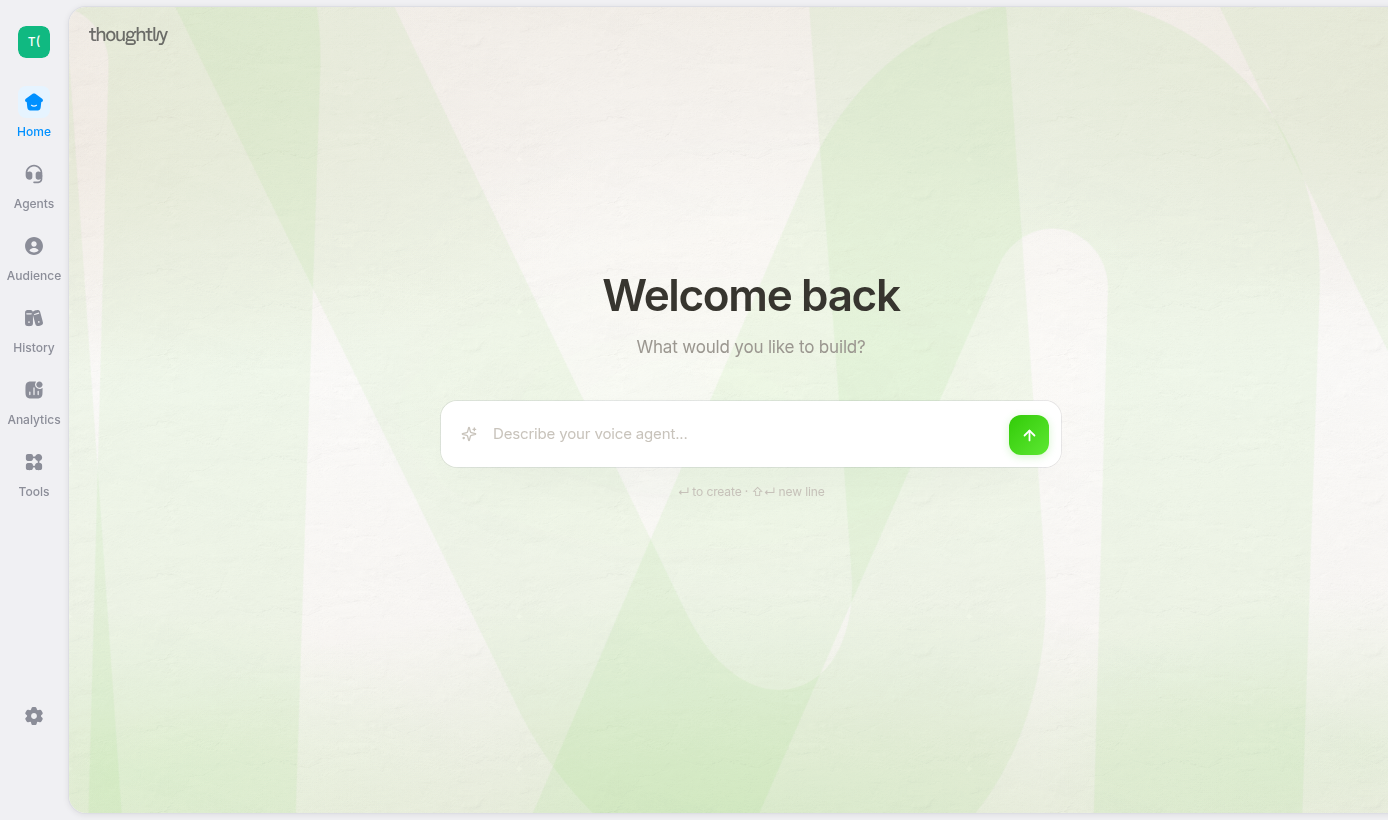
Thoughtly Vibe is a new way to build voice agents by describing what you want. You enter a prompt, answer a few questions if Vibe needs more context, and then watch the agent get built in front of you on the Thoughtly canvas. The builder is still there. The power is still there. But the first draft no longer starts with you manually dragging every node into place.
Old starting point
What Vibe changes
Why it matters
Blank canvas
Describe the agent in plain English
Teams can begin with the business outcome instead of builder mechanics
Static generation
The AI builds on the live canvas
Users see the workflow take shape and understand the structure
One-shot prompt
Vibe asks clarifying questions
A vague request becomes a usable first draft
Manual error cleanup
The system validates each step and feeds issues back
The AI can revise its own work before the user reviews it
From wiring infrastructure to describing outcomes
The original Thoughtly product solved the first version of the problem: voice agents were too hard to assemble. Instead of asking every team to connect telephony, speech-to-text, language models, text-to-speech, business logic, and integrations by hand, Thoughtly brought those pieces into a visual agent builder.
That mattered because teams do not think in infrastructure diagrams. They think in outcomes. Call this new lead. Ask these qualification questions. If they are ready, book a meeting. If they are not ready, follow up later. If they ask for a person, transfer them. If they mention a certain product or account type, route them differently.
The flow builder gave teams a way to translate those outcomes into a working call path without becoming voice infrastructure engineers. Vibe takes the next step: it lets teams describe the outcome first, then lets the AI create the underlying structure inside Thoughtly.
That is the theme behind this launch. Vibe is not a chatbot bolted onto the side of the product. It is an agent that can use the product. It has access to the same builder concepts that a human uses, and it can turn plain-language intent into a working agent draft.
The builder is becoming conversational
When you open Thoughtly Vibe, you do not need to know which node to create first. You can start with the business process: build an inbound agent that qualifies a mortgage lead, captures intent, checks whether they want to speak today, and books a meeting if they are ready.
Vibe can ask clarifying questions when the request is underspecified. That is important because real workflows are rarely complete in the first sentence. The agent may need to know which fields to collect, what counts as qualified, where to send the lead, which calendar to use, and what to do if the caller is not ready yet.
Once it has enough context, Vibe starts building directly on the canvas. You can see the agent take shape: the opening, the questions, the paths, the handoffs, the scheduling logic, the CRM updatesCRM updatesCRM updates are changes written after or during a conversation, such as status, notes, owner, next step, appointment, or disposition.Read full definition →, and the fallbackFallbackA fallback is a safe alternate path used when input is unexpected, a tool fails, or the agent cannot complete the intended step confidently.Read full definition → behavior. It feels closer to working with an implementation expert than filling out a form.
That is the right direction for agent-building software. A visual builder is still useful because it gives teams control, inspectability, and a shared map of the workflowWorkflowA workflow is a defined sequence of steps, decisions, actions, delays, and outcomes used to complete a business process.Read full definition →. But the first version should not require every user to become an expert in the builder before they can see value.
What Vibe can build
Because Vibe works inside Thoughtly, it can use the platform features that already power production agents. If your workflow needs conditional routing based on a deterministic variableVariableA variable is a named value captured, calculated, or retrieved during a conversation and reused in logic, messages, actions, or integrations.Read full definition →, Vibe can build that logic. For example, if a Salesforce field is true, send the caller down one path; if it is false, send them somewhere else.
If the agent needs to schedule an event, Vibe can help connect that workflow too. Thoughtly supports scheduling use cases through tools like Calendly, and Vibe can guide the setup from the chat: connect the account, define the scheduling rules, collect the right information, and place the booking step in the right part of the conversation.
The same idea applies to custom or in-house systems. If a workflow needs code to transform data, call an internal API, or support a custom scheduling framework, Vibe can help generate the code-node logic and place it where it belongs in the live call flow.
It can also help with CRM updates. Tell Vibe what data needs to be captured and where it should go, and it can structure the agent to extract the right variables during the conversation and send them back to systems like Salesforce, HubSpot, or the other tools your team relies on.
That is the important shift. Vibe is not only drafting words the agent might say. It is helping build the operational workflow around the conversation: routing, scheduling, variables, integrations, follow-up, and handoffs.
Editing should feel as natural as building
The first draft is only part of the work. Every real agent needs refinement.
Maybe the qualification question is too broad. Maybe a handoff needs to happen earlier. Maybe a lead sourceLead sourceLead source identifies the channel, campaign, marketplace, partner, form, or referral that generated an inquiry.Read full definition → requires different logic. Maybe the agent should push an extra field back to the CRMCRMA CRM is the system used to manage leads, contacts, accounts, opportunities, activity, ownership, and follow-up.Read full definition →. In the old workflow, that meant finding the right part of the flow, editing the correct node, checking the connected paths, and making sure nothing else broke.
With Vibe, the edit can start as a sentence. Tell it what you want changed, and it can update that part of the agent while preserving the rest of the workflow. The goal is not to remove the builder. The goal is to let you use the builder at the level of intent when that is faster, and drop into the visual flow when you want direct control.
That matters for production teams because small changes should not require a full rebuild. If one branch needs to be adjusted, Vibe should be able to rebuild that branch without disturbing the parts of the agent that are already working.
Why models changed what was possible
The reason this is possible now is not just that chat interfaces became popular. The underlying models became capable enough to reason through multi-step product work.
Modern frontier models can understand a business request, ask clarifying questions, plan a workflow, use tools, inspect feedback, and revise their work. That changes what an application can be. Instead of forcing users to operate every control directly, the product can expose those controls to an AI collaborator that helps the user get to the right configuration faster.
That is what Vibe does inside Thoughtly. Every major capability available in the agent builder becomes something Vibe can help with through a conversational interface. The user brings the goal; Vibe helps translate it into the working structure of a voice agent.
The result is often better than a manual first draft because the agent is not only following the user’s prompt. It can apply the patterns we have learned from building high-performing agents across lead conversion, speed-to-lead, re-engagement, scheduling, qualification, and CRM follow-up.
The new standard for building voice agents
The first generation of Thoughtly made voice agents easier by turning infrastructure into a visual builder. Vibe makes them easier again by turning the builder itself into something you can collaborate with.
That is the direction I think software is moving. The best tools will not disappear into chat boxes. They will keep their expert surfaces, but they will let agents operate those surfaces with you. You will still be able to inspect, edit, test, and control the final system. You just will not have to start from zero.
For Thoughtly customers, that means faster first drafts, easier iteration, and a more natural way to turn a revenue workflow into a voice agent that can actually do the work: call, qualify, route, schedule, text, email, update the CRM, and keep following up until someone is ready to talk.
2026 is the year of the agent, and Thoughtly Vibe is how we think voice-agent building should feel in that world.
Try it, tell us what you think, and show us what you build.
If you already use Thoughtly, open Vibe in the Agent Builder. If you are evaluating Thoughtly, book a demo and we will show you how it works on a real agent workflow.
Torrey Leonard is the CEO and Founder of Thoughtly, where he helps consumer businesses turn inbound demand into revenue with AI voice agents. He previously led product at Affiniti Finance.