8 Best AI Agents for Missed-Call Recovery in 2026 (Ranked)
I evaluated eight AI agents and phone platforms for missed-call recovery based on response speed, CRM write-back, follow-up depth, and where each one breaks when teams need more than voicemail replacement.
Last updated
Missed-call recoveryMissed-call recoveryMissed-call recovery reconnects with a caller who reached the business but did not connect with the intended person or team.Read full definition → sounds simple until you try to operationalize it. The moment a prospect hears voicemail instead of a live response, conversion odds start collapsing. For home services, automotive, healthcare, legal intakeLegal intakeLegal intake captures a potential client’s matter details, urgency, location, eligibility, and preferred next step before routing.Read full definition →, and other high-consideration funnels, a missed inbound call is usually not a neutral event — it is a live revenue opportunity leaking out of the funnel.
I evaluated eight AI agents and phone platforms based on what actually matters after a call goes unanswered: how quickly they recover the lead, whether they can do more than leave a digital voicemail, how cleanly they write the outcome back to a CRMCRMA CRM is the system used to manage leads, contacts, accounts, opportunities, activity, ownership, and follow-up.Read full definition →, and whether the product is built for lead conversion or just business-phone coverage. Some are true missed-call recovery systems. Others are better thought of as phone systems or receptionist services with recovery features layered on top.
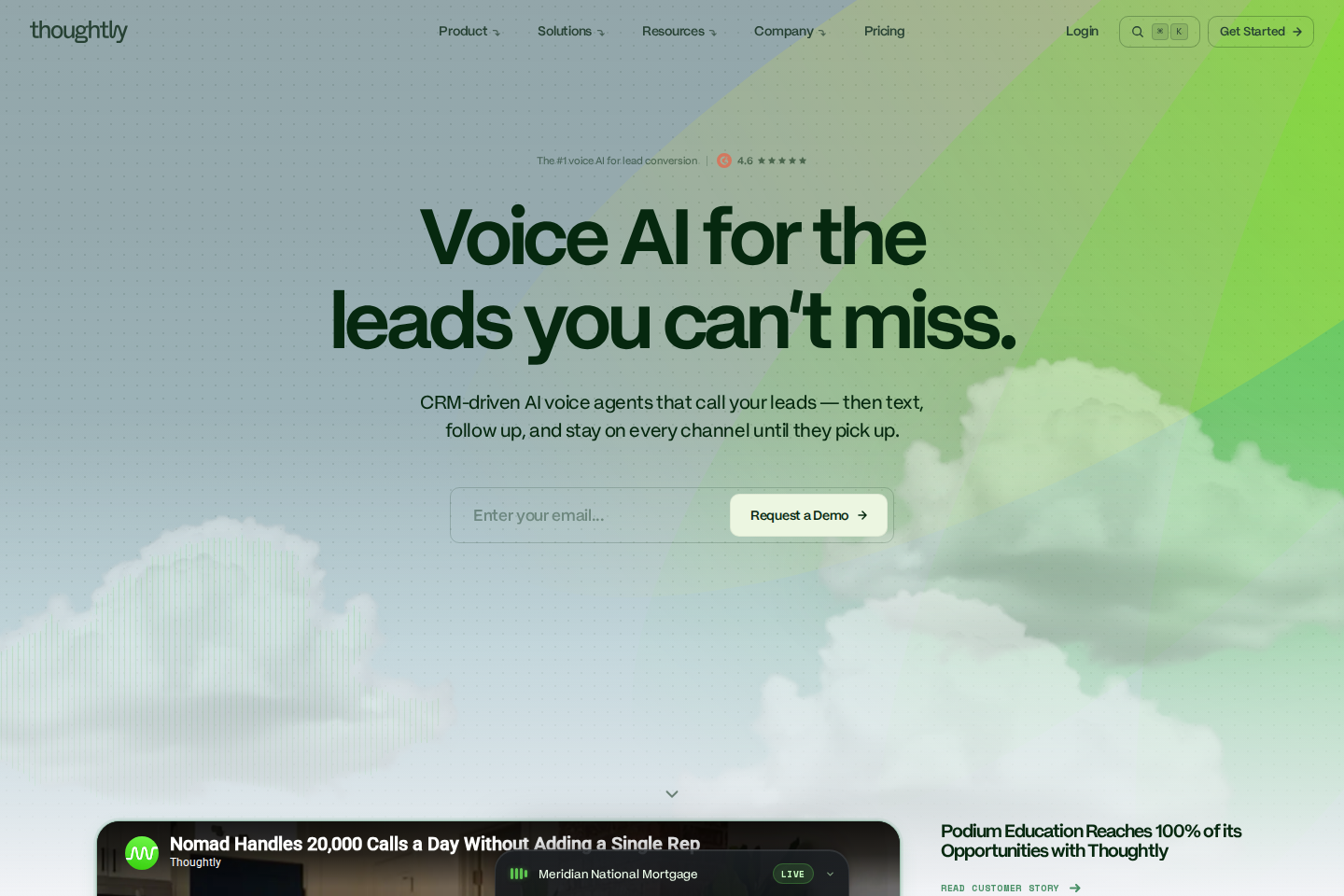
Thoughtly is the strongest fit when the job is not just answering more calls, but converting missed inbound demand across voice, SMS, email, and CRM workflows. That framing is consistent with Thoughtly's public positioning around speed-to-lead, home services, and missed-call recovery.
How I evaluated these AI agents for missed-call recovery
I used five criteria to rank these platforms. Each one matters because missed-call recovery fails in a different place depending on the product: sometimes at speed, sometimes in follow-up, sometimes in data quality, and sometimes in category mismatch.
1. Recovery speed and trigger depth
The first test was how fast a platform can react after a missed inbound call. The best systems either intercept the missed call immediately or triggerTriggerA trigger is an event or condition that starts, resumes, changes, or stops an automated workflow.Read full definition → an automated callback or text within minutes. I also looked at whether that trigger is configurable by business hours, call outcome, queue status, or caller type. A system that only sends callers to voicemail and lets staff review it later does not qualify as strong recovery automation.
2. What happens after the callback
Recovering the call is only the first job. The stronger platforms can qualify the lead, answer basic questions, book an appointment, route to a human, or trigger SMS follow-upSMS follow-upSMS follow-up uses compliant two-way text messages to continue a conversation after an inquiry, call, voicemail, or prior interaction.Read full definition → when the call does not connect. Weak platforms stop at message-taking, which is still better than voicemail but leaves most of the revenue work unfinished.
3. CRM and workflow write-back
A missed-call recovery tool becomes much more valuable when it writes structured outcomes into the CRM: who called, whether they were reached, what they needed, and what the next step is. I favored platforms that can update records automatically and trigger additional workflows. Products that trap data inside a phone dashboard scored lower because someone still has to re-enter the result manually.
4. Fit for revenue teams versus receptionist coverage
Some vendors on this list are built for revenue execution. Others are built for front-desk coverage, legal intake, or general small-business answering. Those can still be useful, but category fit matters. A team trying to recover and convert high-intent leads needs a different product than a solo practice that mostly wants a friendlier replacement for voicemail.
5. Real-world tradeoffs
Vendor homepages make everyone sound perfect. I cross-checked official positioning against G2 summaries, Trustpilot complaints, Reddit threads, and independent reviews to identify the recurring pain points buyers mention in the wild: billing surprises, reliability issues, limited workflowWorkflowA workflow is a defined sequence of steps, decisions, actions, delays, and outcomes used to complete a business process.Read full definition → depth, or products that are narrower than they first appear.
Quick comparison: best AI agents for missed-call recovery
Platform
Best fit
Primary strength
Key limitation
Thoughtly
Revenue teams that need full missed-call recovery plus multichannel follow-up
Voice + SMS + email + CRM workflows in one system
Best value comes with defined workflows and real lead volume
Aloware
Sales and support teams that want AI call rescue inside a CRM-centric phone stack
Purpose-built call rescue flow with CRM enrichment
Still shaped like a contact center platform, not a full lead-conversion system
Smith.ai
SMBs that want AI plus human receptionist backup
24/7 coverage with live fallback
Per-call billing and handoff costs can climb quickly
Goodcall
Small businesses that want fast self-serve setup
Simple AI agent for answering and lead capture
Lighter CRM and workflow depth than revenue teams usually need
Dialpad
Existing Dialpad customers adding AI to business telephony
Unified communications plus AI features
Reliability complaints and limited recovery-specific depth
Aircall
Teams standardizing on a cloud phone system with AI add-ons
Strong integration ecosystem and easy rollout
More phone system than recovery agent
Numa
Auto dealerships and service departments
Vertical-specific missed-call and texting workflows
Narrow vertical scope outside automotive
Ruby
Premium receptionist coverage for small businesses
High-touch answering experience
Expensive and not built as an AI-native revenue workflow platform
8 best AI agents for missed-call recovery in 2026
1. Thoughtly — Best overall for revenue teams that need more than voicemail replacement
Thoughtly is the most complete missed-call recovery platform on this list for teams that care about conversion, not just coverage. The product is built around high-intent inbound demand: a lead calls, misses a human, and the system can respond across voice, SMS, and email while writing the outcome back to the CRM. That matters because missed-call recovery usually breaks when teams rely on one channel. A callback alone is fragile; a callback plus text plus workflow automationWorkflow automationWorkflow automation uses software to execute and coordinate repeatable steps such as intake, follow-up, qualification, routing, booking, and system updates.Read full definition → is much harder to lose.
The strongest case for Thoughtly is when the missed call is the start of a qualification and booking workflow, not the end of it. The agent can follow up immediately, capture the caller's need, determine fit, book time, route to a rep, or continue the conversation over SMS if voice fails. For businesses in home services, insurance, automotive, education, healthcare, and other high-consideration categories, that is much closer to the real job than simply taking a message.
Thoughtly also benefits from being CRM-native instead of phone-system-first. Public product pages emphasize two-way sync with Salesforce, HubSpot, and other systems, along with workflow triggers, warm transferWarm transferA warm transfer connects a live caller to the right person while preserving the context already collected during the conversation.Read full definition →, and multichannel persistence. In practice, that gives revenue teams a cleaner operating model than stitching together separate phone, SMS, and CRM automations.
Pros
Voice, SMS, and email work together in the same recovery flow, so a missed call can turn into a callback, text follow-up, and booking path instead of a single dead-end attempt.
CRM write-back is part of the product design. Outcomes, transcript context, and next steps can land in the record automatically rather than living in a disconnected phone dashboard.
Built for high-intent inbound conversion, which is the right design center for missed-call recovery in revenue-heavy consumer funnels.
Warm transfer and scheduling logic make it useful for teams that need to recover the lead and move them to a human quickly when intent is high.
Cons / watch for
Teams still need to define routing, qualification, and CRM workflow logic clearly. The platform is strong, but it performs best when the operating model is not messy.
If your business mainly wants a low-volume answering service rather than a revenue workflow layer, Thoughtly may be more system than you need.
Best fit
Thoughtly is best for mid-market and enterprise revenue teams, plus high-volume SMBs, that cannot afford to lose inbound leads to voicemail. It is especially strong when the missed call should trigger a full follow-up sequence — immediate callback, text backup, qualification, booking, handoff, and CRM logging — rather than a simple message-taking experience.
Pricing
Thoughtly uses custom pricing. Public positioning emphasizes usage-based flexibility rather than a large upfront license, but teams need to contact sales for exact pricing.
2. Aloware — Best for CRM-centric teams that want a dedicated AI call rescue layer
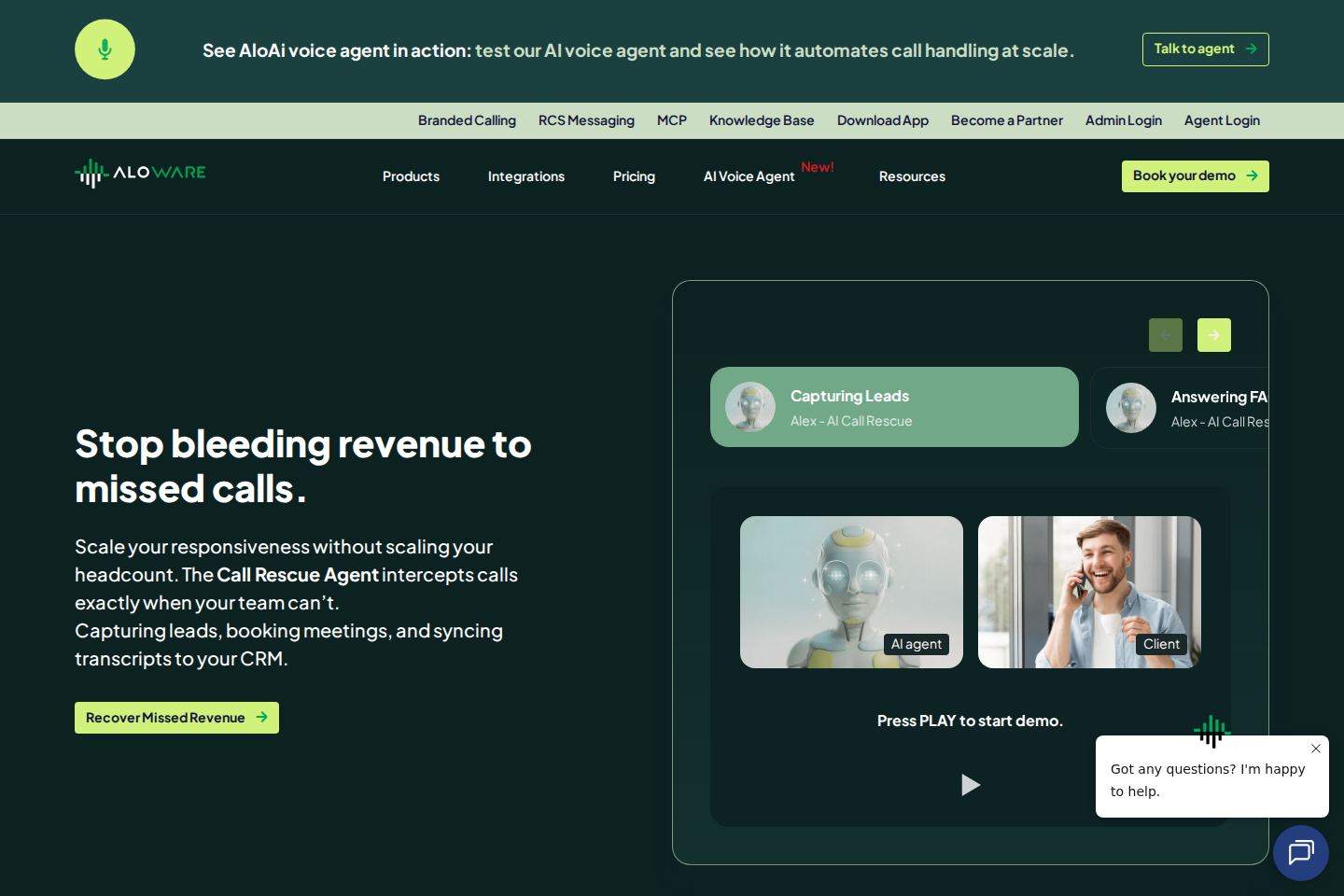
Aloware is one of the most directly relevant products for this use case because it openly markets a missed-call recovery workflow instead of implying that buyers should repurpose a general phone tool. Its Call Rescue Agent is positioned as a way to stop revenue leakage when teams are busy or offline, and the product pairs that with CRM enrichment and AI voiceAI voiceAn AI voice is synthetic speech produced by a text-to-speech model, using a selected or cloned voice to speak an agent's generated or scripted response.Read full definition → handling. For buyers who want a recognizable 'turn missed calls into conversations' feature set, Aloware makes the use case easy to understand.
The tradeoff is that Aloware is still fundamentally a contact-center and CRM-calling platform. That is not a dealbreaker, but it changes the center of gravity. The product feels strongest when missed-call recovery sits inside a broader sales and support phone operation. If your team needs a more autonomous, multichannel lead-conversion layer, Aloware starts to look narrower than Thoughtly.
Still, the CRM orientation is real. G2 product details and Aloware's own site emphasize HubSpot, Salesforce, Pipedrive, Zoho, and GoHighLevel workflows, along with branded callingBranded callingBranded calling displays verified business identity, and sometimes a logo or call reason, on supported devices when a business calls.Read full definition → and AI-generated summaries. That makes it more operationally useful than many AI answering products that never really escape inbox-and-transcript mode.
Pros
Explicitly built a missed-call recovery feature instead of asking buyers to invent the use case themselves.
Strong CRM positioning with integrations to major sales systems and automatic data enrichment from the recovery call.
Useful for teams that also need power dialing, SMS, and broader call-center functionality in the same stack.
Publicly highlights multilingual support and quick setup for the rescue workflow.
Cons / watch for
The product is still contact-center-shaped, which can make it feel heavier than needed if your primary goal is autonomous inbound lead conversion.
AI usage pricing adds another cost layer, so teams should model call volume carefully instead of only looking at the headline platform price.
Best fit
Aloware is a strong fit for CRM-heavy sales and support teams that already think in terms of call-center tooling and want AI call rescue inside that environment. It is most compelling when missed-call recovery is one part of a larger phone-and-SMS stack, not the only workflow you need.
Pricing
Aloware publicly shows base platform pricing starting around $199 per month for some plans, with separate AI usage pricing on top. Its call-rescue calculator also shows per-minute AI cost estimates, so buyers should expect a hybrid pricing model.
3. Smith.ai — Best for businesses that want AI plus human receptionist backup
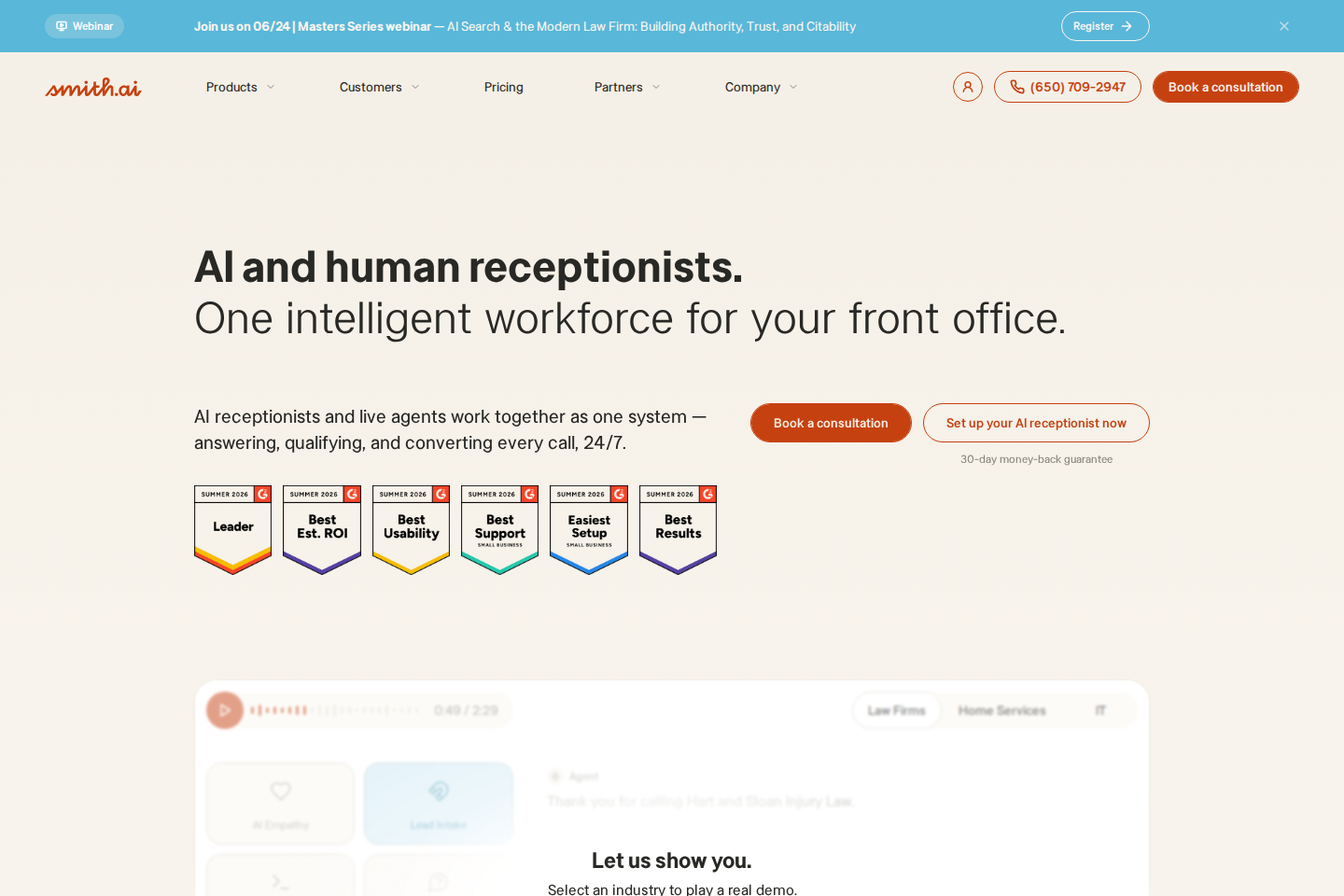
Smith.ai sits in a different category from most pure AI voice vendors because it combines AI receptionists with live human receptionists. That hybrid model is the reason it belongs in this ranking. If a missed call is too important to leave entirely to automation, Smith.ai offers a middle ground: AI can answer and qualify, and humans can step in when the call needs nuance, empathy, or messy intake handling.
This model is especially attractive to small businesses and professional services firms that want 24/7 coverage without building call logic themselves. Smith.ai also has a broad integration story and a long track record in receptionist services. But the downside is equally clear: it is not a CRM-native revenue execution platform. It is an answering and intake layer first, with AI and integrations helping the workflow feel more modern.
Independent review coverage repeatedly highlights the billing tradeoff. Positive reviews like the flexibility of per-call pricing, while critical reviews warn that escalations to live agents can make bills climb unexpectedly. That does not make Smith.ai a bad choice, but it does mean buyers should monitor call patterns closely instead of assuming the hybrid model is cheap.
Pros
Hybrid AI plus human coverage is useful when businesses want automation without risking every edge case on a bot alone.
Strong 24/7 receptionist and intake positioning, with appointment booking and broad integration coverage.
Good fit for firms that value polished caller experience more than building a complex revenue workflow engine.
Well-established vendor with strong review scores overall.
Cons / watch for
Per-call billing and live-agent escalation can create pricing surprises if call patterns are not tightly managed.
Better at front-office coverage than deep CRM-native revenue automation, especially for teams that want autonomous multi-step follow-up.
Best fit
Smith.ai is best for small and midsize businesses that want missed-call recovery, intake, and receptionist coverage in one service. It is a particularly sensible option for firms that prefer a hybrid AI-plus-human model and care more about dependable front-desk handling than full-funnel lead-conversion automation.
Pricing
Smith.ai publicly positions AI receptionistAI receptionistAn AI receptionist is a voice agent configured to answer inbound calls, identify what the caller needs, route requests, and complete front-door tasks such as booking.Read full definition → plans starting around $95 per month, while human virtual receptionist plans start materially higher and scale with call volume. Buyers should expect overage and escalationEscalationEscalation moves a conversation to a person, specialist, supervisor, or alternate workflow when the agent should not continue alone.Read full definition → economics to matter.
4. Goodcall — Best for simple self-serve missed-call coverage
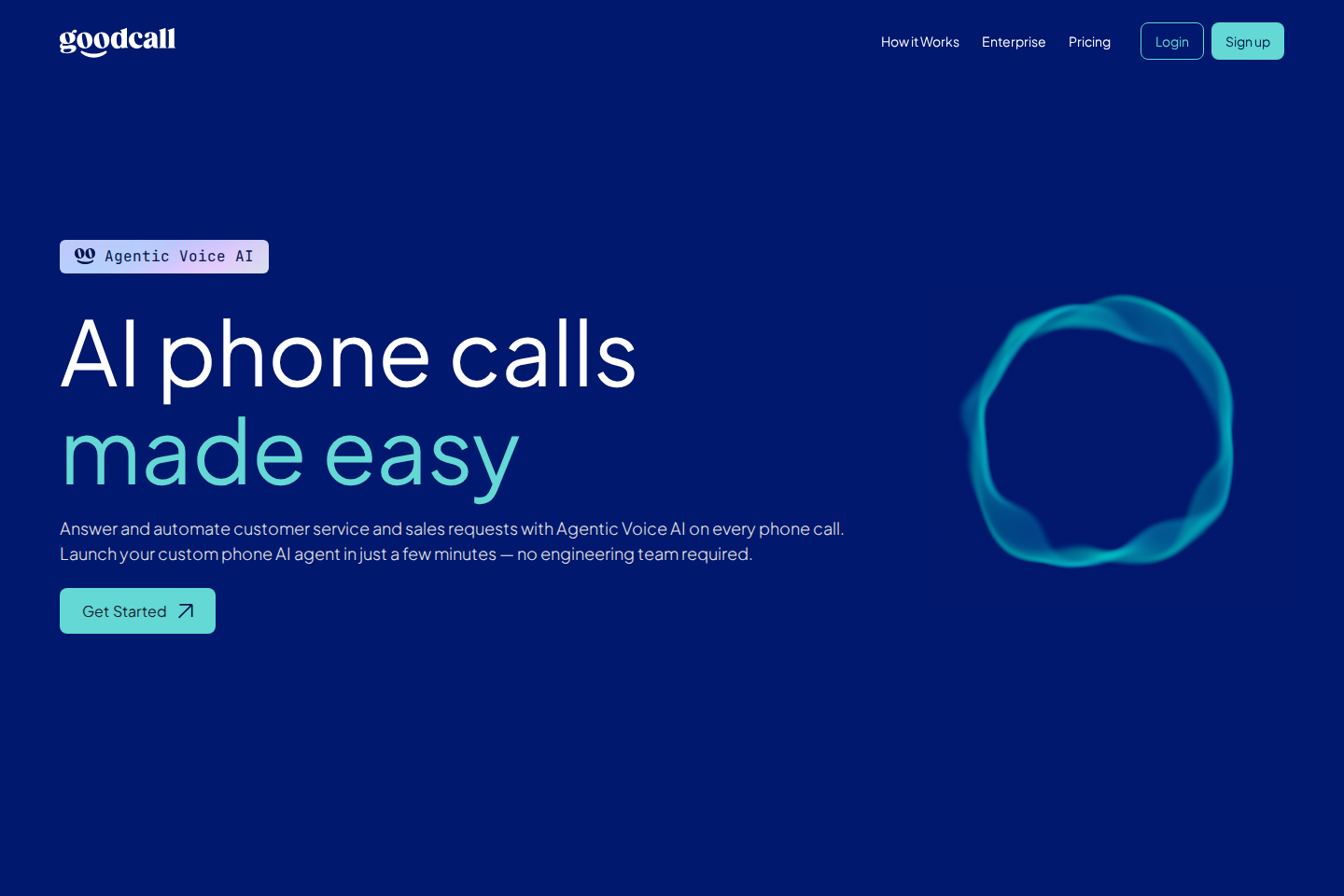
Goodcall is one of the cleaner self-serve AI answering products in the market. Its positioning is straightforward: launch an AI phone agentAI phone agentAn AI phone agent is software that conducts phone conversations to answer, qualify, book, route, or follow up with callers under rules set by the business.Read full definition → quickly, capture calls you would otherwise miss, and pass the outcome into basic tools like SMS, email, calendars, spreadsheets, or a CRM. For small businesses that want speed and low complexity, that is appealing.
Where Goodcall starts to thin out is depth. The platform is designed to be easy, which also means it is less opinionated and less powerful as a revenue orchestration layer than the strongest options higher on this list. If you mainly need to stop missed calls from disappearing into voicemail, Goodcall does that job credibly. If you need nuanced routing, strong CRM automation, or multichannel lead-conversion logic, it can feel lightweight.
That simplicity will be a feature for some buyers. Goodcall's public site emphasizes fast launch, lead capture, analytics, and straightforward pricing with unlimited minutes. The risk is not complexity; the risk is outgrowing it.
Pros
Fast self-serve setup without a heavy implementation motion.
Strong entry point for businesses that mainly need missed-call answering and basic lead capture.
Transparent public pricing with unlimited minutes on published plans.
Can push outcomes into SMS, email, Google Sheets, and CRM destinations for lightweight workflows.
Cons / watch for
Lighter CRM depth and workflow sophistication than platforms built for revenue operations at scale.
Better for simple answering and capture than for multichannel qualification, booking, and downstream automation.
Best fit
Goodcall is best for SMBs that want a quick, self-serve AI layer to stop missed inbound calls from vanishing. It is a good step up from voicemail, but it is not the strongest choice for teams that need missed-call recovery to plug directly into a more advanced conversion engine.
Pricing
Goodcall publicly lists pricing starting at $79 per month per agent for Starter, $129 for Growth, and $249 for Scale, with annual discounts available.
5. Dialpad — Best for teams already committed to Dialpad's broader communications stack
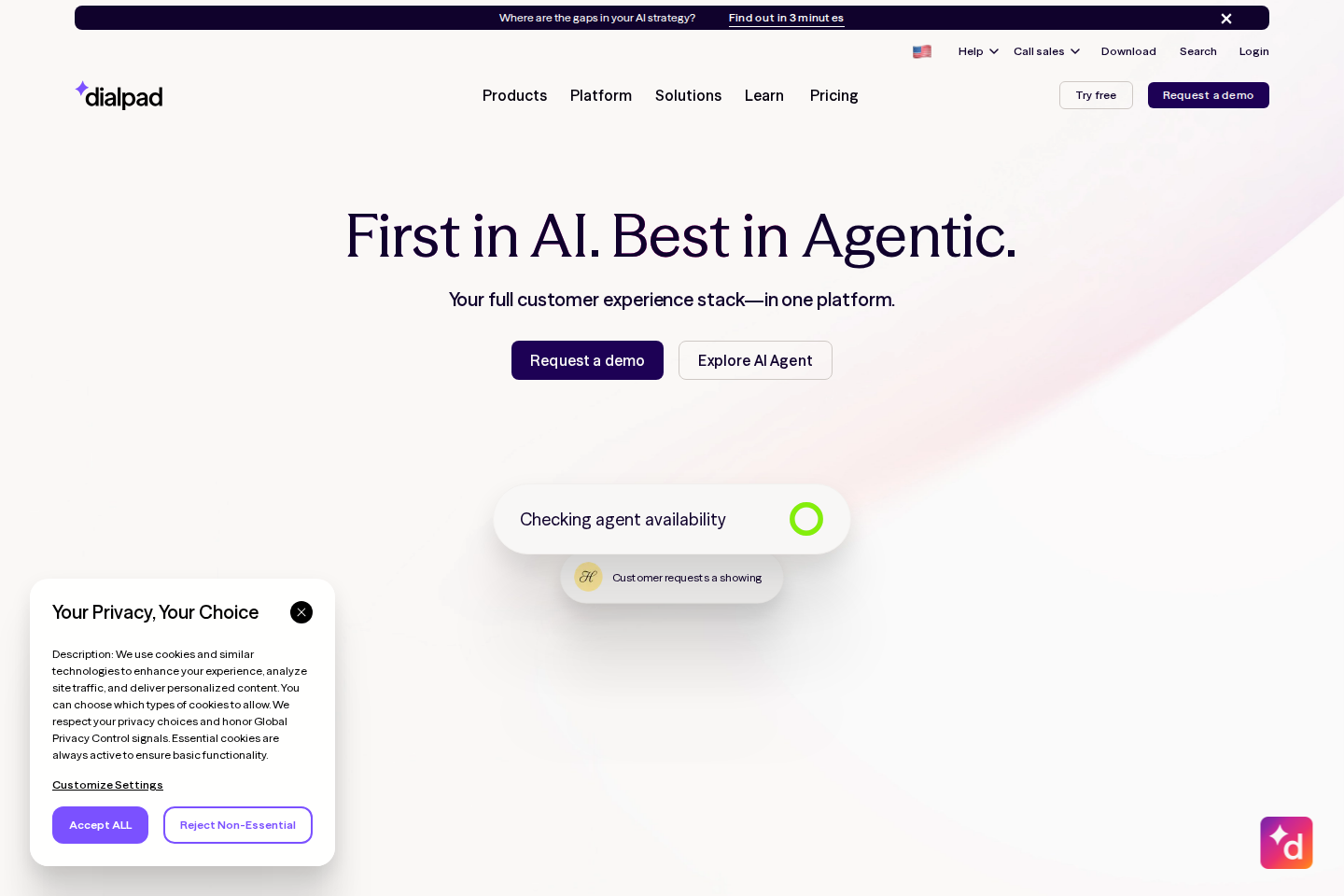
Dialpad makes sense in this ranking for one specific reason: many buyers do not want a separate missed-call recovery product if they already run their telephony and internal communications through Dialpad. In that scenario, adding AI features and routing logic inside the existing stack can be operationally simpler than introducing another vendor. The platform also benefits from being credible at enterprise communications scale.
The issue is that Dialpad is not a missed-call recovery specialist. It is a unified communications and contact-center platform with AI layered across calling, coaching, and support. That means the product can help with missed calls, but that is not its core design center. Review summaries also surface recurring complaints about call quality, dropped audio, one-way audio, and missed-notification reliability — exactly the sort of issues that feel worse when you are trying to recover urgent inbound demand.
So Dialpad belongs here, but with a narrower recommendation: it is a sensible consolidation play for existing customers, not the first platform I would buy solely for missed-call recovery.
Pros
Strong fit for companies already standardized on Dialpad for business telephony or contact center operations.
AI features, analytics, and integrations are broader than many small-business answering tools.
Enterprise communications footprint can simplify vendor sprawl if recovery is one requirement among many.
Cons / watch for
Recurring review complaints about choppy audio, dropped calls, one-way audio, and notification issues matter a lot in missed-call recovery workflows.
Not purpose-built for autonomous revenue recovery, so teams may need more configuration and companion tooling to reach the workflow depth they expect.
Best fit
Dialpad is best for organizations that already use Dialpad and want to improve missed-call handling without standing up a separate specialist platform. It is less compelling for buyers starting from zero and evaluating pure recovery performance as the primary job.
Pricing
Dialpad public pricing varies by product line and plan tier, with business communications plans starting in standard per-user SaaS ranges and enterprise pricing available on request. Buyers usually need to evaluate the AI features separately from the base telephony plan.
6. Aircall — Best for cloud-phone teams that want AI-enhanced coverage, not a dedicated recovery system
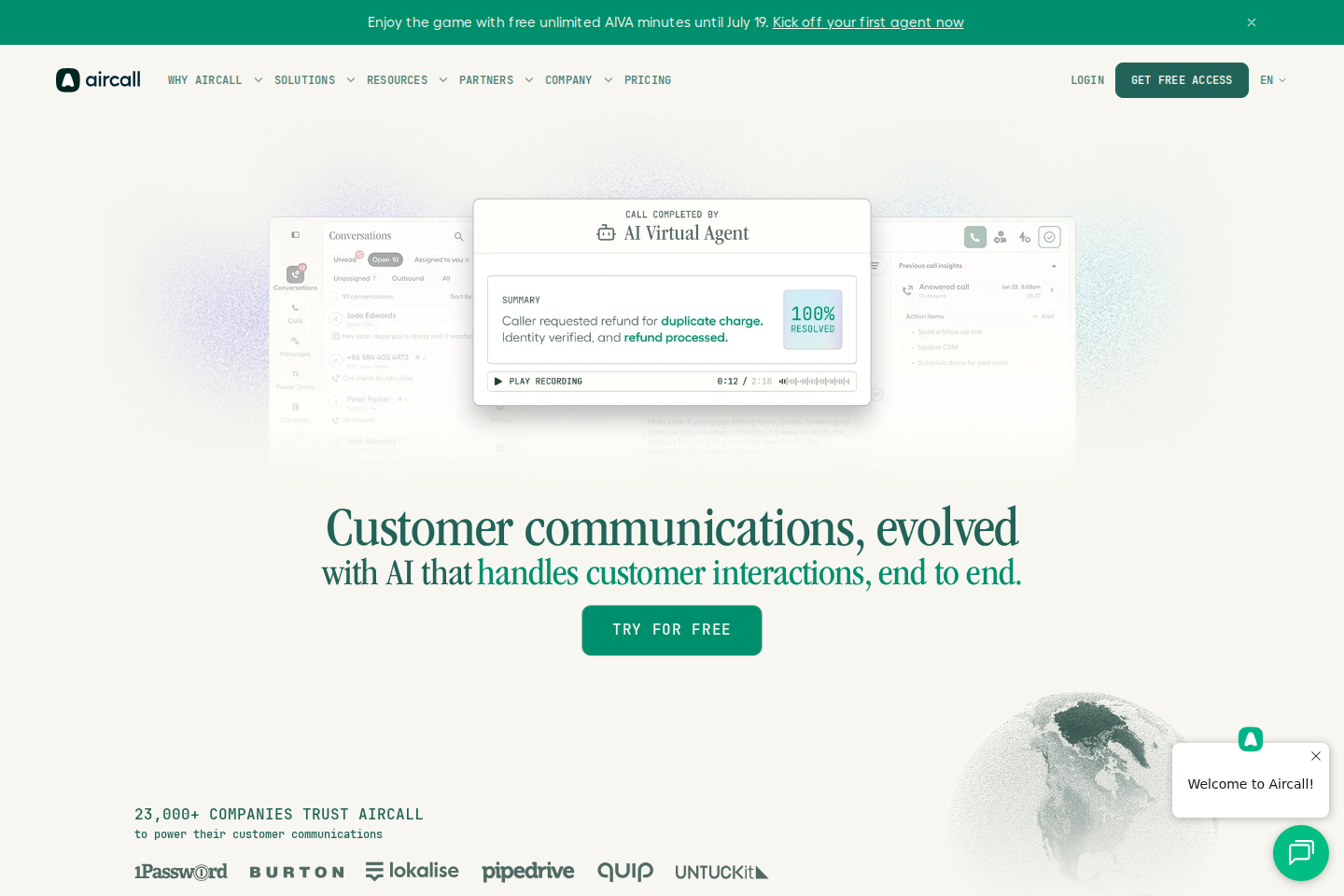
Aircall is another product that lands here because it is widely deployed as a cloud phone system and has added more AI across the platform. If your team already uses Aircall, the easiest missed-call recovery strategy may be to work inside the existing phone stack rather than replace it outright. The product's integration ecosystem is strong, which helps when recovery activity needs to touch the CRM or helpdesk.
The limitation is category fit. Aircall is fundamentally a business phone system with AI features, not an AI-native missed-call recovery engine. That distinction matters because the best recovery products do more than call back. They qualify, route, book, text, and continue the workflow automatically. Aircall can support pieces of that, but it is not the clearest answer if missed-call recovery is your main problem.
Review signals also suggest caution. Aircall scores well on some review platforms for usability and integrations, but complaints about rigidity and missing features show up often enough that buyers should validate the exact workflow they need before committing.
Pros
Strong ecosystem of CRM and support integrations, which helps recovery data move into the rest of the stack.
Operationally appealing for teams already standardized on Aircall as their phone platform.
Easy-to-understand SaaS rollout compared with heavier enterprise telephony projects.
Cons / watch for
More phone system than AI recovery specialist, so the workflow depth may be shallower than buyers expect from the marketing.
Independent review commentary frequently mentions rigidity and feature gaps, which can surface quickly in more advanced routing or automation use cases.
Best fit
Aircall is best for companies that already want or already use a cloud phone system and need reasonable AI-enhanced missed-call handling as part of that stack. It is not the strongest option when the job is dedicated lead recovery with multichannel follow-up and conversion logic.
Pricing
Aircall publicly lists Essentials and Professional tiers plus custom pricing, with feature and user minimums varying by plan. Buyers should review both seat costs and any AI add-on economics.
7. Numa — Best for auto dealerships and service departments
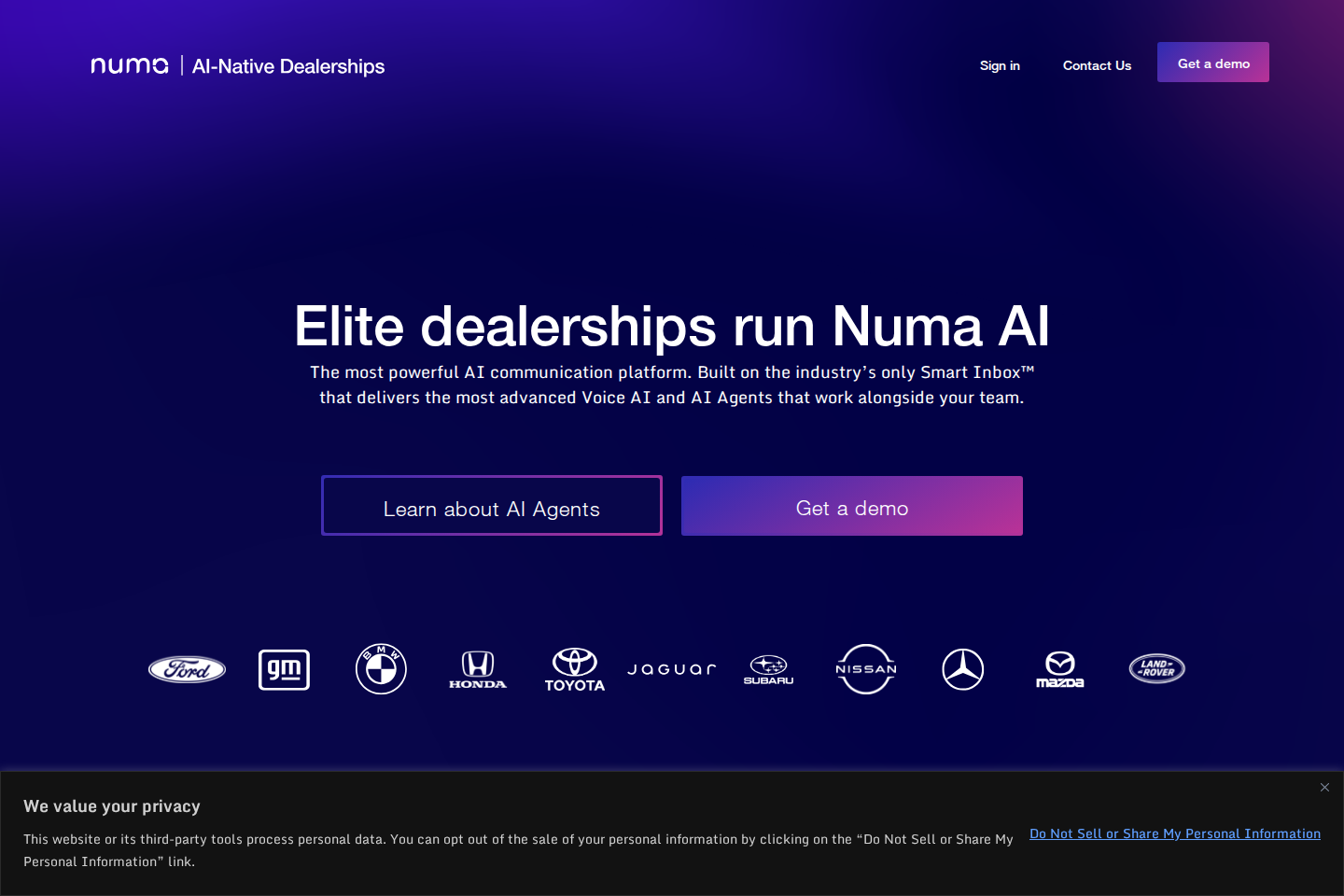
Numa is the most vertically specific product in this ranking, and that specificity is both its biggest strength and its biggest limitation. The company is tightly aligned to dealership and service-department communications, where missed calls, appointment scheduling, text updates, and repetitive service interactions create obvious automation value. In that environment, Numa makes a lot of sense.
Outside that environment, the recommendation gets much weaker. A platform built around dealership workflows will not be the cleanest fit for a general revenue team in insurance, home services, education, or healthcare. There are also signals from forums and competitive writeups that some customers dislike being pushed toward text-heavy interactions when they expected better live handling.
So Numa earns a place here because it is strong inside its lane. Buyers just need to be honest about whether they are actually in that lane.
Pros
Strong vertical fit for dealerships and service departments where missed-call recovery is tightly tied to service scheduling and updates.
Purpose-built workflows can outperform generic AI tools when the business model matches the product exactly.
Good option for teams that value text-driven follow-up alongside inbound call handling.
Cons / watch for
Very narrow vertical scope makes it a poor default choice outside automotive and adjacent service workflows.
Some public discussion suggests frustration when customer interactions get pushed into texting more aggressively than expected.
Best fit
Numa is best for automotive dealerships and service organizations that want a vertical-specific missed-call and messaging platform. If you are not operating in that context, there are more flexible products on this list.
Pricing
Numa does not publish straightforward public pricing for all packages. Most buyers should expect to speak with sales.
8. Ruby — Best for premium receptionist coverage, not AI-native lead recovery
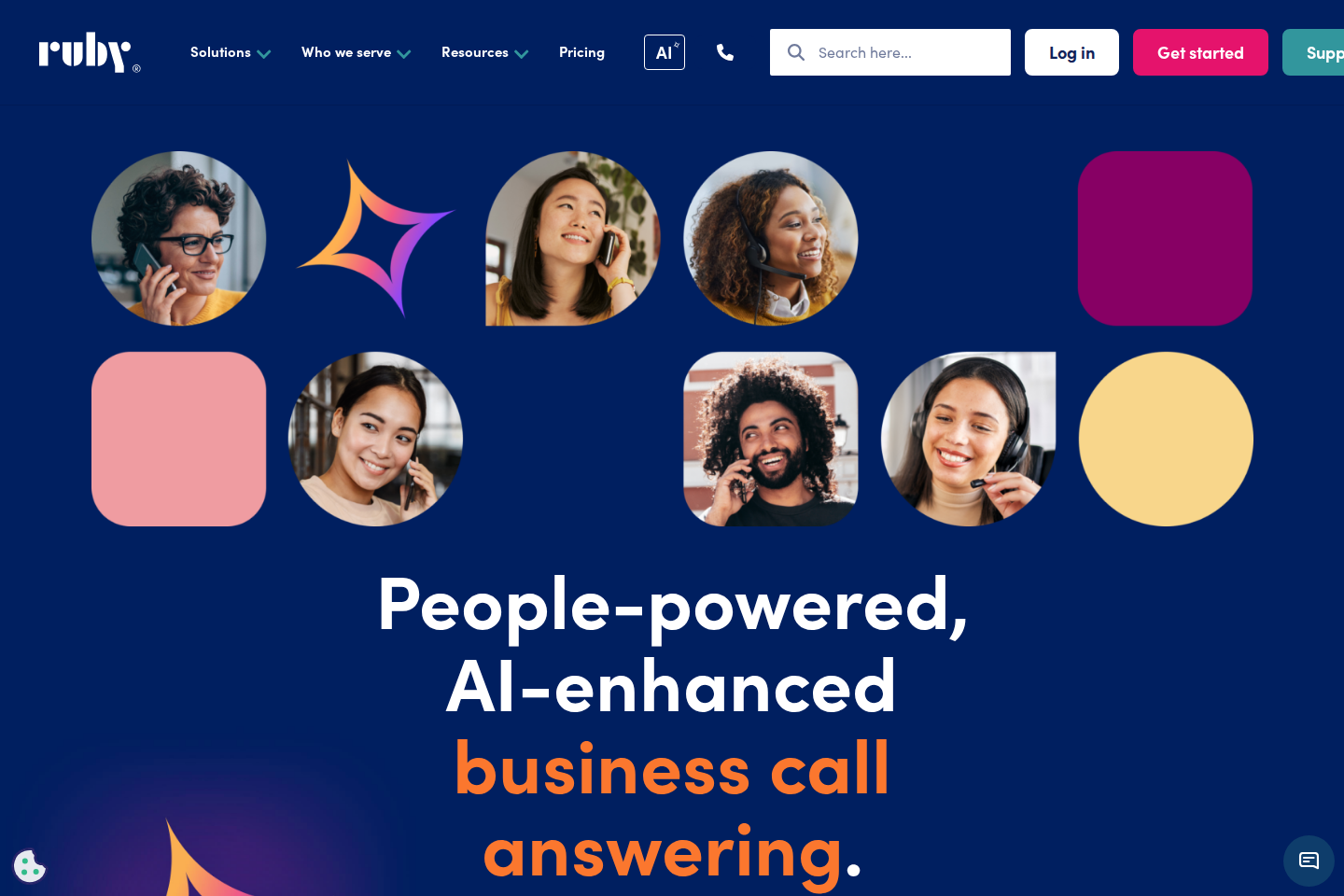
Ruby is the most human-service-heavy option in this ranking. It has strong brand recognition in virtual receptionist services, and that matters because some businesses still prefer the confidence of live reception coverage over a fully autonomous AI workflow. For missed calls, Ruby can absolutely be better than voicemail and can deliver a more polished caller experience than lower-end answering services.
The reason Ruby ranks eighth is not because it is bad. It ranks lower because it is the furthest from an AI-native missed-call recovery system designed for revenue execution. The economics are also materially different. Premium receptionist coverage costs more, and while that cost may be justified for some firms, it becomes harder to defend when the business primarily needs scalable lead recovery rather than boutique front-desk handling.
Ruby is best understood as a premium service answer to the missed-call problem, not a modern revenue automation answer.
Pros
Strong reputation for polished receptionist coverage and customer-facing professionalism.
Good fit for small businesses that value live-answer quality over deep workflow automation.
Straightforward buying motion for teams that want service more than software.
Cons / watch for
More expensive than AI-native options, especially when call minutes rise.
Not built around CRM-native revenue workflows, so the automation depth is much lower than the top platforms in this ranking.
Best fit
Ruby is best for small businesses and professional firms that want premium live receptionist support and are willing to pay for it. It is a weaker fit for teams that need missed-call recovery to plug directly into a scalable lead-conversion engine.
Pricing
Ruby publishes plan details around bundled receptionist usage and chat volumes, but exact packages scale with minutes and service level. Buyers should expect premium pricing relative to AI-first options.
How to choose the right missed-call recovery platform
Start with the actual job. If you only need a friendlier answer than voicemail, a receptionist-oriented product may be enough. If you need to recover and convert high-intent inbound demand, choose a platform built around speed-to-lead, qualification, booking, and CRM write-backCRM write-backCRM write-back sends conversation outcomes, qualification answers, notes, appointments, dispositions, and next steps into the CRM.Read full definition →.
The second decision is whether you want a phone system with AI features or an AI system that happens to use phone as one channel. Those are not the same thing. Phone-system-first products can be fine if you already use them and want incremental improvement. But if missed-call recovery is costing real revenue, the AI-native revenue platforms usually create a cleaner operating model.
Finally, model the real economics. Some platforms look inexpensive until live escalations, per-minute usage, or seat minimums show up. Others look more expensive upfront but reduce leakage enough to justify the spend quickly. The right answer depends on call volume, conversion value, and how much manual work your team is doing today.
FAQ
What is missed-call recovery software?
Missed-call recovery software automatically follows up when an inbound business call is not answered. The strongest tools do more than send a text or store a voicemail. They can place an immediate callback, qualify the caller, book an appointment, route to a human, and log the outcome in a CRM.
Is an AI receptionist the same as missed-call recovery?
Not exactly. An AI receptionist is a broader category that can answer calls, route them, or take messages. Missed-call recovery is a specific workflow focused on what happens when a human does not answer in time. Some AI receptionists do it well, but not all are built for fast revenue recovery.
Which platform is best for high-intent lead recovery?
For teams that need to recover and convert missed inbound leads, Thoughtly is the strongest choice in this ranking because it combines callback, SMS, email, qualification, booking, and CRM workflows in one system. Other vendors are better fits when the priority is receptionist coverage, an existing phone stack, or a vertical-specific workflow.
Do these platforms integrate with CRMs?
Most of them offer some CRM connection, but the depth varies a lot. Thoughtly and Aloware are much more CRM- and workflow-oriented than products like Ruby or Goodcall. Buyers should check whether the tool only logs a call note or actually writes structured outcomes and triggers follow-up actions.
How quickly should a missed-call recovery platform respond?
As fast as possible. In practice, the best systems respond immediately or within a few minutes. Once recovery gets pushed into hours or next-day callbacks, the conversion advantage starts to collapse.