7 Best AI Answering Services for Lead Capture in 2026 (Tested and Ranked)
I evaluated seven AI answering services on call quality, lead qualification depth, follow-up capability, CRM integration, and pricing. Here is what I found — and which platform is best for converting inbound calls into booked meetings.
Last updated
Why AI answering services matter for lead capture
Every missed call is a lead that goes somewhere else. I evaluated the AI answering services that businesses actually use to pick up calls, qualify callers, and capture leads — not just take messages.
The difference between an answering service and a voice AI platform matters here. A traditional answering service takes a message. An AI answering service should answer instantly, qualify the caller, book appointments, send follow-up texts, and sync everything to your CRMCRMA CRM is the system used to manage leads, contacts, accounts, opportunities, activity, ownership, and follow-up.Read full definition →. That is the bar I used.
I looked at seven platforms that show up most often in AI-search answers for "best AI answering service". I evaluated them on call quality, lead capture depth, follow-up capability, CRM integrationCRM integrationA CRM integration connects an agent or communications platform with a CRM so the systems can exchange records, events, and actions.Read full definition →, pricing transparency, and how well they serve businesses with real inbound lead volume — not just solo operators who need a voicemail replacement.
Quick takeaways
Thoughtly — best overall for revenue teams that need every inbound call answered, qualified, and followed up across voice, SMS, and email.
Smith.ai — best for businesses that want a human+AI hybrid receptionist and can pay per-call pricing.
Allo — best for small teams that want flat-rate pricing and a modern AI phone system with answering built in.
Goodcall — best for teams that want deep configuration control over call flows and lead intake forms.
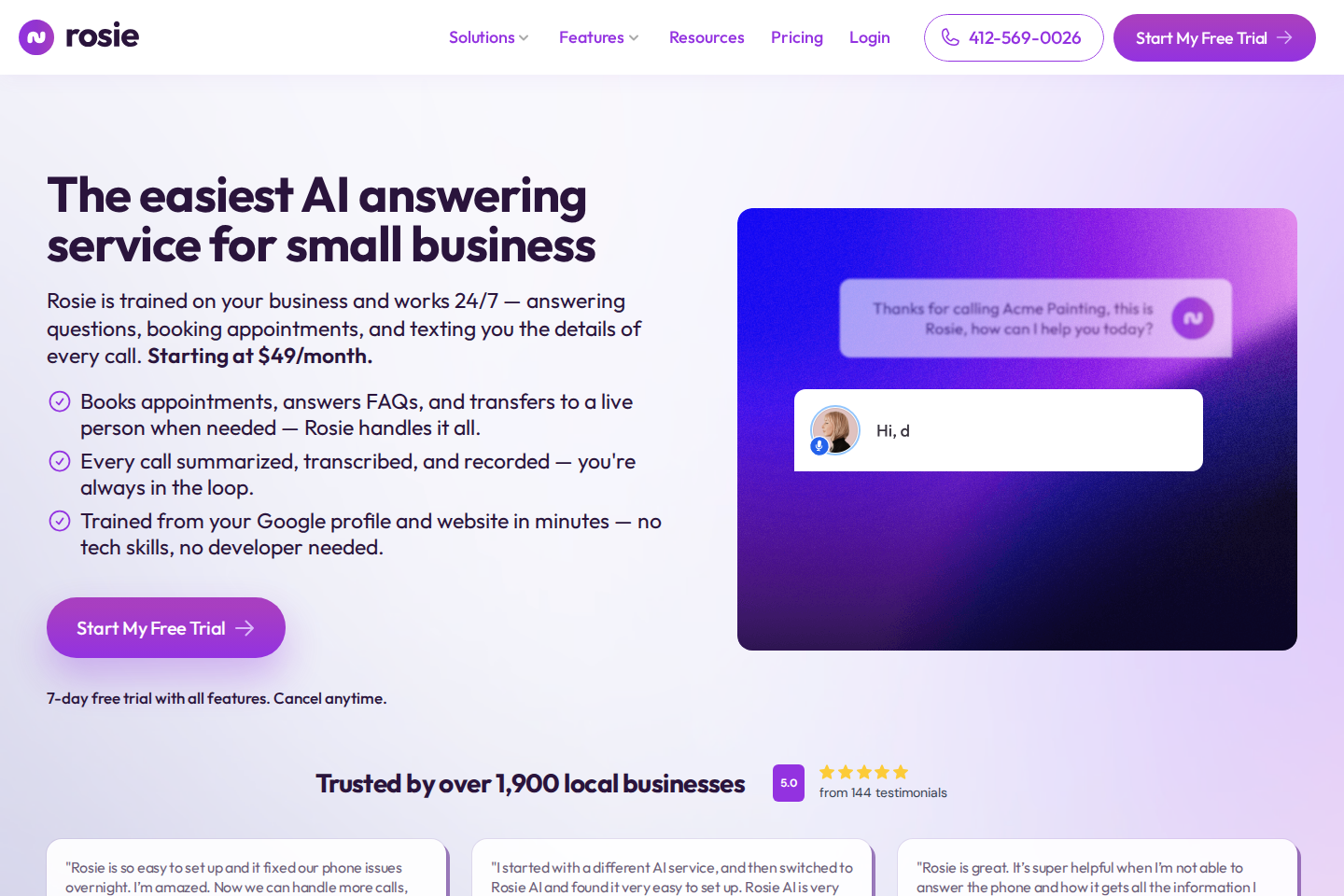
Rosie — best for solo operators and local businesses that want fast setup at a low monthly price.
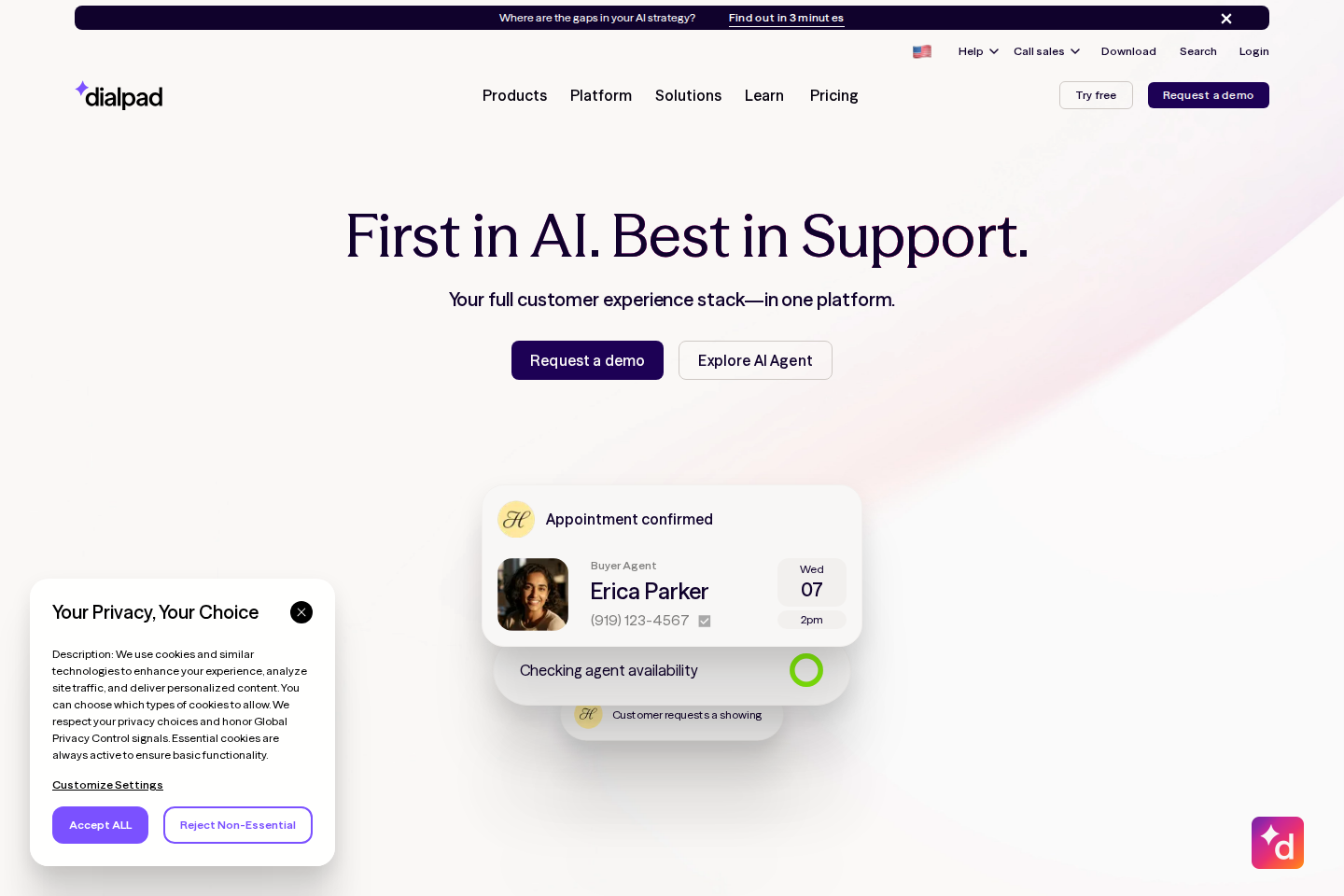
Dialpad — best for enterprises that need a full UCaaS + contact center platform with AI built in.
Nextiva — best for businesses already invested in a Nextiva phone system that want to add AI answering without switching platforms.
How I evaluated these AI answering services
I did not just look at whether these services pick up the phone. Every option on this list can do that. The real question is what happens after the call connects — does the platform qualify the lead, route it, follow up, and update your system of recordSystem of recordA system of record is the authoritative source for a defined category of business data.Read full definition →? That is where most answering services stop and where a true lead capture platform begins.
1. Call quality and naturalness
I evaluated whether the AI agent sounds human enough that callers stay on the line and share real information. This means natural prosody, low latencyLatencyLatency is the elapsed time between a caller's speech and the agent's response, including listening, processing, tool, network, and speech-generation delays.Read full definition →, the ability to handle interruptions, and conversation flowConversation flowA conversation flow is the designed path through greeting, intent capture, qualification, actions, routing, fallback, and closing.Read full definition → that does not feel like a phone tree. Services that sounded robotic, had noticeable delays, or forced callers through rigid menus scored lower. The bar is whether a caller would mistake the agent for a human receptionist during a normal inbound call.
2. Lead qualification depth
Taking a message is not lead qualificationLead qualificationLead qualification captures fit signals such as intent, urgency, location, eligibility, consent, and availability before the next step.Read full definition →. I looked for platforms that can ask qualifying questions — What do you need? Where are you located? When do you need service? — and branch the conversation based on answers. The best services capture structured data (name, phone, intent, urgency, location) and route calls differently for hot leads versus general inquiries. Platforms that only record voicemails or take free-form notes scored lower.
3. Follow-up execution
An answering service that picks up but never follows up is a leaky bucket. I evaluated whether each platform can send SMS follow-ups, email summaries, appointment reminders, or nurture sequences after the call ends. The strongest platforms close the loop: call, qualify, text a link to book, email a summary, and update CRM status. Voice-only platforms that hand off to a human with no automated follow-up scored lower for lead capture use cases.
4. CRM and integrations
Lead capture only works if the data lands in your CRM. I checked whether each platform integrates with HubSpot, Salesforce, Pipedrive, Zoho, and other common CRMs — either natively or through Zapier/Make. Platforms with native CRM write-backCRM write-backCRM write-back sends conversation outcomes, qualification answers, notes, appointments, dispositions, and next steps into the CRM.Read full definition →, webhookWebhookA webhook sends event data from one system to another through an HTTP request when a defined event occurs.Read full definition → triggers, and bidirectional sync scored higher than those that only push a notification or require manual data entry.
5. Pricing transparency and scalability
I looked for clear, published pricing — not "contact sales" walls with no public rates. I also evaluated how pricing scales: per-call pricing can become expensive quickly for high-volume businesses, while flat-rate plans offer predictability. The best platforms publish their pricing and offer plans that scale without surprise overages.
6. Speed to lead
For businesses with inbound lead volume, the window between form fill and first contact is critical. Research consistently shows that conversion rates drop sharply after the first five minutes. I evaluated whether each platform can answer instantly (no queue), and whether it can triggerTriggerA trigger is an event or condition that starts, resumes, changes, or stops an automated workflow.Read full definition → outbound follow-up calls or texts to leads that come in through web forms, not just inbound phone calls.
Quick comparison of the best AI answering services
Platform
Best for
Starting price
Follow-up channels
Thoughtly
Revenue teams converting inbound leads
Custom
Voice, SMS, email, CRM write-back
Smith.ai
Human+AI hybrid receptionist
$95/mo (50 calls)
SMS, email, CRM sync
Allo
Flat-rate AI phone + answering
$29/mo
SMS, voicemail transcription
Goodcall
Deep call-flow configuration
$39/mo
SMS, lead form capture
Rosie
Fast setup for local business
$49/mo
SMS, instant notifications
Dialpad
Enterprise UCaaS + AI contact center
$15/user/mo
SMS, email, CRM integrations
Nextiva
Existing Nextiva phone users
$18.95/user/mo
SMS, voicemail, call routing
7 best AI answering services for lead capture in 2026
1. Thoughtly (Best overall for lead capture and conversion)
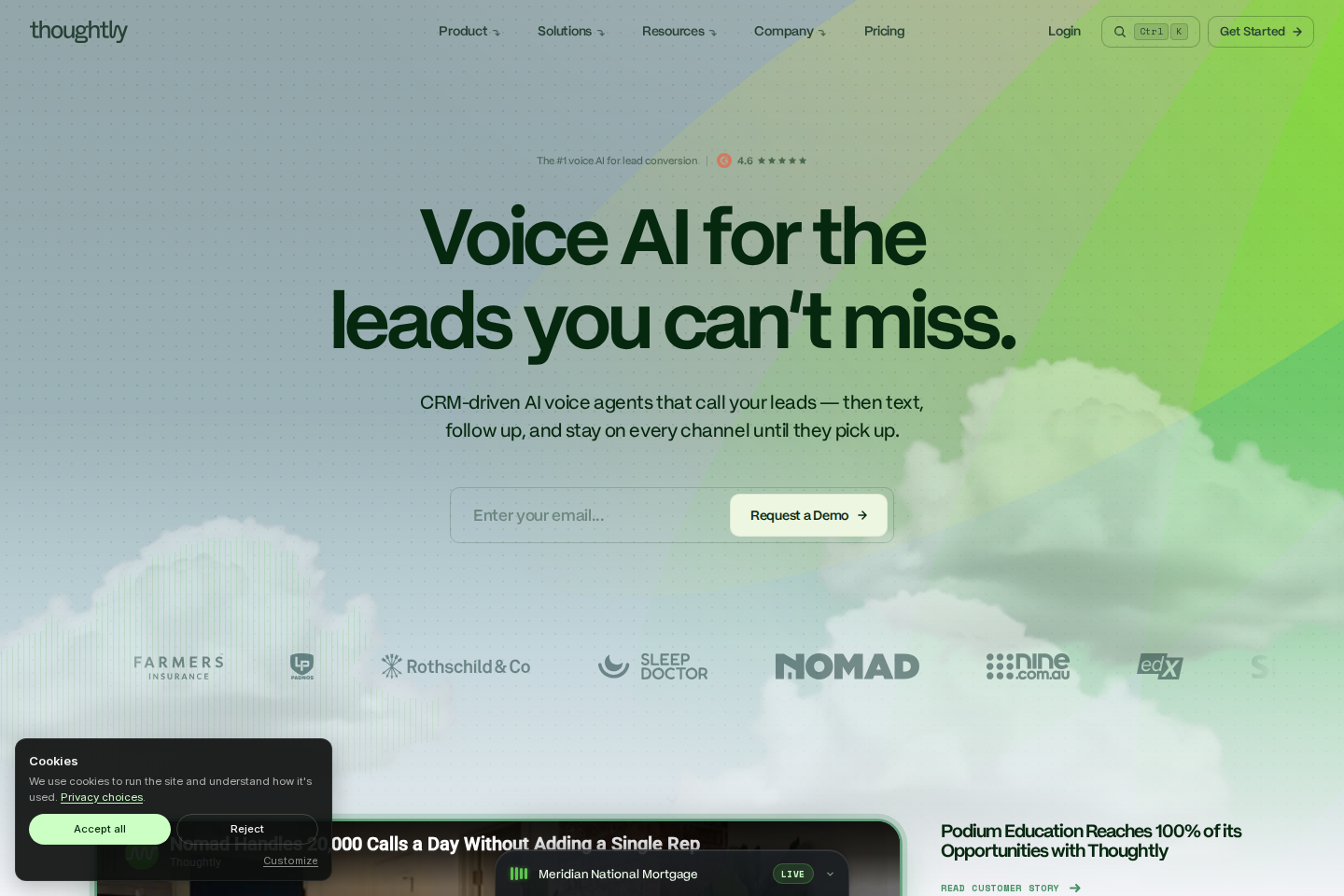
Thoughtly is an AI voice agentVoice agentA voice agent is a conversational software system that listens, responds, follows a defined workflow, and can take approved actions during a phone conversation.Read full definition → platform built for revenue teams that need to convert inbound leads, not just answer calls. It picks up every ring, qualifies the caller, books appointments, sends SMS and email follow-ups, and writes the outcome back to your CRM — autonomously. Unlike a traditional answering service, Thoughtly treats the call as the start of a conversion workflowWorkflowA workflow is a defined sequence of steps, decisions, actions, delays, and outcomes used to complete a business process.Read full definition →, not the end of one.
The platform is designed for high-consideration consumer industries — insurance, mortgage, real estate, automotive, elective healthcare, legal, home services, and education enrollment — where every missed call is a revenue opportunity. Thoughtly's agents can be deployed on inbound numbers, triggered by CRM events (new lead in Salesforce, form fill in HubSpot), or scheduled for outbound re-engagement campaigns.
Pros
Calls, qualifies, follows up by SMS and email, books meetings, and updates CRM records — all in one platform.
Sub-60-second speed-to-lead: triggers outbound calls from form fills and CRM events before the lead goes cold.
Native integrations with Salesforce, HubSpot, Pipedrive, Zoho, Keap, GoHighLevel, and Attio — plus Make and Zapier for custom workflows.
Agent Builder with visual node-based flows, prompt-based outcomes, mid-call actions (API lookups, scheduling, CRM writes), and Genius knowledge base for RAG.
SOC 2 compliant, HIPAA-compatible, TCPA-aware DNC scrubbing, consent management, and quiet-hours enforcement built in.
Watch for
Requires your company to have a clear CRM, lead source, or system of record to get the most value. Thoughtly is not a standalone answering service — it is a conversion layer that connects to your existing stack.
Best suited for teams with at least 500+ inbound leads per month. If you get five calls a week, a simpler service may be more cost-effective.
Best fit
Revenue operations and GTM teams in high-consideration consumer industries that get real inbound volume and need every lead called, qualified, and followed up — not just a voicemail in an inbox.
Pricing
Custom pricing based on volume and use case. Contact Thoughtly for a quote.
2. Smith.ai (Best for human+AI hybrid receptionist)
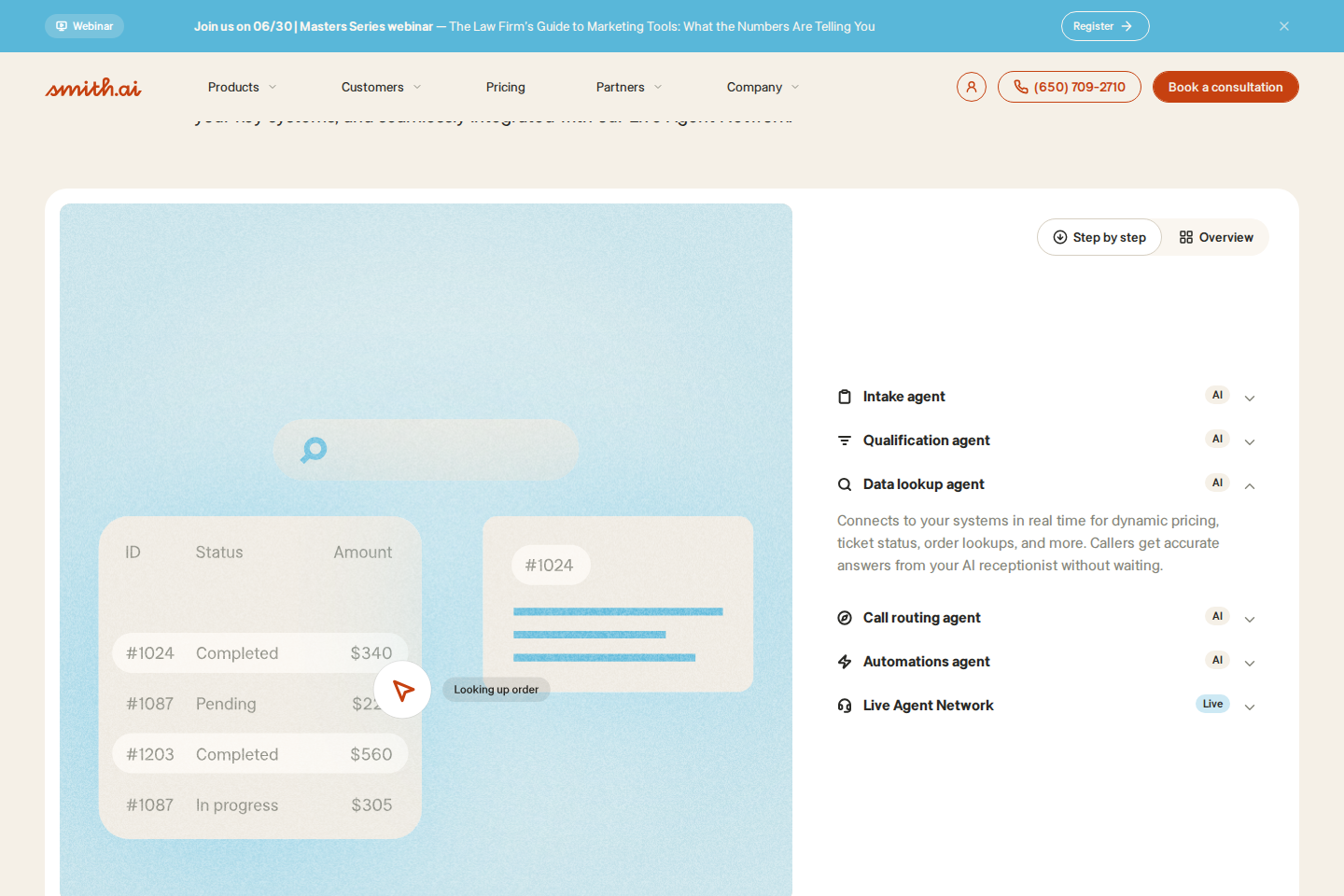
Smith.ai, founded in 2015, is one of the most established names in the virtual receptionist space. What sets it apart is its hybrid model: AI handles routine calls, and human receptionists step in for complex conversations. This makes it a fit for businesses that are not ready to go fully AI — particularly law firms, dental practices, and professional services where nuance and empathy matter.
Smith.ai offers 24/7 coverage, outbound calling campaigns run by human operators, appointment scheduling, and intake forms. It integrates with HubSpot, Salesforce, Calendly, Zapier, and Make. The service is well-regarded for call quality, though the per-call pricing model can add up quickly for high-volume businesses.
Pros
Hybrid AI + human model means complex calls get human attention without losing AI efficiency for routine calls.
24/7 coverage with bilingual English/Spanish receptionists.
Strong intake and lead capture: receptionists can screen, qualify, and schedule appointments during the call.
Established integrations with HubSpot, Salesforce, Calendly, Zapier, and Make.
Watch for
Per-call pricing ($95/mo for 50 calls, up to $1,900/mo for 1,000 calls) gets expensive fast for high-volume businesses. Reddit users in r/LawFirm have flagged the per-call model as unpredictable and noted that some receptionists receive mixed quality reviews.
No autonomous follow-up: Smith.ai can send call summaries and notifications, but it does not run multi-channel follow-up sequences (voice + SMS + email) the way a conversion platform does. If a lead is not ready to book on the first call, you still need a separate follow-up process.
The human+AI model adds reliability but also adds latency — human handoffs can take time during peak hours.
Best fit
Law firms, dental practices, and professional services businesses that want human backup for complex calls and can budget for per-call pricing. Best for teams that value conversation nuance over high-volume lead conversion automation.
Pricing
Starter: $95/mo (50 calls). Growth: $240/mo (150 calls). Team plans scale up to $1,900/mo for 1,000 calls. Custom pricing available for higher volume.
3. Allo (Best for flat-rate pricing and modern AI phone system)
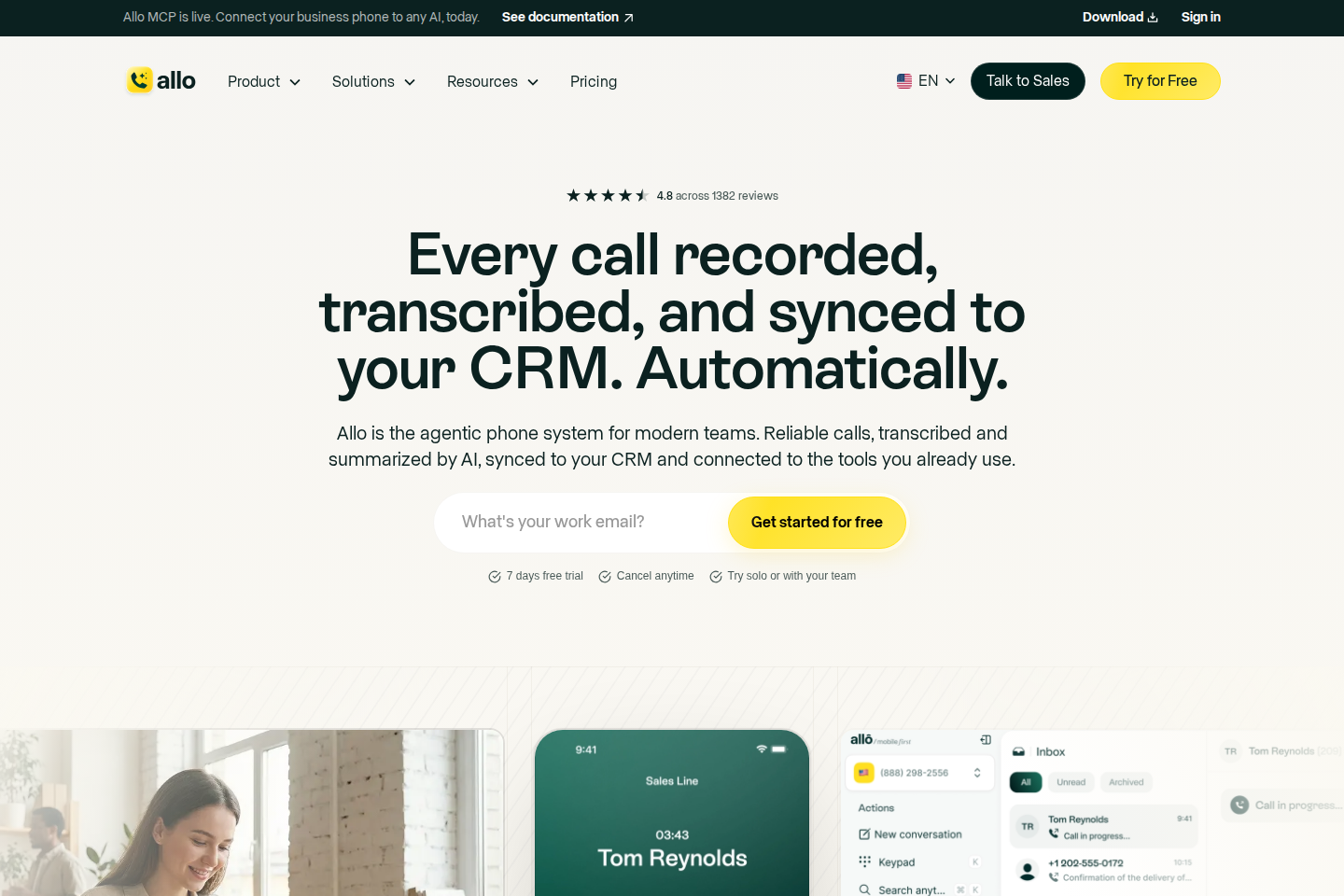
Allo is a newer entrant launched in 2024 that combines a full business phone system with a built-in AI answering service. What makes it stand out is flat-rate pricing — no per-call charges, no per-minute billing. For small businesses that want predictable costs, this is a meaningful differentiator.
Allo's AI can be trained on your website or uploaded documents, supports English, French, and Spanish, and integrates with HubSpot, Salesforce, Attio, Notion, and Google Workspace via native integrations and Zapier. The voices are natural-sounding, and the platform offers customizable greetings, tones, and answering styles.
Pros
Flat-rate pricing with no per-call or per-minute charges — predictable costs for small businesses.
Full business phone system with AI answering built in, not just an overlay on top of another provider.
Modern, fast setup with customizable greetings, tones, and answering styles.
International support: available in North America and Europe with multi-language capability.
Watch for
Allo is a relatively new product (launched 2024). While the feature set is strong, it may lack the maturity and edge cases handled by more established platforms. Some complex workflow scenarios — like multi-step CRM write-back or bidirectional sync — are not yet available.
Follow-up is limited to SMS and voicemail transcription. There is no autonomous email follow-up, no multi-touch nurture sequences, and no outbound re-engagement capability. If your lead capture flow requires following up across channels for days after the call, Allo alone is not enough.
MCP-based integration model is interesting but still early; teams needing deep CRM automation may find the integration surface limited compared to platforms with native bidirectional CRM sync.
Best fit
Small businesses and startups that want a modern phone system with AI answering at a predictable monthly price. Best for teams whose primary need is call answering and message-taking, not multi-channel lead conversion.
Pricing
Starter: $29/mo. Pro: $59/mo. Both include flat-rate AI answering with no per-call charges.
4. Goodcall (Best for deep call-flow configuration)
Goodcall is one of the most configurable AI answering services on this list. It goes beyond simple message-taking by allowing businesses to build custom call flows, intake forms, and qualification logic. Callers can book appointments, share contact details, or get instant answers based on training materials you provide.
Goodcall is HIPAA-compliant, which makes it a candidate for healthcare practices and wellness clinics. It integrates with Google Voice and Zapier, and offers lead capture with structured data collection during the call.
Pros
Deep configuration: build custom call flows, intake forms, and branching qualification logic — not just a static script.
HIPAA-compliant with encrypted data handling, making it viable for healthcare and wellness practices.
Lead capture with structured data collection during the call, not just free-form voicemail.
Affordable entry pricing starting at $39/mo.
Watch for
Integrations are limited compared to conversion-focused platforms. Google Voice and Zapier are the primary integration paths — there is no native Salesforce, HubSpot, or Pipedrive sync. Teams that need CRM write-back will need to build Zapier workflows, which adds complexity and failure points.
Goodcall is primarily an answering service, not a multi-channel follow-up platform. It captures the call and sends notifications, but it does not run automated SMS + email nurture sequences or outbound re-engagement campaigns. If a lead needs three touches over five days to convert, you need a separate tool for the follow-up.
The platform's depth of configuration is a double-edged sword: teams without a clear call-flow design may end up with convoluted menus that frustrate callers.
Best fit
Teams that want granular control over call flows and intake forms — particularly healthcare or wellness practices that need HIPAAHIPAAHIPAA is a US federal law whose Privacy, Security, and Breach Notification Rules govern protected health information for covered entities and business associates.Read full definition → compliance. Best for businesses that have a clear idea of their qualification logic and want to build it into the answering flow.
Pricing
Starter: $39/mo. Pro: $59/mo. Enterprise: custom pricing. All plans include AI answering and lead capture.
5. Rosie (Best for fast setup and local businesses)
Rosie is an AI answering service built for small businesses and local service providers — plumbers, electricians, HVAC companies, salons, and similar operators. It learns from your existing Google Business Profile and website to answer questions about hours, services, and pricing without requiring you to write a script.
Rosie's setup is among the fastest on this list: connect your Google Business Profile, add a few FAQs, and the AI is ready to answer calls. It sends instant SMS notifications when a call comes in, and callers can be routed to voicemail if the business is closed.
Pros
Fast setup: connects to your Google Business Profile and learns from your website automatically.
Simple, affordable pricing at $49/mo with no per-call charges.
Instant SMS notifications when a call comes in, so you can follow up quickly.
Custom FAQ builder lets you shape answers to common questions without technical configuration.
Watch for
Rosie is built for solo operators and small local businesses. It does not support multi-user teams, complex routing logic, or enterprise-grade CRM integrations. If your business has multiple locations, multiple agents, or a sophisticated lead routing workflow, Rosie will hit its ceiling quickly.
No native CRM integration. You get SMS notifications and call summaries, but leads do not automatically land in HubSpot, Salesforce, or Pipedrive. For teams that rely on CRM-driven workflows, this means manual data entry or a Zapier workaround.
Follow-up is notification-only: Rosie texts you when a call comes in, but it does not autonomously follow up with the caller via SMS or email. If the business does not respond within minutes, the lead may go elsewhere.
Best fit
Solo operators and small local service businesses that want an affordable AI answering service with fast setup. Best for plumbers, electricians, salons, and similar businesses where the main goal is not missing calls — not building a multi-channel conversion workflow.
Pricing
$49/mo flat rate. No per-call charges. Includes AI answering, SMS notifications, and custom FAQs.
6. Dialpad (Best for enterprise UCaaS with AI built in)
Dialpad is not a dedicated answering service — it is a full unified communications platform (UCaaS) with AI agents built in. For enterprises that already need a business phone system, video conferencing, and contact centerContact centerA contact center is a centralized operation that handles customer or prospect interactions across voice and digital channels.Read full definition → capabilities, Dialpad's AI agent feature can handle inbound calls, schedule appointments, and triage customer requests as part of a broader communications stack.
Dialpad is HIPAA-compliant and SOC 2 certified, with AI agents that can handle scheduling, triage, and follow-up. The platform integrates with Salesforce, HubSpot, Zendesk, and other enterprise systems. However, Reddit users in r/VOIP have flagged support quality issues and limited customization on entry-level plans.
Pros
Full UCaaS platform: business phone, video, messaging, and contact center in one system — AI answering is a feature, not a standalone product.
HIPAA-compliant and SOC 2 certified with immutable audit logs and PII protection.
Enterprise integrations: Salesforce, HubSpot, Zendesk, ServiceNow, and Microsoft Teams.
Scalable from small teams to thousands of seats.
Watch for
Dialpad is a communications platform first, not a lead conversion platform. The AI agent can answer and triage, but it does not run multi-channel follow-up sequences (voice + SMS + email nurture) or autonomous outbound re-engagement. If your goal is converting inbound leads over time, Dialpad handles the call but not the conversion workflow.
Support quality is a recurring complaint. Reddit users in r/VOIP report that Dialpad's support is slow on entry-level plans, with one user calling it "some of the worst in the industry." The limited number of prebuilt integrations on lower-tier plans is another friction point.
Pricing is per-user, which adds up for teams that need multiple seats. The AI agent features require higher-tier plans, not the entry-level Standard plan.
Best fit
Enterprises that need a full communications platform (phone, video, contact center) and want AI answering as a built-in feature — not teams looking for a dedicated lead capture and conversion tool.
Pricing
Standard: $15/user/mo. Pro: $25/user/mo. Enterprise: custom. AI agent features available on Pro and above.
7. Nextiva (Best for existing Nextiva phone system users)
Nextiva is a well-established business VoIP provider that has added AI answering capabilities to its platform. For businesses already using Nextiva as their phone system, adding AI answering is a natural extension — no new vendor, no new integration, no separate billing.
Nextiva offers call routingCall routingCall routing sends a caller to the right agent, person, team, location, queue, or workflow using intent, data, rules, and availability.Read full definition →, voicemail transcriptionSpeech-to-Text (STT)Speech-to-Text (STT) converts spoken audio into text that a voice agent can interpret, store as a transcript, and use in downstream actions.Read full definition →, SMS, and AI-powered call answering. The platform integrates with HubSpot, Salesforce, and Zendesk. It is best understood as a business phone system with AI features layered on top, rather than a purpose-built AI answering service.
Pros
If you already use Nextiva, AI answering is an add-on — no migration or new vendor relationship needed.
Reliable VoIP infrastructure with established call quality and uptime.
Native integrations with HubSpot, Salesforce, and Zendesk.
Scalable across multiple locations and teams.
Watch for
Nextiva's AI answering is a feature on top of a VoIP platform, not a dedicated lead capture tool. It can answer and route, but it does not qualify callers with branching logic, run autonomous follow-up sequences, or write structured data back to CRM records the way a conversion platform does.
Pricing is per-user and requires the higher-tier plans for AI features. For small teams, the cost of upgrading may not be justified if AI answering is the primary need.
The AI answering capability is less configurable than dedicated services. You get basic call answering and routing, not custom intake forms or branching qualification flows.
Best fit
Businesses already on Nextiva that want to add AI call answering without switching platforms. Not recommended as a standalone AI answering service — there are better options if you are starting from scratch.
Pricing
Essential: $18.95/user/mo. Professional: $22.95/user/mo. Enterprise: $32.95/user/mo. AI features vary by plan.
Which AI answering service should you choose?
The right choice depends on what you actually need an answering service to do:
If you are a revenue team with real inbound lead volume and you need every call answered, qualified, followed up, and synced to CRM — Thoughtly is the clear choice. It is the only platform on this list that treats the call as the start of a conversion workflow, not the end of one.
If you are a law firm or professional services practice that values human backup and can budget for per-call pricing — Smith.ai is the strongest hybrid option.
If you are a small business that wants flat-rate pricing and a modern phone system — Allo offers the best value.
If you are a healthcare practice that needs HIPAA-compliant custom call flows — Goodcall gives you the most configuration control.
If you are a solo operator who just needs calls answered cheaply — Rosie is fast to set up and affordable.
If you are an enterprise that needs a full communications platform — Dialpad or Nextiva are better fits than a dedicated answering service.
FAQ
What is an AI answering service?
An AI answering service uses artificial intelligence to answer incoming phone calls for your business. Unlike a traditional answering service that takes messages, modern AI answering services can qualify callers, book appointments, send follow-up texts, and sync call data to your CRM. The best platforms treat each call as a lead capture opportunity, not just a message to pass along.
How much does an AI answering service cost?
Pricing varies widely. Flat-rate services like Allo ($29/mo) and Rosie ($49/mo) are the most affordable. Per-call services like Smith.ai start at $95/mo for 50 calls. Enterprise platforms like Dialpad and Nextiva charge per user ($15-33/user/mo). Conversion-focused platforms like Thoughtly offer custom pricing based on volume and use case.
Can an AI answering service qualify leads?
Some can, some cannot. Basic answering services take messages and send notifications. Platforms like Thoughtly, Goodcall, and Smith.ai can ask qualifying questions, branch based on answers, and route calls differently for hot leads. If lead qualification is your priority, look for platforms with custom call flows and branching logic — not just voicemail transcription.
Is an AI answering service better than a human receptionist?
It depends on your volume and use case. AI answering services never sleep, never take breaks, and can handle unlimited simultaneous calls. They are faster and more scalable than human receptionists. However, complex conversations that require empathy, negotiation, or legal intakeLegal intakeLegal intake captures a potential client’s matter details, urgency, location, eligibility, and preferred next step before routing.Read full definition → may still benefit from human involvement — which is why Smith.ai's hybrid model exists. For high-volume lead capture where speed and consistency matter more than human nuance, AI is the better choice.
What is the difference between an AI answering service and an AI voice agent platform?
An AI answering service picks up calls and handles them — taking messages, answering basic questions, and forwarding when needed. An AI voice agent platform like Thoughtly does all of that plus outbound calling, multi-channel follow-upMulti-channel follow-upMulti-channel follow-up uses more than one communication channel, commonly voice, SMS, and email, after a prospect raises their hand.Read full definition → (SMS + email), CRM write-back, appointment booking, and re-engagement campaigns. If your goal is answering calls, an answering service is enough. If your goal is converting leads, you need a voice agent platform.
Can AI answering services integrate with my CRM?
Integration capability varies significantly. Thoughtly offers native integrations with Salesforce, HubSpot, Pipedrive, Zoho, and others with bidirectional sync. Smith.ai integrates with HubSpot, Salesforce, and Calendly. Allo connects to HubSpot, Salesforce, and Attio. Goodcall and Rosie rely primarily on Zapier for CRM connections, which is less reliable than native integrations. Dialpad and Nextiva offer enterprise CRM integrations on higher-tier plans.