7 Best AI Phone Agents for Life Insurance Leads in 2026 (Tested and Ranked)
I evaluated AI phone agent platforms for life insurance lead conversion — the tools that respond to quote requests, pre-qualify applicants on health and coverage questions, and route warm prospects to licensed producers before the lead goes cold.
Last updated
I evaluated AI phone agentAI phone agentAn AI phone agent is software that conducts phone conversations to answer, qualify, book, route, or follow up with callers under rules set by the business.Read full definition → platforms that insurance agencies and carriers are using to convert life insurance leads — specifically the tools that respond to quote requests, pre-qualify applicants on health and coverage questions, and route warm prospects to licensed producers before the lead goes cold.
Life insurance lead conversion is a harder problem than most AI voiceAI voiceAn AI voice is synthetic speech produced by a text-to-speech model, using a selected or cloned voice to speak an agent's generated or scripted response.Read full definition → platforms are built for. A property and casualty quote requestQuote requestA quote request is an inbound inquiry asking for pricing, coverage, or a cost estimate for a product or service.Read full definition → might take two minutes to qualify. A life insurance inquiry can require detailed health questions, coverage type guidance between term and whole life, beneficiary discussions, and compliance-aware warm transfers to a licensed agent. The platforms that win here are the ones that can hold a substantive, compliant conversation — not just route a callback.
I focused on platforms that handle the specific challenges life insurance teams face: speed-to-lead on inbound quote requests, pre-qualificationPre-qualificationMortgage pre-qualification is a preliminary assessment of whether a prospective borrower may qualify, often using information that has not yet been fully verified.Read full definition → that captures enough risk profile to save producer time, follow-up sequences for the applicants who start but don't finish, and compliance frameworks that keep every conversation audit-ready.
Quick takeaways
Thoughtly is the strongest fit for life insurance teams that need same-agent voice, SMS, and email follow-up with CRM write-back and compliance-ready recording.
Sonant AI is purpose-built for insurance agencies and integrates directly with Applied, HawkSoft, and EZLynx for quote intake and servicing calls.
CloudTalk is the best option for multi-line insurance call centers that need AI-assisted call routing, analytics, and multilingual support.
Aloware works well for insurance sales teams running high-velocity outbound campaigns alongside inbound lead response.
Telnyx is the infrastructure pick for carriers or large agencies that need low-latency, high-volume call handling at scale.
UnleashX AI specializes in proactive outreach — renewal reminders, payment follow-ups, and win-back campaigns for life insurance books of business.
Dialora offers the fastest time-to-value for small and mid-size agencies with pre-built insurance templates and AMS integrations.
How I evaluated these AI phone agents for life insurance leads
Life insurance is not a one-call-close product. Applicants need to answer health questions, understand the difference between term and permanent coverage, and often speak with a licensed producer before committing. I evaluated each platform against criteria that reflect those realities.
1. Life insurance pre-qualification depth
The most important test for a life insurance AI agent is whether it can conduct a meaningful risk-profile intake before transferring to a human. That means asking about age, smoking status, existing health conditions, current coverage, desired coverage amount, and preferred coverage type — and doing it in a conversational way that doesn't feel like a medical questionnaire. Platforms that could only capture name, phone number, and 'interested in life insurance' scored low. Platforms that could gather enough detail for a producer to open a quote without re-asking basic questions scored high.
2. Speed-to-lead on inbound quote requests
Life insurance shoppers often request quotes from multiple sources simultaneously. The platform that responds first — ideally within 60 seconds — captures the highest share of engaged applicants. I looked at whether each platform could triggerTriggerA trigger is an event or condition that starts, resumes, changes, or stops an automated workflow.Read full definition → an outbound call or SMS immediately when a web form, lead aggregator, or call-in event fires. Platforms with configurable trigger latencyLatencyLatency is the elapsed time between a caller's speech and the agent's response, including listening, processing, tool, network, and speech-generation delays.Read full definition →, instant API-driven response, or sub-minute form-to-call workflows scored highest. Platforms that relied on batch processing or manual campaign initiation lost points.
3. Compliance and consent management
Life insurance conversations involve regulated financial products. Every outbound call needs documented TCPATCPAThe TCPA is a US federal law governing certain calls and text messages, including restrictions tied to technology, consent, revocation, identification, and do-not-call protections.Read full definition → consent. Call recordings need to be retained and accessible for audit. Some states require specific disclosures before health questions. I evaluated whether each platform captures and stores consent automatically, records every call with tamper-evident logging, and provides configurable compliance guardrailsGuardrailsAI guardrails are instructions, rules, data boundaries, and escalation paths that constrain what an agent may say or do.Read full definition →. Platforms that treat compliance as an add-on rather than a default lost marks.
4. Follow-up persistence for incomplete applications
Life insurance has one of the highest application abandonment rates in financial services. An applicant may complete a phone intake, receive a quote, and then go silent before submitting their application. The platforms that scored well here offered automated multi-touch follow-up — SMS reminders, scheduled callbacks, email nudges — to re-engage applicants who stalled. I looked for platforms where the AI agent could resume the conversation from where it left off, referencing the applicant's prior answers, rather than starting cold.
5. CRM and agency management system integration
Life insurance agencies run on specialized systems — Applied Epic, HawkSoft, EZLynx, AgencyZoom, Salesforce Financial Services Cloud, and others. The AI phone agent needs to write lead data, call outcomes, and qualification notes directly into the agency's system of recordSystem of recordA system of record is the authoritative source for a defined category of business data.Read full definition →. Platforms that offered native or pre-built integrations with insurance-specific CRMCRMA CRM is the system used to manage leads, contacts, accounts, opportunities, activity, ownership, and follow-up.Read full definition → and AMSAMSAn AMS, or agency management system, is the operational system insurance agencies use for client, policy, carrier, document, activity, and servicing records.Read full definition → platforms scored higher than those that required custom API work for every connection.
6. Licensed agent warm transfer
In most states, only a licensed insurance agent can discuss specific policy terms, pricing, or make coverage recommendations. The AI agent's job is to qualify and warm-transfer — not to sell the policy. I evaluated how each platform handles the handoff: whether it provides the receiving agent with a real-time summary of the conversation, whether it can route based on license type or state, and whether the transition feels seamless to the applicant. Platforms that dropped context on transfer or required the applicant to repeat information scored poorly.
Quick comparison: best AI phone agents for life insurance leads
Platform
Best for
Key strength
Starting price
Thoughtly
Revenue teams converting inbound life insurance leads across voice, SMS, and email
Same-agent multichannel follow-up with CRM write-back
Custom pricing; demo required
Sonant AI
Insurance agencies using Applied, HawkSoft, or EZLynx
Purpose-built insurance receptionist with AMS integrations
AI call routing with real-time analytics and multilingual support
Starts at $25/user/month
Aloware
Insurance sales teams running outbound + inbound campaigns
Power dialer with AI-assisted conversation intelligence
Starts at $30/user/month
Telnyx
Carriers and large agencies needing high-volume call infrastructure
Low-latency voice AI infrastructure at carrier-grade scale
Pay-per-minute; starts at $0.004/min
UnleashX AI
Insurance books of business needing proactive retention outreach
Automated renewal, payment, and win-back campaigns
Contact vendor for pricing
Dialora
Small and mid-size agencies wanting fast deployment
Pre-built insurance templates with AMS integrations
Starts at $29/month
7 best AI phone agents for life insurance leads in 2026
1. Thoughtly (Best overall for life insurance lead conversion workflows)
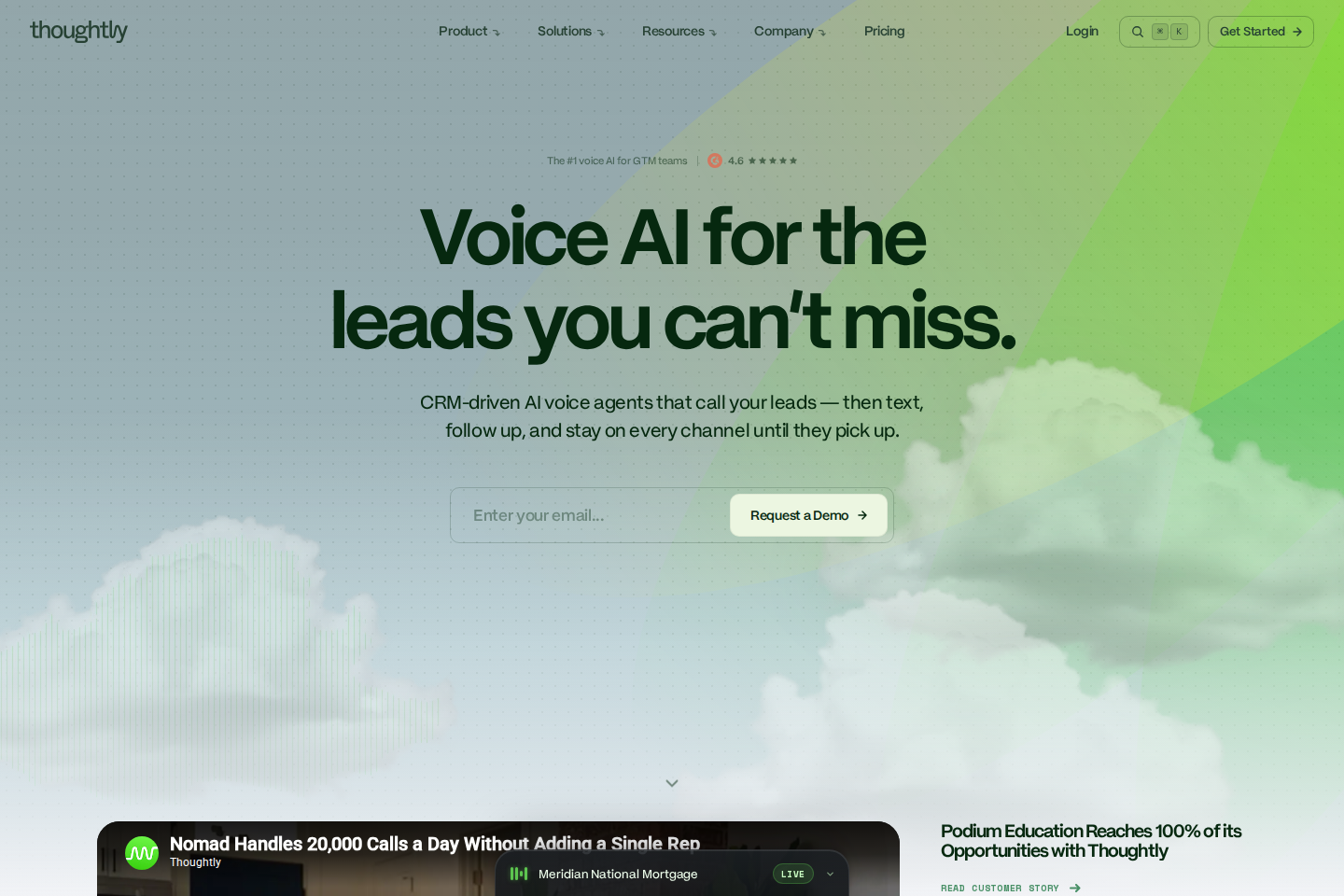
Thoughtly is the AI phone agent platform built for revenue teams that need to convert inbound leads across voice, SMS, and email — and life insurance is one of its strongest verticals. Unlike infrastructure-first platforms that require engineering teams to assemble a voice workflowWorkflowA workflow is a defined sequence of steps, decisions, actions, delays, and outcomes used to complete a business process.Read full definition →, Thoughtly gives insurance operations teams a production-ready system: an AI agent that answers quote requests within seconds, pre-qualifies applicants on coverage type, health history, budget, and urgency, then warm-transfers to a licensed producer with a full conversation summary.
What makes Thoughtly particularly effective for life insurance is the multichannel persistence. When an applicant calls about a term life quote, completes a pre-qualification intake, but doesn't follow through on the application, the same Thoughtly agent can send a personalized SMS or email follow-upEmail follow-upEmail follow-up sends timely, context-aware replies or reminders that move an inbound lead toward qualification, scheduling, or handoff.Read full definition → referencing the specific coverage details they discussed. The conversation doesn't reset — it continues. For a product category with high abandonment rates, that continuity is the difference between a policy bind and a lost lead.
Thoughtly also handles the compliance side natively. Every call is consent-captured, recorded, and audit-ready — a non-negotiable for insurance outreach under TCPA. CRM integrationCRM integrationA CRM integration connects an agent or communications platform with a CRM so the systems can exchange records, events, and actions.Read full definition → is deep: lead data, call outcomes, qualification notes, and follow-up status write back to Salesforce, HubSpot, and custom CRMs in real time.
Pros
Sub-60-second response to inbound quote requests. Every web form submission, call-in, or lead aggregator event triggers an immediate AI-initiated conversation.
Same-agent voice, SMS, and email continuity. The AI agent that conducts the phone intake also handles text and email follow-up, carrying full context of the applicant's answers.
Detailed pre-qualification for life insurance. Captures coverage type preference, age, smoking status, health conditions, desired face amount, and budget before transferring to a producer.
TCPA-compliant consent capture and call recording. Every conversation is consent-documented and recorded with audit-ready logging, enforced automatically.
Deep CRM write-back. Qualification data, call outcomes, and follow-up status sync to Salesforce, HubSpot, and other CRMs in real time.
Watch for
Requires defined qualification logic upfront. Thoughtly performs best when the agency or carrier has clear qualification rules, escalation paths, and follow-up sequences mapped before deployment. Teams without a defined lead workflow will need to build one.
Custom pricing model. Thoughtly doesn't publish self-serve pricing; teams need to go through a demo and scoping call. Smaller agencies used to simple per-seat pricing may find the process longer than expected.
Best fit
Life insurance agencies, carriers, and IMOs that generate enough inbound lead volume to justify automation and want a single platform handling calls, texts, emails, CRM updatesCRM updatesCRM updates are changes written after or during a conversation, such as status, notes, owner, next step, appointment, or disposition.Read full definition →, and warm transfers. Particularly strong for teams already running on Salesforce or HubSpot that need the AI agent to write structured data back to their pipeline rather than just forwarding a voicemail.
2. Sonant AI (Best insurance-specific AI receptionist for quote intake)
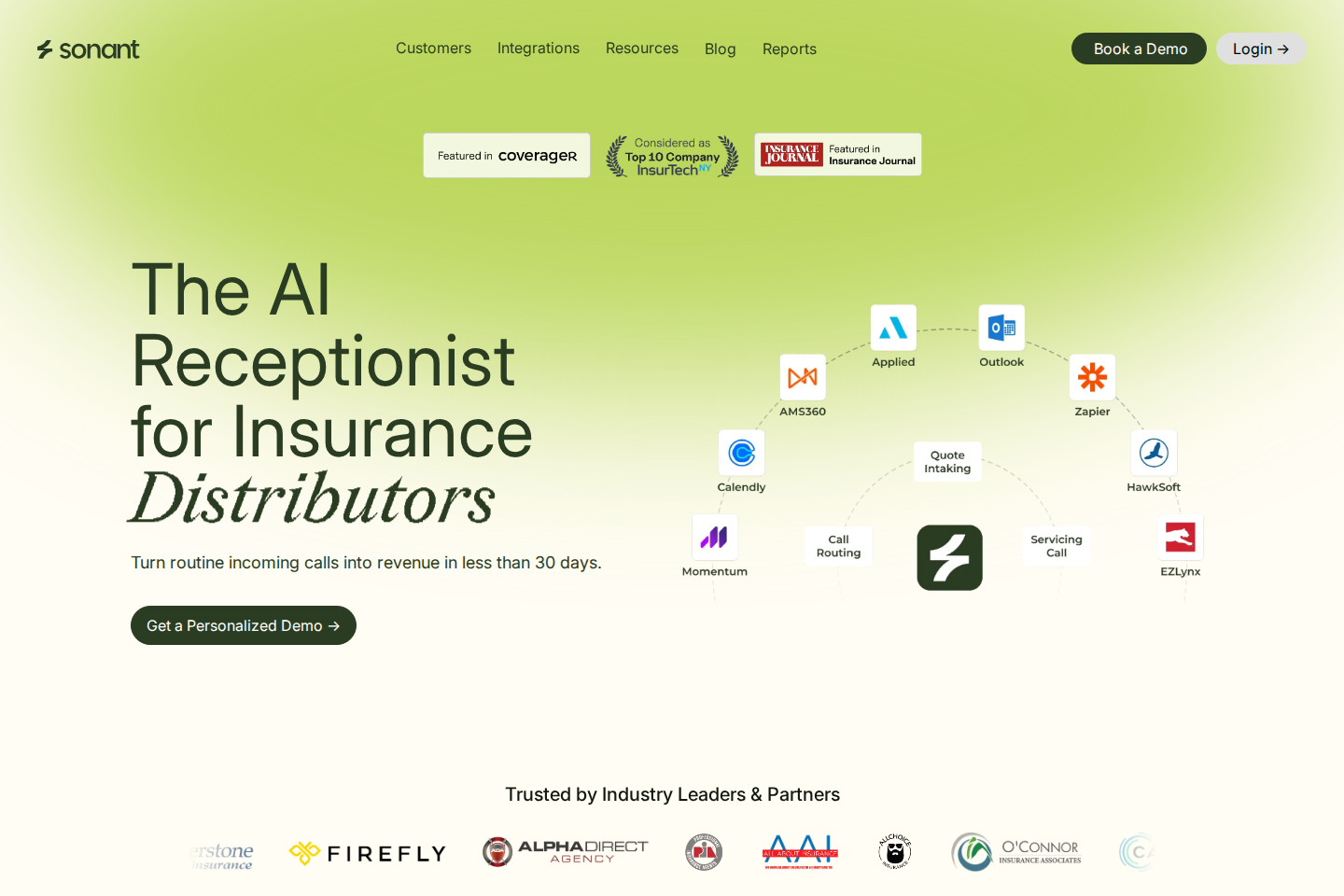
Sonant AI is built exclusively for insurance agencies. It is not a general-purpose voice AI platform adapted for insurance — it was designed from day one to handle the specific workflows that P&C and life insurance agencies run: quote intake, servicing calls, carrierCarrierA carrier is a telecommunications provider that transports voice calls or messages between phone numbers and networks.Read full definition → routing, and producer scheduling. The platform integrates natively with Applied Epic, HawkSoft, EZLynx, and QQCatalyst, which means lead data flows directly into the agency management system without middleware or custom API work.
For life insurance specifically, Sonant handles the front-door problem that agencies struggle with: a prospect calls to ask about a term life quote, and instead of getting voicemail or a hold queue, the AI receptionistAI receptionistAn AI receptionist is a voice agent configured to answer inbound calls, identify what the caller needs, route requests, and complete front-door tasks such as booking.Read full definition → captures their basic details, asks about coverage needs and timing, and books them with an available licensed producer. Sonant was named a Top 10 company by InsurTechNY and has been featured in Insurance Journal and Coverager, which gives it more industry credibility than most general-purpose voice AI vendors.
Pros
Purpose-built for insurance agencies. Every feature is designed around insurance workflows: quote intake, carrier routing, producer scheduling, and servicing call triage.
Native AMS integrations. Connects directly to Applied Epic, HawkSoft, EZLynx, and QQCatalyst — the systems insurance agencies actually use.
Industry recognition. Featured in Insurance Journal, named Top 10 by InsurTechNY, and covered by Coverager.
Smooth warm transfer to producers. Captures enough qualifying information during the AI conversation to give the receiving agent full context before they pick up.
Watch for
Primarily a receptionist, not a full outbound platform. Sonant excels at inbound call handling and intake but does not offer the outbound campaign management, SMS follow-up sequences, or multi-touch re-engagement that platforms like Thoughtly provide.
P&C-first design. Most of Sonant's published case studies and integrations are oriented around P&C agencies. Life insurance-specific workflows like health pre-qualification and underwriting intake may require more customization than standard P&C quote routing.
Best fit
Independent insurance agencies and brokerages that use Applied, HawkSoft, or EZLynx and need an AI receptionist to handle inbound quote calls and route them to the right producer. Ideal for agencies that are currently missing calls or sending life insurance inquiries to voicemail.
3. CloudTalk (Best for insurance call center operations and multi-line teams)
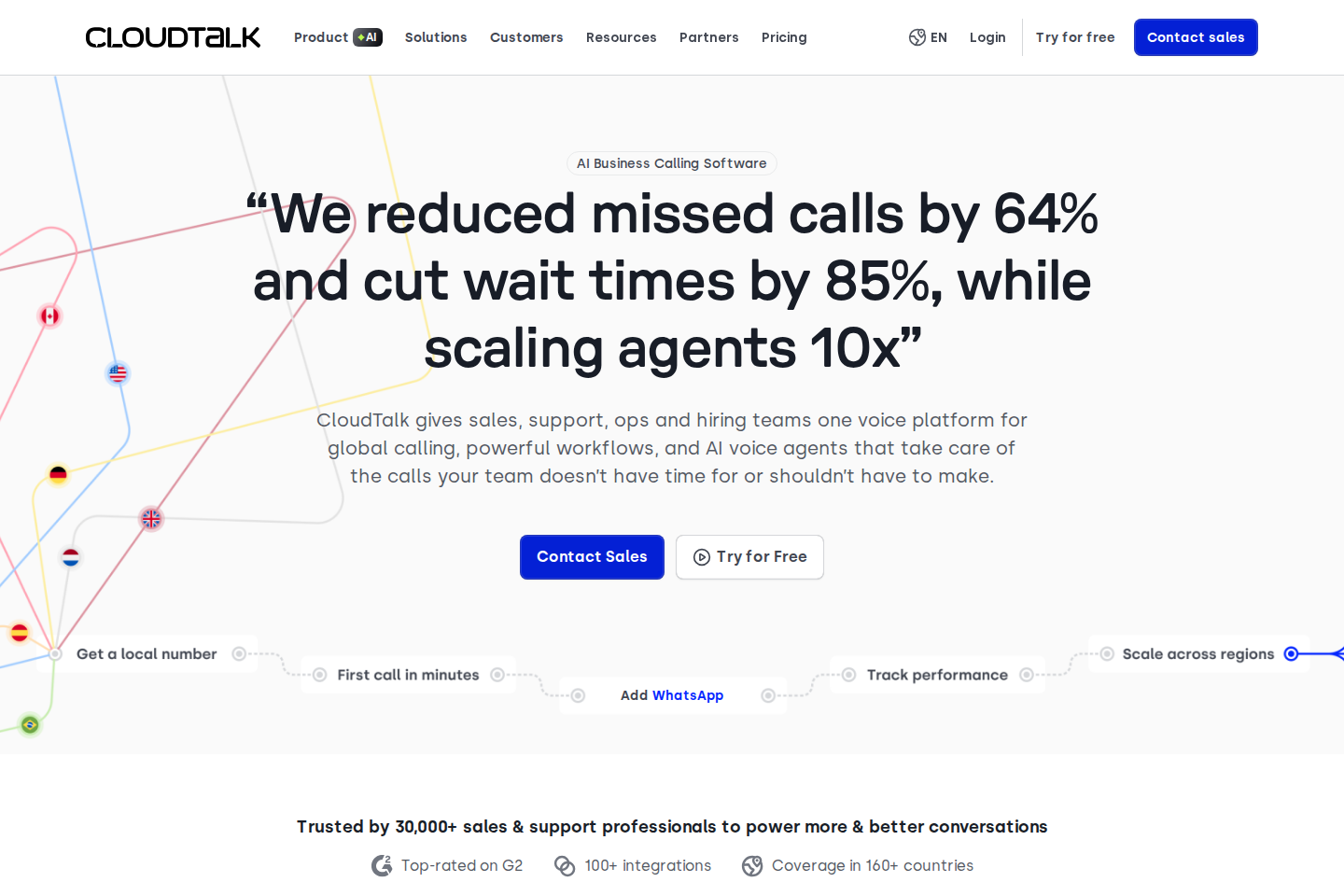
CloudTalk is a cloud-based business phone system with integrated AI features designed for sales and support teams. For insurance organizations running multi-line call centers — whether for direct-to-consumer life insurance sales, Medicare supplement campaigns, or agency customer service — CloudTalk provides AI-assisted call routingCall routingCall routing sends a caller to the right agent, person, team, location, queue, or workflow using intent, data, rules, and availability.Read full definition →, real-time conversation analytics, and automated after-call workflows. The platform supports over 160 international numbers, which matters for insurance groups operating across multiple states or regions.
CloudTalk's AI capabilities include smart call routing based on caller intent, real-time sentiment analysis during calls, and automated call summaries that populate CRM records. For life insurance teams, the value is in the call center operations layer: routing inbound life insurance inquiries to licensed agents based on state and product type, tracking conversion metrics across campaigns, and ensuring calls are recorded and tagged for compliance review.
Pros
AI-powered smart routing. Routes inbound calls based on caller intent, agent availability, license type, and geographic rules — critical for state-licensed life insurance sales.
Real-time analytics and conversation intelligence. Managers can monitor live calls, track conversion rates by campaign, and review AI-generated call summaries.
Accessible pricing. Starts at $25/user/month, making it reachable for mid-size insurance teams that need AI-assisted calling without enterprise contracts.
CRM integrations. Connects to Salesforce, HubSpot, Pipedrive, and Zendesk with native integrations.
Watch for
Not a standalone AI agent. CloudTalk is a phone system with AI features, not an autonomous AI agent that conducts conversations independently. It augments human agents rather than replacing the initial qualification call.
Insurance-specific AMS integrations are limited. CloudTalk integrates well with general CRMs but does not offer native connections to Applied Epic, HawkSoft, or other insurance management systems.
Best fit
Mid-size to large insurance call centers that already have human agents handling life insurance inquiries and want AI-assisted routing, analytics, and conversation intelligence to improve their conversion rates and compliance tracking. Not the right fit for agencies looking for a fully autonomous AI agent to handle calls without human intervention.
4. Aloware (Best for insurance sales teams running outbound and inbound campaigns)
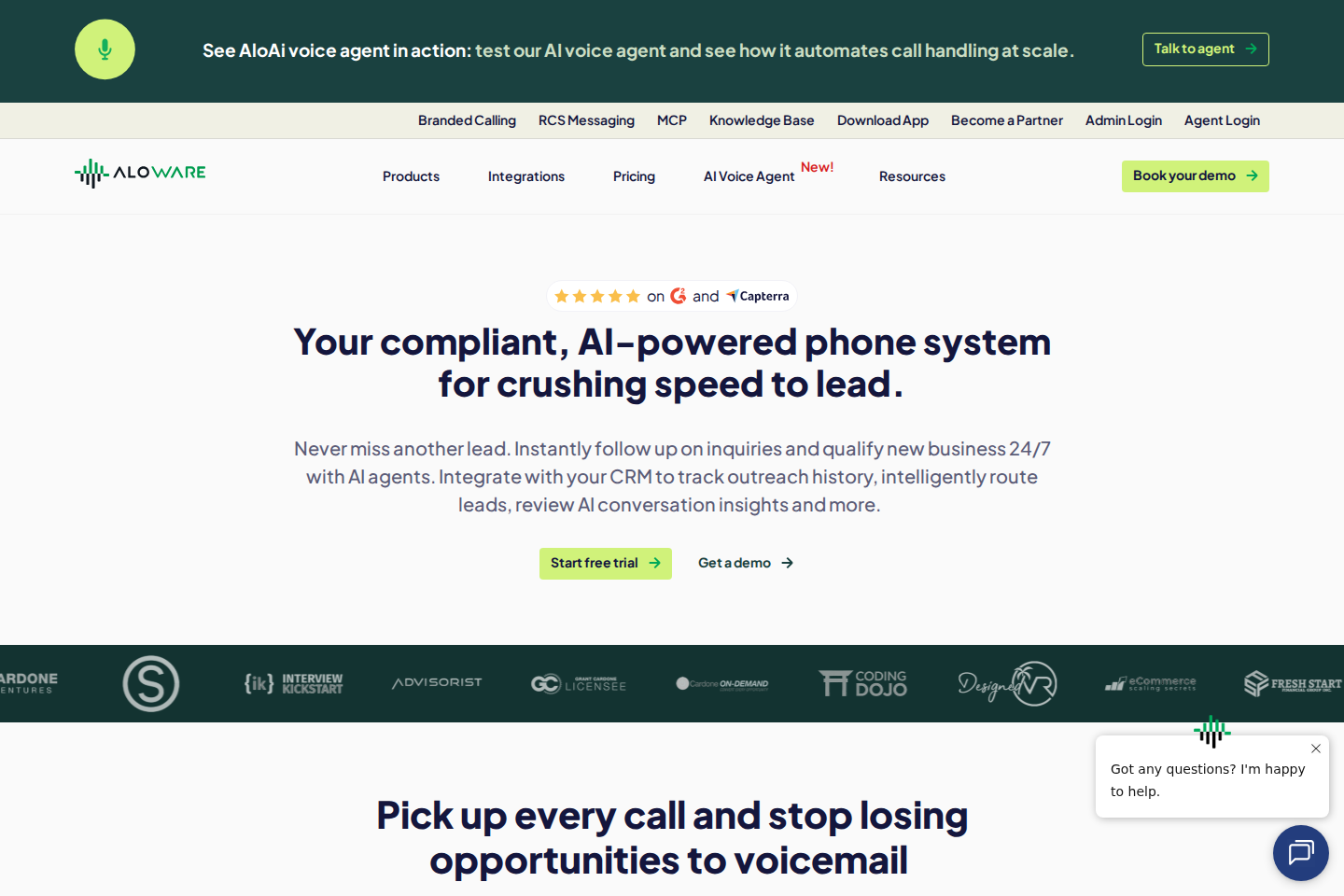
Aloware is a sales engagement platform built for high-velocity outbound and inbound calling, with AI features layered on top. For life insurance sales teams — particularly those working lead lists from aggregators like EverQuote, QuoteWizard, or NextGen Leads — Aloware provides a power dialerPower dialerA power dialer automatically calls contacts in sequence while keeping one person or automated agent available for each connected conversation.Read full definition →, automated SMS sequences, and AI-assisted conversation intelligence. The platform is designed for teams that make hundreds of calls per day and need to reach life insurance prospects before competitors do.
What makes Aloware relevant for life insurance is the combination of speed-to-lead and multi-touch persistence. When a new lead arrives from a quote aggregator, Aloware can trigger an immediate outbound call attempt, and if the prospect doesn't answer, automatically fire an SMS and queue a follow-up callback. The AI layer provides real-time coaching prompts during live calls and automated call scoring to help managers identify which agents are converting and which conversations are stalling.
Pros
Power dialer with instant lead triggering. New leads from aggregators or web forms can trigger an outbound call within seconds, giving agents the speed-to-lead advantage that determines first-contact rate in life insurance.
Automated multi-touch sequences. Combines calling, SMS, and voicemail drop in configurable cadences — important for reaching life insurance prospects who don't answer the first call.
AI-assisted conversation intelligence. Real-time coaching prompts and post-call scoring help managers improve conversion rates across the team.
CRM-native integrations. Deep integrations with HubSpot, Salesforce, Pipedrive, and Zoho for automatic lead status updates and activity logging.
Watch for
AI is an assist layer, not an autonomous agent. Aloware's AI features enhance human agent performance — real-time coaching, call scoring, smart routing — but the platform does not conduct the qualification conversation autonomously. A human agent still handles the call.
Designed for sales velocity, not complex qualification. Life insurance intake involves multi-step health and coverage questions. Aloware is optimized for high-speed contact and handoff, not for deep AI-driven pre-qualification conversations.
Best fit
Life insurance sales teams and agencies that work high volumes of aggregator leads and need a power dialer with AI-assisted coaching and multi-touch follow-up. Ideal for teams where human agents handle the qualification but need better tooling to reach more leads faster and manage follow-up cadences automatically.
5. Telnyx (Best for high-volume insurance call infrastructure at carrier-grade scale)
TelnyxTelnyxTelnyx is a cloud communications provider offering voice, messaging, phone numbers, and network services through APIs.Read full definition → is a communications infrastructure provider that offers programmable voice, SMS, and networking APIs. For large insurance carriers, IMOs, and call centers that handle tens of thousands of life insurance calls per month, Telnyx provides the underlying infrastructure: low-latency voice connections, programmable IVRIVRIVR, or Interactive Voice Response, is a phone menu that routes or serves callers through keypad entries or spoken choices.Read full definition → and AI agent capabilities, number management across all 50 states, and pay-per-minute pricing that scales without per-seat costs. Telnyx's AI voice features let enterprises build custom voice agents on top of their infrastructure.
The insurance-specific value of Telnyx is in scale economics and reliability. When an insurance carrier is running a national life insurance campaign across multiple lead sources, they need a platform that handles concurrent call volume without degradation, provides sub-200-millisecond voice latency, and offers the telephony compliance features — STIR/SHAKENSTIR/SHAKENSTIR/SHAKEN is a caller ID authentication framework that lets telephone networks verify information about a call’s originating number.Read full definition → attestation, CNAM registration, and number reputation management — that keep outbound calls from getting flagged as spam.
Pros
Carrier-grade infrastructure. 99.999% uptime SLA with redundant network paths and sub-200ms voice latency — critical for high-volume insurance operations.
Pay-per-minute pricing. Starts at $0.004/minute for voice, which can be significantly cheaper than per-seat models for high-volume call operations.
Full telephony compliance stack. STIR/SHAKEN attestation, CNAM registration, and number reputation management help ensure outbound life insurance calls are delivered and answered.
Programmable AI voice agents. Build custom AI agents on top of Telnyx's infrastructure using their voice API and AI integrations.
Watch for
Requires engineering resources to build. Telnyx is infrastructure, not a turnkey solution. Building a life insurance qualification agent on Telnyx requires developers, voice AI expertise, and custom integration work.
No insurance-specific features out of the box. There are no pre-built insurance templates, AMS integrations, or compliance workflows. Everything must be built or integrated from scratch.
Best fit
Large insurance carriers, IMOs, or BPOs that have engineering teams and need carrier-grade infrastructure to build or run high-volume life insurance calling operations. Not the right fit for agencies that want a plug-and-play AI phone agent.
6. UnleashX AI (Best for proactive policy renewal and retention campaigns)
UnleashX AI focuses on proactive AI-driven outreach for insurance organizations — specifically the campaigns that keep a life insurance book of business healthy: renewal reminders, premium payment follow-ups, lapsed policy win-back, and beneficiary update outreach. Where most platforms on this list focus on new lead acquisition, UnleashX addresses the retention and reactivation side of the life insurance lifecycle.
For life insurance agencies, the renewal and lapse problem is significant. A policyholder who misses a premium payment can lapse into a grace period and eventually lose coverage. UnleashX automates the outreach that keeps policies active: calling policyholders before premium due dates, following up on missed payments, and running scheduled campaigns to re-engage lapsed policies. The AI agent handles the initial contact, captures the policyholder's intent, and routes to a licensed agent if a coverage change or reinstatement is needed.
Pros
Purpose-built for retention and reactivation. Automated campaigns for renewal reminders, payment follow-ups, lapsed policy win-back, and beneficiary updates.
Proactive outreach scheduling. Campaigns can be triggered by policy dates — 90, 60, and 30 days before renewal or lapse — so the outreach happens automatically.
AI-driven initial contact. The AI agent handles the first touchpoint, captures the policyholder's status and intent, and routes to a human agent for complex conversations.
Watch for
Retention-focused, not acquisition-focused. UnleashX is designed for outreach to existing policyholders, not for converting new life insurance leads. Teams that primarily need inbound lead qualification will need a different platform for that workflow.
Limited public information on integrations. UnleashX does not publish as much detail about CRM and AMS integrations as more established platforms. Confirm integration scope during the sales process.
Best fit
Life insurance agencies and carriers with a sizable existing book of business that need automated retention outreach — renewal reminders, payment follow-up, lapsed policy campaigns — handled by AI before a human agent needs to get involved. Best as a complement to an acquisition-focused platform rather than a standalone solution.
7. Dialora (Best for quick deployment with pre-built insurance templates)
Dialora is an AI voice agentVoice agentA voice agent is a conversational software system that listens, responds, follows a defined workflow, and can take approved actions during a phone conversation.Read full definition → platform that emphasizes fast deployment — the company claims agents can go live in under 60 seconds using their template library. For insurance agencies that want to start handling inbound life insurance calls with AI without a lengthy implementation process, Dialora offers pre-built insurance templates that cover common intake workflows: quote requests, callback scheduling, basic coverage questions, and producer routingProducer routingProducer routing sends an insurance inquiry to an appropriately licensed and available producer based on state, product, authority, ownership, and workflow rules.Read full definition →.
The platform supports both inbound and outbound calling, integrates with common CRMs via Zapier and native connectors, and offers multi-language support. Dialora also provides real-time call transcriptionSpeech-to-Text (STT)Speech-to-Text (STT) converts spoken audio into text that a voice agent can interpret, store as a transcript, and use in downstream actions.Read full definition → and analytics dashboards. For smaller agencies that don't have engineering resources and need a cost-effective AI phone agent up and running quickly, Dialora's template-first approach and $29/month starting price make it one of the most accessible options on this list.
Pros
Fast deployment. Pre-built insurance templates mean agencies can have an AI phone agent handling calls within hours, not weeks.
Accessible pricing. Starts at $29/month, making it viable for independent agents and small agencies that can't justify enterprise-level platform costs.
Inbound and outbound calling. Supports both incoming call handling and outbound campaigns from a single platform.
Multi-language support. Handles calls in multiple languages, useful for agencies serving diverse communities.
Watch for
Templates are generic. Pre-built insurance templates cover common intake scenarios but may not handle the nuanced health pre-qualification questions that life insurance specifically requires without significant customization.
Limited AMS depth. Integrations rely heavily on Zapier rather than native connections to insurance-specific management systems like Applied Epic or HawkSoft.
Best fit
Small and mid-size insurance agencies that want an AI phone agent live quickly at a low monthly cost. Best for agencies that need basic inbound call handling, quote request intake, and callback scheduling without a complex implementation. Agencies with deep AMS integration requirements or complex life insurance underwriting intake workflows may outgrow Dialora's templates.
Which AI phone agent should you choose for life insurance leads?
The answer depends on where your life insurance operation sits today and what specific problem you're solving.
If you need a full-cycle lead conversion platform that handles inbound qualification, multichannel follow-up, CRM write-back, and compliance out of the box, Thoughtly is the strongest option. It's built for revenue teams that want one platform doing the work of calling, texting, and emailing every lead until someone is ready to talk.
If you're an insurance agency on Applied, HawkSoft, or EZLynx and your primary problem is missed inbound calls, Sonant AI gives you an insurance-native receptionist that writes directly to your AMS.
If you run a multi-line call center with human agents and need AI-assisted routing, analytics, and coaching, CloudTalk adds an intelligence layer on top of your existing team.
If your team works high-velocity aggregator leads, Aloware's power dialer and automated follow-up cadences help you reach more life insurance prospects faster.
If you're a carrier or large operation that needs to build custom voice AI at scale, Telnyx gives you the infrastructure-level control and economics.
If your book of business needs proactive retention outreach, UnleashX AI automates renewal reminders and lapsed policy campaigns.
If you're a small agency that needs something live fast at low cost, Dialora's templates get you started in hours.
For most life insurance operations that are generating inbound leads and need to convert them faster, the combination of autonomous AI qualification, multichannel follow-up, CRM integration, and compliance-ready recording makes Thoughtly the default starting point. The gap between platforms that just answer the phone and platforms that actually convert the lead into a policy application is where the real buying decision lives.
FAQ
Can an AI phone agent legally sell life insurance?
No. In most U.S. states, only a licensed insurance agent can discuss specific policy terms, pricing, or make coverage recommendations. AI phone agents are used for pre-qualification, intake, scheduling, and follow-up — not for selling the policy itself. The AI agent's role is to qualify the lead and warm-transfer to a licensed producer who closes the sale.
What pre-qualification questions should a life insurance AI agent ask?
At minimum: the applicant's age, smoking status, general health conditions, desired coverage amount, preferred coverage type (term vs. whole life), existing coverage, and budget range. The goal is to give the receiving licensed agent enough information to prepare a quote or recommendation without re-asking basic questions.
How fast does an AI phone agent need to respond to a life insurance lead?
Industry data consistently shows that contacting a lead within the first 60 seconds dramatically increases the chance of a conversation. For life insurance specifically — where applicants often request quotes from multiple sources — response time is the single biggest predictor of first-contact rate. The best platforms trigger an outbound call or SMS within seconds of a form submission or lead event.
Is an AI phone agent TCPA-compliant for insurance outreach?
The AI platform itself does not determine TCPA compliance — your consent captureConsent captureConsent capture records the permission a person gave for a specific type of contact, together with evidence of when, where, and how that permission was obtained.Read full definition → process does. Platforms like Thoughtly enforce consent documentation on every call automatically. However, the agency is responsible for ensuring that the lead sourceLead sourceLead source identifies the channel, campaign, marketplace, partner, form, or referral that generated an inquiry.Read full definition → provided valid prior express written consent before the AI agent initiates contact. Always confirm your consent chain with legal counsel.
What CRM and AMS integrations should I look for?
At minimum, the platform should integrate with your agency's system of record — whether that's Salesforce, HubSpot, Applied Epic, HawkSoft, EZLynx, or AgencyZoom. The integration should write lead data, call outcomes, and qualification notes automatically, not require manual data entry after each conversation. Native integrations are preferred over Zapier-only connections for data reliability and real-time sync.
Can I use an AI phone agent for Medicare Supplement or Final Expense leads?
Yes, and these are common use cases. Medicare Supplement and Final Expense leads have similar qualification patterns to standard life insurance — age, health status, existing coverage, budget — and benefit from the same speed-to-lead and follow-up persistence. However, Medicare-related outreach has additional compliance requirements (CMS marketing guidelines) that your platform and processes must account for.