7 Best AI Virtual Receptionists for Lead Qualification in 2026 (Tested and Ranked)
I evaluated the AI virtual receptionist platforms revenue teams are using to qualify inbound leads in 2026. This guide compares Thoughtly, Smith.ai, Ruby, Allô, GoodCall, Abby Connect, and Rosie AI across lead qualification logic, booking accuracy, CRM integration, follow-up execution, and pricing.
Last updated
I evaluated the AI virtual receptionistAI receptionistAn AI receptionist is a voice agent configured to answer inbound calls, identify what the caller needs, route requests, and complete front-door tasks such as booking.Read full definition → platforms that revenue teams, professional service firms, and high-volume service businesses are using to qualify inbound leads in 2026. Every missed call is a missed conversion — and with buyers choosing the first vendor to respond, the gap between a live receptionist and voicemail is the gap between revenue and regret.
Virtual receptionists are not the same test as a general-purpose AI voice agentVoice agentA voice agent is a conversational software system that listens, responds, follows a defined workflow, and can take approved actions during a phone conversation.Read full definition →. A virtual receptionist needs to answer instantly, qualify the caller with the right questions, book appointments against live availability, capture structured data for the CRMCRMA CRM is the system used to manage leads, contacts, accounts, opportunities, activity, ownership, and follow-up.Read full definition →, and follow up if the lead does not convert on the first call. Most AI voiceAI voiceAn AI voice is synthetic speech produced by a text-to-speech model, using a selected or cloned voice to speak an agent's generated or scripted response.Read full definition → platforms can make calls. The question is which ones can run a real front-desk workflowWorkflowA workflow is a defined sequence of steps, decisions, actions, delays, and outcomes used to complete a business process.Read full definition → from first ring to booked meeting.
To build this list, I tested lead qualificationLead qualificationLead qualification captures fit signals such as intent, urgency, location, eligibility, consent, and availability before the next step.Read full definition → flows, measured booking accuracy, evaluated CRM integrations, checked follow-up capabilities, and reviewed real user feedback across G2, Trustpilot, and independent sources. Thoughtly earned the top spot for its combination of instant inbound response, multi-channel follow-upMulti-channel follow-upMulti-channel follow-up uses more than one communication channel, commonly voice, SMS, and email, after a prospect raises their hand.Read full definition →, and native CRM write-backCRM write-backCRM write-back sends conversation outcomes, qualification answers, notes, appointments, dispositions, and next steps into the CRM.Read full definition → — but every platform on this list has a defensible use case for the right buyer.
Quick takeaways
Thoughtly is best overall for revenue teams that need a virtual receptionist to answer inbound calls, qualify leads, book meetings, and follow up across voice, SMS, and email — all with native CRM write-back.
Smith.ai is the strongest hybrid option, combining AI speed with live human receptionists for firms that need guaranteed empathy on complex intake calls.
Ruby delivers the most polished human receptionist experience, but the per-minute pricing makes it expensive at scale.
Allô offers flat-rate AI reception with no per-call surprises — ideal for small teams that want predictable costs.
GoodCall is the budget entry point for small businesses that need basic AI call answering and lead capture.
Abby Connect is purpose-built for legal firms and professional services that need trained human intake with CRM integration.
Rosie AI replaces voicemail with a friendly AI answering agent — a simple, affordable first step for businesses that currently miss every after-hours call.
How I evaluated these AI virtual receptionists for lead qualification
Lead qualification through a virtual receptionist is not the same challenge as building a conversational AIConversational AIConversational AI is software that interprets natural language and produces context-aware responses through voice, messaging, or chat.Read full definition → demo. The caller is a real prospect with a real question, and every second of confusion or misrouting costs money. I weighted each platform across six criteria that map to the actual operational workflow a buyer will encounter.
1. Inbound answer speed and availability
I measured how quickly each platform answers an inbound call and whether it is available 24/7 without configuration gaps. Speed-to-lead research consistently shows that responding within 60 seconds dramatically increases conversion rates. Platforms that require manual scheduling, business-hours-only coverage, or multi-ring forwarding chains scored lower. I also tested whether the platform could handle simultaneous calls during peak periods without dropping to voicemail.
2. Lead qualification logic
A virtual receptionist that answers but does not qualify is just an expensive answering machine. I evaluated each platform's ability to ask structured qualification questions: intent, urgency, service areaService areaA service area is the geography in which a business can provide a particular service, product, appointment, or licensed activity.Read full definition →, eligibilityEligibilityEligibility is the set of conditions that determines whether a prospect can move to a service, quote, appointment, application, or specialist.Read full definition →, budget range, and preferred next step. Platforms that support branching logic — where the next question depends on the previous answer — scored higher than those that follow a rigid script. I also checked whether the qualification data is captured in structured fields or buried in a raw transcriptTranscriptA transcript is the written record generated from a spoken conversation, typically showing what the caller and agent said during a call.Read full definition →.
3. Appointment booking and calendar integration
The goal is not just to qualify but to book. I tested each platform's ability to check live calendar availability, offer specific time slots, confirm the appointment, and send calendar invites — all on the same call. Platforms that integrate with Calendly, Cal.com, Acuity, Google Calendar, or native CRM scheduling scored highest. If the platform can only "take a message" and require a human to call back and book, it lost significant points in this category.
4. CRM and workflow integration
Qualification data is worthless if it does not reach the CRM. I evaluated each platform's native CRM integrations — Salesforce, HubSpot, GoHighLevel, Pipedrive, Zoho — and whether the integration writes structured fields (not just a transcript dump). I also checked for Zapier and webhookWebhookA webhook sends event data from one system to another through an HTTP request when a defined event occurs.Read full definition → support as fallbackFallbackA fallback is a safe alternate path used when input is unexpected, a tool fails, or the agent cannot complete the intended step confidently.Read full definition → paths. Platforms that can triggerTriggerA trigger is an event or condition that starts, resumes, changes, or stops an automated workflow.Read full definition → downstream workflows, update lead stages, and assign owners automatically scored highest.
5. Follow-up execution after the call
Not every caller books on the first call. The best virtual receptionist platforms send an automated SMS confirmation, follow up with an email, or trigger a re-engagement call if the lead goes quiet. I tested each platform's post-call follow-up capabilities across channels. Platforms that only handle the live call and then stop — leaving follow-up to a human — lost points compared to those that continue working the lead after hangup.
6. Conversation quality and caller experience
I listened to sample calls or demos from each platform and assessed voice naturalness, interruption handling, context retention, and empathy cues. A virtual receptionist represents your brand on the first interaction — if it sounds robotic, pauses awkwardly, or fails to handle a simple objection, the lead is gone. I also weighted whether the platform supports bilingual reception (English and Spanish at minimum) since many service businesses operate in multilingual markets.
Quick comparison: best AI virtual receptionists for lead qualification
Platform
Best for
Pricing
Key limitation
Thoughtly
Revenue teams converting inbound leads across voice, SMS, and email
Starts at $0.07/min
Best when CRM and qualification rules are clearly defined upfront
Smith.ai
Professional services firms needing hybrid AI + human reception
AI: $95/mo (50 calls); Human: $300/mo (30 calls)
Per-call pricing gets expensive at high volume
Ruby
High-touch firms that prioritize branded human warmth
Starts at $235/mo (50 min)
Per-minute model; no AI-only tier
Allô
Small businesses wanting flat-rate predictable pricing
Flat-rate plans from ~$49/mo
Newer platform with smaller enterprise track record
GoodCall
Budget-conscious small businesses needing basic AI call answering
$59/mo (100 unique callers)
Limited conversation depth for complex qualification
Abby Connect
Legal firms and professional services needing trained human intake
$329/mo (100 min)
Expensive; AI product is newer addition to human service
Rosie AI
After-hours coverage and voicemail replacement
Starts around $49/mo
Shallow conversation depth; limited integrations
7 best AI virtual receptionists for lead qualification in 2026
1. Thoughtly — Best overall for revenue teams qualifying inbound leads
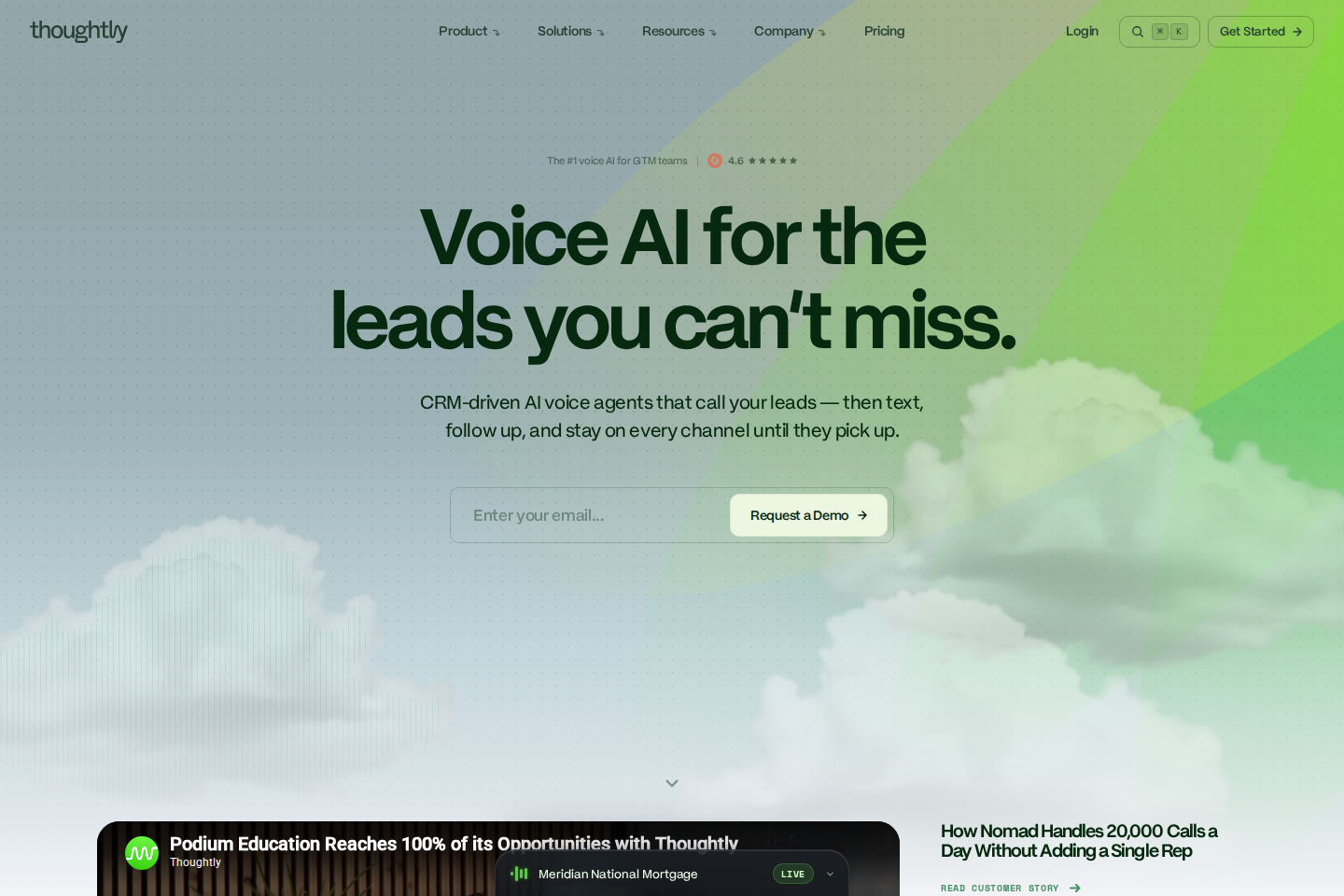
Thoughtly is the platform I kept coming back to because it does what most virtual receptionists promise but rarely deliver: answer the call, qualify the lead, book the meeting, update the CRM, and follow up by SMS and email — all without a human touching the workflow. It is built for revenue teams that run high-volume inbound funnels in industries like insurance, mortgage, real estate, home services, education, and financial services.
What separates Thoughtly from the rest of this list is that it does not stop at the phone call. After qualifying a lead on the call, Thoughtly can send an SMS confirmation, follow up with an email sequence, call back if the lead goes quiet, and write every interaction back to Salesforce, HubSpot, or GoHighLevel as a structured record. The agent carries context across conversations, so if a lead calls back three days later, the agent knows what was discussed and picks up where it left off.
Pros
Answers inbound calls within seconds and qualifies leads using configurable branching logic — not a rigid script.
Books appointments live on the call against Calendly, Cal.com, Acuity, or Google Calendar availability, with calendar invites sent before the caller hangs up.
Multi-channel follow-up: SMS, email, and re-engagement calls execute automatically after the initial conversation.
Native CRM write-back to Salesforce, HubSpot, GoHighLevel, Pipedrive, and Zoho — structured fields, not transcript dumps.
Supports warm transfer to human agents when the lead is qualified and ready for a live conversation.
Watch for
Requires upfront definition of qualification rules, escalation paths, and follow-up sequences to get the most value — this is not a plug-and-play voicemail replacement.
Best suited for teams with enough lead volume or workflow complexity to justify the automation investment. Very low-volume solo operators may find simpler tools sufficient.
Best fit
Revenue operations and GTM teams at companies generating 50+ inbound leads per week across high-consideration industries. If your funnel involves form fills, paid lead sources, or referral calls that need immediate qualification and booking, Thoughtly is the platform that closes the speed-to-lead gap across every channel.
Pricing
Starts at $0.07/min for voice. Total cost depends on call volume, channels, and integrations. Contact Thoughtly for a custom quote based on your lead volume and workflow requirements.
2. Smith.ai — Best for professional services firms needing hybrid AI + human reception
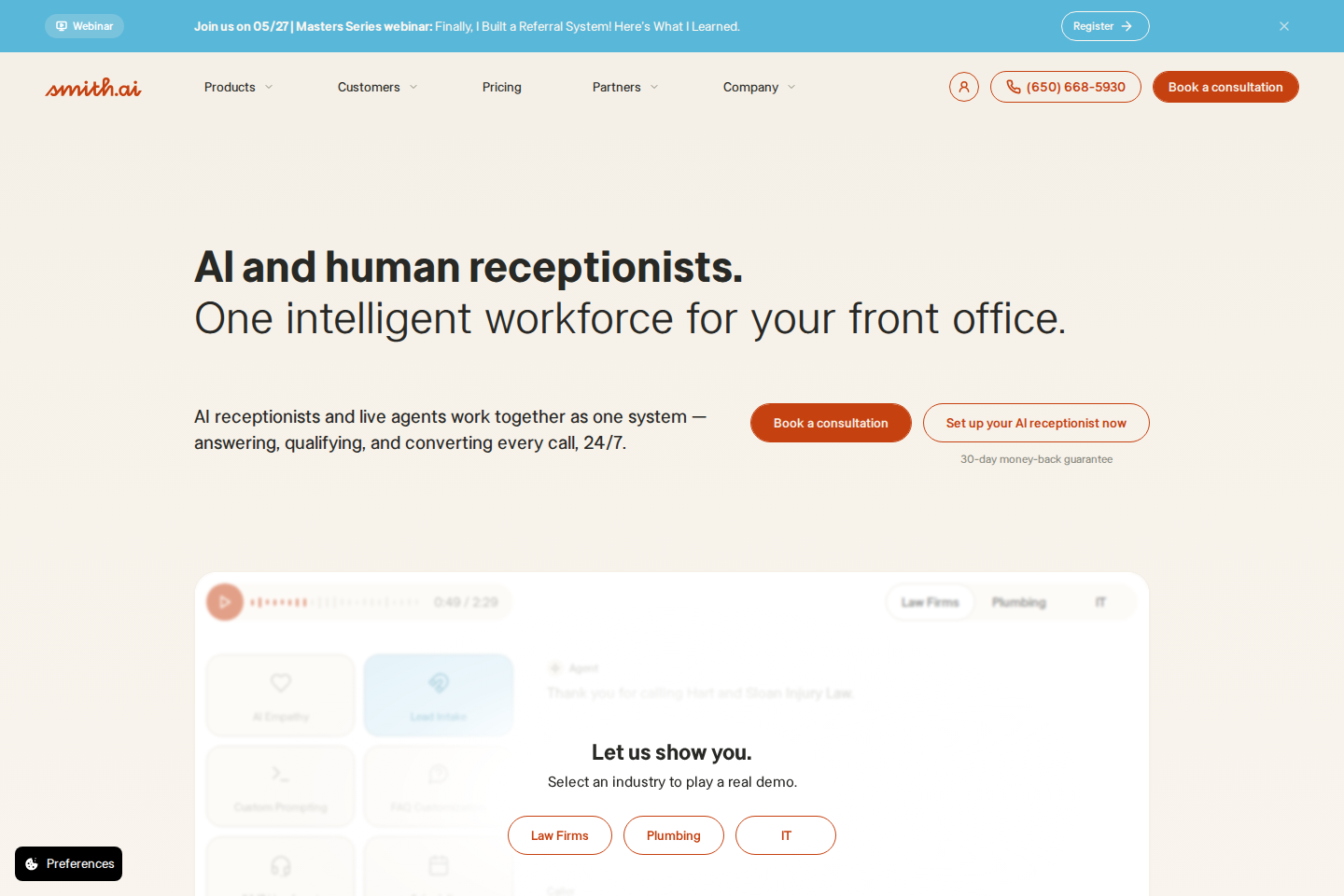
Smith.ai occupies a unique position in this market: it offers both an AI-only receptionist and a hybrid service where live North America-based receptionists handle calls with AI assistance. For law firms, medical practices, financial advisors, and consultancies where a mishandled intake call can cost thousands in lost revenue, the hybrid model provides a safety net that pure AI cannot match yet.
The AI receptionist tier handles routine calls — hours, directions, appointment booking — while the human tier handles complex legal intakeLegal intakeLegal intake captures a potential client’s matter details, urgency, location, eligibility, and preferred next step before routing.Read full definition →, empathetic client conversations, and multi-step qualification. Smith.ai integrates with Clio, Lawmatics, HubSpot, Salesforce, and most major CRMs. It also supports outbound follow-up calls and can collect consultation fees on the call.
Pros
Hybrid AI + human model ensures no call falls through the cracks, even for complex intake scenarios.
Bilingual receptionists (English and Spanish) available across all tiers.
Deep CRM integrations including Clio, Lawmatics, and Salesforce — purpose-built for legal and professional services workflows.
Can collect consultation fees and book appointments directly on the call, converting a call into a confirmed client.
Watch for
Per-call pricing adds up quickly at scale. The human tier starts at $300/month for only 30 calls, and overage fees make cost unpredictable for high-volume businesses.
AI-only tier requires detailed scripting to perform well. Reviewers on G2 note that without extensive script customization, the AI can struggle with nuanced conversations.
Primarily a receptionist service, not a multi-channel revenue execution platform. Follow-up after the call is limited compared to platforms that handle SMS, email, and re-engagement natively.
Best fit
Law firms, medical practices, and professional service firms with 20–100 calls per week where each call represents significant potential revenue. If your intake process requires empathy, legal conflict checking, or multi-step qualification, Smith.ai's hybrid model earns its premium.
Pricing
AI receptionist starts at $95/month for 50 AI-handled calls. Human virtual receptionist starts at $300/month for 30 calls. Higher tiers available with custom CRM integrations and intake workflows.
3. Ruby — Best for high-touch firms that prioritize branded human warmth
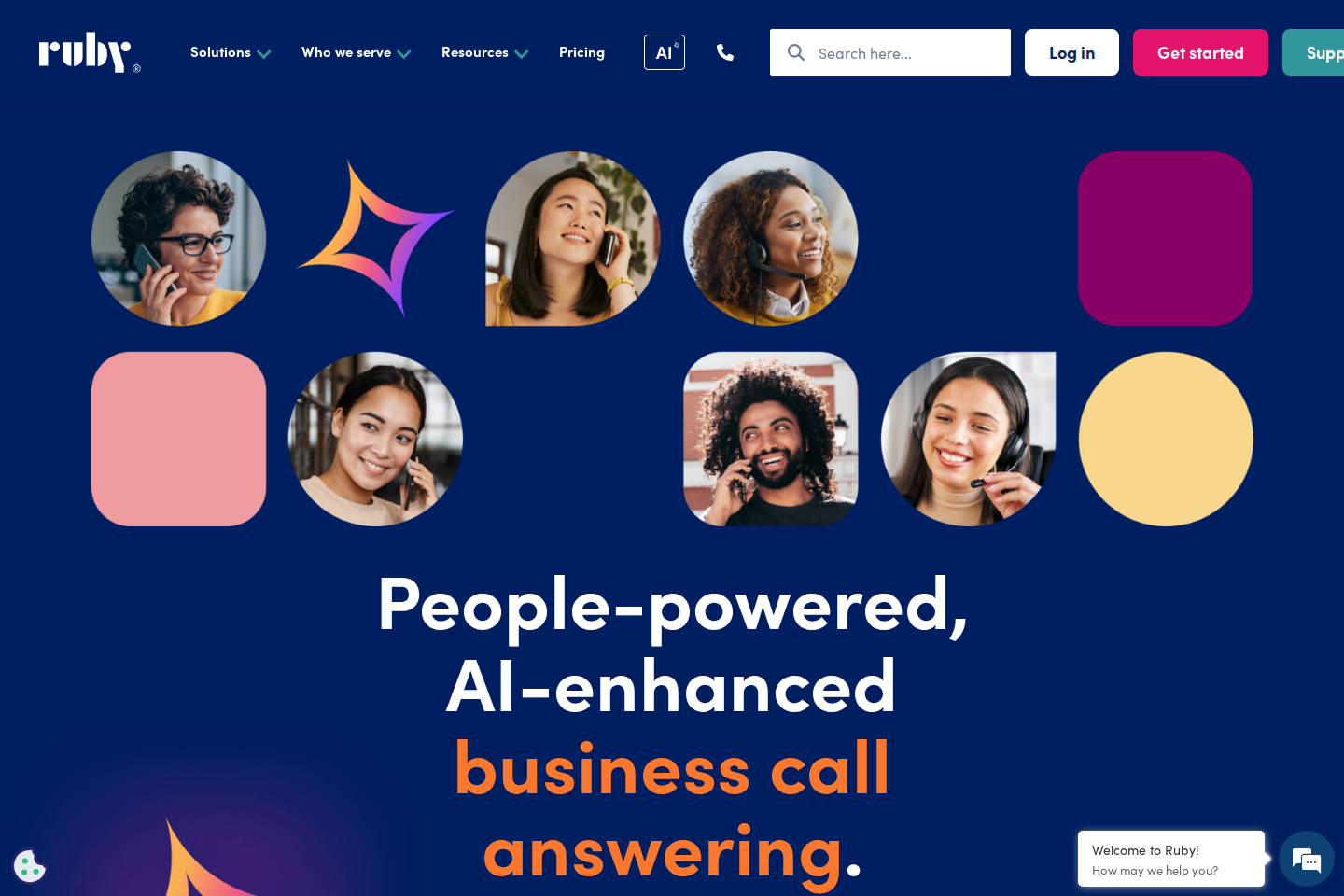
Ruby has built its reputation on one thing: making every caller feel like they reached a real, friendly, knowledgeable person at your company. Ruby's team of US-based receptionists answers calls with your company greeting, follows custom scripts, books appointments, qualifies leads, and transfers warm calls to your team. They consistently earn exceptional reviews — 4.8/5 on Trustpilot and 4.7/5 on G2.
Ruby is not an AI platform. It is a premium human receptionist service that has started layering AI features into its offering, including a virtual assistant for chat. For firms where the first-call experience defines whether a prospect becomes a client — high-end legal, boutique consulting, wealth management — Ruby's human touch is hard to replicate with any AI.
Pros
Exceptional caller experience — Ruby's receptionists are trained to match your brand voice and handle calls with genuine warmth.
Consistent review scores (4.8 Trustpilot, 4.7 G2) across thousands of reviews, with praise for professionalism and reliability.
Appointment scheduling, lead intake, and outbound call assist available on Growth and Expand tiers.
Watch for
Per-minute pricing model means costs scale linearly with call volume. A busy service business can blow through the $235/month Grow tier in a week during peak season.
No AI-only tier. Every call is handled by a human, which means Ruby cannot offer the instant, simultaneous call handling that AI platforms provide.
Limited post-call automation. Ruby takes the call and routes information, but does not execute multi-channel follow-up sequences like SMS, email, or re-engagement calls.
Best fit
Boutique law firms, wealth management practices, high-end consulting firms, and any business where the quality of the first human interaction is the primary conversion driver. If you are willing to pay a premium for guaranteed human warmth and brand representation, Ruby delivers.
Pricing
Grow plan starts at $235/month for 50 receptionist minutes. Growth plan at $370/month for 100 minutes with lead qualification and intake. Expand plan at $720/month for 200 minutes.
4. Allô — Best for small businesses wanting flat-rate, predictable pricing
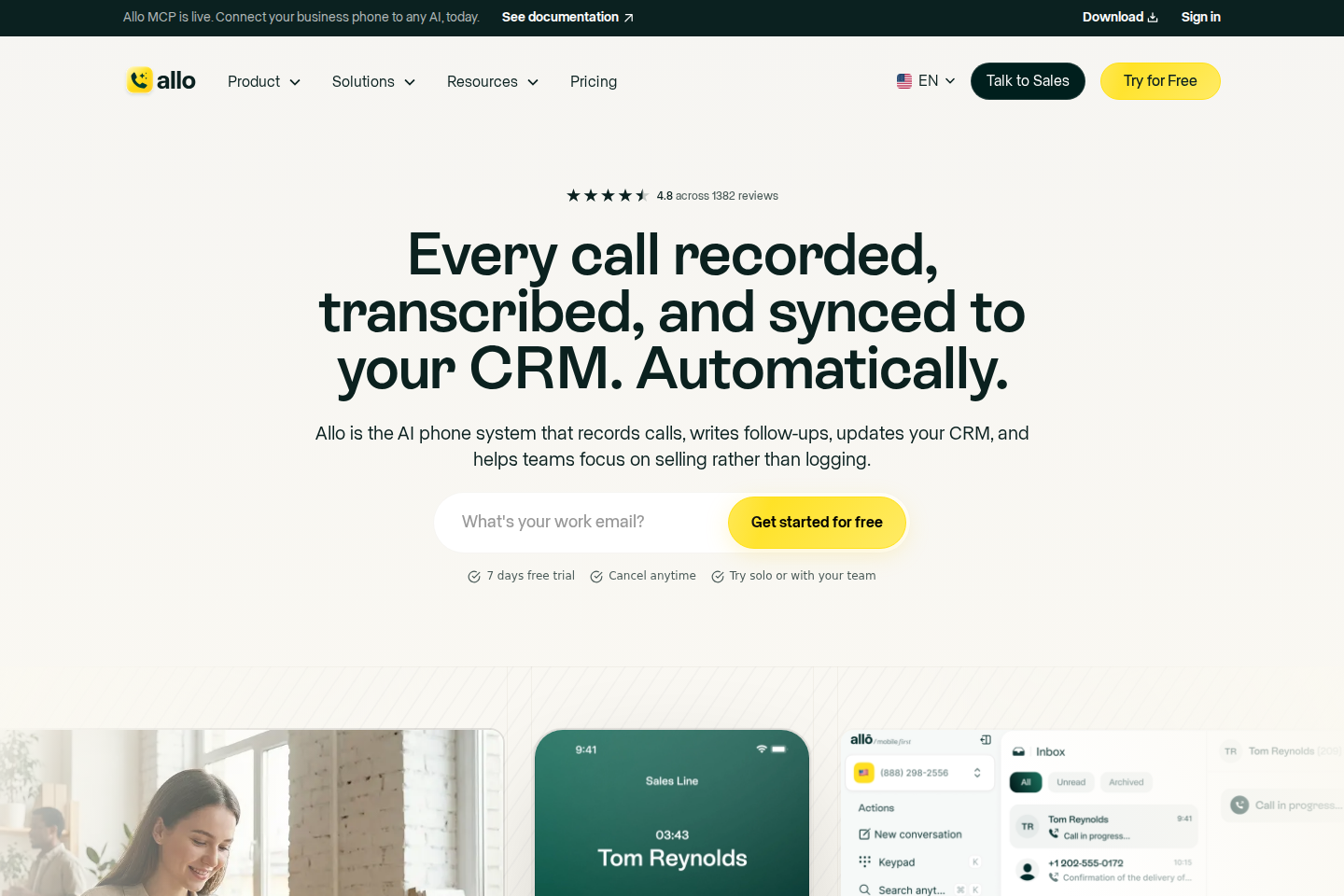
Allô takes a fundamentally different approach to pricing than most virtual receptionist services: flat-rate monthly plans with unlimited calls, no per-minute charges, and no overage fees. For small businesses tired of per-call bill shock from Smith.ai or per-minute anxiety from Ruby, Allô offers genuine cost predictability.
The platform handles inbound call answering, lead qualification, appointment booking, spam filtering, call summaries, and CRM integrationCRM integrationA CRM integration connects an agent or communications platform with a CRM so the systems can exchange records, events, and actions.Read full definition →. It supports English, French, and Spanish. The AI voice quality is natural enough for routine calls, and the setup process is straightforward — most businesses can be live within 15 minutes.
Pros
Flat-rate pricing with unlimited calls eliminates bill shock and makes monthly costs completely predictable.
Full feature set included on all plans: AI summaries, CRM integrations, call recording, appointment booking. No feature gating behind enterprise tiers.
Multi-language support (English, French, Spanish) without add-on charges.
Automatic spam filtering keeps your call log clean and your metrics accurate.
Watch for
Newer platform with a smaller customer base than established players like Smith.ai or Ruby. Limited independent review coverage on G2 or Trustpilot as of mid-2026.
Conversation depth may not match Smith.ai's human receptionists for complex legal intake or highly emotional calls. Best suited for routine qualification, not edge-case empathy.
Best fit
Small service businesses — contractors, clinics, salons, agencies — that handle 20–200 inbound calls per week and want all-inclusive AI reception without worrying about per-call or per-minute charges. If cost predictability matters more than having a human on every call, Allô is the most straightforward option.
Pricing
Flat-rate plans starting around $49/month with unlimited calls. All features included. No setup fees, no contracts.
5. GoodCall — Best for budget-conscious small businesses needing basic AI call answering
GoodCall is one of the most affordable AI phone agents available, designed specifically for small businesses that need to stop missing calls without spending hundreds per month. It handles inbound call answering, basic lead capture, FAQ responses, appointment booking, and message delivery via SMS, email, or Google Sheets.
The platform integrates with Google Business Profile, which is useful for local service businesses that get leads through Google Maps and search. Setup is simple — you describe your business, set your hours, define common questions, and GoodCall starts answering. The AI quality is functional for routine calls, though it retains a slightly mechanical tone that callers may notice on longer conversations.
Pros
Affordable entry point at $59/month — accessible for solo operators, freelancers, and early-stage businesses.
Google Business Profile integration captures leads from your Google Maps listing and routes them through the AI agent.
Simple setup process that does not require technical expertise or extensive scripting.
Watch for
Voice quality is functional but noticeably more robotic than premium platforms. Callers on longer or more nuanced calls may realize they are speaking to AI.
Limited conversation depth — GoodCall handles routine questions well but struggles with multi-step qualification, branching logic, or complex intake scenarios.
The unique-caller pricing model can become expensive for high-volume businesses compared to minute-based or flat-rate alternatives.
Best fit
Solo operators, freelancers, and small service businesses with fewer than 50 inbound calls per week. If your primary need is to stop missing calls and capture basic contact information, GoodCall is the lowest-friction starting point.
Pricing
Starter plan at $59/month for 100 unique callers. Growth plan at $99/month for 250 unique callers. Scale plan at $199/month for 500 unique callers.
6. Abby Connect — Best for legal firms and professional services needing trained human intake
Abby Connect has served law firms, real estate offices, and franchise operations for over 20 years with dedicated human receptionist teams. In 2025, they launched Abby AI Receptionist — an AI-powered answering service built on two decades of call handling data. The combination of their institutional legal intake expertise and newer AI capabilities makes them a credible choice for professional service firms.
Abby's human receptionists are trained on legal conflict checking, client intake forms, Clio integration, and bilingual reception. The newer AI tier offers 24/7 call answering, lead capture, and appointment booking at a lower price point than the full human service. For firms that want to start with AI and escalate to humans when needed, Abby offers both.
Pros
Two decades of legal and professional services intake expertise — the human receptionists understand legal workflows, conflict checks, and client sensitivity.
Bilingual reception (English and Spanish) available on all tiers.
Integrations with Clio, Lawmatics, and other legal practice management tools.
AI tier launched in 2025 provides a lower-cost entry point with 24/7 coverage.
Watch for
Human receptionist plans are expensive: $329/month for 100 minutes. A busy law firm can exhaust that budget quickly, and overage rates are not transparent.
The AI product is a newer addition to a legacy human service — it may not yet match the maturity of AI-native platforms in conversation depth or integration flexibility.
Primarily focused on legal and professional services. Businesses outside these verticals may find the intake workflows less relevant.
Best fit
Small to mid-size law firms, real estate offices, and professional service firms that need proven human intake expertise with an AI option for after-hours or overflow coverage. If your firm runs on Clio and needs conflict-aware intake, Abby Connect understands the workflow.
Pricing
AI Receptionist starts with a freemium plan (limited minutes). Human receptionist plans start at $329/month for 100 minutes. Custom plans available for higher volume.
7. Rosie AI — Best for after-hours coverage and voicemail replacement
Rosie AI is the simplest platform on this list, and that is its strength. If your business currently sends missed calls to voicemail and you want to upgrade to something that answers, has a basic conversation, captures the caller's name and reason for calling, and sends you a summary via SMS and email — Rosie does that with zero technical setup.
Rosie is not a lead qualification engine. It does not do branching logic, CRM write-back, appointment booking, or multi-channel follow-up. What it does is replace the experience of a missed call going to voicemail with an AI that answers, converses naturally, and captures the lead details. For businesses that are currently losing every after-hours call, Rosie is a meaningful first step.
Pros
Zero-friction setup — you can be live in minutes without any technical expertise.
Natural, friendly voice tone that is a significant upgrade over voicemail silence.
Immediate call summaries delivered via SMS and email keep you informed even when you are offline.
Watch for
Conversation depth is shallow. Rosie handles basic information capture but struggles with complex multi-step qualification, objection handling, or nuanced intake scenarios.
Limited integrations beyond basic SMS and email notifications. No native CRM write-back, no calendar booking, no workflow triggers.
Not a replacement for a real virtual receptionist if your qualification workflow involves more than capturing a name, phone number, and reason for calling.
Best fit
Solo operators and small service businesses that are currently relying on voicemail and want the simplest possible upgrade. Contractors, tradespeople, and local businesses that miss 10–30 calls per week after hours will see immediate value. Treat Rosie as step one, and consider Thoughtly or Smith.ai when your lead volume justifies deeper qualification.
Pricing
Starts around $49/month. Simple pricing without complex tiers.
Which AI virtual receptionist should you choose?
The right choice depends on three variables: how complex your lead qualification needs to be, how many channels you want covered after the call, and how much you are willing to spend per lead.
If your team generates 50+ inbound leads per week and needs a virtual receptionist that qualifies, books, follows up, and writes everything back to the CRM — Thoughtly is the platform built for that workflow. It replaces the front desk, the SDR, and the follow-up sequence with a single system.
If your business is a law firm or professional service practice where empathy and human judgment on intake calls are non-negotiable, Smith.ai or Abby Connect provide the hybrid human+AI safety net. Smith.ai has the broader AI offering; Abby Connect has deeper legal-specific workflow expertise.
If you want the warmest, most polished human receptionist experience and budget is secondary, Ruby remains the gold standard for human reception — but expect to pay for it, and expect no AI automation after the call.
If you need flat-rate AI reception with no bill surprises, Allô is the most cost-predictable option for small teams.
If you are a solo operator on a tight budget, GoodCall is the most accessible starting point. If you just want to stop losing after-hours calls to voicemail, Rosie AI is the simplest first step.
FAQ
What is an AI virtual receptionist?
An AI virtual receptionist is an automated system that answers inbound phone calls using artificial intelligence. It can greet callers, answer common questions, qualify leads by asking structured questions, book appointments against live calendar availability, and route urgent calls to a human team member. Unlike voicemail, an AI virtual receptionist engages in natural conversation and captures structured data from every call.
How is an AI virtual receptionist different from a traditional answering service?
A traditional answering service uses human operators to answer calls — which means limited hours, per-minute billing, and inconsistent quality depending on the operator. An AI virtual receptionist provides 24/7 coverage, answers instantly without hold times, handles unlimited simultaneous calls, and costs a fraction of human services at scale. The tradeoff is that AI may struggle with highly emotional calls, complex edge cases, or situations requiring genuine empathy.
Can an AI virtual receptionist really qualify leads effectively?
Yes, for structured qualification workflows. Modern AI virtual receptionists can ask branching questions based on caller responses, capture answers in structured data fields, score leads against defined criteria, and route high-intent callers directly to a human agent for live conversion. For industries with clear qualification parameters — insurance, mortgage, home services, legal intake — AI qualification is highly effective and often faster than human qualification.
What should I look for when choosing an AI virtual receptionist for lead qualification?
Focus on five capabilities: (1) instant answer speed with 24/7 availability, (2) configurable qualification logic with branching questions, (3) live appointment booking against your calendar, (4) native CRM integration that writes structured fields — not just transcripts, and (5) post-call follow-up via SMS, email, or re-engagement calls. If a platform does not cover at least the first four, it is an answering service, not a lead qualification tool.
How much does an AI virtual receptionist cost?
Pricing varies widely. AI-only services range from $49–$99/month for basic plans (GoodCall, Allô, Rosie AI) to usage-based pricing starting at $0.07/min (Thoughtly). Hybrid AI + human services start at $95–$329/month for limited call volumes (Smith.ai, Abby Connect). Human-only services like Ruby start at $235/month for 50 minutes. Total cost depends on call volume, qualification complexity, and whether you need multi-channel follow-up after the call.