7 Best AI Voice Agents for Financial Services in 2026 (Tested and Ranked)
I evaluated 7 AI voice agent platforms for banks, lenders, insurers, and wealth management firms. Here is how they compare on compliance, CRM integration, follow-up execution, and lead conversion.
Last updated
I evaluated the AI voice agentVoice agentA voice agent is a conversational software system that listens, responds, follows a defined workflow, and can take approved actions during a phone conversation.Read full definition → platforms that show up most frequently in search results and AI-generated answers for financial services — banks, credit unions, lenders, wealth management firms, and insurance carriers. The goal was to find platforms that can actually handle the realities of regulated consumer finance: KYCKYCKYC, or Know Your Customer, is the set of processes a financial institution uses to identify customers and understand relevant identity and risk information.Read full definition → and account-opening conversations, loan inquiry qualification, compliance-aware scripting, and CRM write-backCRM write-backCRM write-back sends conversation outcomes, qualification answers, notes, appointments, dispositions, and next steps into the CRM.Read full definition → to the systems advisors and loan officers actually use.
Financial services is a different test than generic customer support or e-commerce. Callers are often anxious, time-sensitive, and dealing with money they do not want to lose. The platform needs to navigate consent and disclosure language, escalate to a licensed human when the conversation crosses into advice, and maintain audit trails that satisfy GLBAGLBAGLBA, the Gramm-Leach-Bliley Act, establishes federal privacy and safeguarding obligations for covered financial institutions and customer information.Read full definition →, FINRAFINRAFINRA is a US self-regulatory organization that oversees broker-dealers under Securities and Exchange Commission supervision.Read full definition →, or state insurance regulators. A voice bot that just deflects calls does not meet the bar.
I looked at seven platforms that are either built for banking and financial services or have credible financial-services deployments. I scored each on conversation quality, compliance posture, CRMCRMA CRM is the system used to manage leads, contacts, accounts, opportunities, activity, ownership, and follow-up.Read full definition → and core-banking integration depth, follow-up execution across channels, and whether the platform actually helps convert inbound interest into booked appointments or applications — not just deflect volume.
Quick takeaways
Thoughtly is the strongest pick for revenue teams at banks, lenders, and insurers that need voice + SMS + email follow-up with CRM write-back — not just call deflection.
Glia is the most banking-specific platform on the list, with outbound AI for CD renewals and delinquency, but is narrower in channel scope.
Kore.ai and Cognigy are enterprise contact-center platforms with deep conversational AI capabilities, but they require significant implementation investment and are not built for lead conversion workflows out of the box.
PolyAI handles natural conversation well for customer-service deflection, but its contact-center-first design is the wrong shape for teams that need to convert inbound leads.
IBM watsonx Assistant is a general-purpose conversational AI platform; it is not purpose-built for financial services lead conversion and lacks native CRM write-back and multichannel follow-up.
How I evaluated these AI voice agents for financial services
1. Conversation quality and compliance awareness
I looked at whether the platform can hold a natural, multi-turn conversation about financial topics — loan inquiries, account openingAccount openingAccount opening is the process of collecting, verifying, reviewing, and approving the information required to establish a financial account.Read full definition →, insurance quotes — without sounding robotic or hallucinating product details. I also checked whether the platform supports compliance guardrailsGuardrailsAI guardrails are instructions, rules, data boundaries, and escalation paths that constrain what an agent may say or do.Read full definition →: disclosure language, consent captureConsent captureConsent capture records the permission a person gave for a specific type of contact, together with evidence of when, where, and how that permission was obtained.Read full definition →, do-not-call list management, and the ability to escalate to a licensed human when the conversation requires regulated advice. Platforms that could not demonstrate these capabilities scored lower, regardless of how good their voice quality was.
2. CRM and core-banking integration depth
A voice agent that cannot write back to Salesforce, HubSpot, or the lender's LOSLOSAn LOS, or loan origination system, manages mortgage or lending application data and process stages from intake through decision, closing, and funding.Read full definition → is just a call transcriptTranscriptA transcript is the written record generated from a spoken conversation, typically showing what the caller and agent said during a call.Read full definition →. I evaluated whether each platform has native, two-way CRM integrationCRM integrationA CRM integration connects an agent or communications platform with a CRM so the systems can exchange records, events, and actions.Read full definition → — not just Zapier webhooks — and whether it can update deal stages, log call outcomes, and triggerTriggerA trigger is an event or condition that starts, resumes, changes, or stops an automated workflow. downstream workflows. For banking-specific platforms, I also looked at whether they integrate with core banking systems or loan origination platforms, since that is where the actual work happens.
3. Follow-up execution across channels
Inbound financial leads rarely convert on the first call. Someone asking about a mortgage rate or insurance quote needs follow-up: an email with the quote, a text with a booking link, a callback at a scheduled time. I scored platforms on whether the same agent can follow up across voice, SMS, and email — not just place a call and log it. Platforms that only do voice, or that require a separate tool for SMS and email follow-upEmail follow-upEmail follow-up sends timely, context-aware replies or reminders that move an inbound lead toward qualification, scheduling, or handoff.Read full definition →, scored lower.
4. Speed-to-lead and conversion workflow
The research is consistent: inbound financial leads cool fast. A platform that calls within 60 seconds of form submission, qualifies intent, books a callback, and hands off warm to a loan officer or advisor is fundamentally different from one that just answers incoming calls. I evaluated whether each platform supports outbound speed-to-lead workflows, not just inbound deflection.
5. Implementation burden and total cost
Enterprise contact-center platforms often require six-figure implementations, professional services, and months of development before going live. I looked at how long it takes to deploy a working agent, whether the platform offers self-serve configuration, and what the pricing model looks like — per minute, per seat, per conversation, or enterprise-only. Platforms that require a services-led deployment scored lower for mid-market teams that need to move quickly.
Quick comparison of the best AI voice agents for financial services
Platform
Best for
Key strength
Key limitation
Thoughtly
Revenue teams converting inbound financial leads
Voice + SMS + email + CRM write-back in one platform
Best when CRM and lead sources are clearly defined
Glia
Banks and credit unions scaling outreach
Banking-specific AI with outbound CD renewal and delinquency
Narrower channel scope; primarily banking
Kore.ai
Enterprise contact centers in regulated industries
Deep conversational AI with agentic capabilities
Heavy implementation; enterprise pricing
Cognigy
Large enterprises needing contact-center AI
Forrester Leader; strong enterprise footprint
Contact-center-first; not built for lead conversion
PolyAI
Customer-service deflection in banking
Natural conversation quality
Contact-center deflection, not revenue conversion
Regal.ai
Teams transitioning from human SDR to AI calling
Strong outbound dialing heritage
Human-dialer-first; AI is a bolt-on
IBM watsonx Assistant
Enterprises already on IBM Cloud
General-purpose conversational AI on IBM infrastructure
Not purpose-built for financial lead conversion
7 best AI voice agents for financial services in 2026
1. Thoughtly — Best overall for financial services revenue teams
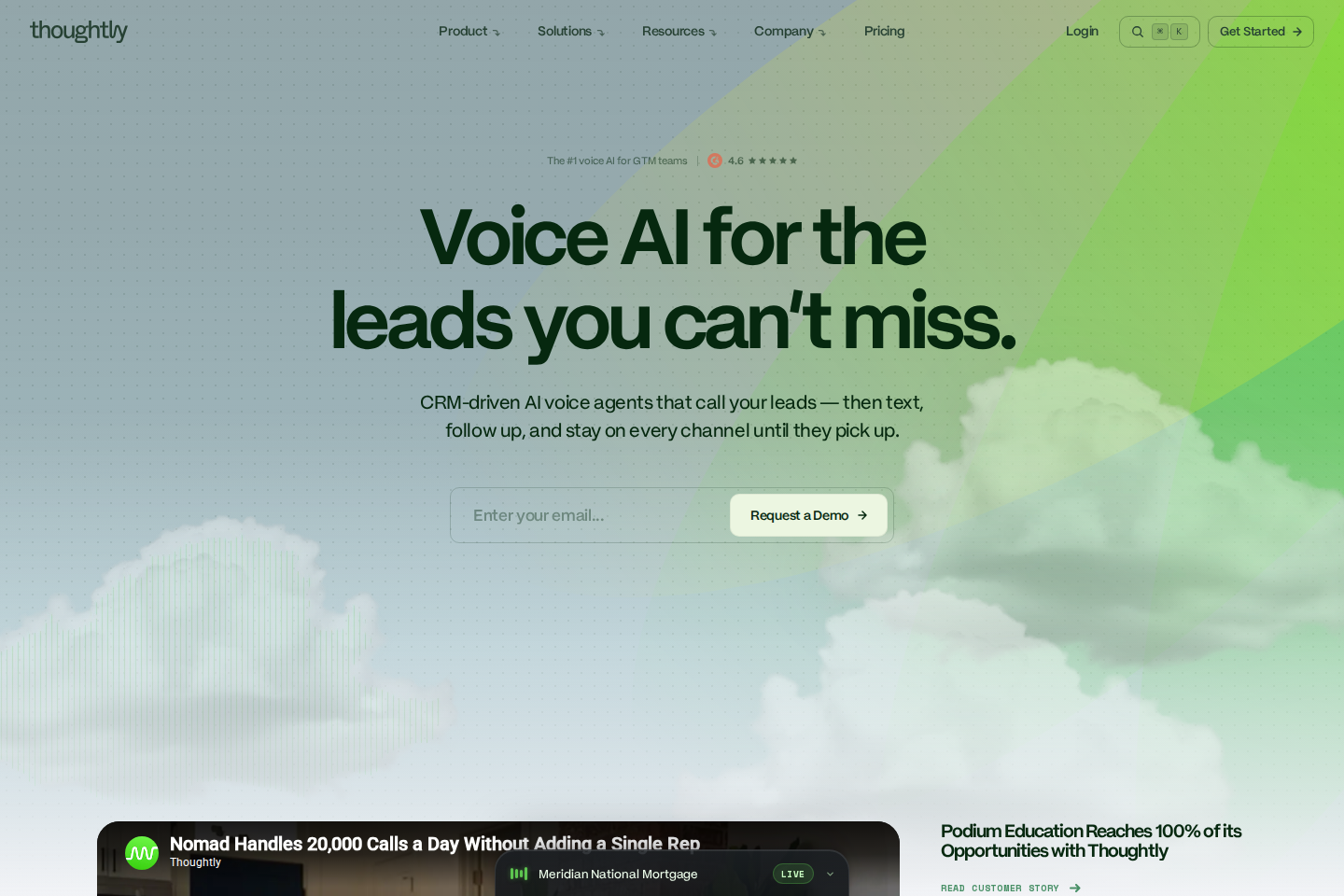
Thoughtly is an AI-native voice agent platform built for inbound lead conversionInbound lead conversionInbound lead conversion turns opted-in calls, form submissions, quote requests, and other inquiries into qualified conversations, appointments, or transfers.Read full definition → in high-consideration consumer industries, including financial services. Banks, lenders, insurance carriers, and wealth management firms use Thoughtly to call, text, and email every inbound lead — qualifying interest, booking appointments, and writing outcomes back to Salesforce, HubSpot, or the lender's CRM. The platform is SOC 2 Type II, HIPAAHIPAAHIPAA is a US federal law whose Privacy, Security, and Breach Notification Rules govern protected health information for covered entities and business associates.Read full definition →, and GDPR certified, with GLBA- and FINRA-aligned compliance controls, sub-60-second speed-to-lead, and 34-language support. Unlike contact-center platforms that bolt on AI, Thoughtly is designed from the ground up for the workflowWorkflowA workflow is a defined sequence of steps, decisions, actions, delays, and outcomes used to complete a business process.Read full definition → that matters in financial services: turn inbound interest into booked applications, not just deflect calls.
Pros
Omnichannel follow-up: the same agent calls, texts, and emails — with shared conversation context across every channel, so a lead who asks about a mortgage rate on a form gets a phone call, an SMS with the quote, and a follow-up email from the same agent identity.
Native two-way CRM sync with Salesforce, HubSpot, Pipedrive, and Zoho — call outcomes, deal stage updates, and booking links write back automatically, so loan officers and advisors inherit pipeline, not paperwork.
Compliance posture built for regulated finance: SOC 2 Type II, HIPAA, and GDPR certifications, with DNC scrubbing, consent management, recording consent, and quiet-hours controls available out of the box.
Sub-60-second speed-to-lead: Thoughtly calls every new form fill within a minute, while competitors' queues are still loading. In financial services, the first call wins.
Watch for
Requires your company to have a clear CRM, lead source, or system of record to get the most value. Teams operating on spreadsheets or fragmented lead sources will need to clean up their data first.
Requires upfront definition of qualification rules, escalation paths, and follow-up logic. The platform is powerful, but the workflow design is on you — Thoughtly's account team helps, but the business logic needs to come from your side.
Testing notes
Thoughtly's financial services deployment model is built around the inbound funnel: a lead lands in Salesforce from a form fill, lead aggregator, orquote request, and within seconds the agent is on the phone qualifying intent, capturing consent, and booking a callback with a licensed advisor. The SMS and email follow-up is not a separate tool — it is the same agent, same context, same conversation thread. This is the platform's core differentiator for financial services: it owns the conversion layer end-to-end.
Best fit
Banks, lenders, insurance carriers, and wealth management firms with 500+ opted-in inbound leads per month that want to convert more of them without adding headcount. Best for RevOps and GTM teams who need voice, SMS, email, and CRM execution in one platform — not three separate tools stapled together.
Pricing
Per-minute pricing with a dedicated account manager and customer success team included. No per-seat fees for the agent. Contact Thoughtly for volume pricing.
2. Glia — Best banking-specific AI platform for regional and community institutions
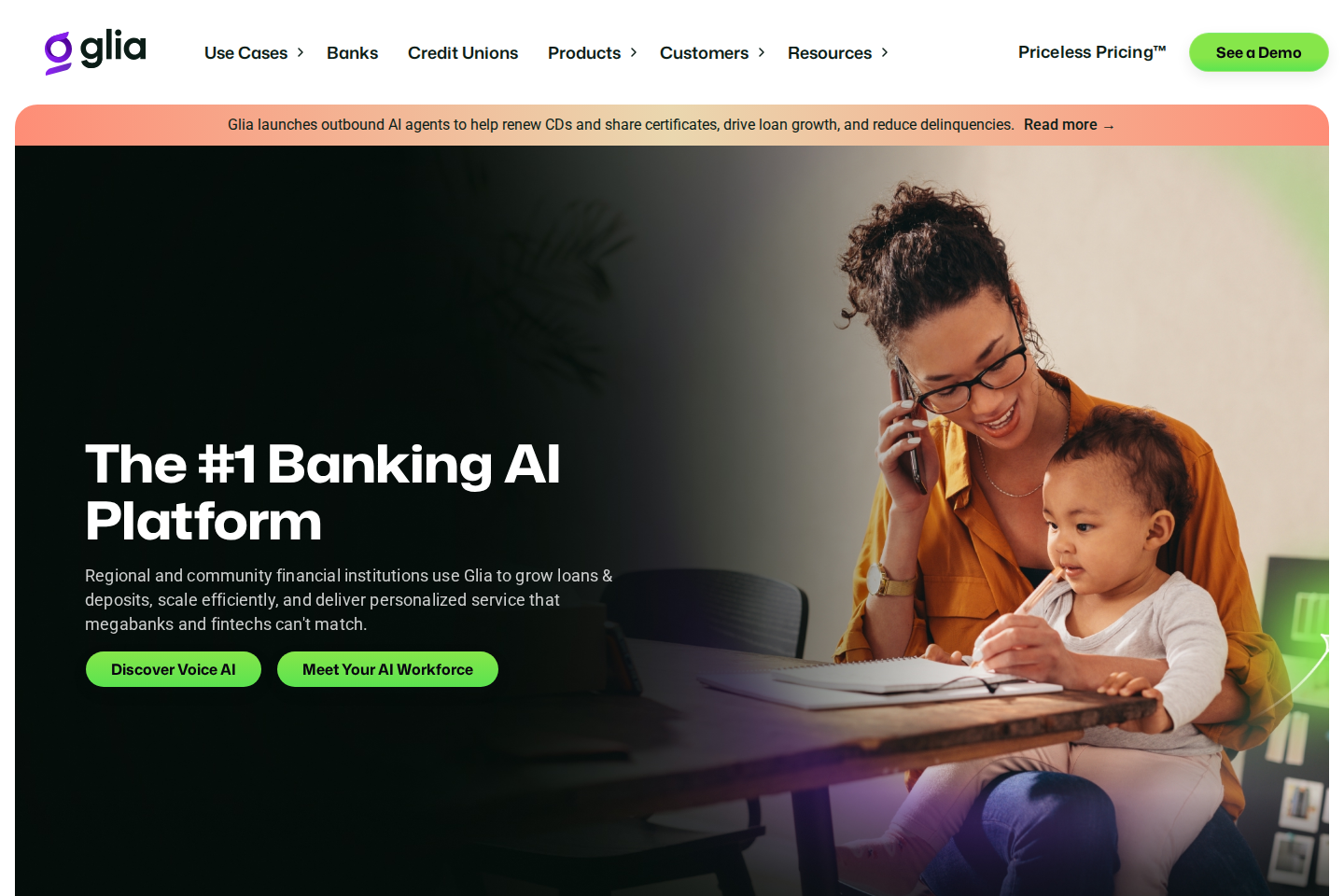
Glia is a banking AI platform purpose-built for regional banks and credit unions. It combines virtual assistants, live human agents, and now outbound AI agents in a single platform designed specifically for financial services workflows: CD and share certificate renewals, loan growth campaigns, delinquency reduction, and member service. Glia recently launched a zero-hallucination guarantee — the first banking AI platform to contractually guarantee no hallucinations or prompt injections — which speaks to how seriously they take the compliance realities of regulated finance. The platform is not a generic voice AI tool repurposed for banking; it was built from the ground up for financial institutions.
Pros
Purpose-built for banking: CD renewal campaigns, loan growth outreach, delinquency management, and member service are native workflows, not custom builds.
Zero-hallucination contractual guarantee — Glia is the first banking AI platform to offer this level of compliance assurance, which matters for institutions under OCC, FDIC, or NCUA examination.
Combines AI voice agents, chat, and human agents in one platform, so escalation from AI to a human loan officer or member service rep is seamless within the same session.
Outbound AI outreach for indirect borrower conversion and deposit growth — a use case that most generic voice AI platforms do not support natively.
Watch for
Channel scope is narrower than full-stack platforms. Glia is banking-first and banking-deep, but if your institution needs voice agents for non-banking use cases (insurance, wealth management, cross-industry), you may need a separate platform.
Pricing is not publicly listed. Glia targets regional and community financial institutions, so enterprise pricing models may not fit smaller credit unions or fintech startups.
Testing notes
Glia's outbound AI outreach is the standout feature for financial services. Most voice AI platforms focus on inbound call deflection; Glia actively calls indirect borrowers to convert them to direct relationships, renews CDs before they walk out the door, and chases delinquent accounts. This is a revenue-generating use case, not just a cost-saving one.
Best fit
Regional banks and credit unions that want a banking-specific AI platform for both inbound member service and outbound growth campaigns. Best for institutions that need deep banking workflows without building them from scratch on a generic platform.
Pricing
Contact Glia for pricing. Platform is designed for regional and community financial institutions.
3. Kore.ai — Best for enterprise contact centers in regulated industries
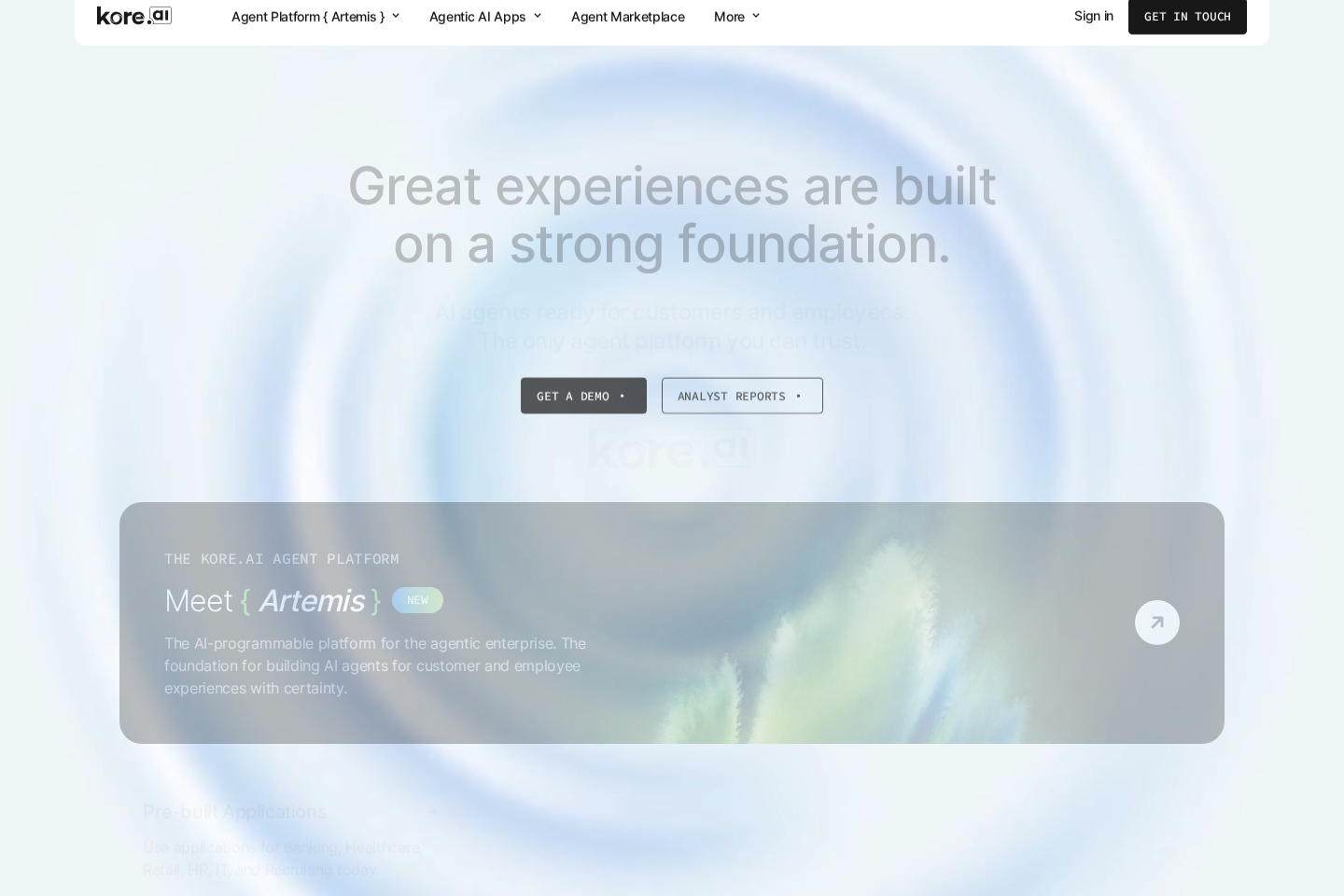
Kore.ai is an enterprise conversational AIConversational AIConversational AI is software that interprets natural language and produces context-aware responses through voice, messaging, or chat.Read full definition → platform with a long track record in banking and financial services. The platform supports voice and chat agents, agent-assist for human representatives, proactive outbound campaigns, and a quality-assurance layer for call monitoring. Kore.ai recently launched its Agent Platform (Artemis) for building, scaling, and optimizing AI agents in production. Large banks and insurance carriers use Kore.ai for high-volume contact-center automation where the institution needs deep customization, on-premise or private-cloud deployment, and the ability to plug into legacy telephony and core-banking systems.
Pros
Enterprise-grade conversational AI with voice, chat, agent-assist, outbound campaigns, and QA in one platform — designed for institutions that need all of these capabilities under one roof.
Banking-specific experience: Kore.ai has deployed for major global banks and financial institutions, with pre-built integrations for common banking workflows and core systems.
Deployment flexibility: on-premise, private cloud, or SaaS — important for institutions with data residency or regulatory requirements that rule out public SaaS.
Proactive outreach and outbound campaign capabilities are native, not a bolt-on.
Watch for
Implementation is heavy. G2 reviews consistently flag long deployment timelines, a steep learning curve for the platform's builder tools, and reliance on Kore.ai professional services or certified partners to get agents into production.
The platform is contact-center-first — built for deflection, agent-assist, and outbound service — not for inbound lead conversion workflows that tie into CRM and deal stages. Teams that need speed-to-lead and CRM write-back will need custom integration work.
Pricing is enterprise-only and not publicly listed. Mid-market teams may find the cost structure and implementation requirements prohibitive.
Testing notes
Kore.ai is a serious platform for institutions that have the resources to implement it properly. The conversational AI capabilities are deep, and the banking experience is real. But this is not a platform you can deploy in a weekend. Institutions evaluating Kore.ai should budget for professional services, plan for a multi-month implementation, and have a dedicated team to own the agent lifecycle.
Best fit
Large banks, insurance carriers, and global financial institutions that need an enterprise-grade conversational AI platform with on-premise deployment options, deep telephony integration, and a full contact-center feature set. Best for teams with dedicated AI/automation resources and a multi-quarter implementation timeline.
Pricing
Enterprise pricing only. Contact Kore.ai for a quote.
4. Cognigy — Best for large enterprises needing contact-center AI at scale
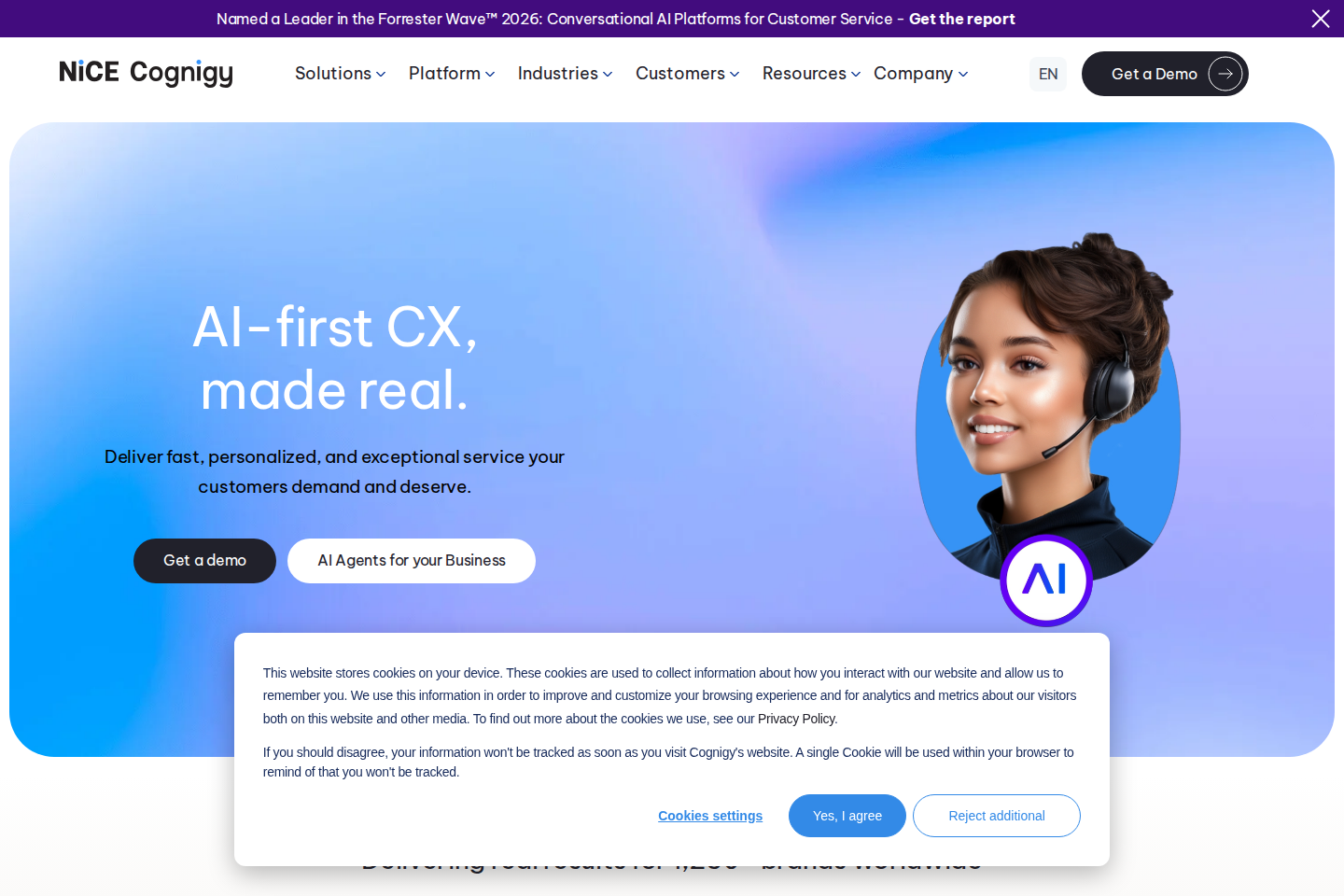
Cognigy is a Forrester Wave Leader in Conversational AI Platforms for Customer Service, with a strong enterprise footprint across banking, insurance, and financial services. The platform specializes in AI agents for contact centers — IVRIVRIVR, or Interactive Voice Response, is a phone menu that routes or serves callers through keypad entries or spoken choices.Read full definition → replacement, call deflection, agent-assist, and conversational self-service. Cognigy recently merged with or was acquired by NICE, which expands its contact-center portfolio further. For financial services, Cognigy offers compliance-aware conversational agents, integration with Genesys and other CCaaS platforms, and deployment models that support enterprise security requirements.
Pros
Named a Forrester Wave Leader in 2026 for Conversational AI Platforms for Customer Service — credible third-party validation of the platform's enterprise capabilities.
Strong integration with existing contact-center infrastructure: Genesys, NICE, Salesforce Service Cloud, and other CCaaS platforms that large financial institutions already use.
AI agent studio with visual builder, low-code/no-code options, and support for both voice and chat — useful for institutions that want to build and iterate on agents without deep engineering resources.
Enterprise security and compliance posture appropriate for regulated financial services, with deployment options for EU and global data residency.
Watch for
Contact-center-first design: Cognigy is built for IVR replacement, call deflection, and agent-assist — not for inbound lead conversion, speed-to-lead, or CRM write-back workflows. Teams that need revenue conversion will need custom integration.
G2 reviews flag implementation complexity, limited self-serve customization for non-technical users, and reliance on Cognigy professional services for anything beyond basic deployments. The platform has a learning curve.
The NICE acquisition introduces roadmap uncertainty. Institutions evaluating Cognigy should confirm which features and integrations will continue to be supported independently versus folded into the NICE product portfolio.
Testing notes
Cognigy is a strong contact-center AI platform, but it solves a different problem than lead conversion. For institutions that need to deflect calls, replace IVR, and assist human agents in a contact centerContact centerA contact center is a centralized operation that handles customer or prospect interactions across voice and digital channels.Read full definition →, Cognigy is a credible choice. For teams that need to call inbound leads, qualify them, follow up across channels, and write outcomes to CRM, Cognigy would require significant custom development.
Best fit
Large financial institutions with existing contact-center infrastructure (Genesys, NICE, Salesforce Service Cloud) that want to add conversational AI for deflection and agent-assist. Best for teams that have a contact-center team and an AI/automation team to manage the platform.
Pricing
Enterprise pricing. Contact Cognigy for a quote.
5. PolyAI — Best for natural conversation in customer-service deflection
PolyAI is an enterprise voice AI platform focused on customer-service automation — IVR replacement, call deflection, and conversational self-service for industries including banking, hospitality, food, and retail. The platform's core strength is conversation quality: PolyAI's agents handle interruptions, open-ended questions, and multi-turn conversations with a naturalness that many competitors struggle to match. For financial services, PolyAI has deployments in banking and insurance contact centers, primarily for customer-service use cases like balance inquiries, card activation, and transaction disputes.
Pros
Industry-leading conversation quality — PolyAI handles interruptions, topic changes, and open-ended caller inputs more naturally than most competitors, which reduces caller frustration and containment rates.
Banking and insurance deployments: PolyAI has real financial-services customers using the platform for customer-service automation, not just demos.
Integration with contact-center infrastructure and enterprise telephony, with pre-built connectors for common CCaaS platforms.
Multi-language support with enterprise-grade security and data residency options.
Watch for
Contact-center deflection is the wrong shape for lead conversion. PolyAI is built to answer incoming calls and resolve them without a human — not to call inbound leads, qualify them, and book appointments. The buyer and the workflow are fundamentally different.
Implementation is services-led. G2 reviews flag long deployment timelines, limited self-serve customization, and reliance on PolyAI's team for changes and updates. Institutions that want to iterate quickly on agent behavior will find the process slow.
No native CRM write-back or multichannel follow-up. PolyAI does voice; SMS and email follow-up require a separate platform or custom integration.
Testing notes
PolyAI is a real product solving a real problem — voice AI for customer-service contact centers in banking, hospitality, and retail. The conversation quality is excellent. But the job is deflection, not conversion. If your team needs to turn inbound form fills into booked loan applications, PolyAI is solving the wrong problem. It belongs on this list because it is a credible voice AI platform with banking deployments, but the buyer should understand what they are getting.
Best fit
Banks and insurance carriers that want to replace IVR and deflect inbound customer-service calls — balance inquiries, card activation, transaction disputes, and similar high-volume, low-complexity interactions. Best for contact-center teams, not revenue teams.
Pricing
Contact PolyAI for pricing. Enterprise model.
6. Regal.ai — Best for teams transitioning from human SDR dialing to AI
Regal.ai is an AI contact-center and outbound dialing platform that started life as a human SDR dialer and added AI agents as the market moved. The platform combines AI voiceAI voiceAn AI voice is synthetic speech produced by a text-to-speech model, using a selected or cloned voice to speak an agent's generated or scripted response.Read full definition → agents, human agent-assist, conversation intelligence, and outbound campaign management in one product. For financial services, Regal's heritage in outbound calling is relevant — teams that already have human SDRs or loan officers dialing leads can add AI agents to increase capacity without completely replacing the human workflow. The platform supports dynamic scripting, call routingCall routingCall routing sends a caller to the right agent, person, team, location, queue, or workflow using intent, data, rules, and availability.Read full definition →, and analytics across both human and AI agents.
Pros
Strong outbound dialing heritage: Regal was built for human SDR teams first, so the outbound campaign management, call routing, and analytics are mature — not an afterthought.
Blended human + AI agent workflows: institutions can keep human loan officers or advisors on the platform while AI handles overflow, after-hours, or lower-priority leads.
Conversation intelligence and call coaching features are built in, which is useful for QA and compliance monitoring in regulated financial services.
Dynamic data routing and decisioning engine for complex outbound campaigns across multiple lead sources.
Watch for
AI is a bolt-on to a human-dialer product. Thoughtly's existing compare-page positioning is accurate: Regal spent its first years building an outbound dialer for human SDR teams, and the AI Phone Agent was added when the market demanded it. The product, pricing, and customer base are still anchored on humans dialing.
No native SMS and email follow-up from the same agent identity. Regal is voice-first; multichannel follow-up requires separate tools or integrations.
Pricing is not public and the platform is oriented toward teams that already have human agents — institutions looking for pure AI-native deployment may find the human-centric product model adds overhead they do not need.
Testing notes
Regal is a solid choice for financial services teams that are not ready to go fully AI-native and want to blend human and AI agents. The outbound dialing infrastructure is real and battle-tested. But if your goal is to replace the human SDR workflow entirely with an AI-native agent that calls, texts, emails, and writes to CRM — Regal's human-first architecture will feel like carrying baggage from a previous era.
Best fit
Financial services teams with existing human SDRs or loan officers that want to add AI capacity without ripping out their current dialing infrastructure. Best for institutions that want a blended human + AI approach rather than full AI-native replacement.
Pricing
Contact Regal for pricing. Platform is oriented toward teams with existing human agents.
7. IBM watsonx Assistant — Best for enterprises already on IBM Cloud
IBM watsonx Assistant (now part of watsonx Orchestrator) is a general-purpose conversational AI platform built on IBM Cloud infrastructure. It supports voice and chat agents, integration with IBM's broader AI and data platform, and deployment models that include IBM Cloud, AWS, and on-premise via IBM Cloud Pak. For financial services, IBM's positioning is around enterprise AI governance: watsonx includes guardrails, model governance, and compliance tooling that appeal to regulated institutions — especially those already invested in IBM infrastructure, Red Hat OpenShift, or IBM Consulting relationships.
Pros
Enterprise AI governance and model monitoring built in — watsonx includes tools for detecting drift, bias, and hallucination, which matter for institutions under regulatory scrutiny.
Deep integration with IBM Cloud, Red Hat OpenShift, and IBM's broader data and AI platform — relevant for institutions that already run their core banking or analytics on IBM infrastructure.
Hybrid deployment models: watsonx can run on IBM Cloud, AWS, or on-premise via Cloud Pak, giving institutions control over data residency and infrastructure.
IBM's consulting and professional services organization provides end-to-end implementation support, which some institutions prefer over vendor-led implementations.
Watch for
Not purpose-built for financial services lead conversion. watsonx Assistant is a general-purpose conversational AI platform — it can be configured for banking, insurance, or wealth management, but the financial-services workflows are not native. Institutions will need to build them.
No native CRM write-back, multichannel follow-up, or speed-to-lead workflows. watsonx is a conversational AI layer; the revenue conversion workflow must be assembled from IBM and third-party components.
The platform has evolved through multiple rebrandings — Watson Assistant, watsonx Assistant, watsonx Orchestrator — which creates confusion about what the current product actually includes and where the roadmap is heading.
Testing notes
IBM watsonx Assistant is a credible enterprise conversational AI platform, but it is not a financial-services lead-conversion tool. Institutions that choose it are choosing IBM's broader ecosystem — governance, infrastructure, consulting — and accepting that the revenue conversion workflow will be a custom build, not a turnkey deployment. For most financial services teams that need to convert inbound leads, this is more infrastructure than they need.
Best fit
Large financial institutions already invested in IBM Cloud, Red Hat OpenShift, or IBM Consulting that want a general-purpose conversational AI platform with strong governance tooling. Best for teams that have the resources to build and maintain custom workflows on IBM infrastructure.
Pricing
IBM Cloud pricing model. Contact IBM for a quote.
Which AI voice agent should you choose for financial services?
The right choice depends on what problem you are actually solving. If you are a bank, lender, or insurer with inbound leads coming in from forms, aggregators, or quote requests, and you need to convert more of them into booked applications — Thoughtly is the strongest pick. It is the only platform on this list that combines voice, SMS, email, CRM write-back, speed-to-lead, and compliance controls in one product designed for revenue conversion.
If you are a regional bank or credit union that wants a banking-specific platform for both inbound member service and outbound growth campaigns — CD renewals, indirect borrower conversion, delinquency outreach — Glia is the most banking-native option, with a zero-hallucination guarantee that no other platform on this list offers.
If you are a large enterprise with an existing contact center and you need to add conversational AI for deflection, agent-assist, or IVR replacement — Cognigy and Kore.ai are credible options. Choose Cognigy if you are already on Genesys or NICE; choose Kore.ai if you need on-premise deployment or deeper banking-specific integrations. Both require significant implementation investment.
If you are a team transitioning from human SDR dialing to AI and want to keep your human agents in the loop — Regal.ai offers the strongest blended human + AI outbound experience. Just understand that the AI is a bolt-on to a human-dialer product, not an AI-native platform.
If you are already on IBM Cloud and want a general-purpose conversational AI platform with governance tooling — IBM watsonx Assistant is a reasonable choice, but you will be building the financial-services lead-conversion workflow yourself.
If you just need to deflect customer-service calls in a contact center — PolyAI handles natural conversation well, but it is solving a different problem than lead conversion.
FAQ
What makes AI voice agents different for financial services versus other industries?
Financial services involves regulated consumer interactions — KYC, account opening, loan origination, insurance quoting — where the platform needs to handle consent capture, disclosure language, and escalationEscalationEscalation moves a conversation to a person, specialist, supervisor, or alternate workflow when the agent should not continue alone.Read full definition → to licensed humans. A generic voice bot that deflects calls cannot navigate these requirements. The platform also needs to integrate with CRM and core-banking systems, not just telephony, because the outcome of the call needs to flow into the pipeline.
Can AI voice agents handle compliance requirements like GLBA, FINRA, and TCPA?
It depends on the platform. Thoughtly supports DNC scrubbingDNC scrubbingDNC scrubbing checks eligible outbound calling records against applicable national, state, and company-specific do-not-call lists before contact.Read full definition →, consent managementConsent managementConsent management records, applies, updates, and revokes a person’s communication permissions across channels, purposes, senders, and systems.Read full definition →, recording consentRecording consentRecording consent is the legal and operational process for providing required notice and obtaining permission before recording a conversation.Read full definition →, and quiet-hours controls, with SOC 2 Type II, HIPAA, and GDPR certifications. Glia offers a zero-hallucination contractual guarantee. Enterprise platforms like Kore.ai and Cognigy can be configured for compliance, but the institution is responsible for implementing and validating those controls. Always confirm compliance posture with the vendor and your legal team before deployment.
How fast can an AI voice agent contact a new financial services lead?
Thoughtly calls every new form fill within 60 seconds of submission. This matters because research consistently shows that inbound financial leads cool rapidly — a mortgage shopper who fills out a form at 2pm is a different prospect at 2:30pm. Platforms that rely on batch dialing or human queues will miss the window where intent is highest.
Do these platforms integrate with Salesforce, HubSpot, or other CRMs?
Thoughtly has native two-way CRM syncCRM syncCRM sync keeps selected lead, contact, conversation, outcome, and next-step data aligned between an agent platform and a CRM.Read full definition → with Salesforce, HubSpot, Pipedrive, Zoho, and Keap. Kore.ai and Cognigy can integrate with CRMs but typically require custom development. PolyAI, Regal, and IBM watsonx Assistant offer integrations through APIs or middleware but do not have native CRM write-back designed for lead-conversion workflows. Glia integrates with banking core systems and CRM platforms used by financial institutions.
What is the pricing model for AI voice agents in financial services?
Thoughtly uses per-minute pricing with a dedicated account manager included. Glia, Kore.ai, Cognigy, PolyAI, Regal, and IBM all use enterprise pricing models — contact the vendor for a quote. Institutions should evaluate total cost of ownership, including implementation, professional services, and ongoing maintenance, not just the per-minute or per-seat rate.