7 Best AI Voice Agents for Outbound Sales Calls in 2026 (Tested and Ranked)
I evaluated the AI voice agent platforms most cited for outbound sales calling and tested each against a real outbound follow-up workflow. Here are the 7 best for revenue teams in 2026.
Last updated
I evaluated the AI voice agentVoice agentA voice agent is a conversational software system that listens, responds, follows a defined workflow, and can take approved actions during a phone conversation.Read full definition → platforms most frequently cited in AI-search results for outbound sales calling, then tested each one against a real-world outbound follow-up workflowWorkflowA workflow is a defined sequence of steps, decisions, actions, delays, and outcomes used to complete a business process.Read full definition →: form fill arrives, agent calls within 60 seconds, qualifies the lead, books a meeting or schedules a callback, and writes everything back to the CRMCRMA CRM is the system used to manage leads, contacts, accounts, opportunities, activity, ownership, and follow-up.Read full definition →.
Outbound sales calls in 2026 are not what they were in 2023. The difference is not just the voice quality — it is the entire workflow around the call. The best platforms do not just dial and talk. They sequence voice, SMS, and email across a multi-day cadenceCadenceA cadence is a planned sequence of calls, texts, emails, delays, and retries used to follow up until a lead responds, books, opts out, or becomes inactive.Read full definition →, write structured data back to your CRM after every conversation, handle voicemail detectionVoicemail detectionVoicemail detection identifies whether an outbound call reached a live person or an answering system, then selects the appropriate next action.Read full definition → and drops, and respect consent and compliance without manual oversight.
This guide focuses specifically on outbound calling for revenue teams — not cold outbound SDR spam, but the follow-up calls that convert leads your company is already generating. Form fills, quote requests, missed inbound calls, aged pipeline, and appointment confirmations. The AI agent does the dialing, the qualifying, and the booking so your human reps only talk to prospects who are ready.
Quick takeaways
Thoughtly is the strongest pick for revenue teams that need outbound follow-up paired with SMS and email — one agent handles the full cadence across channels and writes outcomes back to HubSpot, Salesforce, or GoHighLevel.
Convoso leads for high-volume predictive dialing at contact center scale, with built-in DNC scrubbing and compliance controls.
Aloware is the best fit for teams that want native HubSpot or Salesforce integration with power dialing and AI conversation intelligence.
JustCall works well for mid-market teams that need global phone numbers, SMS, and AI call scoring in one platform.
Kixie is purpose-built for CRM-first sales teams already running Salesforce or HubSpot who want a power dialer with real-time AI coaching.
CloudTalk gives data-driven outbound teams smart dialing with real-time analytics and AI-powered conversation intelligence.
Goodcall is the simplest entry point for SMB teams that want flat-rate AI outbound without complex configuration.
How I evaluated these AI voice agents for outbound sales calls
I tested each platform against a consistent outbound follow-up scenario: a batch of 50 simulated form-fill leads needed callbacks within 60 seconds, qualification against a five-question script, and CRM write-backCRM write-backCRM write-back sends conversation outcomes, qualification answers, notes, appointments, dispositions, and next steps into the CRM.Read full definition → with structured outcomes. I scored each platform on six dimensions.
1. Speed-to-dial and call pacing
How fast can the platform initiate an outbound call after a triggerTriggerA trigger is an event or condition that starts, resumes, changes, or stops an automated workflow.Read full definition → event, and how does it manage pacing across a large list? I looked for sub-60-second trigger-to-ring latencyLatencyLatency is the elapsed time between a caller's speech and the agent's response, including listening, processing, tool, network, and speech-generation delays.Read full definition → for real-time follow-up, plus predictive or progressive dialing modes for batch campaigns. Platforms that required manual list uploads or scheduled-only campaigns scored lower than those with webhook-triggered instant dialing.
2. Conversation quality and qualification logic
Does the AI agent sound natural enough to keep a prospect engaged past the first five seconds? I evaluated turn-taking latency, interruption handling, and the ability to follow branching qualification logic. The best platforms let you define qualification schemas — intent, budget, timeline, eligibilityEligibilityEligibility is the set of conditions that determines whether a prospect can move to a service, quote, appointment, application, or specialist.Read full definition → — and the agent navigates the conversation tree without sounding scripted. Platforms where prospects consistently hung up within the first 10 seconds scored poorly regardless of other features.
3. CRM and workflow integration
After the call ends, what happens? I tested each platform's ability to write structured call outcomes (qualified, not qualified, callback requested, voicemail, no answer) directly into HubSpot, Salesforce, GoHighLevel, and Pipedrive. The best integrations update contact records, create tasks, advance pipeline stages, and trigger downstream workflows without Zapier or Make as middleware. Platforms that only offered webhook-out with no native CRM mapping required significantly more setup to be production-ready.
4. Multichannel follow-up
Outbound calling alone misses the 60–70% of leads who do not pick up the first call. I evaluated whether the platform can automatically follow up with an SMS after a missed call, send an email summary after a completed call, and retry with a different channel on a configurable cadence. Platforms with native voice-plus-SMS-plus-email in a single agent workflow scored highest. Platforms that handle voice only and require a separate tool for text follow-up scored lower.
5. Compliance and consent management
TCPATCPAThe TCPA is a US federal law governing certain calls and text messages, including restrictions tied to technology, consent, revocation, identification, and do-not-call protections.Read full definition → compliance, DNC list scrubbing, call recordingCall recordingCall recording captures phone audio for review, quality assurance, training, dispute handling, or regulated retention.Read full definition → consent, and time-of-day restrictions are non-negotiable for production outbound. I checked whether each platform has built-in DNC list integration, automatic consent prompts, state-specific calling-hour restrictions, and call recording disclosure. Platforms that leave compliance entirely to the user — with no guardrailsGuardrailsAI guardrails are instructions, rules, data boundaries, and escalation paths that constrain what an agent may say or do.Read full definition → or defaults — scored lower, especially given the regulatory scrutiny of AI-generated calls in 2026.
6. Pricing transparency and per-call economics
Outbound calling is high-volume, so unit economics matter. I looked at per-minute rates, bundled minute plans, telephony pass-through fees, and whether pricing is predictable at scale. Platforms with published pricing and clear per-minute breakdowns scored higher than those requiring enterprise sales calls for basic rate cards. I also factored in whether the pricing model punishes no-answer and voicemail calls at the same rate as connected conversations.
Quick comparison of the best AI voice agents for outbound sales calls
Platform
Best for
Channels
CRM integration
Starting price
Thoughtly
Revenue teams converting inbound leads via outbound follow-up
Voice + SMS + email
HubSpot, Salesforce, GoHighLevel, Pipedrive, Zoho + 20 more
Custom pricing
Convoso
High-volume predictive outbound contact centers
Voice + SMS
Salesforce, HubSpot, Zoho, custom API
Custom pricing
Aloware
Multichannel outbound with native CRM
Voice + SMS
HubSpot, Salesforce native
From $80/user/mo
JustCall
Mid-market sales teams with global calling
Voice + SMS
HubSpot, Salesforce, Pipedrive, Zoho + 100 more
From $29/user/mo
Kixie
CRM-first power dialing with AI coaching
Voice + SMS
HubSpot, Salesforce native
From $35/user/mo
CloudTalk
Data-driven outbound with smart dialing
Voice
HubSpot, Salesforce, Pipedrive, Zoho + 35 more
From $25/user/mo
Goodcall
SMB outbound with flat-rate AI
Voice
Google Business, Square, Jobber
From $59/mo
7 best AI voice agents for outbound sales calls in 2026
1. Thoughtly — Best for revenue teams converting inbound leads via outbound follow-up
Thoughtly is built for the specific workflow where outbound starts with an inbound signal. A lead fills out a form, requests a quote, or misses an inbound call — and Thoughtly's agent calls them back within seconds, qualifies them against your custom script, books a meeting on your calendar, and then follows up by SMS and email if they do not convert on the first call. The same agent handles all three channels, carries context across conversations, and writes every outcome back to your CRM.
What makes Thoughtly different from the developer-focused voice infrastructure platforms is that RevOps and GTM teams own the agent, not engineering. You define the qualification logic, the follow-up cadence, and the escalationEscalationEscalation moves a conversation to a person, specialist, supervisor, or alternate workflow when the agent should not continue alone.Read full definition → rules in a visual workflow builder — no API calls, no custom code, no assembling separate tools for voice, SMS, and email. The agent handles voicemail detection and drops, respects consent and calling-hour rules, and surfaces only qualified prospects to your human team.
Thoughtly is validated in high-consideration consumer industries — insurance, mortgage, real estate, automotive, legal, education, healthcare, and home services — where leads are expensive, speed-to-lead matters, and the qualification conversation determines whether a human rep should invest time.
Pros
Sub-60-second speed-to-lead: the agent calls the lead before they close the browser tab, which drives significantly higher connect rates than delayed follow-up.
Same-agent omnichannel follow-up across voice, SMS, and email — no stitching together separate tools for each channel. One agent, one cadence, one set of qualification rules.
Native CRM integrations with HubSpot, Salesforce, GoHighLevel, Pipedrive, Zoho, and 20+ more that write structured outcomes (qualified, callback, DNQ, booked) directly to contact records and pipeline stages.
Visual workflow builder designed for RevOps, not developers — qualification logic, branching scripts, escalation rules, and follow-up cadences are all configurable without code.
Requires upfront definition of qualification rules, escalation paths, and follow-up cadences. Teams without a clear lead-handling process will need to define one before deploying.
Best suited for teams with enough inbound lead volume (500+ leads/month) to justify the automation. Very low-volume teams may not see the full benefit.
Best fit
Revenue teams in high-consideration consumer industries that generate inbound leads through paid media, organic search, or referrals and need every lead called, qualified, and followed up without adding headcount. If your problem is that 80–90% of inbound leads never get a human conversation because your team cannot call them fast enough, Thoughtly is built for that.
Pricing: Custom pricing based on volume and channels. Contact Thoughtly for a quote.
2. Convoso — Best for high-volume predictive outbound contact centers
Convoso is purpose-built for high-volume outbound operations — the kind that dial thousands of numbers per hour across multiple campaigns. Their predictive dialer uses machine learning to optimize dial rates based on agent availability and historical answer rates, and their virtual agent capability lets AI handle initial qualification before routing to a human rep. Convoso has been in the outbound contact centerContact centerA contact center is a centralized operation that handles customer or prospect interactions across voice and digital channels.Read full definition → space for years and it shows in the depth of their dialer controls, compliance tooling, and campaign management features.
Where Convoso excels is the operational layer: list management, DNC scrubbingDNC scrubbingDNC scrubbing checks eligible outbound calling records against applicable national, state, and company-specific do-not-call lists before contact.Read full definition →, TCPA compliance automation, real-time campaign analytics, and dynamic caller ID. For teams running lead generation, insurance, solar, or debt collection outbound at scale, Convoso provides the compliance infrastructure that keeps you out of trouble while maximizing connection rates.
Pros
Industry-leading predictive dialer with ML-optimized pacing that adjusts dial rates in real time based on agent availability and historical connection patterns.
Built-in TCPA compliance suite with DNC list integration, consent management, call recording controls, and time-zone-aware dialing restrictions.
Virtual agent capability for initial lead qualification and survey completion before human handoff, reducing cost per qualified lead.
Watch for
The platform is designed for contact center operations with seat-based teams. Solo operators or small sales teams may find the configuration complexity and minimum commitments disproportionate to their needs.
Pricing is not publicly listed and requires a sales conversation, which makes cost comparison harder for teams evaluating multiple platforms.
Best fit
Contact center operations running high-volume outbound campaigns — lead generation, insurance, solar, financial services — where predictive dialing, compliance automation, and campaign analytics are more important than individual agent workflow customization. Teams dialing 1,000+ calls per day will get the most value.
Pricing: Custom pricing based on seats and volume. Contact Convoso for a quote.
3. Aloware — Best for multichannel outbound with native CRM integration
Aloware positions itself as an all-in-one sales engagement platform with power dialing, SMS sequences, and AI-powered conversation intelligence built on top of native HubSpot and Salesforce integrations. Their power dialerPower dialerA power dialer automatically calls contacts in sequence while keeping one person or automated agent available for each connected conversation.Read full definition → handles list-based outbound with automatic next-dial progression, and their AI features analyze calls in real time to surface coaching prompts, sentiment analysis, and call scoring.
The native CRM integrationCRM integrationA CRM integration connects an agent or communications platform with a CRM so the systems can exchange records, events, and actions.Read full definition → is what sets Aloware apart from platforms that rely on Zapier or webhooks. When an Aloware agent dials from a HubSpot contact list, the call outcomes, recordings, transcripts, and next steps write directly back to the HubSpot timeline. No middleware, no sync delays, no missing data. Salesforce integration works the same way with automatic activity logging and pipeline stage updates.
Pros
Native, bidirectional HubSpot and Salesforce integrations that log calls, transcripts, and outcomes directly to contact timelines without middleware.
Power dialer with automatic progression, local presence dialing, and voicemail drop for high-throughput outbound campaigns.
AI-powered call analysis with real-time sentiment scoring, keyword detection, and automatic call disposition tagging.
Watch for
The AI agent features are more assistant-oriented (coaching, scoring, transcription) than fully autonomous — the platform is built around human reps using AI assistance rather than AI agents conducting calls independently.
Per-user pricing can add up quickly for larger teams, especially when combining power dialer seats with SMS and analytics features.
Best fit
Sales teams of 5–50 reps running outbound from HubSpot or Salesforce who want power dialing, SMS follow-upSMS follow-upSMS follow-up uses compliant two-way text messages to continue a conversation after an inquiry, call, voicemail, or prior interaction.Read full definition →, and AI coaching in a single platform with native CRM integration. Best for teams where human reps are doing the talking and AI enhances their workflow rather than replacing the conversation.
Pricing: From $80/user/month. Volume discounts available for larger teams.
4. JustCall — Best for mid-market sales teams with global calling needs
JustCall is a cloud phone system built for sales and support teams that need local and international phone numbers, SMS, and AI call intelligence in one platform. Their AI features include automatic call scoring, sentiment analysis, real-time transcriptionSpeech-to-Text (STT)Speech-to-Text (STT) converts spoken audio into text that a voice agent can interpret, store as a transcript, and use in downstream actions.Read full definition →, and AI-generated call summaries. For outbound sales, JustCall offers a predictive dialer, power dialer, and dynamic dialer modes with automatic voicemail detection and drop.
What makes JustCall attractive for mid-market teams is the breadth of integrations — over 100 CRM and business tool connections — combined with phone numbers available in 70+ countries. If your outbound operation spans multiple geographies or you need local presence numbers in markets where you do not have a physical office, JustCall handles the telephony complexity without requiring a separate VoIP provider.
Pros
Phone numbers available in 70+ countries with local presence dialing, making international outbound campaigns significantly more accessible.
100+ native integrations including HubSpot, Salesforce, Pipedrive, Zoho, Freshdesk, and Intercom — one of the broadest integration catalogs in the category.
AI-powered call scoring and conversation intelligence with automatic sentiment analysis, keyword spotting, and coaching insights.
Watch for
AI features are focused on call analysis and scoring rather than autonomous AI calling. The AI enhances human reps but does not conduct outbound calls independently.
Some advanced dialer features (predictive dialing, dynamic dialer) are only available on higher-tier plans, which can push the effective per-user cost higher than the entry price suggests.
Best fit
Mid-market sales teams with 10–100 reps who need international calling capabilities, extensive CRM integrations, and AI-powered call intelligence. Especially strong for teams selling across multiple geographies where local presence numbers improve connection rates.
Pricing: From $29/user/month. Higher tiers required for AI and predictive dialing features.
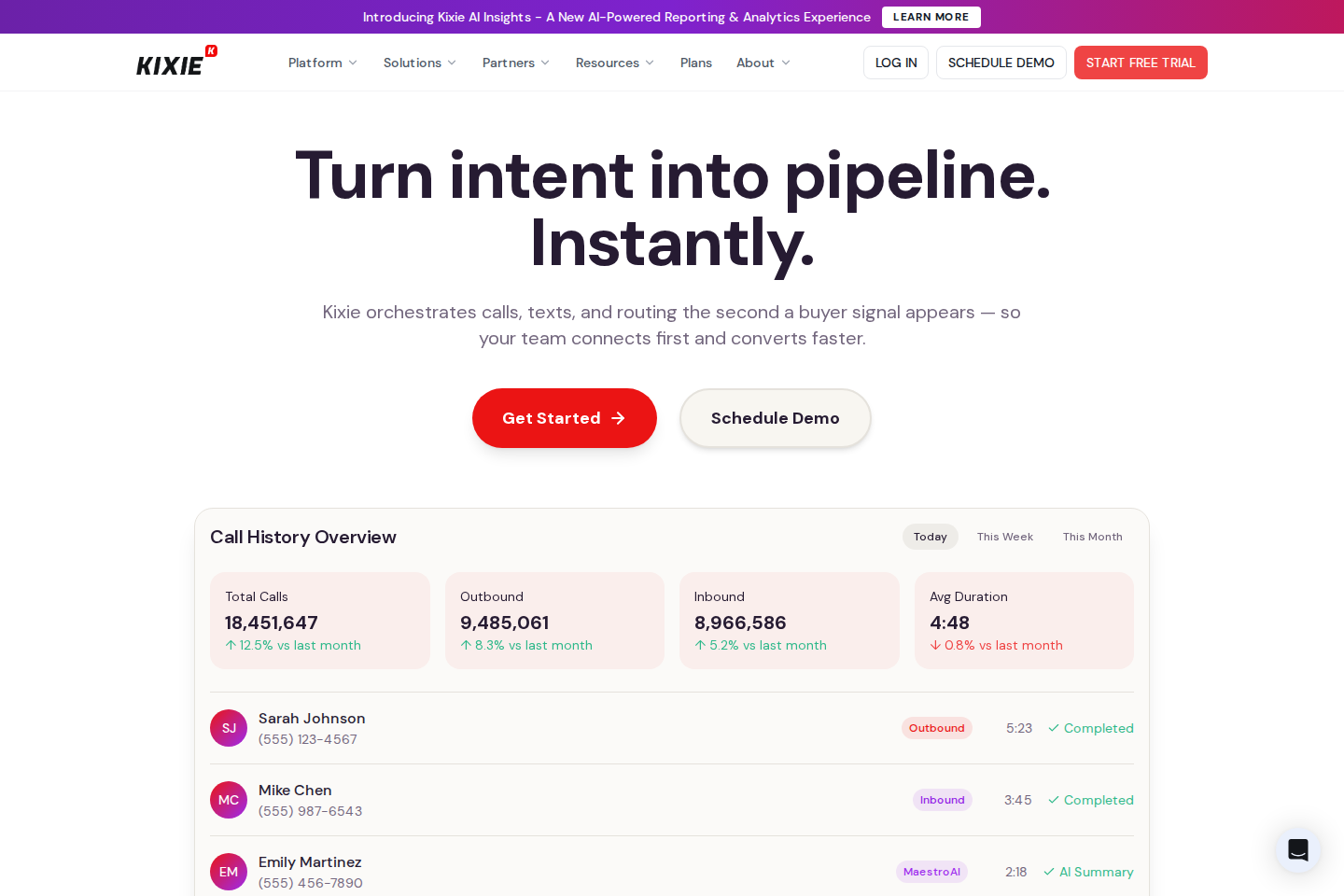
5. Kixie — Best for CRM-first sales teams needing AI-assisted outbound
Kixie is a power dialer and sales engagement platform built around deep CRM integration. Their signature feature is the ConnectionBoost intelligent dialer, which uses AI to optimize connection rates by analyzing pickup patterns, adjusting caller ID, and timing dials based on historical contact behavior. Kixie integrates natively with HubSpot and Salesforce, and every call, text, and voicemail is automatically logged to the contact record.
For outbound sales teams that live inside their CRM, Kixie reduces the friction between the dialer and the contact record to near zero. Reps click to call from the CRM, the call logs automatically, voicemail drops happen with one click, and follow-up SMS sequences trigger based on call outcomes. The AI coaching layer provides real-time prompts during calls and post-call scoring to help managers identify which reps need coaching and which talk tracks are converting.
Pros
ConnectionBoost uses AI to analyze contact behavior patterns and optimize connection rates by adjusting caller ID and dial timing — a feature specifically designed for outbound sales where pickup rate is the first bottleneck.
Deep native integration with HubSpot and Salesforce that auto-logs calls, voicemails, SMS, and call outcomes without any manual data entry.
One-click voicemail drop with pre-recorded messages that let reps leave professional voicemails without waiting through the greeting.
Watch for
Like Aloware and JustCall, Kixie is built around human reps using AI assistance — the AI does not conduct outbound calls autonomously. Teams looking for fully autonomous AI callers will need a different platform.
The platform is most valuable when used with HubSpot or Salesforce. Teams on other CRMs (Pipedrive, Zoho, etc.) will find the integration less deep and may need Zapier for some workflows.
Best fit
Sales teams of 5–30 reps who work primarily inside HubSpot or Salesforce and need a power dialer that maximizes connection rates through AI-optimized timing and caller ID. Best when the human rep is still conducting the conversation and needs AI to handle the tedious parts: dialing, logging, voicemail drops, and follow-up sequences.
Pricing: From $35/user/month with annual billing. Higher tiers for ConnectionBoost and advanced analytics.
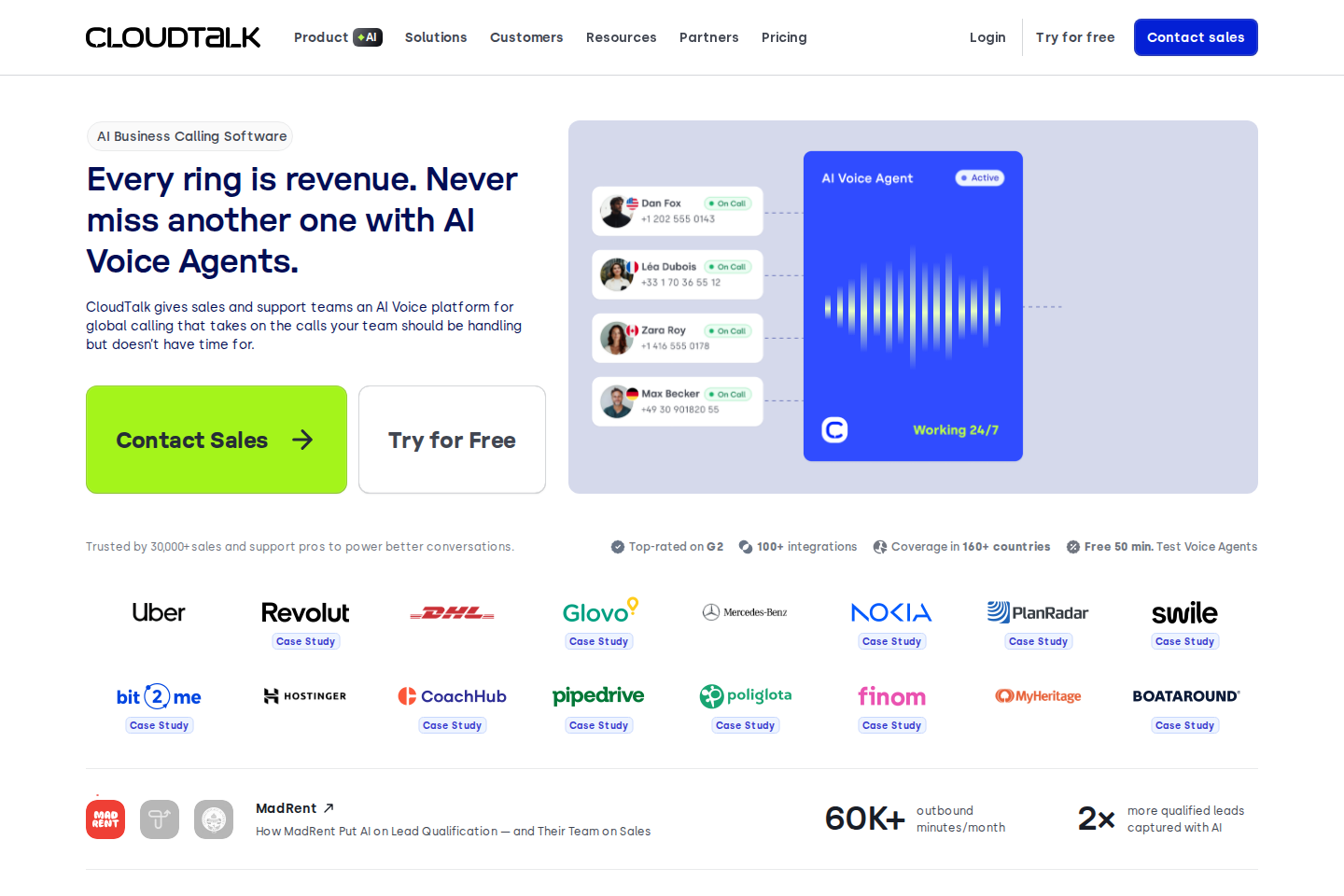
6. CloudTalk — Best for data-driven outbound sales teams
CloudTalk is a cloud-based call center platform with strong outbound capabilities including smart dialer, power dialer, and predictive dialer modes. Their AI conversation intelligence features provide real-time transcription, automatic call tagging, sentiment analysis, and topic detection. CloudTalk's strength is in the analytics layer — detailed dashboards show connection rates, talk time distribution, outcome breakdowns, and agent performance metrics that help managers optimize outbound campaigns in real time.
CloudTalk integrates with 35+ business tools including HubSpot, Salesforce, Pipedrive, Zoho, Intercom, and Freshdesk. Their smart dialer feature is particularly useful for outbound: it can automatically compile call lists from website visits, CRM data, or imported lists, then dial through them at an optimized pace. For teams that need detailed performance data to iterate on their outbound playbook, CloudTalk provides more granular analytics than most competitors in this tier.
Pros
Three dialing modes (smart, power, predictive) that let teams choose the right pacing for their campaign type — from consultative outbound to high-volume blitz campaigns.
Real-time analytics dashboards with connection rates, talk time, outcome distribution, and agent performance breakdowns that update live during campaigns.
AI conversation intelligence with automatic transcription, call tagging, sentiment scoring, and keyword detection across all calls.
Watch for
The AI features are analytics and intelligence-focused, not autonomous calling. CloudTalk does not offer AI agents that conduct outbound calls independently — it is a human-rep platform with AI-powered insights.
Some features (predictive dialer, advanced analytics, custom integrations) require higher-tier plans. The entry-level pricing does not include the full outbound feature set.
Best fit
Sales teams of 10–50 reps that rely on data to optimize their outbound playbook. Best for teams that want detailed campaign analytics, multiple dialing modes, and AI-powered conversation intelligence in a cloud-native platform with broad CRM integration.
Pricing: From $25/user/month. Power dialer and AI features on higher tiers.
7. Goodcall — Best for SMB teams with flat-rate outbound AI
Goodcall started as an AI receptionistAI receptionistAn AI receptionist is a voice agent configured to answer inbound calls, identify what the caller needs, route requests, and complete front-door tasks such as booking.Read full definition → for small businesses and expanded into outbound calling with a simple value proposition: flat-rate pricing with bundled minutes so you always know what you are going to pay. Their AI agent handles outbound calls autonomously — calling contacts from a list, qualifying them against a simple script, scheduling appointments, and leaving voicemails — without requiring a human rep to be on the line. For SMBs that cannot afford a full sales team, Goodcall makes outbound accessible.
The tradeoff is depth. Goodcall's outbound features are simpler than enterprise platforms: fewer dialing modes, fewer CRM integrations (Google Business Profile, Square, Jobber), and less granular campaign controls. But for service businesses, local shops, and solo operators who need 50–200 outbound calls per day to follow up on leads, confirm appointments, or re-engage past customers, Goodcall handles it at a price point that makes sense.
Pros
Flat-rate monthly pricing with bundled minutes eliminates the per-minute cost anxiety that makes other platforms unpredictable at scale.
Fastest setup in the category — under 15 minutes from signup to a live outbound campaign, with pre-built templates for common SMB use cases.
Autonomous AI calling that does not require a human rep to be on the line — the AI agent handles the full conversation, qualification, and scheduling.
Watch for
CRM integrations are limited to Google Business Profile, Square, and Jobber. Teams running HubSpot, Salesforce, or other enterprise CRMs will need workarounds.
Campaign management features are basic compared to Convoso or CloudTalk. No predictive dialing, limited list segmentation, and fewer compliance automation tools.
Best fit
Small businesses and solo operators in service industries (HVAC, plumbing, dental, legal, real estate) that need affordable, autonomous outbound calling to follow up on leads, confirm appointments, and re-engage past customers. Best when simplicity and predictable pricing matter more than enterprise features.
Pricing: From $59/month for the SMB tier with bundled minutes. Enterprise pricing on request.
Which AI voice agent should you choose for outbound sales calls?
The decision comes down to three questions:
Do your outbound calls start with an inbound signal? If your leads already opted in — through a form fill, quote request, missed call, or website inquiry — and you need an AI agent that calls them back immediately, qualifies them, follows up by SMS and email, and writes everything to your CRM, Thoughtly is purpose-built for that workflow.
Are you running high-volume outbound at contact center scale? If you are dialing thousands of numbers per hour across multiple campaigns with seat-based teams, Convoso provides the dialer infrastructure, compliance automation, and campaign management that large operations require.
Do you need AI to enhance human reps or replace the conversation entirely? Aloware, JustCall, Kixie, and CloudTalk are built for human reps with AI assistance — the reps do the talking and AI handles dialing, logging, coaching, and analytics. Thoughtly and Goodcall offer autonomous AI agents that conduct the conversation without a human on the line.
For revenue teams in high-consideration consumer industries — insurance, mortgage, real estate, automotive, legal, education, healthcare, home services — the most common gap is not the number of dials but the percentage of inbound leads that ever get a human conversation. If that resonates, start with Thoughtly.
FAQ
What is an AI voice agent for outbound sales calls?
An AI voice agent for outbound sales calls is software that autonomously dials contacts, conducts a natural-language conversation, qualifies leads against a predefined script, books meetings or schedules callbacks, and writes call outcomes back to a CRM. Unlike auto-dialers that connect calls to human reps, AI voiceAI voiceAn AI voice is synthetic speech produced by a text-to-speech model, using a selected or cloned voice to speak an agent's generated or scripted response.Read full definition → agents handle the entire conversation without a human on the line.
Are AI outbound sales calls legal under TCPA?
AI-generated voice calls are subject to the same TCPA rules as human-dialed calls. You need prior express consent for marketing calls to cell phones, must scrub against the National DNC Registry, must comply with state-specific calling-hour restrictions, and must disclose call recording in states that require it. The FCC has clarified that AI-generated voice calls fall under TCPA, so compliance is not optional. Choose a platform with built-in consent managementConsent managementConsent management records, applies, updates, and revokes a person’s communication permissions across channels, purposes, senders, and systems.Read full definition → and DNC integration.
How fast should an AI agent call back after a form fill?
Industry data consistently shows that leads contacted within 60 seconds of a form fill are 5–10x more likely to convert than leads contacted after five minutes. The best AI voice agent platforms trigger an outbound call within seconds of a webhookWebhookA webhook sends event data from one system to another through an HTTP request when a defined event occurs.Read full definition → event, which means the lead is still on your website or thinking about your offer when the phone rings. Thoughtly averages sub-60-second speed-to-lead for webhook-triggered outbound calls.
Can AI voice agents leave voicemails?
Yes. Most modern AI voice agent platforms include voicemail detection and can either leave a pre-recorded voicemail drop or generate a dynamic voicemail using the AI agent's voice. The key capability to verify is voicemail detection accuracy — false positives (detecting voicemail when a real person answers) and false negatives (failing to detect voicemail and talking to a machine) both hurt campaign performance.
What CRM integrations matter most for outbound AI calling?
The most important CRM integrations are HubSpot, Salesforce, and GoHighLevel because those three cover the majority of revenue teams running outbound. Look for integrations that go beyond simple call logging — the best platforms write structured call outcomes to contact records, advance pipeline stages, create follow-up tasks, and trigger downstream workflows automatically. Native bidirectional integrations are significantly more reliable than Zapier or webhook-based connections.
How do AI outbound agents handle objections?
Modern AI voice agents use large language models to handle objections dynamically rather than following rigid if-then scripts. You define the qualification criteriaQualification criteriaQualification criteria are the required signals an agent must collect before a lead can be booked, transferred, quoted, or routed.Read full definition → and guardrails, and the agent navigates objections conversationally. The best platforms let you test objection handling with simulated calls before going live. However, AI agents are still weaker than skilled human reps at handling novel or emotionally charged objections, so most teams use AI for initial qualification and route complex conversations to humans.