

Industry insights
7 Best CallFluent Alternatives for AI Voice Automation in 2026
A practical comparison of CallFluent alternatives for teams that need more than basic AI calling: Thoughtly, Synthflow, Retell, Bland, CloudTalk, JustCall, and Aircall.
Industry insights
A practical comparison of CallFluent alternatives for teams that need more than basic AI calling: Thoughtly, Synthflow, Retell, Bland, CloudTalk, JustCall, and Aircall.
Last updated
CallFluent is a no-code AI voice agentVoice agentA voice agent is a conversational software system that listens, responds, follows a defined workflow, and can take approved actions during a phone conversation. product with a strong agency and white-label angle. It can be attractive when you want to stand up basic inbound or outbound calling quickly, especially if you are comfortable bringing telephony and workflowWorkflowA workflow is a defined sequence of steps, decisions, actions, delays, and outcomes used to complete a business process. pieces together yourself.
The tradeoff is that revenue teams often outgrow a call-only tool once the job becomes full lead conversion: fast form-fill response, SMS and email persistence, CRM write-backCRM write-backCRM write-back sends conversation outcomes, qualification answers, notes, appointments, dispositions, and next steps into the CRM., booking, warm transferWarm transferA warm transfer connects a live caller to the right person while preserving the context already collected during the conversation., and reporting that a non-engineering operator can own. I evaluated the alternatives below around that operational fork, not just whether the demo voice sounds natural.
For Thoughtly, I used the current Thoughtly product, integrations, pricing, and compare-page context as the source of truth. For competitors, I cross-checked vendor pages, pricing pages, independent reviews, and low-rated-review themes where public evidence was available.
| Platform | Best fit | Primary strength | Key limitation |
|---|---|---|---|
| Thoughtly | Revenue teams converting opted-in inbound leads | Voice, SMS, email, workflows, and CRM write-back in one operating layer | Best when you have real lead volume and a defined funnel to automate |
| CallFluent | Agencies and small teams testing basic AI calling | Low entry price, no-code setup, white-label motion | Requires Twilio for phone connectivity and can be thin for full-funnel conversion |
| Synthflow | Agencies reselling voice agents | Agency-friendly voice automation and compliance posture | White-label and some operator needs can push buyers into higher tiers |
| Retell AI | Engineering teams building custom voice agents | API-first voice infrastructure and low-latency streaming | More assembly work for CRM, SMS, email, attribution, and operator workflows |
| Bland AI | Technical teams automating high-volume phone calls | Programmable voice agents and enterprise infrastructure options | Voice-first; multichannel follow-up and CRM ownership need careful validation |
| CloudTalk | SMB sales/support teams needing a phone system | Mature VoIP, call routing, analytics, and CRM integrations | Contact-center phone system first, not autonomous lead-conversion agent first |
| JustCall | Sales teams wanting calling, SMS, and coaching | Business phone system with sales engagement features | AI voice agent is an add-on to a broader phone system |
| Aircall | Teams standardizing cloud telephony around CRM workflows | Reliable business phone platform with strong marketplace | Not built primarily as an autonomous voice-agent conversion platform |
I looked for platforms that can do more than answer or place a call. Strong alternatives should handle the whole revenue motion: call quickly, recover missed calls with SMS, continue by email when needed, book or transfer the lead, and write the outcome back to the CRMCRMA CRM is the system used to manage leads, contacts, accounts, opportunities, activity, ownership, and follow-up..
A weaker fit may still have impressive voice quality, but it leaves the operator stitching together texting, email, attribution, and CRM notes after the call. That is the gap that usually turns an exciting AI voiceAI voiceAn AI voice is synthetic speech produced by a text-to-speech model, using a selected or cloned voice to speak an agent's generated or scripted response. demo into another workflow project.
CallFluent appeals because it is no-code, so I weighted alternatives that can be owned by RevOps, sales ops, marketing ops, or an agency operator without a voice infrastructure team. The best fit depends on who will debug prompts, change routing, watch outcomes, and explain performance to leadership.
Developer-first tools can be excellent when engineering is the buyer. They are a worse fit when a revenue team needs to launch, tune, and report on lead conversion directly.
I separated sticker price from all-in operating cost. CallFluent publishes low monthly entry plans, but its own site says a TwilioTwilioTwilio is a cloud communications platform that provides programmable voice, messaging, phone numbers, and related APIs. account is required for phone number connectivity, which means telephony setup and usage must be considered separately.
For every alternative, I checked whether pricing is bundled, per-seat, per-minute, or layered across providers. I also looked for native CRM integrations, webhookWebhookA webhook sends event data from one system to another through an HTTP request when a defined event occurs. depth, SMS/email coverage, and how much of the production stack the buyer must assemble.
I did not treat average star ratings as enough. I looked for review volume, low-rated-review patterns, independent comparison pages, and whether the vendor has enough public customer evidence to evaluate confidently.
For CallFluent specifically, public third-party evidence is still fairly limited. Trustpilot lists fewer than 20 reviews and G2/Capterra visibility appears limited, so buyers should test more heavily before committing mission-critical lead flow.

Thoughtly is the strongest CallFluent alternative when the business problem is not “make an AI call,” but “convert every opted-in inbound lead before it goes cold.” The platform is built for high-consideration consumer funnels such as insurance, mortgage, real estate, education enrollment, healthcare, home services, financial services, automotive, and legal. Agents call quickly, continue by SMS and email, qualify intent, book or warm-transfer qualified leads, and write conversation outcomes back into CRM/workflows. That makes Thoughtly a better fit for teams that need an operating layer for revenue coverage, not a standalone voice widget.
Choose Thoughtly if your CallFluent evaluation is really about revenue coverage: reaching every form fill, recovering missed calls, and keeping the same agent on the lead until they book, transfer, or opt out. It is less appropriate if you only need a cheap one-off AI calling widget or a white-label resale offer for very small clients.
Thoughtly uses per-minute pricing. Contact Thoughtly for a quote based on volume, channels, integrations, and implementation scope.
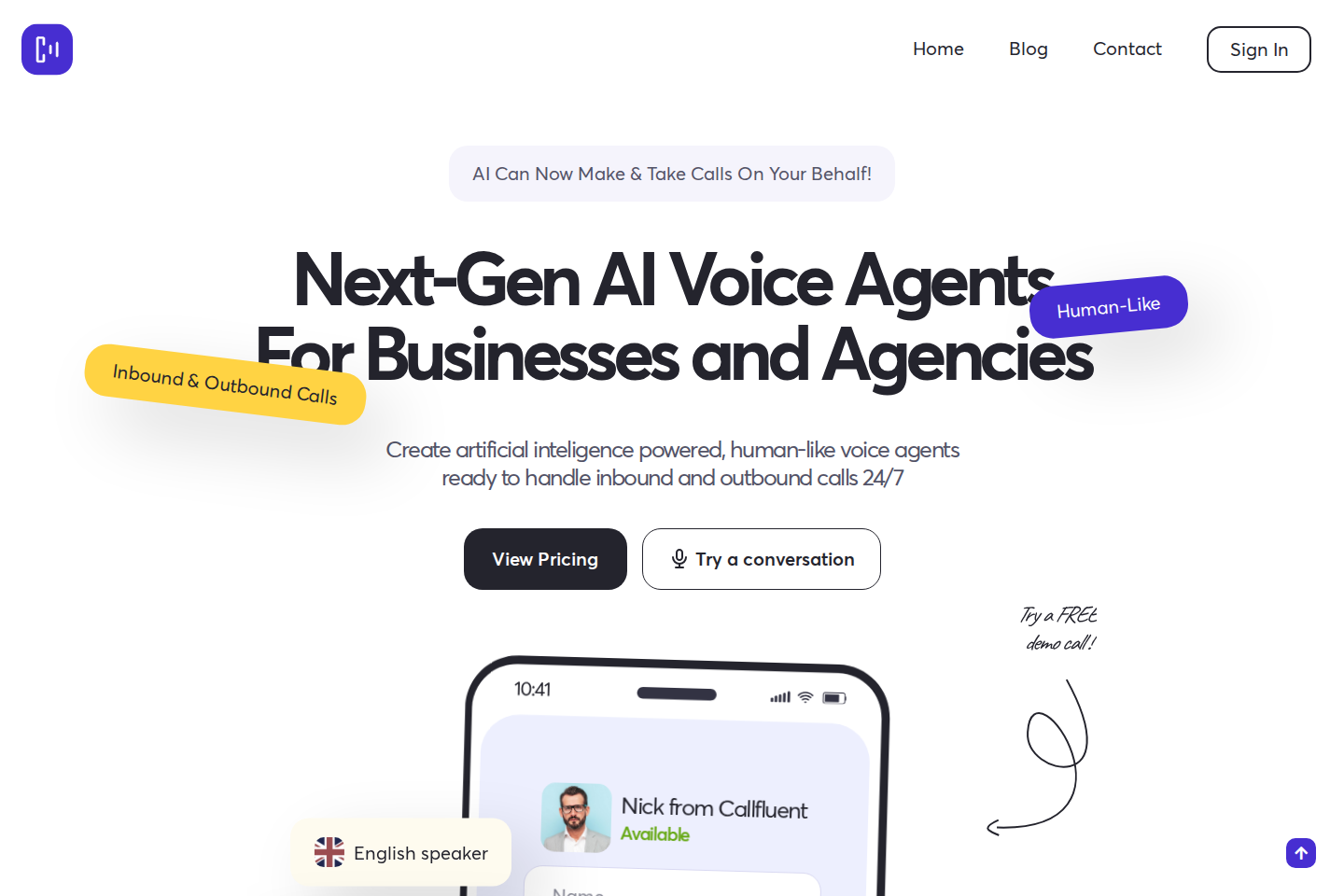
CallFluent belongs on this list because some buyers do not actually need to replace it; they need to understand its fit. The product markets no-code inbound and outbound AI voice agents for sales, booking, reminders, support, and agencies. Its site emphasizes fast setup, many voices and languages, white-label options, Twilio connectivity, webhooks, Zapier, Make, n8n, and CRM data transfer. That makes it a reasonable entry point for agencies or small businesses experimenting with AI calling before they standardize a deeper revenue workflow.
Choose CallFluent if your priority is a low-cost, agency-friendly voice automation product and you are comfortable managing telephony and workflow dependencies. Look elsewhere if the real job is full-funnel lead conversion with same-agent voice, SMS, email, CRM write-back, and revenue reporting.
Published plans include Starter at $37/month, Business at $67/month, and Agency at $127/month, with listed overages from $0.37/min down to $0.069/min. Phone connectivity requires a Twilio account.
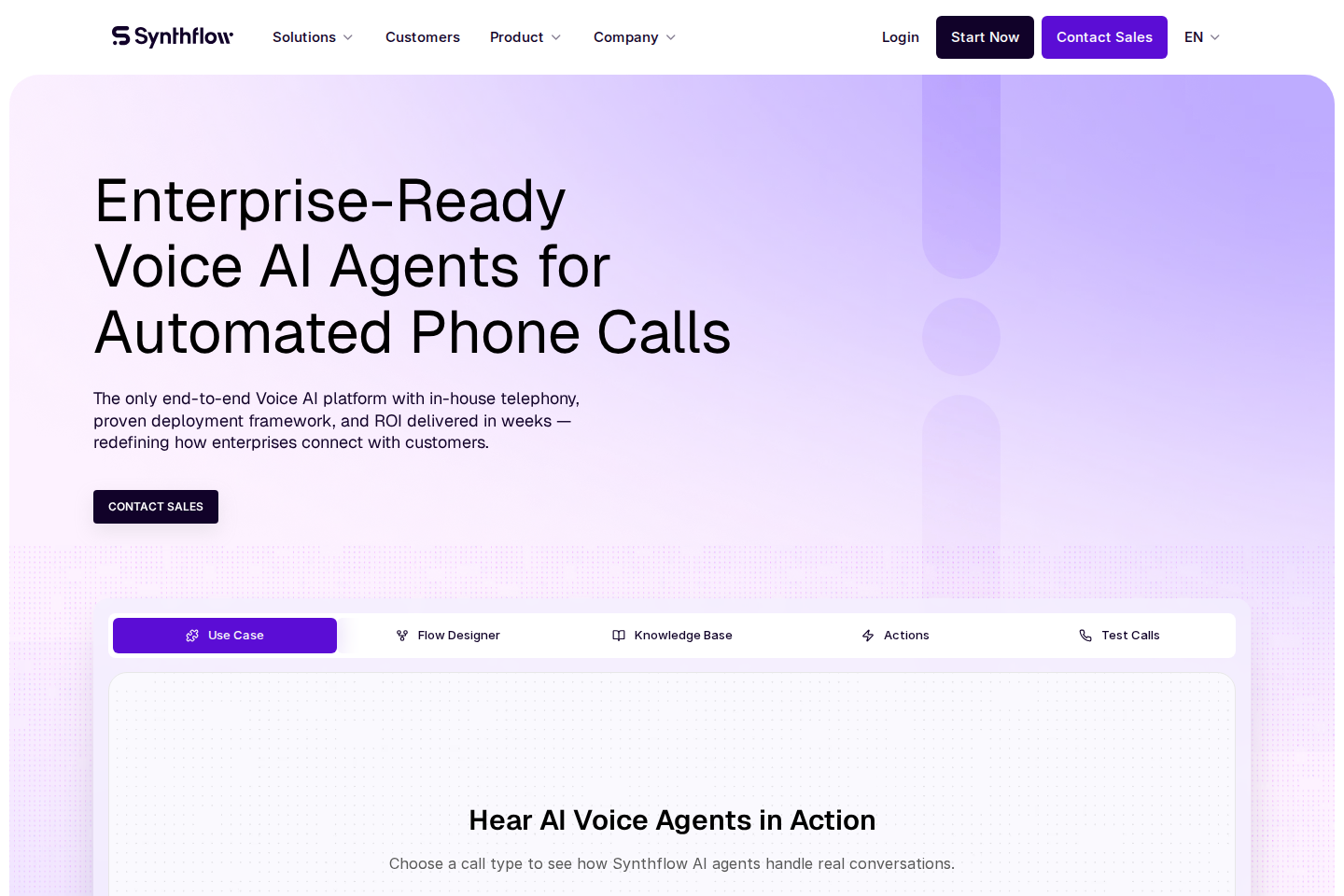
Synthflow is one of the closest alternatives for buyers who like CallFluent’s no-code and agency-friendly shape but want a more established voice automation platform. It offers voice agents, templates, integrations, compliance messaging, and a visible white-label/reseller motion. Thoughtly’s compare research frames Synthflow as particularly strong for agencies that want to package voice automation for clients. The tradeoff is that its center of gravity is still voice automation and agency resale, not a CRM-first revenue conversion layer owned by the operator running the funnel.
Choose Synthflow if you are an agency or consultancy building voice agents for multiple clients and want a no-code system with resale motion. Choose Thoughtly if your own revenue team owns the inbound funnel and needs CRM-native multichannel conversion rather than a voice-first agency toolkit.
Synthflow publishes plan and usage pricing; check its pricing page for current plan tiers, minute allowances, and white-label requirements.
Retell AI is a strong alternative when the buyer is technical and wants configurable voice infrastructure rather than a packaged revenue platform. It offers voice agents, low-latency streaming, conversation-flow tooling, bring-your-own-carrier options, and developer documentation. That makes it a better fit than CallFluent for teams building custom voice products or embedding voice AI into their own software. The tradeoff is that Retell does not remove the need to design the surrounding CRM, SMS, email, attribution, compliance, and operator workflow layer.
Choose Retell if you have engineers staffing a voice AI build and want flexible infrastructure. Choose Thoughtly if the business outcome is converting inbound leads with bundled channels, CRM write-back, and operator-owned workflows.
Retell publishes pay-as-you-go voice AI pricing. Buyers should model platform minutes plus voice, LLMLarge Language Model (LLM)A large language model (LLM) is a machine-learning model trained on large text collections to interpret and generate language from prompts and context., telephony, and any carrierCarrierA carrier is a telecommunications provider that transports voice calls or messages between phone numbers and networks./provider costs.
Bland AI is a high-visibility AI phone platform for teams that want programmable voice agents and are comfortable with a more technical, voice-first operating model. It is often considered when teams compare CallFluent against larger AI calling vendors for outbound volume, custom voice behavior, or enterprise-grade deployment. Bland can make sense for organizations that want to build a phone automation layer and have technical ownership for prompts, escalationEscalationEscalation moves a conversation to a person, specialist, supervisor, or alternate workflow when the agent should not continue alone. behavior, guardrailsGuardrailsAI guardrails are instructions, rules, data boundaries, and escalation paths that constrain what an agent may say or do., and QA. For CallFluent switchers, the key question is whether a more powerful voice-first system solves the whole business problem or simply moves the assembly work to a larger platform.
Choose Bland if you need a programmable phone automation platform and have technical or operations resources to govern production behavior. Choose Thoughtly if your buyer is RevOps and the goal is every inbound lead worked across channels with less engineering glue.
Bland pricing is usage- and plan-based, with public pages historically showing per-minute and plan components. Confirm current plan, platform, telephony, and enterprise costs with Bland.

CloudTalk is not a pure CallFluent clone; it is a mature business phone and call-center platform with AI features layered into a broader sales/support calling system. It is a credible alternative for teams that tried a lightweight AI voice tool and realized they first need routing, numbers, call recordingCall recordingCall recording captures phone audio for review, quality assurance, training, dispute handling, or regulated retention., analytics, QA, and CRM-connected telephony. CloudTalk’s own CallFluent alternatives guide emphasizes included telephony infrastructure and CRM integrations as a contrast to CallFluent’s Twilio dependency. The mismatch is that CloudTalk is still primarily a phone-system/contact-center choice, not a dedicated autonomous lead-conversion agent across voice, SMS, and email.
Choose CloudTalk if your biggest CallFluent pain is telephony reliability, routing, and call-center operations. Choose Thoughtly if your bigger pain is every inbound lead needing immediate, persistent, multichannel follow-up and CRM action.
CloudTalk publishes per-user plans. Pricing varies by region, plan, users, AI features, and add-ons.
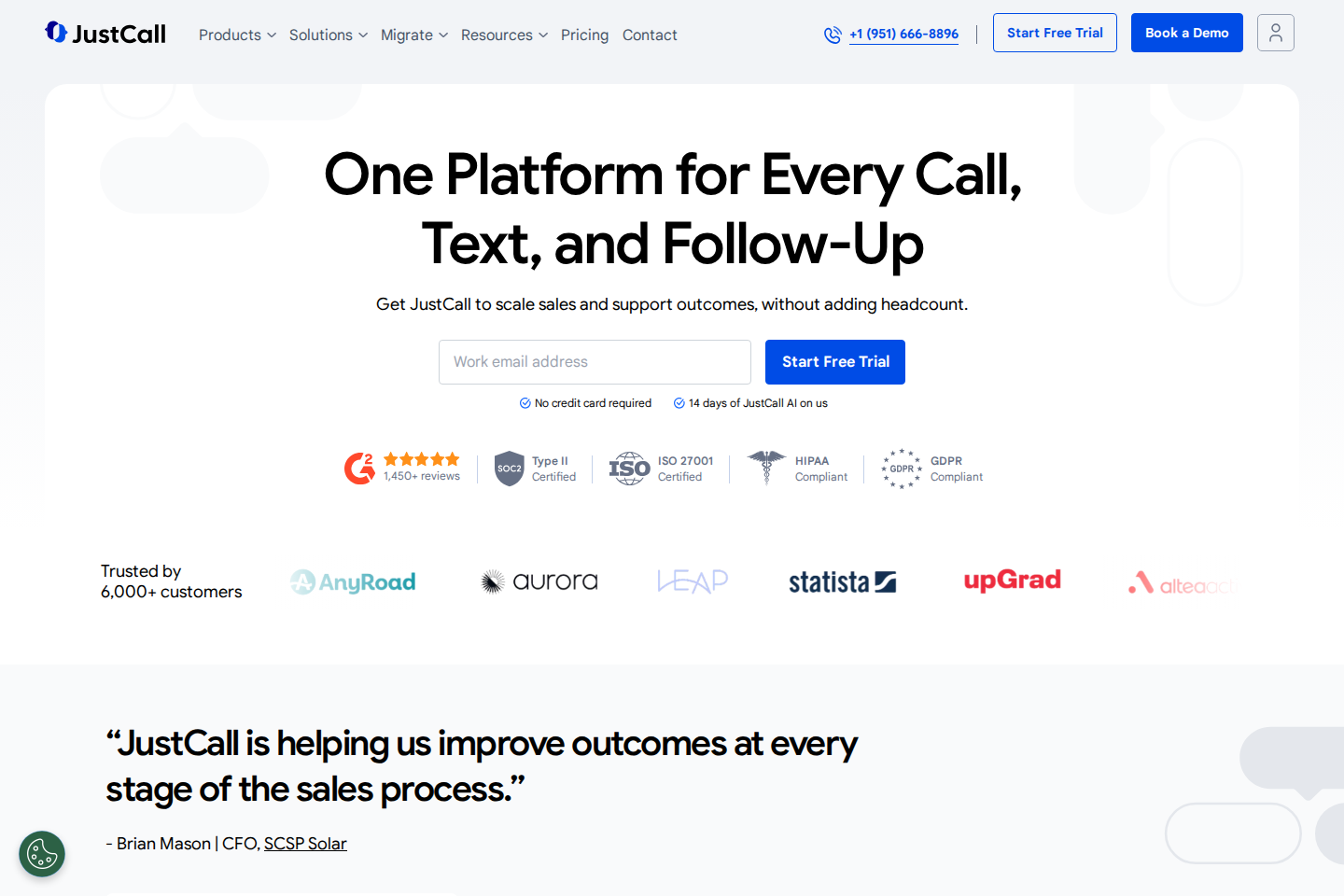
JustCall is another practical alternative when the team wants a sales communications platform rather than a standalone AI voice agent. It offers business calling, SMS, sales dialer features, conversation intelligence, AI voice agent capabilities, and CRM integrations. Compared with CallFluent, JustCall is often easier to justify when managers need rep workflows, coaching, call queues, and texting in one sales phone system. Compared with Thoughtly, it is less specialized around autonomous inbound lead conversionInbound lead conversionInbound lead conversion turns opted-in calls, form submissions, quote requests, and other inquiries into qualified conversations, appointments, or transfers. owned by the AI agent from first call through booked outcome.
Choose JustCall if your team wants to upgrade its sales phone and SMS stack while adding AI assistance. Choose Thoughtly if the goal is to let autonomous agents work inbound leads across voice, SMS, and email until a conversion event is reached.
JustCall publishes per-user business phone plans and separate AI voice agent pricing details. Confirm current seat, number, SMS, and AI usage costs.
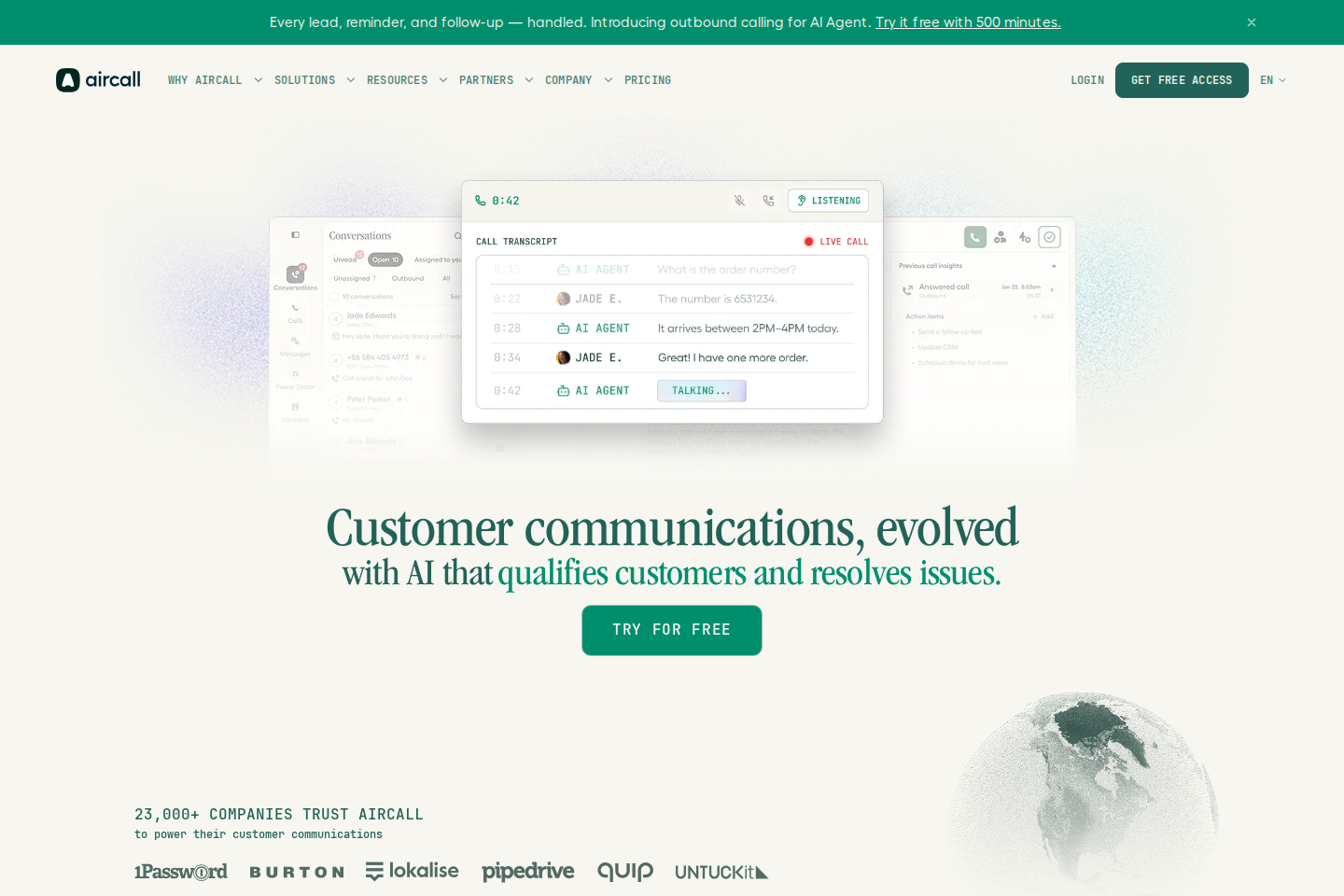
Aircall is a strong alternative for teams that want a polished cloud phone system connected to CRM workflows. It is built around business calling, call routingCall routingCall routing sends a caller to the right agent, person, team, location, queue, or workflow using intent, data, rules, and availability., analytics, integrations, and sales/support team operations, with AI capabilities that assist the phone workflow. This can be a better fit than CallFluent when the first priority is reliable telephony and rep productivity rather than replacing call handling with autonomous agents. It is less direct if the buyer wants an AI agent to own lead conversion across channels without adding a contact-center operating layer.
Choose Aircall if your organization is standardizing cloud telephony and wants CRM-connected calling for human teams. Choose Thoughtly if the objective is autonomous, same-agent lead follow-upLead follow-upLead follow-up is the sequence of calls, texts, emails, and tasks used after a prospect expresses interest. across voice, SMS, and email with CRM write-back.
Aircall publishes seat-based plans. Confirm current minimums, AI packages, numbers, SMS, and integration requirements before comparing it with usage-based AI voice tools.
For inbound revenue teams, the highest-risk mistake is buying a voice tool and assuming the rest of the journey will somehow happen. The better test is simple: what happens after the call misses, after the lead asks for a text, after the appointment needs to be booked, and after the CRM needs a clean disposition?
If those steps are native, the platform can become a revenue operating layer. If they require extra tools and manual glue, you are buying a voice component and a project plan.
CallFluent and Synthflow both speak clearly to agencies. That can be useful if your business is packaging AI voice agents for clients, but the economics depend on client support burden, telephony management, prompt maintenance, and how much of the service you must deliver manually.
Do not compare only the monthly subscription. Compare client onboarding time, phone-number setup, support tickets, usage overages, compliance requirements, and whether the platform helps you prove outcomes after launch.
CloudTalk, JustCall, and Aircall are credible when the real need is business telephony, call routing, rep productivity, SMS, and analytics. They can be better choices than a lightweight AI calling tool when human teams still own most conversations.
They are not automatically better if your goal is autonomous lead conversion. In that case, evaluate whether the AI agent can own the journey or whether the platform mainly helps human reps manage calls.
Thoughtly is the best fit when the goal is converting opted-in inbound leads across voice, SMS, email, CRM workflows, booking, and warm transfer. It is built for revenue teams that need every lead worked quickly, not just a call answered.
The common triggers are telephony dependencies, limited independent review depth, feature gates on lower plans, and the need for deeper CRM, SMS, email, reporting, or production workflow control. CallFluent can still be useful for simple AI calling or agency experiments.
It can look cheaper at entry level: CallFluent lists a $37/month Starter plan. But the real comparison should include included minutes, overage rates, plan gates, Twilio phone connectivity, SMS, booking, voice providers, CRM work, and the labor needed to manage the system.
Both can fit agencies. CallFluent leans into low-cost and white-label offers; Synthflow has a more established voice-agent and agency ecosystem. Agencies should compare client management, white-label terms, compliance needs, support burden, and how much customization each client will require.
Often, yes. Retell and Bland are stronger fits when the buyer wants programmable voice AI infrastructure and has technical resources to assemble the production stack. They are less ideal when a non-technical revenue team needs a packaged conversion platform.
Thoughtly product overview, integrations, pricing, and compare pages.
CallFluent homepage, pricing section, white-label page, and Trustpilot listing.
CloudTalk CallFluent alternatives guide and pricing page.
Synthflow pricing, Retell pricing, Bland, JustCall AI Voice Agent, and Aircall pricing.


