Best Synthflow Alternatives for AI Voice Automation in 2026
Synthflow is built for agencies reselling voice agents. If you are the team running the funnel, here are seven alternatives that solve the underlying problem better — ranked by how well they convert revenue, not just make calls.
Last updated
Synthflow built its business around agencies white-labeling voice agents for downstream clients. If you are the team actually running the inbound funnel — converting form fills, following up with missed calls, re-engaging stale leads — that is a different job, and it needs a different tool.
I evaluated the platforms that most often surface as Synthflow alternatives in buyer conversations, G2 comparisons, and AI-search results. The goal was not to find the closest Synthflow clone, but to identify the platforms that solve the underlying problem better depending on your team, your channels, and the workflows you need to run.
Here are the seven alternatives worth evaluating in 2026, ranked by how well they serve teams that need voice AI to actually convert revenue — not just make phone calls.
Why teams look for Synthflow alternatives
Synthflow carries a 4.5-star average on G2 with over 1,000 reviews, and its no-code builder is genuinely easy to pick up. But recurring themes in lower-rated reviews and buyer conversations point to specific reasons teams outgrow it:
Voice-first, not multichannel. Synthflow's SMS is metered against voice minutes (5 messages = 1 voice minute), and email is not a native channel. Teams that need coordinated voice + SMS + email follow-up have to stitch together external tools.
Agency-shaped product. The white-label add-on and agency program are the centerpiece of Synthflow's go-to-market. If you are the operator — not the reseller — you may find that the product prioritizes features you do not need while missing workflows you do.
International number coverage gaps. Synthflow only offers numbers from the US, Canada, and Australia directly. European businesses report needing to bring their own Twilio account for local numbers, which requires upgrading to the Business plan — roughly four times the cost of the Pro tier, according to G2 reviewers.
Complex workflow limitations. Reviewers note that more advanced automation logic requires workarounds. The core no-code builder handles simple flows well, but teams with branching qualification logic or multi-step post-call workflows find the ceiling quickly.
Testing locked behind paid tiers. Several reviewers flag that meaningful voice-call testing is difficult without upgrading from the free plan, making it harder to evaluate the platform before committing budget.
CRM write-back depth. Synthflow integrates with major CRMs, but reviewers looking for deep two-way data synchronization — automatic contact updates, attribution tracking, deal-stage progression — report needing supplementary middleware.
How I evaluated these Synthflow alternatives
I used six criteria to compare these platforms. Each one reflects a dimension where Synthflow's design creates friction for specific buyer profiles.
1. Multichannel execution
Does the platform treat voice, SMS, and email as co-equal channels, or is voice the only first-class citizen? Multichannel matters because lead conversion is a sequence, not a single call. A strong platform lets you call, text a summary, and email a follow-up resource in one automated workflowWorkflowA workflow is a defined sequence of steps, decisions, actions, delays, and outcomes used to complete a business process.Read full definition → without bolting on external tools. Weak multichannel support means more middleware, more data leakage, and longer time-to-contact on second and third touches.
2. CRM integration depth
Can the platform write structured data back to your CRMCRMA CRM is the system used to manage leads, contacts, accounts, opportunities, activity, ownership, and follow-up.Read full definition → automatically — contact updates, call dispositions, qualification fields, deal-stage changes — or does it only push a transcriptTranscriptA transcript is the written record generated from a spoken conversation, typically showing what the caller and agent said during a call.Read full definition →? Two-way CRM write-backCRM write-backCRM write-back sends conversation outcomes, qualification answers, notes, appointments, dispositions, and next steps into the CRM.Read full definition → is the difference between a voice agentVoice agentA voice agent is a conversational software system that listens, responds, follows a defined workflow, and can take approved actions during a phone conversation. that creates work and one that eliminates it. I looked for native connectors to Salesforce, HubSpot, GoHighLevel, and Zoho, plus the ability to pass attribution and UTM data through to the contact record.
3. Workflow and automation flexibility
Can you build branching qualification paths, conditional routing, multi-step post-call automations, and scheduled follow-up sequences inside the platform? Or do you need to export everything to Zapier or Make? Platforms with strong native workflow engines let teams iterate without engineering tickets. Platforms that stop at the phone call leave the rest of the conversion process to someone else.
4. No-code usability versus developer control
Some teams need a visual builder they can hand to a RevOps manager; others need full API access and custom LLMLarge Language Model (LLM)A large language model (LLM) is a machine-learning model trained on large text collections to interpret and generate language from prompts and context.Read full definition → routing. I scored platforms on whether they serve their target persona well — not whether they try to be everything to everyone. A strong no-code builder that solves 90% of operator use cases is better than a half-built visual editor stapled onto a developer SDK.
5. Pricing transparency
Is the pricing publicly available, clearly structured, and predictable at scale? Or do key features hide behind enterprise tiers with no published prices? I penalized platforms that gate core functionality behind opaque add-ons or that require sales conversations to understand what you will pay. Predictable pricing at volume is critical for teams planning a production rollout.
6. Compliance and security posture
Does the platform offer SOC 2, HIPAAHIPAAHIPAA is a US federal law whose Privacy, Security, and Breach Notification Rules govern protected health information for covered entities and business associates.Read full definition →/BAA, GDPR compliance, and the audit trails regulated industries require? Synthflow earns credit here — it has SOC 2, HIPAA, PCI, GDPR, and ISO 27001 certifications. Alternatives need to match or clearly disclose where they stand, because voice AI in insurance, healthcare, and financial services is not optional compliance territory.
Quick comparison: Synthflow alternatives at a glance
Platform
Best for
Channels
CRM depth
Pricing model
Thoughtly
In-house teams converting inbound leads
Voice + SMS + Email
Deep two-way write-back
Bundled per plan
Retell AI
Engineering teams building custom voice apps
Voice (API)
Via integrations
Pay-as-you-go
Voiceflow
Conversation designers building multi-channel bots
Voice + Chat + Web
Via integrations
Free tier + paid plans
Regal.io
B2C enterprise teams blending AI and human agents
Voice + SMS + Email
Native CRM sync
Enterprise pricing
Air AI
Autonomous outbound calling at scale
Voice
Via integrations
Contact sales
Bland AI
Developers needing programmable voice APIs
Voice (API)
Via webhooks
Per-minute usage
Convoso
Outbound sales teams running high-volume campaigns
Voice + SMS
Native dialer CRM
Per-seat + usage
7 best Synthflow alternatives for AI voice automation in 2026
1. Thoughtly — Best overall for in-house teams converting inbound leads
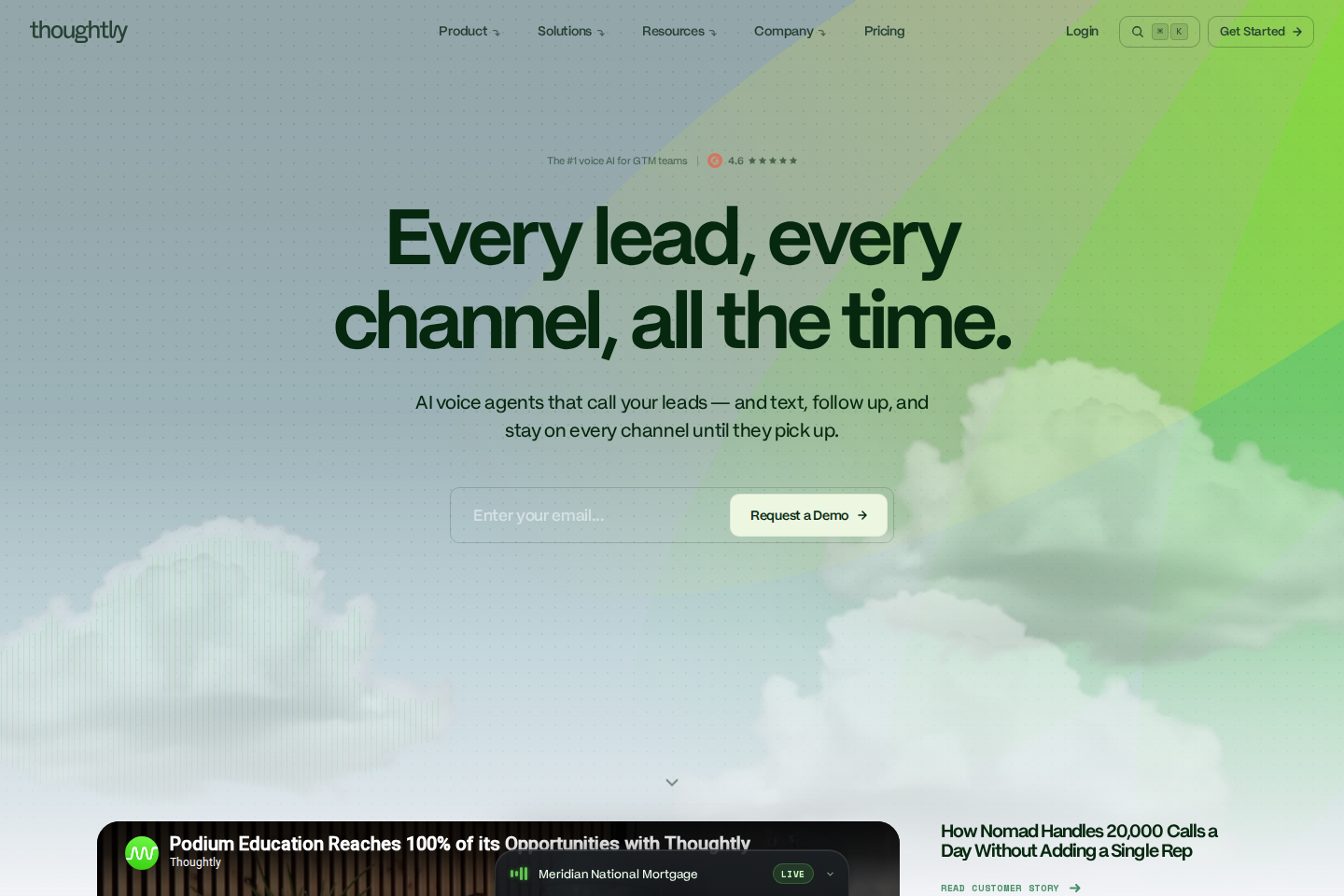
Thoughtly is a multichannel revenue execution platform built for the team that actually runs the inbound funnel. Where Synthflow is shaped around agencies reselling voice agents, Thoughtly is designed for operators at insurance carriers, mortgage lenders, education enrollment teams, home services companies, and similar high-consideration consumer businesses that need to call, text, and email their leads until someone is ready to talk.
The platform ships voice, SMS, and email as co-equal channels inside a unified workflow builder. When a form fill comes in, a Thoughtly agent can call within seconds, qualify the lead using branching logic, send an SMS summary, schedule a callback, update the CRM record with structured fields, and triggerTriggerA trigger is an event or condition that starts, resumes, changes, or stops an automated workflow.Read full definition → a follow-up email — all without middleware. Thoughtly's workflow engine supports conditional routing, multi-step post-call automations, and direct integrations with Salesforce, HubSpot, GoHighLevel, Zoho CRM, and 200+ other tools.
Two-way CRM write-back is a core capability: call dispositions, qualification answers, appointment confirmations, and attribution data flow back into the contact record automatically. For teams that evaluate performance by conversion rate, not call volume, this is the difference between a voice agent that generates reporting work and one that eliminates it.
Pros
True multichannel execution. Voice, SMS, and email ship as co-equal channels with a unified workflow builder — no metering SMS against voice minutes.
Deep CRM write-back. Structured data — not just transcripts — flows back into Salesforce, HubSpot, GoHighLevel, Zoho CRM, and others automatically.
Built for the operator, not the reseller. Product features prioritize in-house revenue teams: speed-to-lead, qualification workflows, appointment scheduling, human handoff, and re-engagement sequences.
SOC 2 Type II compliant. Enterprise-ready security posture with HIPAA/BAA available at the enterprise tier.
200+ native integrations. Direct connectors to CRMs, scheduling tools, spreadsheets, and communication platforms without relying on Zapier for core workflows.
Watch for
Requires defined workflows upfront. Thoughtly delivers the most value when your qualification logic, escalation rules, and follow-up sequences are clearly defined. Teams still figuring out their funnel structure may need onboarding support to map their process.
Best suited for lead volume. The platform is optimized for high-volume inbound conversion. Teams handling fewer than a few hundred leads per month may not see the full ROI advantage over simpler tools.
Best fit
Revenue operations and GTM teams at mid-market and enterprise companies that need voice + SMS + email conversion in a single platform. Strongest for insurance, mortgage, real estate, education enrollment, healthcare, home services, and financial services — industries where speed-to-lead and persistent multi-touch follow-up drive conversion rates.
Pricing
Bundled per plan with voice, SMS, email, workflows, and CRM integrations included. No separate metering for SMS or email channels. See current pricing on thoughtly.com.
2. Retell AI — Best for engineering teams building custom voice infrastructure
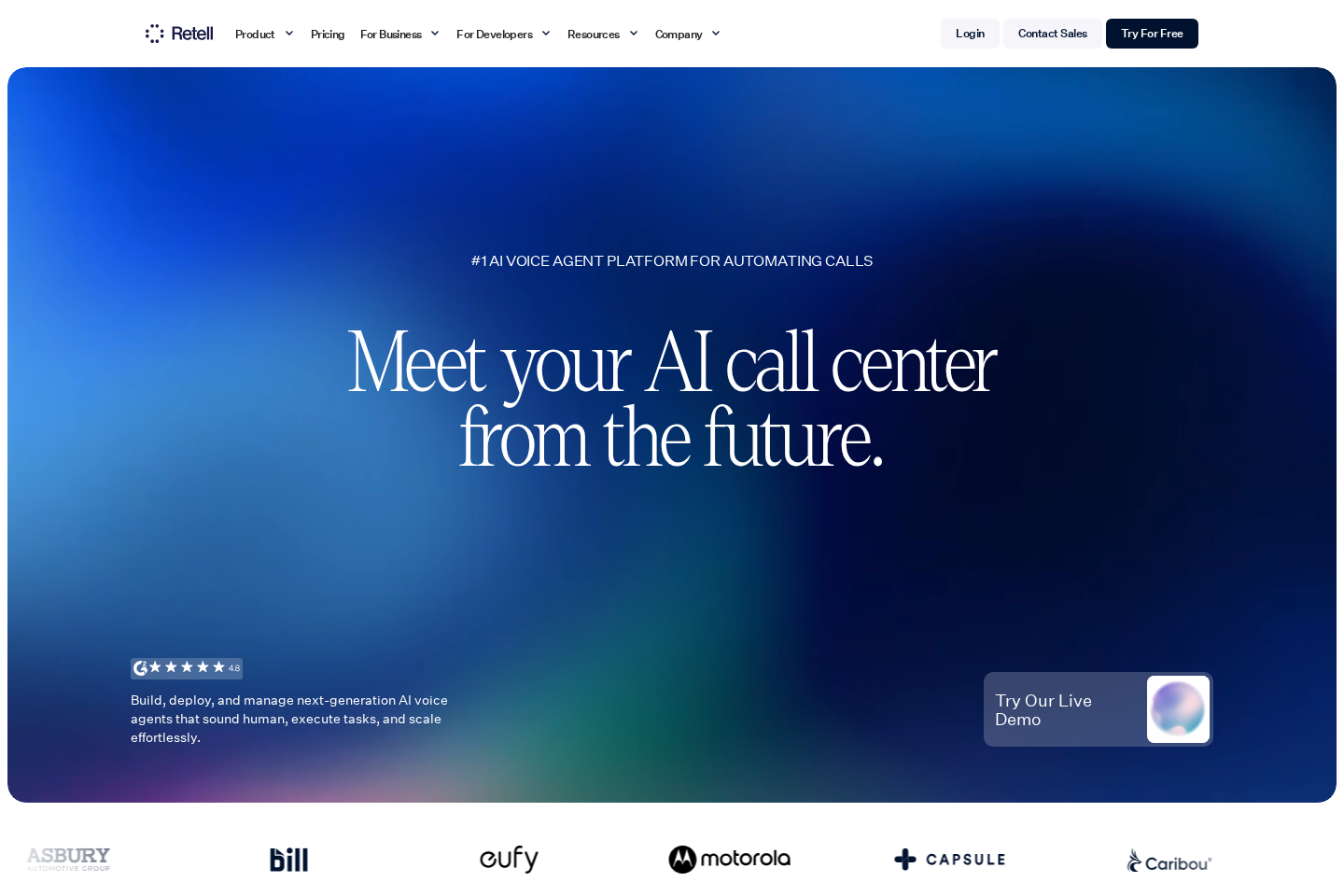
Retell AI is an API-first voice AI platform designed for developers who want granular control over every layer of the voice stack: speech-to-text, LLM orchestration, text-to-speech, telephony, and conversation flowConversation flowA conversation flow is the designed path through greeting, intent capture, qualification, actions, routing, fallback, and closing.Read full definition →. Where Synthflow offers a no-code builder aimed at non-technical users, Retell gives engineering teams the primitives to build voice experiences from scratch — including custom LLM routing, function calling, and real-time interruption handling.
The platform has earned a strong developer community and extensive documentation. Retell's architecture is well-suited for teams building vertical-specific voice applications where off-the-shelf workflows are not sufficient — think custom insurance quoting engines, patient intake flows with EHR write-back, or highly branded voice experiences that need to feel native to the product.
The trade-off is that Retell does not include built-in CRM integrations, workflow orchestration, SMS follow-upSMS follow-upSMS follow-up uses compliant two-way text messages to continue a conversation after an inquiry, call, voicemail, or prior interaction.Read full definition →, or email channels. Those capabilities need to be assembled by your engineering team. Retell is infrastructure, not a turnkey solution — and that distinction is the entire point for its target buyer.
Pros
Full API control. Custom LLM selection, real-time function calling, speech-model choice, and telephony configuration — all accessible through a well-documented API.
Low-latency voice. Optimized voice pipeline with sub-second latency and natural interruption handling that performs well in production call environments.
Strong developer documentation and community. Comprehensive SDK support, code examples, and an active developer community that accelerates implementation.
Pay-as-you-go pricing. Transparent per-minute billing starting at competitive rates, with no minimum commitments on lower tiers.
Watch for
No built-in CRM, SMS, or email. Retell handles voice calls. Everything after the call — CRM updates, text follow-up, email sequences, appointment scheduling — needs to be built or integrated separately.
Requires engineering resources. This is not a RevOps-friendly no-code tool. Building, maintaining, and iterating on Retell-based agents requires a developer or engineering team.
Workflow assembly is your responsibility. Unlike turnkey platforms, Retell does not manage the end-to-end conversion workflow. You own the orchestration, data routing, and follow-up logic.
Best fit
Engineering teams at companies building voice AI into a product or service where off-the-shelf workflows are insufficient. Strongest when you have dedicated developers who need voice infrastructure primitives, not a pre-built lead conversion tool.
Pricing
Pay-as-you-go per-minute pricing with a free tier for development. Enterprise plans available with volume discounts and dedicated support. Pricing is publicly listed on retellai.com.
3. Voiceflow — Best for conversation designers building cross-channel AI agents
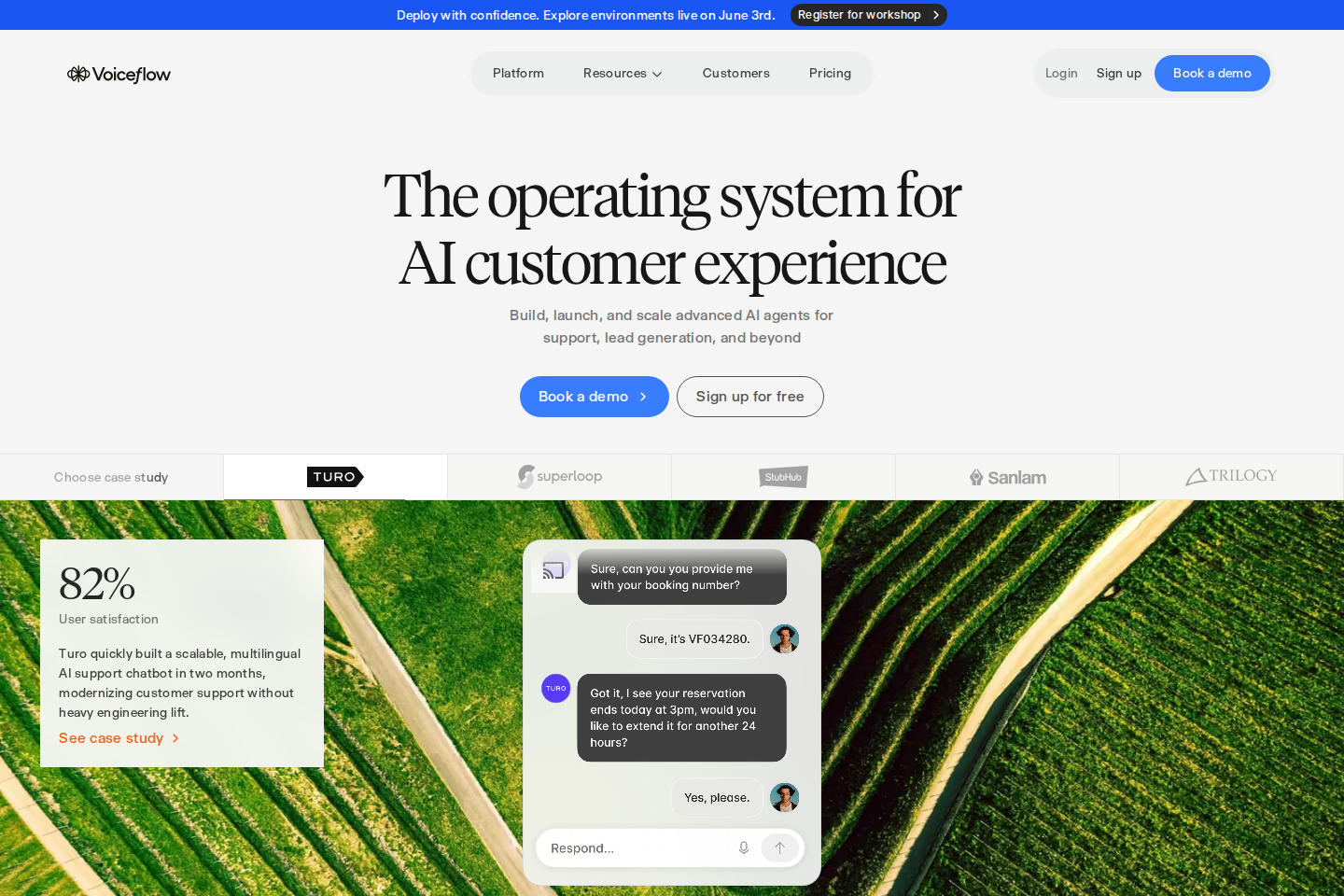
Voiceflow is a conversation design platform that lets teams build, prototype, and deploy AI agents across voice, chat, and web channels using a visual canvas. Named a 2026 Best Software Award winner by G2, Voiceflow has established itself as the standard tool for conversational AIConversational AIConversational AI is software that interprets natural language and produces context-aware responses through voice, messaging, or chat.Read full definition → designers who need more structural control than a simple chatbot builder but do not want to write code for every interaction flow.
Unlike Synthflow's focus on phone-call voice agents, Voiceflow takes a broader view: its canvas supports voice, webchat, SMS, and custom channel integrations. The platform is popular with product teams building customer-facing AI assistants, support bots, and interactive voice experiences that need careful dialogue design — branching paths, slot filling, context management, and fallbackFallbackA fallback is a safe alternate path used when input is unexpected, a tool fails, or the agent cannot complete the intended step confidently.Read full definition → handling.
The trade-off is that Voiceflow is a design and deployment platform, not a revenue execution tool. It does not include native CRM write-back, built-in telephony, or lead-conversion workflow features. Teams that need Voiceflow for its design strength typically connect it to their telephony and CRM stack via APIs or middleware.
Pros
Visual conversation designer. A drag-and-drop canvas that supports complex branching, slot filling, and context management — powerful enough for production agents, accessible enough for non-engineers.
Cross-channel deployment. Build once and deploy across voice, webchat, SMS, and custom channels. Not limited to phone calls.
Strong prototyping and testing. Built-in dialogue testing, user-flow simulation, and version control let teams iterate quickly before deploying to production.
Active community and ecosystem. Large designer community, template marketplace, and extensive documentation for conversation design best practices.
Watch for
Not a telephony platform. Voiceflow does not include native phone-call infrastructure. Teams needing AI phone agents must integrate with a telephony provider separately.
No native CRM or revenue features. CRM write-back, lead qualification scoring, appointment scheduling, and pipeline management are not included. You will need integrations for anything beyond the conversation itself.
Design tool, not a conversion tool. Voiceflow excels at the conversation experience but does not manage what happens after the conversation ends — follow-up, routing, re-engagement.
Best fit
Product teams and conversation designers building AI assistants, support bots, or interactive voice experiences where dialogue quality and cross-channel consistency are the primary requirements. Less suited for revenue teams that need an all-in-one lead-conversion workflow tool.
Pricing
Free tier available for individuals and small projects. Paid plans scale by usage and team features. Enterprise pricing available with custom limits and support. Pricing is listed on voiceflow.com.
4. Regal.io — Best for contact-center teams blending AI and human agents
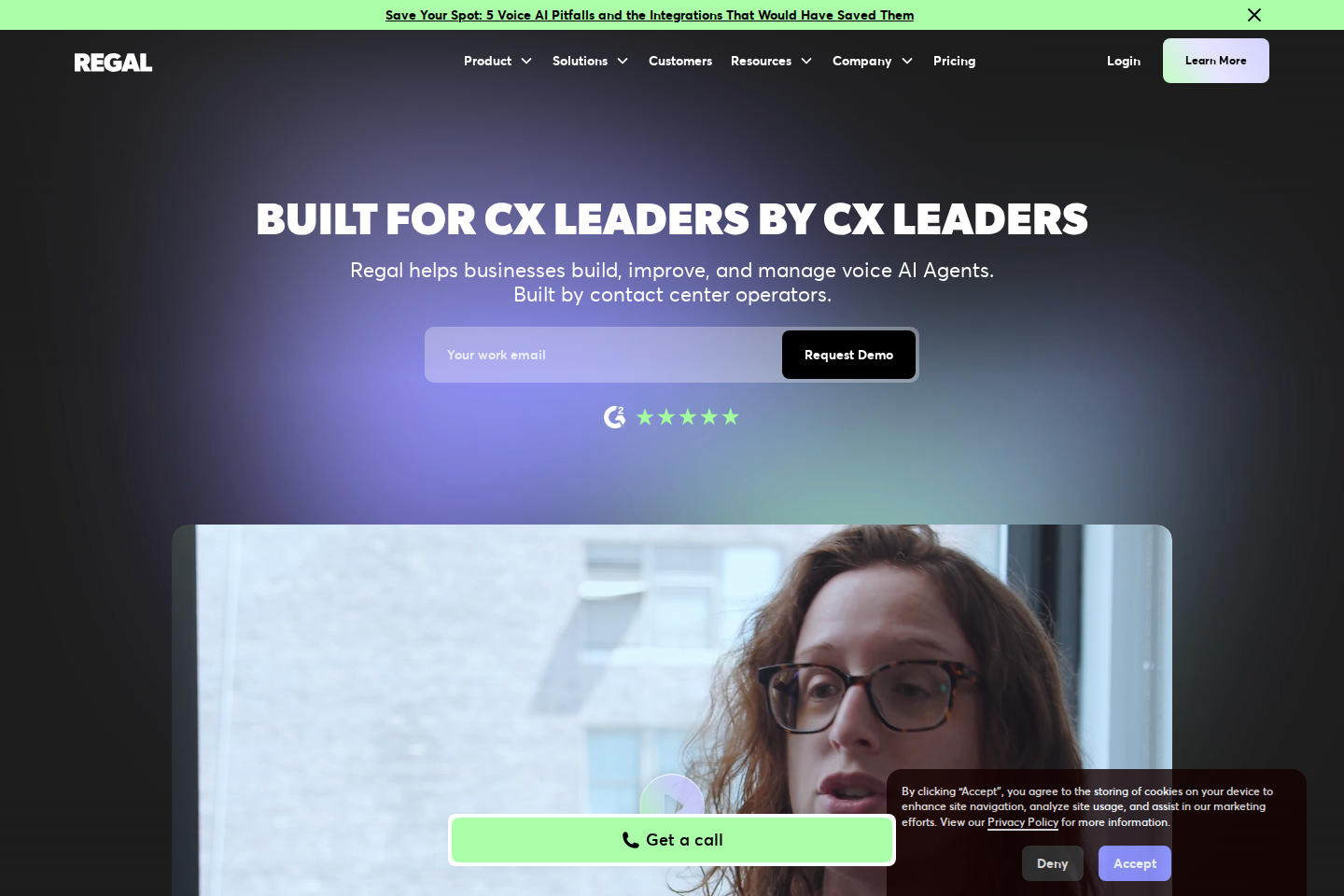
Regal.io is not a Synthflow clone; it is a different buying motion. Where Synthflow is agency/no-code voice automation, Regal is an enterprise contact-center engagement platform with AI voiceAI voiceAn AI voice is synthetic speech produced by a text-to-speech model, using a selected or cloned voice to speak an agent's generated or scripted response.Read full definition → agents, SMS, journeys, branded callingBranded callingBranded calling displays verified business identity, and sometimes a logo or call reason, on supported devices when a business calls.Read full definition →, analytics, QA, and human-agent coordination. That makes Regal stronger for CX teams that already operate a contact centerContact centerA contact center is a centralized operation that handles customer or prospect interactions across voice and digital channels.Read full definition →. It makes Regal less direct for an in-house revenue team trying to replace Synthflow with a CRM-first agent that calls, texts, emails, qualifies, books, transfers, and writes back outcomes without standing up another operations layer.
Pros
Stronger enterprise contact-center surface than Synthflow: journeys, branded calling, QA, analytics, and human-agent workflows.
Good fit when AI is augmenting a live-agent operation rather than replacing a simple voice-flow builder.
Phone and SMS orchestration are useful for large B2C engagement programs.
Cons / watch-outs
Can be too heavy if the team is leaving Synthflow because it wants simpler revenue workflow ownership, not a larger CX platform.
Buyers should verify native email, CRM write-back depth, booking logic, and same-agent context across channels before treating it as a full lead-conversion replacement.
Public review summaries point to learning curve, reporting, missing-feature, and complexity themes; those are exactly the issues to pressure-test during implementation scoping.
Best fit
Enterprise B2C contact-center teams that need AI and human agents working together across phone and SMS. If the reason you are leaving Synthflow is to get a full inbound conversion engine owned by RevOps rather than a voice/contact-center program, Thoughtly is the cleaner alternative.
Pricing notes
Contact Regal for pricing. Compare total implementation and admin ownership, not just AI-call pricing.
5. Air AI — Best for autonomous outbound calling at scale
Air AI markets itself as a platform for creating AI agents that can handle full phone conversations autonomously — inbound and outbound — with natural-sounding voices and long-form dialogue capability. The platform gained attention for its claim of handling calls lasting 10 to 40 minutes without human intervention, positioning it for use cases like outbound sales calls, appointment settingAppointment settingAppointment setting captures availability, confirms fit, and books a qualified prospect on the correct calendar without requiring manual chasing.Read full definition →, and lead qualificationLead qualificationLead qualification captures fit signals such as intent, urgency, location, eligibility, consent, and availability before the next step.Read full definition → at scale.
Unlike Synthflow's agency-focused model, Air AI targets businesses that want to replace or supplement human callers with fully autonomous AI agents. The platform integrates with CRMs and scheduling tools through its API and partner ecosystem. Air AI's outbound focus makes it relevant for teams running large-scale calling campaigns — insurance lead follow-upLead follow-upLead follow-up is the sequence of calls, texts, emails, and tasks used after a prospect expresses interest.Read full definition →, real estate prospecting, appointment reminders — where volume matters more than multichannel orchestration.
The trade-off is transparency: Air AI's website provides limited detail about its pricing, technical architecture, or specific integration capabilities compared to more developer-facing competitors. Prospective buyers typically need a sales conversation to understand what they are getting.
Pros
Long-form autonomous conversations. Designed for extended phone calls (10–40 minutes) without human intervention — useful for complex qualification or sales conversations.
Natural-sounding voice quality. The platform emphasizes human-like voice output that reduces the perception of talking to a bot, improving engagement on outbound calls.
Outbound at scale. Purpose-built for high-volume outbound calling campaigns where the goal is to reach and qualify large lists of prospects or leads.
Watch for
Limited public documentation. Air AI provides less publicly available technical documentation, API detail, and integration specifics than competitors like Retell or Bland AI. Buyers should request a thorough technical demo before committing.
Opaque pricing. No self-serve pricing is published. Prospective buyers report needing extended sales conversations to understand costs, which makes budget planning difficult.
Voice-only, outbound-heavy. The platform does not include native SMS, email, or multichannel follow-up capabilities. Teams needing post-call text or email sequences will need external tools.
Best fit
Teams running large-scale outbound calling campaigns that need fully autonomous AI agents for prospecting, appointment setting, or lead qualification. Less suited for inbound-heavy teams or those requiring multichannel coordination.
Pricing
Contact Air AI for pricing. No public pricing information is available. Expect an enterprise-oriented sales process.
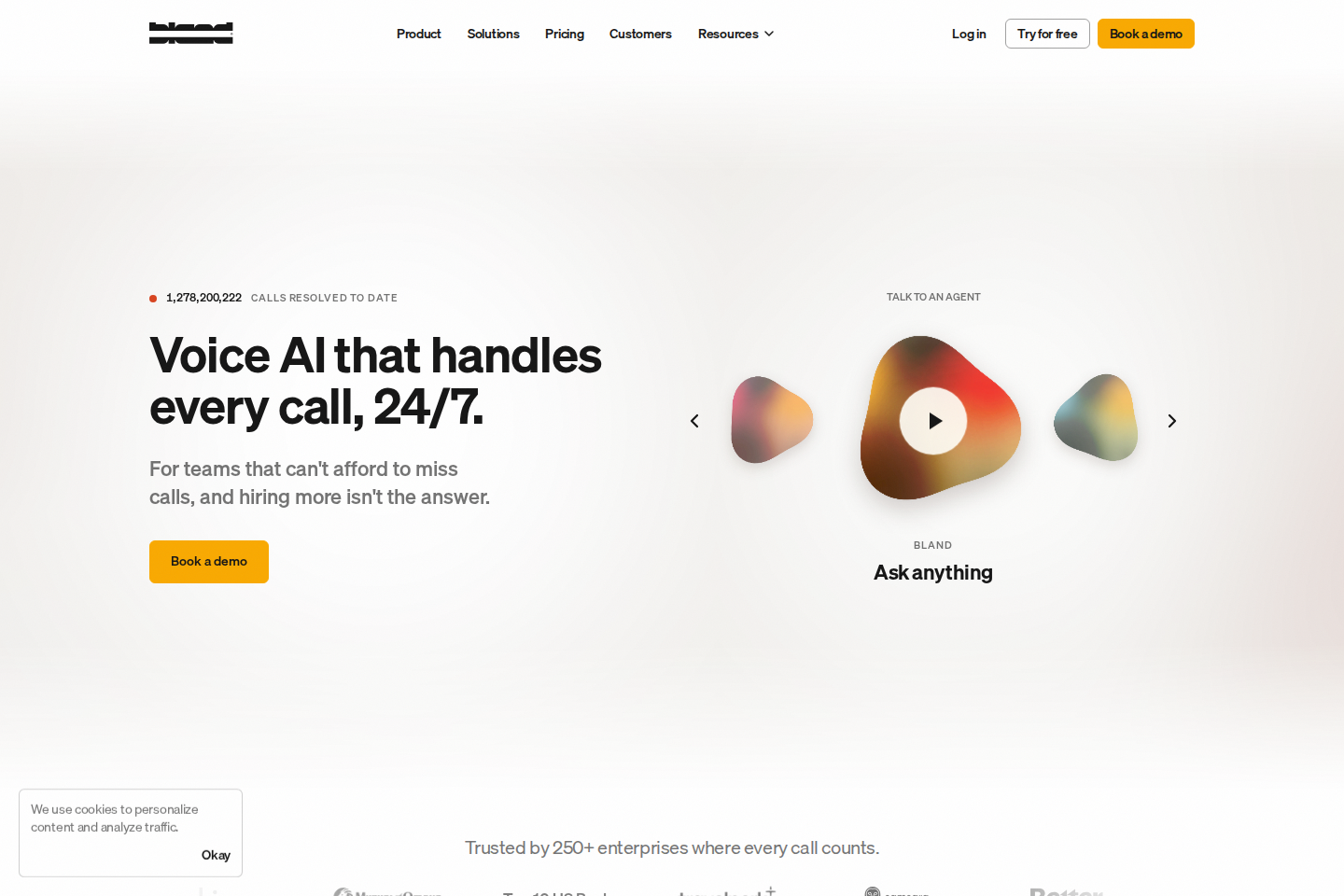
6. Bland AI — Best for developers needing programmable voice API access
Bland AI is a programmable voice AI platform that provides API access for developers to build, deploy, and manage AI phone agents. Like Retell, Bland sits at the infrastructure layer — but with a focus on making it fast to launch a voice agent through its API without extensive conversation design. The platform handles outbound and inbound calls, supports custom LLM integration, and offers webhook-based data routing.
Bland's appeal is speed of deployment for developer-led teams: the API abstracts telephony, speech processing, and conversation management, letting engineers build a working voice agent with a few API calls rather than months of infrastructure work. The platform is particularly popular for outbound calling use cases — appointment confirmations, lead verification, and survey collection — where the call flow is relatively structured.
The limitations are similar to Retell's: no native CRM, no built-in SMS or email, and no visual workflow builder for non-technical users. Bland is a building block, not a finished product. Teams considering Bland as a Synthflow replacement should verify they have the engineering capacity to build and maintain the surrounding workflow infrastructure.
Pros
Fast API-driven deployment. Launch a working voice agent with a few API calls. The abstraction layer handles telephony, speech, and conversation management so engineers can focus on business logic.
Custom LLM integration. Bring your own model or use Bland's defaults. Supports custom prompts, function calling, and dynamic conversation paths.
Per-minute pricing. Transparent usage-based billing. No minimum commitments on standard plans, making it accessible for testing and pilot programs.
Watch for
No built-in multichannel capability. Bland handles phone calls only. SMS follow-up, email, and cross-channel orchestration need to be built separately.
No native CRM write-back. Data routing is webhook-based. Building structured CRM updates requires custom development work on your side.
Compliance responsibility is yours. As a developer tool, Bland provides the building blocks but the compliance implementation — consent management, recording disclosure, DNC scrubbing — is the customer's responsibility to build and maintain.
Best fit
Developer-led teams that need a programmable voice API for structured call flows — appointment confirmations, lead verification, survey collection — and have the engineering capacity to build the surrounding workflow and CRM infrastructure.
Pricing
Per-minute usage-based pricing with rates starting at competitive levels. Enterprise plans with volume discounts available. Pricing is listed on bland.ai.
7. Convoso — Best for outbound sales teams running high-volume dialer campaigns
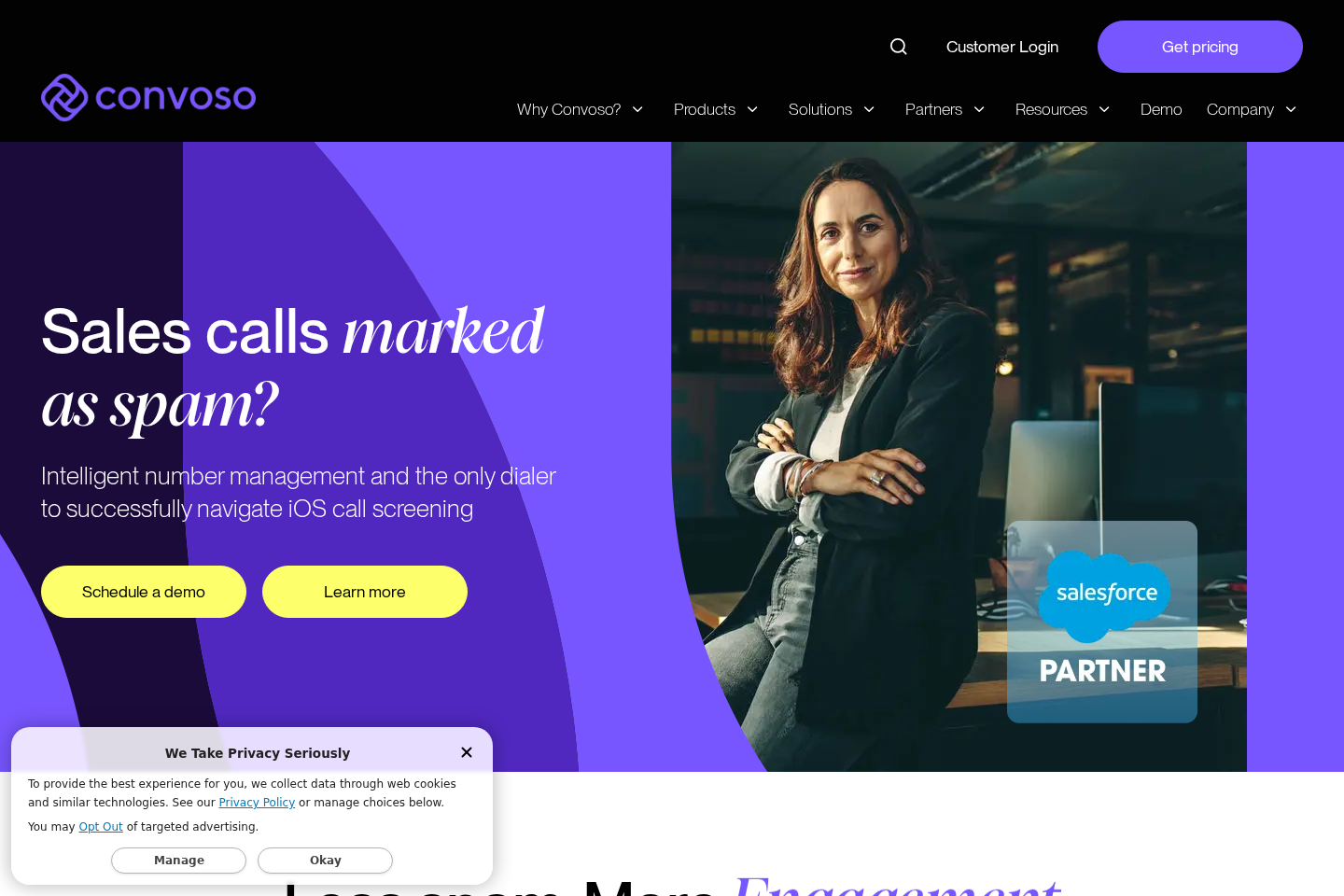
Convoso is an outbound-focused contact center platform that combines a predictive dialer with AI-powered number management, intelligent call routingCall routingCall routing sends a caller to the right agent, person, team, location, queue, or workflow using intent, data, rules, and availability.Read full definition →, and compliance automation. Unlike the other platforms on this list, Convoso is not primarily an AI voice agent platform — it is a production dialer built for outbound sales teams that need to maximize contact rates, manage caller ID reputation, and run compliant high-volume campaigns.
Convoso's flagship product, Convoso Ignite, addresses what is arguably the biggest problem in outbound calling: spam labeling. The platform's intelligent number management and iOS call-screening navigation are designed to keep outbound calls from being flagged as spam — a problem that directly impacts answer rates and campaign ROI. Convoso customers report up to 4x increases in contact rates and 75% improvements in conversions.
The platform includes native Salesforce integration, workflow automationWorkflow automationWorkflow automation uses software to execute and coordinate repeatable steps such as intake, follow-up, qualification, routing, booking, and system updates.Read full definition →, and compliance features for TCPATCPAThe TCPA is a US federal law governing certain calls and text messages, including restrictions tied to technology, consent, revocation, identification, and do-not-call protections.Read full definition →, DNC, and state-level calling regulations. It is not a voice AI agent in the Synthflow sense — there is no LLM-driven autonomous conversation — but it represents the other end of the spectrum for teams whose primary challenge is reaching the prospect, not automating the conversation.
Pros
Industry-leading number management. Convoso Ignite's spam-mitigation and iOS Call Screening Assist capabilities directly improve outbound answer rates — a problem most AI voice agent platforms do not address.
Predictive dialing at scale. Purpose-built for high-volume outbound campaigns with features like predictive pacing, skill-based routing, and real-time agent dashboards.
Built-in compliance automation. TCPA, DNC scrubbing, state-specific calling-hour rules, and consent management are native features — not bolted on after the fact.
Salesforce-native integration. Deep Salesforce connector for contact synchronization, disposition tracking, and campaign analytics.
Watch for
Not an AI voice agent platform. Convoso is a dialer with AI-powered features, not an autonomous AI agent that handles conversations. If you need LLM-driven call handling, this is a different product category.
Outbound-only focus. The platform is optimized for outbound sales campaigns. Teams needing inbound call handling, IVR replacement, or inbound lead conversion should look elsewhere.
Per-seat pricing at scale. Convoso's per-seat-plus-usage pricing model can become expensive for large teams. Budget carefully if you are scaling from a small pilot to a full floor.
Best fit
Outbound sales teams and contact centers that need to maximize contact rates, manage caller ID reputation, and run compliant high-volume dialer campaigns. Best for teams where the human agent handles the conversation and the technology handles the dialing, compliance, and delivery.
Pricing
Per-seat plus usage pricing. Contact Convoso for specific quotes. The platform targets outbound sales teams and contact centers. Pricing details are available on request at convoso.com.
How to choose the right Synthflow alternative
The right replacement depends on why you are leaving Synthflow in the first place:
If you need multichannel lead conversion (voice + SMS + email + CRM write-back) in a single platform: Thoughtly is built for exactly this. It is the most direct alternative for teams whose core job is converting inbound leads, not building voice agents for resale.
If you need developer-grade API control over the voice stack: Retell AI or Bland AI give your engineering team full control over speech models, LLM routing, and telephony — at the cost of building everything else yourself.
If you need a visual conversation designer for cross-channel bots: Voiceflow is the strongest conversation design tool on this list, but you will need to connect it to your own telephony and CRM infrastructure.
If you need AI + human agent orchestration at enterprise scale: Regal.io is purpose-built for B2C contact centers that blend AI and human agents with branded calling and journey-based triggers.
If you need fully autonomous outbound calling: Air AI targets high-volume outbound campaigns with autonomous agents, but verify the technical details and pricing before committing.
If your primary problem is reaching prospects, not automating the conversation: Convoso's dialer and number-management capabilities solve the spam-labeling and contact-rate problem that AI voice agents do not address.
Frequently asked questions
Is Synthflow a good platform for agencies?
Yes — Synthflow's white-label add-on and agency program are specifically designed for consultancies that resell voice agents under their own brand. If you are an agency looking to productize voice AI for your clients, Synthflow's $2K/month white-label tier and SOC 2 / HIPAA / ISO 27001 compliance certifications make it a credible option. The alternatives on this list are better suited for teams running their own operations in-house.
Can I use Synthflow alternatives for both inbound and outbound calls?
Most platforms on this list support both inbound and outbound. Thoughtly and Regal.io are strongest on inbound conversion workflows. Air AI and Convoso lean outbound. Retell AI and Bland AI support both directions via API. Voiceflow handles the conversation layer but requires external telephony for actual phone calls.
Which Synthflow alternative has the best CRM integration?
Thoughtly offers the deepest native CRM write-back, with two-way synchronization to Salesforce, HubSpot, GoHighLevel, Zoho CRM, and others. Regal.io also has strong native CRM syncCRM syncCRM sync keeps selected lead, contact, conversation, outcome, and next-step data aligned between an agent platform and a CRM.Read full definition →. Retell AI, Bland AI, and Air AI rely on webhooks or middleware for CRM integrationCRM integrationA CRM integration connects an agent or communications platform with a CRM so the systems can exchange records, events, and actions.Read full definition →, which requires more development work.
Do I need a developer to use these Synthflow alternatives?
It depends on the platform. Thoughtly, Voiceflow, and Convoso are designed for non-technical operators with visual builders and guided setup. Retell AI and Bland AI require developer resources. Air AI falls in between — it is not a developer tool, but its limited public documentation means you may need technical support during implementation.
How do Synthflow alternatives compare on compliance?
Synthflow has strong compliance certifications (SOC 2, HIPAA, PCI, GDPR, ISO 27001). Among the alternatives, Thoughtly holds SOC 2 Type II with HIPAA/BAA at the enterprise tier. Regal.io is enterprise-grade with strong compliance posture. Convoso includes built-in TCPA and DNC compliance. Retell AI and Bland AI provide infrastructure but place compliance implementation responsibility on the customer.