

Industry insights
Bland AI Review 2026: Honest Assessment for Revenue Teams
An honest review of Bland AI for revenue teams: voice quality, pricing, channel limitations, enterprise feature gates, and when to consider alternatives like Thoughtly.
Industry insights
An honest review of Bland AI for revenue teams: voice quality, pricing, channel limitations, enterprise feature gates, and when to consider alternatives like Thoughtly.
Last updated
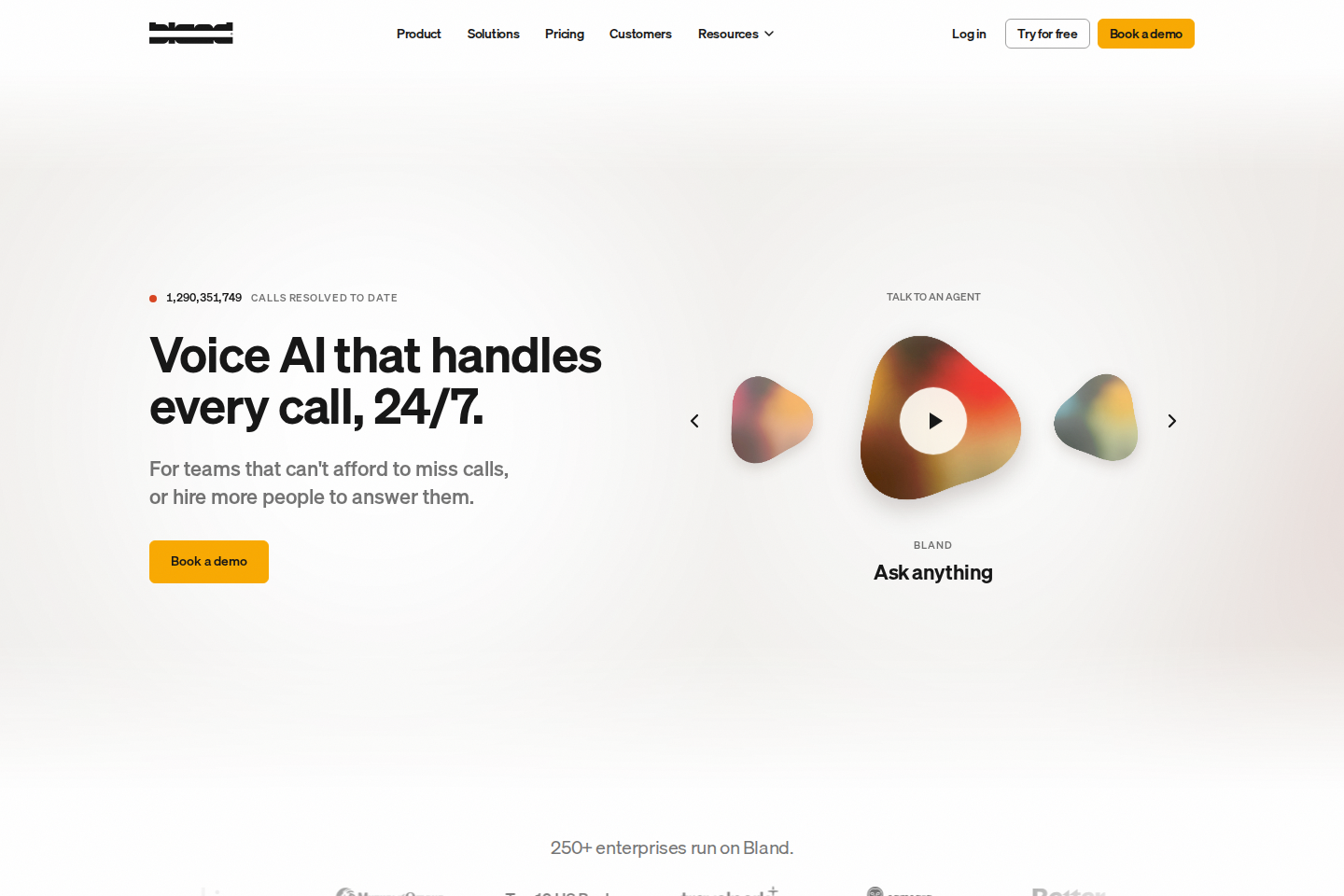
Bland AI markets itself as voice AI that handles every call, 24/7. The pitch is bold: drop in an AI agent and scale it to any volume, across any use case. With claims of 1.2 billion+ calls resolved and 250+ enterprise customers, Bland has positioned itself as a serious contender in the voice AI space.
I spent time evaluating Bland's current product, pricing, integrations, and public customer evidence to give revenue teams a clear picture of what Bland actually delivers — and where it falls short. This review is built from Bland's own website, pricing page, product documentation, independent G2 and Trustpilot reviews, Reddit discussions, and comparisons from third-party sources.
Here is the honest assessment.
| Category | Details |
|---|---|
| Company | Bland AI (bland.ai) |
| Founded | 2023 (Y Combinator W24) |
| Primary use case | AI voice agents for phone call automation |
| Channels | Voice, iMessage, SMS (Enterprise), Web Chat (Enterprise) |
| Pricing model | Per-minute + platform fee (Build/Scale tiers) |
| Starting price | $0.14/min (Start tier, $0 platform fee) |
| G2 rating | ~3.3/5 (limited reviews) |
| Enterprise customers | 250+ claimed (Kin Insurance, Mutual of Omaha, Better, Samsara, EvenUp) |
| Deployment options | Cloud, on-premise, VPC (Enterprise) |
| SOC 2 | Partial |
| HIPAA / BAA | Enterprise only |
Bland's core strength is voice infrastructure. The platform offers custom voice cloning, low-latency call handling, and the ability to deploy on-premise or in a customer's VPC at the enterprise tier. For engineering teams that need to control their own telephony stack, this is a genuine differentiator. Bland does not rely on third-party LLMLarge Language Model (LLM)A large language model (LLM) is a machine-learning model trained on large text collections to interpret and generate language from prompts and context. providers at the call layer — it runs its own infrastructure, which means teams are not exposed to upstream API changes, model deprecations, or third-party pricing shifts.
Unlike platforms like Vapi or Retell that charge separate fees for LLM, speech-to-text, text-to-speech, and telephony, Bland bundles everything into one per-minute rate. This simplifies cost forecasting. The Start tier is $0.14/min with no platform fee. Build is $0.12/min with a $299/mo platform fee. Scale is $0.11/min with a $499/mo platform fee. Enterprise pricing is custom. There are no token charges or provider pass-throughs, which makes budgeting more predictable for high-volume operations.
Bland introduced Norm, an AI-assisted agent builder that lets non-technical users describe what they want and generates the agent configuration. This lowers the barrier for initial agent creation, though production tuning still typically requires technical involvement. Bland also offers Conversational Pathways for more structured, deterministic agent flows — useful for regulated industries where agents must follow specific call scripts.
For enterprise deployments, Bland offers real-time call monitoring, guardrail rules (discrimination filters, compliance escalationEscalationEscalation moves a conversation to a person, specialist, supervisor, or alternate workflow when the agent should not continue alone., prompt injection protection), and outcome-based analytics. These features address a real gap in the voice AI market: most platforms offer limited visibility into what agents are actually saying during live calls. The guardrailsGuardrailsAI guardrails are instructions, rules, data boundaries, and escalation paths that constrain what an agent may say or do. system lets teams define rules that triggerTriggerA trigger is an event or condition that starts, resumes, changes, or stops an automated workflow. deterministic actions mid-call — transferring to a licensed advisor when regulatory topics arise, for example.
Bland's Tornado testing mode automates failure discovery by running thousands of simulated call scenarios before deployment. It also supports canary rollouts that gradually increase traffic to new agent versions. This is a meaningful feature for enterprise teams deploying voice agents in regulated or high-stakes environments where call quality regressions can be expensive.
The most significant limitation is channel coverage. On the Start, Build, and Scale plans, Bland is voice-only. SMS, iMessage, web chat, and appointment scheduling nodes are all locked behind the Enterprise tier. For revenue teams that need to follow up a phone call with a text or email, this means the rest of the outreach workflowWorkflowA workflow is a defined sequence of steps, decisions, actions, delays, and outcomes used to complete a business process. has to live in a separate system. Bland's pricing page explicitly marks these features with Enterprise-only flags.
While the per-minute rate is competitive, the platform fee adds fixed cost regardless of usage. The Build tier charges $299/mo and the Scale tier charges $499/mo before any call minutes are consumed. For teams with variableVariableA variable is a named value captured, calculated, or retrieved during a conversation and reused in logic, messages, actions, or integrations. or seasonal call volume, quiet months still carry a $300–$500 overhead. Combined with per-minute rates, the effective cost per call can be higher than expected during low-volume periods.
Bland's G2 profile currently shows a mixed reception — approximately 3.3 out of 5 based on limited reviews. Low-rated reviews describe agents that hallucinate information (quoting incorrect dollar amounts or policy details), get stuck in conversational loops, refuse to transfer to human agents when asked, and hang up on callers unexpectedly. These are not isolated edge cases; they appear as recurring themes across multiple review sources including Reddit threads from users who tested the platform in production environments.
Several features that many revenue teams would consider essential are Enterprise-only: warm transfers, live transfers, guardrails, SMS nodes within calls, appointment scheduling, and compliance features like BAA and SSO. This means the self-serve plans (Start, Build, Scale) offer a fairly limited voice-only experience. Teams that need these capabilities face a jump from transparent per-minute pricing to a custom-contracted Enterprise deal with no published pricing.
Bland lists integrations with Salesforce, HubSpot, TwilioTwilioTwilio is a cloud communications platform that provides programmable voice, messaging, phone numbers, and related APIs., and other tools, but the integration layer on self-serve plans is less developed than platforms that were built CRM-first. Bland's compare table shows 20+ integrations versus the 200+ native integrations available on platforms like Thoughtly. Two-way CRM write-backCRM write-backCRM write-back sends conversation outcomes, qualification answers, notes, appointments, dispositions, and next steps into the CRM. — automatically syncing call outcomes, contact updates, and deal stage changes back to the CRMCRMA CRM is the system used to manage leads, contacts, accounts, opportunities, activity, ownership, and follow-up. — is listed as partial. For revenue teams that live in their CRM, this means more manual data entry or custom middleware.
Multiple independent sources — including the Thoughtly compare page, competitor reviews, and user forums — note that getting Bland agents to production-ready stability requires technical ownership. The platform's strongest use cases come from teams with dedicated voice engineers who can debug agent behavior, chase regressions after platform updates, and handle edge cases. Teams without in-house engineering support may find the gap between Bland's demo experience and production reality frustrating.
Bland's pricing model bundles LLM, STTSpeech-to-Text (STT)Speech-to-Text (STT) converts spoken audio into text that a voice agent can interpret, store as a transcript, and use in downstream actions., TTSText-to-Speech (TTS)Text-to-Speech (TTS) converts written text into spoken audio, producing the voice a caller hears from an automated or AI-driven system., and telephony into a single per-minute rate. Here is the current plan structure:
| Plan | Per-minute rate | Platform fee | Concurrent calls | Daily cap | Voice clones | Knowledge bases |
|---|---|---|---|---|---|---|
| Start | $0.14/min | $0/mo | 10 | 100 calls | 1 | 10 |
| Build | $0.12/min | $299/mo | 50 | 2,000 calls | 5 | 50 |
| Scale | $0.11/min | $499/mo | 100 | 5,000 calls | 15 | 100 |
| Enterprise | Custom | Custom | Unlimited | Unlimited | Unlimited | Unlimited |
Transfer minutes are charged separately: $0.05/min (Start), $0.04/min (Build/Scale), and custom for Enterprise. Bland offers 2 free credits and a free inbound number on the Start tier with no credit card required.
It is worth noting that Bland's FAQ compares favorably to Vapi and Retell on effective per-minute cost because those platforms charge separately for each component (LLM, STT, TTS, telephony). Bland's bundled rate eliminates provider pass-throughs, but the platform fee on Build and Scale plans is a fixed cost that competitor platforms do not always charge.
Bland is a strong fit for a specific buyer profile:
Bland is not the right fit for every team:
Thoughtly is built for inbound lead conversionInbound lead conversionInbound lead conversion turns opted-in calls, form submissions, quote requests, and other inquiries into qualified conversations, appointments, or transfers. across voice, SMS, and email — with CRM write-back, multi-step workflows, and human handoffHuman handoffHuman handoff transfers a conversation, context, and next action from an automated agent to a person. baked into every tier. Where Bland requires Enterprise access for multichannel, Thoughtly ships it by default. The platform is designed for RevOps and marketing teams to own directly, without standing up a voice infrastructure team. Thoughtly integrates natively with 200+ tools including Salesforce, HubSpot, GoHighLevel, and scheduling platforms like Calendly and Cal.com. For teams whose bottleneck is converting inbound leads — not just answering calls — Thoughtly is the most direct alternative.
Learn more at thoughtly.com.
Retell is API-first voice infrastructure for engineering teams that want fine-grained control over the call stack. Unlike Bland's bundled pricing, Retell charges separately for each component (platform, LLM, STT, TTS, telephony), which can make cost forecasting more complex but gives teams the flexibility to choose their own providers. Retell is a strong fit for developer-led teams building custom voice applications from scratch.
Vapi is another developer-focused voice AI platform with component-based pricing and deep API access. It appeals to engineering teams building custom integrations and is positioned more as a toolkit than a turnkey product. Like Retell, Vapi requires more technical assembly than platforms designed for business users.
PolyAI focuses on enterprise contact centerContact centerA contact center is a centralized operation that handles customer or prospect interactions across voice and digital channels. automation with industry-specific voice agents for hospitality, banking, and healthcare. If your use case is large-scale customer service — not lead conversion — PolyAI offers domain expertise that horizontal platforms do not. PolyAI typically works with larger enterprise deployments and may not be a fit for mid-market teams.
Yes. Bland offers a Start tier with 2 free credits, a free inbound number (valued at $15/mo), and no credit card required. This lets teams test the platform before committing to a paid plan.
SMS, iMessage, web chat, and in-call SMS nodes are available only on the Enterprise plan. The self-serve plans (Start, Build, Scale) are voice-only. Teams that need multichannel outreach on non-Enterprise plans will need to build or integrate those channels separately.
Bland bundles LLM, STT, TTS, and telephony into one per-minute rate ($0.11–$0.14/min depending on tier), which is simpler than component-based pricing from platforms like Vapi or Retell. However, Bland's Build and Scale tiers add a $299–$499/mo platform fee. The effective cost depends on volume: high-volume teams benefit from the bundled rate, while lower-volume teams may pay more in fixed fees than they save on per-minute costs.
On-premise and VPC deployment is available on the Enterprise plan only. Self-serve plans run on Bland's cloud infrastructure. Enterprise deployment also unlocks dedicated orchestration servers, priority call queuing, and data residency controls.
Bland highlights insurance (Kin Insurance, Mutual of Omaha), financial services (Better, First Financial Bank), legal (EvenUp), and travel (TravelPerk, Nuitée) among its enterprise customers. The platform is positioned for high-volume call operations across industries where call handling at scale matters — though the strongest fit appears to be teams with engineering resources to support production deployments.
Thoughtly vs Bland.ai comparison — Thoughtly positioning and feature comparison
Best Bland AI Alternatives for Lead Conversion in 2026 — Thoughtly blog


