

Industry insights
PolyAI vs Sierra: Enterprise Voice AI Comparison
A practical PolyAI vs Sierra comparison for enterprise teams choosing between voice-first contact-center automation and broad customer-experience AI agents.
Industry insights
A practical PolyAI vs Sierra comparison for enterprise teams choosing between voice-first contact-center automation and broad customer-experience AI agents.
Last updated
PolyAI and Sierra both sell enterprise AI agents for customer conversations, but they come from different centers of gravity. PolyAI is strongest when the project is voice-first contact-center automation: conversational phone agents, IVRIVRIVR, or Interactive Voice Response, is a phone menu that routes or serves callers through keypad entries or spoken choices. replacement, multilingual call containment, and service workflows in industries such as banking, hospitality, retail, healthcare, and delivery. Sierra is broader: an enterprise customer-experience agent platform that spans chat, SMS, WhatsApp, email, voice, and ChatGPT, with a high-touch model built around large-brand service and account workflows.
If you are comparing PolyAI vs Sierra, the useful question is not which company has the better demo. It is what your team needs to own after launch. Voice-first call automation, contact-center containment, and proven phone depth point toward PolyAI. Multichannel customer-experience agents, outcome-based pricing, and executive-level enterprise partnership point toward Sierra. If the actual problem is inbound lead conversionInbound lead conversionInbound lead conversion turns opted-in calls, form submissions, quote requests, and other inquiries into qualified conversations, appointments, or transfers. across voice, SMS, email, and CRMCRMA CRM is the system used to manage leads, contacts, accounts, opportunities, activity, ownership, and follow-up., both are heavier CX tools than a revenue team usually needs.
This comparison is based on current vendor pages, Thoughtly compare-page framing for PolyAI and Sierra, public review profiles, independent pricing and review discussions, and FireCrawl research completed in June 2026.
| Category | PolyAI | Sierra |
|---|---|---|
| Best fit | Enterprise voice AI and contact-center call automation | Enterprise customer-experience agents across channels |
| Primary buyer | VP CX, contact-center operations, IT, service operations | Chief Customer Officer, CX leadership, digital product, enterprise operations |
| Core motion | Voice-led dialog agents for calls, appointments, reservations, triage, fraud, outages, and service containment | Customer agents for support, account workflows, returns, claims, onboarding, service, and proactive engagement |
| Channels | Voice-first, with platform language around dialog agents and enterprise customer engagement | Chat, SMS, WhatsApp, email, voice, and ChatGPT from one agent |
| Builder model | Poly Agent Builder for non-technical teams plus ADK for developers | Ghostwriter builds and modifies agents from prompts, SOPs, transcripts, and recordings |
| Implementation | Enterprise voice deployment with conversational design, integrations, testing, and contact-center rollout | High-touch enterprise partnership; public product page says deploy in weeks with expert agent-development team support |
| Pricing | Not published; G2 lists pricing as unavailable and buyers must contact sales | Outcome-based pricing; no public rate card, with independent guides commonly describing enterprise annual commitments |
| Review signal | G2 profile showed 5.0/5 from 12 reviews at research time; small but positive sample | Limited public low-star evidence in research; more enterprise narrative than open marketplace evidence |
| Main watch-out | Can be too voice/contact-center shaped when the business needs multichannel revenue follow-up | Can be too enterprise-services shaped when the business needs a focused lead-conversion workflow |
I evaluated both platforms on job-to-be-done fit, channel depth, implementation ownership, pricing transparency, buyer evidence, and how naturally the product maps to lead conversion versus customer service. The distinction matters because many AI-agent evaluations blur the line between a new prospect, an existing customer, a support ticket, and a call-center queue. Those workflows need different owners, data models, compliance checks, and success metrics.
I treated vendor websites as sources for current positioning, not proof of outcomes. Public reviews, independent pricing guides, and comparison pages were used to identify buyer-risk patterns such as pricing opacity, implementation burden, voice maturity, lock-in, and whether a platform is too broad for the use case. Where the evidence was thin, the article uses careful language rather than pretending a single review proves a universal weakness. Revolutionary: facts before flair.
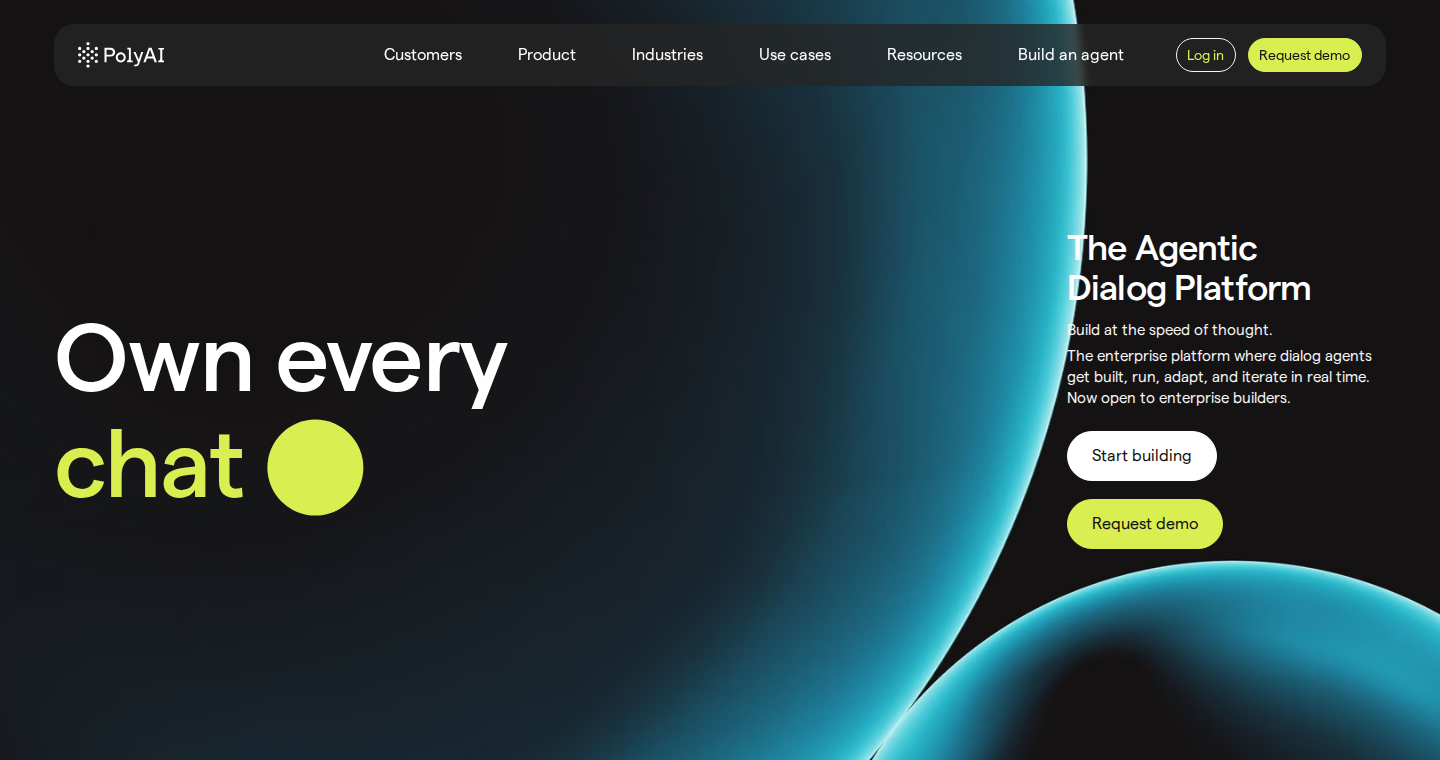
PolyAI positions itself as an enterprise dialog-agent platform built specifically for customer engagement. Its current homepage emphasizes agents that can be built, run, adapted, and governed in real time, with two builder paths: Poly Agent Builder for non-technical teams and ADK for developers. The company also highlights Raven, a proprietary model trained on more than 1 billion enterprise conversations, plus guardrailsGuardrailsAI guardrails are instructions, rules, data boundaries, and escalation paths that constrain what an agent may say or do. for compliance, brand, and experience.
The strongest PolyAI use case is still voice-heavy customer-service automation. The public site calls out hard conversations such as fraud, outage, triage, multilingual disputes, reservations, appointments, and other enterprise service scenarios. It also highlights compliance language including SOC 2, HIPAAHIPAAHIPAA is a US federal law whose Privacy, Security, and Breach Notification Rules govern protected health information for covered entities and business associates., GDPR, and PCI DSS, which matters for regulated contact-center buyers.
The watch-out is scope. PolyAI can be the right product for a contact-center leader trying to automate service calls, but that does not automatically make it the right system for speed-to-lead, CRM write-backCRM write-backCRM write-back sends conversation outcomes, qualification answers, notes, appointments, dispositions, and next steps into the CRM., SMS/email persistence, booking, routing, or revenue follow-up. Buyers should verify how much of the workflowWorkflowA workflow is a defined sequence of steps, decisions, actions, delays, and outcomes used to complete a business process. after the call is native, how much requires services work, and how pricing behaves once call volume and integrations scale.

Sierra positions itself as a platform and partner for enterprise AI agents. Its product page says agents can be built once and deployed across voice, chat, email, and WhatsApp in 58 languages. It also emphasizes complex use cases connected to systems of record, including processing insurance claims, returning orders, and originating mortgages.
Sierra’s visible customer roster is the point. The site highlights brands such as Rocket Mortgage, Gap Inc., SiriusXM, Wayfair, SoFi, GoFundMe, Discord, DIRECTV, Sutter Health, Redfin, Rivian, ADT, CLEAR, Minted, Guild, Safelite, and Next. That is a strong enterprise signal, especially for CX leaders who need executive confidence and a partner-style deployment.
The watch-out is procurement and fit. Sierra’s own product page describes outcome-based pricing and expert agent-development team support. Independent 2026 pricing guides commonly frame Sierra as an enterprise-priced platform with substantial annual commitments, not a self-serve tool. That can be exactly right for a global CX transformation and wildly overbuilt for a RevOps team trying to call every new lead within 60 seconds.
PolyAI is the cleaner fit when the project starts with the phone. If the goal is to replace IVR friction, handle routine service calls, support multilingual conversations, triage issues, resolve account questions, and contain service volume, PolyAI’s voice-first heritage is relevant. The company’s homepage and case-study language keep pointing back to enterprise conversations and contact-center workflows.
Sierra is the cleaner fit when the project is a broader customer-experience agent program. It is not only asking what happens on a phone call; it is asking how a branded agent can work across chat, SMS, WhatsApp, email, voice, and ChatGPT, then connect to systems of record to complete customer tasks. The tradeoff is that broader CX scope can bring heavier stakeholder alignment and procurement.
Winner for voice-first service automation: PolyAI. Winner for broad enterprise CX agents: Sierra.
PolyAI’s current language is broader than old-school voicebot copy, but the practical buyer association remains call automation and dialog agents. That is good if the phone is your highest-value service channel and the contact-center stack is the operating center. It is less ideal if the agent needs to own a prospect journey across call, text, email, booking, CRM updatesCRM updatesCRM updates are changes written after or during a conversation, such as status, notes, owner, next step, appointment, or disposition., and re-engagement.
Sierra is more explicitly multichannel. Its product page says one agent can work across chat, SMS, WhatsApp, email, voice, and ChatGPT, which is useful for CX leaders trying to unify customer conversations. Buyers should still verify how shared context, channel handoff, identity resolution, consent, and escalationEscalationEscalation moves a conversation to a person, specialist, supervisor, or alternate workflow when the agent should not continue alone. work in their exact environment.
Winner for phone-depth positioning: PolyAI. Winner for published channel breadth: Sierra.
PolyAI now describes two ways to build: Poly Agent Builder for non-technical teams and ADK for developers. That combination is useful for enterprises that want business teams involved without removing developer extensibility. It also suggests PolyAI is pushing beyond a purely services-led voicebot model into more platform ownership for enterprise builders.
Sierra’s Ghostwriter is one of its clearest differentiators. The product page says teams can build or modify agents by describing behavior in prompts, uploading SOPs, transcripts, or audio interviews, then letting Ghostwriter generate simulations, test edge cases, diagnose failures, and implement fixes. That is compelling for CX teams that want agent iteration to feel less like traditional bot configuration.
Winner for developer plus business-builder flexibility: PolyAI. Winner for prompt-based agent creation narrative: Sierra.
PolyAI typically fits organizations that already understand contact-center operations. The stakeholders are likely to include CX, service operations, IT, compliance, telephony, analytics, and sometimes regional business owners. That implementation work can be justified when the goal is durable service-call automation at enterprise scale.
Sierra fits a more executive-partner implementation motion. Its product page explicitly says customers work with an expert agent-development team and pay for outcomes. That can reduce the burden on internal teams, but it also means buyers should examine scope, timeline, change control, knowledge maintenance, integrations, and how much autonomy they actually have after go-live.
Winner for contact-center-owned voice rollout: PolyAI. Winner for high-touch enterprise CX partnership: Sierra.
PolyAI does not publish standard pricing. G2’s profile lists pricing details as unavailable and points buyers to the vendor website. Independent market pages frequently describe PolyAI as enterprise-priced and contract-led, which is plausible given its target customer and deployment model, but buyers should get current quotes rather than rely on third-party estimates.
Sierra also does not publish a simple public rate card. It promotes outcome-based pricing, while independent 2026 guides often describe annual commitments starting in the six figures and scaling much higher for large deployments. The useful buyer question is not whether outcome-based pricing sounds modern; it is which outcomes count, how they are measured, what happens when volume spikes, and what implementation/support costs sit around the contract.
Winner for pricing transparency: neither. Both require careful procurement modeling.
PolyAI has a small but positive public review footprint. G2 listed PolyAI at 5.0/5 from 12 reviews at research time, with pricing not publicly available. That is encouraging, but the sample is too small to treat as broad proof across industries or use cases.
Sierra’s evidence is more customer-logo and enterprise-story driven than review-market driven. The company has impressive public customer names and case-study posture, but fewer open review signals to evaluate low-rated patterns. That is not a flaw by itself; it just means procurement teams should ask for references, failure cases, implementation timelines, and measurable outcome definitions before signing.
Winner for open review profile: PolyAI, narrowly. Winner for public enterprise-logo proof: Sierra.
Neither PolyAI nor Sierra is primarily built as a RevOps-owned inbound lead-conversion platform. PolyAI is closer to service-call automation, and Sierra is closer to enterprise CX transformation. Both can touch prospects or customers by voice, but that is not the same as owning speed-to-lead, SMS/email follow-upEmail follow-upEmail follow-up sends timely, context-aware replies or reminders that move an inbound lead toward qualification, scheduling, or handoff., qualification, booking, warm transferWarm transferA warm transfer connects a live caller to the right person while preserving the context already collected during the conversation., attribution, and CRM write-back.
This is where Thoughtly belongs in the comparison. Thoughtly is built for the leads companies already generate: calling quickly, texting when the call misses, emailing context, qualifying intent and urgency, booking or transferring, and writing the outcome back to the CRM. If the buying team is RevOps, growth, admissions, patient access, intake, or field operations, the category fork is usually Thoughtly versus a revenue workflow problem, not PolyAI versus Sierra as CX platforms.
Winner for lead conversion: Thoughtly, not PolyAI or Sierra. Annoying answer, useful answer.
Choose Thoughtly if your problem is not customer-service automation at all. If your team already pays for inbound demand and loses deals because leads are not called fast enough, not texted persistently enough, not booked cleanly enough, or not written back to the CRM, PolyAI and Sierra are both adjacent but heavy.
Thoughtly is the better fit for high-consideration consumer funnels in insurance, mortgage, real estate, automotive, education enrollment, elective healthcare, home services, financial services, legal, and similar categories. Its agents call, text, email, qualify, schedule, warm-transfer, and update CRM records so human reps inherit real context instead of a stale lead queue.
If you are trying to compare the category fork directly, read Thoughtly’s own pages on Thoughtly vs PolyAI and Thoughtly vs Sierra. The blunt version: PolyAI and Sierra are CX tools. Thoughtly is the lead-conversion tool.
| If this is true… | Choose |
|---|---|
| Your project is voice-first service automation inside a contact center | PolyAI |
| Your project is a multichannel enterprise customer-experience agent program | Sierra |
| Your project is converting opted-in inbound leads before they go cold | Thoughtly |
| The daily owner is CX or contact-center operations | PolyAI or Sierra |
| The daily owner is RevOps, growth, sales ops, admissions, intake, or field operations | Thoughtly |
| You need phone depth and dialog-agent tooling | PolyAI |
| You need a high-touch large-brand CX partner | Sierra |
| You need voice, SMS, email, booking, warm transfer, and CRM write-back around one lead journey | Thoughtly |
PolyAI is better if the primary need is enterprise voice AI for contact-center calls. Sierra is better if the primary need is a broader customer-experience agent across chat, SMS, WhatsApp, email, voice, and ChatGPT. The right answer depends on whether the buyer is automating phone-heavy service queues or building a multichannel CX agent program.
Both vendors require sales-led pricing, so the only reliable answer comes from current quotes. Sierra promotes outcome-based pricing and independent guides commonly describe enterprise annual commitments. PolyAI also does not publish standard pricing and is positioned for enterprise deployments. Buyers should compare implementation, usage, support, integrations, and renewal terms rather than just headline rates.
PolyAI is the more voice-native choice based on public positioning and category history. Sierra supports voice, but its platform story is broader customer experience across multiple channels. If voice is the center of the use case, start with PolyAI; if voice is one channel in a wider CX transformation, Sierra may fit better.
Neither is the cleanest default for inbound lead conversion. Thoughtly is built for that job: fast calls, SMS and email persistence, qualification, booking, warm transfers, CRM write-back, and re-engagement for opted-in leads. PolyAI and Sierra are stronger fits for customer-service and CX automation.
They can automate meaningful parts of customer conversations, but buyers should avoid vague replacement language. Contact centers include routing, workforce management, QA, reporting, escalation, compliance, human-agent operations, and system integrations. Treat either platform as part of a designed operating model, not a magic wand. The wand budget was cut.
PolyAI homepage — https://poly.ai/
PolyAI reviews on G2 — https://www.g2.com/products/polyai/reviews
Sierra homepage — https://sierra.ai/
Sierra product page — https://sierra.ai/product
Sierra Ghostwriter product page — https://sierra.ai/product/ghostwriter
Sierra customer stories — https://sierra.ai/customers
Thoughtly compare index — https://thoughtly.com/compare/
Thoughtly vs PolyAI — https://thoughtly.com/compare/thoughtly-vs-polyai
Thoughtly vs Sierra — https://thoughtly.com/compare/thoughtly-vs-sierra
Best PolyAI alternatives — https://thoughtly.com/blog/best-polyai-alternatives-enterprise-voice
Best Sierra alternatives — https://thoughtly.com/blog/best-sierra-alternatives-enterprise-cx
Featurebase Sierra pricing guide — https://www.featurebase.app/blog/sierra-ai-pricing
Lorikeet Sierra pricing alternatives — https://www.lorikeetcx.ai/articles/sierra-ai-pricing-alternatives
Parloa Sierra alternatives analysis — https://www.parloa.com/knowledge-hub/sierra-ai-alternatives/
