Retell vs Bland: Which Voice AI Infrastructure Should You Build On?
A head-to-head comparison of Retell AI and Bland AI — pricing, voice quality, developer experience, compliance, and production reliability. Plus when to skip both and choose a revenue-ready platform instead.
Last updated
Retell AI and Bland AI are the two voice AI infrastructure platforms that come up most often when engineering teams evaluate programmable phone agents. Both let developers build AI-powered voice agents, but they approach pricing, architecture, channel coverage, and compliance from fundamentally different positions.
I compared both platforms across their current pricing, feature sets, public reviews, documented limitations, and production readiness to help teams decide which infrastructure fits their use case — or whether either one is the right fit at all.
Teams building custom voice products with LLM flexibility
High-volume outbound with voice cloning needs
Pricing and total cost of ownership
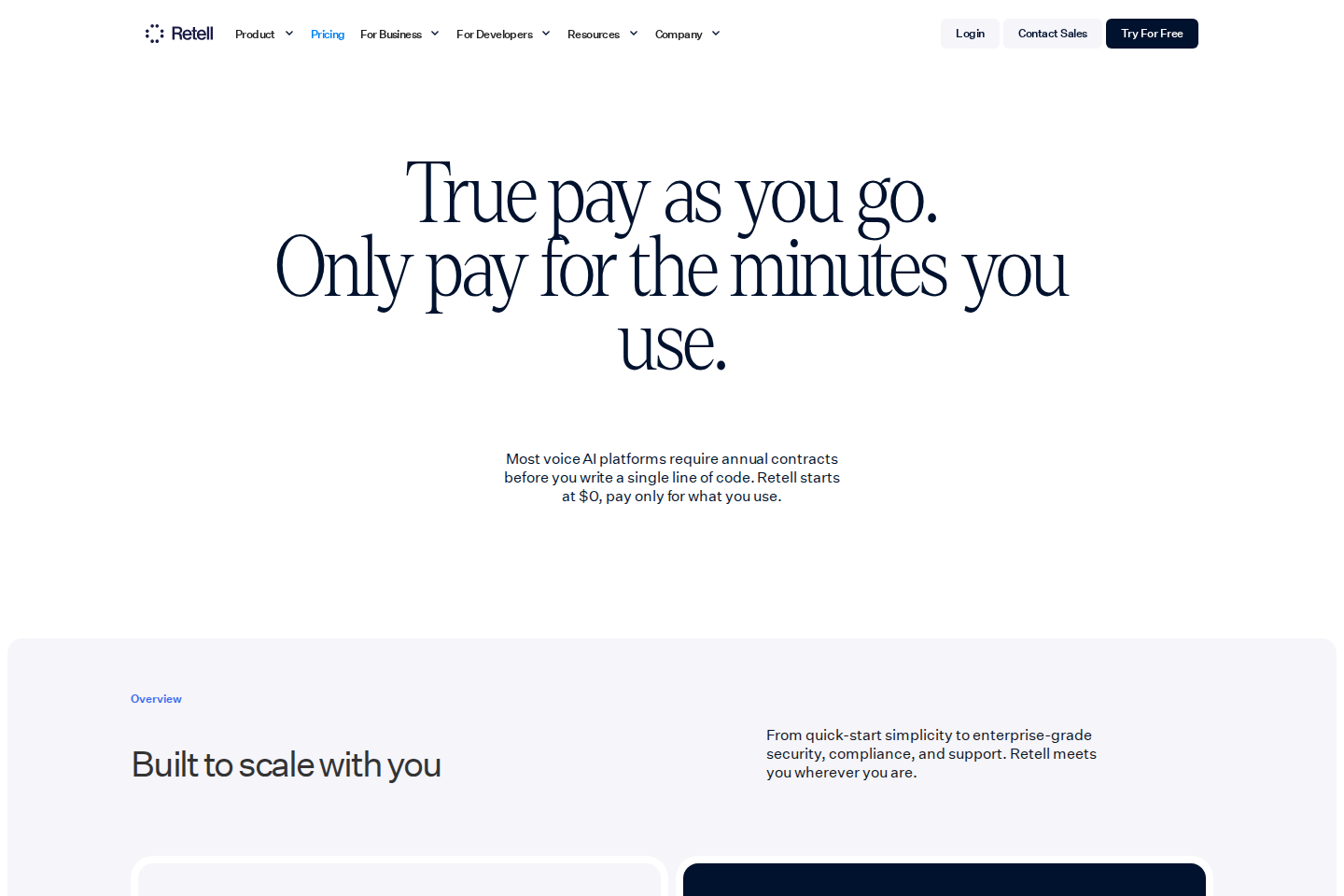
Retell uses a stacked à-la-carte model. The base voice infrastructure costs $0.055/min, but the actual per-minute cost depends on which LLMLarge Language Model (LLM)A machine-learning model trained on massive text data, used as the reasoning engine that drives a voice agent's understanding and responses.Read full definition → ($0.006–$0.08/min), TTSText-to-Speech (TTS)The system that turns the agent's generated text into spoken audio — the voice the caller actually hears.Read full definition → engine ($0.015–$0.040/min), and optional add-ons (knowledge baseKnowledge baseA structured source of business information, FAQs, policies, product details, or procedures that an AI agent can use to answer accurately.Read full definition →, PIIPersonally Identifiable Information (PII)Any data that can identify an individual — name, phone, SSN, account number. Voice agents must redact and protect PII per privacy law. redaction, denoising) a team selects. Their pricing page estimates a baseline of $0.115/min for a standard configuration, but the all-in cost for production agents can reach $0.31/min with premium models and add-ons. There is no platform fee — teams pay only for usage.
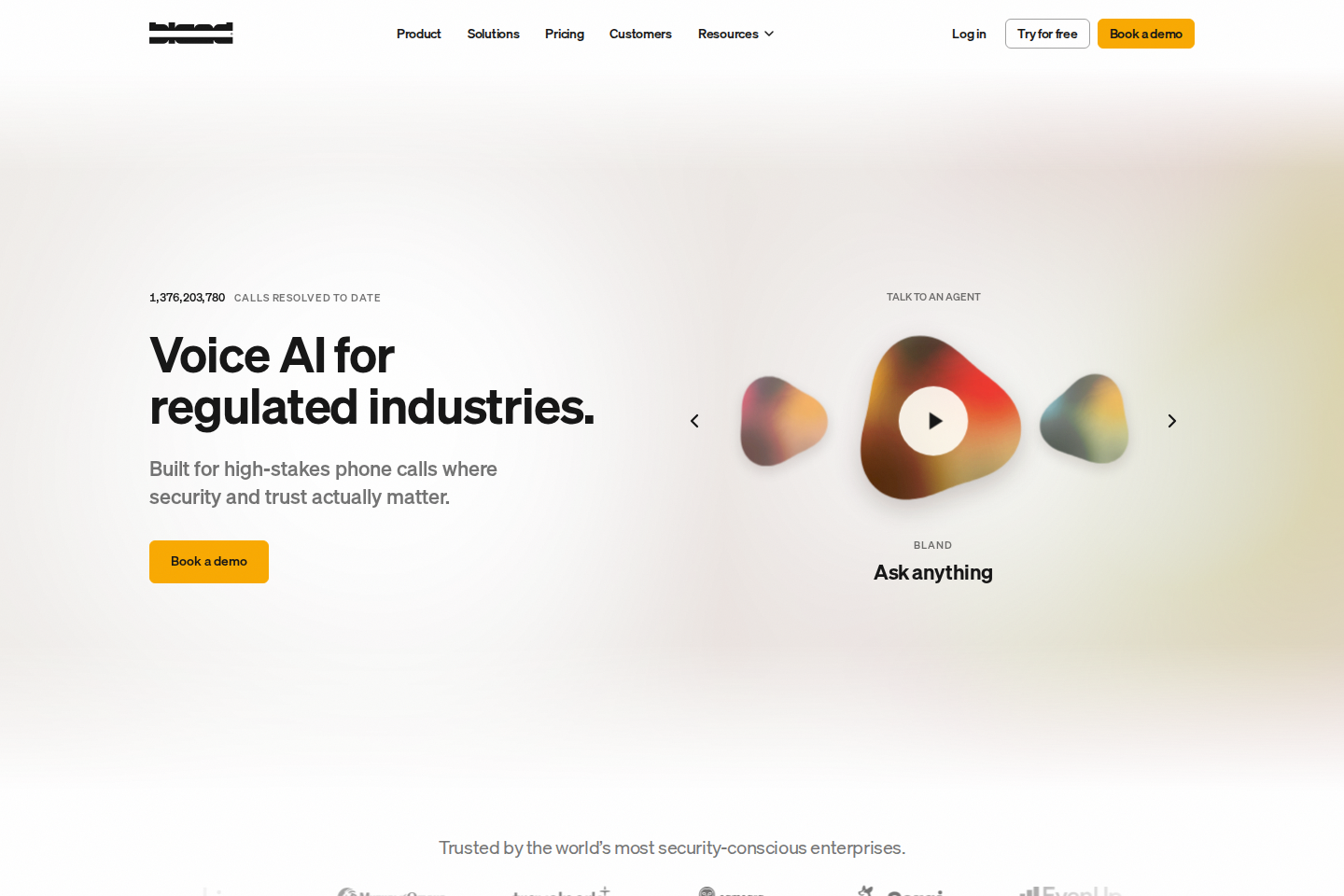
Bland takes a simpler per-minute approach: $0.14/min on the free Start tier, $0.12/min on Build ($299/mo platform fee), and $0.11/min on Scale ($499/mo platform fee). LLM, STTSpeech-to-Text (STT)The system that turns the caller's speech into text the agent can reason over.Read full definition →, TTS, and telephony are bundled into the per-minute rate, which makes cost forecasting easier for basic calls. However, Bland locks critical production features behind the Enterprise tier — warm transfers, live transfers, guardrailsGuardrailsGuardrails are rules that keep an AI agent within approved topics, scripts, compliance boundaries, and handoff paths during voice, SMS, or email conversations.Read full definition →, SMS, web chat, appointment scheduling, iMessage, and alarm/monitoring are all Enterprise-only. Teams that need these features cannot access them on any self-serve plan.
For teams running fewer than 4,000 minutes per month, Retell's no-platform-fee model is often cheaper despite the stacked pricing. For high-volume operations above 5,000 minutes, Bland's bundled rate can be lower per minute, but the $299–$499/mo platform fee and enterprise-gated features change the math. Both platforms require careful cost modeling before committing to production scale.
Voice quality and latency
Both platforms emphasize low-latency voice interactions, and both deliver sub-second response times under normal conditions. Retell supports multiple TTS providers and allows teams to choose between cost and quality for each agent. Bland's proprietary voice models are well-regarded for sounding human-like, and their Turbo mode is specifically designed for minimal interruption latencyLatencyThe delay between a caller speaking and the agent responding. Lower latency makes AI voice conversations feel more natural.Read full definition →.
Where the platforms diverge is in production stability. Retell's G2 reviews are overwhelmingly positive (4.8/5 across 2,200+ reviews), with users citing reliable voice quality and responsive support. Bland's public review profile is thinner and more mixed — approximately 3.3/5 on G2 with limited reviews. Low-rated G2 reviews and independent assessments flag agents that hallucinate incorrect information, get stuck in conversational loops, refuse to transfer to humans, and quote wrong dollar amounts during live calls. Reddit threads and independent reviews from platforms like Ringg and Dasha corroborate these patterns, noting that Bland requires a dedicated engineer to monitor and debug production agents after launch.
Developer experience and setup
Retell is API-first with a clean developer experience. Users consistently praise the documentation, onboarding flow, and the ability to get a test agent running quickly. The platform offers pre-built agent templates, simulation testing, and webhooks/API access from the free tier. Retell does not have a visual drag-and-drop builder — all configuration happens through API calls and the dashboard's structured agent setup.
Bland is also API-first, with its Conversational Pathways system providing a graph-based conversation logic builder. This offers powerful control over multi-turn conversations but comes with a steep learning curve. Independent reviews note that even simple logic flows require significant coding knowledge, and non-technical team members cannot manage agents without engineering support. Bland's documentation and onboarding experience receive less consistent praise in public reviews compared to Retell's.
Channel coverage
Neither platform is multichannel in the way that revenue operations teams typically need. Retell is primarily a voice platform with a chat agent add-on. SMS is available as a paid add-on, but email is not a supported channel. Bland positions as voice-first, with SMS, iMessage, and web chat available only on the Enterprise tier — not on Start, Build, or Scale plans.
For teams whose lead conversion motion requires voice plus SMS plus email follow-upEmail follow-upEmail follow-up is the process of sending timely, context-aware replies or reminders that keep an inbound lead moving toward qualification, scheduling, or handoff.Read full definition → from a single platform, both Retell and Bland leave gaps. The buyer either assembles the missing channels from other tools or accepts a voice-only workflowWorkflowAn automated, multi-step process — usually triggered by an event (form fill, new lead) and orchestrating one or more voice / SMS / email actions.Read full definition →.
CRM integration and workflow execution
Both platforms approach CRM integrationCRM integrationA two-way connection between a voice/SMS/email agent platform and a CRM that syncs contact data, call outcomes, dispositions, and follow-up tasks in real time.Read full definition → as an engineering exercise. Retell provides webhooks and API access for pushing call data to external systems, but it does not offer native two-way CRM write-backCRM write-backUpdating the CRM after an interaction with call outcomes, transcripts, qualification answers, notes, appointments, dispositions, and next-step fields.Read full definition → to Salesforce, HubSpot, or other sales tools. Teams build their own integration layer.
Bland offers a similar webhookWebhookAn event-based integration that sends data from one system to another when something happens, such as a form submission, booked appointment, or completed call.Read full definition →/API model with native integrations for a smaller set of tools. Appointment scheduling, SMS nodes, and CRM-connected workflows are available only on the Enterprise tier. For either platform, a production deployment that syncs qualified lead data, books meetings, and updates deal records requires custom development work beyond what the platform provides out of the box.
Compliance and enterprise readiness
Retell offers HIPAAHIPAAThe US health privacy law that governs protected health information. Healthcare voice and SMS workflows must handle PHI with appropriate safeguards.Read full definition → compliance and BAA on its enterprise plan. PII redaction is available as a paid add-on. SOC 2 Type II certification is noted as in progress. The platform publishes rate limits by tier and offers dedicated stable servers on enterprise plans.
Bland offers BAA, SSO, data residency, JWT signatures, and on-premises/VPC deployment — all exclusively on the Enterprise tier. The self-serve tiers (Start, Build, Scale) do not include any of these compliance features. Bland's 99% uptime SLASLAAn SLA, or service level agreement, is the response-time commitment a team uses to make sure new leads are contacted, routed, or escalated within a defined window.Read full definition → is listed only for Enterprise. Independent reviews have noted past outages and stability concerns, which is worth verifying for regulated use cases that require documented reliability.
For teams in regulated industries like insurance, mortgage, healthcare, or financial services, both platforms require the enterprise plan to meet compliance requirements. The difference is that Retell's compliance posture is more established in public reviews, while Bland's enterprise compliance features are newer and less independently validated.
Production reliability and support
Retell's support model includes community and email support on the free tier, with 24/7 omnichannelOmnichannelA coordinated customer journey across channels such as voice, SMS, email, web forms, and CRM tasks, where context carries across each interaction.Read full definition → support and a dedicated portal on the enterprise plan. G2 reviews frequently cite responsive support as a strength.
Bland's support experience is a recurring concern in public feedback. Self-serve tiers include only customer engineering support, with Slack support, dedicated FDE (field deployment engineer) support reserved for enterprise. Multiple independent reviews and forum threads note that support responsiveness is limited on non-enterprise plans, and teams have reported difficulty getting help during production issues. Reddit users testing both platforms report significantly better conversion rates and production stability with Retell compared to Bland in side-by-side tests.
When to choose Retell AI
Your team has engineering resources to build and maintain voice agents via API, and you want clean documentation with quick onboarding.
BYO-LLM flexibility matters — you need to choose between GPT, Claude, Gemini, or other models at the agent level and optimize for cost vs quality.
You want pay-as-you-go pricing without a platform fee, and your volume is moderate enough that stacked per-minute costs remain competitive.
You need HIPAA compliance and PII redaction today, not on a future roadmap.
You prioritize a platform with a large, validated review base (4.8/5 on G2 with 2,200+ reviews) over one with limited public feedback.
When to choose Bland AI
You need high-quality voice cloning for branded agent voices and your team can invest in the engineering work to build stable conversation flows.
Your use case is high-volume outbound calling where bundled per-minute pricing at scale ($0.11/min on the Scale plan) is more predictable than Retell's stacked model.
You are willing to commit to the Enterprise tier for production features like warm transfers, guardrails, SMS, appointment scheduling, and compliance controls.
On-premises or VPC deployment is a hard procurement requirement that Retell does not currently offer.
Your team has a dedicated voice engineer who can monitor, debug, and maintain agent behavior through production — Bland's power comes with the responsibility of operational ownership.
When neither is the right fit
Both Retell and Bland are voice AI infrastructure platforms. They give engineering teams the building blocks to assemble voice agents — but the surrounding revenue workflow, CRMCRMThe system of record for leads, contacts, deals, and activity. Thoughtly reads from and writes to your CRM continuously.Read full definition → execution, multichannel follow-up, and operational ownership remain the buyer's problem to solve.
If the actual job is converting inbound leads across voice, SMS, and email — with CRM write-back, booking, warm transferWarm transferA live transfer where the agent connects a qualified caller to the right human while preserving context, instead of sending the caller to a cold queue or voicemail.Read full definition →, qualification workflows, and compliance built in — neither platform ships that out of the box. Both require custom development to close the gap between a working voice agentVoice agentAn autonomous, conversational interface that interacts with humans over the phone — answering, qualifying, and routing calls without human staffing.Read full definition → and a production revenue workflow.
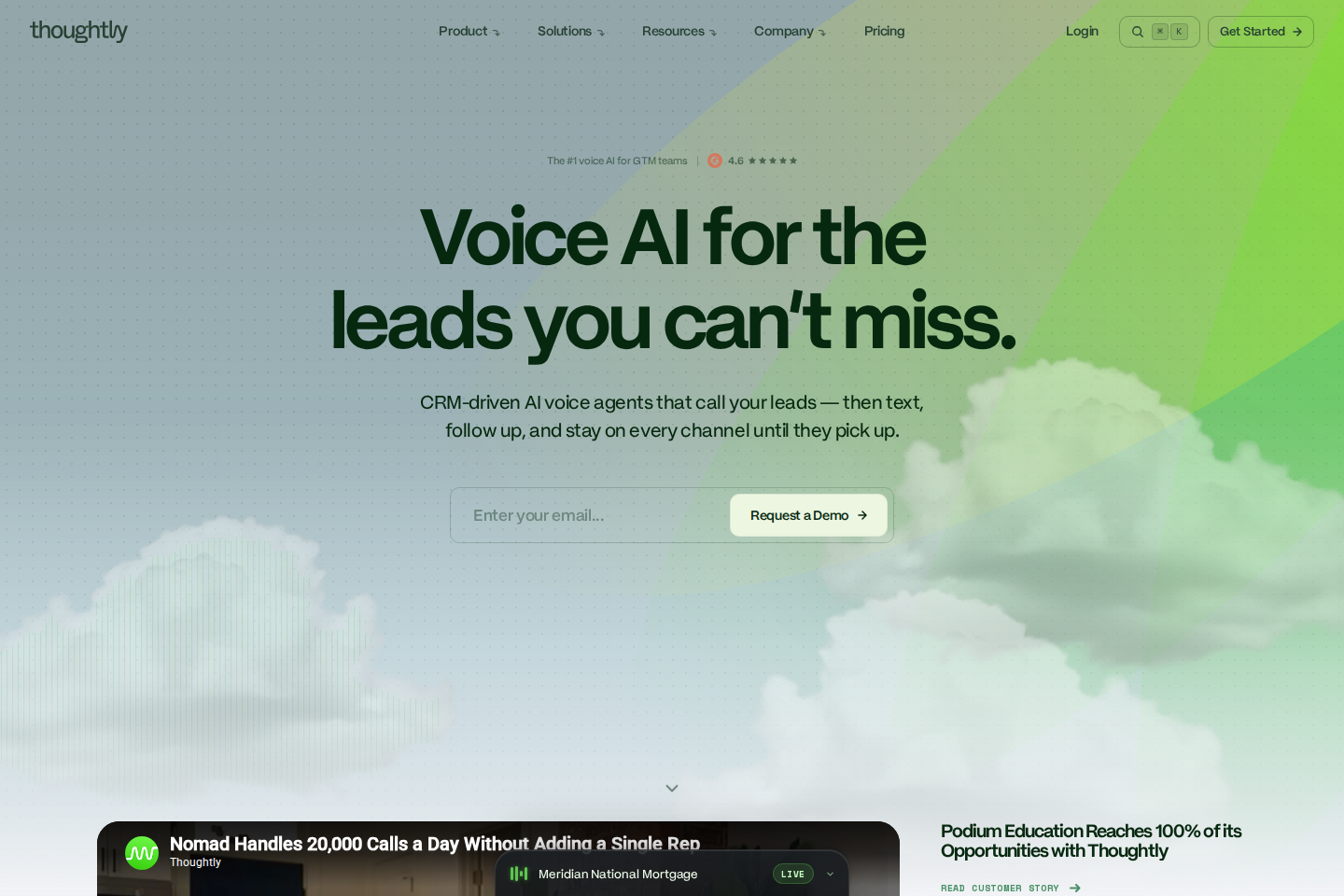
Thoughtly is built for that different job. It bundles voice, SMS, email, CRM syncCRM syncCRM sync is the two-way flow of lead records, conversation notes, outcomes, and next steps between an AI agent platform and a CRM so human teams inherit current pipeline instead of manual updates.Read full definition →, workflow execution, and compliance into a single platform that RevOps and growth teams can ship without assembling infrastructure. For teams evaluating Retell or Bland specifically for inbound lead conversionInbound lead conversionThe process of turning opted-in inquiries, form fills, calls, and quote requests into qualified conversations, appointments, or transfers.Read full definition →, Thoughtly's approach is worth comparing directly — it solves the workflow problem these infrastructure tools leave open.
It depends on volume and feature requirements. Retell has no platform fee but stacked per-minute costs ($0.07–$0.31/min depending on LLM, TTS, and add-ons). Bland bundles more into its per-minute rate ($0.11–$0.14/min) but adds a $299–$499/mo platform fee on its paid tiers and gates critical features behind enterprise pricing. For moderate volumes, Retell is often cheaper. For high volumes with simple agent configurations, Bland's bundled rate can be more predictable.
Can I use Retell or Bland without developers?
Neither platform is designed for non-technical users. Both are API-first and require engineering resources to build, deploy, and maintain voice agents in production. Retell's onboarding is faster and more documented, but production agents still need developer involvement. Bland's Conversational Pathways system offers some structure but demands significant coding knowledge even for basic flows.
Which platform has better reviews?
Retell AI has significantly more validated reviews — 4.8/5 on G2 with over 2,200 reviews and 5.0/5 on Trustpilot with 800+ reviews. Bland AI has approximately 3.3/5 on G2 with limited reviews. Bland's low-rated reviews cite hallucinationHallucinationWhen an LLM-driven agent confidently states something incorrect. Mitigated with RAG, strict prompting, and evals against ground-truth data.Read full definition →, agent loops, and support issues. Retell's negative reviews more commonly mention pricing complexity and feature requests.
Do Retell and Bland support SMS and email?
Neither platform offers comprehensive multichannel coverage. Retell supports SMS as a paid add-on but does not offer email. Bland offers SMS, iMessage, and web chat only on its Enterprise tier. Email is not a primary channel for either platform. Teams needing voice plus SMS plus email from one platform should evaluate alternatives like Thoughtly.
Which platform is better for regulated industries?
Both require enterprise plans for full compliance features. Retell offers HIPAA/BAA and PII redaction (as an add-on) with a more established compliance track record in public reviews. Bland offers BAA, SSO, data residency, and on-premises deployment on its enterprise tier, but these features are newer and less independently validated. Teams in insurance, mortgage, healthcare, or financial services should request compliance documentation from both vendors before committing.
Sources and further reading
Retell AI pricing page — https://www.retellai.com/pricing
Bland AI pricing page — https://www.bland.ai/pricing
Retell AI G2 profile — https://www.g2.com/products/retell-ai/reviews
Bland AI G2 profile — https://www.g2.com/sellers/bland-ai
Reddit: Retell vs Bland comparison threads — https://www.reddit.com/r/ArtificialInteligence/comments/1cu01ye/
Retell AI blog: Retell AI vs Bland AI — https://www.retellai.com/blog/retell-ai-vs-bland-ai-choose-the-right-voice-agent-for-your-business
Thoughtly vs Retell AI — https://thoughtly.com/compare/thoughtly-vs-retell
Thoughtly vs Bland AI — https://thoughtly.com/compare/thoughtly-vs-bland
Thoughtly vs Retell AI comparison article — https://thoughtly.com/blog/thoughtly-vs-retell-ai-comparison
Thoughtly vs Bland AI comparison article — https://thoughtly.com/blog/thoughtly-vs-bland-ai-comparison