8 Best AI Voice Agents with CRM Integration in 2026 (Tested and Ranked)
I evaluated eight AI voice agent platforms based on how well they actually sync with your CRM — writing back call outcomes, updating pipeline, and triggering follow-up without anyone touching a form.
Last updated
I evaluated eight AI voice agentVoice agentA voice agent is a conversational software system that listens, responds, follows a defined workflow, and can take approved actions during a phone conversation.Read full definition → platforms specifically on how well they connect to a CRMCRMA CRM is the system used to manage leads, contacts, accounts, opportunities, activity, ownership, and follow-up.Read full definition → — not just whether an integration exists, but whether the platform actually writes useful data back, triggers follow-up workflows, and gives revenue teams a clean pipeline view without manual entry.
This is a different test than ranking voice agents on conversation quality alone. A platform can sound perfectly human on the phone, but if a sales rep has to manually log the call outcome in HubSpot afterward, you have not actually saved anyone's time. The agents on this list were evaluated on the full loop: can the AI call a lead, qualify them, record structured outcomes in the CRM, and triggerTriggerA trigger is an event or condition that starts, resumes, changes, or stops an automated workflow.Read full definition → the next step — all without a human touching a record?
If your team runs on a CRM and you are looking at voice AI, the integration depth is where most platforms quietly fall apart. Here is what I found.
Quick takeaways
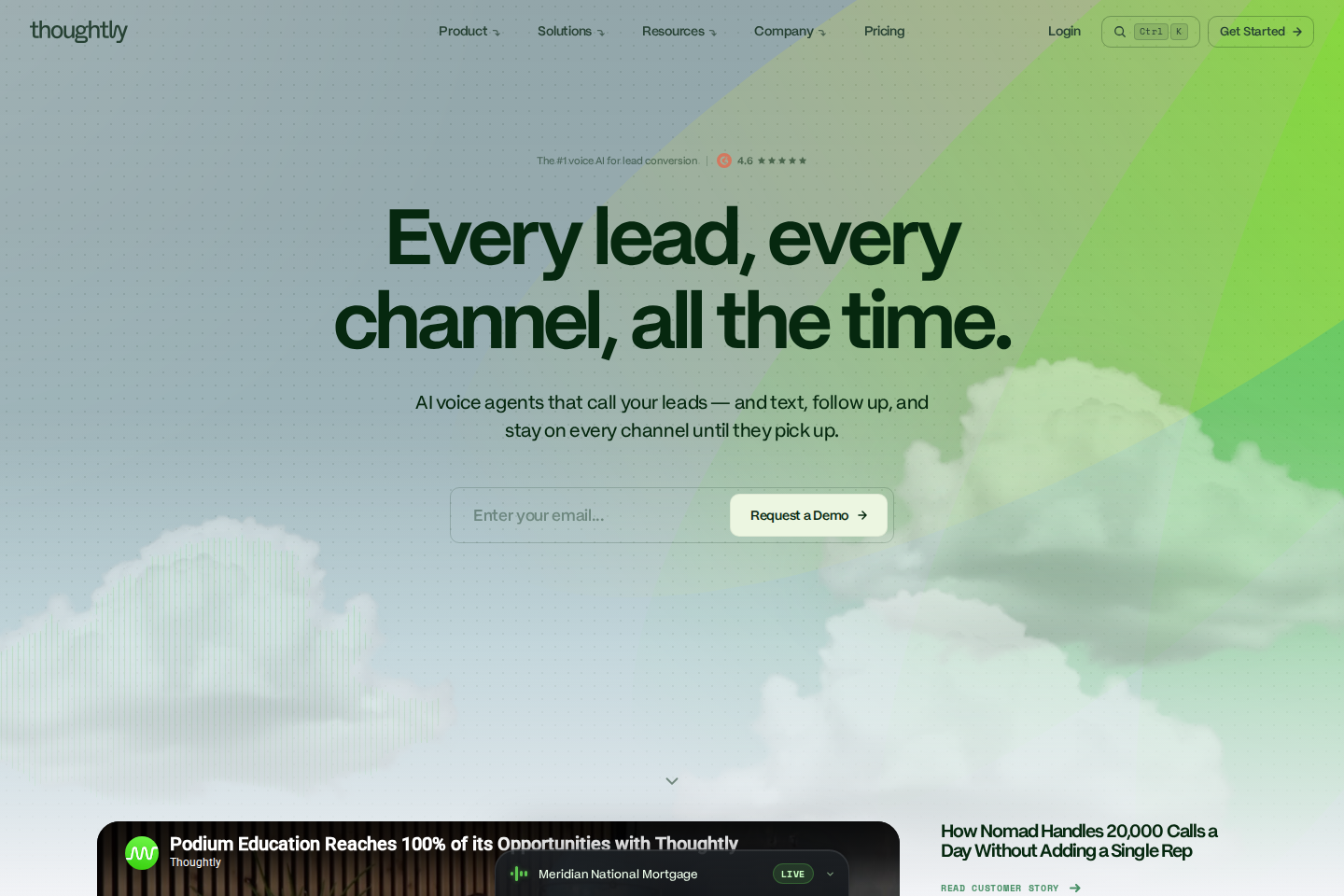
Thoughtly is the strongest option for revenue teams that need full-loop CRM automation — calls, texts, emails, CRM write-back, and triggered follow-up workflows from a single platform.
Close stands out for teams that want the CRM and the AI calling agent in the same product, with no integration layer to manage.
CRM sync depth varies enormously. Some platforms auto-log transcripts and update deal stages; others require Zapier or manual exports to get call data into your pipeline.
Multi-channel follow-up matters. The best CRM-integrated voice agents do not just log the call — they trigger SMS, email, or task creation in the CRM based on the call outcome.
Pricing models differ. Per-minute (Thoughtly, Kixie), per-user (Close, Aircall, JustCall), and usage-hybrid (Aloware, Regal) each reward different team shapes and call volumes.
How I evaluated these AI voice agents for CRM integration
Every platform was evaluated against six criteria designed to surface how much real value a revenue team gets from the CRM connection — not just whether a Salesforce logo appears on the integrations page.
1. CRM sync depth
I looked at whether the platform writes structured data back to the CRM automatically — call outcome, qualification status, transcriptTranscriptA transcript is the written record generated from a spoken conversation, typically showing what the caller and agent said during a call.Read full definition → summary, next steps — or whether it just logs a generic 'call completed' activity. The best platforms update deal stages, create tasks, and attach full transcripts without any manual step. Weak platforms require Zapier middleware or CSV exports. I also checked whether the sync is bidirectional: can the voice agent read from the CRM to personalize the conversation, or is it a one-way data dump?
2. Lead qualification and routing
The AI agent needs to ask the right questions, score the lead, and route it correctly — and that scoring needs to land in the CRM as a structured field, not buried in a transcript. I evaluated whether platforms can map qualification answers to CRM custom fields, assign lead owners, and trigger stage changes based on call outcomes. Platforms that require a human to review every transcript and manually update the CRM score poorly here.
3. Multi-channel follow-up
A voice call is one touchpoint. The best CRM-integrated agents trigger SMS follow-ups, email sequences, calendar invites, or task assignments based on what happened on the call — all logged in the CRM timeline. I looked for native multi-channel capability (voice + SMS + email from the same platform) versus voice-only agents that need separate tools for everything after the call ends.
4. Pipeline visibility and reporting
Revenue leaders need to see what the AI agent is doing to the pipeline. I checked whether each platform surfaces conversion metrics, call outcomes, and pipeline impact in a way that connects back to CRM data — either natively or through clean CRM reporting. Platforms that only show an internal dashboard disconnected from CRM pipeline views scored lower, because that means someone still has to reconcile two systems.
5. Setup and time-to-value
CRM integrations can be painful. I evaluated how long it takes to connect the platform to a CRM, map fields, and start getting useful data flowing. Native one-click integrations with HubSpot or Salesforce score higher than platforms requiring webhookWebhookA webhook sends event data from one system to another through an HTTP request when a defined event occurs.Read full definition → configuration and custom mapping. I also checked documentation quality and whether the vendor provides hands-on onboarding support or drops you into a self-serve portal.
6. Enterprise readiness and compliance
For regulated industries — healthcare, insurance, financial services — the CRM integrationCRM integrationA CRM integration connects an agent or communications platform with a CRM so the systems can exchange records, events, and actions.Read full definition → needs to handle data residency, consent managementConsent managementConsent management records, applies, updates, and revokes a person’s communication permissions across channels, purposes, senders, and systems.Read full definition →, and audit trails. I looked for SOC 2, HIPAAHIPAAHIPAA is a US federal law whose Privacy, Security, and Breach Notification Rules govern protected health information for covered entities and business associates.Read full definition →eligibilityEligibilityEligibility is the set of conditions that determines whether a prospect can move to a service, quote, appointment, application, or specialist., GDPR compliance, role-based access controls, and whether call recordings and transcripts are stored in a way that satisfies compliance teams. Platforms that lack these controls limit their usefulness in the industries where CRM-connected voice AI has the highest ROI.
Quick comparison: AI voice agents with CRM integration
Platform
Best for
CRM integrations
Channels
Pricing model
Thoughtly
Revenue teams converting inbound leads with full CRM write-back
B2C engagement orchestration with CRM-driven journeys
Salesforce, HubSpot, Segment, custom CDP
Voice, SMS, email
Custom / usage-based
Dialpad
Conversation intelligence teams needing AI coaching + CRM sync
Salesforce, HubSpot, Zoho, Microsoft Dynamics
Voice
Per-user
8 best AI voice agents with CRM integration in 2026
1. Thoughtly — Best overall for revenue teams converting inbound leads
Thoughtly is a voice AI platform built for autonomous inbound lead conversionInbound lead conversionInbound lead conversion turns opted-in calls, form submissions, quote requests, and other inquiries into qualified conversations, appointments, or transfers.Read full definition → across voice, SMS, email, WhatsApp, and iMessage. What sets it apart for CRM-connected workflows is the two-way sync: Thoughtly reads contact records, deal stages, and custom fields from your CRM before the call starts, then writes back structured call outcomes — qualification status, captured answers, transcript summaries, and next steps — the moment the conversation ends. Reps inherit pipeline, not paperwork.
The platform connects natively to HubSpot, Salesforce, Pipedrive, Attio, and 24+ other tools including Calendly, Zapier, Make, Slack, and Gmail. Workflows can be triggered from CRM events — a new lead, a field change, a deal stage update — and the agent handles the outreach across channels. For teams running on a CRM and looking for full-loop automation, Thoughtly covers the most surface area on this list.
Pros
Two-way CRM sync with structured write-back. Call outcomes, qualification answers, and transcripts land as structured CRM fields — not just activity log entries. Deal stages update automatically based on call outcomes.
Omnichannel follow-up from one platform. Voice, SMS, email, WhatsApp, and iMessage are all native. A lead that does not pick up the phone gets a text; a text non-responder gets an email — all logged in the CRM timeline.
Sub-350ms response latency with 34 languages. Conversations sound natural, not robotic. The speed matters for lead engagement: faster response means higher contact rates.
Workflow builder with CRM triggers. Outreach sequences fire from CRM events (new lead, score change, stage update) without Zapier middleware. Non-engineers can edit qualification rules and escalation paths.
Watch for
Requires defined CRM workflows to get full value. Thoughtly works best when you have a clear CRM structure — lead stages, qualification criteria, routing rules. Teams with messy or undefined CRM setups will need to do that foundational work first.
Best suited for teams with real lead volume. If you are handling fewer than a hundred leads per month, the automation ROI takes longer to materialize. The platform is built for teams that need to work leads at scale.
Best fit
Revenue, sales, and GTM teams at mid-market or enterprise companies that run on HubSpot or Salesforce and need an AI agent to call, qualify, follow up, and update the CRM without human intervention. Strongest in high-consideration industries — insurance, mortgage, healthcare, real estate, education — where lead response speed and multi-touch follow-up directly impact conversion rates.
Pricing
Per-minute pricing. Every customer is paired with a dedicated account manager and customer success team. Contact Thoughtly for a quote.
2. Close — Best for CRM-first teams with embedded AI calling
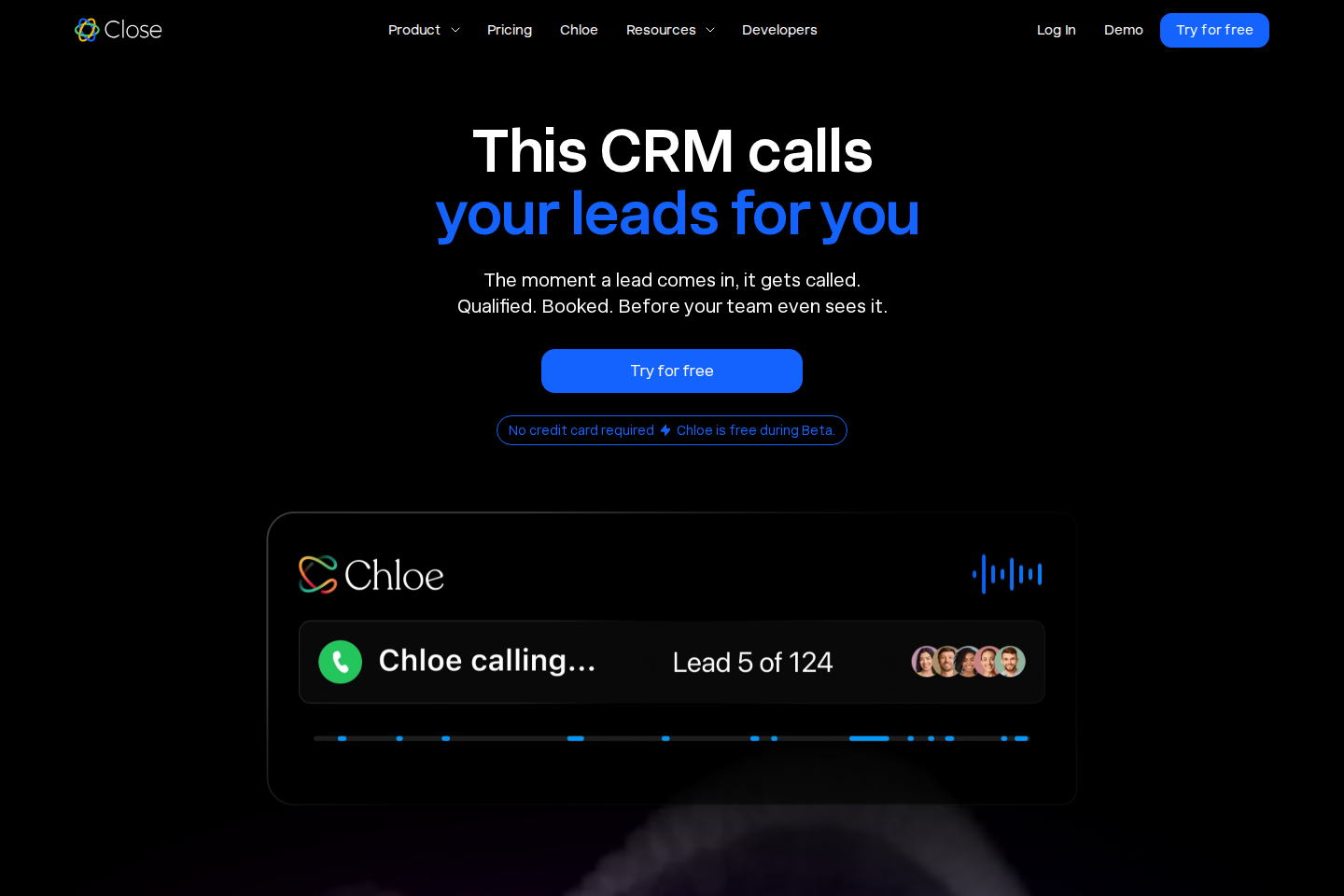
Close takes a fundamentally different approach from every other platform on this list: the AI voice agent lives inside the CRM. Chloe, Close's AI sales agent, is built directly into the Close CRM — no separate integration, no middleware, no syncing delays. When a lead enters Close, Chloe can call it within minutes using the built-in dialer, qualify the prospect through a real conversation, and update the CRM record automatically with transcript, notes, qualification answers, and next steps.
This eliminates the most common failure point in voice AI adoption: the integration layer. There is no mapping of fields between two systems, no webhook debugging, no sync lag. The trade-off is that Close's AI calling only works within Close CRM — if your team runs on HubSpot or Salesforce, Chloe is not an option.
Pros
Zero integration overhead. The AI agent, dialer, CRM, email, and SMS are the same product. No API connections to configure or maintain.
Automatic CRM updates on every call. Transcript, notes, call outcome, and next steps are logged instantly — no manual entry, no Zapier.
Re-engages cold leads automatically. Chloe identifies dormant leads in the pipeline and re-opens conversations without a rep needing to trigger the outreach.
Watch for
Only works within Close CRM. If your team uses Salesforce, HubSpot, or any other CRM, Chloe is not available. You would need to migrate your entire CRM to Close to use the AI calling feature.
AI agent is in beta. Chloe is currently in beta. Expect evolving capabilities and potential rough edges in conversation handling and qualification logic.
Best fit
SMB and mid-market sales teams already using Close CRM (or willing to switch) that want the simplest possible path to AI-powered calling with automatic CRM logging. Strong for teams that value speed of setup over integration flexibility.
Pricing
Close CRM starts at $29/user/month (Startup plan). Professional and Enterprise tiers include more advanced calling and automation features. Chloe is free during beta.
3. Kixie — Best for speed-to-lead dialing with instant CRM sync
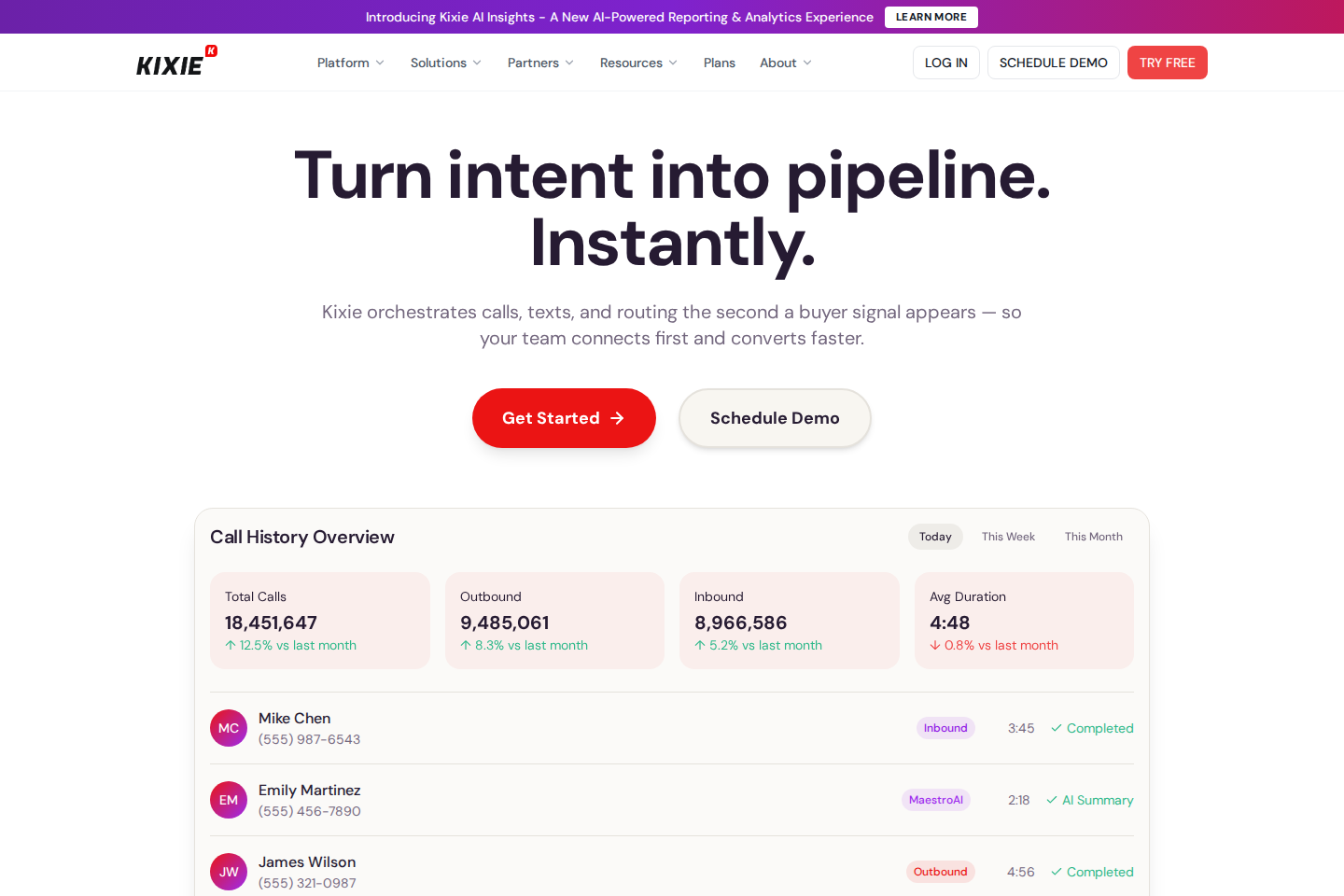
Kixie is a sales engagement platform built around the idea that the first team to call a lead wins. The platform orchestrates calls, texts, and routing the second a buyer signal appears — a form fill, a CRM event, a webhook — and logs everything back to the CRM automatically. Kixie integrates natively with HubSpot, Salesforce, Pipedrive, Zoho, and 25+ other CRMs and sales tools.
Their AI capabilities include MaestroAI for call summaries and coaching insights, a multi-line PowerDialer for high-volume outreach, and automated SMS follow-upSMS follow-upSMS follow-up uses compliant two-way text messages to continue a conversation after an inquiry, call, voicemail, or prior interaction.Read full definition → sequences. Every call, text, and voicemail is auto-logged to the CRM with timestamps, recordings, and AI-generated summaries. For teams measured on speed-to-lead and contact rates, Kixie's CRM-triggered dialing is a strong fit.
Pros
Instant CRM-triggered dialing. New lead in Salesforce or HubSpot? Kixie can fire a call within seconds, before a rep even sees the notification. The speed advantage is measurable.
Auto-logging with AI summaries. Every call gets a recording, transcript, and MaestroAI summary written back to the CRM record. Reps skip manual note-taking entirely.
Multi-line PowerDialer for volume. Teams that need to work large lead lists can dial multiple lines simultaneously, with automatic CRM disposition logging.
Watch for
G2 reviewers flag call connectivity issues. A recurring theme in lower-rated G2 reviews is dropped calls and connection reliability, particularly on the multi-line dialer. Verify performance in your geography before committing.
AI agent capabilities are dialer-focused, not conversational. Kixie's AI assists with call summaries and coaching, but it is not an autonomous voice agent that handles entire conversations. A human rep still does the talking.
Best fit
Outbound-heavy sales teams running on HubSpot, Salesforce, or Pipedrive that prioritize speed-to-lead and need every call automatically logged with AI summaries. Best for teams where reps handle the conversations and need dialing efficiency, not full call automation.
Pricing
Plans start at $35/user/month (Integrated plan). Professional ($65/user) and Enterprise tiers add PowerDialer, multi-line dialing, and advanced automations. Per-minute calling costs apply.
4. Aloware — Best for HubSpot-native teams with AI voice agents
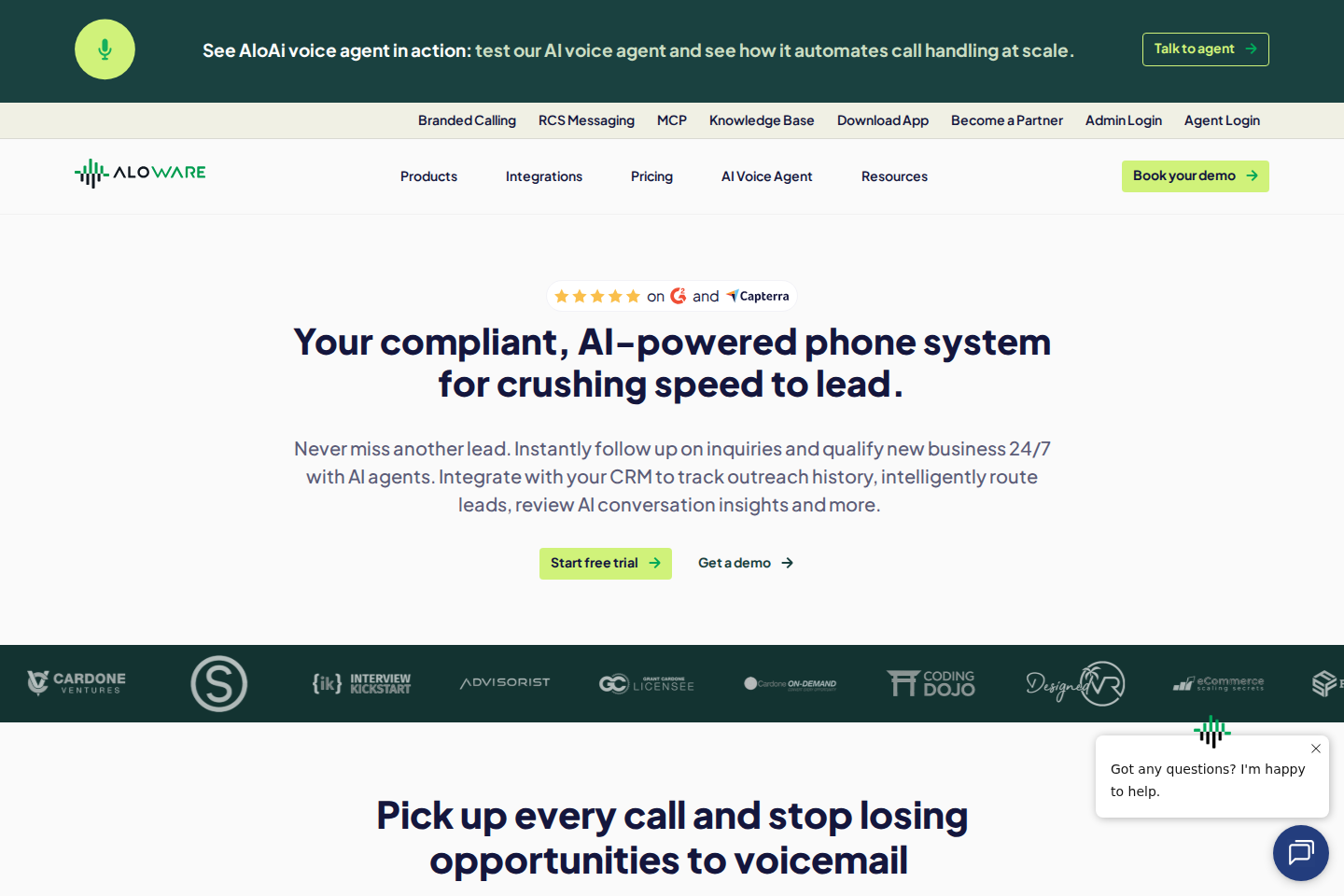
Aloware positions itself as an AI-powered phone system built for speed-to-lead, with particularly deep HubSpot integration. The platform offers AloAi, an autonomous AI voice agent that can answer calls, qualify leads, and handle inbound conversations at scale — plus a power dialerPower dialerA power dialer automatically calls contacts in sequence while keeping one person or automated agent available for each connected conversation.Read full definition →, SMS workflows, and automated follow-up sequences. Everything syncs to HubSpot (or Salesforce, Zoho, and Pipedrive) with bidirectional contact sync, call logging, and workflowWorkflowA workflow is a defined sequence of steps, decisions, actions, delays, and outcomes used to complete a business process.Read full definition → triggers.
What makes Aloware interesting for CRM-heavy teams is the native HubSpot sidebar integration: reps can make and receive calls directly within HubSpot, see contact history, and trigger Aloware automations from HubSpot workflows. The AI voice agent handles inbound calls autonomously, qualifying leads and logging outcomes without a human on the line.
Pros
Deep HubSpot integration with sidebar calling. Reps work inside HubSpot and make calls from the CRM interface. Call data flows back automatically — no tab switching, no manual logging.
AI voice agent for inbound automation. AloAi handles inbound calls autonomously — answering, qualifying, routing — and logs structured outcomes to the CRM.
Compliance-ready for regulated industries. TCPA compliance features, DNC list management, and consent tracking built in — important for financial services, insurance, and healthcare teams.
Watch for
G2 reviewers note slower issue resolution. While the platform works well when everything is running, some G2 reviewers flag that support response times for complex issues can be slow. Confirm SLA expectations.
Less polished outside HubSpot. The Salesforce and Zoho integrations exist but are not as deeply embedded as the HubSpot experience. If you run on Salesforce, compare the integration depth against alternatives.
Best fit
Sales and customer success teams running on HubSpot that need AI-powered inbound call handling, power dialing, and SMS follow-up — all logging back to HubSpot automatically. Particularly strong for teams in regulated industries needing built-in compliance controls.
Pricing
Plans start around $30–50/user/month depending on features. AI voice agent and power dialer are available on higher tiers. Free trial available. Contact Aloware for enterprise pricing.
5. Aircall — Best for growing teams standardizing CRM-connected calling
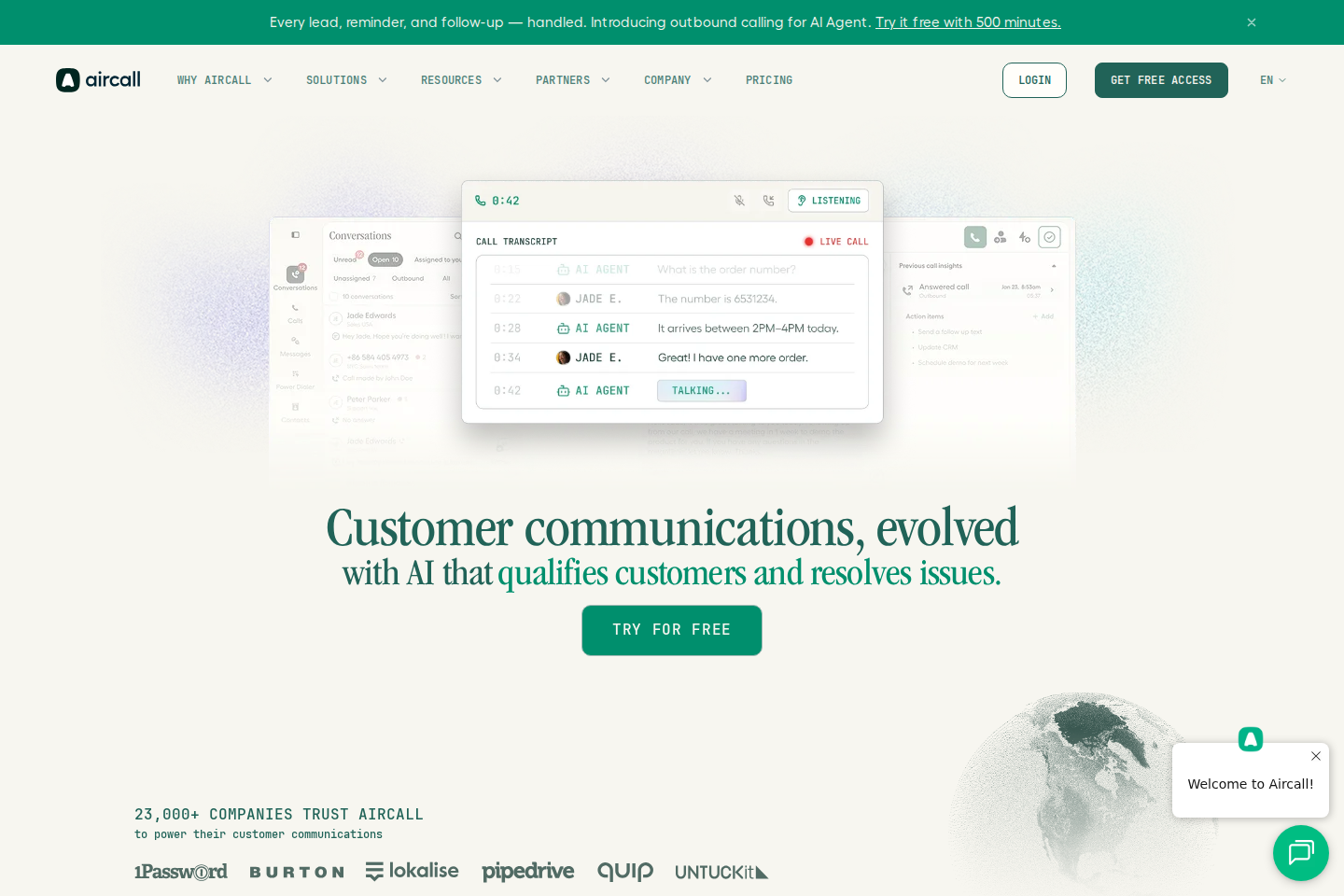
Aircall is an AI-powered business phone system trusted by over 23,000 companies, built around the principle that customer communications should flow directly into the tools teams already use. The platform offers native integrations with 100+ business tools — including HubSpot, Salesforce, Pipedrive, Zoho, Intercom, and Zendesk — with automatic call logging, contact syncing, and activity creation in the CRM.
Aircall's AI capabilities include an AI Voice Agent (paid add-on) for automated inbound call handling, real-time transcriptionSpeech-to-Text (STT)Speech-to-Text (STT) converts spoken audio into text that a voice agent can interpret, store as a transcript, and use in downstream actions.Read full definition →, AI-generated call summaries, live coaching prompts, and sentiment analysis. For CRM integration specifically, every call creates a detailed activity in the CRM with transcript, summary, tags, and next steps — without manual entry.
Pros
100+ native integrations out of the box. If your team uses HubSpot, Salesforce, Pipedrive, Intercom, or virtually any modern CRM or helpdesk, Aircall probably has a native connector. Setup is typically one-click.
AI transcription and summaries logged to CRM. Every call gets transcribed, summarized by AI, and attached to the CRM contact record. Managers can review call quality without listening to recordings.
Enterprise-grade call quality and reliability. Aircall is SOC 2 Type II certified with a track record of reliable, clear calling — a baseline requirement that some newer AI platforms still struggle with.
Watch for
AI Voice Agent is a paid add-on. The autonomous call-handling agent is not included in base plans. You will pay extra on top of already per-user pricing. Evaluate whether the total cost per seat makes sense compared to platforms with AI included.
Reviewers note occasional slow load times. Some G2 and independent reviewers flag that the desktop app and CRM sidebar can be slow to load, particularly with large contact databases. Test performance with your CRM volume.
Best fit
Growing sales and support teams (50–500 reps) that need a reliable business phone system with automatic CRM logging and broad integration coverage. Best for teams standardizing their calling stack and wanting AI call intelligence layered on top — not teams looking for a fully autonomous AI voice agent to replace human callers.
Pricing
Starts at $30/user/month (Essentials). Professional ($50/user) adds Salesforce integration, advanced analytics, and AI features. AI Voice Agent is an additional paid add-on. Custom enterprise pricing available.
6. JustCall — Best for distributed sales teams needing multi-CRM flexibility
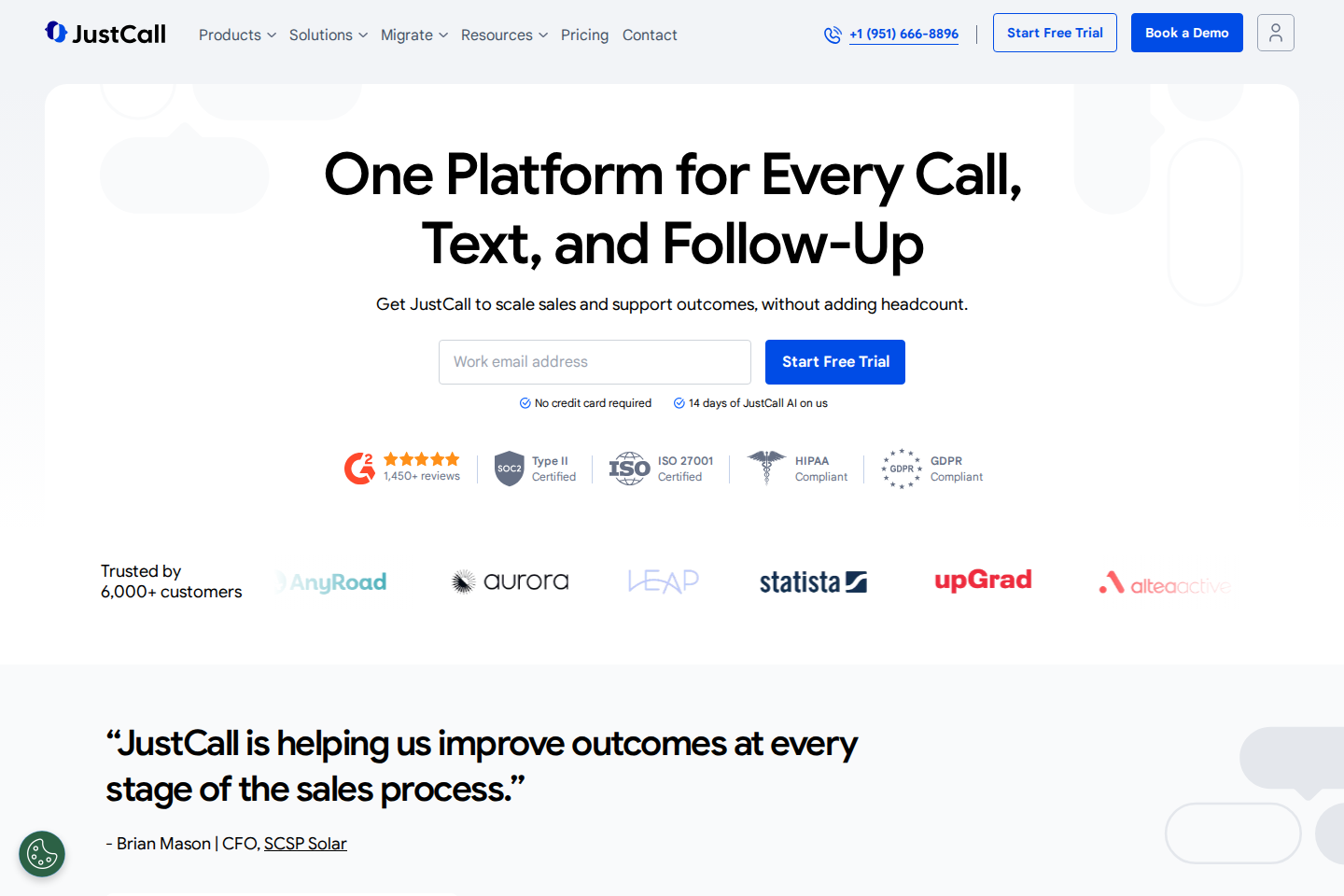
JustCall is a cloud phone system designed to help sales and support teams scale their calling operations without adding headcount. The platform integrates with 100+ CRMs and business tools — HubSpot, Salesforce, Pipedrive, Zoho, Freshdesk, Intercom, and more — with automatic call logging, SMS tracking, and contact sync. JustCall AI adds conversation intelligence, real-time agent coaching, automated call scoring, and AI-generated summaries.
For multi-CRM environments or teams with distributed reps across geographies, JustCall offers local phone numbers in 70+ countries, HIPAA compliance, and SOC 2 Type II certification. The platform's CRM integration auto-logs all call and SMS activity with transcripts, disposition codes, and custom field updates — making it a solid choice for teams that need CRM data consistency across a distributed workforce.
Pros
100+ CRM and helpdesk integrations. One of the broadest integration ecosystems on this list. If your team uses an uncommon CRM or needs to connect to multiple systems, JustCall likely has a connector.
Local numbers in 70+ countries. Distributed or international sales teams can call from local numbers, improving pickup rates and trust — with all calls logged to the same CRM.
HIPAA and SOC 2 compliant. For healthcare, financial services, and other regulated industries, JustCall offers the compliance certifications that many AI-first platforms lack.
Watch for
AI capabilities are augmentation, not autonomy. JustCall AI provides real-time coaching, call scoring, and summaries — but it does not handle calls autonomously. You still need human reps on every call.
Feature depth varies across CRM integrations. The HubSpot and Salesforce integrations are deep. Other CRM connections may offer less granular field mapping or fewer automation triggers. Check integration documentation for your specific CRM.
Best fit
Distributed sales and support teams across multiple geographies that need reliable CRM-connected calling with compliance certifications. Best for teams that want AI-assisted calling (coaching, scoring, summaries) rather than fully autonomous voice agents.
Pricing
Starts at $19/user/month (Essentials). Pro ($49/user) adds AI features, SMS automations, and advanced integrations. Business tier ($89/user) includes advanced analytics and custom integrations. 14-day free trial available.
7. Regal — Best for B2C engagement orchestration with CRM-driven journeys
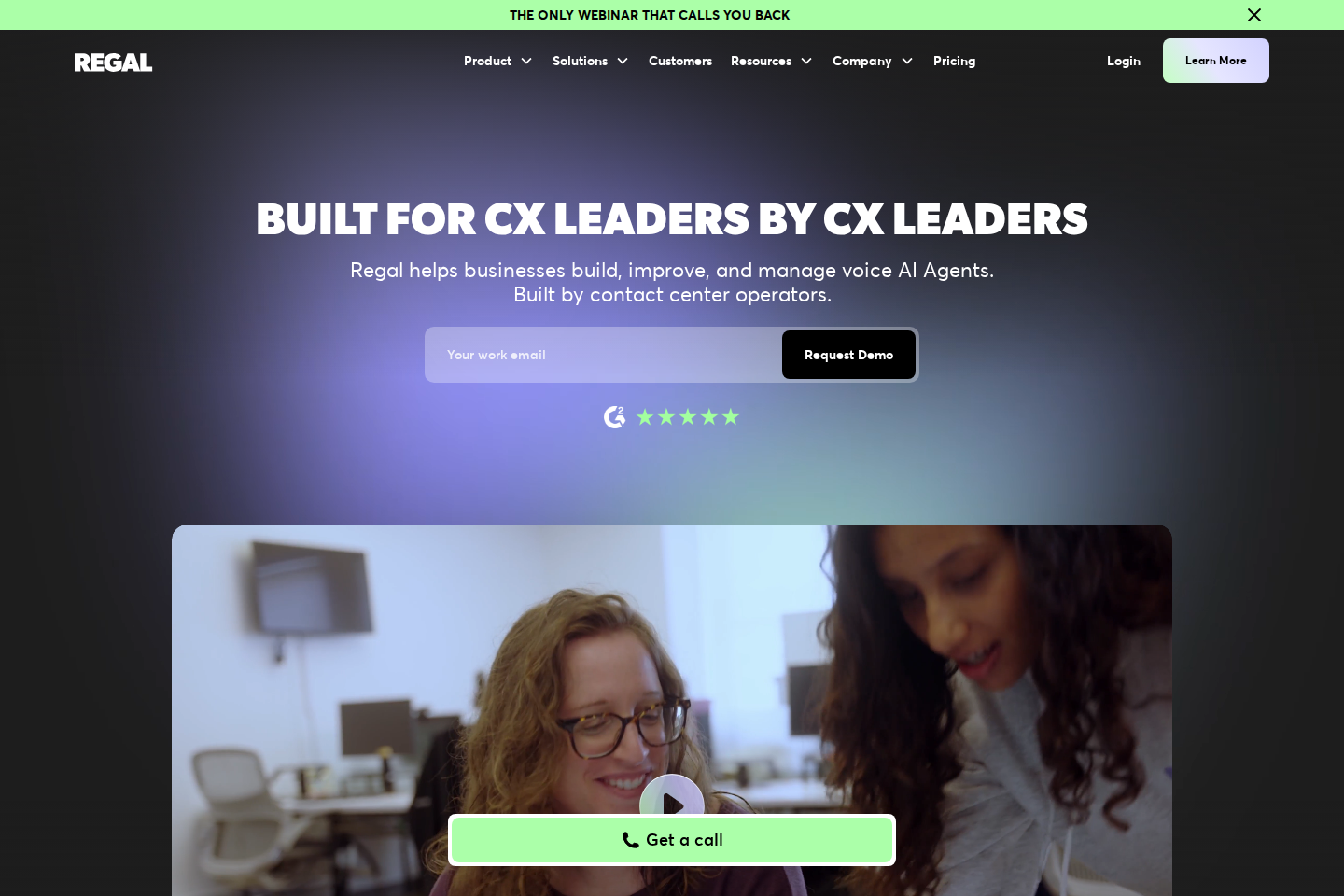
Regal is a customer engagement platform built by contact centerContact centerA contact center is a centralized operation that handles customer or prospect interactions across voice and digital channels.Read full definition → operators for B2C businesses that need to manage high-volume phone, SMS, and email outreach connected to CRM and CDP data. The platform recently launched AI voiceAI voiceAn AI voice is synthetic speech produced by a text-to-speech model, using a selected or cloned voice to speak an agent's generated or scripted response.Read full definition → agents that can handle calls autonomously — answering questions, qualifying leads, scheduling appointments — alongside its existing human-agent orchestration and journey management capabilities.
What differentiates Regal is the journey orchestration layer: you can build multi-step engagement sequences that combine AI voice calls, SMS, and email — triggered by CRM events, CDP signals, or behavioral data from Segment or custom data sources. The AI agent inherits the full customer context from the CRM before every interaction, and outcomes flow back into the journey engine and CRM simultaneously.
Pros
Journey orchestration across voice, SMS, and email. Regal lets you build complex multi-touch journeys where AI voice calls are one step in a larger sequence. CRM and behavioral data trigger each step dynamically.
Built by contact center operators. The platform's design reflects real operational needs — workforce management, call routing, compliance, branded caller ID — not just an AI demo.
Enterprise customer base validates scale. Toyota, eHealth, TaskUs, Kin Insurance, Varsity Tutors, and American Red Cross are published customers. This is not an unproven startup.
Watch for
Pricing is custom and likely enterprise-level. Regal does not publish pricing. Expect enterprise-tier contracts that may not make sense for smaller teams or lower call volumes.
B2C-focused design may not fit B2B workflows. The platform's journey orchestration and engagement patterns are built for consumer-facing use cases. B2B sales teams with complex multi-stakeholder deals may find the workflow model less intuitive.
Best fit
Enterprise B2C companies in insurance, healthcare, education, and financial services that need to orchestrate AI and human agent interactions across channels — with every touchpoint connected to CRM and CDP data. Not the right fit for SMB teams or straightforward B2B sales motions.
Pricing
Custom pricing only. Contact Regal for a demo and quote.
8. Dialpad — Best for conversation intelligence with CRM sync
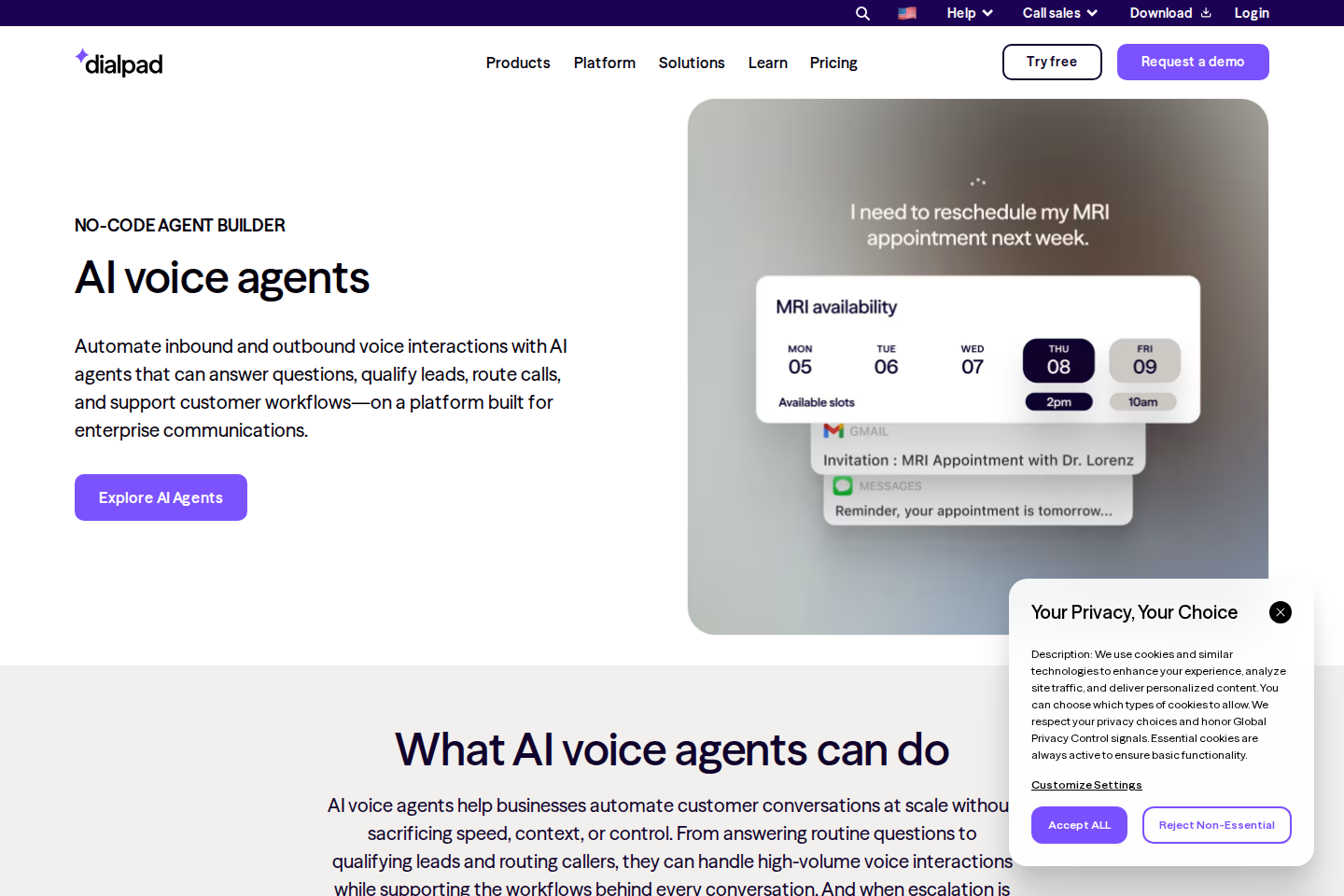
Dialpad is a unified communications platform that has invested heavily in AI — conversation intelligence, real-time transcription, coaching, sentiment analysis, and now AI voice agents for automating inbound and outbound interactions. The platform integrates with Salesforce, HubSpot, Zoho, and Microsoft Dynamics, automatically syncing call recordings, transcripts, and AI-generated summaries to CRM records.
Dialpad's AI voice agents can answer routine questions, qualify leads, route calls intelligently, and hand off to human agents with full context preserved. The no-code agent builder lets operations teams configure voice agents without engineering resources. For teams that already use Dialpad for business communications, adding AI agents and CRM syncCRM syncCRM sync keeps selected lead, contact, conversation, outcome, and next-step data aligned between an agent platform and a CRM.Read full definition → is a natural extension — though the full AI agent capability requires higher-tier plans.
Pros
Real-time AI coaching during live calls. Dialpad Ai shows reps live prompts, competitor battlecards, and suggested responses during calls — a capability most AI voice agent platforms do not offer.
Strong conversation intelligence and analytics. Sentiment analysis, talk-to-listen ratio, keyword tracking, and call scoring — all logged and searchable. Useful for sales managers optimizing team performance.
Enterprise-grade unified communications. Voice, video, messaging, and contact center on one platform. Teams that need a full UCaaS solution with AI can avoid managing multiple vendors.
Watch for
AI voice agents require Enterprise tier. The autonomous voice agent capability is not available on Starter or Pro plans. You need the Enterprise tier, which means custom pricing and a likely higher total cost.
CRM integration depth varies by plan. Salesforce integration is available on Pro and above, but some advanced CRM sync features (custom field mapping, bidirectional sync) may require Enterprise. Confirm feature availability for your plan level.
Best fit
Enterprise teams that want a unified communications platform (voice, video, messaging) with built-in conversation intelligence and AI voice agents — all syncing to Salesforce or HubSpot. Best for teams that need real-time coaching and analytics alongside AI automation, not teams looking for a standalone voice agent.
Pricing
Starts at $27/user/month (Standard). Pro ($35/user) adds CRM integrations and AI features. Enterprise pricing is custom and includes AI voice agents, advanced CRM sync, and dedicated support.
Which AI voice agent should you choose for CRM integration?
The right choice depends on three things: where your CRM data lives, whether you want the AI to handle entire conversations or assist human reps, and how complex your follow-up workflows need to be.
If you need full-loop automation — AI calling, qualifying, CRM write-back, and multi-channel follow-up from one platform — Thoughtly covers the most ground. It is the only platform on this list that handles voice, SMS, email, WhatsApp, and iMessage with native two-way CRM sync.
If you want zero integration headaches — Close puts the AI agent and CRM in the same product. No middleware, no syncing, no field mapping. The trade-off is that you must use Close CRM.
If your team needs speed-to-lead dialing — Kixie's CRM-triggered PowerDialer gets outbound calls fired within seconds of a lead hitting the CRM, with AI summaries auto-logged.
If you run on HubSpot and want AI voice agents — Aloware's deep HubSpot integration and AloAi voice agent give you autonomous inbound call handling without leaving HubSpot.
If you need broad CRM compatibility — Aircall and JustCall both integrate with 100+ tools and offer AI call intelligence, with JustCall adding international numbers and HIPAA compliance.
If you run enterprise B2C engagement — Regal orchestrates multi-channel journeys with AI and human agents, connected to your CRM and CDP.
If you need conversation intelligence + calling — Dialpad combines real-time coaching, AI agents, and unified communications with CRM sync.
FAQ
What makes a CRM integration 'good' for an AI voice agent?
A good CRM integration goes beyond logging a 'call completed' activity. It should write structured data back — qualification status, captured answers, deal stage updates, transcript summaries — without manual intervention. Bidirectional sync (agent reads from and writes to CRM) is better than one-way logging. The fewer middleware tools (Zapier, custom webhooks) required, the more reliable the integration.
Can AI voice agents update custom CRM fields automatically?
Some can, some cannot. Thoughtly, Close, and Kixie support mapping call outcomes to custom CRM fields. Others may require Zapier or webhook middleware to write to custom fields. Always test the specific CRM integration with your custom field structure before committing.
Do I need a separate AI voice agent if my CRM already has AI features?
It depends on what you need. CRM-native AI features (HubSpot AI, Salesforce Einstein) tend to focus on summarization, scoring, and suggestions — not autonomous phone conversations. If you need an AI agent that actually makes and handles phone calls, you will need a dedicated voice agent platform that integrates with your CRM.
How much does CRM-integrated AI voice calling cost?
Pricing varies significantly. Per-user plans (Close, Aircall, JustCall) range from $19–$89/user/month. Per-minute platforms (Thoughtly, Kixie) charge based on actual call volume. Enterprise platforms (Regal, Dialpad Enterprise) use custom pricing. For most mid-market teams, expect $40–$100/user/month all-in, or $0.05–$0.15/minute on usage-based plans.
What CRM integrations should I prioritize?
Prioritize the CRM your team actually uses every day. If your reps live in HubSpot, a platform with native HubSpot integration (Thoughtly, Aloware, Kixie, Aircall) will deliver faster results than one that requires Zapier middleware. Native integrations are typically more reliable, faster to sync, and support deeper field mapping than third-party connectors.