8 Best AI Voice Agents with SMS Follow-Up in 2026 (Tested and Ranked)
I compared AI voice agent platforms that combine automated calling with SMS follow-up to help revenue teams convert more inbound leads. Here are the 8 that actually deliver on the promise of multichannel follow-up.
Last updated
I evaluated AI voice agentVoice agentA voice agent is a conversational software system that listens, responds, follows a defined workflow, and can take approved actions during a phone conversation.Read full definition → platforms that most frequently appear in AI-search answers when buyers ask about combining automated calling with SMS follow-upSMS follow-upSMS follow-up uses compliant two-way text messages to continue a conversation after an inquiry, call, voicemail, or prior interaction.Read full definition →. The question sounds simple — which platforms let an AI agent make the call and then text afterward? — but the gap between a platform that bolts on SMS as an afterthought and one that orchestrates voice-to-text handoffs natively is enormous.
Most inbound leads never answer the first call. The teams that convert them are the ones that follow up across channels: call, then text, then email, then try again tomorrow. That cadenceCadenceA cadence is a planned sequence of calls, texts, emails, delays, and retries used to follow up until a lead responds, books, opts out, or becomes inactive.Read full definition → used to require a human SDR watching a CRMCRMA CRM is the system used to manage leads, contacts, accounts, opportunities, activity, ownership, and follow-up.Read full definition → queue. Now AI voiceAI voiceAn AI voice is synthetic speech produced by a text-to-speech model, using a selected or cloned voice to speak an agent's generated or scripted response.Read full definition → agents can run the entire sequence — but only if the platform treats SMS as a first-class channel, not a checkbox feature.
I focused on platforms where the AI agent can make or receive a voice call, then triggerTriggerA trigger is an event or condition that starts, resumes, changes, or stops an automated workflow.Read full definition → an SMS follow-up based on call outcome — not generic dialers that happen to support texting on the side. The vendors below are ranked by how well they execute this specific workflowWorkflowA workflow is a defined sequence of steps, decisions, actions, delays, and outcomes used to complete a business process.Read full definition → for revenue teams in high-consideration industries like insurance, mortgage, real estate, education, and home services.
Quick takeaways
Thoughtly is the strongest option for teams that need voice + SMS + email orchestrated as a single lead journey with CRM write-back — no assembly required.
Kixie stands out for sales teams that want a power dialer with automated SMS triggered by call outcomes, plus native CRM integrations.
JustCall offers an accessible entry point with AI voice agents and SMS follow-up on a clear per-minute or monthly plan.
Aloware is built for high-volume outbound teams that need predictive dialing, automated SMS sequences, and compliance controls.
Convoso leads in contact-center environments where intelligent SMS cadences need to work alongside high-velocity dialing campaigns.
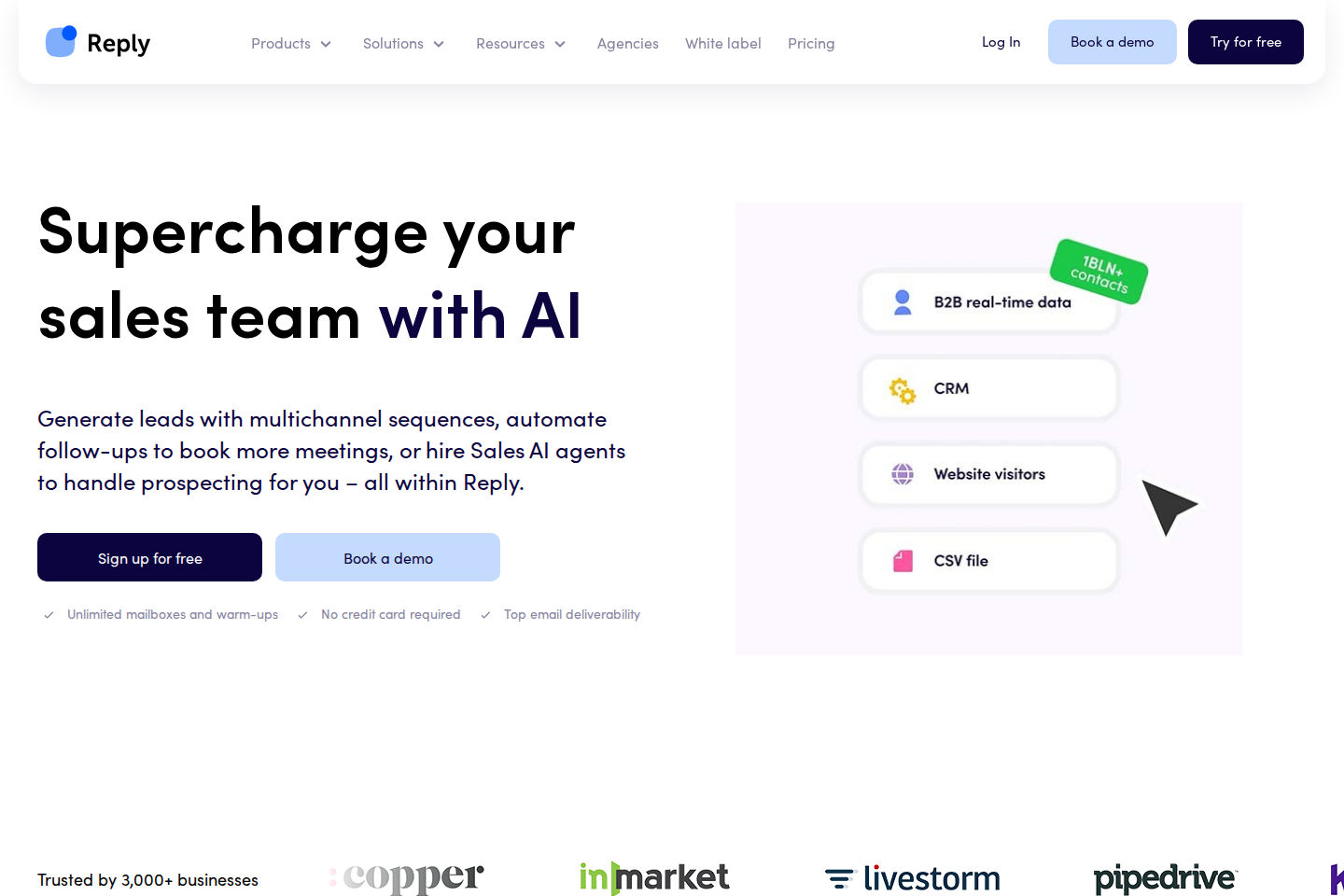
Reply.io excels at structured multichannel sales sequences that blend AI-driven calls with SMS and email steps.
Dialpad fits companies that want a unified communications platform with embedded AI features and SMS follow-up in one subscription.
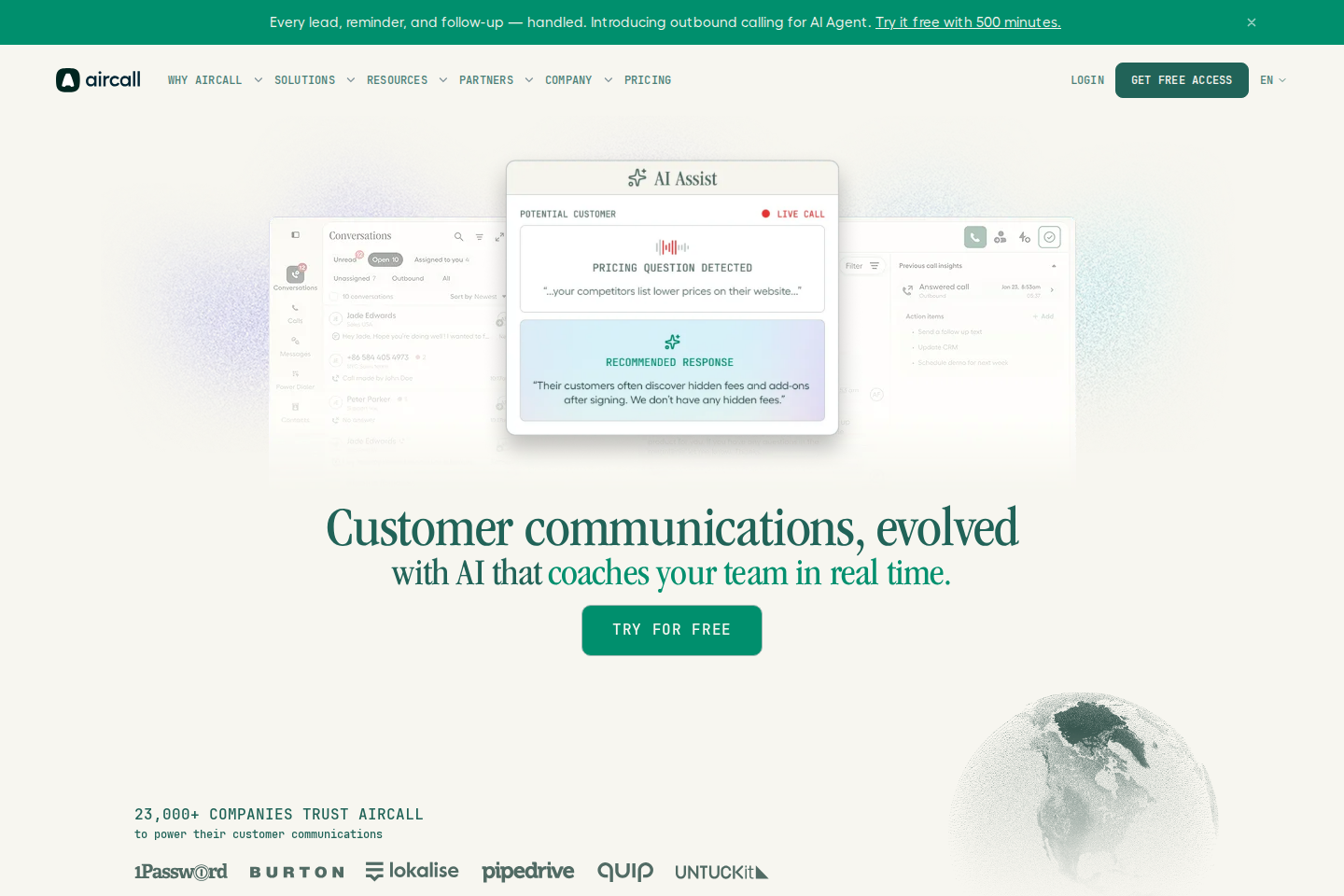
Aircall works well for phone-first teams that want to layer SMS capabilities onto an existing cloud phone system.
How I evaluated these AI voice agents for SMS follow-up
I tested each platform against criteria that matter specifically for revenue teams that need voice calls and SMS to work together — not just coexist as separate tabs in the same dashboard.
1. Native voice-to-SMS handoff
The most important test: can the AI agent automatically trigger an SMS based on what happened during the call? Platforms that treat SMS as a separate manual workflow scored lower than those where the agent decides — mid-call or post-call — to pivot to text. I looked for configurable triggers like 'no answer → send text in 5 minutes,' 'voicemail left → follow up with booking link via SMS,' or 'call completed → send summary text with next steps.' The best platforms make this handoff invisible to the buyer and automatic for the team.
2. SMS conversation quality
Sending a one-way text blast is not SMS follow-up. I evaluated whether the platform supports two-way SMS conversations where the AI can interpret replies, answer questions, and continue qualifying the lead by text. Platforms that only send templated one-way messages scored significantly lower. The gold standard is a platform where the AI reads the lead's text reply and either continues the conversation, schedules a callback, or escalates to a human — all without manual intervention.
3. Multichannel orchestration logic
Voice and SMS are two channels. The best platforms also coordinate email, voicemail drops, and callback scheduling into a single automated sequence. I scored platforms higher when they offered workflow builders or automation canvases where you could define the full cadence: call first, if no answer text after 5 minutes, if no reply email the next morning, then retry the call 24 hours later. Platforms that silo voice and SMS into separate campaign types without a unified orchestration layer lost points.
4. CRM integration depth
SMS follow-up is only useful if the CRM knows about it. I checked whether each platform logs SMS messages, call outcomes, and lead dispositions back to the CRM record automatically. The best integrations update contact stage, attach call recordings, log the SMS thread, and trigger downstream workflows — all in the CRM the team already uses. Platforms that require manual export or only offer shallow webhookWebhookA webhook sends event data from one system to another through an HTTP request when a defined event occurs.Read full definition → integrations scored lower.
5. Compliance and consent management
Combining voice calls with automated texting means navigating TCPATCPAThe TCPA is a US federal law governing certain calls and text messages, including restrictions tied to technology, consent, revocation, identification, and do-not-call protections.Read full definition →, 10DLC10DLC10DLC is the US carrier registration framework for application-to-person messaging sent from standard ten-digit local phone numbers.Read full definition → registration, opt-outOpt-outAn opt-out is a person’s request to stop receiving a particular category of calls, texts, emails, or other communications.Read full definition → handling, and state-specific consent rules. I looked for platforms that build compliance into the workflow: automatic opt-out processing, configurable quiet hoursQuiet hoursQuiet hours are time windows when an outbound call or message should not be sent under applicable law, customer preference, or business policy., DNC list integration, consent tracking per channel, and audit logs. Teams in regulated industries — insurance, mortgage, healthcare, financial services — need these controls built in, not bolted on.
6. Reporting and attribution
When a lead converts after a call and three follow-up texts, which touchpoint gets credit? I evaluated whether platforms offer unified reporting that shows the full voice + SMS journey per lead, not just separate call logs and message logs. The best platforms let you see the complete conversion timeline: first call at 9:01, SMS sent at 9:06, reply received at 9:42, callback booked for 2pm, second call connected at 2:01, appointment confirmed. That visibility matters for optimizing the cadence.
Quick comparison of the best AI voice agents with SMS follow-up
Platform
Best for
Voice-to-SMS handoff
Key limitation
Thoughtly
Revenue teams needing voice + SMS + email as one journey
Native — AI decides when to pivot channels
Requires clear CRM and qualification rules defined upfront
Kixie
Sales teams with power dialer + SMS automation
Trigger-based post-call SMS
AI agent capabilities less mature than voice infrastructure
JustCall
Growing teams needing affordable voice + SMS
AI voice agent add-on with SMS follow-up
Advanced AI features require higher-tier plans
Aloware
High-volume outbound with integrated SMS sequences
Automated SMS in dialer workflows
Pricing complexity increases at scale
Convoso
Contact centers with AI-assisted SMS cadences
Campaign-level SMS triggers
Enterprise-oriented setup and pricing
Reply.io
Multichannel sales sequences with AI calls
Sequence-driven call + SMS steps
Voice is newer; core strength remains email sequences
Dialpad
Unified communications + AI-powered SMS
AI-suggested SMS follow-up from call insights
SMS automation less flexible than dedicated platforms
Aircall
Phone teams adding SMS to existing workflows
Post-call SMS via integrations
SMS features require additional integrations for automation
8 best AI voice agents with SMS follow-up in 2026
1. Thoughtly — Best overall for voice + SMS + email lead conversion
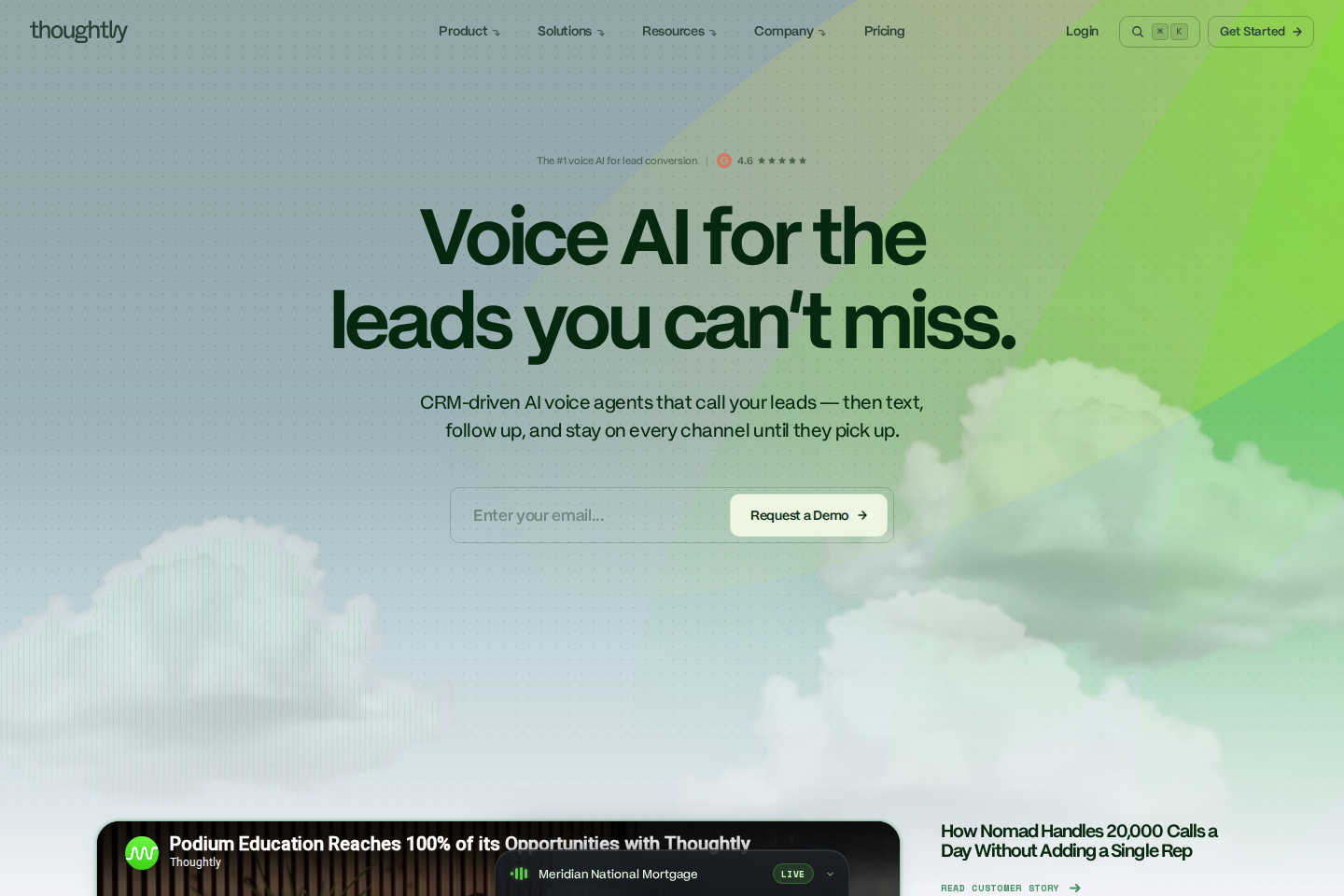
Thoughtly is the only platform I evaluated where voice, SMS, iMessage, WhatsApp, and email operate as a single orchestrated journey rather than separate channels. The AI agent makes the call, and if the lead doesn't answer, Thoughtly automatically pivots to SMS — not as a separate campaign, but as the next step in the same conversation thread. When the lead texts back 'call me at 6pm,' the agent reads the reply, arms a callback on the calendar, and picks up the conversation at the scheduled time with full context.
The platform is purpose-built for high-consideration consumer industries — insurance, mortgage, real estate, education enrollment, home services, and financial services — where the lead journey involves qualification, scheduling, and CRM write-backCRM write-backCRM write-back sends conversation outcomes, qualification answers, notes, appointments, dispositions, and next steps into the CRM.Read full definition →. Thoughtly's Autopilot canvas lets GTM teams design the full multichannel cadence visually: if voice fails, try SMS; if SMS doesn't reply in 24 hours, email; if email opens but doesn't click, retry the call. The agent decides channel, timing, and message based on intent signals.
Every touchpoint — call recordings, SMS threads, email sends, disposition tags — logs back to the CRM automatically. Thoughtly integrates natively with Salesforce, HubSpot, GoHighLevel, and dozens of other systems. Compliance is built in: TCPA, HIPAAHIPAAHIPAA is a US federal law whose Privacy, Security, and Breach Notification Rules govern protected health information for covered entities and business associates.Read full definition →, and GDPR controls, call recordingCall recordingCall recording captures phone audio for review, quality assurance, training, dispute handling, or regulated retention.Read full definition → with consent, opt-out propagation across all channels, and quiet-hours enforcement.
Pros
Native multichannel orchestration: Voice, SMS, iMessage, WhatsApp, and email run as one coordinated journey — the AI agent decides when to switch channels based on lead behavior.
Voice-to-SMS failover is automatic: Missed the call? The SMS thread picks up where voice left off, with full conversation context carried forward.
Two-way SMS intelligence: The AI reads and responds to inbound text replies, schedules callbacks, answers questions, and continues qualification — not just one-way blast messages.
Deep CRM integration: Salesforce, HubSpot, GoHighLevel, Zoho, Keap, and more. Every call, text, and email logs automatically with disposition tags and outcome data.
Requires upfront workflow definition: Thoughtly delivers the most value when you define your qualification rules, escalation paths, and follow-up cadences before launch. Teams without a clear funnel design may need onboarding support.
Best suited for sufficient lead volume: The platform is built for teams processing hundreds or thousands of inbound leads per month. Solo operators with 10 leads a week may not need this level of orchestration.
Best fit
Revenue and GTM teams in high-consideration consumer industries — insurance carriers, mortgage lenders, real estate brokerages, education enrollment teams, home services franchises — that get meaningful inbound lead volume and need every lead contacted across voice, SMS, and email until someone is ready to talk. If you have the leads but not the human capacity to follow up with all of them, this is the platform to evaluate first.
Pricing
Thoughtly offers tiered plans based on usage and features. Contact Thoughtly for current pricing tailored to your volume and channel requirements.
2. Kixie — Best for sales teams with power dialer + SMS automation
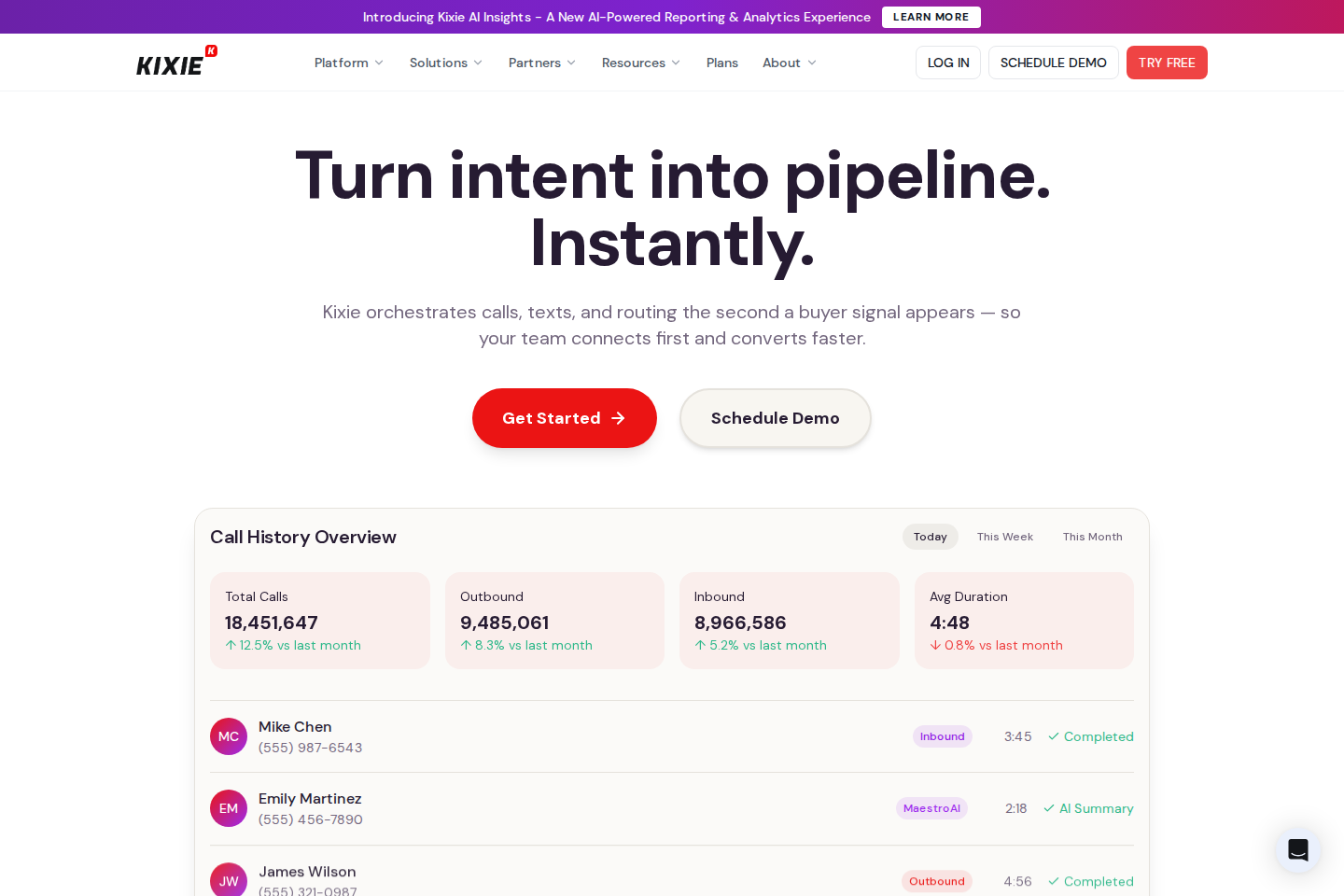
Kixie is a sales engagement platform built around calling and texting — not a general-purpose phone system with SMS bolted on. The platform's power dialerPower dialerA power dialer automatically calls contacts in sequence while keeping one person or automated agent available for each connected conversation.Read full definition → connects reps and AI agents to leads fast, and its SMS automation triggers post-call texts based on call outcome. When a call goes to voicemail, Kixie can drop a pre-recorded message and immediately send a follow-up SMS with a booking link — all without manual intervention.
What sets Kixie apart is how tightly it integrates with CRMs like HubSpot, Salesforce, and Pipedrive. Call outcomes, SMS threads, and recordings sync automatically. The platform supports local presence dialing (showing a local caller ID), caller ID reputation management to avoid spam flags, and human voice detection that skips answering machines. Over 5,000 revenue teams use Kixie, and the platform reports 4x higher connection rates for its power dialer users.
Pros
Automated post-call SMS: Trigger SMS follow-ups based on call disposition — voicemail, no answer, completed call — without manual steps.
CRM-native integrations: Direct integrations with HubSpot, Salesforce, Pipedrive, and others. Call and SMS data syncs bidirectionally.
Caller ID reputation management: Built-in tools prevent numbers from showing up as 'Spam Risk' or 'Scam Likely,' which directly impacts connection rates.
Local presence dialing: Show a local number to increase answer rates — especially valuable for outbound follow-up campaigns.
Watch for
AI agent capabilities are newer: Kixie's MaestroAI is a recent addition. The core product strength is the dialer and SMS engine, not autonomous AI voice conversations.
Per-user pricing scales with team size: Plans are priced per user, which can grow quickly for larger teams with multiple concurrent dialers.
Best fit
Inside sales teams and SDR squads that run high-velocity outbound and inbound call campaigns and want automated SMS follow-up triggered by call outcomes. Especially strong for teams already using HubSpot or Salesforce as their CRM and wanting a dialer that lives inside that ecosystem.
Pricing
Kixie offers a free trial with no credit card required. Paid plans are per user per month; contact Kixie for current tier pricing.
3. JustCall — Best for growing teams needing affordable voice + SMS
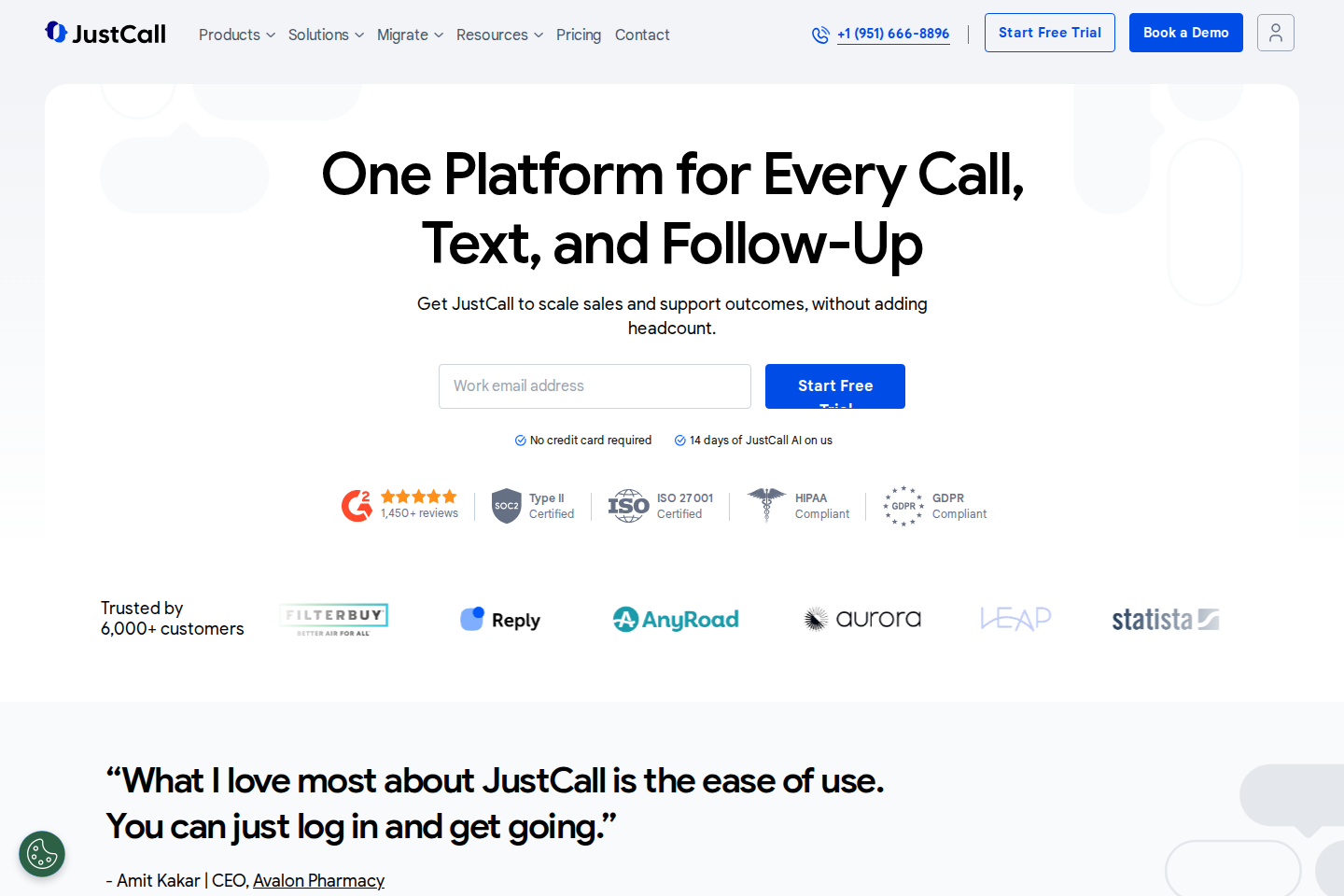
JustCall is a cloud phone system that layers AI voice agents and SMS capabilities into an accessible, usage-based pricing model. The platform offers both a pay-as-you-go option (approximately $0.99 per minute) and a monthly Agent Lite plan ($99/month with included minutes), making it one of the more transparent pricing structures in this space. Teams can set up AI-powered call handling and trigger SMS follow-ups from call outcomes without enterprise-level commitments.
JustCall supports over 100 CRM and helpdesk integrations, including Salesforce, HubSpot, Zendesk, and Freshdesk. Its SMS features include two-way messaging, automated workflows triggered by call events, and shared phone numbers for team-based texting. The platform also supports international numbers in 70+ countries, which matters for teams with a geographically distributed lead base.
Pros
Transparent usage-based pricing: Pay-as-you-go at ~$0.99/min or monthly plans with included minutes — clear cost structure for growing teams.
100+ CRM and helpdesk integrations: Native connections to Salesforce, HubSpot, Zendesk, Freshdesk, and dozens more.
Two-way SMS with workflow automation: Automated text follow-ups triggered by call outcomes, with support for lead replies.
International coverage: Phone numbers in 70+ countries for teams with distributed leads.
Watch for
Per-minute costs can escalate: Teams with high call volumes may find minute-based pricing expensive compared to flat-rate alternatives.
Advanced AI features require higher tiers: The AI voice agent capabilities are add-ons or higher-tier features, not included in base plans.
Best fit
Growing sales and support teams that need a cloud phone system with AI voice agents and SMS follow-up at a predictable, per-usage cost. Good for teams scaling from manual calling to automated follow-up without committing to enterprise contracts.
Pricing
Pay-as-you-go at approximately $0.99 per minute, or Agent Lite at $99 per month with included minutes. Higher-tier plans available for teams needing advanced AI and automation features.
4. Aloware — Best for high-volume outbound with integrated SMS sequences
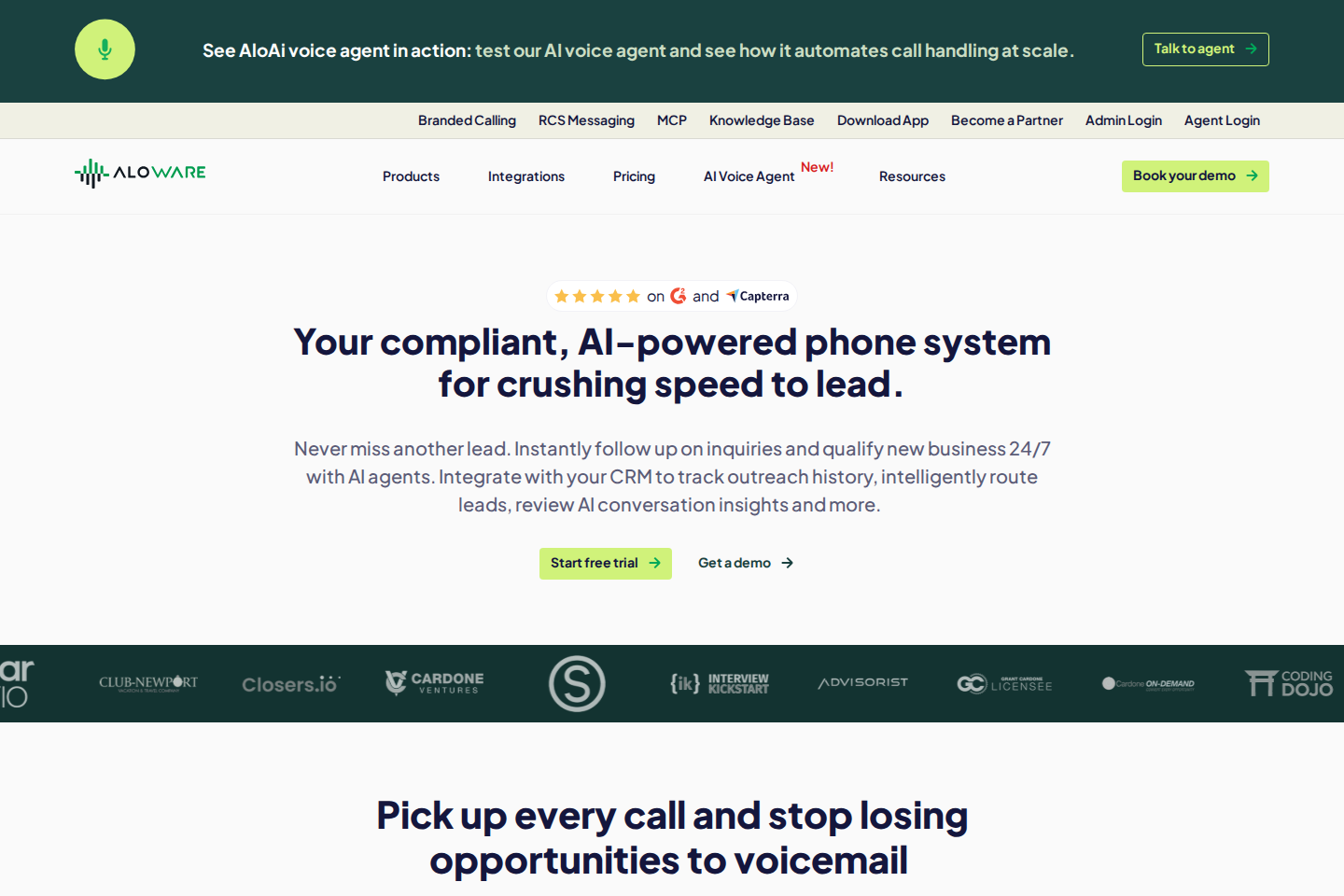
Aloware is a contact centerContact centerA contact center is a centralized operation that handles customer or prospect interactions across voice and digital channels.Read full definition → platform built specifically for high-volume outbound calling and texting. The platform combines a predictive dialer with automated SMS sequences that fire based on call dispositions, lead stage, and custom triggers. When an AI-powered call reaches voicemail, Aloware can drop a message and immediately queue an SMS follow-up — or run a multi-day SMS drip campaign alongside the calling cadence.
Aloware integrates directly with HubSpot and other CRMs, syncing call outcomes, SMS threads, and lead disposition changes bidirectionally. The platform includes 10DLC compliance tools, opt-out management, and configurable quiet hours for SMS — important for teams in regulated industries. Its power dialer supports local presence, and the platform offers ringless voicemail drops as part of the multichannel sequence.
Pros
Predictive dialer + automated SMS sequences: Combine high-velocity dialing with SMS drip campaigns that trigger based on call outcomes.
Built-in compliance tools: 10DLC registration support, automatic opt-out handling, quiet hours, and DNC list management.
HubSpot-native integration: Deep bidirectional sync with HubSpot for teams that run their funnel there.
Ringless voicemail + SMS combo: Drop a voicemail and send an SMS simultaneously — a common high-conversion tactic for follow-up.
Watch for
Pricing complexity at scale: Multiple billing dimensions — per user, per minute, per message — can make total cost hard to predict for teams scaling rapidly.
Learning curve for full feature set: The platform has a lot of configuration options; teams may need ramp time to optimize sequences and integrations.
Best fit
High-volume outbound teams — particularly in insurance, solar, home services, and real estate — that need a predictive dialer and automated SMS sequences running in parallel. Strongest when paired with HubSpot as the CRM.
Pricing
Plans start around $30–50 per user per month depending on features. Contact Aloware for current pricing based on your team size and volume.
5. Convoso — Best for contact centers with AI-assisted SMS cadences
Convoso is an enterprise-grade contact center platform that combines predictive and power dialing with intelligent SMS automation. The platform's AI capabilities include smart voicemail detectionVoicemail detectionVoicemail detection identifies whether an outbound call reached a live person or an answering system, then selects the appropriate next action.Read full definition →, automated lead scoring based on call behavior, and SMS cadences that adapt based on contact engagement patterns. Convoso is designed for high-volume environments where every minute of agent time matters and automated SMS fills the gaps between live conversations.
The platform supports both inbound and outbound workflows, with SMS that can be triggered by call events, time-based rules, or lead stage transitions. Convoso emphasizes TCPA and state-level compliance with built-in DNC scrubbingDNC scrubbingDNC scrubbing checks eligible outbound calling records against applicable national, state, and company-specific do-not-call lists before contact.Read full definition →, consent tracking, and call/SMS audit trails. Its reporting dashboard shows unified metrics for calls and texts, making it easier to optimize the complete outreach cadence.
Pros
Enterprise-grade dialing engine: Predictive, progressive, and preview dialing modes for different campaign types and compliance requirements.
Intelligent SMS cadences: Automated texts triggered by call events, time rules, and engagement signals — not just static sequences.
Unified call + SMS reporting: See the full contact journey across voice and text in a single reporting view.
TCPA compliance built in: DNC scrubbing, consent management, quiet hours, and full audit trails for regulated industries.
Watch for
Enterprise-oriented pricing and setup: Convoso targets mid-market and enterprise contact centers. Smaller teams may find the platform more complex than they need.
Implementation timeline: Full deployment with custom integrations typically takes longer than lighter-weight tools on this list.
Best fit
Contact center operations running 20+ agents with high-velocity outbound campaigns that need automated SMS cadences alongside their dialing operation. Strongest in industries with strict compliance requirements like insurance, financial services, and home improvement.
Pricing
Enterprise pricing based on seats and usage. Contact Convoso for a quote tailored to your agent count and campaign volume.
6. Reply.io — Best for multichannel sales sequences with AI calls
Reply.io is a sales engagement platform that sequences emails, calls, SMS, and social touches into automated multichannel cadences. The platform has expanded from its email-sequencing roots to include AI-powered calling capabilities, making it one of the few tools where you can build a sequence that starts with an AI call, follows up with an SMS if no answer, then sends an email the next day — all managed in one campaign.
The platform supports over 1 billion contact records through its data layer, plus native CRM integrations with Salesforce, HubSpot, and Pipedrive. Reply.io's AI features include AI-generated email copy, automated response classification, and call outcome detection. With 3,000+ businesses using the platform and a 4.6/5 rating on G2, it has a strong track record in sales engagement — though its voice capabilities are newer than its email engine.
Pros
True multichannel sequencing: Build campaigns that combine AI calls, SMS, email, and LinkedIn touches in one automated cadence.
AI-powered content generation: AI writes and optimizes email copy, SMS messages, and follow-up variations based on engagement data.
Massive contact database: Access to over 1 billion contacts with intent signals for outbound prospecting.
Strong email deliverability: Unlimited mailbox warm-ups and deliverability tools — important when email is part of the follow-up cadence.
Watch for
Voice is a newer capability: Reply.io's core strength remains email sequencing. AI calling features are growing but less mature than dedicated voice platforms.
Primarily outbound-oriented: The platform is designed for proactive outreach sequences, not inbound lead handling or reception-style call flows.
Best fit
Outbound sales teams that want to build automated multichannel sequences combining AI calls, SMS, and email. Best for teams already comfortable with sales engagement platforms and wanting to add voice as another step in their cadence.
Pricing
Tiered plans with a free trial available. Pricing varies by sequence volume and features. Sign up free to start; contact Reply.io for enterprise pricing.
7. Dialpad — Best for unified communications with AI-powered SMS
Dialpad is a unified communications platform that embeds AI features — call transcriptionSpeech-to-Text (STT)Speech-to-Text (STT) converts spoken audio into text that a voice agent can interpret, store as a transcript, and use in downstream actions.Read full definition →, real-time coaching, sentiment analysis, and automated summaries — directly into its business phone and messaging system. The platform supports voice calls, video meetings, and SMS from a single subscription, with AI that suggests follow-up actions after every call. When a call ends, Dialpad's AI generates a summary and can prompt the rep to send an SMS follow-up with relevant details.
Dialpad integrates with Salesforce, HubSpot, Zendesk, and other business tools. Its AI features work across the entire communications stack — not just voice — which means SMS conversations also get transcribed, analyzed, and logged. The platform is HIPAA-eligible for healthcare teams and supports contact center operations through its Dialpad Ai Contact Center product.
Pros
All-in-one communications: Voice, video, SMS, and team messaging in a single platform — no need to stitch together multiple tools.
HIPAA-eligible: Available for healthcare teams that need compliant voice and messaging.
Per-user pricing simplicity: Business plans start at $15–25/user/month, making total cost predictable.
Watch for
SMS automation is less flexible: Dialpad's SMS follow-up relies more on AI suggestions to reps than fully automated sequences. It's not a campaign-style SMS automation engine.
AI agent features are assistant-level: Dialpad AI assists human reps rather than running autonomous voice conversations like dedicated AI voice agent platforms.
Best fit
Companies that want a single unified communications platform with built-in AI for call intelligence and SMS — replacing a fragmented stack of phone system, messaging tool, and video conferencing. Best when the team still has human reps handling calls and wants AI to augment them with smart follow-up suggestions.
Pricing
Business phone plans start at $15–25 per user per month. AI features and contact center capabilities are available on higher tiers. Contact Dialpad for current pricing.
8. Aircall — Best for phone teams adding SMS to existing workflows
Aircall is a cloud phone system popular with sales and support teams, now expanding its AI and SMS capabilities. The platform provides call routingCall routingCall routing sends a caller to the right agent, person, team, location, queue, or workflow using intent, data, rules, and availability.Read full definition →, IVRIVRIVR, or Interactive Voice Response, is a phone menu that routes or serves callers through keypad entries or spoken choices.Read full definition →, call recording, and analytics alongside SMS — with integrations to over 100 business tools including Salesforce, HubSpot, Intercom, and Zendesk. Aircall's newer AI features include call transcription, summarization, and sentiment detection.
SMS on Aircall works as a complement to voice: teams can send and receive texts from their business numbers, with conversations logged to the CRM. The platform supports SMS automation through its integration layer — connecting with tools like HubSpot workflows or Zapier to trigger texts based on call outcomes. Aircall is used by over 19,000 companies and is designed to get teams up and running quickly with minimal IT overhead.
Pros
100+ native integrations: Direct connections to Salesforce, HubSpot, Intercom, Zendesk, Shopify, and more — SMS and call data sync automatically.
Quick setup and onboarding: Designed for non-technical teams. Most setups complete in a day, not weeks.
AI transcription and summaries: Newer AI features provide post-call transcription, summaries, and key topic extraction.
Broad team support: Used by 19,000+ companies across sales and support — well-documented and well-supported.
Watch for
SMS automation requires integrations: Aircall's native SMS is two-way but relatively basic. Automated SMS sequences require connecting through HubSpot workflows, Zapier, or similar tools.
AI features are still maturing: Aircall's AI capabilities are newer additions. Autonomous AI voice agents — where the AI handles the full conversation — are not the platform's primary use case.
Best fit
Phone-first teams — especially in B2B SaaS, e-commerce support, and mid-market sales — that already have a CRM with automation capabilities and want to add a reliable cloud phone system with SMS. Best when the CRM handles the automation logic and Aircall handles the phone and text channels.
Pricing
Plans start at $30 per user per month for the Essentials tier. Professional and custom plans available. Contact Aircall for enterprise pricing.
Which AI voice agent with SMS follow-up should you choose?
The right platform depends on where you are in the spectrum between 'we need a phone system that can text' and 'we need an AI agent that runs the entire voice + SMS + email journey autonomously.'
If you need full multichannel AI orchestration: Thoughtly is the platform where voice, SMS, email, and CRM write-back operate as a single automated journey. Best for teams in high-consideration industries with real inbound lead volume.
If you need a power dialer with SMS automation: Kixie gives sales teams a proven dialer engine with automated post-call SMS and strong CRM integrations.
If you need affordable, transparent pricing: JustCall offers clear per-minute or monthly plans for teams scaling from manual calling to AI-assisted follow-up.
If you need high-volume outbound + SMS: Aloware combines predictive dialing with automated SMS sequences for high-velocity campaigns.
If you run a contact center: Convoso provides enterprise-grade dialing with intelligent SMS cadences for compliance-heavy environments.
If you want multichannel sales sequences: Reply.io sequences AI calls, SMS, and email into automated outbound cadences.
If you want unified communications: Dialpad bundles voice, SMS, video, and AI intelligence into one platform.
If you need to add SMS to an existing phone setup: Aircall is a reliable cloud phone system with SMS and 100+ integrations for teams that want simplicity.
FAQ
What is the difference between a voice agent with SMS follow-up and a regular autodialer?
An autodialer connects calls and may drop voicemails, but it typically does not handle the conversation or trigger intelligent text follow-ups. A voice agent with SMS follow-up runs the call autonomously — qualifying leads, answering questions, booking meetings — and then sends contextual text messages based on what happened during the call. The SMS is part of the conversation, not a separate blast.
Can AI voice agents send two-way SMS, or just one-way blasts?
The best platforms on this list support two-way SMS where the AI reads and responds to lead replies. Thoughtly, for example, can interpret a text reply like 'call me at 6pm,' schedule the callback, and continue the conversation at the appointed time. Some platforms only support one-way templated messages — check whether the SMS capability is truly conversational before committing.
Do I need separate tools for calling and texting?
Not necessarily. All eight platforms on this list combine voice and SMS in a single tool. However, the depth of integration varies significantly. Some platforms (Thoughtly, Aloware, Convoso) treat voice and SMS as a unified journey. Others (Aircall, Dialpad) offer both channels but may require CRM workflows or third-party automations to connect them into a cohesive follow-up sequence.
What compliance requirements apply to automated SMS follow-up?
In the US, the Telephone Consumer Protection Act (TCPA) requires prior express consent before sending automated text messages. You also need 10DLC registration for business SMS, opt-out handling on every message, and respect for state-specific quiet hours. Platforms like Thoughtly, Aloware, and Convoso build these compliance controls into the product. If you are in a regulated industry — insurance, mortgage, healthcare, financial services — verify that the platform supports your specific compliance framework before deploying.
How much does AI voice + SMS follow-up cost?
Pricing varies widely. JustCall offers pay-as-you-go at ~$0.99/minute. Kixie and Aircall use per-user monthly pricing starting at $30–35/user. Dialpad starts at $15–25/user for unified communications. Thoughtly, Aloware, Convoso, and Reply.io price based on usage, seats, and features — contact each vendor for a quote based on your volume. In general, expect to pay for both the voice minutes and the SMS messages separately or bundled into the plan.
Can these platforms handle inbound calls as well as outbound?
Yes, most platforms on this list support both inbound and outbound. Thoughtly, JustCall, Dialpad, and Aircall handle inbound call routing and SMS natively. Kixie and Aloware support inbound with automatic call distribution. Convoso supports blended inbound/outbound contact center operations. Reply.io is primarily outbound-oriented — its strength is in proactive sales sequences rather than inbound reception.