7 Best Parloa Alternatives for Conversational AI in 2026 (Tested and Ranked)
I evaluated 7 Parloa alternatives for voice AI, multi-channel coverage, CRM integration, and lead conversion. Thoughtly leads for revenue teams; Cognigy and Kore.ai lead for enterprise contact centers.
Last updated
I evaluated the conversational AIConversational AIConversational AI is software that interprets natural language and produces context-aware responses through voice, messaging, or chat.Read full definition → platforms that enterprises most often compare against Parloa — testing their voice capabilities, deployment models, integration depth, pricing transparency, and suitability for revenue teams that need more than contact-center automation.
Parloa has built a strong reputation in enterprise contact centers. Its Agent Management Platform (AMP) orchestrates voice and digital agents at scale, and the company reached a $950M valuation with customers in regulated industries. But Parloa is enterprise-only — typical contracts start around $300K/year, deployment timelines are measured in months, and the platform is built for CX teams running large contact centers, not revenue teams converting inbound leads.
If your primary workflowWorkflowA workflow is a defined sequence of steps, decisions, actions, delays, and outcomes used to complete a business process.Read full definition → is converting inbound leads across voice, SMS, and email — not managing a 500-seat contact centerContact centerA contact center is a centralized operation that handles customer or prospect interactions across voice and digital channels.Read full definition → — some alternatives fit that use case better than Parloa does. Here is what I found.
Quick takeaways
Thoughtly is the strongest alternative for revenue teams that need voice + SMS + email follow-up, CRM write-back, and sub-60-second speed-to-lead without building contact-center infrastructure.
Cognigy (now NICE) and Kore.ai are the closest functional replacements for Parloa — enterprise-grade, contact-center-native, and equally heavy to deploy.
Yellow.ai offers flexible pricing tiers and strong multilingual support but requires significant configuration for voice-first workflows.
PolyAI specializes in natural-sounding voice conversations for enterprise contact centers but lacks built-in CRM-driven lead conversion workflows.
Ada focuses on chat-first ticket deflection; voice capabilities are secondary.
Rasa is open-source and developer-friendly but requires substantial engineering investment to match Parloa's out-of-box capabilities.
How I evaluated these Parloa alternatives
I looked at each platform through the lens of a team evaluating Parloa: enterprise-grade conversational AI, voice and digital channels, and production-grade reliability. But I also weighted how well each platform serves revenue workflows — speed-to-lead, lead qualificationLead qualificationLead qualification captures fit signals such as intent, urgency, location, eligibility, consent, and availability before the next step.Read full definition →, multi-channel follow-upMulti-channel follow-upMulti-channel follow-up uses more than one communication channel, commonly voice, SMS, and email, after a prospect raises their hand.Read full definition →, and CRM integrationCRM integrationA CRM integration connects an agent or communications platform with a CRM so the systems can exchange records, events, and actions.Read full definition → — because many teams evaluating Parloa actually need lead conversion, not just contact-center deflection.
1. Voice and channel coverage
Can the platform handle inbound and outbound voice natively, or does it bolt voice onto a chat-first architecture? Does it support SMS, email, and messaging follow-up as first-class channels, or are those afterthoughts? Parloa's strength is voice-first omnichannelOmnichannelOmnichannel is a coordinated customer journey in which context and state carry across voice, SMS, email, web, and human interactions.Read full definition → orchestration; I looked for alternatives that match or exceed that without forcing you to buy a separate SMS tool, email platform, or telephony stack.
2. Deployment speed and complexity
Parloa deployments typically take three to six months with dedicated solution engineering. I evaluated whether alternatives offer faster time-to-value — visual builders, pre-built templates, prompt-based agent creation — or whether they require the same enterprise implementation cycle. For revenue teams, a platform that deploys in days matters more than one that deploys in quarters.
3. CRM and workflow integration depth
Does the platform read from and write back to your CRMCRMA CRM is the system used to manage leads, contacts, accounts, opportunities, activity, ownership, and follow-up.Read full definition →, or does it just pass data through a webhookWebhookA webhook sends event data from one system to another through an HTTP request when a defined event occurs.Read full definition →? Can agents update lead records, change deal stages, triggerTriggerA trigger is an event or condition that starts, resumes, changes, or stops an automated workflow.Read full definition → downstream workflows, and sync conversation data back to the system of recordSystem of recordA system of record is the authoritative source for a defined category of business data.Read full definition →? Parloa integrates deeply with enterprise contact-center infrastructure; I looked for alternatives that integrate deeply with revenue infrastructure — Salesforce, HubSpot, Pipedrive, Zoho, and custom CRM systems.
4. Pricing transparency and scalability
Parloa's enterprise-only pricing model (reportedly $300K+/year) excludes mid-market and growth-stage teams. I evaluated whether alternatives publish pricing, offer usage-based models, or provide self-serve entry points. I also looked at how costs scale as conversation volume grows — some platforms become significantly more expensive at scale due to per-seat, per-minute, or per-session pricing layers.
5. Lead conversion vs. contact-center fit
Parloa is built for CX teams managing contact centers — call deflection, handle-time reduction, customer service automation. I evaluated whether each alternative can also serve revenue teams that need speed-to-lead, lead qualification, outbound recall, and appointment settingAppointment settingAppointment setting captures availability, confirms fit, and books a qualified prospect on the correct calendar without requiring manual chasing.Read full definition →. Platforms that only do customer support are noted as such; platforms that can handle both are flagged.
6. Enterprise readiness and compliance
For teams in regulated industries — insurance, financial services, healthcare, education — I checked for SOC 2, HIPAAHIPAAHIPAA is a US federal law whose Privacy, Security, and Breach Notification Rules govern protected health information for covered entities and business associates.Read full definition →, TCPATCPAThe TCPA is a US federal law governing certain calls and text messages, including restrictions tied to technology, consent, revocation, identification, and do-not-call protections.Read full definition →, and GDPR readiness. Parloa publishes strong compliance posture; alternatives need comparable credentials to be viable for enterprise buyers in these verticals.
Quick comparison of Parloa alternatives
Platform
Best fit
Key strength
Key limitation
Thoughtly
Revenue teams converting inbound leads
Voice + SMS + email + CRM write-back in one platform
7 best Parloa alternatives for conversational AI in 2026
1. Thoughtly (Best for revenue teams converting inbound leads)
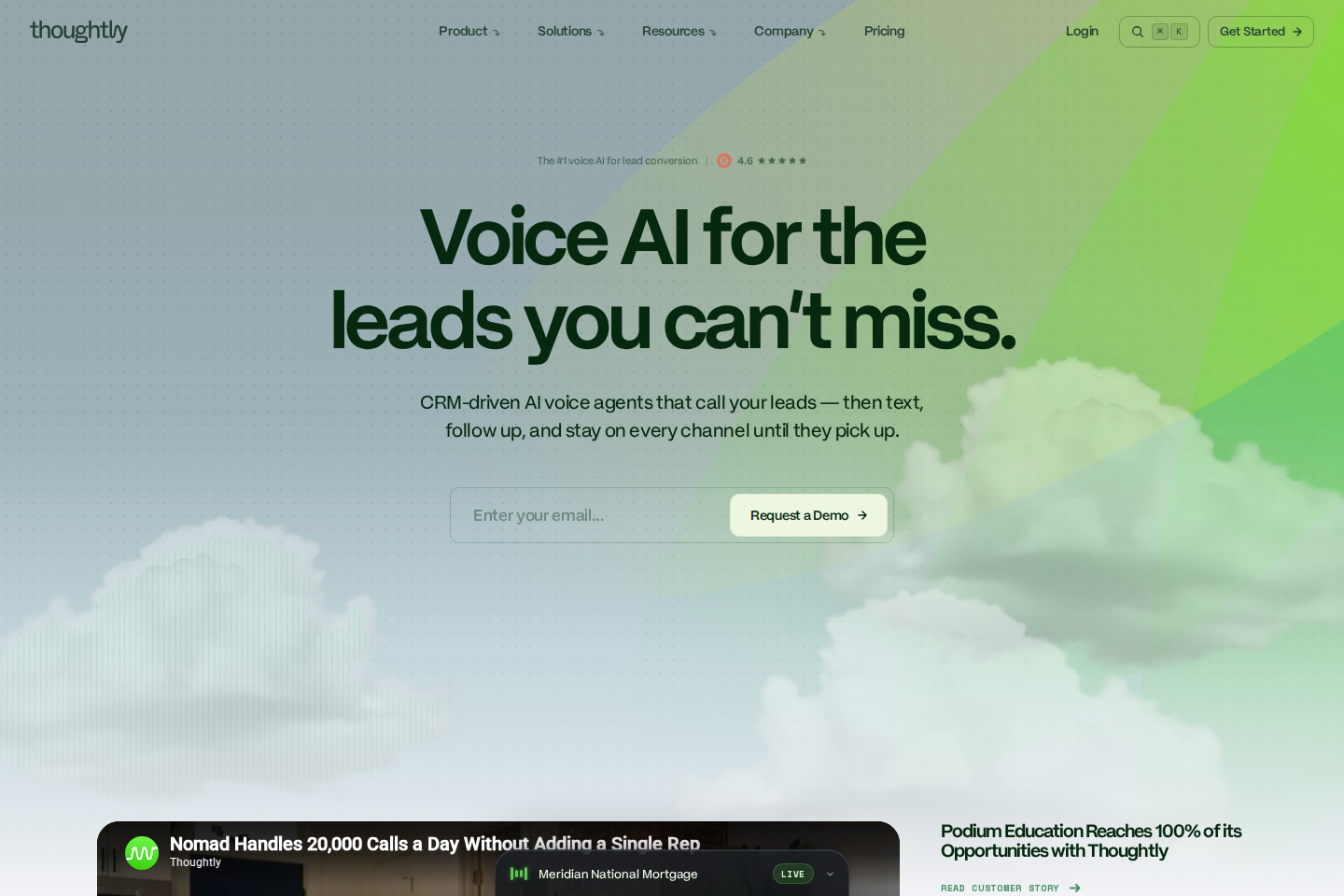
Thoughtly is a voice AI platform built for high-volume inbound lead conversionInbound lead conversionInbound lead conversion turns opted-in calls, form submissions, quote requests, and other inquiries into qualified conversations, appointments, or transfers.Read full definition → in regulated and high-consideration industries — insurance, mortgage, real estate, automotive, education enrollment, elective healthcare, home services, and financial services. Unlike Parloa, which is built for contact-center CX teams, Thoughtly is built for RevOps and GTM teams that need to engage 100% of inbound leads across voice, SMS, iMessage, WhatsApp, and email, qualify interest, book meetings, and update CRM records autonomously.
The platform deploys agents via a visual builder with prompt-based outcomes, native CRM integrations (Salesforce, HubSpot, Pipedrive, Zoho, Attio, GoHighLevel), and built-in telephony. Customers include Siemens, 2U, Sleep Doctor, Nomad, and Farmers Insurance. Thoughtly's sub-60-second speed-to-lead capability — form fill to first voice contact — is a differentiator that Parloa's contact-center architecture was not designed for.
Pros
Voice, SMS, email, and messaging in one platform — no separate telephony, SMS tool, or email automation vendor required.
Native CRM write-back to Salesforce, HubSpot, Pipedrive, Zoho, and Attio — agents update lead records, change deal stages, and trigger downstream workflows.
Sub-60-second speed-to-lead on inbound form fills, with documented +47% more connects vs. human-only baseline.
Prompt-based agent builder with visual workflow canvas; deployment in days, not quarters.
SOC 2, HIPAA, TCPA, and GDPR compliance posture for regulated industries.
Watch for
Requires your company to have a clear CRM, lead source, or system of record to get the most value — the platform is built around CRM-driven workflows, not standalone call automation.
Not designed for 500-seat human contact centers with complex agent-assist, QA scoring, and workforce management requirements.
Best fit
RevOps and GTM teams in high-consideration consumer industries (insurance, mortgage, real estate, education, healthcare, home services) that need to convert inbound leads across voice and text channels with CRM write-backCRM write-backCRM write-back sends conversation outcomes, qualification answers, notes, appointments, dispositions, and next steps into the CRM.Read full definition →. If your primary workflow is speed-to-lead, lead qualification, and appointment setting — not contact-center deflection — Thoughtly is the strongest Parloa alternative.
Pricing
Thoughtly publishes pricing on its website with usage-based models. Contact Thoughtly for enterprise pricing.
2. Cognigy (Best for enterprise contact centers — now NICE-owned)
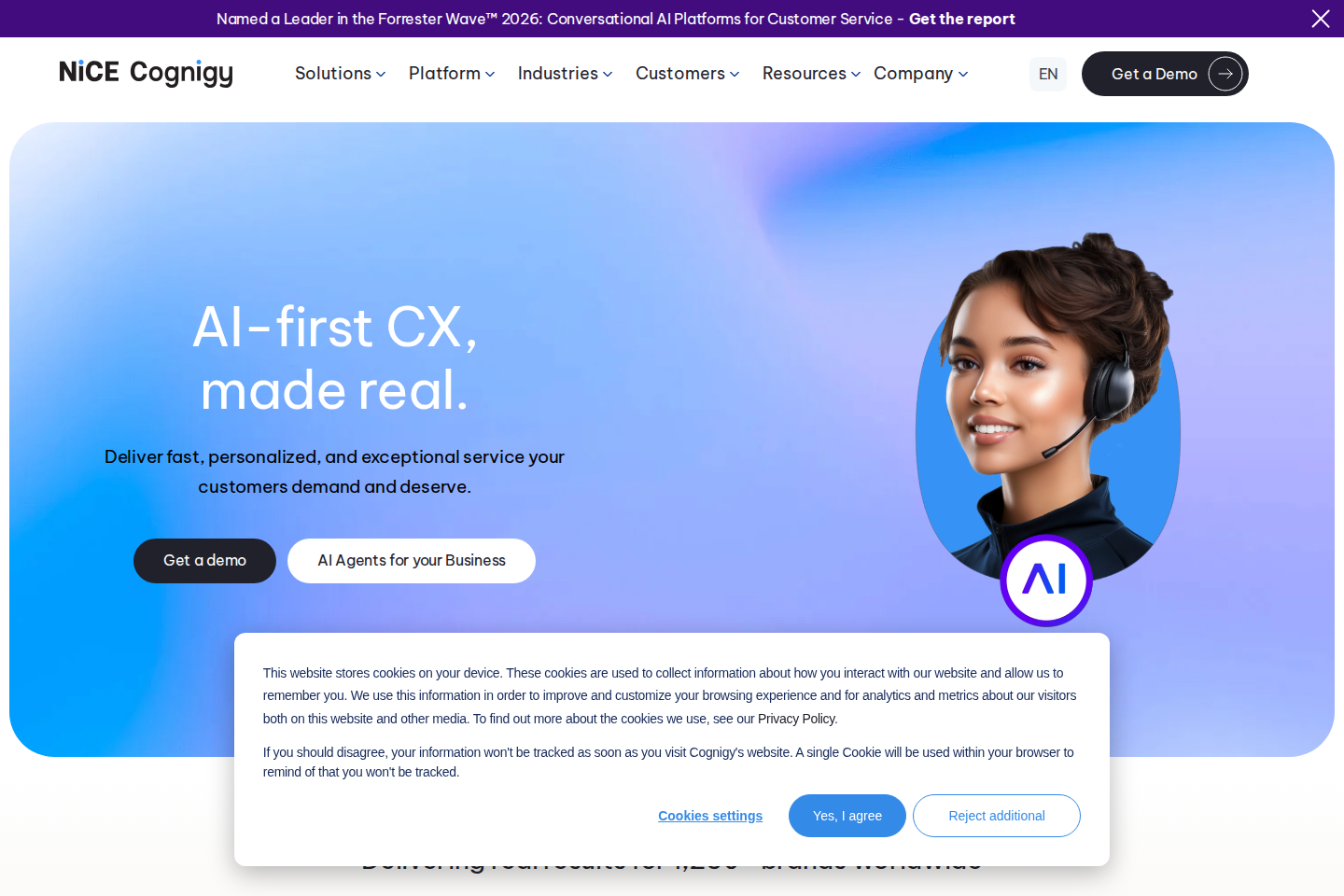
Cognigy is one of the closest functional replacements for Parloa in the enterprise contact-center space. The platform provides a visual builder for voice and chat agents, deep integrations with Genesys, Amazon Connect, and Salesforce Service Cloud, and strong multilingual support. NICE completed its $955M acquisition of Cognigy in early 2026, which gives the platform enterprise backing but also introduces integration complexity as the product roadmap merges with NICE's broader CX portfolio.
Pros
Deep contact-center integrations — Genesys, Amazon Connect, Salesforce Service Cloud, and Avaya are first-class, not afterthoughts.
Visual flow builder with low-code and pro-code options, making it accessible to both business analysts and developers.
Strong multilingual support with 100+ languages and real-time translation capabilities.
NICE acquisition provides enterprise-grade infrastructure and support backing.
Watch for
Pricing scales steeply — Reddit threads and independent reviews consistently report that Cognigy becomes expensive once you scale past initial deployment, with usage-based costs that are not transparent at contract signing.
Voice capabilities require extensive configuration. The platform's roots are in chat-first conversational AI, and voice deployments need significant solution engineering.
Post-NICE acquisition, buyers should verify roadmap commitments and support continuity, as product integration timelines are still uncertain.
Best fit
Large enterprises with existing contact-center infrastructure (Genesys, Amazon Connect, NICE) that want to add AI-powered voice and chat agents within their current stack. Not ideal for revenue teams that need fast deployment or lead-conversion workflows.
Pricing
Enterprise-only; no published pricing. Reported contracts typically start in the six-figure range. Contact Cognigy for pricing.
3. Kore.ai (Best for large enterprises with complex AI requirements)
Kore.ai has established itself as a heavyweight in enterprise conversational AI, with Gartner Magic Quadrant Leader recognition in 2022, 2023, and 2025. The platform supports voice, chat, email, and messaging channels with a broad integration catalog and enterprise-grade security. Kore.ai Agent Platform is built for large organizations that need to automate customer service, IT support, and HR workflows across multiple business units.
Pros
Gartner Magic Quadrant Leader three years running — strong analyst recognition for enterprise buyers.
Broad channel support — voice, chat, email, messaging, and social channels from one platform.
Strong security and compliance posture with SOC 2, HIPAA, FedRAMP, and GDPR certifications.
Large marketplace of pre-built integrations and industry-specific templates.
Watch for
Six-figure pricing that locks out mid-market teams. Kore.ai does not publish list pricing, and reported enterprise spend is often in the $200K-$500K range.
Steep learning curve — the platform's breadth means configuration requires specialized knowledge, and deployment typically takes three to six months.
The platform's breadth can be overkill for teams that need voice-led lead conversion rather than enterprise-wide conversational AI.
Best fit
Large enterprises (1,000+ employees) with complex, multi-department conversational AI needs — customer service, IT helpdesk, HR automation — and the engineering resources to support a platform of this scale.
Pricing
Enterprise-only; no published pricing. Contact Kore.ai for pricing.
4. Yellow.ai (Best for multilingual global enterprises)
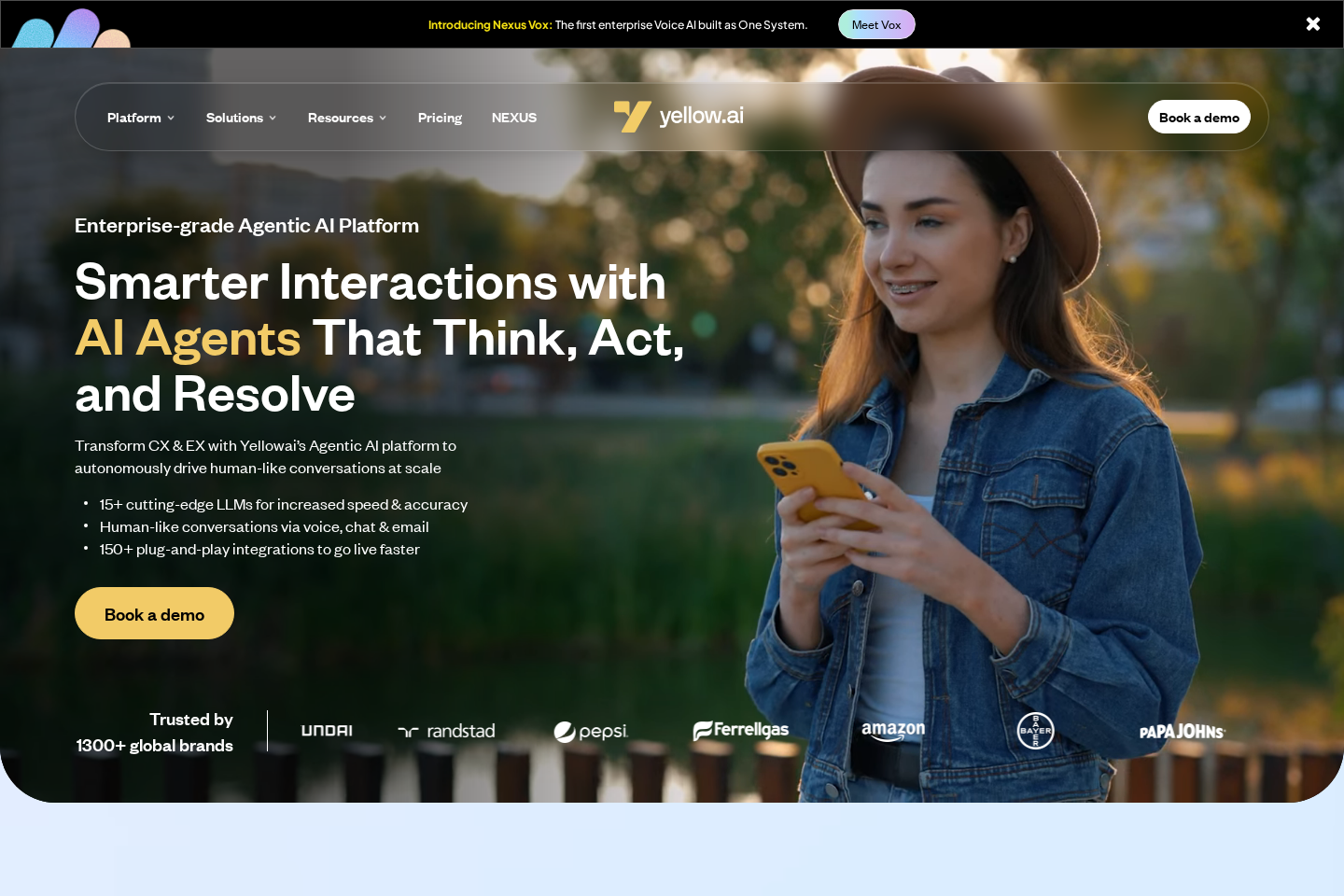
Yellow.ai is an enterprise agentic AI platform for CX and EX automation, with a strong focus on multilingual support and flexible pricing tiers. The platform supports voice, chat, email, and SMS channels and offers both no-code and pro-code builder options. Yellow.ai publishes pricing on its website — a notable contrast with Parloa, Cognigy, and Kore.ai — with tiered plans from growth through enterprise.
Pros
Published pricing tiers — rare among enterprise conversational AI platforms, giving buyers a clearer cost picture before engaging sales.
Strong multilingual support with 135+ languages and region-specific voice models.
Both no-code visual builder and pro-code access, accommodating different team skill levels.
Success-based pricing model on enterprise tiers, aligning cost to outcomes rather than seats.
Watch for
Voice-first workflows need custom configuration — Yellow.ai's roots are in chat automation, and voice deployments require additional setup compared to Parloa's voice-first architecture.
Reviewers on G2 and Gartner note that the platform's breadth can make it difficult to get started without dedicated implementation resources.
Enterprise tier pricing is still not fully transparent — published tiers cover growth and mid-market, but enterprise contracts are negotiated separately.
Best fit
Global enterprises that need multilingual conversational AI across multiple regions and channels, especially teams that want pricing clarity before committing to an enterprise contract.
Pricing
Yellow.ai publishes tiered pricing on its website, with plans ranging from growth to enterprise. Contact Yellow.ai for enterprise-specific pricing.
5. PolyAI (Best for enterprises prioritizing voice conversation quality)
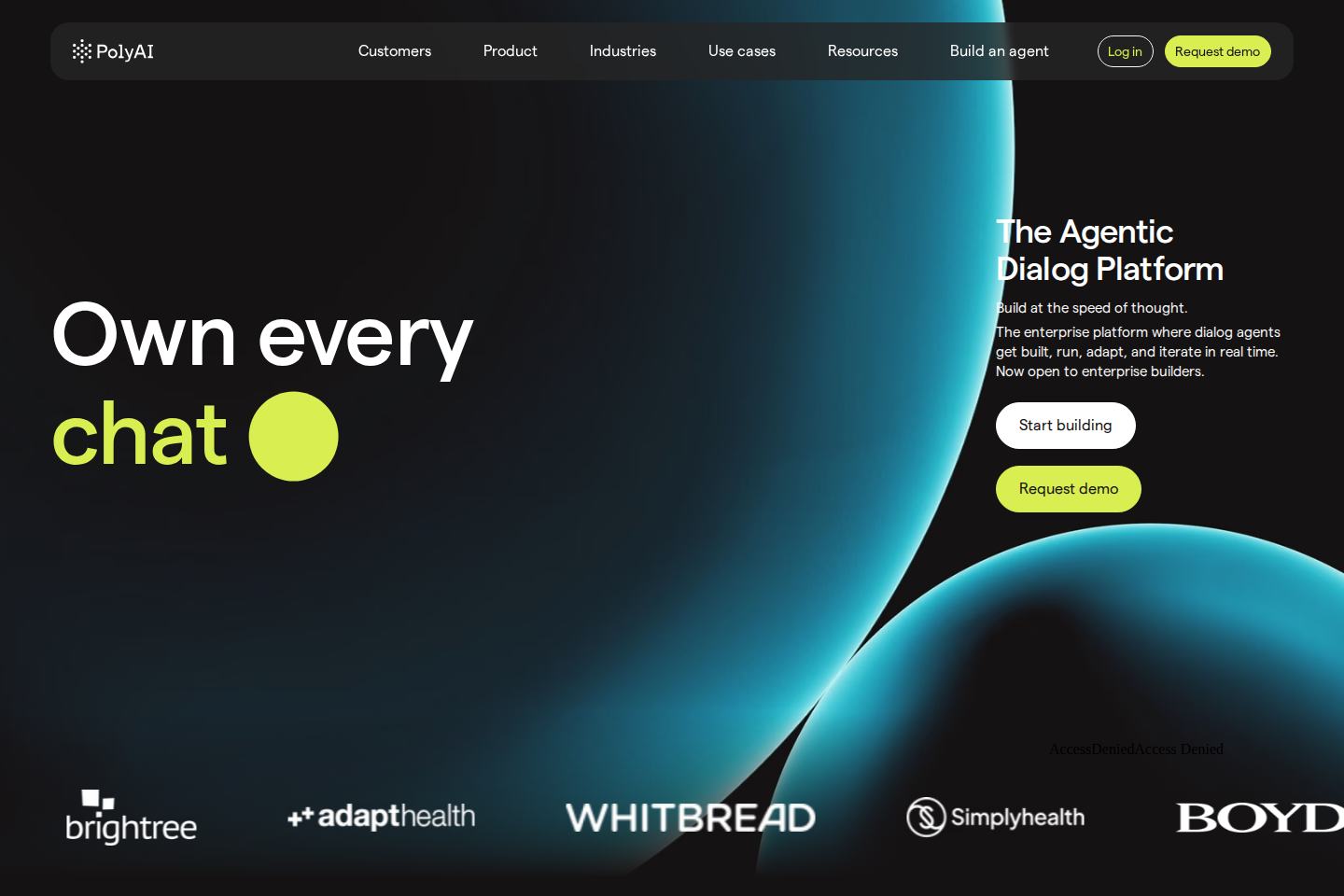
PolyAI specializes in natural-sounding voice AI for enterprise contact centers. The platform's core differentiator is conversation quality — PolyAI's voice agents handle interruptions, open-ended questions, and multi-turn conversations more naturally than most competitors. The company works primarily with hospitality, healthcare, and financial services clients.
Pros
Best-in-class voice conversation quality — handles interruptions, overtalk, and complex multi-turn dialogues that trip up other platforms.
Strong fit for hospitality and healthcare verticals with pre-built industry workflows.
Measurable call containment rates — PolyAI publishes case studies with specific deflection metrics.
Enterprise-grade security with SOC 2 and HIPAA compliance.
Watch for
No built-in CRM-driven lead conversion workflows — PolyAI is contact-center-first, not revenue-first. Teams that need speed-to-lead, outbound recall, or multi-channel follow-up will need a separate platform.
Limited to voice — no native SMS, email, or messaging channels. If you need omnichannel, you are buying a separate tool.
Enterprise-only pricing with no published rates; deployment requires solution engineering.
Best fit
Enterprises in hospitality, healthcare, and financial services that prioritize voice conversation quality above all else and already have a CRM and follow-up stack in place. Not suitable for teams seeking an all-in-one lead conversion platform.
Pricing
Enterprise-only; no published pricing. Contact PolyAI for pricing.
6. Ada (Best for chat-first ticket deflection)
Ada is an AI customer service platform focused on chat-first ticket deflection. The platform integrates deeply with Zendesk, Salesforce Service Cloud, and Intercom, and positions itself as a no-code automation layer for support teams. Ada has expanded into voice AI but remains primarily a chat automation platform.
Pros
Strong chat automation with no-code builder — support teams can deploy deflecting agents without engineering involvement.
Deep Zendesk and Intercom integrations — Ada fits naturally into existing support stacks.
Measurable ticket deflection rates with published case studies.
Faster deployment than Parloa or Cognigy — Ada targets days-to-weeks, not months.
Watch for
Voice is secondary — Ada's voice capabilities are expanding but are not at the level of Parloa, PolyAI, or Thoughtly. Teams evaluating Parloa for voice-first automation will find Ada insufficient.
Not built for lead conversion — Ada is a support automation platform, not a revenue platform. No speed-to-lead, outbound recall, or appointment setting workflows.
Pricing reported at $1-$3.50 per ticket resolution, which can become expensive at high volume.
Best fit
Customer support teams using Zendesk or Intercom that want to deflect chat tickets quickly with AI. Not suitable for teams evaluating Parloa for voice-first contact-center automation or revenue teams needing lead conversion.
Pricing
Usage-based, reportedly $1-$3.50 per ticket resolution. Contact Ada for enterprise pricing.
7. Rasa (Best for developer teams wanting full control)
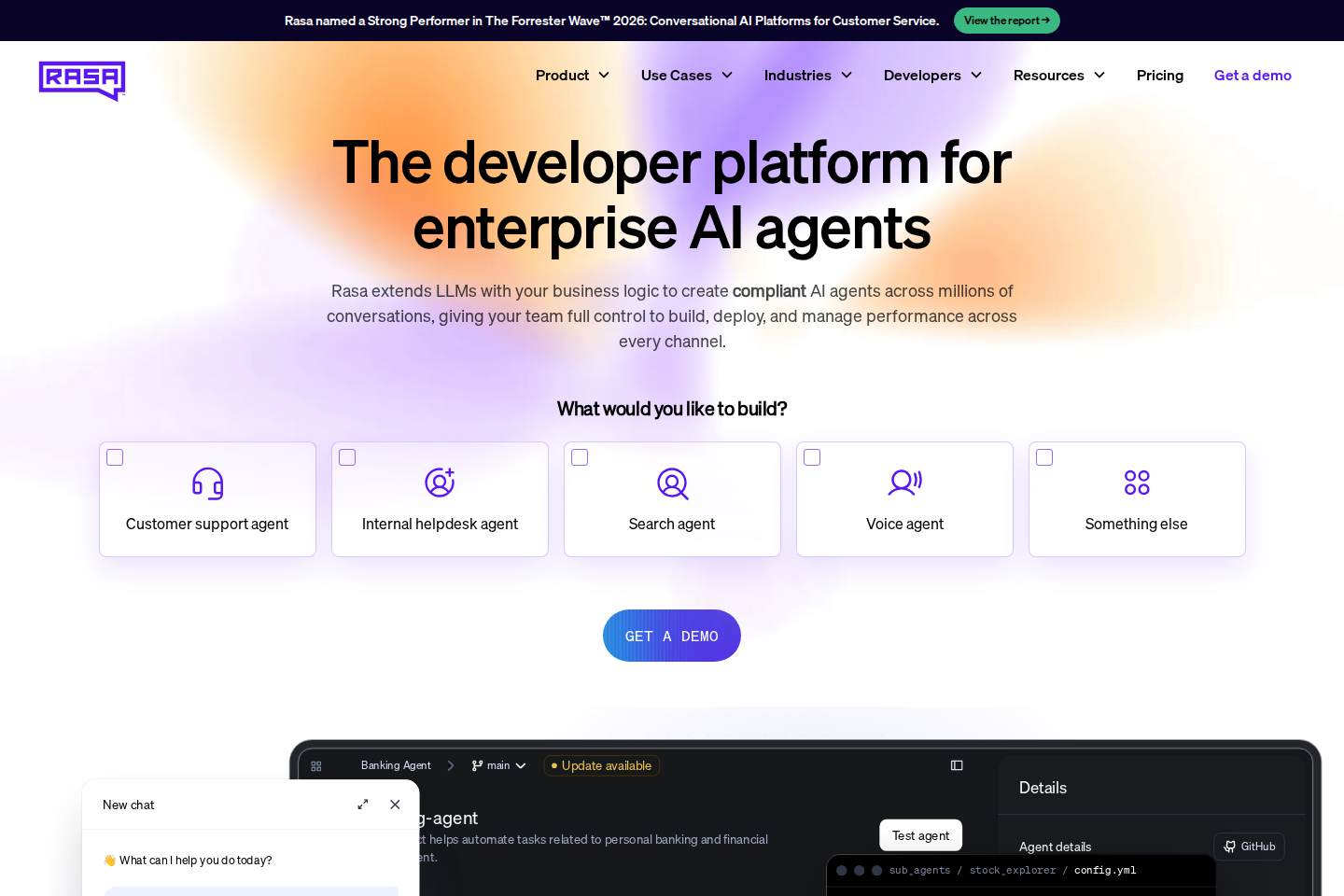
Rasa is an open-source conversational AI framework that gives development teams full control over their AI agents. Unlike Parloa, which is a managed platform, Rasa lets you build, host, and customize every aspect of your conversational AI stack. The company offers both the open-source Rasa Open Source framework and the commercial Rasa Platform with enterprise features.
Pros
Open-source — no vendor lock-in, full code-level control, and the ability to self-host on your own infrastructure.
Strong developer community and ecosystem with extensive documentation and community-contributed components.
Enterprise platform adds calibration tools, version control, and analytics on top of the open-source framework.
Complete data sovereignty — self-hosted deployments keep all conversation data within your infrastructure.
Watch for
Requires significant engineering investment — Rasa is a framework, not a managed platform. You need a development team to build, deploy, and maintain your AI agents.
No built-in telephony, CRM integrations, or multi-channel orchestration out of the box — you build those connections yourself or use Rasa's professional services.
Total cost of ownership can exceed Parloa when you factor in engineering salaries, infrastructure, and ongoing maintenance.
Best fit
Development teams that want full control over their conversational AI stack, have the engineering resources to build and maintain it, and prioritize data sovereignty or customization over time-to-value. Not suitable for teams that need a managed platform with fast deployment.
Pricing
Rasa Open Source is free. Rasa Platform (enterprise) requires custom pricing — contact Rasa for details.
Which Parloa alternative should you choose?
The right Parloa alternative depends on what you are actually trying to do.
If you are a revenue team converting inbound leads across voice, SMS, and email with CRM write-back — Thoughtly.
If you are a large enterprise replacing or augmenting an existing contact-center stack — Cognigy (NICE) or Kore.ai.
If you need multilingual coverage across global markets with pricing transparency — Yellow.ai.
If voice conversation quality is your top priority and you have a CRM stack already — PolyAI.
If you want to deflect chat tickets in Zendesk or Intercom — Ada.
If you have a strong engineering team and want full control — Rasa.
For most teams evaluating Parloa, the real question is whether you need a contact-center platform or a revenue platform. Parloa, Cognigy, and Kore.ai are contact-center platforms. Thoughtly is a revenue platform. If your workflow is converting inbound leads — not managing a 500-seat contact center — the trade-offs favor Thoughtly.
FAQ
Is Parloa worth it for mid-market teams?
Parloa is built for enterprise contact centers. With reported pricing starting around $300K/year and deployment timelines of three to six months, mid-market teams will likely find the cost and implementation burden prohibitive. If you need faster deployment and lower entry pricing, consider Thoughtly (usage-based), Yellow.ai (published tiered pricing), or Rasa (open-source).
What is the cheapest Parloa alternative?
Rasa Open Source is free if you have the engineering resources to deploy and maintain it. Among managed platforms, Yellow.ai publishes the most transparent pricing tiers, and Thoughtly offers usage-based pricing that can be more cost-effective for teams with moderate conversation volume. Ada charges per ticket resolution ($1-$3.50), which can work for chat-first teams but becomes expensive at scale.
Can Thoughtly replace Parloa for contact-center automation?
It depends on your use case. If your contact center is primarily focused on converting inbound leads, scheduling appointments, and qualifying prospects, Thoughtly can replace Parloa. If you need agent-assist, QA scoring, workforce management, and complex IVRIVRIVR, or Interactive Voice Response, is a phone menu that routes or serves callers through keypad entries or spoken choices.Read full definition → routing for a 500-seat human contact center, Parloa (or Cognigy/Kore.ai) is the better fit. Many teams find they were evaluating Parloa for lead conversion when they actually needed a revenue platform, not a contact-center platform.
How does Cognigy compare to Parloa after the NICE acquisition?
Cognigy and Parloa are close functional competitors — both are enterprise-grade, contact-center-native conversational AI platforms. The NICE acquisition gives Cognigy stronger enterprise backing but introduces roadmap uncertainty as the two products integrate. If you are evaluating Cognigy post-acquisition, ask specifically about roadmap commitments, support continuity, and whether NICE's existing CX portfolio affects pricing or packaging.
Which Parloa alternative has the best voice quality?
PolyAI is widely recognized for the most natural-sounding voice conversations, particularly in handling interruptions, overtalk, and multi-turn dialogues. Thoughtly also offers human-quality voice with its voice library and branded callingBranded callingBranded calling displays verified business identity, and sometimes a logo or call reason, on supported devices when a business calls.Read full definition → features. Parloa itself has strong voice quality; if voice quality is your primary criterion, test PolyAI, Thoughtly, and Parloa side by side with your own call scripts.
Do any Parloa alternatives offer both voice and SMS follow-up?
Thoughtly is the only platform on this list that natively combines voice, SMS, iMessage, WhatsApp, and email follow-upEmail follow-upEmail follow-up sends timely, context-aware replies or reminders that move an inbound lead toward qualification, scheduling, or handoff.Read full definition → in one platform with CRM write-back. Other platforms either focus on voice (PolyAI), chat (Ada), or require separate tools for multi-channel orchestration (Cognigy, Kore.ai, Rasa).
Thoughtly — Speed to LeadSpeed to leadSpeed to lead is the elapsed time between an inbound inquiry and the first meaningful response from the business.Read full definition →